

Note: This article contains affiliate links. If you click on these links and make a purchase, I may earn a small commission at no extra cost to you. This helps support my research and content. Read my full affiliate disclosure here.
When you need to remove weeds without damaging the grass, choosing the right lawn friendly weed killer matters. Different products act on different weed types, vary in how quickly they work, and differ in how they affect turf color and recovery. This guide highlights five top lawn friendly weed killers shortlisted for typical backyard, suburban, and small commercial lawns. We evaluated each option for how effectively it controls common broadleaf weeds, how safe it is for established turf, and how easy it is to apply. Read on for practical buying guidance and factors that matter when selecting a weed control product for your lawn.
Top Picks at a Glance
| Best Overall The best all-around choice for most situations | Ortho WeedClear Weed Killer for Lawns with Comfort Wand, 1 gal | 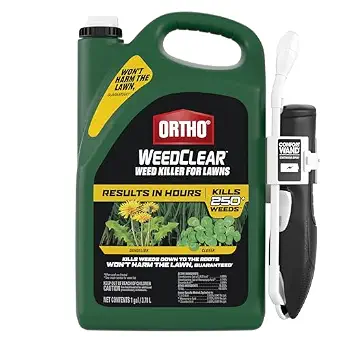 |
| Best Quality Built to a higher standard if you want something more solid | Nufarm Change Up Premium Selective Herbicide, 32 oz |  |
| Best Value The sweet spot between price and what you get | Spectracide Large Plot Weed Stop for Lawns Concentrate, 1 Gal |  |
| Best Budget The cheapest option that still gets the job done reliably | Spectracide Weed Stop for Lawns Concentrate, 32 oz Ready-to-Spray | 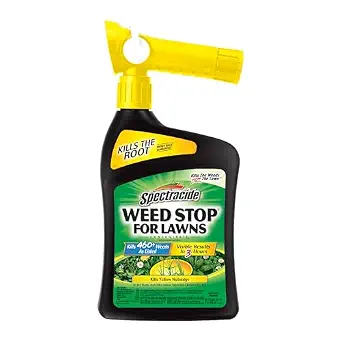 |
| Best Seller A high-volume bestseller chosen again and again | Scotts Liquid Turf Builder Plus 2 Weed Control, 32 fl. oz. |  |
Ortho WeedClear Weed Killer for Lawns with Comfort Wand, 1 gal

| Unit Count | 128 Fluid Ounces |
|---|---|
| Item Form | Spray |
| Coverage | 16000 square feet |
| Kills | Over 250 listed weeds |
Ortho WeedClear is a 1 gallon ready-to-use weed spray formulated to target broadleaf lawn weeds without harming turf when applied as directed. It uses a three-ingredient herbicide blend that claims visible wilting in hours and is rainproof after about an hour, so you can treat patches and return to normal use quickly. The included Comfort Wand provides continuous, precise spraying for spot treatments or small broadcast jobs without separate pumps, which makes application straightforward for homeowners. The formula lists control for over 250 weeds including dandelions, clover, chickweed and poison ivy and gives instructions for both spot and diluted broadcast use. Practical benefits include fast visible results, an applicator that reduces overspray, and clear timing guidance for re-entry of people and pets after drying. Limitations are typical for broadleaf herbicides: it works best on actively growing weeds in spring or fall and is not a year-long preventer or brush killer, so repeat treatments or different products are needed for persistent or woody plants.
Best for: Homeowners who want a straightforward, lawn-safe solution for common broadleaf weeds and prefer an easy, targeted applicator for spot treatments and small-area broadcasts.
Less Ideal for: People who need season-long prevention, broad-spectrum brush or woody-plant control, or a single-application cure for long-established infestations should choose a different product or professional service.
- Ready-to-use formula with attached Comfort Wand for precise, continuous spraying
- Kills over 250 common broadleaf lawn weeds down to the root
- Visible results in hours and becomes rainproof about one hour after application
- Clear directions for spot and broadcast use including re-entry guidance for people and pets
- Not designed for year-long prevention or for tough brush and woody weeds
- Best results require treating weeds when actively growing which may need seasonal timing
Verdict: A user-friendly, lawn-safe ready-to-use weed spray with a comfort wand that quickly knocks back common broadleaf weeds for balanced, routine lawn care.
Nufarm Change Up Premium Selective Herbicide, 32 oz

| Item Form | Liquid |
|---|---|
| Coverage | 1000 square feet |
| Active Ingredients | MCPA, fluroxypyr, dicamba |
| Unit Count | 32 Ounce |
Nufarm Change Up is a concentrated liquid selective herbicide designed for turf managers and homeowners who need strong control of broadleaf weeds without harming common turfgrasses. It combines MCPA, fluroxypyr and dicamba to deliver fast knockdown on more than 200 species, including dandelion, plantain, oxalis and thistles. The product is mixed and applied to lawns at labeled rates to treat up to about 1,000 square feet per bottle's coverage indication, and it is labeled for both cool- and warm-season grasses so it fits a wide range of lawns. Practical benefits include broad spectrum efficacy, relatively quick visual control, and formulation that avoids 2,4-D for properties sensitive to that ingredient. Important limitations are that it is a chemical treatment requiring careful rate calculation and following label precautions, and it targets broadleaf weeds so grassy weed control will require different products or cultural practices. Users should expect to follow safety and application guidelines closely to avoid off-target damage.
Best for: Buyers who prioritize powerful, fast broadleaf weed control for maintained lawns and want a single selective product that works across common turf types.
Less Ideal for: People seeking organic or nonchemical weed control, or those whose main problem is grassy weeds rather than broadleaf species.
- Controls over 200 broadleaf weed species including hard-to-kill varieties
- Labeled for both cool- and warm-season turfgrasses for wide turf compatibility
- Contains a blend of three active ingredients for faster and more complete control
- Coverage listed to treat about 1,000 square feet from the unit volume
- Not formulated to control grassy weeds so additional products or methods are needed
Verdict: Choose Nufarm Change Up when you need a fast, turf-safe selective herbicide that reliably knocks out a wide range of broadleaf weeds across cool- and warm-season lawns.
Spectracide Large Plot Weed Stop for Lawns Concentrate, 1 Gal

| Unit Count | 128 Fluid Ounces |
|---|---|
| Item Form | Liquid |
| Coverage | 32000 square feet |
Spectracide Large Plot Weed Stop is a concentrate lawn herbicide made for treating large areas of turf without damaging the grass when applied correctly. You mix the concentrate with water and apply with a tank or hose-end sprayer to control more than 200 listed broadleaf weeds, including dandelion, chickweed and clover. It is formulated to kill weeds down to the root and produces visible results in hours, and the label states the product becomes rainproof within a few hours so it is less likely to wash off after application. Typical use is in spring or fall, with mowing and watering guidance to improve uptake. Important limitations are following temperature and application windows precisely to avoid grass injury and repeating spot treatments for very tough weeds after three weeks. Because it is a large-capacity concentrate, it is best suited for homeowners with medium to very large lawns who want to cover extensive area efficiently rather than for one-off small-plot use.
Best for: Homeowners with medium to large lawns who prioritize efficient, broad-spectrum control and want a product that treats large areas without frequent repurchasing.
Less Ideal for: People with very small lawns, container gardens, or those who prefer a ready-to-spray bottle or nonchemical weed control methods should look elsewhere.
- Concentrated formula covers a large area when mixed, stated coverage up to 32,000 sq ft for northern grasses
- Kills 200+ listed broadleaf weeds and targets roots for longer control
- Becomes rainproof within hours, reducing loss from unexpected rain
- Works on common tough weeds like dandelion, chickweed and clover with visible results in hours
- Must not be applied when air temperatures exceed 85°F or it can harm turf
- Requires proper mixing and sprayer equipment which adds prep time
- Spot re-treatment may be needed for certain persistent weeds
Verdict: A cost-effective concentrated herbicide for homeowners who need fast, large-area broadleaf weed control without harming established turf when used as directed.
Spectracide Weed Stop for Lawns Concentrate, 32 oz Ready-to-Spray

| Unit Count | 32 Ounce |
|---|---|
| Item Form | Liquid |
| Coverage | 8,000 square feet |
| Active Ingredients | 2,4-D, Mecoprop-P, Dicamba, Sulfentrazone |
Spectracide Weed Stop for Lawns is a hose-attach concentrate that sprays a fast-acting herbicide over turf to control broadleaf weeds. It is used by connecting the QuickFlip sprayer to a garden hose and applying until weeds are wet, typically when daytime temps are between 45 and 90 degrees. The formula targets over 460 listed weeds, including dandelion, clover and chickweed, and claims visible results in as little as three hours because it kills by contact down to the root. Practical benefits include broad weed coverage from one 32 oz bottle and an easy sprayer that removes mixing guesswork. Important limitations are temperature and turf restrictions you must follow to avoid lawn injury and the wait time before reseeding. It is not a selective solution for grassy weeds like crabgrass and requires care around sensitive turf types and newly emerged zoysiagrass.
Best for: Buyers who want an inexpensive, easy-to-use solution to knock back common broadleaf lawn weeds on established turf without mixing concentrates or hiring a pro.
Less Ideal for: People needing control of grassy weeds like crabgrass or those wanting a product safe for newly seeded lawns or just-emerged zoysiagrass.
- Ready-to-spray QuickFlip sprayer attaches to a hose for fast, no-mix application
- Controls a very large list of broadleaf weeds including dandelion and clover
- Visible results reported in about three hours when applied correctly
- Not suitable for all turf conditions and can injure grass if applied above recommended temperatures
- Targets broadleaf weeds only and will not control many grassy weeds or sedges
Verdict: A budget-friendly, ready-to-spray concentrate that quickly tackles common broadleaf lawn weeds for homeowners who want simple, fast control.
Scotts Liquid Turf Builder Plus 2 Weed Control, 32 fl. oz.

| Item Form | Spray |
|---|---|
| Coverage | 6000 square_feet |
| Liquid Volume | 32 fluid ounces |
| Active Ingredients | Nitrogen |
Scotts Liquid Turf Builder Plus 2 Weed Control is a ready-to-use hose-end applicator that combines a quick-acting nitrogen lawn food with a broadleaf weed killer. You apply it by attaching the bottle to a garden hose and spraying evenly across actively growing turf when conditions are calm and below 85°F. The product targets common lawn weeds such as dandelions, clover, chickweed, and ground ivy while feeding grass, and the label gives clear timing and watering instructions to protect results. Notable features include the pre-mixed hose connection for fast application and coverage claims of up to 6,000 sq ft on warm-season lawns and 4,000 sq ft on cool-season lawns from a 32 fl. oz. bottle. Practical benefits are simple, low-effort application and simultaneous weed control plus fertilization for routine lawn maintenance. Important limitations are that it only controls the weeds listed on the label, may cause temporary injury on some bermudagrass varieties, and you must avoid watering for 48 hours after use and follow temperature guidance for safe application.
Best for: Homeowners who prefer a low-risk, easy-to-use solution to maintain a healthy lawn and reduce common broadleaf weeds without mixing chemicals or hiring a pro.
Less Ideal for: People needing a broad-spectrum or professional-strength herbicide for tough perennial weeds or gardeners who want an all-purpose product safe for flower beds and vegetable gardens.
- Ready-to-spray hose-end applicator simplifies application with no measuring or mixing
- Provides both nitrogen fertilizer and broadleaf weed control in one step
- Clear use instructions on timing, watering restrictions, and reapplication interval
- Advertised coverage up to 6,000 sq ft (warm-season) and 4,000 sq ft (cool-season) from one bottle
- Only controls the specific weeds listed on the label so stubborn or unlisted weeds may need other treatments
- May cause temporary injury to some bermudagrass varieties
- Requires waiting 48 hours without watering and avoiding >85°F for safe application
Verdict: A convenient ready-to-spray lawn food that safely combines a nitrogen boost with label-listed broadleaf weed control for low-effort lawn maintenance.
Choosing the Right Lawn Friendly Weed Killer: Key Factors to Consider
Active Ingredient and Mode of Action
Knowing the active ingredient tells you what weeds the product will control and how it will interact with your turf. Selective lawn-friendly formulations use modes of action that target broadleaf physiology while sparing grass species; systemic actives move through the plant and are better for deep-rooted weeds, while contact actives burn foliage and work faster but may leave roots alive.
Understanding mode of action also helps avoid resistance. Repeated use of the same mechanism of action can select for tolerant weeds. For lawn management, rotate products or alternate cultural controls after several applications to preserve long-term effectiveness.
Labeled Turf Species and Timing
Check the label for specified lawn grasses and any seasonal restrictions. Some products are safe on cool-season grasses but can injure warm-season turf when applied during heat stress, and vice versa. Labels list tolerant species and any temperature or growth-stage cautions.
Timing matters because weeds are easiest to control when actively growing. Spring and fall are often the best windows for many broadleaf weeds. Avoid applications during drought stress or extreme heat, when turf is more vulnerable to injury and herbicide uptake can be unpredictable.
Application Method and Coverage Needs
Decide whether you need a spot treatment, broadcast spray, or ready-to-use wand. Concentrates give flexibility and lower packaging waste but require accurate mixing and a sprayer. Ready-to-use bottles are convenient for small patches but can be more expensive per area.
Uniform coverage is crucial for consistent results. For granular herbicides, even distribution and incorporation (if required) matter. For sprays, nozzle choice, spray pressure, and walking speed determine coverage; uneven application leads to patchy control and wasted product.
Speed of Results Versus Residual Activity
Some lawn-friendly products show visible yellowing or wilting within days, which is satisfying but may only reflect foliar burn. Systemic products can take longer to show full control as they translocate to roots, but they reduce regrowth risk. Residual activity in the soil can prevent new seedlings for a time but may interfere with overseeding.
If you plan to reseed or overseed soon, choose a formulation with minimal soil residual activity or follow label waiting periods. For long-term prevention of annual weed seedlings, residual activity can be an advantage in established lawns.
Safety, Re-entry, and Environmental Considerations
Lawn applications often occur where children and pets play, so re-entry intervals, pet precautions, and runoff risk are practical concerns. Read label guidance for drying times, allowed post-application activities, and restrictions near water features.
Consider drift risk when spraying near flower beds or vegetable gardens. Environmental considerations also include persistence and impact on non-target plants. Use targeted spot applications when possible and follow label rates to limit off-target damage.
Weed Spectrum and Specific Targets
Different formulations excel on different weed groups. Broadleaf-focused products will control dandelions, clover, chickweed, and plantain but might be weak on grassy weeds like crabgrass. Conversely, some lawn-friendly herbicides include active ingredients or mixes that broaden the control spectrum.
Match the product to the weed species present. A product that is very effective on clover may be only moderately effective on chickweed. Accurate weed identification and selecting a product labeled for those species yields better outcomes and reduces repeat applications.
When To Use Spot Treatments Versus Broadcast Applications
Spot treatments minimize turf exposure and are the safest option for small infestations. Use a targeted wand or a ready-to-use applicator on individual dandelions, clover patches, or isolated weeds. For scattered weeds across a lawn, repeated spot treatments are often more economical and reduce overall chemical load.
- Spot treatments: ideal for isolated weeds, lower total product use, reduced drift risk
- Broadcast sprays: better for widespread infestations, require careful mixing and even coverage
- Granular options: useful for preemergent control or large areas when labeled for turf
Timing Applications Around Lawn Care Activities
Coordinate herbicide use with mowing, irrigation, and overseeding. Avoid mowing for a few days before and after a treatment so weed foliage remains intact for uptake. Watering schedules depend on the product: some require dry foliage for foliar uptake, others need moisture to activate soil residuals.
- Mowing: do not mow immediately after application unless label allows
- Irrigation: follow label on whether to water in or keep dry
- Overseeding: observe label wait times to avoid harming new grass seedlings
Identifying Common Lawn Weeds Quickly
Accurate identification helps you choose the most effective control. Broadleaf weeds have net-like veins and broad leaves, while grassy weeds form tufts or have narrow blade-like leaves. Use a simple field guide or phone images to compare leaf shape, growth habit, and flower appearance to common species in your region.
- Look for leaf arrangement and flower structure
- Note growth habit: spreading mat versus single stalk
- Seasonality: some weeds peak in spring, others in summer or fall
Protecting Flower Beds and Gardens During Lawn Treatments
Drift and runoff pose the main risks to adjacent beds. Create buffer zones, avoid windy days, and use lower-pressure nozzles to reduce fine spray. If possible, cover delicate plants or water the soil beneath them to reduce foliar contact from drift.
- Use shields or spray guards near borders
- Avoid application before heavy rain to reduce runoff
- Rinse sprayer thoroughly after use to avoid cross-contamination
Integrating Cultural Controls With Chemical Treatments
Combine herbicide use with cultural practices to reduce future weed pressure. Improve turf density through proper mowing, fertilization, and irrigation to shade out seedlings. Hand-pulling and dethatching reduce perennial weed sources and help herbicides reach target tissues more effectively.
- Core aeration and overseeding to thicken turf
- Appropriate nitrogen timing to favor grass over weeds
- Mechanical removal of large taproots before herbicide use
How We Chose the Best Lawn Friendly Weed Killer
We focused on products that are explicitly formulated to remove common broadleaf and grassy weeds while limiting injury to established turf. Our selection filters emphasized four to six concrete, observable criteria relevant to gardeners: active ingredient profile and selectivity, labeled turf species and safety margins, documented efficacy on typical weeds, application flexibility and coverage methods, and persistence or re-entry intervals for lawn use. We excluded any products labeled only for industrial or non-turf uses, experimental formulations lacking clear user guidance, and broad-spectrum herbicides that are not selective for lawns. For each candidate we checked whether labels specified safe use on common lawn grasses, how quickly results are reported under normal conditions, and whether the product offers spot- or broadcast-application options. We also considered safety instructions and re-entry times since those affect when children and pets can resume lawn use. The scoring and selection reflect these practical dimensions rather than brand reputation or price alone.
FAQ
Will a lawn friendly weed killer harm my grass if applied at the wrong time?
It often depends on turf species and environmental stress. Applying during drought or extreme heat increases injury risk. Always follow label timing and temperature guidance for the listed lawn grasses.
Can I overseed my lawn soon after applying a weed killer?
That usually depends on residual activity. Many products require a waiting period before reseeding; others have minimal soil persistence and allow earlier overseeding. Check label reseeding intervals for the specific formulation.
Are lawn friendly weed killers safe for pets and children right away?
Safety varies by product. Labels provide re-entry and pet restrictions, often recommending that treated areas remain dry until the product has settled and sometimes longer. Follow label guidance for drying times and re-entry.
How many applications are typically needed to control stubborn perennial weeds?
Perennial weeds often need more than one treatment because roots store energy. Expect multiple applications spaced according to label directions, combined with mechanical removal for the best long-term control.
Will a lawn friendly product control both broadleaf and grassy weeds?
Some formulations target both groups but many are specialized for broadleaf weeds and are less effective on grassy weeds. Choose a product labeled for the specific weeds you have or plan a combined program if needed.
Final Verdict
Choose a lawn friendly weed killer that matches the weeds you face and the lawn species you grow. Prioritize products that list your turf on the label, offer the application method you need, and fit your timing for mowing, irrigation, and overseeding. Balance speed of visible control with long-term root kill and plan cultural practices alongside chemical control to reduce future infestations. With the right match and careful application, you can remove weeds while keeping your lawn healthy and resilient.
