

Note: This article contains affiliate links. If you click on these links and make a purchase, I may earn a small commission at no extra cost to you. This helps support my research and content. Read my full affiliate disclosure here.
Pests in turf can quickly damage grass, stress roots, and undo weeks of lawn care. Choosing the right lawn insect killer matters because different products vary in how quickly they work, how much area they cover, and how they affect beneficial insects and soil life. This guide shortlists seven top options suited to typical home lawns and evaluates them on practical performance factors gardeners care about. You will find straightforward guidance on application methods, persistence, and safety so you can pick an insect control approach that matches your lawn size, pest type, and tolerance for environmental risk. The picks below were screened for coverage, ease of use, and compatibility with common lawn routines.
Top Picks at a Glance
| Best Overall The best all-around choice for most situations | Spectracide Large Plot Triazicide Insect Killer Concentrate, 1 Gallon |  |
| Best Quality Built to a higher standard if you want something more solid | The Andersons DuoCide Lawn Insect Control Granules (18 lb) |  |
| Best Value The sweet spot between price and what you get | Ortho BugClear Lawn Insect Killer, 20 lb. |  |
| Best Budget The cheapest option that still gets the job done reliably | Spectracide Triazicide Insect Killer for Lawns & Landscapes, 32 oz |  |
| Highest Rated A top-rated pick with lots of positive feedback | Atticus Contraxio SC Spinosad Insecticide Concentrate (32 fl oz) |  |
| Most Popular A crowd favorite that many people choose with confidence | Ortho BugClear Insect Killer for Lawns & Landscapes Ready-to-Spray, 32 fl oz |  |
| Best Seller A high-volume bestseller chosen again and again | Ortho Home Defense Insect Killer for Indoor & Perimeter, 1.33 gal. with Comfort Wand |  |
Spectracide Large Plot Triazicide Insect Killer Concentrate, 1 Gallon

| Unit Count | 128 Fluid Ounces |
|---|---|
| Item Form | Spray |
| Target Species | Insects |
| Liquid Volume | 1 gallons |
Spectracide Large Plot Triazicide is a 1-gallon concentrate formulated to kill more than 180 listed pests on contact and provide residual control for up to two months when used as directed. You mix the concentrate with water and apply it with a tank sprayer to lawns, flower and vegetable gardens, trees, and shrubs to target ants, aphids, fleas, ticks, Japanese beetles and many other surface and listed insects. Its large-plot coverage makes it suitable for bigger yards since a single gallon can treat very large areas when diluted at label rates. Notable practical benefits are broad-spectrum control, non-staining claims when used properly, and the convenience of a concentrate for cost-effective coverage. Important limitations are that it requires a separate sprayer and careful mixing to avoid over- or under-dosing, it is not selective so it can harm beneficial insects, and safety precautions are necessary to protect people, pets, and water sources. Read and follow the label for application rates, protective equipment, and site restrictions.
Best for: Homeowners with medium to large lawns who want a single, broad-spectrum solution for recurring lawn and landscape pest problems and who are comfortable mixing and applying concentrates.
Less Ideal for: Small-plot gardeners who prefer targeted or organic options and people who want a ready-to-use product without mixing or specialized application equipment.
- Broad-spectrum formula labeled for 180+ pests including common lawn and landscape insects
- Long residual protection up to two months when applied correctly
- Concentrate format offers large-plot coverage from a single container
- Non-staining when used as directed, suitable for use on lawns and many landscape plants
- Requires a separate tank sprayer and correct dilution for safe, effective use
- Not selective and can impact beneficial insects and pollinators if oversprayed
Verdict: Choose this concentrate if you need broad, long-lasting control across large lawns and landscapes and are prepared to mix and apply a tank-spray solution.
The Andersons DuoCide Lawn Insect Control Granules (18 lb)

| Item Form | Granule |
|---|---|
| Coverage | 9000 sq ft |
| Active Ingredients | bifenthrin |
The Andersons DuoCide is a dual‑action granular insect control formulated to kill pests both above and below the turf surface. You spread the granules across your lawn and water them in; the DG granule formulation disperses quickly so active ingredients move into the soil where grubs and other below‑ground pests live while also providing surface control of ticks, ants, fleas and more. It contains bifenthrin and carbaryl, which account for its broad-spectrum, professional-grade performance and single-application convenience for many common problems. Practical benefits include wide 9,000 sq ft coverage from one bag and visible reduction of both soil-dwelling and surface pests when applied according to directions. Important limitations are the need for careful handling and protective gear during application and adherence to label restrictions such as regional sale limits and setback/water instructions; it is not suitable for use where label warnings prohibit it. This product is best used by people comfortable following pesticide safety directions who want a fast, powerful solution for heavy or persistent lawn pest pressure.
Best for: Homeowners facing heavy or recurring lawn pest problems who prioritize fast, professional-strength control and are willing to follow pesticide safety and application instructions.
Less Ideal for: Gardners who prefer organic or nonchemical pest control methods or those unwilling to use products that require protective handling and strict label compliance.
- Broad-spectrum control targeting more than 50 lawn pests including grubs, ticks, fleas and ants
- DG granule formulation disperses quickly when watered to reach below-surface pests
- Covers up to 9,000 sq ft from a single 18 lb bag for large lawns
- Contains two professional-grade active ingredients (bifenthrin and carbaryl) for strong efficacy
- Requires careful handling and protective clothing due to concentrated insecticides
- Not available for sale in certain regions and must be used according to label restrictions
Verdict: Choose DuoCide when you need a single, strong granular treatment that kills a wide range of lawn pests both above and below the turf.
Ortho BugClear Lawn Insect Killer, 20 lb.

| Item Form | Granules |
|---|---|
| Target Species | Insects |
| Coverage | Treats up to 33,000 sq ft |
| Residual Control | Up to 6 months (ants), 3 months (other listed pests) |
Ortho BugClear Lawn Insect Killer is a 20 lb. granular treatment for lawns and landscape beds that targets ants, ticks, fleas, grubs, armyworms, and other listed pests. You apply it with a broadcast spreader, water it in, and the formula begins killing on contact within minutes for many pests while leaving a residual barrier that can last up to six months against ants and about three months for other insects. The product covers large areas—Ortho states this bag treats up to 33,000 sq ft—so it suits routine seasonal treatments on medium to large yards. Key practical benefits are simple application with a compatible spreader, quick knockdown of active insects, and multi-month protection that reduces how often you need to re-treat. Limitations to note are the granule format requires even spreading and immediate watering, performance varies by pest (some ants and fire ants are excluded) and it does not replace targeted grub-specific or professional treatments for heavy infestations.
Best for: Buyers who want an efficient, low-effort seasonal solution to reduce common lawn pests across large yards and minimize repeat treatments.
Less Ideal for: Homeowners needing a liquid or spot-treatment solution, those with small container or indoor gardens, or properties with severe, specialized infestations that need professional or targeted grub control.
- Fast contact kill for many listed lawn pests
- Long residual control up to 6 months for most ants and about 3 months for other insects
- Large coverage suitable for medium to very large yards
- Easy to apply using a standard broadcast spreader and water-in activation
- Does not control all ant species and excludes fire ants for fast action
- Granule format requires precise spreading and immediate watering to activate
Verdict: A practical, large-area granular treatment that quickly reduces common lawn pests and provides multi-month protection so you can treat less often.
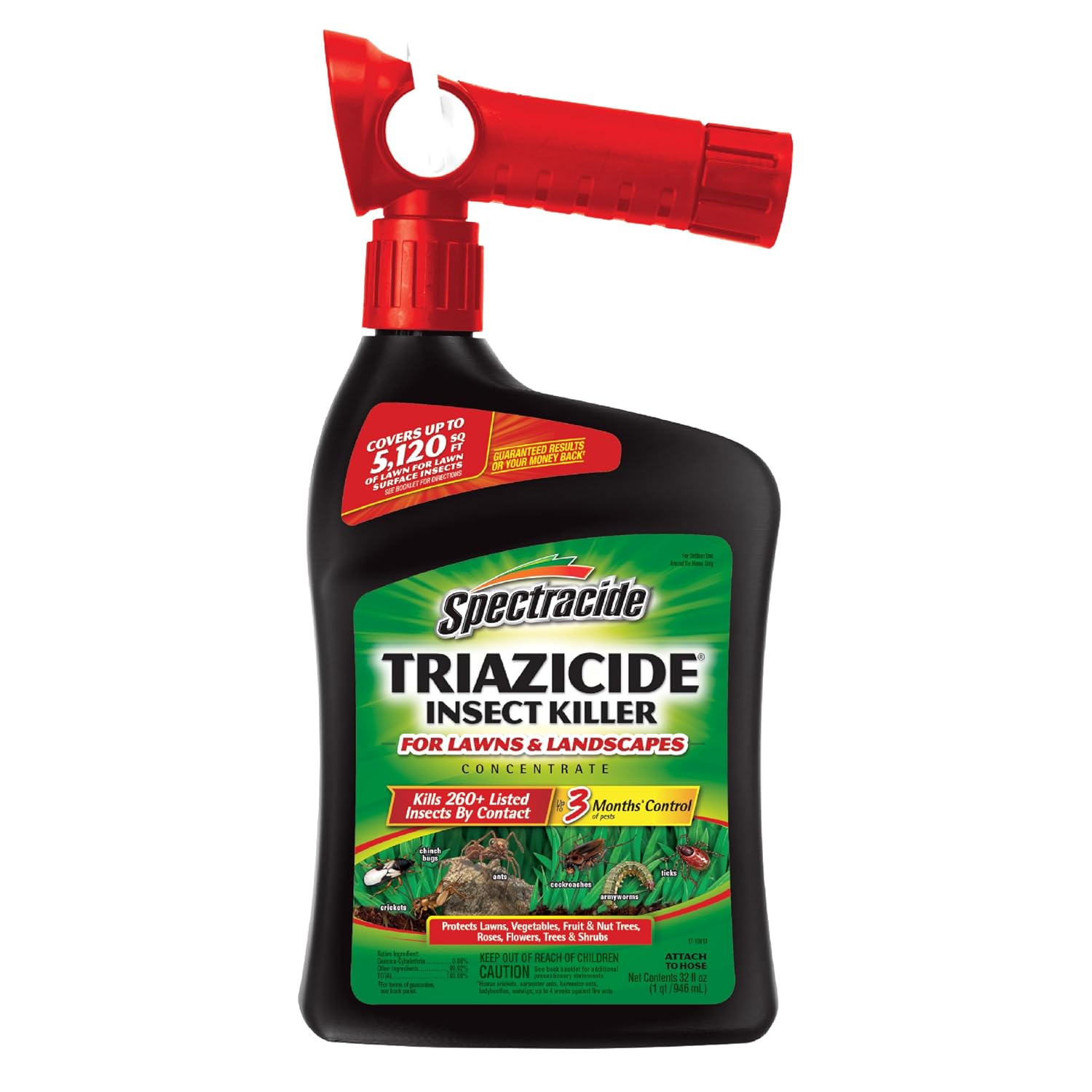
Spectracide Triazicide Insect Killer for Lawns & Landscapes, 32 oz
| Unit Count | 32 Ounce |
|---|---|
| Item Type Name | Lawn Insect Killer |
| Liquid Volume | 32 fluid ounces |
| Active Ingredients | Gamma-Cyhalothrin (0.08%) |
Spectracide Triazicide is a concentrated insect killer designed to protect lawns, flower beds, trees and shrubs from a very wide range of surface and soil insect pests. You mix the concentrate with water and apply it with a tank sprayer or hose-end applicator to treat turf, ornamentals and around vegetable and flower gardens. The formula lists Gamma-cyhalothrin as the active ingredient and advertises up to three months of protection when used as directed, with claims of fast knockdown for fleas, ticks, Japanese beetles and many common lawn insects. Practical benefits include versatile use across many planting areas, a high coverage rate per bottle when diluted, and a nonstaining formula for most siding. Important limitations are the toxicity to fish and bees, so care is needed to avoid drift and runoff and not to treat blooming plants; the product also requires careful handling and following label safety instructions. For gardeners on a budget it delivers broad-spectrum control in a single concentrate but must be used cautiously around pollinators and water.
Best for: Budget-minded homeowners who need an all-purpose, concentrated insect treatment to protect lawns and surrounding planting beds and who are willing to follow label safety steps when applying.
Less Ideal for: People with ponds or nearby water bodies, or gardeners who prioritize pollinator-friendly or organic pest control methods should consider less toxic alternatives.
- Broad spectrum: lists control of 260+ insects including fleas, ticks and Japanese beetles
- Concentrate format that dilutes for high coverage when mixed with a sprayer
- Can be used on lawns, trees, shrubs, flowers and around vegetable gardens
- Non-staining when used as directed
- Highly toxic to fish and harmful to bees, so it requires precautions to avoid runoff and drift
- Contains a synthetic pyrethroid active ingredient that requires careful handling and strict adherence to label directions
Verdict: This concentrate gives budget-minded gardeners broad, fast-acting control of a long list of lawn and landscape pests when applied carefully according to the label.
Atticus Contraxio SC Spinosad Insecticide Concentrate (32 fl oz)

| Liquid Volume | 32 fluid ounces |
|---|---|
| Active Ingredients | Spinosad |
| Item Form | Liquid |
| Specification Met | EPA |
Contraxio SC is a suspension concentrate formulated with 11.6% spinosad for fast contact and residual control of common lawn and garden pests. You mix measured amounts with water and apply with a pump or hand sprayer to turf, ornamentals, vegetables, fruit trees, greenhouse crops, or directly to fire ant mounds following label rates. The formula is labelled to knock down caterpillars, thrips, spider mites, beetles, leafminers and many more, typically showing control within 1 to 3 days and up to two weeks of residual activity for pests that ingest treated foliage. Practical benefits include a single product that covers grass-to-garden needs and a low-odor, pet-safe claim once sprays have dried. Important limitations are that you must follow crop- and pest-specific mixing rates and re-entry timings on the label, and concentrated handling requires care and proper measuring. This is a workhorse option for routine and targeted pest control when you want reliable, quick knockdown across multiple plant types rather than an all-in-one fertilizer or systemic solution.
Best for: Gardeners and property managers who need a dependable, fast-acting insecticide that covers lawns and edible or ornamental plantings with predictable results.
Less Ideal for: Users seeking a systemic long‑term solution or a ready-to-use spray who prefer minimal mixing or very long residual activity should consider alternate products.
- Broad-spectrum control labeled for 50+ pests including caterpillars, thrips, mites, beetles and fire ants.
- Fast action on contact with typical visible control in 1–3 days and up to 14 days residual control.
- Versatile label for lawns, ornamentals, vegetables, fruit trees, greenhouse and nursery use.
- Pet-safe once spray has fully dried and low-odor formulation for backyard use.
- Concentrate requires precise measuring and mixing for different crops and pest rates.
- Not a systemic product so repeated applications may be needed for heavy or persistent infestations.
- Some state or crop registrations may be restricted so label compliance is required.
Verdict: Buy this if you want a single, reliable spinosad concentrate that delivers fast knockdown and two-week residual control across lawns and garden plantings.
Ortho BugClear Insect Killer for Lawns & Landscapes Ready-to-Spray, 32 fl oz

| Item Form | Aerosol |
|---|---|
| Target Species | Ant |
| Liquid Volume | 32 fluid ounces |
| Included Components | Ortho – 0448605 |
Ortho BugClear Ready-to-Spray is a hose-attached lawn and landscape insect killer designed for homeowners who want fast, broad outdoor pest control without mixing chemicals. You connect a garden hose to the bottle, spray lawns, foundation perimeters, ornamentals and certain edible plants following label directions, and the product begins killing many listed insects within minutes. The formula lists common active ingredients used in outdoor pest treatments and claims coverage up to a 5,300 sq ft lawn or targeted perimeter areas. Practical benefits include quick application with minimal setup, odor-free and non-staining formula, and multi-insect control that covers ants, ticks, mosquitoes, fleas and many more so you can protect family outdoor spaces and reduce pest damage. Important limitations are that it is a contact and residual insecticide so timing matters (apply when insects first appear and avoid rain for 24 hours) and users must follow safety guidance to protect pollinators and avoid drift onto blooming plants. This product suits routine seasonal treatments but requires careful application near beneficials and edible plants according to the label.
Best for: Homeowners who prioritize a proven, easy-to-apply solution to reduce outdoor pests quickly and who prefer products with established user feedback and widespread use.
Less Ideal for: Organic gardeners, people with heavy pollinator plantings, or anyone wanting a non-chemical approach should consider alternative mechanical or organically labeled treatments.
- Ready-to-use hose‑end applicator for fast, no-mix application
- Kills a very broad list of outdoor pests including ants, ticks and mosquitoes
- Covers a large lawn area (up to 5,300 sq ft) or targeted foundation/perimeter zones
- Non-staining and low odor formulation for comfortable application
- Contains synthetic insecticides that require careful timing and protective clothing during application
- Not safe to spray on blooming plants or when pollinators are active
Verdict: A fast, no-mix hose‑end insect spray that delivers broad, homeowner-friendly control across lawns and perimeter areas.
Ortho Home Defense Insect Killer for Indoor & Perimeter, 1.33 gal. with Comfort Wand

| Item Form | Spray |
|---|---|
| Target Species | Insects |
| Liquid Volume | 1.33 gallons |
| Active Ingredients | Bifenthrin 0.05%, Zeta-Cypermethrin 0.0125% |
This Ortho Home Defense ready-to-use spray is designed to kill a wide range of common pests and create a protective barrier around the home and nearby lawn areas. It is typically applied along foundation perimeters, patios, decks and indoor non-porous surfaces to prevent ants, roaches, spiders and other listed insects from entering living spaces. The included battery-powered Comfort Wand gives a continuous spray for easier application without bending or pumping, and the formula dries clear with no noticeable fumes. The product advertises up to 12 months of indoor protection against ants, roaches and spiders on non-porous surfaces, which suits scheduled preventative treatments as well as spot interventions after activity is seen. Important limitations are that active ingredients are synthetic insecticides (bifenthrin and zeta-cypermethrin) so care around children, pets and pollinator-attractive plants is required, and it should be applied only to specified surfaces and per label directions. For homeowners who want a straightforward, long-lasting perimeter treatment, this makes routine insect control manageable but it is not an organic option.
Best for: Homeowners who prioritize reliable, easy-to-apply insect control and want a visible perimeter defense they can use themselves without professional equipment.
Less Ideal for: People seeking organic or non-chemical pest control solutions or those who need treatments specifically formulated for use on flowering plants or to protect pollinators.
- Ready-to-use formula with included battery-powered Comfort Wand for continuous spray and easier application
- Labels a broad spectrum of target insects including ants, roaches, spiders and mosquitoes
- Dries clear with minimal fumes thanks to Invisi-Shield Technology
- Claims up to 12 months indoor barrier protection against ants, roaches and spiders when applied to non-porous surfaces
- Contains synthetic insecticides (bifenthrin and zeta-cypermethrin) that require careful use around children, pets and desirable plants
- Long-term protection claim applies to indoor non-porous surfaces and may not translate fully to outdoor lawn conditions
Verdict: A user-friendly, long-lasting ready-to-use perimeter and indoor spray that makes routine insect prevention and spot control simple for risk-conscious homeowners.
Choosing the Right Lawn Insect Killer: Key Factors to Consider
Coverage Area and Application Rate
How much turf a single treatment covers matters because it determines how many passes or product units you need. Labels list coverage in square feet per package or per gallon, and that affects budgets and storage. A product that treats large areas with a single application is more convenient for big yards, while concentrated formulations can be better for spot treatments or small lawns.
Application rate also influences labor and distribution uniformity. Granular options often provide even spread with a broadcast spreader but can be harder to calibrate precisely on small patches. Liquid concentrates give fine control for spot applications or irregular shapes but require mixing and a sprayer. Consider how your lawn shape and size will affect the real-world coverage you achieve.
Speed of Knockdown and Symptom Relief
Some lawn insect killers act quickly, reducing visible insect activity within hours, while others work more slowly but offer longer control. Fast knockdown is useful when you need immediate relief from damaging pests such as grubs or chinch bugs that are actively feeding. Slower-acting systemic or residual options may not show instant results but can prevent future generations from establishing.
Think about whether you need immediate symptom relief or longer-term suppression. Quick-acting contact products are effective for spot outbreaks. Products with delayed or systemic action are better for preventive seasonal treatments where the goal is to reduce insect populations over weeks.
Residual Control and Longevity
Residual duration defines how long a treatment continues to suppress or kill pests after application. Longer residual products reduce the frequency of reapplication, which can be helpful in high-pressure pest years or for lawns where repeat treatment is difficult.
However, longer persistence can increase risk to beneficial insects and may interact with mowing and irrigation schedules. Shorter-residual options allow more flexible timing around outdoor activities and pollinator presence. Match residual expectations to your pest pressure and how often you are willing to treat.
Application Method and Equipment Needs
Different products require different tools: broadcast spreaders for granules, pump or hose-end sprayers for liquids, or professional sprayers for higher-volume treatments. Equipment affects how evenly the product is delivered and the effort required. If you already own a spreader or sprayer, choose a compatible formulation to avoid extra expense.
Also consider calibration and overlap. Even distribution matters for both efficacy and environmental safety. Some formulations include dye or colorants to help see coverage, which can reduce double-treating. Read label guidance on mixing, nozzle selection, and suggested walk speeds to get consistent results.
Non-target Safety and Environmental Impact
Lawn treatments can affect pollinators, beneficial insects, pets, and nearby water. Look for products with lower toxicity to bees and aquatic organisms if you have flowering borders, vegetable beds, or water features nearby. Timing plays a role: applying when flowers are not blooming and wind is low reduces exposure to non-target species.
Consider persistence in soil and the potential for runoff. Products that break down quickly lessen long-term environmental exposure but may require more frequent applications. Carefully follow label instructions about buffer zones near water and restrictions on post-treatment irrigation or rain forecasts.
Label Clarity and Personal Safety Requirements
A clear label that explains target pests, application rates, protective equipment, and re-entry intervals makes treatments easier and safer. Some products require minimal protective gear for homeowners, while others mandate more protective clothing or restrict use to licensed applicators.
Understand re-entry time for children and pets, and any restrictions on mowing, watering, or overseeding after application. Good labels also list compatible grasses and any temperature or moisture limits for optimal efficacy.
Common Lawn Pests and When to Treat
Different insects demand different responses. Surface-feeding pests like chinch bugs and sod webworms are easiest to detect from brown patches and active adults, and treatments timed to adult or early larval stages are most effective. Grubs that feed on roots often cause turf to lift easily and usually require treatment in late summer when larvae are small and still feeding at soil surface depth.
Monitoring before treating reduces unnecessary applications. Regularly inspect turf by parting grass and looking for larvae, testing for spongy turf by lifting edges, and watching for patterns in damage. Treat when scouting confirms pest presence or when threshold levels for your lawn type are exceeded.
- Scout regularly in high-use areas
- Treat surface-feeders when active adults or young larvae are present
- Address grubs during late summer when small and feeding near the surface
Timing Treatments Around Lawn Care Tasks
Coordinate insecticide application with mowing, irrigation, and overseeding. Mow a day or two before treatment so clippings do not interfere with coverage, and avoid mowing immediately after applying a product that needs leaf contact. For liquid treatments that require moisture to move into the canopy, time application before a light irrigation if the label permits.
Avoid applying before heavy rain forecasts to reduce runoff risk. For overseeding or sodding, check label restrictions on seeding intervals after treatment. Some products require waiting several weeks before planting seed to avoid harming germinating grass.
- Mow 24-48 hours before application
- Check label for irrigation timing
- Do not apply before heavy rain or overseeding without label clearance
Spot Treatment Vs Whole-Lawn Applications
Spot treating small outbreaks saves product and reduces non-target exposure. Use spot sprays or granular spotters for isolated patches. Whole-lawn treatments make sense for diffuse or recurring infestations and for preventive seasonal programs when pest pressure is widespread.
When choosing spot treatments, find the infestation edge and treat a margin of healthy turf to prevent reinvasion. For whole-lawn applications, ensure even coverage to avoid missed pockets where pests can survive and recolonize.
- Map infested areas before treating
- Include a buffer of healthy turf when spot treating
- Use consistent application patterns for whole-lawn coverage
Integrating Cultural Controls with Chemical Options
Healthy lawn practices reduce pest susceptibility. Proper mowing height, balanced fertilization, and targeted irrigation discourage conditions that favor many insects. Thicker, vigorous turf can tolerate some insect feeding without long-term injury, reducing the need for chemical control.
Use insecticide treatments as part of an integrated approach. Aeration, dethatching, and correcting drainage can address underlying issues that attract pests. Combine these cultural tactics with labeled treatments when monitoring shows pest populations above action thresholds.
- Maintain correct mowing height and fertility
- Fix drainage and compacted areas to reduce pest habitat
- Use insecticides only when monitoring indicates action is needed
How We Chose the Best Lawn Insect Killer
We focused on real-world effectiveness and gardener priorities to create a compact list of seven lawn insect killers suitable for home turf. Selection began with products formulated for common turf pests and application methods suitable for small to medium lawns. We prioritized options that offer measurable coverage per treatment, demonstrated residual control against typical lawn insects, and include guidance for safe use around people, pets, and pollinators. Evaluation criteria emphasized spread and coverage rates, speed and duration of insect control, application flexibility (granular versus liquid, broadcast versus spot), and environmental risk factors such as non-target toxicity and persistence in soil. Usability considerations included clarity of label instructions, required protective equipment, and compatibility with irrigation schedules. We excluded specialist agricultural formulations, unregistered home remedies, and products lacking clear turf label instructions. The resulting shortlist balances practical control, safety, and user convenience for typical residential lawns.
FAQ
How do I know if my lawn has grubs or a surface-feeding pest?
Grub damage usually appears as irregular, spongy patches where turf pulls up easily and roots are compromised. Surface-feeders create more discrete browning and visible small moths, beetles, or adults. Inspect by parting turf and looking for larvae; grub larvae are C-shaped white grubs while surface-feeding larvae are slimmer and more active near the thatch.
When is the best time of year to treat for lawn insects?
Timing depends on the pest. Grubs are easiest to control in late summer when larvae are small. Surface-feeding pests are often treated in late spring to early summer when adults lay eggs and young larvae emerge. Monitor local pest cycles and treat when immature stages are present for the best control.
Can I apply a lawn insect killer the same day I fertilize?
Often you can but check labels. Some products recommend spacing applications to avoid stressing turf with multiple treatments in a short period. Light irrigation after fertilizing may affect insecticide uptake, so follow label guidance on watering and sequencing treatments.
Are there safer options for yards with kids and pets?
Yes. Look for formulations with lower acute toxicity and clear re-entry intervals. Granular options and products labeled for minimal exposure can be applied with fewer immediate restrictions, but you must still follow re-entry and pet-safety instructions on the label. Timing treatments when children and pets are unlikely to be in the yard reduces exposure risk.
Will treating the lawn harm bees and other beneficial insects?
Treatments that contact blooming plants or drift onto flower patches pose the greatest risk to pollinators. Applying insecticides when flowers are not present, avoiding drift, and using targeted spot treatments minimize harm. Products with low systemic activity and short residual life are generally less harmful to bees once label directions are followed.
Final Verdict
Choose a lawn insect killer based on the pests you find, the size of the area you need to treat, and how cautious you must be about non-target effects. Prioritize clear label instructions, an application method you can execute accurately, and an appropriate balance between fast knockdown and residual control. If you have a small, isolated outbreak, spot treatments and targeted products reduce environmental exposure. For routine seasonal programs on larger lawns, choose options with consistent coverage and predictable residual activity while planning treatments around mowing, irrigation, and flowering periods to protect beneficials.
