

Note: This article contains affiliate links. If you click on these links and make a purchase, I may earn a small commission at no extra cost to you. This helps support my research and content. Read my full affiliate disclosure here.
Keeping pests at bay without damaging turf is the main challenge when treating a lawn. The right lawn insecticide spray controls damaging grubs, chinch bugs, sod webworms, and surface-feeding beetles while preserving grass health, beneficial insects nearby, and soil biology. This guide shortlists six top options that fit common lawn sizes and care routines. We evaluate each pick for how well it covers treated area, how turf-safe it is, and how easy it is to apply and incorporate into regular maintenance. Read on to find which spray suits your lawn size, pest pressure, and safety priorities before the product list.
Top Picks at a Glance
| Best Overall The best all-around choice for most situations | Quali-Pro Bifenthrin I/T 7.9F Insecticide, 1 Gallon |  |
| Best Quality Built to a higher standard if you want something more solid | Talstar One Insecticide Concentrate, 1 Gallon |  |
| Best Value The sweet spot between price and what you get | Cutter Backyard Bug Control Spray Concentrate, 32 oz (2 pack) |  |
| Best Budget The cheapest option that still gets the job done reliably | Spectracide Triazicide Insect Killer for Lawns & Landscapes, 32 oz |  |
| Most Popular A crowd favorite that many people choose with confidence | Ortho BugClear Insect Killer for Lawns & Landscapes Ready-to-Spray, 32 oz |  |
| Best Seller A high-volume bestseller chosen again and again | Atticus Talak 7.9% Bifenthrin Indoor/Outdoor Insecticide Concentrate, 32 oz |  |
Quali-Pro Bifenthrin I/T 7.9F Insecticide, 1 Gallon

| Item Form | Spray |
|---|---|
| Target Species | Termites, Carpenter Ants |
| Liquid Volume | 1 gallons |
| Active Ingredients | Bifenthrin |
This one-gallon Quali-Pro Bifenthrin I/T 7.9F is a flowable pyrethroid designed for preventive and residual control of a broad range of pests in lawns and landscaped areas. It is typically mixed and applied as a spray to turf, ornamental beds, foundations and around structures to suppress termites, carpenter ants, fleas, ticks, mites and similar pests. Key features include a long-lasting residual, compatibility with many turf and ornamental tank-mix partners, and a no-odor, non-irritating formulation that dries without visible residue. In practice it provides dependable knockdown and weeks of protection when applied at recommended rates, making it suited for routine perimeter treatments and spot-control of persistent infestations. Important limitations are that it is a concentrated professional-style product requiring careful dilution, protective equipment, and adherence to label directions for safe use around people, pets and desirable plants. It is not a ready-to-use consumer spray and should be used only where labeled.
Best for: Buyers who prioritize a reliable, long-lasting perimeter or spot-treatment solution for recurring or hard-to-control outdoor pests and who are comfortable following label directions and using concentrated products.
Less Ideal for: Casual users who want a simple ready-to-use spray for occasional bug bites or very small lawns should consider consumer-grade aerosols or hose-end products instead.
- Long-lasting residual control effective against termites, carpenter ants and other pests
- Compatible with herbicides, fungicides, insecticides and liquid fertilizers for tank mixes
- No-odor, non-irritating formula that dries with no visible residue
- Available in a one-gallon concentrated flowable for multiple applications
- Concentrated product requires dilution and protective equipment for safe handling
- Not intended as a ready-to-use consumer spray and may be overkill for very small yards
Verdict: Choose this product when you need a dependable, long-lasting concentrated insecticide for routine perimeter and spot treatments in lawns and ornamentals.
Talstar One Insecticide Concentrate, 1 Gallon

| Active ingredient | Bifenthrin 7.9% |
|---|---|
| Formulation | Concentrate, water-based |
| Coverage intent | Perimeter and structural applications |
| Pest range | Controls 75+ pests including ticks |
Talstar One is a professional-strength bifenthrin concentrate designed to provide broad-spectrum control of ants, spiders, roaches, fleas, ticks, mosquitoes, and many other pests. You mix the concentrate with water and apply it as a perimeter spray around foundations, doors, and windows or to targeted cracks and crevices indoors. Notable features include a water-based, low-odor formula that dries clear and a residual effect that reduces the need for frequent reapplications on lawns, ornamentals, shrubs, and structural surfaces. For yards with tick pressure, treating perimeters and vegetation provides a dependable barrier that helps reduce tick encounters when applied according to label directions. The product is concentrated so one gallon treats large areas, which makes it efficient for seasonal maintenance across multiple structures. Important limitations are that it is a pesticide that requires careful handling and strict adherence to label rates and application restrictions, and it is not a ready-to-use spray so you will need appropriate mixing and application equipment for safe, effective coverage.
Best for: Buyers who prioritize reliable, residual pest control for yards and perimeters and who are comfortable using concentrated pesticides with proper safety practices.
Less Ideal for: Casual users who want a ready-to-use product or those unwilling to follow pesticide label precautions and use appropriate application equipment.
- Broad-spectrum control that includes ticks and common yard pests
- Concentrated formula covers large areas and is cost-efficient for seasonal treatments
- Water-based, low-odor formula dries clear and is suitable for outdoor living spaces
- Suitable for both perimeter and targeted indoor/structural applications
- Concentrate requires proper mixing and application equipment for safe use
- Contains bifenthrin so users must follow label precautions to protect people, pets, and beneficial insects
Verdict: Choose Talstar One when you need a concentrated, long-lasting perimeter treatment that reliably reduces tick pressure across yards and structures.
Cutter Backyard Bug Control Spray Concentrate, 32 oz (2 pack)

| Unit Count | 64 Fluid Ounces |
|---|---|
| Item Form | Spray |
| Target Species | Insects |
| Active Ingredients | Lambda Cyhalothrin |
This Cutter Backyard Bug Control Spray Concentrate is a hose‑end applicator concentrate designed to treat lawns, shrubs and other outdoor surfaces to reduce mosquitoes and a range of listed insects. You attach the QuickFlip hose‑end sprayer, walk the area and apply as a cover spray; the ready‑to‑mix nozzle meters water automatically so you do not need separate measuring. The formula lists lambda‑cyhalothrin as an active ingredient and claims up to 12 weeks of control and coverage for up to 5,000 sq ft per bottle, which makes it suitable for seasonal perimeter treatments and spot landscape applications. Practical benefits include easy application with the flip‑on nozzle, thorough foliar coverage when used as directed, and long residual control that reduces repeat treatments. Important limitations are that it is a pesticide so you must keep children and pets out of treated areas until dry, follow label restrictions for vegetables and sensitive areas, and avoid applications before rain or near drains or water bodies.
Best for: Buyers who want a simple, ready‑to‑use perimeter treatment to reduce mosquitoes and common yard insects across lawns and landscaped beds without frequent reapplication.
Less Ideal for: People who need an organic, pet‑safe, or water‑safe option for insect control or those who require frequent spot treatments in small container gardens.
- Hose‑end QuickFlip sprayer for fast, no‑mix application over large areas
- Claims up to 12 weeks of residual control, reducing the need for frequent reapplications
- Covers up to 5,000 sq ft per bottle for single‑treatment perimeter protection
- Works on lawns, shrubs and outdoor surfaces for flexible use around the yard
- Contains a synthetic pesticide ingredient and requires strict adherence to safety and label restrictions
- Not intended for use where runoff could reach water bodies or drains
Verdict: A convenient hose‑end concentrate that delivers broad yard coverage and long‑lasting mosquito and insect control with minimal setup.
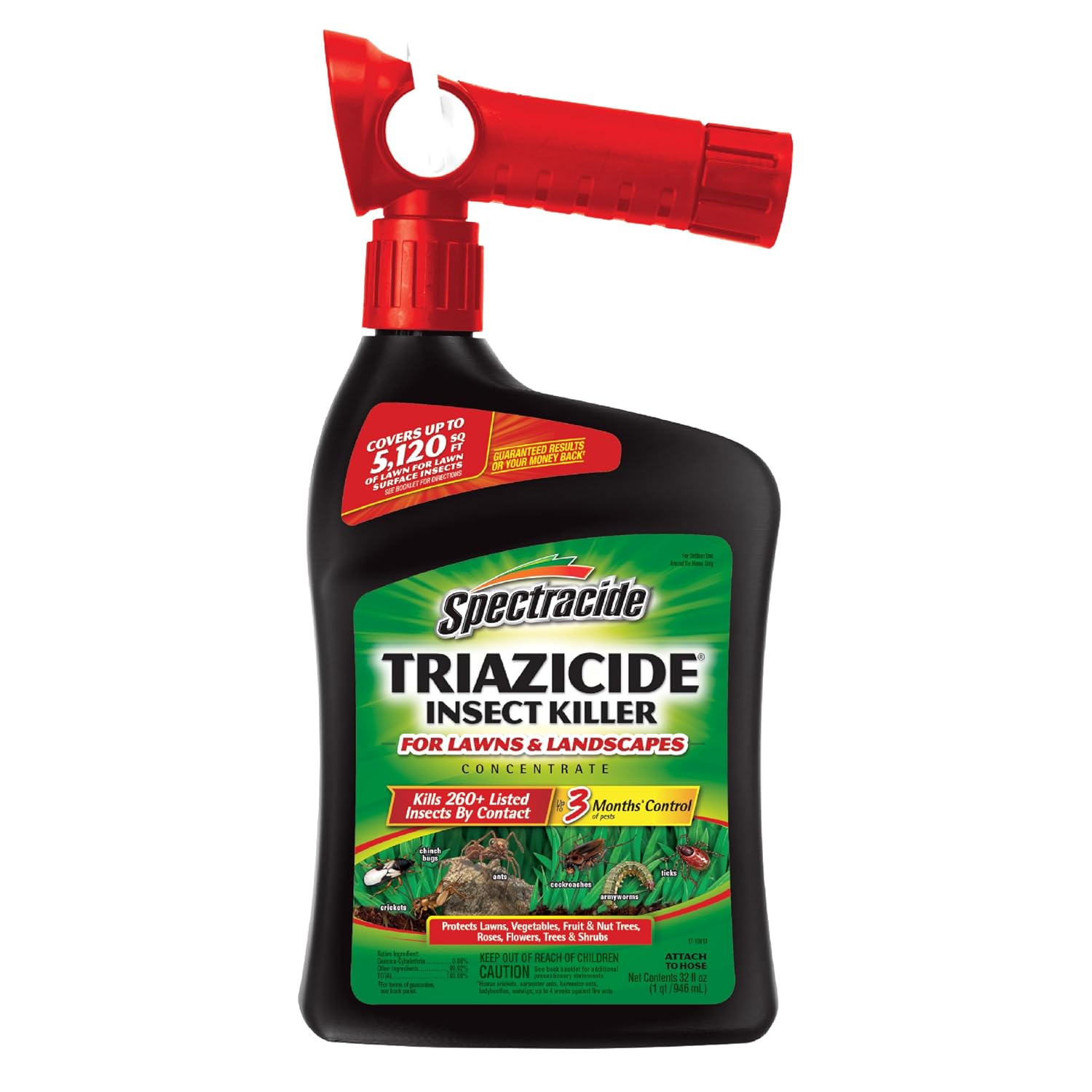
Spectracide Triazicide Insect Killer for Lawns & Landscapes, 32 oz
| Unit Count | 32 Ounce |
|---|---|
| Item Form | Spray |
| Target Species | Insects |
| Active Ingredients | Gamma-Cyhalothrin (0.08%) |
Spectracide Triazicide is a 32-ounce concentrate formulated to control more than 260 listed insects on lawns, flower beds, trees, shrubs and around vegetables. You mix the concentrate with water and apply it with a tank or hose-end sprayer; the ready-to-spray variant can attach to a garden hose for quicker application. The active ingredient, gamma-cyhalothrin, delivers fast contact kill for pests such as fleas, ticks, Japanese beetles and many surface insects, and the label claims protection for up to three months in some uses. It is non-staining when used as directed and can treat large areas, making it practical for whole-yard applications and targeted mound treatments like fire ants. Important limitations include toxicity to fish and bees, so it must not be applied near water or blooming plants, and the product requires careful handling and adherence to safety directions. Follow mixing rates and timing recommendations for best results and to minimize environmental risk.
Best for: Buyers who need an affordable, large-area solution to knock down common lawn and landscape pests and prefer a concentrate that stretches coverage when mixed.
Less Ideal for: People with small ornamental gardens near ponds, homeowners who prioritize pollinator-safe products, or those unwilling to follow pesticide safety precautions should consider gentler or targeted alternatives.
- Concentrate covers large areas so a single bottle treats many square feet when mixed correctly
- Fast-acting contact kill for a wide range of listed insects including fleas, ticks and Japanese beetles
- Versatile use on lawns, flower beds, trees, shrubs and around vegetables
- Non-staining when used as directed and available in hose-end ready-to-spray format for easier application
- Highly toxic to aquatic life and bees so it cannot be used near water or blooming plants
- Requires careful mixing and protective handling due to chemical toxicity
Verdict: A cost-effective, fast-acting concentrate for treating broad lawn and landscape pest problems when used with care and proper precautions.
Ortho BugClear Insect Killer for Lawns & Landscapes Ready-to-Spray, 32 oz

| Item Form | Aerosol |
|---|---|
| Target Species | Ant |
| Liquid Volume | 32 fluid ounces |
Ortho BugClear Ready-to-Spray is a hose‑end insecticide designed for homeowners who want a fast, no-mix solution to reduce mosquitoes and many other yard pests. You attach the 32 oz. bottle to a garden hose and apply across lawns, foundation perimeters and ornamentals; one bottle covers up to about a 5,300 sq ft lawn or targeted perimeter areas. The formula lists bifenthrin and zeta‑cypermethrin and is described as non‑staining and odor free, with knockdown that starts within minutes and protection that can last for months. Practical benefits include quick application without measuring, broad-spectrum control of dozens of species including mosquitoes and ticks, and compatibility with turf, shrubs and listed edibles when used as directed. Important limitations are that it is a contact/residual insecticide so timing matters for weather and pollinator safety, and hose-end coverage is fixed so very large properties may need multiple bottles; follow label precautions for pets, people and bloom protection.
Best for: Homeowners who want an affordable, easy-to-use mosquito and general yard pest treatment they can apply themselves without mixing concentrates.
Less Ideal for: People who prefer organic or non-chemical mosquito control methods or those managing very large properties who need professional-scale coverage.
- Ready-to-spray hose-end design for quick, no-mix application
- Claims fast knockdown and long-lasting residual control
- Broad-spectrum label lists many outdoor pests including mosquitoes and ticks
- Non-staining and low odor for outdoor use near living spaces
- Contains synthetic pyrethroids that require careful timing and avoidance of blooming plants to protect pollinators
- Single bottle covers limited area for very large yards
Verdict: A budget-friendly, ready-to-spray option that makes quick, DIY mosquito and yard pest control simple for typical residential lawns.
Atticus Talak 7.9% Bifenthrin Indoor/Outdoor Insecticide Concentrate, 32 oz

| Active Ingredient | Bifenthrin |
|---|---|
| Formulation | Suspension Concentrate |
| Liquid Volume | 32 fluid ounces |
| Length of Control | Up to three months |
| Target Species | Insects |
Talak 7.9% is a liquid concentrate for treating lawns, landscaping, outdoor living areas and indoor perimeter spots like baseboards and cabinets. You dilute the concentrate with water to create a spray for barrier treatments, spot applications or lawn mixes; label rates explain how much to mix per gallon depending on the use. The product uses bifenthrin, a proven broad-spectrum active ingredient, and the manufacturer states it controls over 75 species and can give residual control for as long as three months. Its water-based formula dries clear, leaves no odor or visible residue, and is not phytotoxic on plants when used per label. Practical benefits include flexible indoor and outdoor use, clear drying, and a bottle designed for easier pouring. Important limitations are that solutions should be mixed only for same-day use, it is not registered for sale in a few states, and it is not approved for fogger application, so professional-style misting methods are not appropriate.
Best for: Buyers who want a single, reliable product to protect yards, patios and building perimeters from a wide range of common pests and prefer conservative, label-driven application practices.
Less Ideal for: People seeking ready-to-use sprays or fogger-compatible products or those in states where this formulation is not registered should look at alternatives.
- Broad-spectrum control listed for 75+ indoor and outdoor pest species
- Water-based formula that dries clear and leaves no odor or residue
- Flexible label directions for lawns, landscapes, hardscapes and indoor perimeter treatments
- Long residual activity up to three months when applied at recommended rates
- Mixed spray solutions cannot be stored and must be used the same day
- Not approved for fogger application and not available for sale in some states
Verdict: A versatile, water-based bifenthrin concentrate that delivers long-lasting, broad-spectrum outdoor (and perimeter indoor) control when used according to the label.
Choosing the Right Lawn Insecticide Spray: Key Factors to Consider
Target Pest Spectrum
Different insecticide sprays control different pest groups, for example subterranean grubs, surface-feeding caterpillars, or sap-sucking insects. Knowing which pests are actively damaging your lawn matters because a product labeled mainly for surface pests may not control grubs living below the soil.
Inspect your turf for signs such as brown patches that lift easily, chewed blades, or visible larvae and adults. Match the spray's labeled pest list to the pests you see or the common problems in your region. Choosing a product with a broader spectrum can simplify treatment when multiple pests are present, but broader chemistry can also increase non-target risks, so balance range with safety needs.
Turfgrass Compatibility and Safety
Different grass species tolerate active ingredients and application timings differently. Some chemistries can cause turf discoloration under heat stress or when applied at high concentrations. Check label directions for turf species, maximum application rates, and temperature cautions.
Consider the lawn's current condition: newly seeded or sodded areas often need gentler options and longer wait times before application. Also factor in nearby ornamental beds and desired pollinator protection; choose sprays with clear guidance for buffer zones and safe intervals before irrigation or rainfall.
Coverage Area and Concentration
Coverage per bottle and the necessary dilution ratio determine how much product you actually need for your lawn. Labels list treated square feet per container at recommended rates. A concentrated formula may be economical but increases mixing steps and chance of error, while ready-to-use sprays trade cost per area for convenience.
Estimate your lawn area accurately and choose a product with an appropriate treated-area rating. Consider hose-end or pump sprayer compatibility, and whether the product requires multiple passes for full control. Underestimating coverage needs can lead to patchy control and the need for reapplication.
Application Method and Equipment
How you apply the spray affects uniformity and effectiveness. Some products are formulated for hand-pump sprayers, others for hose-end applicators or broadcast sprayers. Nozzle type and spray pattern influence where the active ingredient lands and how much reaches the thatch versus the soil where grubs reside.
Choose a product that matches the equipment you already use or are willing to use. Look for clear mixing charts, labeled nozzle recommendations, and instructions for treating edges and shaded areas. Ease of rinsing and cleaning the sprayer after use also reduces risks of carryover damage to ornamentals.
Residual Activity and Re-entry Intervals
Residual activity determines how long a treatment remains effective and whether repeat applications are needed within a season. Short-residual options reduce long-term exposure to non-target organisms but may require more frequent reapplication. Longer residual chemistries can provide season-long suppression of some pests but may restrict when people, pets, or livestock can safely re-enter treated areas.
Check label guidance for rainfastness, how long the product remains effective, and required re-entry intervals. Align residual expectations with your maintenance calendar and any events such as gatherings or irrigation schedules to avoid inconvenient restrictions.
Environmental Restrictions and Buffer Zones
Many lawn insecticide sprays carry specific instructions for use near water, storm drains, or pollinator-attractive plants. Some active ingredients require strict setbacks from ponds or streams and instructions to avoid overspray into storm systems. Others set explicit limits on flowering plants to protect pollinators.
Understand your property's drainage and nearby water features before choosing a spray. Choosing a product with clear, practical buffer zone instructions and lower aquatic toxicity can simplify compliance and reduce environmental risk.
When To Treat Your Lawn
Timing treatments to insect life cycles gives the best chance of control. For grubs, treat when larvae are small and actively feeding near the root zone. For surface-feeding caterpillars and beetles, target timing when young larvae or adults are most active and before visible turf damage becomes extensive.
Weather affects efficacy. Apply when no heavy rain is expected for at least 24 hours so the spray can settle or be watered in if label directions call for it. Avoid applying during heat spikes that can stress turf and increase injury risk.
- Treat grubs in late summer to early fall when larvae are small in many climates
- Target surface pests in late spring through summer depending on species
- Avoid applications immediately before or after heavy rain unless label allows
Application Best Practices
Follow label mixing rates exactly and measure concentrates carefully. Over-concentrating can injure turf and under-concentrating reduces control. Walk at a steady pace and overlap spray swaths slightly to avoid missed patches.
If the label directs watering-in after application for soil-active ingredients, do so with light irrigation that will move the active ingredient into the root zone without creating runoff. Clean equipment after use and store remaining product safely in its original container.
- Calibrate sprayer to known output per minute for consistent coverage
- Wear recommended protective gear during mixing and application
- Rinse sprayers in a manner consistent with label disposal instructions
Integrating Chemical Control With Cultural Practices
Chemical treatments work best when combined with good turf culture. Maintain proper mowing height, irrigate deeply and infrequently, and aerate compacted soils to bolster root health. Healthy turf tolerates some insect feeding and recovers faster after treatment.
Address underlying stressors that make a lawn more susceptible to pests. Overwatering, poor drainage, and nutrient imbalances can increase pest problems, so correct those issues alongside targeted insecticide use.
- Spot-treat high-pressure areas rather than blanket-spraying when feasible
- Use soil tests and adjust fertility to support resilient turf
- Keep mowing blades sharp to reduce plant stress
Safety Around People, Pets, and Pollinators
Plan treatments to minimize exposure risk. Apply during times when children and pets are unlikely to be on the lawn and observe labeled re-entry intervals. Consider mowing before application to remove debris that can trap spray droplets.
To protect pollinators, avoid spraying when nearby ornamentals are in bloom and choose products with lower acute pollinator toxicity or clear buffer guidance.
- Post signs or notify household members when applications are made
- Keep pets off treated areas for the full re-entry period listed on the label
- Avoid applying to flowering plants and maintain buffer zones
What To Expect After Treatment
Some products provide rapid knockdown of visible adults and early-stage larvae, while soil-active chemistries reduce grub populations more slowly as the active ingredient moves into the root zone. Expect turf recovery to take days to weeks depending on damage extent and lawn vigor.
Monitor treated areas for signs of continued activity and follow label guidance for retreatment intervals rather than guessing. If damage persists beyond labeled expectations, revisit cultural practices and consider a different control strategy.
- Visible pest reduction can be immediate for contact sprays
- Soil-active treatments may take several days to show grub control
- Avoid reapplying sooner than label minimums to prevent turf injury
How We Chose the Best Lawn Insecticide Spray
We focused on practical, gardener-centered criteria that determine whether a lawn insecticide spray will succeed in real turf conditions. Primary evaluation criteria included effectiveness against common turf pests over both grub and surface-feeding stages, safety margin for common turfgrass species and nearby ornamental beds, coverage efficiency and realistic treated area per unit, and application ease including mixing, nozzle options, and compatibility with common spreader/sprayer gear. We also considered persistence and re-entry intervals so treatments fit normal lawn-use schedules, and environmental profile factors such as labeled restrictions for water bodies and pollinator exposure. Products that lacked clear turf safety instructions, had overly restrictive water-use limitations for typical suburban yards, or required specialized equipment beyond common garden sprayers were excluded. The final list contains sprays that balance clear label directions, measurable treated-area performance, and practical safety guidance gardeners can follow.
FAQ
Can I apply insecticide to a newly seeded or sodded lawn?
It depends on the product label. Newly seeded and sodded areas often require delayed treatment to avoid injuring tender roots and shoots. Check label guidance for minimum establishment time before application and select options labeled safe for new turf if needed.
How soon after rain should I apply a lawn spray?
Apply when no heavy rain is expected for at least 24 hours unless the label specifies otherwise. Some products require light irrigation after application to move the chemical into the soil, while others must remain dry to be effective.
Will insecticide sprays harm earthworms and beneficial soil organisms?
Some active ingredients are less harmful to soil biota than others. Labels do not always detail sublethal effects, so choose products with lower soil toxicity when preserving beneficial organisms is a priority. Cultural controls can reduce reliance on chemicals.
How often can I reapply if pests return?
Follow the minimum retreatment interval on the label. Intervals vary by chemistry and pest. Repeating applications more frequently than labeled can increase turf injury and environmental risk, so address cultural issues before retreating.
Are there safer options for yards with nearby water features?
Yes. Choose products with lower aquatic toxicity and clear buffer-zone instructions. Always follow label setbacks from ponds, streams, and drains and avoid applying when runoff is likely.
Can I mix insecticide with fertilizer or other lawn products?
Only mix products that are explicitly labeled as compatible. Tank-mixing can change efficacy and increase phytotoxicity risk. If mixing is necessary, do a small jar test or follow manufacturer compatibility guidance.
Final Verdict
Pick a lawn insecticide spray that matches the specific pests you need to control and the size and condition of your turf. Prioritize products with clear turf compatibility, sensible coverage-per-unit, and label instructions that fit your watering and activity schedule. Balance residual control with safety needs around people, pets, and water. Focus on correct timing, precise mixing, and integrating chemical control with cultural practices. Doing so reduces the number of treatments needed and helps you protect both turf health and the wider yard ecosystem when managing common lawn pests.
