

Note: This article contains affiliate links. If you click on these links and make a purchase, I may earn a small commission at no extra cost to you. This helps support my research and content. Read my full affiliate disclosure here.
Lawn spray insect killer choices affect how quickly you stop visible pest damage and how safe treatments are for kids, pets, and beneficial insects. Pick the right spray and you get more consistent brown-spot control, fewer repeat treatments, and less risk of runoff into flower beds or water features. This guide covers seven shortlisted options that perform well in typical home lawns and smaller properties. We evaluated each product on how much area a single application covers, how long control lasts, and how easy the spray is to apply and handle. Read on to match a spray to the size of your turf, the pests you see, and any safety constraints in your yard.
Top Picks at a Glance
| Best Overall The best all-around choice for most situations | BioAdvanced Complete Insect Killer Concentrate (40 oz) |  |
| Best Quality Built to a higher standard if you want something more solid | Atticus Talak 7.9% Indoor/Outdoor Bifenthrin Insecticide Concentrate (1 gal) |  |
| Best Value The sweet spot between price and what you get | Cutter Backyard Bug Control Spray Concentrate, 32 oz (2 pack) |  |
| Best Budget The cheapest option that still gets the job done reliably | Spectracide Triazicide Insect Killer for Lawns & Landscapes, 32 oz |  |
| Highest Rated A top-rated pick with lots of positive feedback | Sevin Insect Killer Concentrate, 1 Gallon |  |
| Most Popular A crowd favorite that many people choose with confidence | Ortho BugClear Insect Killer for Lawns & Landscapes Ready-to-Spray, 32 oz |  |
| Best Seller A high-volume bestseller chosen again and again | Atticus Talak 7.9% Bifenthrin Indoor/Outdoor Insecticide Concentrate, 32 oz |  |
BioAdvanced Complete Insect Killer Concentrate (40 oz)

| Unit Count | 40 Fluid Ounces |
|---|---|
| Item Form | Concentrate |
| Target Species | Insects |
| Active Ingredients | 0.72% Imidacloprid, 0.36% Beta-Cyfluthrin |
| Specification Met | EPA |
The BioAdvanced Complete Insect Killer concentrate is designed to treat lawns and turf for a wide range of pests by combining a fast-acting surface ingredient with a longer-lasting soil-active ingredient. You dilute the 40 oz bottle per the label and apply with a pump sprayer or hose attachment to treat yard areas where ants, grubs, ticks, mosquitoes and other listed insects are active. Notable features include a two-way formula that claims to kill surface insects within 24 hours and provide subsurface control for up to three months, plus rainproof protection for roughly 30 days after application. In practice this makes it useful for seasonal preventive treatments or spot treatments after spotting pest activity. Important limitations: it is a chemical concentrate that requires careful mixing and strict adherence to safety directions, it is not labeled for sale in several states, and it targets listed pests only so label review is necessary before use. Expect effective, broad-spectrum lawn control when used as instructed but plan to follow safety precautions for people, pets, and pollinators.
Best for: Homeowners who want a single, season-ready products to reduce common lawn pests and who are comfortable mixing and applying concentrated insecticide for routine preventive or spot treatments.
Less Ideal for: People who prefer organic or non-chemical pest control methods or those who need a product labeled for use in restricted states should look for alternatives.
- Two-way formula that treats both surface and soil insects
- Fast knockdown of listed surface pests, with subsurface control lasting up to three months
- Covers a large area from a single 40 oz bottle when diluted
- Rainproof protection that holds for about 30 days after application
- Requires precise dilution and safe handling as a concentrated chemical product
- Not legal for sale in several states so availability and use restrictions apply
Verdict: If you want a single concentrate that delivers quick surface knockdown plus months of soil protection for common lawn pests, this bottle is a practical, effective choice.
Atticus Talak 7.9% Indoor/Outdoor Bifenthrin Insecticide Concentrate (1 gal)

| Active Ingredients | Bifenthrin |
|---|---|
| Formulation | Suspension Concentrate |
| Unit Count | 128 Fluid Ounces |
| Specification Met | EPA |
Talak 7.9% is a water-based bifenthrin concentrate meant as a flexible indoor and outdoor insect control product. You dilute the concentrate with water and apply it as a spray for perimeter barrier treatments, to turf, to ornamentals, or to interior baseboards and other problem areas. The label lists control of more than 75 pests including mosquitoes and ticks, and the formula is designed to kill on contact and provide residual control for up to three months. Practical benefits include a clear, odor-free spray that dries without staining and a bottle that allows easier small pours for accurate mixing. Important limitations are that mixed solutions should be used the same day and it is not approved for fogger use, so it is best for targeted spray applications rather than broadcast fogging. As with any bifenthrin product, users should follow label directions closely and consider nonchemical options for integrated mosquito management.
Best for: Buyers who want a single, versatile insecticide to treat both perimeter and landscape mosquito problems and prefer a product that delivers residual control without odors or visible residue.
Less Ideal for: People seeking a ready-to-use fogging or misting solution or those who need an insecticide they can pre-mix and store for later use.
- Broad-spectrum control listing more than 75 indoor and outdoor pests including mosquitoes and ticks.
- Water-based formula that dries clear, leaves no residue, and is odor-free for use around living areas.
- Long residual effect with label claim of up to three months of control per application.
- Mixes with water for adjustable application rates across lawns, landscapes, and surfaces.
- Bottle design supports easier small pours to reduce mess when measuring concentrate.
- Mixed spray cannot be stored and must be used the same day.
- Not approved for use in foggers, limiting application methods to direct sprays.
Verdict: A versatile, long-lasting bifenthrin concentrate that provides broad-spectrum mosquito and perimeter control for users who want one product for indoor and outdoor applications.
Cutter Backyard Bug Control Spray Concentrate, 32 oz (2 pack)

| Unit Count | 64 Fluid Ounces |
|---|---|
| Item Form | Spray |
| Target Species | Insects |
| Active Ingredients | Lambda Cyhalothrin |
This Cutter Backyard Bug Control Spray Concentrate is a hose‑end applicator concentrate designed to treat lawns, shrubs and other outdoor surfaces to reduce mosquitoes and a range of listed insects. You attach the QuickFlip hose‑end sprayer, walk the area and apply as a cover spray; the ready‑to‑mix nozzle meters water automatically so you do not need separate measuring. The formula lists lambda‑cyhalothrin as an active ingredient and claims up to 12 weeks of control and coverage for up to 5,000 sq ft per bottle, which makes it suitable for seasonal perimeter treatments and spot landscape applications. Practical benefits include easy application with the flip‑on nozzle, thorough foliar coverage when used as directed, and long residual control that reduces repeat treatments. Important limitations are that it is a pesticide so you must keep children and pets out of treated areas until dry, follow label restrictions for vegetables and sensitive areas, and avoid applications before rain or near drains or water bodies.
Best for: Buyers who want a simple, ready‑to‑use perimeter treatment to reduce mosquitoes and common yard insects across lawns and landscaped beds without frequent reapplication.
Less Ideal for: People who need an organic, pet‑safe, or water‑safe option for insect control or those who require frequent spot treatments in small container gardens.
- Hose‑end QuickFlip sprayer for fast, no‑mix application over large areas
- Claims up to 12 weeks of residual control, reducing the need for frequent reapplications
- Covers up to 5,000 sq ft per bottle for single‑treatment perimeter protection
- Works on lawns, shrubs and outdoor surfaces for flexible use around the yard
- Contains a synthetic pesticide ingredient and requires strict adherence to safety and label restrictions
- Not intended for use where runoff could reach water bodies or drains
Verdict: A convenient hose‑end concentrate that delivers broad yard coverage and long‑lasting mosquito and insect control with minimal setup.
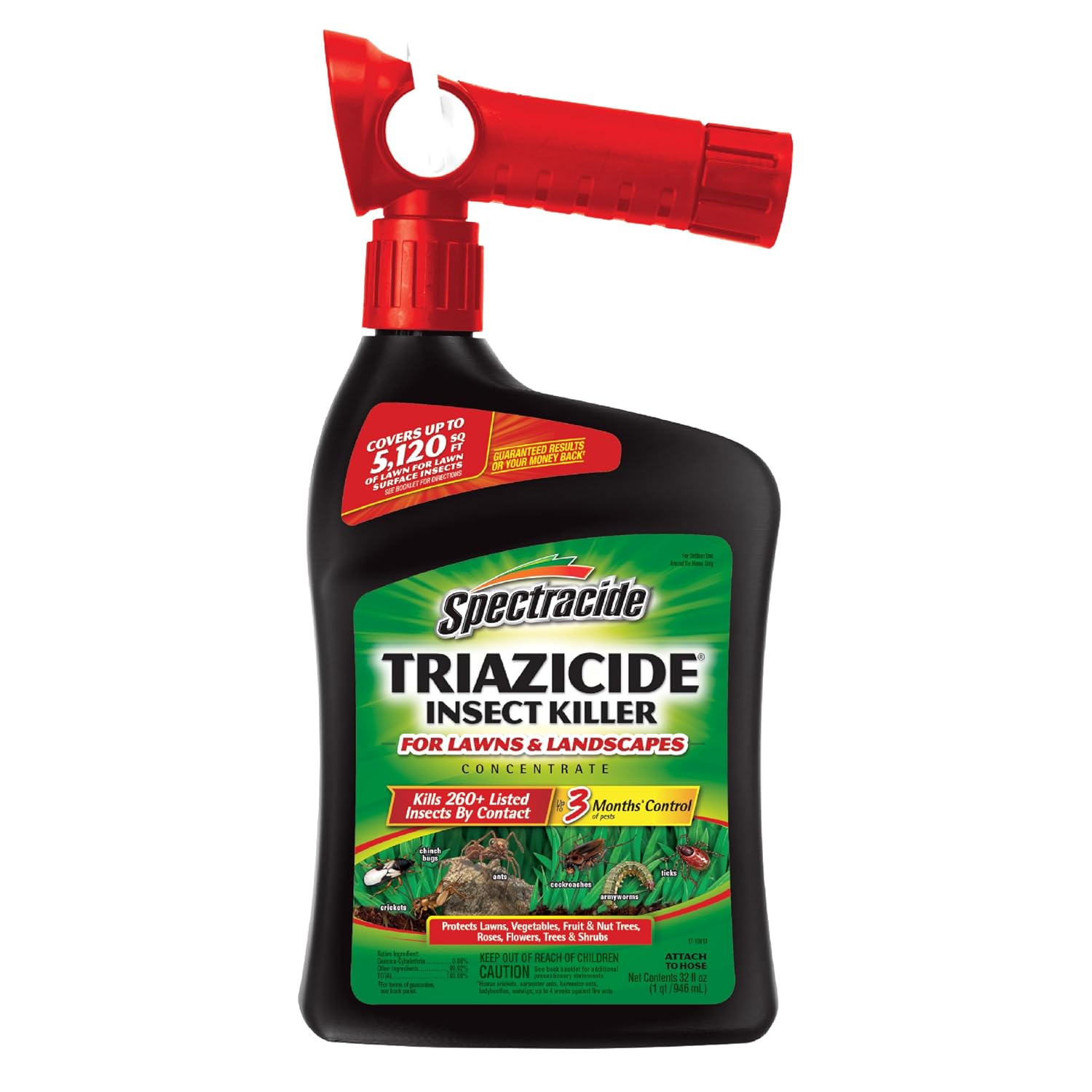
Spectracide Triazicide Insect Killer for Lawns & Landscapes, 32 oz
| Unit Count | 32 Ounce |
|---|---|
| Item Form | Spray |
| Target Species | Insects |
| Active Ingredients | Gamma-Cyhalothrin (0.08%) |
Spectracide Triazicide is a 32-ounce concentrate formulated to control more than 260 listed insects on lawns, flower beds, trees, shrubs and around vegetables. You mix the concentrate with water and apply it with a tank or hose-end sprayer; the ready-to-spray variant can attach to a garden hose for quicker application. The active ingredient, gamma-cyhalothrin, delivers fast contact kill for pests such as fleas, ticks, Japanese beetles and many surface insects, and the label claims protection for up to three months in some uses. It is non-staining when used as directed and can treat large areas, making it practical for whole-yard applications and targeted mound treatments like fire ants. Important limitations include toxicity to fish and bees, so it must not be applied near water or blooming plants, and the product requires careful handling and adherence to safety directions. Follow mixing rates and timing recommendations for best results and to minimize environmental risk.
Best for: Buyers who need an affordable, large-area solution to knock down common lawn and landscape pests and prefer a concentrate that stretches coverage when mixed.
Less Ideal for: People with small ornamental gardens near ponds, homeowners who prioritize pollinator-safe products, or those unwilling to follow pesticide safety precautions should consider gentler or targeted alternatives.
- Concentrate covers large areas so a single bottle treats many square feet when mixed correctly
- Fast-acting contact kill for a wide range of listed insects including fleas, ticks and Japanese beetles
- Versatile use on lawns, flower beds, trees, shrubs and around vegetables
- Non-staining when used as directed and available in hose-end ready-to-spray format for easier application
- Highly toxic to aquatic life and bees so it cannot be used near water or blooming plants
- Requires careful mixing and protective handling due to chemical toxicity
Verdict: A cost-effective, fast-acting concentrate for treating broad lawn and landscape pest problems when used with care and proper precautions.
Sevin Insect Killer Concentrate, 1 Gallon

| Unit Count | 128 Fluid Ounces |
|---|---|
| Item Form | Liquid |
| Target Species | Insects |
| Active Ingredients | Zeta Cypermethrin |
Sevin Insect Killer Concentrate is a one-gallon liquid concentrate intended for gardeners who need broad-spectrum, fast-acting insect control. You measure the concentrate (label example 4 fl oz per gallon), mix it with water in a pump or handheld sprayer, and apply it to foliage, lawns, shrubs and listed edible crops to kill pests by contact. The formula lists zeta-cypermethrin as the active ingredient and claims control of more than 500 insects including aphids, Japanese beetles, armyworms and Colorado potato beetles, with residual protection that can last up to three months for many pests. The product includes a measuring cap for accurate mixing and is versatile across flowers, vegetables and ornamental plants. Important limitations are that it should not be applied to open blooms to protect pollinators, some pests (fire ants, fleas, ticks, mosquitoes) have shorter control, and it is not registered for certain uses in some states. Follow label directions closely for rates, spray timing, and reentry intervals to get the performance-oriented results this concentrate is designed to deliver.
Best for: Gardeners who prioritize reliable, high-performance pest control across vegetables, ornamentals and lawns and who are comfortable following label safety and application instructions.
Less Ideal for: Those seeking an organic or pollinator-safe insecticide or people who prefer spot treatments rather than mixing and spraying larger areas.
- Broad-spectrum control listed for over 500 insect pests, covering many common garden threats
- Concentrate format lets you treat large areas economically when mixed to label rates
- Fast-acting contact kill with residual protection on many pests for weeks to months
- Includes measuring cap for accurate dilution and works with standard garden sprayers
- Contains a synthetic pyrethroid active ingredient requiring careful use around pollinators and follow-up label precautions
- Not registered for some regional uses and some pests have shorter residual control
Verdict: Choose Sevin Concentrate when you need a powerful, economical concentrate that delivers broad and lasting control of common garden insect pests.
Ortho BugClear Insect Killer for Lawns & Landscapes Ready-to-Spray, 32 oz

| Item Form | Aerosol |
|---|---|
| Target Species | Ant |
| Liquid Volume | 32 fluid ounces |
Ortho BugClear Ready-to-Spray is a hose‑end insecticide designed for homeowners who want a fast, no-mix solution to reduce mosquitoes and many other yard pests. You attach the 32 oz. bottle to a garden hose and apply across lawns, foundation perimeters and ornamentals; one bottle covers up to about a 5,300 sq ft lawn or targeted perimeter areas. The formula lists bifenthrin and zeta‑cypermethrin and is described as non‑staining and odor free, with knockdown that starts within minutes and protection that can last for months. Practical benefits include quick application without measuring, broad-spectrum control of dozens of species including mosquitoes and ticks, and compatibility with turf, shrubs and listed edibles when used as directed. Important limitations are that it is a contact/residual insecticide so timing matters for weather and pollinator safety, and hose-end coverage is fixed so very large properties may need multiple bottles; follow label precautions for pets, people and bloom protection.
Best for: Homeowners who want an affordable, easy-to-use mosquito and general yard pest treatment they can apply themselves without mixing concentrates.
Less Ideal for: People who prefer organic or non-chemical mosquito control methods or those managing very large properties who need professional-scale coverage.
- Ready-to-spray hose-end design for quick, no-mix application
- Claims fast knockdown and long-lasting residual control
- Broad-spectrum label lists many outdoor pests including mosquitoes and ticks
- Non-staining and low odor for outdoor use near living spaces
- Contains synthetic pyrethroids that require careful timing and avoidance of blooming plants to protect pollinators
- Single bottle covers limited area for very large yards
Verdict: A budget-friendly, ready-to-spray option that makes quick, DIY mosquito and yard pest control simple for typical residential lawns.
Atticus Talak 7.9% Bifenthrin Indoor/Outdoor Insecticide Concentrate, 32 oz

| Active Ingredient | Bifenthrin |
|---|---|
| Formulation | Suspension Concentrate |
| Liquid Volume | 32 fluid ounces |
| Length of Control | Up to three months |
| Target Species | Insects |
Talak 7.9% is a liquid concentrate for treating lawns, landscaping, outdoor living areas and indoor perimeter spots like baseboards and cabinets. You dilute the concentrate with water to create a spray for barrier treatments, spot applications or lawn mixes; label rates explain how much to mix per gallon depending on the use. The product uses bifenthrin, a proven broad-spectrum active ingredient, and the manufacturer states it controls over 75 species and can give residual control for as long as three months. Its water-based formula dries clear, leaves no odor or visible residue, and is not phytotoxic on plants when used per label. Practical benefits include flexible indoor and outdoor use, clear drying, and a bottle designed for easier pouring. Important limitations are that solutions should be mixed only for same-day use, it is not registered for sale in a few states, and it is not approved for fogger application, so professional-style misting methods are not appropriate.
Best for: Buyers who want a single, reliable product to protect yards, patios and building perimeters from a wide range of common pests and prefer conservative, label-driven application practices.
Less Ideal for: People seeking ready-to-use sprays or fogger-compatible products or those in states where this formulation is not registered should look at alternatives.
- Broad-spectrum control listed for 75+ indoor and outdoor pest species
- Water-based formula that dries clear and leaves no odor or residue
- Flexible label directions for lawns, landscapes, hardscapes and indoor perimeter treatments
- Long residual activity up to three months when applied at recommended rates
- Mixed spray solutions cannot be stored and must be used the same day
- Not approved for fogger application and not available for sale in some states
Verdict: A versatile, water-based bifenthrin concentrate that delivers long-lasting, broad-spectrum outdoor (and perimeter indoor) control when used according to the label.
Choosing the Right Lawn Spray Insect Killer: Key Factors to Consider
Coverage Per Application
Coverage determines how much lawn area a single bottle or container will treat and directly affects convenience. For larger yards you will want a product with a higher treated-area claim or one that dilutes to a larger volume so you avoid multiple refills or repeated trips to mix more solution.
Coverage also influences cost per application and the time you spend spraying. Low-coverage concentrates can still be useful for spot treatments, but they are less practical for whole-lawn applications. Check label instructions for treated-area rates and account for overlap when walking spray patterns to avoid overapplication.
Residual Control Duration
Residual control is how long the active ingredient remains effective on turf after application. Longer residuals reduce the frequency of reapplication and help control pests that move through the lawn over several days.
Residual duration varies by active ingredient, sunlight exposure, mowing, and irrigation. If your lawn faces persistent infestations, a longer residual can give more sustained suppression. For lawns near pollinator habitat or water, shorter residuals may be preferable to reduce environmental exposure.
Applicator Ease and Coverage Uniformity
How the product is applied affects spray pattern uniformity, drift risk, and user fatigue. Trigger and pump sprayers are simple for small areas and spot treatments, but maintaining even walking speed and nozzle distance is important to avoid streaks. Hose-end sprayers and hose-attached tanks can cover larger areas faster, but they require careful calibration to get the right dilution and application rate.
Also consider mixing steps and whether the product requires measuring. Pre-mixed options cut errors but add transport and disposal considerations. Look for adjustable nozzles or pressure controls that make it easier to deliver a consistent, light spray that settles into grass blades rather than pooling.
Safety and Environmental Risk
Safety considerations include label-required personal protective equipment, re-entry intervals, pet and turf toxicity notes, and restrictions near bodies of water. Some active ingredients are more toxic to aquatic invertebrates or beneficial insects, so follow buffer and application guidance closely.
Assess how the product behaves when it rains or when the lawn is irrigated. Some formulations bind quickly and resist wash-off, while others wash away and pose runoff concerns. If you have young children, pets, or pollinator plantings adjacent to the lawn, choose a product with lower non-target risk or plan treatments when pollinators are least active.
Turf Compatibility and Timing
Different turf species and lawn conditions respond differently to sprays. Some formulations are safe on cool-season grasses but may stress certain warm-season varieties, especially under heat or drought. Injury risk also rises if you apply during peak heat or immediately after fertilization.
Timing matters for pest life stages. For soil-dwelling grubs you need timing aligned with larval feeding, while surface-feeding beetles or caterpillars are best controlled when active adults or young larvae are present. Read label guidance for tolerant turf types and recommended application windows to reduce turf injury and increase control success.
Mixing, Storage, and Waste Handling
How a product mixes, how long a mixed solution remains usable, and how to store unused concentrate influence practical use. Concentrates that need precise measurement increase the chance of mix errors, while premixed sprays lower user error but create more container waste.
Consider how to safely store residual concentrate away from children, pets, and sunlight, and follow label instructions for disposing of leftover spray or empty containers. Some products have specific disposal instructions to reduce environmental contamination; planning ahead saves time and keeps your lawn work compliant.
Common Lawn Pests and Which Spray Actions Matter
Knowing which pests you have helps narrow the spray choices. Surface feeders like sod webworms, armyworms, and cutworms are controlled most effectively by sprays that contact the insect. Soil-dwelling pests such as white grubs may require products labeled for soil penetration or spot applications during vulnerable larval stages.
- Inspect for damage patterns: irregular brown patches, visible larvae, or chewed grass blades.
- Time sprays for the pest life stage that is most susceptible to contact or systemic action.
- Combine cultural practices such as dethatching and proper irrigation to reduce pest pressure and reliance on sprays.
Application Tips for Even Coverage
Walk at a steady pace and overlap each pass by about 20 percent to prevent untreated bands. Keep the nozzle height low above the turf so droplets land on blades instead of drifting. For hose-end applicators, calibrate flow rate per label instructions before treating the entire lawn.
- Spray during calm weather to minimize drift.
- Avoid mowing 24 hours before or after treatment unless the label permits.
- Rinse sprayer components after use and dispose of rinse water according to label rules.
Protecting Pollinators and Beneficials
Spray treatments can affect bees and beneficial predatory insects if applications land on flowering plants or are made when pollinators are active. To reduce risk, avoid spraying during bloom and treat early morning or late evening when pollinator activity is low.
If your lawn borders pollinator gardens, create a buffer and spot-treat problem areas rather than broadcasting across the entire turf. Use the least-toxic effective option and follow label restrictions for flower and plant contact.
- Maintain a flowering buffer at the lawn edge rather than spraying into bloom zones.
- Consider mechanical controls or spot treatments for minor infestations to protect beneficial insects.
Watering and Mowing After Treatment
Irrigation scheduling after application affects how a product performs. Some sprays require a dry period to adhere and provide residual control, while others need light watering to move active ingredients into thatch and soil. Follow the label for re-watering windows to avoid washing away treatment or reducing efficacy.
Mowing can remove treated leaf tissue, so delaying mowing for the recommended interval preserves control. If you must mow, do so carefully and reapply only if the label allows and if pest pressure justifies it.
- Check label for required rainfast period.
- Avoid high-pressure irrigation immediately after spraying unless instructed.
How We Chose the Best Lawn Spray Insect Killer
We shortlisted products that are widely used for turf pest control and that meet practical gardener expectations for coverage, handling, and safety. Our selection favored formulations and applicator types that provide even distribution across typical lawn surfaces and that have clear label guidance for common turf pests. We excluded specialty formulations intended only for indoor or turfgrass-free uses. Evaluation criteria reflected real-world decisions gardeners face. We checked published label coverage rates to estimate how much lawn a single container treats. We assessed active-ingredient persistence and recommended re-treatment intervals to judge how long control lasts. Ease-of-application looked at trigger vs hose-end vs pump sprayers, mixing requirements, and nozzle control. Safety and environmental impact considered user PPE recommendations, restrictions near water, and stated effects on pollinators and beneficials. Finally, formulation versatility measured whether a product can be used on different turf types and around ornamental beds with proper precautions. Products were excluded if label instructions were vague about turf use, if the formulation targets only non-lawn pests, or if the applicator type prevents even coverage on grass. The result is a list focused on reliable, practical lawn sprays that suit typical home turfcare routines.
FAQ
How soon will I see results after applying a lawn spray insect killer?
Results vary by pest and product. Contact sprays often reduce visible insect activity within 24 to 48 hours, while residual or systemic products may take several days to show effect. Activity also depends on infestation severity and environmental conditions.
Can I use the same spray across different turfgrass types?
Many sprays are labeled for multiple turf species, but some active ingredients have restrictions for warm-season or newly established lawns. Always check the label for turf compatibility and any temperature-related application warnings.
Is it safe to treat my lawn if I have pollinator plantings nearby?
It often depends. Avoid spraying during bloom and when pollinators are active. Use spot treatments and buffer zones to protect flowers, and choose lower-risk formulations when possible. Label directions will state specific pollinator precautions.
How long should I wait to let pets back on the lawn?
Follow the product label for re-entry or pet restrictions. Many products allow pets back once spray has dried, while others specify a waiting period. If in doubt, keep pets off treated areas until the application is fully dry and the label-specified interval has passed.
Can I mix a lawn spray with fertilizer or other garden chemicals?
Mixing with fertilizers or other pesticides is only safe if the label explicitly permits it. Unapproved tank mixes can reduce efficacy, increase turf injury risk, or change environmental behavior. When in doubt, apply separately on different days.
Final Verdict
Choose a lawn spray insect killer based on the size of the area you need to treat, the pest species and life stage, and any safety constraints like pets or nearby pollinator plantings. Prioritize clear label directions for coverage and timing, and select an applicator type that matches the scale of your turfwork. Accept tradeoffs between longer residual control and environmental exposure, and plan cultural tactics to lower reliance on sprays. With proper timing and safe handling you can target pests effectively while protecting your lawn and garden ecosystem.
