

Note: This article contains affiliate links. If you click on these links and make a purchase, I may earn a small commission at no extra cost to you. This helps support my research and content. Read my full affiliate disclosure here.
Choosing the right LED grow light bulb matters whether you are starting seedlings on a windowsill, supplementing a balcony garden, or running a small indoor grow. Light spectrum, intensity, and the bulb's coverage pattern determine how well plants germinate, stretch, and flower under artificial light. This guide shortlists the leading LED bulbs designed specifically for plant growth, focusing on real garden performance rather than specs alone. We evaluated bulbs for spectrum quality, usable canopy coverage, heat behavior, and energy draw to help you pick an option that matches your grow space and plant types. Read on for practical buying guidance and a breakdown of the criteria we used.
Top Picks at a Glance
| Best Overall The best all-around choice for most situations | SANSI PAR25 24W Full Spectrum LED Grow Light Bulb (E26) |  |
| Best Quality Built to a higher standard if you want something more solid | SANSI PAR25 32W Full Spectrum LED Grow Light Bulb (E26) | |
| Best Value The sweet spot between price and what you get | SANSI PAR20 10W Full-Spectrum LED Grow Light Bulb (2-Pack) |  |
| Best Budget The cheapest option that still gets the job done reliably | mfxmf A19 Full-Spectrum LED Grow Light Bulb, 9W (2-Pack) |  |
| Highest Rated A top-rated pick with lots of positive feedback | GISMIOSY 20W Full Spectrum LED Grow Light Bulb with Built‑in Plant Fan (E26, 6000K) |  |
| Most Popular A crowd favorite that many people choose with confidence | Briignite A19 Full-Spectrum LED Grow Light Bulb (2-Pack) |  |
| Best Seller A high-volume bestseller chosen again and again | Briignite A19 Full Spectrum LED Grow Light Bulb (4-Pack) |  |
SANSI PAR25 24W Full Spectrum LED Grow Light Bulb (E26)

| Wattage | 24 watts |
|---|---|
| Bulb Base | E26 |
| Color Temperature | 4000 Kelvin |
| Color Rendering Index | 97 |
| Light Source Operating Life | 25000 hours |
The SANSI PAR25 24W LED grow bulb is a full spectrum replacement bulb made for indoor plant lighting where a balance of brightness, color accuracy, and efficiency matters. It screws into a standard E26 fixture and delivers about 2400 lumens with a reported PPFD of 227 μmol/s/㎡ at 1 foot, making it suitable for seedlings, foliage plants, and supplemental light for larger specimens. Notable features include a high CRI (97) and a 4000K spectrum that closely mimics daylight, a ceramic chip-on-ceramic heat-sink design for improved thermal conduction, and an estimated 25,000-hour life. In practice that means good color rendering for monitoring plant health and lower running costs than an incandescent of equivalent output. The 60 degree beam focuses light for targeted coverage rather than wide-area lighting, so you may need multiple bulbs or reflectors for larger setups. It is ETL listed and built with flame-retardant ceramic for safety, but it is an indoor corded electric solution so planning fixture placement and ventilation is still important.
Best for: Buyers who want a dependable, daylight-accurate bulb for indoor plants and value a balance of efficiency, color fidelity, and long life for small to medium setups.
Less Ideal for: People who need wide-area or high-intensity canopy lighting for large grow tents or commercial setups should choose larger fixtures designed for broader coverage.
- Full spectrum 4000K output with CRI 97 for natural color rendering and plant-friendly spectrum
- Energy efficient 24W LED delivering ~2400 lumens and a reported PPFD suitable for close supplemental lighting
- Ceramic chip-on-ceramic design improves heat conduction and component reliability
- ETL listed and flame-retardant construction for safer indoor use
- Estimated 25,000-hour operating life reduces replacement frequency
- 60° beam angle provides focused coverage, so multiple bulbs are needed for larger grow areas
Verdict: A reliable, daylight-accurate 24W LED grow bulb that balances efficiency, color fidelity, and safety for small to medium indoor plant setups.
SANSI PAR25 32W Full Spectrum LED Grow Light Bulb (E26)
| Wattage | 32 watts |
|---|---|
| Bulb Base | E26 |
| Color Temperature | 4000 Kelvin |
| Color Rendering Index | 95 |
| Light Source Operating Life | 25000 hours |
The SANSI PAR25 32W LED grow bulb is built as a high-performance screw-in lamp for indoor plant supplementation. It produces about 3200 lumens at 4000K with a high CRI (95) and a focused 60 degree beam to concentrate light where plants need it most. The bulb uses a ceramic Chip-on-Ceramic heat sink and secondary optics to raise PPFD (listed at 423 μmol/s/m² at 1 ft), which makes it suitable for seedlings, leafy greens, and houseplants in single-bulb setups or small grow tents. It runs on standard 120V E26 sockets and claims a 25,000-hour life and ETL/CE safety listings. Practical benefits include strong light output for its wattage, more natural color rendering for evaluating plant health, and lower surface heat thanks to the ceramic construction. Limitations are the narrow 60 degree beam that requires careful positioning for even canopy coverage and the single-bulb format that may not scale efficiently for larger racks or full flowering rooms.
Best for: Growers who prioritize measured light output and efficiency for small-scale performance setups, like single-shelf grow tents, propagation trays, or dedicated houseplant lighting.
Less Ideal for: Large canopy growers or those needing wide-area, uniform coverage without using multiple bulbs should consider panel-style fixtures instead.
- High PPFD concentration (423 μmol/s/m² @1 ft) for effective light delivery to plant canopy
- Full spectrum 4000K output with CRI 95 for accurate color rendering and all-stage growth
- Ceramic Chip-on-Ceramic design improves heat dissipation and component reliability
- Screw-in E26 form factor works in standard lamps and fixtures without adapters
- 60 degree beam angle focuses light narrowly, requiring multiple bulbs or repositioning for even coverage
- 25,000 hour lifespan is good but shorter than some premium LEDs rated for 40,000+ hours
Verdict: Choose this bulb when you need a compact, high-PPFD screw-in grow light that delivers full-spectrum, natural-looking light for focused small-area grows.
SANSI PAR20 10W Full-Spectrum LED Grow Light Bulb (2-Pack)

| Wattage | 10 watts |
|---|---|
| Bulb Base | E26 |
| Color Temperature | 4000 Kelvin |
| Color Rendering Index | 95 |
| Light Source Operating Life | 25000 hours |
The SANSI PAR20 10W grow bulb is a screw-in full-spectrum LED designed to replace incandescent plant lighting with a low-wattage, high-CRI option for indoor plants. It is used like a normal E26 bulb in clamp lamps, desktop fixtures, or grow lamp sockets to give seedlings, herbs, and houseplants supplemental light. Notable features include a 4000K full spectrum that covers visible wavelengths important for growth, a high CRI of 95 for natural-looking color, a 60 degree beam angle for directed light, and a claimed PPFD/PPF performance that boosts light utilization. The ceramic Chip-on-Ceramic construction improves heat conduction and aims to extend reliability and life to about 25,000 hours. Practical benefits are low power draw (10W) with an incandescent-equivalent output and safer low-IR operation that reduces heat stress near plants. Limitations are modest lumen output (215 lm) and a relatively narrow beam that may require multiple bulbs or closer placement for larger setups or dense canopies, and it is intended for indoor use only. Overall it is a compact, energy-efficient choice for targeted supplemental lighting in small-scale indoor growing situations.
Best for: Buyers who want an easy, energy-conscious way to add reliable supplemental light to small indoor setups and who prioritize efficient, low-heat operation and long service life.
Less Ideal for: Growers planning to light large tents or dense canopies as a primary light source should consider higher-output fixtures or multiple bulbs instead.
- Full-spectrum 4000K light with high CRI (95) for accurate plant color and life-cycle coverage
- Low power consumption (10W) that replaces higher-wattage incandescent equivalents
- E26 PAR20 form factor fits standard household fixtures for easy installation
- Ceramic Chip-on-Ceramic design improves heat dissipation and claimed reliability
- Rated 25,000-hour operating life for long-term use
- Relatively low white brightness (215 lumens) so multiple bulbs may be needed for larger areas
- 60° beam angle concentrates light which can require precise placement to cover multiple plants
Verdict: A compact, low-power full-spectrum PAR20 bulb that gives practical, low-heat supplemental light for small indoor plant setups.
mfxmf A19 Full-Spectrum LED Grow Light Bulb, 9W (2-Pack)

| Wattage | 9 watts |
|---|---|
| Bulb Base | E26 |
| Incandescent Equivalent Wattage | 100 watts |
| Light Color | Red/Blue |
| White Brightness | 1600 lumens |
These mfxmf A19 grow bulbs are straightforward plug-and-play LEDs that aim to replace a 100W incandescent while using only 9W each. Screw them into any standard E26 socket and position 2–4 feet above seedlings, herbs, or potted vegetables to provide a mix of red (630 nm) and blue (460 nm) wavelengths plus broad spectrum output for general growth. Notable features include 1600 lumens white-brightness equivalent, a claimed 20,000-hour life, and a plastic and aluminum cooling structure to manage heat during long runs. Because they are standard bulb shape and voltage compatible with household fixtures, they work well in small grow tents, windowsill setups, and kitchen herb stations without extra hardware. Limitations are typical for A19 bulbs: light is directional and less intense than purpose-built panel fixtures for dense canopies, and the plastic construction is not as rugged as commercial units. These are a practical, low-energy option when you need simple supplemental lighting or a budget first step into indoor growing.
Best for: Buyers who want an inexpensive, easy-to-install way to add supplemental or starter grow lighting for herbs, seedlings, and small indoor plants without changing fixtures.
Less Ideal for: Users planning a larger canopy, multi-tier grow tent, or high-light crops who need higher intensity, uniform coverage should choose purpose-built grow panels instead.
- Full-spectrum output with dedicated red and blue wavelengths suitable for all growth stages
- E26 A19 form factor installs in standard household sockets with no extra fixtures
- Low power draw at 9W while advertising a 100W incandescent equivalent for energy savings
- Claimed 20,000-hour lifetime and cooling elements to support longer continuous use
- Less concentrated light output than dedicated LED panels, so multiple bulbs needed for larger or dense plantings
- Plastic construction is less durable than metal-bodied professional grow lights
Verdict: A low-cost, easy-to-use full-spectrum bulb solution for beginners and anyone needing simple supplemental indoor lighting.
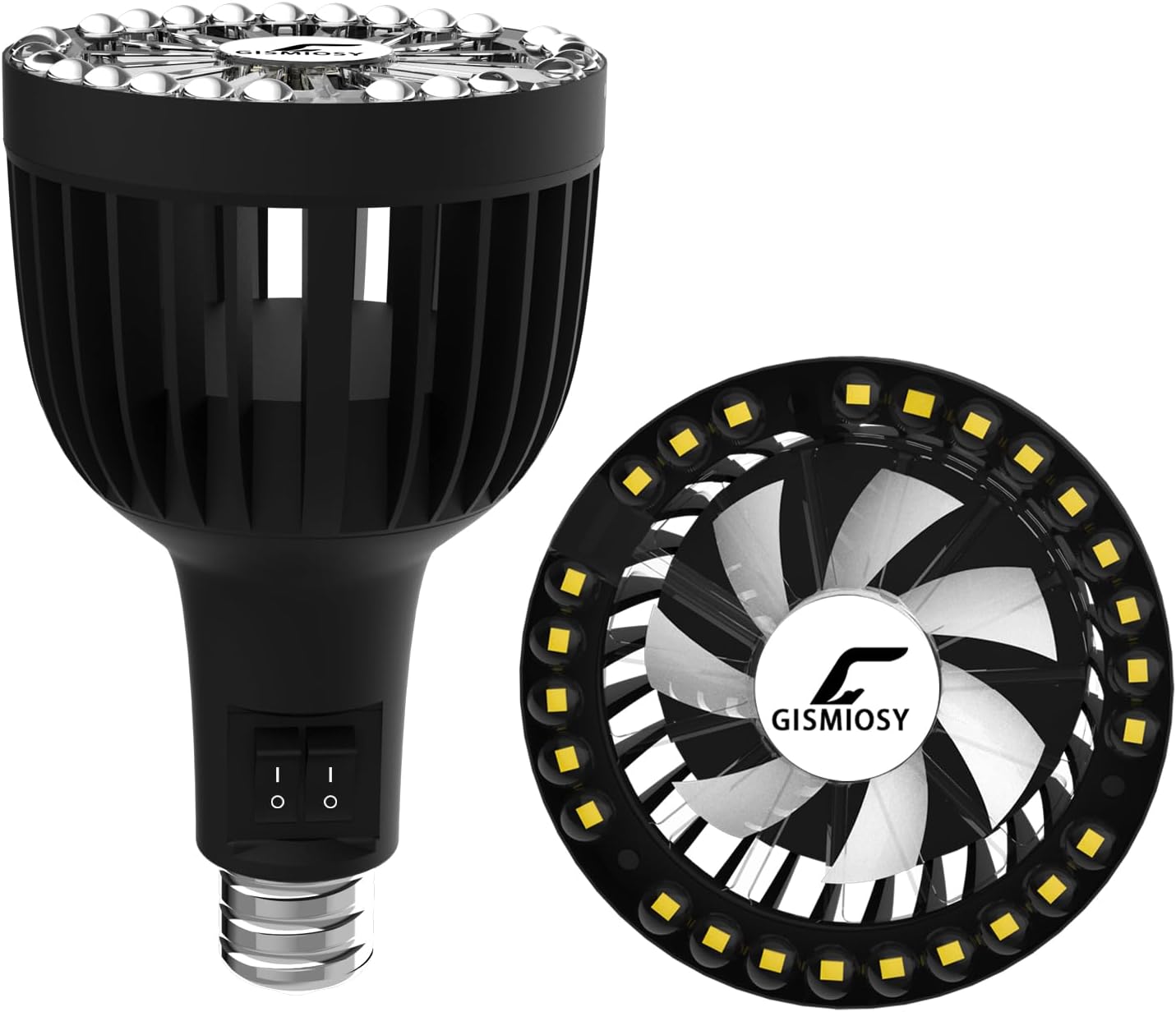
GISMIOSY 20W Full Spectrum LED Grow Light Bulb with Built‑in Plant Fan (E26, 6000K)
| Wattage | 20 watts |
|---|---|
| Bulb Base | E26 |
| Color Temperature | 6000 Kelvin |
| Power Source | Electric |
| Material Type | Aluminum |
This GISMIOSY grow light bulb combines a 20W full spectrum LED array with a built‑in plant fan to provide both concentrated light and gentle airflow for indoor plants. It installs like a regular E26 bulb, so you can use it in lamps, shelves, or small grow tents without extra hardware. The 6000K daylight spectrum with high CRI makes it easy to monitor plant health under natural‑looking white light rather than purple LEDs. The manufacturer reports high PPFD at short distance, which is useful for seedlings, propagation, herbs and compact vegetable setups when mounted close to the canopy. Independent controls let you run the fan separately to improve air movement and reduce heat buildup around the plant tips. Practical limitations are the recommended close mounting distance for peak PPFD and that a single bulb is best for small setups or spot lighting rather than whole-room coverage. The aluminum construction and active cooling support sustained output, making it a straightforward, no‑fuss option for reliable everyday indoor growing.
Best for: Buyers who want a simple, dependable grow solution that installs like a normal bulb and prioritizes steady performance and plant health for small indoor setups such as propagation stations, shelves, or desktop displays.
Less Ideal for: Growers planning to light large cabinets, multiple full‑shelf layers, or whole-room canopies should look for multi‑unit fixtures or higher‑output panels instead.
- Full spectrum 6000K LED with high CRI for natural white light and easy plant inspection
- Integrated fan with independent control improves airflow and reduces local heat
- Standard E26 base for tool‑free installation in common household fixtures
- Reported high PPFD at short distance suitable for seedlings and propagation
- Aluminum construction and active cooling designed to support stable long‑term performance
- High PPFD performance requires close placement to the canopy, limiting coverage area
- Single 20W bulb is best for spot treatments rather than lighting larger gardens
Verdict: A reliable, easy‑to‑install full‑spectrum grow bulb with built‑in fan ideal for steady, small‑scale indoor plant lighting.
Briignite A19 Full-Spectrum LED Grow Light Bulb (2-Pack)

| Wattage | 12 watts |
|---|---|
| Bulb Base | E26 |
| Color Temperature | 3500 Kelvin |
| Light Output Maximum | 1000 lumens |
| Light Source Operating Life | 30000 hours |
The Briignite A19 full-spectrum grow bulbs are designed to replace a standard household lamp with plant-friendly light that looks natural rather than purple. Each bulb fits an E26 socket and produces about 1000 lumens from roughly 11–12 watts, so they provide bright, energy-efficient illumination for seedlings, leafy greens, herbs, and fruiting vegetables across all growth stages. The bulbs list a 3500–4000K white balance and a high color rendering index, which makes foliage color easy to judge while still supplying red and blue wavelengths plants need. Built from aluminum and plastic with a PAR-shaped reflector, they aim to manage heat and promise long run times around 25,000–30,000 hours. Controls include an app and push-button options for basic scheduling and dimming on some models. Limitations to note are that these are single A19 bulbs best for small setups or supplementing ambient light rather than replacing dedicated multi-panel fixtures for larger or high-light-demand crops, and the stated lifespan may vary with continuous use and ventilation.
Best for: Buyers who want a simple, low-effort way to add effective plant light to a small indoor garden or to supplement existing lighting while keeping a natural room appearance and modest energy use.
Less Ideal for: Growers planning a large multi-shelf setup or cultivating very high-light-demand crops should choose purpose-built high-output panels instead.
- Full-spectrum output that mimics natural daylight while retaining plant-useful red and blue wavelengths
- Energy efficient at about 11–12 watts while producing roughly 1000 lumens
- E26 base fits standard household fixtures for simple installation
- High CRI and warm-white appearance make indoor plants look natural under the light
- Aluminum and plastic construction with PAR reflector to help dissipate heat and direct light
- Single A19 bulbs provide limited canopy coverage so multiple units are needed for larger grow areas
- Not a replacement for high-output commercial fixtures when growing large fruiting crops requiring high PPFD
Verdict: A convenient, natural-looking full-spectrum A19 bulb for small indoor gardens or supplemental lighting that balances plant performance with low energy use.
Briignite A19 Full Spectrum LED Grow Light Bulb (4-Pack)

| Light Type | LED |
|---|---|
| Wattage | 11 watts |
| Bulb Base | E26 |
| Color Temperature | 3500 Kelvin |
| Light Output Maximum | 1000 lumens |
These Briignite A19 grow bulbs are full-spectrum LED replacements intended for everyday indoor plant lighting. They screw into any standard E26 socket and produce about 1,000 lumens at roughly 11 watts, so they run much cooler and use far less electricity than comparable incandescent options. The bulbs aim to mimic natural sunlight with a 3500–4000K white appearance while still delivering red and blue wavelengths plants need across growth stages, making them suitable for herbs, leafy greens and fruiting vegetables. Practical advantages include a wide 180 degree beam for even coverage, an advertised long LED life and simple push-button or app control built into the design. Limitations are that these are non-dimmable in this specific listing and they are indoor-only bulbs, so you will need separate timed fixtures or smart plugs for advanced scheduling and dimming needs. For risk-averse buyers the straightforward E26 fit and familiar white light make these easy to install and integrate into an existing home setup.
Best for: Buyers who want a low-risk, easy-to-install grow light that looks like regular home lighting and supports herbs, greens, and common vegetable seedlings without complex setup.
Less Ideal for: Growers who need built-in dimming, heavy-duty commercial output, or outdoor-rated fixtures should look for dedicated adjustable or weatherproof grow lights instead.
- Full-spectrum output that approximates natural daylight for all growth stages
- Standard E26 base fits common fixtures for easy installation
- High luminous output (about 1000 lumens) while consuming only 11 watts
- Wide 180 degree beam angle for broader, even coverage
- Advertised long operating life (up to 50,000 hours)
- This specific SKU is listed as non-dimmable so brightness cannot be adjusted
- Described control options are basic and advanced scheduling may require third-party timers or smart plugs
Verdict: A simple, low-effort full-spectrum A19 bulb pack that lets you add credible plant lighting to standard fixtures with minimal setup.
Choosing the Right LED Grow Light Bulb: Key Factors to Consider
Light Spectrum and Photosynthetic Photon Flux
Spectrum affects which growth stages a bulb supports. Full-spectrum bulbs that include blue and red peaks generally support both vegetative growth and flowering, while bulbs lacking in key wavelengths can cause stretch or poor bloom. Photosynthetic Photon Flux (PPF) or photosynthetic photon flux density (PPFD) measurements indicate the actual amount of usable light plants receive; higher numbers are important for denser canopies and flowering stages.
When evaluating bulbs, look for clear spectral data or manufacturer PPFD/PPF figures measured at realistic distances. For seedlings and low-light houseplants, lower PPFD at close range can be acceptable. For bloom and fruiting stages, choose bulbs that deliver higher PPF without forcing you to place the lamp so close that heat becomes a problem.
Canopy Coverage and Beam Angle
A bulb's beam angle and lensing determine how much horizontal area a single bulb can light evenly. Narrow beams concentrate light into a small footprint and are best for focused single-plant applications. Wider beams cover more pots but deliver lower intensity per square foot.
Match bulb coverage to your setup: a single-pot grow needs a different footprint than a tray of seedlings. Consider how many bulbs you will realistically mount and whether you prefer fewer bright points or more evenly distributed, lower-intensity light.
Power Draw and Energy Efficiency
LED bulbs vary in how many watts they draw relative to the usable light they produce. Energy-efficient bulbs deliver more PPF per watt, lowering operating cost and heat output. For continuous use over weeks of grow cycles, efficiency quickly becomes an important running-cost factor.
Factor electricity costs and how many hours per day the light will run. Dimmable bulbs or those with multiple power settings help tailor energy use to plant stage and reduce waste during low-demand periods like germination.
Heat Output and Distance to Plants
Even LEDs produce heat, and how that heat is radiated affects how close a bulb can be to foliage. Excessive heat can stress delicate seedlings and accelerate moisture loss, while too much distance reduces usable light. Bulbs with integrated heat sinks or better thermal design allow closer placement without burning plants.
Consider ventilation in the room and whether you need an extra fan for air movement. For small indoor setups, choose bulbs that maintain safe surface temperatures at recommended clearances, and follow manufacturer guidance on minimum distance to foliage.
Fixture Compatibility and Build Quality
Most growers use standard screw-in or bayonet sockets. Compatibility reduces the need for adapters and ensures stable installation. Build quality matters for long-term use: a well-sealed bulb resists dust and humidity found in grow rooms and conserves thermal performance.
Also consider physical size and weight, which affect whether a bulb can be used in clamp lamps or compact fixtures. A sturdier base and good heat sinking extend bulb life and reduce the chance of premature failure.
Control Features and Practical Usability
Dimmability, timing compatibility, and plug-and-play convenience affect everyday use more than raw specs. Dimmable bulbs let you tailor light intensity to each growth stage without changing fixtures. Compatibility with standard light timers or smart controllers adds automation and repeatability to your schedule.
Easy-to-read labeling and clear guidance on recommended hanging distance reduce setup errors. For gardeners managing multiple small grow spaces, standardized control options simplify maintenance and scheduling.
Matching Bulb Strength to Plant Stage
Seedlings, vegetative plants, and flowering specimens have different light demands. Young seedlings thrive under gentler intensity and a higher proportion of blue light to prevent stretching. As plants move into the vegetative phase, increase hours and intensity gradually. For flowering, plants usually need higher overall photon flux and a richer red spectrum to trigger bloom responses.
Plan your bulb layout so you can raise intensity without moving fixtures into the plant canopy. Using bulbs with controllable output or mounting multiple bulbs over a shared canopy gives you flexibility as plants grow.
- Seedlings: lower PPFD, closer blue-rich spectrum
- Vegetative: moderate intensity, balanced spectrum
- Flowering: higher PPFD, stronger red component
Setting Up Bulbs in Small Grow Spaces
In compact setups such as closets, balconies, or under-shelf gardens, fixture placement and ventilation are as important as bulb choice. Place bulbs to create even coverage across the intended canopy and leave room for air circulation above and around plants.
Use reflective surfaces or light-colored walls to recover side light, but avoid trapping heat. If you are limited to a single bulb, prioritize beam patterns that match the pot arrangement to reduce hot spots and shaded gaps.
- Leave recommended clearance for heat dissipation
- Use reflectors or white surfaces to boost side light
- Consider adjustable mounts for raising the bulb as plants grow
Controlling Heat and Humidity with LED Bulbs
LEDs generally run cooler than older lamp types, but heat concentration at the bulb base or canopy can still affect microclimates. Monitor leaf surface temperature and ambient humidity after installing new bulbs, especially in tight enclosures.
Add gentle air movement to prevent stagnant pockets where heat and moisture accumulate. For flowering stages, controlled humidity and temperature help prevent mold and support strong bud development.
- Monitor both air and leaf temperatures
- Use small fans to maintain steady airflow
- Adjust watering as light-driven evapotranspiration changes
Integrating Bulbs with Timers and Controllers
Consistent day length is critical for many plant species. Use timers to establish reliable photoperiods and automate daily light cycles. When using dimmable bulbs, programmable controllers let you simulate dawn and dusk ramps which can reduce stress and encourage steady growth.
Check compatibility between bulbs and your chosen controller. Some LED bulbs are sensitive to simple triac dimmers or require specific driver types to work without flicker.
- Use timers for strict photoperiods
- Confirm dimmer compatibility to avoid flicker
- Program gradual ramps for sensitive plants
Maintenance and Longevity Tips
Keep bulbs and fixtures free of dust and water spray to preserve thermal performance and light output. Inspect bulb bases and fixtures periodically for corrosion or loose contacts. Replace bulbs that show darkening, flicker, or inconsistent output rather than risking uneven plant development.
Rotate or reposition bulbs as plants grow taller to maintain even canopy exposure. Proper maintenance extends service life and preserves predictable light delivery through multiple grow cycles.
- Wipe surfaces gently to remove dust
- Check sockets and connections regularly
- Reposition bulbs to maintain uniform canopy light
How We Chose the Best LED Grow Light Bulb
We focused on attributes that directly affect plant health and day-to-day use in typical indoor garden setups. Key evaluation criteria included spectral balance and photosynthetic photon output, because the right wavelengths and sufficient light per square foot are primary drivers of growth. Canopy coverage and beam angle were assessed to determine how well a bulb lights a seed tray or single-pot cluster without excessive fixture stacking. Energy efficiency and heat management were measured to predict electricity use and whether additional ventilation or distance from plants is required. Build quality and socket compatibility were reviewed to ensure bulbs fit common fixtures and stand up to repeated use. Ease of use factors like dimmability and compatibility with timers were considered for practical setups. We excluded general-purpose or decorative LED bulbs that lack plant-specific spectrum information and any bulbs intended only for commercial high-intensity fixtures. The shortlist prioritizes bulbs with clear lumen and PPF data or equivalent manufacturer spectral graphs, practical beam patterns for small growers, and safe thermal behavior for indoor plant proximity.
FAQ
How close can I place an LED grow light bulb to seedlings?
It depends on the bulb's thermal design and intensity. Many plant-specific LED bulbs can be placed 6 to 12 inches above seedlings, but check the bulb's recommended clearance. Monitor seedlings for signs of heat stress or stretching and adjust height accordingly.
Do I need a full-spectrum bulb for all stages of growth?
Full-spectrum bulbs are versatile and often work for multiple stages because they include both blue and red wavelengths. For specific outcomes, some growers use dedicated vegetative or bloom-spectrum bulbs, but a good full-spectrum option can simplify a small indoor setup.
Will more wattage always mean faster growth?
Not necessarily. Effective growth depends on usable light delivered to the canopy, measured as PPFD or PPF, not just wattage. High-wattage bulbs that concentrate light into a narrow beam may not cover your plants well, while efficient lower-watt bulbs with good beam patterns can produce better results.
Can I use LED grow bulbs in regular household fixtures?
Often you can if the socket type matches and the fixture can support the bulb's size and heat output. Avoid enclosed fixtures unless the bulb is rated for them, and ensure the fixture provides adequate ventilation to prevent early failure.
How do I reduce electricity use without sacrificing yield?
Use higher-efficiency bulbs with better PPF per watt, run lights only for the necessary photoperiod for your species, and employ dimming or multiple lower-power bulbs to focus light where plants need it. Improving canopy coverage reduces wasted light and saves energy overall.
What are signs a bulb is underperforming for my plants?
Watch for slow growth, elongated stems, pale leaves, or uneven development across the canopy. These issues often indicate insufficient intensity or the wrong spectrum. Confirm bulb output and position before changing feeding or watering routines.
Final Verdict
Choose an LED grow light bulb based on the light your plants actually need rather than headline wattage. Prioritize spectrum and PPF output for the growth stage you plan to run, match beam pattern to your canopy layout, and consider energy efficiency and heat behavior for safe, consistent use. For most small indoor gardens, a durable, well-cooled bulb with clear spectral data and compatible controls gives the most predictable results. Balance coverage and intensity to match your space and you will get steady, healthy growth across cycles.
