

Note: This article contains affiliate links. If you click on these links and make a purchase, I may earn a small commission at no extra cost to you. This helps support my research and content. Read my full affiliate disclosure here.
Choosing the right liquid fertilizer for vegetable gardens matters because feeding method and nutrient balance directly affect yield, flavor, and plant health. Liquid fertilizers deliver nutrients quickly to roots and foliage, which is helpful during rapid growth, bloom, and fruit set. In this guide we shortlisted six top liquid options suited to vegetable beds, container veggies, and raised planters, and evaluated them on practical gardener priorities like nutrient profile, ease of application, and safety for edible crops. Below you will find concise product write-ups followed by detailed buying guidance that explains what matters when feeding vegetables and how to use liquid fertilizers safely and effectively.
Top Picks at a Glance
| Best Overall The best all-around choice for most situations | Neptune's Harvest Fish Fertilizer 2-4-1 Organic Liquid Plant Food (Quart) |  |
| Best Quality Built to a higher standard if you want something more solid | FoxFarm Soil Liquid Trio Pack — Big Bloom, Grow Big, Tiger Bloom (3×pint) |  |
| Best Value The sweet spot between price and what you get | Farmer's Secret Fruit & Bloom Booster Liquid Fertilizer (32 oz) |  |
| Best Budget The cheapest option that still gets the job done reliably | True Organic All Purpose Liquid Plant Food 16 oz (NPK 3-2-2) |  |
| Highest Rated A top-rated pick with lots of positive feedback | FoxFarm Grow Big Liquid Plant Food, 6-4-4 Quart Concentrate |  |
| Most Popular A crowd favorite that many people choose with confidence | Miracle-Gro Liquid All Purpose Plant Food Concentrate, 32 oz. |  |
Neptune's Harvest Fish Fertilizer 2-4-1 Organic Liquid Plant Food (Quart)

| Item Form | Liquid |
|---|---|
| Application Method | Soil Drench, Foliar Feed |
| Mixing Ratio | 2-4-1 |
| Liquid Volume | 946 ml |
| Ingredients | Nitrogen-2%, Phosphate-4%, Potash-1% |
Neptune's Harvest Fish Fertilizer is a concentrated organic liquid made from hydrolyzed North Atlantic fish that you dilute for soil drenches or foliar feeding in vegetable beds, containers, lawns and indoor plants. It supplies a low but balanced NPK (2-4-1) along with micronutrients, amino acids and enzymes that support growth, improve soil biology and help plants absorb nutrients. Typical use is one ounce per gallon for general feeding or a foliar spray applied early or late in the day; directions include different dilution rates for houseplants, outdoor beds and turf. Notable features are the cold-processed fish hydrolysate that preserves nutrients, OMRI listing for organic gardening, and a mixing ratio for easy measuring. Practical benefits include improved soil structure over time, support for beneficial microbes, and an easy-to-apply liquid format that doubles as a foliar feed. Important limitations are the relatively low NPK numbers compared with synthetic feeds so you may need complementary fertilizers for rapid heavy-feeding crops, and some gardeners may notice a mild fishy scent compared with non-fish organics.
Best for: Gardeners who want an organic, soil‑building liquid fertilizer for vegetable beds and mixed plantings and who prioritize long‑term soil health over immediate, high‑nitrogen push.
Less Ideal for: Growers seeking high‑nitrogen, fast‑acting synthetic results or those who need a one‑product solution for very heavy‑feeding vegetable varieties should consider complementary fertilizers.
- Organic fish hydrolysate preserves micronutrients and amino acids for broader plant nutrition than NPK alone
- Suitable for soil drench or foliar feed so you can treat containers, beds and houseplants
- OMRI listed and formulated to support soil microbes and long-term soil structure
- Clear dilution directions make it simple to dose for different plant types and uses
- Lower NPK means it is less suitable as the sole fertilizer for fast-growing, heavy-feeding vegetable crops
Verdict: Choose this product if you want an easy-to-use organic liquid that feeds vegetables and builds soil biology rather than forcing rapid growth.
FoxFarm Soil Liquid Trio Pack — Big Bloom, Grow Big, Tiger Bloom (3×pint)

| Item Form | Liquid |
|---|---|
| Specific Uses For Product | Plant Food |
| Coverage | Organic |
| Target Species | Plants |
| Unit Count | 48 Fluid Ounces |
The FoxFarm Soil Liquid Trio is a purpose-built liquid feeding program for vegetable gardens and ornamentals that pairs three concentrates to cover vegetative growth, overall vigor, and flowering/fruit set. Grow Big is intended for vegetative expansion and produces lush leaf and stem development, Big Bloom is a gentle all-stage bloom booster you can use throughout the season, and Tiger Bloom supplies higher phosphorus to push bud and fruit development once flowering begins. In practice this trio gives a clear feeding sequence: use Grow Big during early growth, apply Big Bloom regularly, and switch to Tiger Bloom at first bud set. The liquid format dissolves easily for drench or fertigation and the formulas are greenhouse tested for consistency. Important limitations are that concentrations and application rates must be followed to avoid nutrient burn and the set requires managing three products rather than a single all-in-one feed. The product is best used by gardeners who plan scheduled feedings and want targeted nutrient control for maximizing vegetable yields.
Best for: Gardeners focused on maximizing vegetable yields who are willing to manage stage-specific feedings and monitor application rates for best results.
Less Ideal for: Casual gardeners who prefer a single-feed, low-maintenance fertilizer or those uncomfortable mixing and timing multiple products.
- Three-stage program covers vegetative growth, general bloom support, and flowering/fruit set
- Liquid concentrates dissolve easily for soil drenches or mixing in hose-end or injector systems
- Greenhouse-tested formulas for consistent batch-to-batch performance
- Suitable for a wide range of vegetables, ornamentals, and container plants
- Requires following separate schedules and mixes for each bottle rather than a single-step feed
- No guaranteed organic certification listed despite 'Coverage: Organic' in the product details
Verdict: If you want stage-specific nutrient control to push bigger vegetative growth and higher yields in a vegetable garden, this three-part liquid trio delivers targeted feeding for each growth phase.
Farmer's Secret Fruit & Bloom Booster Liquid Fertilizer (32 oz)

| Item Form | Liquid |
|---|---|
| Specific Uses For Product | Root Development, Seed Development |
| Application Method | pour or spray |
| Target Species | Fruit, vegetable, and flower producing plants |
| Mixing Ratio | 1 teaspoon:2 gallons |
This concentrated liquid formula is designed to push flowering and fruit production by supplying high phosphorus and potassium plus balanced nitrogen and trace minerals. You dilute 1 teaspoon per 2 gallons of water and apply as a soil drench with a watering can or as a foliar spray every 1 to 2 weeks once plants begin to bud. The liquid form makes nutrients immediately available, which is helpful for quick corrective feeding during flowering and fruit set. It is marketed for a wide range of edible and ornamental crops and is compatible with irrigation systems and sprayers. Practical benefits include easy mixing, versatile application methods, and a very concentrated bottle that covers many feedings. Important limitations are that it is a bloom/fruit booster rather than an all-season balanced feed so it is best used during mid-to-late growth stages, and foliar feeding timing matters to avoid evaporation or leaf burn. Users should follow the dilution directions carefully to avoid overapplication.
Best for: Gardeners who prioritize getting more blooms and larger yields from vegetable and fruit beds and want a concentrated, easy-to-use booster to add during flowering and fruit set.
Less Ideal for: Those seeking a single product for all feeding stages or a slow-release granular replacement should consider a balanced base fertilizer or a season-long program instead.
- Highly concentrated formula yields many feedings from one bottle
- Liquid form delivers nutrients immediately for quicker response
- Formulated for flowering and fruiting with elevated phosphorus and potassium
- Can be applied to soil or as a foliar spray and works with irrigation systems
- Not intended as a full-season base fertilizer; best used during bloom and fruiting stages
- Effectiveness depends on correct dilution and application timing
Verdict: A super-concentrated liquid bloom booster that gives gardeners a quick, easy way to increase flowering and fruit set during the mid-to-late season.
True Organic All Purpose Liquid Plant Food 16 oz (NPK 3-2-2)

| Unit Count | 16 Ounce |
|---|---|
| Item Form | Liquid |
| Specific Uses For Product | Agriculture, Gardening |
| Mixing Ratio | 2 fl oz per gallon |
| NPK | 3-2-2 |
True Organic All Purpose Liquid Plant Food is a concentrated, certified organic liquid fertilizer designed for regular use in vegetable gardens and containers. It mixes at 2 fl oz per gallon of water and is applied to soil every two weeks during the growing season, making it easy to feed beds, pots and raised planters without granular mess. The formula lists fish solubles, corn steep liquor, kelp extract, molasses and sulfate of potash, which provide a balance of macronutrients and organic matter that can boost microbial activity and improve soil health over time. Because it is liquid and concentrated, it works quickly when watered in and is convenient for small plots or limited space where you need repeat applications. The bottle size limits coverage per purchase compared with bulk fertilizers, so gardeners with large vegetable plots will need more frequent replenishment. Also, the fish-based ingredients have a noticeable odor that some users may find strong during mixing.
Best for: Home vegetable gardeners who prioritize organic inputs and want a convenient, ready-to-mix liquid feed for beds, containers, and small raised plots.
Less Ideal for: People managing large-acreage gardens or commercial plots who need bulk fertilizer options and lower cost per square foot.
- OMRI-listed organic formula suitable for edible gardens
- Concentrated liquid that mixes at 2 fl oz per gallon for straightforward biweekly feeding
- Contains diverse organic inputs such as fish solubles, kelp extract and molasses to support soil biology
- Made in the USA with farm-grade ingredients and intended for full garden and container use
- 16 oz bottle covers a relatively small area, requiring frequent repurchase for larger vegetable plots
- Fish-based ingredients produce a noticeable smell during mixing
Verdict: A compact, OMRI-listed liquid fertilizer that lets organic vegetable growers feed containers and small beds easily with biweekly applications.
FoxFarm Grow Big Liquid Plant Food, 6-4-4 Quart Concentrate
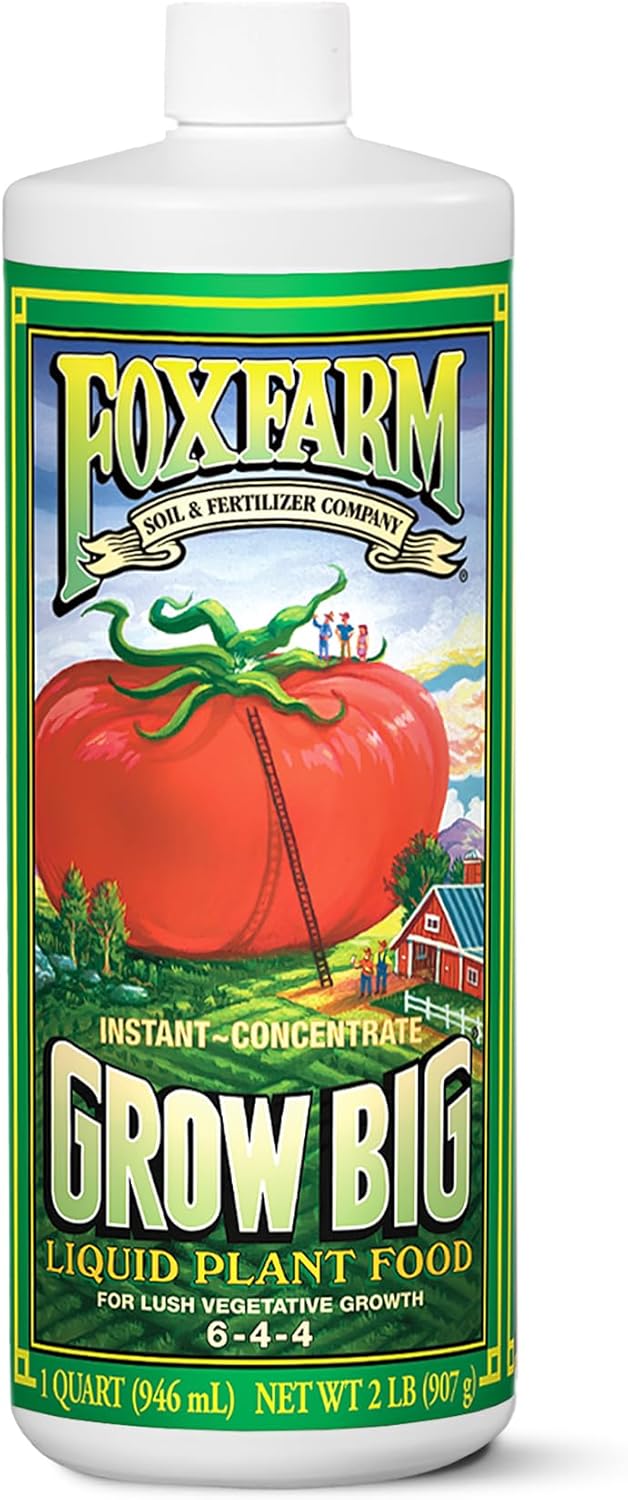
| N-P-K | 6-4-4 |
|---|---|
| Form | Liquid concentrate |
| Unit count | 32 Fluid Ounces |
| Mixing ratio | 2-3 teaspoons per gallon |
FoxFarm Grow Big is a water-soluble concentrate designed to boost vegetative growth and speed nutrient uptake in vegetable gardens and ornamentals. Mixed at 2 to 3 teaspoons per gallon, it can be applied through watering or foliar feeding to quickly deliver nitrogen-focused nutrition that supports larger plants and stronger stems. The low pH formula helps keep micronutrients stable so feedings remain effective, and the quart concentrate covers repeated applications for a small plot or a set of containers. Practical benefits include clear mixing instructions, versatility for both indoor and outdoor use, and a fast-acting effect when plants need a growth push. Limitations to note are the higher nitrogen emphasis, which favors leaf and stem growth over bloom or fruit set, and the presence of phosphorus in the formula that may be restricted in some local lawn rules. For gardeners who prioritize consistent, predictable feedings, this product is straightforward to measure and integrate into a regular watering schedule.
Best for: Gardeners who want a reliable, easy-to-dose liquid fertilizer to encourage rapid vegetative growth in vegetable beds, containers, and established plants and who value predictable results from each feeding.
Less Ideal for: Growers focused primarily on maximizing flowering or fruit set who need a bloom-boosting formula or those working under strict phosphorus-use restrictions in their area.
- Concentrated liquid formula for fast nutrient uptake and quick visible response
- Low pH formulation helps maintain micronutrient stability during storage and application
- Versatile application by watering or foliar feeding for indoor and outdoor use
- Clear mixing ratio (2–3 teaspoons per gallon) simplifies repeatable feedings
- Nutrient ratio (6-4-4) emphasizes vegetative growth rather than flowering or fruit production
- Contains phosphorus which may be restricted by local regulations for turf or non-agricultural use
Verdict: Choose this concentrate when you want a dependable, fast-acting liquid feed to promote vigorous leafy and structural growth in a vegetable garden.
Miracle-Gro Liquid All Purpose Plant Food Concentrate, 32 oz.

| Item Form | Liquid |
|---|---|
| Specific Uses For Product | Plant Growth, Root Development |
| Application Method | Mix with water in a watering can |
| Unit Count | 32 Fluid Ounces |
| Mixing Ratio | 1:10 (concentrate to water, estimate) |
Miracle-Gro Liquid All Purpose Plant Food is a 32-ounce concentrate you mix with water and apply to soil to supply fast-acting nutrients to vegetables, flowers, shrubs and houseplants. Typical use is diluting by cap or teaspoon depending on whether you are feeding garden beds or potted plants, then watering the root zone every 7 to 14 days. Notable features include a simple mixing ratio, clear directions for both garden and container use, and a formula intended to promote plant growth and root development. In practice it makes regular fertilizing easy for busy gardeners and can produce quick visible greening and growth when used as directed. Limitations are that it is an all-purpose formula rather than a vegetable-specific blend, so it lacks targeted high-phosphorus bloom boosters, and frequent applications are required to maintain results. Also, because it is a concentrated liquid, careful measuring is necessary to avoid overfeeding young seedlings or sensitive crops.
Best for: Home vegetable gardeners who want a simple, reliable liquid feed they can mix and apply on a schedule and who prefer products with broad user adoption and clear instructions.
Less Ideal for: Growers seeking a specialty fertilizer formulated specifically to maximize flowering or fruit set, or those who prefer slow-release granular feeds that require less frequent applications.
- Easy-to-mix concentrate with straightforward dilution instructions for garden and container plants
- Formulated for fast uptake to visibly encourage growth and root development
- Versatile for use on vegetables, flowers, shrubs and houseplants
- Established brand with widespread use and documented customer feedback
- Not a vegetable-specific formula so it does not target flowering or fruiting with specialized NPK ratios
- Requires regular reapplication every 1 to 2 weeks to maintain effects
Verdict: A dependable, easy-to-use liquid concentrate for regular feeding that makes keeping a productive vegetable patch simple and consistent.
Choosing the Right Liquid Fertilizer for Vegetable Gardens: Key Factors to Consider
Nutrient Balance and Ratios
Vegetables need different nutrient ratios at different stages. Young transplants benefit from higher nitrogen for leafy growth, while flowering and fruiting stages require more phosphorus and potassium. A liquid fertilizer that lists a clear N-P-K ratio and micro nutrients lets you match feedings to crop stage.
Incorrect ratios can cause excessive foliage at the expense of fruiting or can promote weak plants more susceptible to pests. Look for formulas or mixing instructions that explain when to use higher nitrogen versus bloom formulations. Also consider whether the product supplies calcium, magnesium, or trace elements that commonly limit vegetable yields.
Concentration and Dilution Control
Liquid fertilizers vary from light ready-to-use mixes to concentrated solutions that must be diluted. Concentration affects how easy it is to apply accurate doses across containers and bed sizes. A highly concentrated product can be economical but requires precise measuring tools and clear dilution tables to avoid burning roots or foliage.
Dilution flexibility matters when you are feeding seedlings, mature plants, and heavy feeders in the same garden. Products that provide multiple recommended dilution rates for different stages give you more control and reduce the risk of overfeeding.
Application Method Compatibility
How you apply liquid fertilizer determines its effectiveness. Some formulations are designed for soil drench only, others are labeled for foliar feeding, and some work with both methods. Soil drenches feed via roots and are less likely to cause foliage burn, while foliar sprays can correct micronutrient deficiencies quickly.
Check whether a product mixes well in a watering can, hose-end sprayer, or small pump sprayer. Ease of application across the tools you already own reduces extra work and helps maintain a regular feeding schedule.
Crop Safety and Pre-Harvest Guidance
Because vegetable crops are eaten, safety and clear pre-harvest instructions are important. Trusted liquid fertilizers include explicit guidance on when to stop applications before harvest, safe rates for edible foliage, and whether the product is appropriate for leafy greens versus fruiting crops.
Look for products that avoid ingredients known to leave residues or that provide specific rinsing or withholding intervals. A label that explains how feeding affects edible parts of the plant helps you avoid unintended taste or safety issues.
Effect on Soil Biology and Long-Term Health
Some liquid fertilizers are purely soluble salts, while others include organic compounds or microbial stimulants that support soil biology. Soluble mineral feeds give rapid nutrient availability but can, if overused, alter soil salt balance. Organic or biologically active liquids can improve soil structure and nutrient cycling over time.
Consider whether you want short-term rapid feeding for a single season or a product that contributes to longer-term soil health. Balancing immediate plant needs with practices that preserve soil biology will influence future fertility and water retention.
Ease of Use and Label Clarity
Practical application depends on clear labeling and straightforward instructions. Good products list mixing tables by volume and plant type, provide measurement markings if the container is intended for dosing, and give troubleshooting tips for common problems like leaf burn or poor uptake.
If you frequently rotate crops or split applications between foliar and soil feeds, choose a fertilizer with simple, well-structured guidance. Confusing instructions increase the chance of misapplication and stress on plants.
When to Use Liquid Feeding in Vegetable Beds
Liquid feeding is most useful during rapid growth windows: after transplanting, during early vegetative growth, at first bloom, and while fruit is developing. Because liquids move quickly into the root zone or leaf tissue, they are a practical choice when you need a short-term boost or when correcting a specific deficiency.
For container-grown vegetables, liquid fertilizers are often the easiest way to provide consistent nutrition because soil volume is small and nutrients can be flushed or depleted quickly. In larger in-ground beds, liquids can supplement a good base of compost or slow-release fertilizer during peak demand periods.
- Use light solutions for seedlings and transplants to avoid root burn.
- Apply bloom-boosting ratios at flowering for tomatoes, peppers, and cucurbits.
- Schedule applications to avoid wet foliage at dusk to reduce disease risk.
Foliar Feeding Versus Soil Drench
Foliar feeding applies nutrients directly to leaf surfaces for rapid correction of micronutrient deficits. It can be effective for iron or magnesium deficiencies and when root uptake is limited by cold or waterlogged soil. Foliar sprays should be mixed at lower concentrations than soil drenches and applied during calm, cooler parts of the day.
Soil drenches feed the root system and are generally safer for long-term nutrition. They are better when you want to build plant reserves and avoid repeated foliar applications. Combining both methods sparingly gives quick correction with sustained supply.
- Foliar spray: use low concentrations and test on a few leaves first.
- Soil drench: apply around the drip line for best root uptake.
- Alternate methods rather than relying solely on foliar feeding.
Adjusting Feedings by Vegetable Type
Different vegetables have distinct feeding patterns. Leafy greens usually need steady nitrogen to maintain tender growth, while fruiting crops require less nitrogen and more phosphorus and potassium when flowers set. Root crops benefit from balanced feeds that do not encourage excessive leaf growth at the expense of root development.
Match the dilution and frequency to the plant group. For example, feed lettuce more frequently with a lighter mix and apply a bloom formula less often to beans or peas to avoid excessive vegetative growth that reduces harvest quality.
- Leafy crops: lighter, more frequent nitrogen-rich feeds.
- Fruiters: shift to bloom formulas as flowers appear.
- Roots and bulbs: moderate feeding to protect root development.
Common Application Mistakes to Avoid
Overconcentration and overfrequency are the two most common mistakes. Excessively strong mixes can burn roots and foliage, while feeding too often can lead to salt buildup and reduced soil microbial activity. Follow dilution recommendations and adjust based on plant response rather than on a fixed schedule alone.
Applying during the middle of the day or in direct hot sun increases the chance of foliar burn. Also avoid applying before heavy rain unless you plan to water in the feed, as dilution by rain changes the intended dose.
- Do not exceed recommended concentrations on the label.
- Avoid foliar sprays during hottest hours.
- Monitor plants after the first application and adjust strength if symptoms appear.
Storing and Handling Liquid Fertilizers
Store concentrates in a cool, dry place away from direct sunlight and out of reach of children and pets. Clear labeling of mixing ratios and the date when the container was opened helps prevent accidental overuse or degradation.
If combining liquid fertilizers with other garden inputs, check compatibility and do a small jar test first. Some organics and mineral concentrates can precipitate or react, changing nutrient availability or clogging sprayers.
- Keep original labels and mixing tables visible.
- Rinse sprayers and watering cans after use to avoid residue buildup.
- Dispose of unused diluted mixes according to local guidance; do not pour concentrated product into waterways.
How We Chose the Best Liquid Fertilizer for Vegetable Gardens
We focused on features that matter in active vegetable gardens and used a consistent set of editorial filters to assemble the shortlist. Key evaluation dimensions included nutrient profile accuracy and N-P-K balance for common vegetable needs, concentration and dilution flexibility so gardeners can safely adjust strength, and application methods that work for both soil drench and foliar feeding. We also assessed formulation safety for edible crops, including whether instructions support pre-harvest intervals and clear labeling for foliar use. Ease of use was judged by measuring how simple the product is to mix, whether it works with common watering tools and sprayers, and how well dilution rates are documented. We excluded products intended only for lawns, strictly ornamental use, or for long-term slow-release feeding because they do not match the rapid uptake goals of liquid feeding. Also excluded were concentrates so weak they force impractical application volumes or concentrates so strong they require specialized dosing equipment. The resulting picks emphasize real-world usability in vegetable gardens, flexible feeding strength, and formulations that address blossom set, leafy growth, and soil health without unsafe residue risks.
FAQ
How often should I apply liquid fertilizer to vegetable plants?
Frequency depends on concentration and crop. Light solutions are often applied every one to two weeks for containers and frequent-feeding crops. Heavier concentrations or soil-applied drenches can be used less often. Always follow dilution guidelines and watch plant response.
Can I use the same liquid fertilizer on seedlings and mature plants?
You can use the same product if it offers multiple dilution rates. Seedlings need a much weaker mix to avoid root burn, so check whether the label specifies a seedling or transplant dilution. If not, create a significantly weaker solution for young plants.
Is foliar feeding safe for all vegetable crops?
Foliar feeding is generally safe for many vegetables but should be used with caution. Apply low concentrations, avoid spraying at high temperatures, and do not use on crops with fuzzy leaves that trap residues. Also observe any pre-harvest guidance on the product label.
Will liquid fertilizer affect soil microbes?
Some liquid fertilizers, especially soluble mineral formulations, can change soil salt levels if overused and may temporarily affect surface microbes. Organic or biologically active liquids are usually gentler on soil biology and can support microbial activity when used appropriately.
Can I mix a liquid fertilizer with pesticides or other garden chemicals?
Mixing is possible but depends on compatibility. Always perform a small jar test to check for precipitation or separation and consult product labels for compatibility warnings. When in doubt, apply separately and rinse equipment between uses.
Final Verdict
Prioritize a liquid fertilizer that matches the stage and type of vegetables you grow. Focus on clear nutrient ratios, usable dilution guidance, and application methods that fit your tools and schedule. Balance short-term feeding needs with products that do not harm soil biology or leave problematic residues. By weighing concentration control, crop safety, and ease of application, you can choose a liquid feeding approach that increases productivity without adding unnecessary risk. Use lighter mixes for seedlings, shift ratios at bloom, and monitor plants so you can adjust feedings for the best harvest outcomes.
