

Note: This article contains affiliate links. If you click on these links and make a purchase, I may earn a small commission at no extra cost to you. This helps support my research and content. Read my full affiliate disclosure here.
Fire ants can quickly turn a sunny lawn or vegetable bed into a hazard for kids, pets, and gardeners. Choosing the right liquid fire ant killer matters because products differ in how fast they knock down active mounds, how long they suppress new foraging, and how they behave around turf, ornamentals, and edible areas. This guide covers five top liquid fire ant killers shortlisted for common home and garden situations. We focus on practical factors gardeners care about, including speed of action, coverage per application, and safety around desirable plants. Read on to understand the tradeoffs so you can pick the right liquid treatment for your yard.
Top Picks at a Glance
| Best Overall The best all-around choice for most situations | Talstar One Insecticide Concentrate, 1 Gallon |  |
| Best Quality Built to a higher standard if you want something more solid | Atticus Talak 7.9% Bifenthrin Indoor/Outdoor Insecticide Concentrate, 32 oz |  |
| Best Value The sweet spot between price and what you get | Ortho Orthene Fire Ant Killer Lawn & Landscape Ready-to-Spray |  |
| Best Budget The cheapest option that still gets the job done reliably | BioAdvanced 24 Hour Lawn Insect & Fire Ant Killer, Ready-to-Spray, 32 oz |  |
| Highest Rated A top-rated pick with lots of positive feedback | Quali-Pro Bifenthrin I/T 7.9F Insecticide, 1 Gallon |  |
Talstar One Insecticide Concentrate, 1 Gallon

| Active ingredient | Bifenthrin 7.9% |
|---|---|
| Formulation | Concentrate, water-based |
| Coverage intent | Perimeter and structural applications |
| Pest range | Controls 75+ pests including ticks |
Talstar One is a professional-strength bifenthrin concentrate designed to provide broad-spectrum control of ants, spiders, roaches, fleas, ticks, mosquitoes, and many other pests. You mix the concentrate with water and apply it as a perimeter spray around foundations, doors, and windows or to targeted cracks and crevices indoors. Notable features include a water-based, low-odor formula that dries clear and a residual effect that reduces the need for frequent reapplications on lawns, ornamentals, shrubs, and structural surfaces. For yards with tick pressure, treating perimeters and vegetation provides a dependable barrier that helps reduce tick encounters when applied according to label directions. The product is concentrated so one gallon treats large areas, which makes it efficient for seasonal maintenance across multiple structures. Important limitations are that it is a pesticide that requires careful handling and strict adherence to label rates and application restrictions, and it is not a ready-to-use spray so you will need appropriate mixing and application equipment for safe, effective coverage.
Best for: Buyers who prioritize reliable, residual pest control for yards and perimeters and who are comfortable using concentrated pesticides with proper safety practices.
Less Ideal for: Casual users who want a ready-to-use product or those unwilling to follow pesticide label precautions and use appropriate application equipment.
- Broad-spectrum control that includes ticks and common yard pests
- Concentrated formula covers large areas and is cost-efficient for seasonal treatments
- Water-based, low-odor formula dries clear and is suitable for outdoor living spaces
- Suitable for both perimeter and targeted indoor/structural applications
- Concentrate requires proper mixing and application equipment for safe use
- Contains bifenthrin so users must follow label precautions to protect people, pets, and beneficial insects
Verdict: Choose Talstar One when you need a concentrated, long-lasting perimeter treatment that reliably reduces tick pressure across yards and structures.
Atticus Talak 7.9% Bifenthrin Indoor/Outdoor Insecticide Concentrate, 32 oz

| Active Ingredient | Bifenthrin |
|---|---|
| Formulation | Suspension Concentrate |
| Liquid Volume | 32 fluid ounces |
| Length of Control | Up to three months |
| Target Species | Insects |
Talak 7.9% is a liquid concentrate for treating lawns, landscaping, outdoor living areas and indoor perimeter spots like baseboards and cabinets. You dilute the concentrate with water to create a spray for barrier treatments, spot applications or lawn mixes; label rates explain how much to mix per gallon depending on the use. The product uses bifenthrin, a proven broad-spectrum active ingredient, and the manufacturer states it controls over 75 species and can give residual control for as long as three months. Its water-based formula dries clear, leaves no odor or visible residue, and is not phytotoxic on plants when used per label. Practical benefits include flexible indoor and outdoor use, clear drying, and a bottle designed for easier pouring. Important limitations are that solutions should be mixed only for same-day use, it is not registered for sale in a few states, and it is not approved for fogger application, so professional-style misting methods are not appropriate.
Best for: Buyers who want a single, reliable product to protect yards, patios and building perimeters from a wide range of common pests and prefer conservative, label-driven application practices.
Less Ideal for: People seeking ready-to-use sprays or fogger-compatible products or those in states where this formulation is not registered should look at alternatives.
- Broad-spectrum control listed for 75+ indoor and outdoor pest species
- Water-based formula that dries clear and leaves no odor or residue
- Flexible label directions for lawns, landscapes, hardscapes and indoor perimeter treatments
- Long residual activity up to three months when applied at recommended rates
- Mixed spray solutions cannot be stored and must be used the same day
- Not approved for fogger application and not available for sale in some states
Verdict: A versatile, water-based bifenthrin concentrate that delivers long-lasting, broad-spectrum outdoor (and perimeter indoor) control when used according to the label.
Ortho Orthene Fire Ant Killer Lawn & Landscape Ready-to-Spray

| Coverage | Up to 5,300 sq ft |
|---|---|
| Formulation | Ready-to-spray hose-end |
| Active ingredients | Bifenthrin 0.300%, Zeta-Cypermethrin 0.075% |
| Residual protection | Up to 3 months |
This ready-to-spray Ortho Orthene product attaches to a garden hose to treat lawns, ornamental plants, trees, and shrubs for fire ants and many other listed insects. It is designed for broadcast coverage: turn on the water, slide the sprayer to ON and sweep the spray to wet foliage or turf. Notable features include a hose-end applicator for fast large-area coverage and a formula that claims up to three months of residual control against ants, fleas, and ticks. Practical benefits are quick application across up to 5,300 sq ft from a single 32 fl oz bottle and multi-pest activity so you can treat several problem insects at once. Important limitations are that the product uses synthetic pyrethroid active ingredients and needs four hours to dry before expected rain, so timing matters; it is not for indoor use or aquatic areas and label directions must be followed for safe application. For homeowners who want straightforward, fast treatment of yards and ornamentals, this simplifies routine pest control, but it requires careful use around pollinators and water.
Best for: Homeowners who prioritize efficient, wide-area pest control and want a simple hose-end solution to manage fire ants and common lawn pests without mixing or specialized gear.
Less Ideal for: People managing pollinator-friendly gardens, wet or aquatic areas, or those who prefer non-synthetic or organic pest control approaches should consider alternatives.
- Hose-end ready-to-spray applicator enables fast, uniform treatment of large areas
- Covers up to 5,300 sq ft from a single 32 fl oz container
- Provides residual control for up to three months against ants, fleas, and ticks
- Active ingredients control a broad list of lawn and landscape pests beyond fire ants
- Contains synthetic pyrethroid actives that require careful application around pollinators and water
- Requires at least four hours drying time before rain to be fully effective
Verdict: If you want a fast, no-mix hose-end spray that treats large lawns and prevents fire ant mounds for months, this product delivers simple, broad-spectrum yard protection.
BioAdvanced 24 Hour Lawn Insect & Fire Ant Killer, Ready-to-Spray, 32 oz
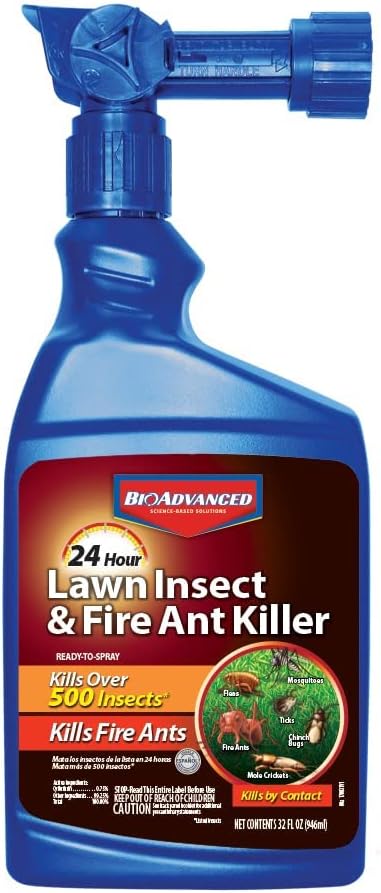
| Unit Count | 32 Ounce |
|---|---|
| Item Type Name | Lawn Insect & Fire Ant Killer |
| Active Ingredient | Cyfluthrin 0.75% |
| EPA Registration Number | 92564-17 |
| Target Species | Insects |
This ready-to-spray BioAdvanced solution is designed to kill fire ants and more than 500 listed lawn pests, delivering visible results in as little as 24 hours. The 32 ounce bottle is a hose-connect concentrate that sprays a treatment over turf, around homes, and directly onto ant mounds, making application quick for routine perimeter and spot treatments. Notable features include a fast-acting cyfluthrin formula and rainproof performance within one hour so treatments are less likely to wash away after light rain. The product claims broad-spectrum control — mosquitoes, fleas, ticks, chinch bugs, grubs and mole crickets are listed — and a single bottle covers several thousand square feet, which helps stretch value for a budget-focused buyer. Limitations to note are the chemical active ingredient, which means observing label precautions for pets and treated areas, and that it is not approved for sale in all states. For homeowners needing a straightforward liquid option to control fire ants and common lawn insects, this is a practical, easy-to-use choice that balances coverage and speed of action.
Best for: Homeowners who want an affordable, no-fuss liquid treatment to control fire ants and common lawn pests across medium to large lawns and who prioritize quick application and coverage.
Less Ideal for: Organic gardeners or households seeking nonchemical or pet-free pest control methods should consider alternative approaches.
- Ready-to-spray hose-connect bottle for fast, low-effort application
- Kills fire ants and over 500 listed lawn pests, including fleas and ticks
- Rainproof in about one hour so treatment holds after light rain
- Single 32 oz bottle covers several thousand square feet, extending value
- Contains synthetic insecticide requiring careful handling and pet precautions
- Not labeled for sale in every state which limits availability
Verdict: A budget-friendly ready-to-spray liquid that delivers fast, wide-area control of fire ants and many common lawn insects.
Quali-Pro Bifenthrin I/T 7.9F Insecticide, 1 Gallon

| Item Form | Spray |
|---|---|
| Target Species | Termites, Carpenter Ants |
| Liquid Volume | 1 gallons |
| Active Ingredients | Bifenthrin |
This one-gallon Quali-Pro Bifenthrin I/T 7.9F is a flowable pyrethroid designed for preventive and residual control of a broad range of pests in lawns and landscaped areas. It is typically mixed and applied as a spray to turf, ornamental beds, foundations and around structures to suppress termites, carpenter ants, fleas, ticks, mites and similar pests. Key features include a long-lasting residual, compatibility with many turf and ornamental tank-mix partners, and a no-odor, non-irritating formulation that dries without visible residue. In practice it provides dependable knockdown and weeks of protection when applied at recommended rates, making it suited for routine perimeter treatments and spot-control of persistent infestations. Important limitations are that it is a concentrated professional-style product requiring careful dilution, protective equipment, and adherence to label directions for safe use around people, pets and desirable plants. It is not a ready-to-use consumer spray and should be used only where labeled.
Best for: Buyers who prioritize a reliable, long-lasting perimeter or spot-treatment solution for recurring or hard-to-control outdoor pests and who are comfortable following label directions and using concentrated products.
Less Ideal for: Casual users who want a simple ready-to-use spray for occasional bug bites or very small lawns should consider consumer-grade aerosols or hose-end products instead.
- Long-lasting residual control effective against termites, carpenter ants and other pests
- Compatible with herbicides, fungicides, insecticides and liquid fertilizers for tank mixes
- No-odor, non-irritating formula that dries with no visible residue
- Available in a one-gallon concentrated flowable for multiple applications
- Concentrated product requires dilution and protective equipment for safe handling
- Not intended as a ready-to-use consumer spray and may be overkill for very small yards
Verdict: Choose this product when you need a dependable, long-lasting concentrated insecticide for routine perimeter and spot treatments in lawns and ornamentals.
Choosing the Right Liquid Fire Ant Killer: Key Factors to Consider
Speed of Knockdown
How quickly a liquid treatment stops worker ants and collapses visible mounds matters if you need immediate relief. Fast-acting formulations can reduce stings and limit the spread of ants to other areas, but very rapid knockdown sometimes means the queen and deeper brood are not affected, allowing colonies to recover.
Consider whether you need immediate safety for children or pets or whether a slower-acting, systemic approach that carries bait into the nest is acceptable. In many yards a combination of quick mound control followed by residual treatment gives the best balance between immediate knockback and longer-term suppression.
Treatment Coverage
Coverage refers to how much area you can treat per container or per gallon of mixed product. For homeowners with small patios or planters, a product designed for spot-treating individual mounds may be enough. Larger lawns and common areas require products that dilute to large volumes and spray evenly from a garden sprayer or hose-end applicator.
Check label mixing rates and the recommended swath width when applied with typical handheld or backpack sprayers. A concentrate that mixes to a generous volume reduces the number of refills and saves time when treating multiple mounds or broad turf areas.
Residual Control
Residual control is the length of time treated soil or foraging territory continues to repel or kill ants after application. Longer residual activity lowers the frequency of retreatment but may increase restrictions around where and when you can apply the product. Residuals vary with irrigation, rainfall, and soil type; sandy soils often reduce residual effectiveness compared with heavier soils.
Think about seasonality and reinfestation risk. If your property sees repeated activity from satellite mounds, choose a product with proven residual action to reduce follow-up treatments and ongoing maintenance.
Application Flexibility
Application flexibility covers how the product is applied and whether it fits your equipment and schedule. Some liquids are designed for direct mound drenching with a narrow nozzle, while others are formulated for broadcast application with a backpack or hose-end sprayer. Mixing ratios and required contact time also affect how many mounds you can treat in an hour.
Gardeners who prefer quick spot treatments should select products with pour-and-drench instructions. Those managing larger properties should favor concentrates that dilute well and work with standard sprayers to minimize labor.
Safety and Label Restrictions
Safety considerations include how long you must keep people and pets off treated areas, any restrictions on using the product near vegetables or water features, and required personal protective equipment during application. Some active ingredients have strict re-entry times for turf or ornamental beds.
Read labels for buffer zone requirements around pollinator-attractive plants and whether the product permits use in vegetable gardens. When safety or environmental sensitivity is a concern, choose formulations with clearer homeowner guidance and shorter re-entry intervals.
When to Use Liquid Treatments Versus Baits
Liquid treatments are best when you need fast control of active mounds, or when ants are stinging people or pets. They deliver insecticide directly into the mound and across the surrounding foraging area, which reduces worker numbers quickly.
Baits work by being carried back to the colony and can eliminate the queen, but they act more slowly. Use liquids for immediate knockdown and consider baits as a follow-up if long-term suppression of the colony is the priority.
- Liquid: quick visible control, useful for stinging incidents
- Bait: slower but can address colony-level elimination
- Combining both methods can give immediate relief and longer-term suppression
Safe Application Around Vegetables and Pollinator Plants
Not all liquid ant killers are labeled for use directly on edible crops or flowering ornamentals. If you plan to treat beds with vegetables or pollinator-attractive flowers, choose products with explicit instructions for edible-area use or apply only to soil paths and non-flowering margins.
Timing applications for periods when pollinators are least active, avoiding spray drift, and rinsing any treated produce when label instructions recommend can reduce risk.
- Check label for vegetable garden and pollinator guidance
- Avoid spraying open blooms during active pollination
- Use targeted mound drench to minimize off-target exposure
Tools and Techniques for Effective Drenching
A steady pour or low-pressure spray that soaks into the mound is more effective than a quick splash. Use a container or sprayer that allows you to deliver the recommended volume slowly so the liquid penetrates nest tunnels.
For multiple mounds across a yard, a backpack sprayer with an adjustable nozzle speeds the job and ensures even coverage. Always follow label mixing rates and safety steps to avoid overapplication.
- Use low-pressure application to increase infiltration
- Deliver label-recommended volume per mound
- Maintain consistent walking pace and nozzle setting for uniform coverage
Managing Expectations After Treatment
You may see worker ant activity decline within minutes to hours, but full colony suppression can take days. New satellite mounds can appear as colonies redistribute; monitor treated areas for several weeks and retreat according to label directions if activity resumes.
Avoid reapplying too soon; follow the recommended retreatment interval to reduce unnecessary chemical exposure and allow residual activity to work.
- Expect visible knockdown quickly with some formulas
- Monitor for new mounds over several weeks
- Follow label retreatment intervals to avoid overuse
Environmental Considerations and Integrated Strategies
Integrate nonchemical measures where practical. Reducing moisture sources, repairing irrigation overspray, and removing food attractants can lower ant pressure. Healthy turf and dense plantings may also reduce desirable nesting sites near activity areas.
When chemical control is necessary, select the least disruptive product that meets your objectives and follow label instructions to protect non-target wildlife and water features.
- Address moisture and food sources to reduce reinfestation
- Use targeted treatments instead of broad broadcast sprays when possible
- Combine cultural controls with chemical treatments for longer-lasting results
How We Chose the Best Liquid Fire Ant Killer
We prioritized practical, garden-focused criteria that reflect how liquid ant treatments perform in real yards. Key evaluation dimensions included speed of visible mound knockdown, the effective treatment radius or coverage per gallon, and residual control duration against re-emergent foragers. We also assessed application flexibility, including compatibility with common sprayers and allowable use around turf, ornamentals, and vegetable gardens. Environmental and human-pet safety considerations were weighed by looking at active ingredient class and label directions for re-entry and edible-area restrictions. Products that required specialized equipment, were limited to commercial use, or lacked clear instructions for homeowner applications were excluded. The final shortlist balances quick mound control with practical coverage and labeled safety guidance so gardeners can match treatments to site size and sensitivity.
FAQ
How long after applying a liquid treatment can I let pets and children back on the lawn?
Re-entry intervals vary by product, but many homeowner liquids allow safe access once the treated area is dry. Check the product label for exact re-entry times and keep pets and children away during application and until the surface is no longer wet.
Will a single liquid treatment eliminate a fire ant colony?
Often a single treatment will knock down visible workers quickly, but complete colony elimination is not guaranteed. Some colonies recover or produce satellite nests, so monitoring and follow-up treatments or complementary baiting may be necessary.
Can I use liquid fire ant killer in my vegetable garden?
It depends on the product label. Some liquids permit application to soil in vegetable beds with specific preharvest intervals or restrictions. Always read the label to confirm whether use is allowed and what precautions are required.
Is it better to drench the mound or broadcast-spray the entire yard?
Drenching targets active mounds and reduces off-target exposure, while broadcast spraying treats foraging zones and can suppress ants across a larger area. The choice depends on infestation size, site sensitivity, and label directions.
How does rainfall affect liquid treatments?
Rain soon after application can wash away contact insecticides and reduce residual control. Many labels recommend applying when rain is not expected for a set period. For best results, treat during a dry window and follow irrigation guidance on the label.
Final Verdict
When selecting a liquid fire ant killer, balance the need for immediate mound knockdown with coverage needs and safety constraints. Fast-acting drenches are useful for stinging incidents, while concentrates that provide broader coverage and longer residuals reduce retreatment frequency. Prioritize products that match your treatment area, equipment, and any restrictions around vegetables or pollinator plants. Take an integrated approach by addressing site conditions and using follow-up monitoring so you can achieve reliable, long-term control with minimal disruption.
