

Note: This article contains affiliate links. If you click on these links and make a purchase, I may earn a small commission at no extra cost to you. This helps support my research and content. Read my full affiliate disclosure here.
When you want bigger, healthier blooms, the right liquid flower fertilizer makes a noticeable difference in both growth rate and flower color. Whether you water container annuals on a balcony or feed perennials and shrubs in a mixed border, a properly balanced liquid fertilizer delivers nutrients fast and allows precise control over frequency and strength. This guide covers seven shortlisted liquid flower fertilizers chosen for gardeners who prioritize bloom production, plant safety, and simple application. Below you will find concise product summaries and a clear set of decision criteria focused on nutrient ratios, ease of application, and suitability for common garden situations. Use the evaluation notes to match a product to your watering routine and plant types before you buy.
Top Picks at a Glance
| Best Overall The best all-around choice for most situations | FoxFarm Big Bloom Liquid Plant Food, 16 fl oz |  |
| Best Quality Built to a higher standard if you want something more solid | Neptune's Harvest Rose & Flowering Liquid Fertilizer (2-6-4), 36 oz |  |
| Best Value The sweet spot between price and what you get | Farmer's Secret Fruit & Bloom Booster Liquid Fertilizer (32 oz) |  |
| Best Budget The cheapest option that still gets the job done reliably | Miracle-Gro Liquid All Purpose Plant Food Concentrate, 32 oz |  |
| Highest Rated A top-rated pick with lots of positive feedback | FoxFarm Tiger Bloom Liquid Plant Food (1 pint) |  |
| Most Popular A crowd favorite that many people choose with confidence | Miracle-Gro Indoor Plant Food for All Plants, Liquid, 8 fl. oz. (2-Pack) |  |
| Best Seller A high-volume bestseller chosen again and again | TPS NUTRIENTS Indoor Plant Food Liquid Fertilizer, 8 fl oz |  |
FoxFarm Big Bloom Liquid Plant Food, 16 fl oz

| Item Form | Liquid |
|---|---|
| Specific Uses For Product | Organic |
| Application Method | watering can, sprayer, or drip system |
| Liquid Volume | 16 fluid ounces |
| Mixing Ratio | 4 |
Big Bloom is a concentrated liquid bloom fertilizer aimed at boosting flowers and fruit by supplying readily available organic nutrients. It mixes into water (manufacturer recommends 4 tablespoons per gallon) and can be applied with a watering can, sprayer, hose-end siphon, or through drip systems, so you can feed potted plants, beds, or containers without changing your routine. Notable features are its OMRI listing for organic use and the inclusion of bat guano and earthworm castings, which provide phosphorus and organic matter to encourage blooms and seed set. Because it is liquid and fast-acting, you can expect visible perk-up within a short time after feeding, and it is suitable for regular use at watering times to extend flowering. Limitations to consider are the small 16 fl oz size for larger gardens and the presence of phosphorus, which may be restricted in some locales and requires careful application to avoid runoff.
Best for: Gardeners focused on maximizing blooms and fruit who want an organic, fast-acting feed they can add to routine watering for container and bed-grown flowering plants.
Less Ideal for: Large-scale landscapers or very large perennial beds who need bulk fertilizer solutions or want to avoid phosphorus-based products due to local regulations.
- OMRI-listed organic formula with natural inputs like bat guano and earthworm castings
- Liquid concentrate allows fast nutrient uptake and flexible application methods
- Works with watering cans, sprayers, hose-end siphons, and drip systems for easy integration
- Small 16 fl oz bottle may require frequent repurchasing for larger flower beds
- Contains phosphorus so local restrictions on phosphorus fertilizers may apply
Verdict: Choose Big Bloom when you want an OMRI-listed, easy-to-apply liquid fertilizer that delivers fast organic nutrients to boost flowering and fruiting.
Neptune's Harvest Rose & Flowering Liquid Fertilizer (2-6-4), 36 oz

| Item Form | Liquid |
|---|---|
| Specific Uses For Product | Plant Growth, Root Development, Seed Development, Soil Conditioning |
| Application Method | Liquid |
| Target Species | Flowers |
| Mixing Ratio | 1 tbsp/gal (houseplants), 1/8 cup/gal (outdoor) |
Neptune's Harvest Rose & Flowering is a ready-to-mix organic liquid fertilizer with an NPK of 2-6-4 designed to encourage stronger roots and fuller blooms on roses and flowering plants. You mix the concentrate into water and apply as a soil drench or foliar feed; the label gives separate ratios for houseplants and outdoor use so it is easy to dose. The formula blends fish, seaweed, molasses, humic acids, yucca extract, microbes, and liquid calcium, which supports soil biology, improves nutrient uptake, and can deepen flower color and bud set. For gardeners focused on performance it helps increase bud density and can be used throughout the growing season without synthetic salts. Expect gradual, steady improvements in vigor rather than an instant flush; because the N is low this is a bloom-focused feed, so it is best paired with a more balanced fertilizer when larger vegetative growth is needed. The 36 ounce bottle covers repeated applications for a season on small to medium beds or containers, and the liquid format makes foliar feeding and quick nutrient delivery straightforward.
Best for: Gardeners who prioritize stronger bloom performance and healthier flower set on roses and other ornamentals and who prefer organic, soil-building feeds over high-salt synthetic boosters.
Less Ideal for: Growers seeking rapid leafy growth or a single all-purpose fertilizer for large landscapes should consider higher-nitrogen or bulk options instead.
- Bloom-focused 2-6-4 NPK encourages bud set and richer flower production
- Organic blend of fish and seaweed plus microbes supports soil biology and nutrient uptake
- Usable as soil drench or foliar feed with clear mixing ratios for different uses
- Liquid concentrate allows quick uptake and easy application to containers and beds
- Low nitrogen content means it will not drive rapid leafy growth on its own
- Smaller 36 oz bottle may require frequent repurchase for large gardens
Verdict: Choose this organic liquid if you want a performance-focused bloom booster that improves bud set and flower quality for roses while feeding soil biology.
Farmer's Secret Fruit & Bloom Booster Liquid Fertilizer (32 oz)

| Item Form | Liquid |
|---|---|
| Specific Uses For Product | Root Development, Seed Development |
| Application Method | pour or spray |
| Target Species | Fruit, vegetable, and flower producing plants |
| Mixing Ratio | 1 teaspoon:2 gallons |
Farmer's Secret Fruit & Bloom Booster is a super-concentrated liquid fertilizer designed for the bloom and fruiting stages of garden plants. You dilute it at the recommended rate and apply by watering can, sprayer, or through irrigation for either soil feeding or foliar feeding; the brand suggests starting applications when buds form and repeating every 1 to 2 weeks. The formula emphasizes higher phosphorus and potassium to encourage blooms and fruit set while supplying nitrogen and trace minerals that support root health and general vigor. Because it is liquid and concentrated, nutrients are immediately available to plants, which can produce visible improvements faster than granular feeds. Practical benefits include flexible application methods, suitability for a wide range of fruiting plants, and a long shelf life. Important limitations are that it requires careful dilution to avoid overfeeding and that optimal timing and results vary by crop and climate, so some trialing on a small number of plants is wise.
Best for: Home gardeners seeking a simple, proven boost for flowering and fruiting plants who prefer an easy-to-use, professional-style liquid feed and play it safe by following dilution instructions.
Less Ideal for: Gardeners who want dry granular feeds, slow-release long-season feeding, or need exact NPK ratios for fine-tuned fertilization plans.
- High phosphorus and potassium focus to support flowering and fruit set.
- Concentrated liquid formula makes nutrients immediately available and extends number of applications per bottle.
- Versatile application: pour, spray, foliar feed, or use with irrigation systems.
- Contains macronutrients plus trace minerals for balanced plant support.
- Long practical shelf life so unopened product can be stored for years.
- Requires precise dilution and schedule to avoid overfeeding sensitive plants.
- No guaranteed NPK numbers listed on the provided details for exact nutrient breakdown.
Verdict: A concentrated liquid bloom booster that reliably supports stronger roots and bigger yields for fruiting plants when used as directed.
Miracle-Gro Liquid All Purpose Plant Food Concentrate, 32 oz

| Item Form | Liquid |
|---|---|
| Specific Uses For Product | Plant Growth, Root Development |
| Application Method | Mix with water in a watering can |
| Mixing Ratio | 1:10 (concentrate to water, estimate) |
Miracle-Gro Liquid All Purpose is a water-soluble concentrate you mix into a watering can and apply every 1 to 2 weeks to container and in-ground plants. It is formulated for general plant growth and root development and is marketed for flowers, vegetables, shrubs and houseplants, so it works as a straightforward feed for flowering bulbs like calla lilies. The bottle’s mixing guidance (cap measures for garden application and 1 teaspoon per gallon for containers) makes it easy to dose for pots or small beds. Practical benefits include fast uptake through the soil when applied as directed and compatibility with routine watering schedules. Limitations to note are that it is an all-purpose formula rather than a bloom-focused or calcium-rich fertilizer tailored specifically to calla lilies, so growers seeking targeted bloom enhancement or specialty nutrition may want a supplement. Also, frequent use at higher-than-recommended strength can risk fertilizer burn, so follow the mixing directions and schedule.
Best for: Buyers who want an affordable, easy-to-use liquid fertilizer to keep calla lilies and other flowering plants regularly fed without fuss.
Less Ideal for: Growers seeking a specialist bloom-boost or a fertilizer formulated for specific micronutrient needs should consider a targeted or bloom-specific product instead.
- Concentrated liquid mixes easily with water for quick application
- Clear dosing instructions for both garden beds and container plants
- Suitable for a wide range of plant types including flowering bulbs and houseplants
- General all-purpose formula not specifically formulated for enhancing blooms of calla lilies
Verdict: A budget-friendly, easy-to-use liquid concentrate that reliably feeds calla lilies and other common garden plants on a regular schedule.
FoxFarm Tiger Bloom Liquid Plant Food (1 pint)
| Item Form | Liquid |
|---|---|
| Specific Uses For Product | Hydroponic |
| Application Method | Watering; Foliar spraying |
| Target Species | Flowering Plants |
| Mixing Ratio | 1:200 or 1:300 |
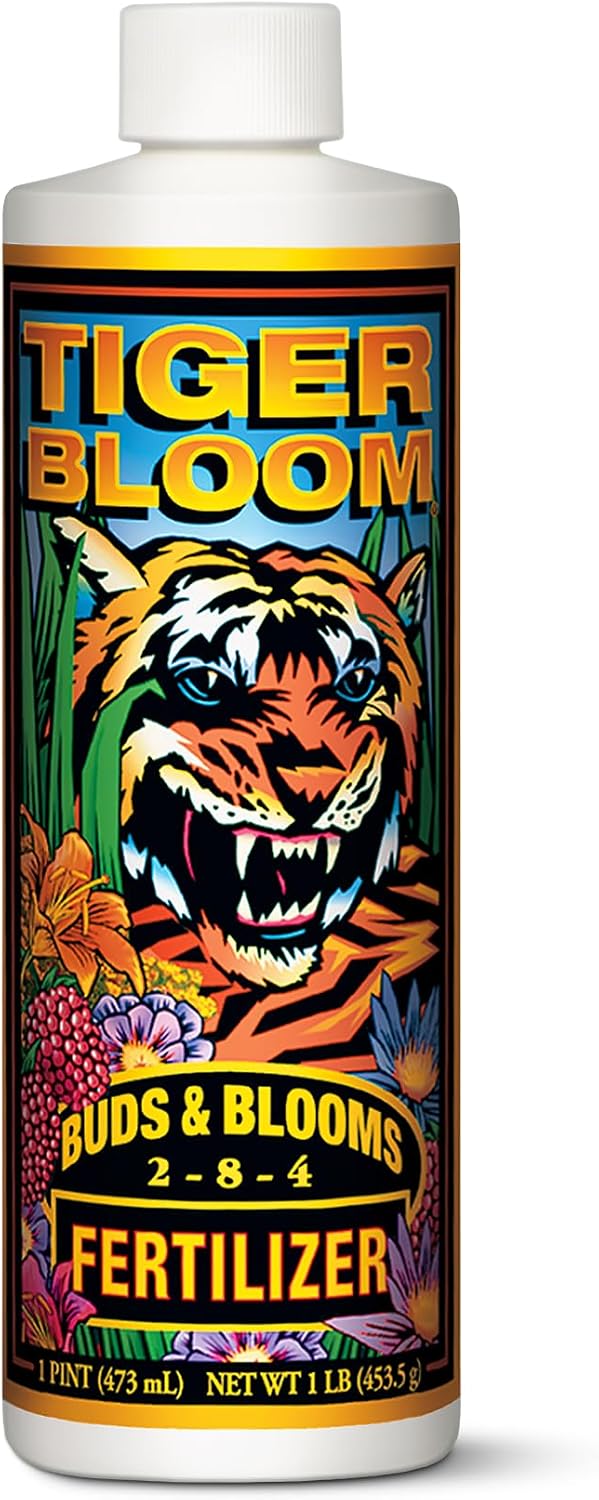
Tiger Bloom is a liquid, high-phosphorus fertilizer designed to push plants into a strong flowering and fruiting phase. You mix a small amount into the irrigation water or use it as a foliar spray and apply from first signs of flowering through harvest. The 2-8-4 formula and included micronutrients support bud set and larger blooms, and the concentrate mixes at 1:200 to 1:300 for routine feeding or 2 to 4 teaspoons per gallon for heavier feeding. It works in both soil and hydroponic setups and is formulated for quick nutrient uptake and stable micronutrient availability during storage. Practical benefits include flexible application methods, suitability for intensive flowering cycles, and a small bottle that lasts when used at recommended dilutions. Important limitations are that it is bloom-focused rather than an all-purpose feed so it may not meet vegetative needs, and the phosphorus content means users near waterways should follow local regulations to avoid runoff issues.
Best for: Serious growers who prioritize maximizing flower and bloom performance and want a concentrated, fast-acting bloom booster for soil or hydroponic environments.
Less Ideal for: Casual gardeners seeking a single all-purpose fertilizer for every growth stage or those managing turf or non-flowering lawns where phosphorus restrictions apply.
- High phosphorus NPK (2-8-4) concentrated for stronger bud development
- Works in soil and hydroponic systems for versatile use
- Liquid concentrate mixes easily for foliar or watering applications
- Formulated for quick nutrient uptake and stable micronutrient availability
- Focused on flowering so it is not a balanced all-stage fertilizer
- Contains phosphorus which may be restricted near waterways
Verdict: Choose Tiger Bloom when you need a concentrated, fast-acting bloom booster to maximize flower and fruit production.
Miracle-Gro Indoor Plant Food for All Plants, Liquid, 8 fl. oz. (2-Pack)

| Item Form | Liquid |
|---|---|
| Application Method | Apply directly to soil or mix with water |
| Target Species | Houseplants |
| Liquid Volume | 8 fluid ounces |
| Mixing Ratio | 4 pumps per 1 quart of water |
Miracle-Gro Indoor Plant Food is a ready-to-use liquid fertilizer for indoor potted plants that you apply either directly to soil or diluted in water. It is typically used every two weeks by mixing the recommended number of pumps into a quart of water or by applying a few pumps for larger pots, making it easy to add to a regular watering routine. The product feeds quickly because nutrients are water-soluble and the pump dispenser gives repeatable doses without measuring spoons. Practical benefits include broad compatibility with most houseplants and a compact bottle size that is convenient for small indoor gardens. Limitations are that the label lists only N, P, K without a full nutrient breakdown, so growers wanting precise NPK ratios or micronutrient profiles may prefer a more detailed formula. Also the 8 fl. oz. bottles are best for hobbyists or small collections rather than large indoor plantings because frequent repurchasing will be necessary for heavy users.
Best for: Buyers who want a simple, low-effort fertilizer to add to a regular watering routine and who prioritize straightforward dosing and broad houseplant compatibility.
Less Ideal for: Specialist growers who need exact NPK ratios, detailed micronutrient information, or bulk quantities for many plants should consider a different product.
- Liquid formula feeds instantly when mixed with water or applied to soil
- Pump dispenser provides simple, repeatable dosing without measuring
- Designed for use with a wide range of indoor plants including herbs, flowers and vegetables
- Full NPK ratio and micronutrient details are not shown on the product summary
- Small 8 fl. oz. bottle size may require frequent replacement for larger collections
Verdict: A convenient, pump-dosed liquid fertilizer that makes fortnightly feeding simple for casual indoor plant owners.
TPS NUTRIENTS Indoor Plant Food Liquid Fertilizer, 8 fl oz

| Item Form | Liquid |
|---|---|
| Specific Uses For Product | Plant Food |
| Application Method | Watering can |
| Mixing Ratio | 2:1 (oz/gallon) or 1:64 (tbsp/gallon) |
TPS NUTRIENTS Indoor Plant Food is a concentrated liquid fertilizer made for regular use with houseplants. You mix the measured dose into water and apply it with your usual watering can; the label gives an easy mixing ratio for household use. Its kelp-enriched formula is pitched at improving leaf color, encouraging steady new growth, and supporting root health, so expect glossier foliage and more frequent leaf production when plants are fed consistently. The 8 fl oz bottle is portable and fits on a plant shelf or utility area, and the liquid form dissolves readily for even application. It is intended for medium coverage and labeled as gentle for weekly feeding, which simplifies care for busy owners. Important limitations are that this is a small bottle meant for regular top-up feedings rather than long-term bulk use, and it assumes you will follow dilution directions to avoid overfeeding. Keep it away from children and pets and avoid skin or eye contact when handling.
Best for: Plant owners who want a simple, low-effort weekly fertilizer to keep indoor foliage vibrant and encourage steady new leaf growth. Good for people who prefer an easy liquid mix applied during regular watering routines.
Less Ideal for: Gardeners needing a bulk or multi-season fertilizer for outdoor beds or large collections should consider larger-capacity or specialized products instead.
- Liquid concentrate mixes easily for even application with a watering can
- Kelp-enriched formula aimed at improving foliage color and encouraging new growth
- Gentle enough for weekly feedings according to product guidance
- Clear mixing instructions for home use
- Small 8 fl oz volume limits how many plants you can feed before repurchasing
- Not formulated or labeled for outdoor or large-scale garden use
Verdict: A convenient kelp-enriched liquid concentrate that makes weekly feeding easy for anyone who wants healthier, more vibrant indoor foliage.
Choosing the Right Liquid Flower Fertilizer: Key Factors to Consider
Nutrient Ratio for Flowering
A fertilizer aimed at flowers typically emphasizes phosphorus and potassium relative to nitrogen because those nutrients support bud set, flower size, and color. Too much nitrogen shifts energy into leafy growth at the expense of blooms. Look at the N-P-K balance and prefer formulas that are explicitly labeled for flowering plants or ornamentals.
Concentration matters more in liquid feeds since they act quickly. A moderate phosphorus boost works for most annuals and perennials, but extremely high phosphorus formulations are rarely necessary and can complicate dosing. Consider how often you plan to feed and whether the ratio fits frequent low-dose feeding or less frequent stronger feeds.
Application Method and Frequency
Liquid fertilizers can be applied as soil drenches, root feeds, or foliar sprays. Foliar feeding gives fast uptake and is useful for quick color boosts, while soil drenching provides longer-lasting nutrient availability. Choose a product that supports the method you prefer and provides clear dilution rates for both approaches.
Frequency is tied to concentration. Some products are designed for weekly low-strength applications, others for biweekly or monthly treatments. Match the recommended schedule to your watering habits to avoid over- or under-feeding, especially for containers that dry out faster and are more prone to salt buildup.
Solubility and Residue
A good liquid fertilizer dissolves clearly without particulate residue that can clog sprayers or leave crust on potting mix. Highly soluble mixes reduce the chance of uneven application and prevent clogged nozzles on hand or hose-end sprayers. Check whether the label mentions complete solubility and whether the product requires vigorous shaking before each use.
Residue also affects salt buildup in containers and compacted soils. Products that leave minimal residue reduce the need for frequent leaching or repotting, which is particularly important for sensitive annuals and newly rooted cuttings.
Compatibility With Containers and Sensitive Plants
Container plants and newly planted ornamentals are more vulnerable to fertilizer burn and salt accumulation. A liquid feed intended for flowers should include instructions for reduced-strength mixes for small pots, seedlings, and recently transplanted specimens. Products that recommend conservative starting strengths and gradual increases are safer for a wider range of plant ages.
Consider whether the fertilizer is labeled safe for succulents, young cuttings, or acid-loving ornamentals if those are in your garden. Compatibility with popular potting mixes and soilless media is also helpful in preventing nutrient lockout or pH swings.
Ease of Measuring and Using
A clear measuring system and straightforward dilution instructions reduce the risk of dosing mistakes. Look for measurable marks on concentrated bottles, included measuring caps, or simple ratios that are easy to reproduce with common kitchen measuring tools. Products that offer both concentrate and ready-to-use options can be more flexible for gardeners with different needs.
Ease of use extends to packaging that resists spills and is easy to store outdoors. If you plan to use a sprayer or hose attachment, confirm compatibility to avoid transfers that waste product or lead to inconsistent application.
When to Use Liquid Feeders in the Growing Season
Liquid flower fertilizers are most effective during active bloom and the immediate pre-bloom period when plants are forming buds. Start at the label's recommended strength once plants are established and increase frequency only if plants show responsiveness without leaf scorch.
For spring- and summer-flowering annuals, a steady weekly or biweekly liquid feed often yields the best visual results. For established perennials and shrubs, use targeted liquid applications during the main flowering window rather than year-round to avoid excessive vegetative growth.
- Begin feeding after the first true leaves or after transplant shock has subsided.
- Reduce or pause feeding as plants move into dormancy or non-flowering seasons.
Foliar Feeding Best Practices
Foliar sprays provide rapid nutrient uptake and are useful for a quick color lift or to correct mild deficiencies. Apply in cooler parts of the day, such as early morning or late afternoon, to reduce leaf burn and improve absorption.
Avoid foliar applications during the heat of midday or when rain is expected within a few hours. Use gentle spray patterns and ensure droplets are fine enough to cover foliage evenly without runoff.
- Test on a few leaves before full-plant application to check sensitivity.
- Do not combine foliar feed with pesticide sprays unless label permits.
Feeding Containers Versus In-Ground Plants
Containers need more frequent feeding because potting mixes have limited nutrient reserves and salts can accumulate quickly. Use lower-strength solutions on containers and flush the potting mix occasionally to prevent salt buildup.
In-ground plants have larger root volumes and buffer nutrients better, so liquid feeds can be applied less frequently. Work fertilizer into watering routines rather than applying heavy single doses in garden beds.
- Use half-strength feeds for small pots and newly rooted plants.
- Deep-water soil around shrubs and perennial beds after applying liquid feed to move nutrients into the root zone.
Adjusting Strength for Plant Sensitivity
Different species and even cultivars vary in tolerance for concentrated feeds. Start at 50 to 75 percent of the recommended strength for sensitive specimens and observe growth over two weeks before increasing. Leaf burn or stunted growth indicates the need to dilute further or reduce frequency.
When in doubt, err on the side of weaker solutions applied more often rather than concentrated doses. This approach reduces risk and provides steady nutrition without shocking the plants.
- Keep a log of dilution strengths and application dates to track plant responses.
- Rinse foliage occasionally if residue appears after repeated foliar feeds.
Common Mistakes to Avoid With Liquid Fertilizers
Over-application is the most frequent error. Excessive feeding can lead to salt buildup, root damage, and fewer blooms. Follow dilution guidance and adapt frequency to rainfall and irrigation patterns.
Mixing incompatible products or combining fertilizer with concentrated garden chemicals can create phytotoxic blends. Always consult labels and avoid combining unless clearly stated as safe.
- Do not apply concentrated feeds to drought-stressed plants.
- Store concentrates out of direct sun and cap containers tightly to maintain stability.
How We Chose the Best Liquid Flower Fertilizer
We focused on attributes that matter to gardeners aiming to increase bloom quantity and quality without risking plant stress. Selection started with liquid formulations designed specifically for flowering plants rather than general-purpose feeds. We prioritized nutrient balance that promotes blooms, including readily available phosphorus and appropriate nitrogen levels to avoid excess leafy growth. Application flexibility was important, so we favored concentrates and ready-to-use liquids that support foliar sprays and soil drenches. Safety for potted plants and sensitivity to fertilizer burn guided our choices, with attention to clear dilution instructions and soluble formulations. We also considered how easily a product integrates with routine watering and common garden tools such as hose-end applicators and sprayers. Excluded products included dry granular feeds, bloom boosters with unbalanced or extreme concentrations likely to damage sensitive ornamentals, and specialty fertilizer blends aimed solely at vegetable or turf use. The end list reflects options that balance bloom promotion, user-friendly dosing, and broad suitability across containers, beds, and hanging baskets.
FAQ
How often should I apply liquid fertilizer to flowering annuals?
Flowering annuals usually respond well to weekly or biweekly low-strength liquid feedings during their bloom period. Adjust frequency based on growth response and avoid applying strong concentrations to newly potted or stressed plants.
Can I use liquid flower fertilizer as a foliar spray?
Yes. Many liquid flower fertilizers are suitable for foliar feeding and give rapid nutritional uptake. Apply during cooler parts of the day and use diluted solutions to prevent leaf scorch.
Will liquid fertilizer change soil pH over time?
Most balanced liquid flower fertilizers have limited immediate effect on soil pH, but repeated use can alter substrate chemistry. Monitor pH for acid- or alkaline-loving plants and leach containers periodically to prevent salt buildup.
Are concentrated liquids safe for small pots and seedlings?
Concentrated products can be safe when diluted appropriately. For seedlings and small pots, start with significantly reduced strength and increase only if plants show healthy growth without leaf tip burn.
Can I mix liquid fertilizer with pesticide sprays?
Mixing is possible but depends on product compatibility. Many labels advise against combining with pesticides unless the manufacturer explicitly states it is safe. When mixing is allowed, perform a small test first.
Final Verdict
Prioritize a liquid flower fertilizer that matches how you garden: choose a soluble, easy-to-dilute formula for containers and frequent feeding, or a concentrated option if you prefer less frequent applications. Focus on a nutrient balance that supports blooms rather than lush foliage and start at conservative strengths for sensitive or newly planted specimens. By aligning application method, strength, and feeding frequency with your plants and watering routine, you can reliably enhance bloom production while minimizing risks like fertilizer burn and salt buildup. Use the evaluation criteria above to pick the type of liquid fertilizer that fits your garden and growing season.
