

Note: This article contains affiliate links. If you click on these links and make a purchase, I may earn a small commission at no extra cost to you. This helps support my research and content. Read my full affiliate disclosure here.
If you care for a large lawn or expansive landscape, choosing a longest range garden sprinkler changes how many heads you need and how evenly water reaches grass and plants. The right long-throw sprinkler reduces gaps, lowers run time, and cuts installation complexity versus many short-range heads. This guide shortlists the top options for long‑range coverage and evaluates them on spray distance, pattern control, and durability. The selections that follow are our top picks for gardeners who need maximum reach. Each choice was vetted for real-world factors like throw consistency, adjustability, and reliability under regular outdoor use. Read on for the evaluation criteria and practical notes to help you pick a long-range sprinkler that fits your lawn layout and watering routine.
Top Picks at a Glance
| Best Overall The best all-around choice for most situations | Orbit Traveling Tractor Self-Propelled Lawn Sprinkler (Cast-Iron) |  |
| Best Quality Built to a higher standard if you want something more solid | New England Garden Tools Heavy Duty Tripod Pulsating Sprinkler (Model 300003) |  |
| Best Value The sweet spot between price and what you get | STYDDI Heavy-Duty Telescoping Tripod Impact Sprinkler |  |
| Best Budget The cheapest option that still gets the job done reliably | SPECILITE Brass Impact Tripod Sprinkler (Adjustable Heights) |  |
| Highest Rated A top-rated pick with lots of positive feedback | OVDSF 2" Farm Irrigation Tripod Sprinkler with Pressure Gauge (Rotary) |  |
| Most Popular A crowd favorite that many people choose with confidence | Orbit Tripod Brass Impact Sprinkler (Adjustable Height) |  |
Orbit Traveling Tractor Self-Propelled Lawn Sprinkler (Cast-Iron)

| Maximum Pressure | 100 psi |
|---|---|
| Maximum Flow Rate | 6.1 gpm |
| Inlet Connection Size | 0.63 inches |
| Material Type | Metal, Plastic |
| Included Components | sprinkler, spray arms |
The Orbit Traveling Tractor is a water-powered, self-propelled sprinkler designed to cover large lawns without constant repositioning. You lay out a hose in the pattern you want and the unit drives itself along that path while its rotary spray arms distribute water; spray diameter is adjustable roughly from 15 to 55 feet and three speed settings control how fast it travels. Its cast-iron body and high-traction spiked wheels give stable movement over wet grass and uneven turf, and an automatic shutoff ramp helps stop the unit when it reaches the hose end to conserve water. Practical benefits include very wide coverage—advertised for up to 13,500 sq ft along 200 ft of hose—reduced manual labor, and durable construction for seasonal use. Important limitations are that it requires sufficient water pressure to propel and run the spray, it only follows the hose layout so complex patterns need planning, and moving obstacles or very steep terrain can disrupt travel. For anyone with a larger lawn who wants low-effort, broad irrigation, this unit simplifies regular watering while delivering customizable coverage.
Best for: Homeowners with mid to large lawns who want a hands‑off solution to irrigate wide areas and value durable equipment that reduces time spent moving sprinklers.
Less Ideal for: Small yards, intricate garden beds, or properties with many obstacles or steep slopes where a stationary or zone-based system would provide more precise coverage.
- Self-propelled design waters along the hose route so you do not need to move the sprinkler manually
- Adjustable spray diameter from about 15 to 55 ft to tailor coverage for different lawn areas
- Three speed settings let you control travel rate and application intensity
- Heavy-duty cast-iron body and high-traction wheels for stable, durable performance
- Automatic shut-off ramp reduces wasted water at the hose end
- Requires adequate water pressure and flow to drive and spray effectively
- Only follows the hose path so you must plan hose layout for desired coverage
- Can be affected by large obstacles, very steep slopes, or tangled hose
Verdict: If you need wide, low‑effort irrigation for a large lawn, this self‑propelled traveling sprinkler delivers broad, adjustable coverage with durable construction.
New England Garden Tools Heavy Duty Tripod Pulsating Sprinkler (Model 300003)

| Coverage Diameter (Ft) | 125 |
|---|---|
| Coverage (Sq Ft) | 12,300 |
| Flow (GPM) | 6.15 |
| Water Pressure (psi) | 40 – 100 |
| Material | Brass head, metal frame |
This tripod pulsating impact sprinkler is built for large lawns, orchards, and fields where reach and robustness matter. The brass impact head and all-metal frame deliver a durable irrigation solution while the telescoping tripod raises the sprinkler between about 4 and 6 feet to clear taller plants or obstacles. It provides adjustable 0–360 degree coverage, variable spray distance and pattern controls, and performs best with a flow near the listed 6.15 GPM and pressures from 20 to 100 psi to achieve its long-range spray. Practical benefits include wide coverage that reduces how often you need to relocate the unit and a stable spike-and-stake base for outdoor conditions. Important limitations are that effective range depends strongly on your water pressure, hose size, and flow rate, and the tall setup must be firmly staked before use to avoid tipping under high pressure. It is a robust option when you need long, adjustable reach but requires checking your water supply to realize the advertised coverage.
Best for: Buyers who prioritize long reach and reliable performance for large lawns, orchards, or commercial plots and who can provide sufficient water flow and pressure.
Less Ideal for: Small yards, low-pressure municipal or weak well systems, or users who prefer lightweight, portable sprinklers that do not require staking.
- Brass impact head and corrosion-resistant metal frame for long service life
- Telescoping tripod raises sprinkler from about 4 to 6 feet to clear tall plants and obstacles
- Adjustable 0–360° range, spray pattern, and distance controls for targeted irrigation
- Designed for high flow and long reach with coverage suited to large lawns, fields, and orchards
- Actual spray diameter and coverage depend on water pressure, hose and flow rather than being guaranteed
- Tall tripod requires secure staking to prevent tipping at higher pressures
Verdict: Choose this heavy-duty tripod impact sprinkler when you need dependable long-range coverage and adjustable patterns for large lawns or farm irrigation.
STYDDI Heavy-Duty Telescoping Tripod Impact Sprinkler

| Maximum Pressure | 150 psi |
|---|---|
| Maximum Flow Rate | 4.9 gpm |
| Inlet Connection Size | 0.75 inches |
| Adjustable Height | 21 Inches to 50 Inches |
| Sprays Distance | Up to 90 ft. in diameter |
The STYDDI tripod impact sprinkler is built to irrigate large yards and areas that standard ground sprinklers cannot reach. It mounts an impact-style sprinkler head on a heavy-duty metal tripod that telescopes from about 21 to 50 inches, so the spray clears low obstacles like beds and fences and can deliver a roughly 90 foot diameter when set to full circle. The head offers adjustable coverage from about 20 degrees up to 360 degrees and connects to a standard 3/4" garden hose thread. Metal zinc-alloy and brass construction and a robust tripod improve stability and resistance to higher pressure, while the pulsating impact mechanism delivers consistent long-range coverage. Expect to clean the nozzle occasionally if rotation weakens and to loosen the adjustment knob before changing height to avoid damage. This sprinkler is best used for broad, infrequent watering of lawns, large planting areas, and sections with obstructions; it is less suitable for precise bed-by-bed watering or very small yards where its range is excessive.
Best for: Homeowners who need a single, robust sprinkler to cover large lawns or irregular yards and who prioritize efficient, long-range watering over fine-tuned zone control.
Less Ideal for: Gardeners with small yards, container gardens, or those who need precise irrigation control for multiple beds or sprinkler zones should look at smaller or zoned options.
- Telescoping tripod raises sprinkler above plants and obstacles for better reach.
- Impact-style head provides long-distance, consistent pulsating spray up to ~90 ft diameter.
- Durable metal construction (zinc-alloy and brass) for higher pressure and weather resistance.
- Adjustable spray arc from about 20 to 360 degrees for customizable coverage.
- Requires periodic cleaning and simple maintenance to prevent clogging and stopping of rotation.
- Large coverage makes it impractical for small or highly precise watering jobs.
Verdict: Choose this tripod impact sprinkler when you need durable, adjustable, long-range coverage to water large or obstructed lawns with a single reliable unit.
SPECILITE Brass Impact Tripod Sprinkler (Adjustable Heights)

| Material Type | Brass, Zinc |
|---|---|
| Maximum Pressure | 60 psi |
| Item Highlight | Sprays Up to 70ft, Covers 5660sqft |
The SPECILITE Brass Impact Tripod Sprinkler is a portable, metal-impact sprinkler mounted on a three-position telescoping tripod for medium to large lawns. Its solid brass impact head delivers a pulsating 360 degree rotation with adjustable arc and distance, and the tripod snaps to 16, 26, or 36 inches so you can raise the spray over beds or lower it for turf. A swivel hose fitting and built-in metal filter reduce clogs and help keep the head running smoothly. In practice this model is useful for quickly covering wide areas up to the advertised distance and for moving between zones; the metal construction resists rust better than plastic and the triangular tripod adds stability on slightly uneven ground. Expect some setup each season and occasional adjustment of the spray stops to dial in coverage; like other impact heads it performs best with steady water pressure and will not self-level on very steep slopes. For buyers focused on long reach and durability, this sprinkler delivers a straightforward, serviceable solution without complex controls.
Best for: Homeowners who need a durable, long‑reach sprinkler to cover large lawns and move between zones while prioritizing reliability and straightforward setup.
Less Ideal for: People who want automated station programming, very fine-tuned zone control, or a lightweight permanent in-ground system for an irrigation plan.
- Brass impact head for durable, consistent pulsating spray and better rust resistance than plastic heads
- Telescoping tripod with three height settings for flexible placement over beds or turf
- Adjustable 360° rotation and spray arc to customize coverage area
- Built-in metal filter and swivel hose fitting reduce clogs and keep flow steady
- Stable triangular tripod base suited to uneven ground
- Performance depends on steady water pressure to reach maximum distance
- All-metal tripod is heavier to move than small plastic stakes
Verdict: Choose this metal-impact tripod sprinkler when you want a simple, durable unit that reliably reaches long distances across large lawns.
OVDSF 2" Farm Irrigation Tripod Sprinkler with Pressure Gauge (Rotary)
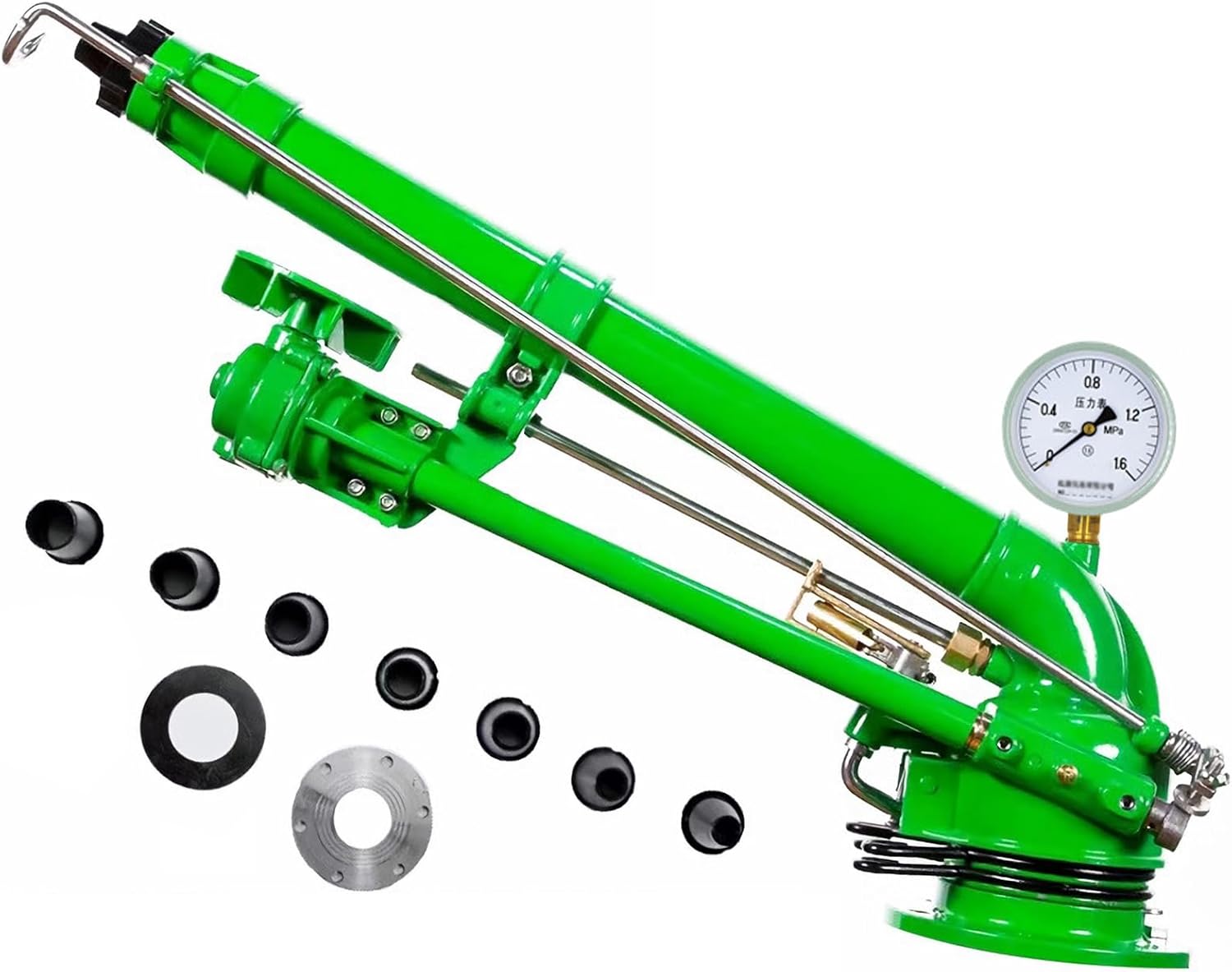
| Maximum Flow Rate | 107.9 cubic meter per hour |
|---|---|
| Inlet Connection Size | 2 inches |
| Spray Range | 190-370 FT in Diameter |
| Working Pressure | 3-8bar |
This OVDSF rotary tripod sprinkler is built for large-scale irrigation and dust-control tasks where long reach and continuous operation matter. It mounts on a tripod and connects via a 2-inch flange, then automatically rotates to cover up to a wide diameter that the manufacturer lists as roughly 190–370 feet. The unit uses a larger turbine and adjustable water-divider needle to produce finer atomized droplets, and it includes seven replaceable nozzles to tune flow and distance. A visible pressure gauge helps monitor operating pressure so you can match pump output to the sprinkler's 3–8 bar working range. Practical benefits include strong atomization that reduces crop damage, modular nozzles for flexible flow rates, and metal construction intended for regular field use. Important limitations are that it needs a substantial pump and plumbing to reach the top flow and range figures and is sized for farms, orchards, or industrial use rather than small lawns or gardens. Expect periodic maintenance of the flange connection and nozzles in abrasive water or high-use scenarios.
Best for: For growers and land managers who need a robust, long-reach sprinkler that can run reliably across large fields or orchards and who prioritize durable components and serviceability.
Less Ideal for: Not a good fit for homeowners with small yards, drip or zone-based systems, or anyone without access to a high-flow pump and 2-inch plumbing.
- Large maximum spray diameter suitable for wide fields and orchards
- 2-inch flange connection provides a secure, serviceable inlet for high-flow setups
- Adjustable turbine and water-divider needle improve atomization and reduce crop damage
- Includes seven replaceable nozzles to tailor flow and throw distance
- Built-in pressure gauge lets you monitor operating pressure on site
- Requires high pump pressure and significant flow to reach the advertised maximum range
- Designed for agricultural or industrial scale so it is overkill for small residential lawns
Verdict: Choose this sprinkler when you need a rugged, long-range rotary unit that can deliver wide, atomized coverage for large fields and orchards.
Orbit Tripod Brass Impact Sprinkler (Adjustable Height)

| Maximum Pressure | 80 psi |
|---|---|
| Maximum Flow Rate | 25 gpm |
| Inlet Connection Size | 0.5 inches |
| Material Type | Aluminum |
The Orbit Tripod Brass Impact Sprinkler lifts a heavy-duty brass impact head on an adjustable metal tripod to deliver long-range, 360-degree coverage across large lawns and landscape areas. Typical use is connecting the 1/2-inch inlet to a garden hose, setting the spray arc and distance with the precision nozzle, then raising the head between 22 and 48 inches to clear tall grass or garden features. Notable features include a durable brass impact head designed for consistent rotation under pressure, an adjustable tripod that stabilizes on uneven ground, and a maximum flow capacity suitable for high-pressure output. In practice this sprinkler provides steady, even distribution over wide areas and is easy to reposition for spot or whole-lawn coverage. Important limitations are that it needs a compatible hose connection and sufficient water pressure to achieve maximum range, and the metal tripod and brass head are heavier than plastic alternatives which affects portability. For homeowners seeking reliable long-distance coverage, this is a simple rugged option that performs well when paired with good water pressure.
Best for: Practical homeowners who want dependable, long-range lawn coverage and prefer proven, rugged hardware with visible performance history.
Less Ideal for: People who need an ultra-lightweight, portable sprinkler for frequent moves or those with low water pressure who need a low-flow solution.
- Heavy-duty brass impact head for consistent long-range rotation
- Adjustable tripod raises sprinkler 22–48 inches for clearer coverage over tall grass
- 360-degree rotating spray for uniform distribution across large areas
- Precision high-pressure nozzle supports long-distance coverage
- Requires good water pressure to reach maximum range
- Heavier aluminum/brass construction makes it less convenient to carry frequently
Verdict: Choose this tripod-mounted brass impact sprinkler when you need reliable, long-distance 360-degree coverage for large lawns backed by durable metal construction.
Choosing the Right Longest Range Garden Sprinkler: Key Factors to Consider
Spray Distance and Water Pressure
How far a sprinkler throws water is the single most important factor for long-range needs. Longer throw requires higher water velocity, which depends on available household or irrigation pressure. Measure your water pressure or estimate based on current sprinklers; a unit that advertises long range but needs higher pressure than you have will underperform.
Also consider how range changes with nozzle size and pressure. Some long-range heads let you swap nozzles to trade distance for flow distribution. Plan for seasonal pressure variations and any pressure losses from long supply runs so the sprinkler can still reach target distances in real conditions.
Coverage Pattern and Uniformity
A sprinkler that reaches far does little good if it drops water unevenly. For large lawns, you need consistent droplet distribution across the arc and at the outer edge to avoid dry rings or soggy centers. Look for adjustable pattern controls that allow you to limit arc, overlap adjacent heads, and tune the outer throw.
Uniformity also depends on nozzle design and rotary mechanics. Oscillating or rotary impact-style heads behave differently at long distances. Consider how the pattern performs near wind-prone areas and whether the device can maintain even coverage when partially obstructed by plants or structures.
Adjustability and Pattern Control
Long-range sprinklers should let you adjust arc, radius, and sometimes droplet size. Arc control helps target specific areas and reduces wasted water on sidewalks or driveways. Radius adjustment prevents overwatering closer to the supply and lets you match spacing between heads.
Controls should be intuitive in the field so you can tweak settings without specialized tools. Fine adjustments are useful for tight landscaping near beds, while coarse controls are acceptable for open turf. Consider whether adjustments hold reliably over seasons and after repeated handling.
Durability and Weather Resistance
Components on long-throw sprinklers experience more mechanical stress and exposure than short-range heads. Materials and seal quality determine resistance to leaking, cracking, and wear of moving parts. Metal drive assemblies and robust plastic formulations usually last longer in outdoor conditions.
Check for UV-stable plastics, corrosion-resistant fasteners, and replaceable seals or nozzles. Durability impacts long-term performance and maintenance frequency, particularly if you run long watering cycles to hit distant turf. A slightly heavier or better-built head often pays off in fewer repairs.
Compatibility and Installation
Consider how the sprinkler connects to your existing irrigation lines or hose system. Standard thread sizes and fitting options simplify integration. Some long-range designs are intended for permanent installation on risers, while others work as temporary in-ground pop-ups or stake-mounted units.
Installation complexity affects how easily you can reposition heads to experiment with spacing. Choose products that match your plan for fixed or movable heads, and verify whether additional fittings, adapters, or pressure-regulating accessories are needed.
When Long Range Matters Most
Long throw becomes critical when single heads must cover wide open turf or when minimizing the number of heads reduces trenching and fittings. If you have large contiguous lawn areas, fewer long-range sprinklers can simplify layout and reduce installation time compared with many short-range heads.
Keep in mind that long-range performance pairs best with thoughtful spacing and overlap. Plan head placement so outer edges overlap slightly to keep uniform distribution, and avoid relying on a single head to water isolated narrow strips or tight planting beds.
- Large contiguous turf benefits from fewer long-throw heads
- Overlap outer edges to preserve uniformity
- Long-range heads are less suited to narrow or irregular beds
Installing Long-Throw Sprinklers on Existing Systems
Retrofit installs are common for homeowners upgrading coverage. Before you begin, shut off the line and relieve pressure. Verify supply-line capacity and measure pressure at the intended station while other zones are idle. Use standard adapters to mate new heads to existing risers when possible.
If pressure is marginal, add a booster pump or install a pressure-regulating device that is compatible with long-range nozzles. Consider scheduling runs at cooler parts of the day to reduce wind drift and evaporation, which have greater impact at higher throws.
- Check line capacity and pressure under normal operating conditions
- Use adapters rather than forcing incompatible threads
- Schedule watering to minimize wind and evaporation effects
Managing Wind and Evaporation with Long Throws
Wind and evaporation reduce coverage effectiveness at long distances. On breezy days, droplets are carried off course and outer zones can end up under-watered. Choose nozzle sizes that produce slightly larger droplets for outer arcs where wind drift is likely.
You can also split stations to run long-range heads during low-wind windows or run shorter cycles with multiple passes to improve infiltration and reduce runoff. Positioning heads with natural windbreaks, like hedges or fences, helps protect the spray path without sacrificing reach.
- Select nozzles for larger droplets in exposed areas
- Use split cycles to improve infiltration
- Place heads where windbreaks reduce drift
Maintenance Tips for Long-Range Sprinklers
Inspect nozzles and seals seasonally since higher velocities can accelerate wear and clogging. Clean or replace clogged nozzles, and keep an eye on the drive mechanism for wobble or uneven rotation. Tighten fittings and replace worn washers to prevent leaks that reduce throw.
Winterize according to local climate by draining lines or blowing out systems if they are in-ground. Store any removable components indoors if they are not designed for freeze conditions. Regular preventive checks keep long-range heads performing closer to their rated distances.
- Seasonal nozzle cleaning prevents loss of spray distance
- Check and replace seals and washers to avoid leaks
- Follow winterization practices for in-ground installations
Layout Strategies for Large Lawns
Map your lawn into zones where a single head can reasonably cover radius and arc needs. Use overlap to ensure the outer edges get consistent water. Place heads on slightly staggered lines rather than a strict grid to reduce banding and minimize dry spots.
Adjust head height and orientation so spray clears mowing patterns and landscape features. For irregular shapes, consider combining long-range heads for open areas with shorter-range heads near beds and borders to maintain precision.
- Stagger heads to reduce banding
- Combine long-range heads with short-range units near edges
- Adjust heights to clear obstacles and match turf patterns
How We Chose the Best Longest Range Garden Sprinkler
We focused on attributes that actually determine performance in large lawns and long-throw applications. Primary evaluation criteria included measurable spray distance under typical household water pressure, pattern control and adjustability for shaping the water arc, and coverage uniformity to avoid dry patches at long ranges. Durability under outdoor exposure and the quality of seals and materials were assessed because long throws accelerate wear on moving parts and joints. Compatibility with common irrigation fittings and ease of setup mattered for backyard installations where simple retrofits are common. Practical maintenance and available replacement parts were considered to ensure long service life. We excluded options designed primarily for misting, delicate plants, or ultra-low-flow systems because those do not deliver the long, concentrated streams needed for large turf areas. We also filtered out specialty agricultural gear not suited to residential connections or typical lawn pressures. The result is a list of long-range garden sprinklers that balance reach, control, and longevity for residential and suburban landscapes.
FAQ
How much water pressure do I need for a long-range sprinkler?
It depends on the unit and nozzle, but long-range sprinklers usually need higher household pressure than short-range heads. Measure pressure at the supply with other zones off and check manufacturer pressure ranges to match nozzle choices.
Can long-range sprinklers work well in windy conditions?
They can work, but wind reduces effective coverage. Use larger-droplet nozzles, run cycles during low-wind periods, or split runs to reduce drift. Positioning near windbreaks also helps maintain uniformity.
Will a long-range head save me installation time?
Often yes for large open areas because fewer heads and less piping are required. However, you still need to plan spacing and lines to ensure overlap and account for pressure losses over long runs.
How do I maintain spray distance over time?
Regularly clean nozzles and inspect seals and moving parts. Replace worn washers and nozzles when flow patterns degrade. Seasonal checks and prompt repairs preserve throw and uniformity.
Are long-range sprinklers suitable for mixed landscapes with beds and borders?
They are best for open turf. For beds and narrow borders, combine long-range heads for the open areas with short-range or precision heads near plantings to avoid overspray.
Final Verdict
For large lawns and open landscapes, prioritize spray distance, pattern uniformity, and robust construction when choosing a longest range garden sprinkler. Balance reach with the ability to fine-tune arc and nozzle size so outer edges receive consistent coverage without wasting water on hard surfaces. Consider pressure capacity and layout strategies to minimize wind and evaporation losses. Focus on durable materials and replaceable nozzles if you expect heavy seasonal use. With those tradeoffs in mind, select a long-range head that matches your supply pressure and layout plan so you get reliable, even irrigation with fewer installed units.
