

Note: This article contains affiliate links. If you click on these links and make a purchase, I may earn a small commission at no extra cost to you. This helps support my research and content. Read my full affiliate disclosure here.
If your yard has low water pressure or a gravity-fed system, a low pressure pop up garden sprinkler can make the difference between patchy watering and a uniformly green lawn. These sprinklers are built to operate with less head pressure while still distributing water evenly and minimizing misting and runoff. In this guide we shortlisted the top options that perform well under constrained pressure, and evaluated each for spray uniformity, build durability, nozzle adjustability, and ease of maintenance. Read on to see which low-pressure pop up sprinklers match different lawn sizes and installation setups, and what tradeoffs to expect when you prioritize low-pressure performance.
Top Picks at a Glance
| Best Overall The best all-around choice for most situations | Rain Bird 1802HV15PR PRS High-Efficiency Pop-Up Sprinkler (8–15 ft, 2" Pop-up) |  |
| Best Quality Built to a higher standard if you want something more solid | Rain Bird 1804HDSP PRS Dual Spray 4" Pop-Up Sprinkler (180° Half Circle, 8–15 ft) |  |
| Best Value The sweet spot between price and what you get | Rain Bird 12SAPROPR Pressure-Regulating Pro Rotary Pop-Up Sprinkler (4" Pop-up) |  |
| Best Budget The cheapest option that still gets the job done reliably | Orbit Professional 4-inch Pressure-Regulating Pop-Up Spray Head with 15-ft Brass Nozzle (Half Spray) |  |
| Highest Rated A top-rated pick with lots of positive feedback | Rain Bird 1804APPR25 1800 Series PRS Pressure-Regulating 4" Pop-Up Sprinkler |  |
Rain Bird 1802HV15PR PRS High-Efficiency Pop-Up Sprinkler (8–15 ft, 2" Pop-up)
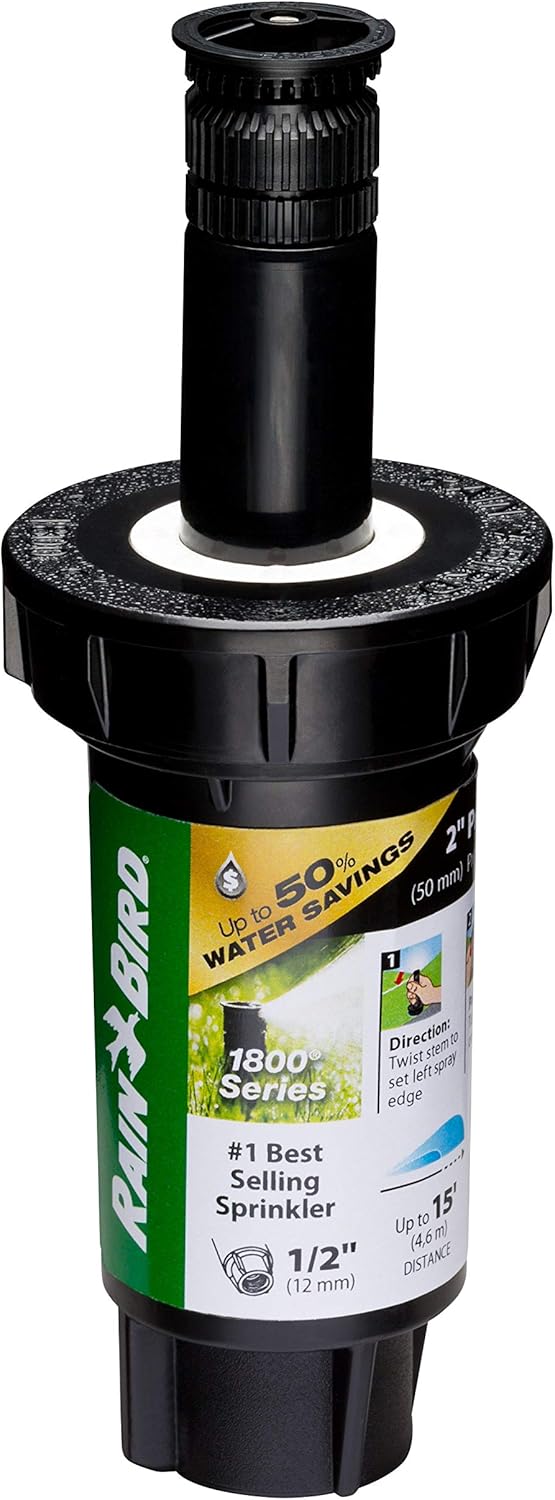
| Spray distance | 8' – 15' |
|---|---|
| Pop-up height | 2" |
| Maximum Pressure | 30 psi |
| Inlet Connection Size | 0.5 inches |
| Material Type | Plastic |
The Rain Bird 1802HV15PR is a compact professional pop-up spray head designed to deliver consistent, water-efficient coverage in residential or light-commercial lawns. It installs like a standard 1800-series head and is typically used on in-ground irrigation zones that need a 8'–15' spray radius. The standout feature is the built-in PRS pressure regulator that holds outlet pressure at 30 psi to prevent misting, reduce wind drift, and maintain even distribution across a zone even when water pressure fluctuates. The HE adjustable nozzle and flow-control design produce larger droplets and improved uniformity close to the head, which helps keep water off sidewalks and driveways. Maintenance is straightforward because the top-removable internals, stainless-steel spring, and a mesh filter allow easy flushing and nozzle swaps without digging. Limits to consider are the fixed regulator set point of 30 psi, so very low-pressure systems may not gain full benefit, and the head is a small 2" pop-up best suited to turf, small beds, and tight landscaping rather than long-range rotary coverage.
Best for: Buyers who want a reliable, water-saving pop-up for typical lawn and garden zones where pressure varies and uniform turf watering is a priority.
Less Ideal for: Not the best choice for large lawns or landscapes that require long-range rotary heads or for projects needing taller pop-ups than 2 inches.
- Built-in 30 psi PRS regulator that reduces misting and evens zone performance
- High-efficiency adjustable nozzle for 8'–15' radius with improved uniformity
- Top-serviceable design and stainless-steel spring for easy maintenance and long life
- Matched precipitation rate so it can be mixed with other Rain Bird spray heads without causing run-off
- Regulator is fixed at 30 psi so it is less helpful on very low-pressure systems
Verdict: Choose this head when you need a compact, pressure-regulated pop-up that reliably saves water and evens coverage in standard low- to mid-pressure lawn zones.
Rain Bird 1804HDSP PRS Dual Spray 4" Pop-Up Sprinkler (180° Half Circle, 8–15 ft)

| Pop-up height | 4" |
|---|---|
| Pattern | 180° half circle |
| Spray distance | 8' – 15' |
| Inlet size | 1/2" |
| Pressure regulator | Built-in 30 psi PRS |
The Rain Bird 1804HDSP PRS is a performance-focused 4" pop-up spray head that combines an internal pressure regulator with a dual-spray nozzle to deliver consistent coverage and reduce water waste. It is typically installed in in-ground irrigation zones where fluctuating or high supply pressure causes misting and uneven distribution. The built-in PRS maintains about 30 psi at the nozzle, which helps preserve nozzle pattern integrity and reduces wind drift, while the dual-spray nozzle waters both close-in areas and the outer radius to avoid brown spots. Installation and maintenance are practical for a homeowner or a pro: the top-accessible components, stainless-steel spring, and mesh filter simplify flushing, adjustments, and repairs without specialty tools. The nozzle adjusts from roughly 8 to 15 feet and offers a Matched Precipitation Rate so it works with other Rain Bird fixed and adjustable sprays. On the downside this is a fixed 180° half-circle model, so you need the correct location or additional models for full or quarter coverage and you must match pop-up height to your landscape needs. For a low-pressure focused system it delivers reliable, efficient performance.
Best for: Owners who prioritize consistent, efficient watering and want a durable pop-up head that reduces waste and performs well on systems with variable or high pressure.
Less Ideal for: People who need fully adjustable arc coverage from a single head or those replacing heads where a different pop-up height is required and matching variants are not available.
- Built-in PRS pressure regulator maintains ~30 psi to prevent misting and improve uniformity
- Dual-spray nozzle provides close-in and outer-radius coverage to eliminate brown spots
- Top-serviceable design and stainless-steel spring allow easy maintenance and reliable retraction
- Matched Precipitation Rate nozzle enables consistent watering with other Rain Bird heads
- Fixed 180° half-circle pattern limits versatility unless paired with other arc options
- Pop-up height and spray radius are fixed by model choice so multiple variants may be needed for a full system
Verdict: Choose this Rain Bird head when you need a durable, low-pressure-friendly pop-up that delivers reliable, water-saving coverage in half-circle lawn zones.
Rain Bird 12SAPROPR Pressure-Regulating Pro Rotary Pop-Up Sprinkler (4" Pop-up)

| Maximum Pressure | 30 psi |
|---|---|
| Maximum Flow Rate | 0.01 cfm |
| Inlet Connection Size | 4 inches |
| Material Type | Plastic |
The Rain Bird 12SAPROPR is a professional-style 4" pop-up rotary sprinkler built for systems with low or inconsistent pressure. It integrates a PRS regulator that holds nozzle outlet pressure at 30 psi so the R-VAN rotary nozzle runs without misting and gives uniform, wind-resistant coverage across the selected 45°–270° arc. Installation and use mirror a standard pop-up head so it can replace existing spray heads in the same zone; the hand-adjustable nozzle and distance control let you fine-tune coverage without tools. The body design emphasizes durability and debris resistance with a co-molded wiper seal, stainless spring, and a flushing action you can trigger by pulling up the nozzle to clear clogs while the water runs. Practical benefits include reduced water waste, better distribution on slopes or compacted soils, and fewer heads needed thanks to the longer 13'–18' throw. Limitations are that it is a single-head solution for medium-range coverage and that you must match it to compatible inlet plumbing and nozzles when designing a full irrigation zone.
Best for: Homeowners and installers who want to optimize water use on yards with low or fluctuating pressure and prefer a reliable, adjustable pop-up head that reduces misting and improves coverage.
Less Ideal for: Those needing very long-throw or heavy-duty metal rotors for large commercial turf areas should consider gear-drive rotors or brass impact sprinklers instead.
- Built-in PRS regulator maintains 30 psi at the nozzle to prevent misting and improve uniformity
- R-VAN rotary nozzle delivers wind-resistant, large-droplet streams for even coverage
- Hand-adjustable pattern and distance let you set arc and range without tools
- Durable 1800-series body with wiper seal and stainless spring resists grit and provides reliable pop-up/ retraction
- Easy flushing by pulling up the nozzle clears debris while running
- Designed for a single mid-range radius so multiple heads are required for larger lawns
- Plastic construction means it is less impact-resistant than metal-bodied commercial heads
Verdict: Choose this head when you need a durable, mid-range pop-up sprinkler that enforces 30 psi at the nozzle to cut misting and save water on low-pressure systems.
Orbit Professional 4-inch Pressure-Regulating Pop-Up Spray Head with 15-ft Brass Nozzle (Half Spray)

| Maximum Pressure | 40 psi |
|---|---|
| Maximum Flow Rate | 1.8 gpm |
| Inlet Connection Size | 0.5 inches |
| Material Type | Brass, Plastic |
The Orbit Professional 4-inch pop-up spray head is a durable sprinkler head built for residential irrigation zones with up to about 15 feet spacing. It installs on standard 1/2-inch female pipe threads and comes with a pre-machined brass nozzle and built-in filter for uniform spray and better clog resistance. The key feature is the adjustable pressure regulator that can be set between 30 and 40 PSI to optimize performance for spray or rotator nozzles and reduce misting in low-pressure systems. A stainless steel riser spring and over-molded wiper seal improve long-term retraction and reduce leaks, while a ratcheting riser lets you fine-tune spray direction after installation. It also includes an integral silt trap for use with less-than-perfect water. On the downside it is a single-head solution so coverage beyond 15 feet needs additional heads and it requires compatible fittings and basic irrigation plumbing skills to install. For a budget-focused project this head delivers professional materials and useful pressure control without premium extras.
Best for: Homeowners installing or repairing small to medium residential irrigation zones who want a durable, professional-feeling spray head that performs well on lower-pressure lines and minimizes maintenance.
Less Ideal for: People who need wide-area coverage from a single unit or who prefer plug-and-play hose-end sprinklers rather than in-ground irrigation components.
- Adjustable pressure regulator (30–40 PSI) improves performance on low-pressure systems
- Brass precision nozzle with built-in filter for uniform spray and durability
- Stainless steel riser spring and over-molded wiper seal for reliable retraction and leak resistance
- Integral silt trap helps maintain function with dirty water
- Designed for up to 15 ft spacing so larger areas require multiple heads
- Requires standard irrigation fittings and some plumbing skill to install
Verdict: A cost-conscious choice that brings professional materials and adjustable pressure control to low-pressure pop-up sprinkler zones.
Rain Bird 1804APPR25 1800 Series PRS Pressure-Regulating 4" Pop-Up Sprinkler

| Maximum Pressure | 30 psi |
|---|---|
| Maximum Flow Rate | 15 liters per minute |
| Material Type | Plastic, Stainless Steel |
| Spray Distance | 8' – 15' |
| Pop-Up Height | 4" |
The Rain Bird 1804APPR25 is a professional 4 inch pop-up spray head that keeps nozzle pressure steady at 30 psi to improve uniformity and cut misting and overspray. It is used in standard in-ground irrigation zones where mid-range spray distance (8 to 15 feet) is needed, and the adjustable collar lets you set the arc from 0° to 360° for corners or full-circle coverage. The integrated PRS regulator and matched precipitation nozzle reduce pressure-related variability across a zone so heads perform more evenly even when system pressure fluctuates. Durable construction — plastic body with stainless-steel spring and a co-molded wiper seal — makes retraction and sealing reliable and simplifies maintenance since components can be removed from the top. Practical benefits include measurable water savings, easier nozzle alignment with the ratchet mechanism, and fewer issues from wind or misting. Important limitations are that it is a fixed spray-style head so it is best for lawns and beds rather than long-distance rotary coverage, and you must choose the correct nozzle type and pop-up height for the exact layout of your system.
Best for: Homeowners or landscapers who want reliable, water-efficient fixed-spray coverage for lawns, beds, and irregular edges and value consistent performance when system pressure varies.
Less Ideal for: Large properties that need long-range rotary rotors or users who prefer variable-flow rotor heads for very wide turf areas.
- Built-in pressure regulator maintains 30 psi at the nozzle for consistent spray performance and reduced misting
- Adjustable 0°–360° arc and top-access distance adjustment provide precise placement without digging
- Durable materials with stainless-steel spring and co-molded wiper seal for reliable retraction and long life
- Matched precipitation nozzle options and ratchet alignment allow uniform coverage across mixed heads
- Spray head design is limited to short-to-mid range fixed spray patterns, not suitable for long-distance rotary needs
- Requires selecting the right nozzle/pop-up height for specific zones which adds planning during installation
Verdict: Choose this Rain Bird PRS pop-up if you need dependable, water-smart fixed-spray coverage with consistent pressure and reduced misting across a lawn zone.
Choosing the Right Low Pressure Pop Up Garden Sprinkler: Key Factors to Consider
Operating Pressure Range
Operating pressure determines whether a pop up sprinkler will throw water in the intended pattern or just dribble. Look for models that specify low-end pressure ratings and maintain useful coverage down to the psi your supply delivers. If the manufacturer lists a pressure-compensating nozzle or a recommended low-pressure range, that typically means the sprinkler will better resist pattern distortion and create less misting, which reduces evaporative loss.
Understanding the actual pressure at sprinkler heads is important because pressure can drop along long runs and at elevation changes. Measure pressure at the outlet nearest the heads or use published friction-loss charts for piping layouts when planning placement.
Nozzle Design and Flow Rate
Nozzle size and orifice geometry control droplet size, throw distance, and the amount of water applied per minute. For low-pressure systems, larger orifice nozzles or special low-pressure spray patterns can produce usable coverage without requiring higher psi. Interchangeable nozzles let you tune arc, radius, and precipitation rate to match soil infiltration and reduce runoff.
Also consider whether nozzles are color-coded or clearly marked, which simplifies selection during installation. A nozzle set with matched precipitation rates helps when mixing sprinkler types on the same zone to avoid uneven watering.
Pop-Up Height and Retraction
Height when extended matters for clearance above turf and obstacles. Short-profile pop-ups sit lower and are less likely to be struck by mowers but may be limited in throw. Taller pop-ups can clear thicker grass and shrubs but must retract fully to avoid damage. Smooth, reliable retraction is especially important in low-pressure setups because partial extension due to weak flow can create misting or erratic spray.
Check that the pop-up mechanism resists sticking from soil, grit, and irrigation chemicals. A design with a simple removable riser makes field servicing easier when a head needs cleaning or a seal replacement.
Materials and Seal Durability
Sprinkler parts are exposed to soil, moisture, and occasional impact. Durable plastics or corrosion-resistant metals used for the body, riser, and internal valve components will last longer in-ground. High-quality seals and O-rings prevent leaks that can waste water and reduce downstream pressure, which is particularly important on low-pressure systems.
Evaluate whether replacement seals and nozzles are readily available. A sprinkler that allows quick seal swaps or that uses common-size parts will extend service life and reduce downtime.
Ease of Installation and Service
Even the best low-pressure sprinkler will perform poorly if installed incorrectly. Look for units with straightforward inlet fittings, clear depth markings, and accessible nozzle access for in-place adjustment. Tools-free or minimal-tool maintenance makes seasonal servicing quicker, especially when you need to clear debris or replace a nozzle.
Consider how the head connects to common lateral piping diameters and whether adapters are included. Ease of servicing also includes the ability to rotate or remove the nozzle without disturbing trenching or surrounding turf.
Pattern Coverage and Overlap
How a sprinkler lays out its spray determines how many heads you need and where to place them. For low-pressure systems, achieving good uniformity often requires closer spacing and careful overlap rather than relying on long throw. Choose heads with predictable arcs and consistent edge definition so you can plan overlap that minimizes dry spots and avoids unnecessary double-watered areas.
Think about how pattern selection affects run times and zone sizing. Denser head spacing can allow shorter run times while keeping application rates within soil infiltration limits.
Sizing Zones for Low Pressure Supplies
Designing irrigation zones for a low-pressure source means prioritizing flow balance over attempting wide coverage with fewer heads. Measure available flow in gallons per minute at the point of connection and plan zones so each head operates within its rated flow range.
Smaller zones with more heads placed for overlap often yield better uniformity than large zones with sparse heads. If you must water large areas, staggered run schedules can allow the supply to recover between zones without overloading the system.
- Measure both flow and pressure before selecting heads and spacing
- Use matched precipitation rate nozzles when mixing head types
- Plan for slightly tighter spacing than high-pressure layouts
Common Installation Pitfalls to Avoid
Avoid placing pop-up heads too close to obstructions such as fences, driveways, or deep shade lines where spray can be wasted. Low-pressure heads are less forgiving of blocked arcs because they cannot compensate with increased velocity.
Do not rely on a single pressure reading at the tap. Friction loss in long lateral lines and elevation changes can reduce pressure at end-of-line heads. Use larger diameter mains or relocate valve manifolds to keep pressure stable across a zone.
- Keep heads clear of debris and excess mulch
- Choose riser height that clears grass but retracts flush
- Avoid excessive lateral run lengths without upsizing pipe
Maintenance and Winterizing Tips
Routine maintenance keeps low-pressure pop up sprinklers operating efficiently. Flush lines during installation to remove construction debris, check nozzles for clogs periodically, and inspect seals each season for hardening or cracking. Small leaks have a disproportionate impact on pressure when your system runs close to the minimum required psi.
When winter approaches, drain or blow out zones per local best practices to prevent freeze damage. For areas with mild winters, removing and cleaning nozzles and lubricating riser seals can extend service life.
- Flush before first use and after major repairs
- Replace hardened O-rings during offseason service
- Store extra nozzles and a small seal kit in your irrigation toolbox
Adjusting Spray Patterns for Water-Smart Lawns
Match spray patterns to turf shape and obstacles to minimize overspray onto sidewalks or driveways. For narrow strips, use nozzles with tighter arcs and shorter radius. For roughly square or circular lawns, use heads with broad, uniform coverage and ensure edges overlap evenly.
Lower pressure systems benefit from tuning run times and start times to avoid watering during the hottest part of the day. Shorter, more frequent cycles allow water to infiltrate without pooling and reduce stress on the supply.
- Tune arcs and radius at installation and re-check after seasonal growth
- Prioritize adjusting trajectory before increasing run time
- Combine lower-radius heads with slightly closer spacing for better uniformity
How We Chose the Best Low Pressure Pop Up Garden Sprinkler
We focused on practical criteria that matter when installing pop up sprinklers on low-pressure systems. Primary evaluation factors were spray uniformity under reduced inlet pressure, nozzle options and adjustability for pattern shaping, pop-up height and retraction reliability to avoid turf damage, materials and seal quality to resist leaks and debris, and ease of access for routine maintenance. We examined technical specifications that indicate low-pressure suitability, such as recommended operating pressure range and nozzle flow rates, and prioritized designs with pressure-compensating features or larger orifice nozzles that maintain pattern at lower psi. We excluded any units designed only for high-pressure irrigation or those requiring special pumps to reach operational pressure. Products lacking clear pressure-range documentation or with consistently poor reported sealing were not considered. Our shortlist balances dependable in-ground performance with straightforward serviceability so gardeners can install, adjust, and maintain sprinklers without frequent replacements.
FAQ
What minimum pressure do low-pressure pop up sprinklers usually need?
Minimum pressure varies by design, but many low-pressure pop up sprinklers can operate usefully between about 20 and 25 psi. It often depends on nozzle choice and pipe layout. Measure pressure at the head location after piping to ensure it is within the head's specified range.
Can I use standard nozzles on a low-pressure pop up head?
Some standard nozzles will work, but they may underperform at low psi by creating mist or poor edge definition. Opt for nozzles labeled for low-pressure operation or choose larger orifices and matched precipitation rate nozzles to maintain even coverage.
How does spacing change with low-pressure irrigation?
Spacing is generally tighter for low-pressure systems. Expect to reduce spacing slightly compared with high-pressure designs to preserve overlap and avoid dry spots. Planning for closer spacing increases the number of heads but improves uniformity.
Do low-pressure pop up sprinklers require special maintenance?
Maintenance is similar to other in-ground heads but more critical because leaks and clogs reduce effective pressure quickly. Regular nozzle cleaning, seal inspection, and occasional riser lubrication will keep performance steady.
Will a low-pressure sprinkler work with a drip irrigation zone?
They are different approaches. Sprinklers apply water over a spray pattern while drip delivers slowly at emitters. You can use both on the same property but avoid mixing them on the same valve zone because their flow and run-time needs are different.
Final Verdict
Choosing the right low-pressure pop up garden sprinkler means balancing spray pattern needs, nozzle options, and reliable mechanical design against the constraints of your water supply. Prioritize models with documented low-end pressure performance, pressure-compensating or larger-orifice nozzles, and durable seals so each head maintains pattern and minimizes leaks. Plan for slightly closer spacing and routine maintenance to protect system pressure and get consistent coverage. With those tradeoffs in mind, pick the sprinkler that fits your zone flow, gives the right arc and radius for your lawn shape, and is straightforward to service. That approach will deliver the most dependable watering from a low-pressure setup.
