

Note: This article contains affiliate links. If you click on these links and make a purchase, I may earn a small commission at no extra cost to you. This helps support my research and content. Read my full affiliate disclosure here.
Choosing the right low wattage pond pump matters more than you might think for small ponds, container water gardens, and backyard fountains. The wrong pump can under-deliver flow, run noisily, or waste power. In this guide we shortlisted five top-performing low wattage pumps and evaluated them on practical gardening criteria like actual flow under head, electrical draw, and long-term reliability. You will find compact options that fit shallow ponds and small recirculating features, plus clear guidance on matching pump output to basin size and hardscape. Below the picks we explain how we tested useful specs and what to consider before buying.
Top Picks at a Glance
| Best Overall The best all-around choice for most situations | Novique 3W Mini Submersible Water Pump (190 L/H) |  |
| Best Quality Built to a higher standard if you want something more solid | Sicce Syncra Silent 0.5 Submersible Water Pump |  |
| Best Value The sweet spot between price and what you get | Jecod PP-377 Submersible Pond Fountain Pump (105 GPH, 5W) |  |
| Best Budget The cheapest option that still gets the job done reliably | DOMICA AM-118 3W Mini Submersible Water Pump (AC) |  |
| Most Popular A crowd favorite that many people choose with confidence | PULACO 160 GPH Submersible Water Pump with Tubing |  |
Novique 3W Mini Submersible Water Pump (190 L/H)

| Power Source | Corded Electric |
|---|---|
| Flow Rate | 190 liters per hour |
| Horsepower | 3 watts |
| Product Style | Submersible |
The Novique 3W mini submersible pump is a small, corded unit intended to move up to 190 L/H (about 50 GPH) of water in compact ponds, tabletop fountains, or aquariums. It installs submerged and includes a short hose and suction cups for horizontal or vertical mounting. Notable features are a 4-speed adjustable flow lever, a fine mesh inlet that reduces suction risk to small fish and shrimp, and a stainless steel shaft for prolonged operation. The motor is engineered for quiet running at roughly 25 to 30 dB, making it suitable for bedroom or office water features. Practical benefits include easy out-of-the-box setup, the ability to tune circulation intensity for different displays, and reasonable protection against debris and electric leakage. Limitations are its low absolute flow and power, so it is best for small installations rather than larger ponds or high-lift applications, and the short cord and tubing mean placement options are somewhat constrained without extensions.
Best for: Buyers who need a quiet, energy-efficient pump for a small pond, tabletop fountain, or planted aquarium and value easy setup and protective features for small aquatic life.
Less Ideal for: Not a good choice for larger garden ponds, heavy filtration systems, or setups that need high head lift or high flow rates.
- Adjustable 4-speed control lets you dial flow from gentle to stronger circulation.
- Ultra-quiet operation (around 25–30 dB) suitable for indoor or near-sleeping areas.
- Anti-suction fine mesh inlet helps protect small fish and shrimp fry.
- Stainless steel shaft and sealed resin body reduce corrosion and electric-leak risk.
- Maximum flow (190 L/H) and 3W power limit use to small ponds, fountains, or tanks.
- Cord and included tubing are relatively short, which may require extensions for some setups.
Verdict: A very quiet, low-wattage submersible pump that delivers adjustable circulation for small ponds and water features where energy use and noise matter.
Sicce Syncra Silent 0.5 Submersible Water Pump
| Flow Rate | 700 liters per hour |
|---|---|
| Maximum Lifting Height | 4 feet |
| Voltage | 120 volts |
| Horsepower | 8 watts |
| Power Source | Ac/dc |
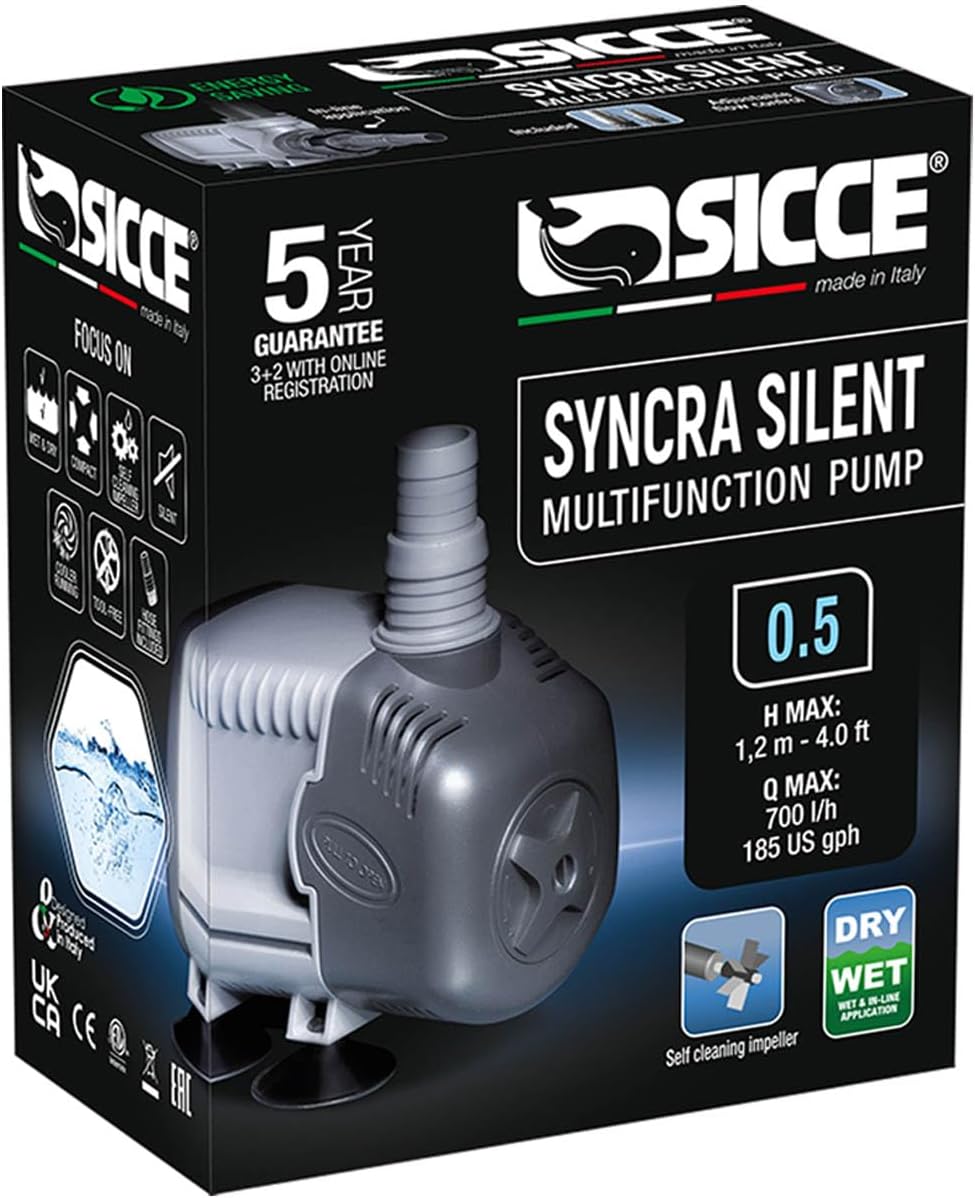
The Sicce Syncra Silent 0.5 is a compact submersible pump built for quiet, continuous circulation where energy use and noise matter. It delivers about 185 US gph (700 L/h) with an adjustable flow regulator and a maximum lift around 4 feet, making it suitable for small ponds, indoor fountains, and aquarium returns. Notable features include a 6-foot cord, tool-free maintenance, stepped hose fittings included in the box, thermal protection, and an AISI 316 stainless steel shaft for corrosion resistance. In practice the pump runs very quietly and the flow control lets you dial in circulation without additional valves. Its low 8 W draw keeps operating costs down, and the taller suction cups reduce vibration transfer to the tank or pond wall. The unit is aimed at applications that need reliable, unobtrusive water movement rather than high-head, high-volume pumping. Limitations are its modest head and flow compared with larger pumps and its indoor-focused specification, so it is not appropriate for large outdoor water features or heavy-duty filtration without staging multiple units.
Best for: Buyers who prioritize quiet, efficient circulation for small ponds, indoor fountains, or aquarium setups and want a durable pump that is easy to install and maintain.
Less Ideal for: People needing high-head or high-volume pumping for large outdoor ponds, heavy filtration systems, or long vertical lifts should consider larger, more powerful models.
- Very low power consumption (8 W) for energy-efficient continuous use
- Nearly silent operation with built-in flow regulator for fine tuning
- Tool-free maintenance and included stepped hoses make installation and upkeep simple
- Stainless steel shaft and thermal protection increase durability and safety
- Maximum head (~4 feet) and flow are modest compared with larger pond pumps
Verdict: If you need a near-silent, energy-sipping pump to provide reliable circulation in a small pond or fountain, this low-wattage Sicce Syncra Silent 0.5 is a top choice.
Jecod PP-377 Submersible Pond Fountain Pump (105 GPH, 5W)
| Flow Rate | 105 gpm |
|---|---|
| Maximum Lifting Height | 25 inches |
| Voltage | 120 volts |
| Horsepower | 5 watts |
| Power Source | ac/dc |
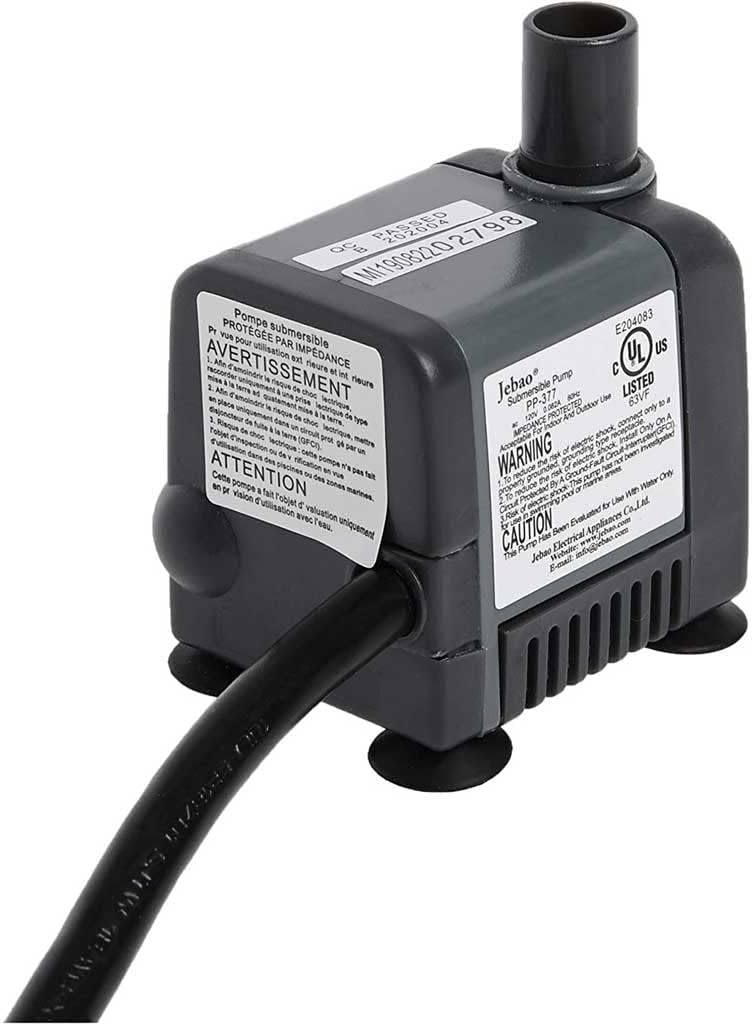
The Jecod PP-377 is a small submersible pond and fountain pump that moves about 105 gallons per hour while drawing only 5 watts, making it a good fit where energy use matters. It is used fully submerged and plugs into a standard AC outlet with an included transformer and power cord. The pump ships with two hose adapters (1/2 inch and 5/16 inch) so you can run a narrow fountain jet or a short circulation line; switching adapters can be tight so pliers may be helpful. Its 25 inch maximum lift lets it handle modest head heights for small water features and shallow recirculation setups. Because it is plastic and compact it is easy to hide in a pond skimmer or under a fountain bowl and operates quietly for minimal disturbance. Limitations are its modest flow and low lift compared with larger pond pumps, so it is not suitable for medium or large ponds or long runs of tubing. For small decorative ponds, tabletop fountains, or battery-sparing backyard setups the PP-377 offers efficient, unobtrusive water movement.
Best for: Buyers who prioritize energy efficiency and need a compact pump for small fountains, tabletop water features, or modest backyard ponds and want a simple plug-and-play solution.
Less Ideal for: Gardeners with larger ponds, long tubing runs, or features requiring high flow or high head should choose a more powerful, heavy-duty pump.
- Very low power draw at 5 watts for minimal energy use
- Compact, submersible design hides easily in small ponds or fountain bowls
- Comes with two hose adapters for different outlet sizes
- Quiet operation suitable for backyard or patio water features
- Limited flow and lift make it unsuitable for medium or large ponds
- Plastic construction may be less durable than heavy-duty metal-bodied pumps
Verdict: This pump is the best low-wattage choice for energy-conscious buyers who need quiet, compact circulation for small ponds and fountains.
DOMICA AM-118 3W Mini Submersible Water Pump (AC)

| Power | 3 Watt |
|---|---|
| Flow Rate | 50 GPH |
| Maximum Lifting Height | 2 feet |
| Power Source | AC 110-120V |
| Power Cord Length | 5.9ft |
The DOMICA AM-118 is a tiny, AC-powered submersible pump that delivers up to 50 GPH while drawing only 3 watts, making it a practical low-energy option for small water features. It is typically placed fully submerged in aquariums, tabletop fountains, or small pond setups and secured with the included suction cups. Notable features include an adjustable flow knob to fine-tune water movement, a 6 ft power cord for flexible placement, and a tool-free casing for simple cleaning and maintenance. Because it is AC 110-120V, it provides steady power without batteries but must never run dry or it can overheat or become noisy. The pump lifts water about 2 feet, so it works best for shallow recirculating setups rather than tall fountain jets. Expect basic plastic construction and straightforward serviceability rather than premium corrosion-resistant materials, but for low-wattage circulation in small installations it is energy efficient and easy to hide in the water.
Best for: Buyers who prioritize running costs and need a discreet, low-power pump for small fountains, tabletop features, aquariums, or very small pond recirculation.
Less Ideal for: Not a good choice for large ponds, tall fountain heads, or off-grid setups that require battery or solar power; those users should choose higher-flow or DC/solar-capable pumps.
- Very low power draw at 3 watts for energy-efficient continuous use
- Adjustable flow knob allows dialed-in water movement up to 50 GPH
- Compact size and included suction cups make hidden, flexible placement simple
- Tool-free disassembly for easy cleaning and basic maintenance
- AC-only design requires a nearby 110-120V outlet and is not battery or solar compatible
- Plastic construction may not be ideal for long-term outdoor exposure in harsh conditions
Verdict: If you need a budget-friendly, ultra-low-wattage pump to quietly circulate water in a small fountain or aquarium, this 3W submersible is a cost-effective pick.
PULACO 160 GPH Submersible Water Pump with Tubing
| Flow Rate | 160 GPH (600 L/H) |
|---|---|
| Maximum Lifting Height | 4 feet |
| Power | 10 Watt |
| Power Source | ac (120 volts) |
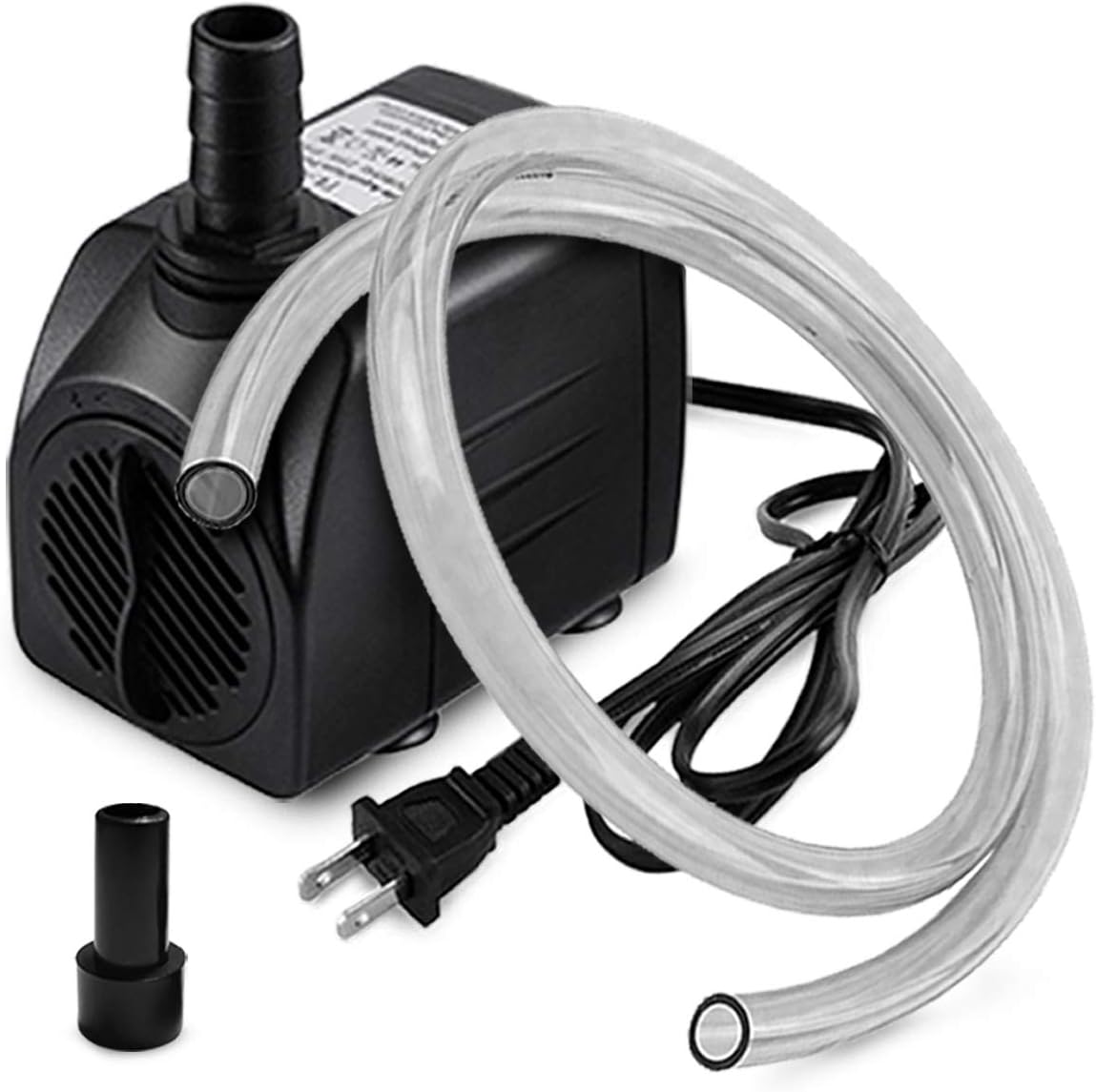
The PULACO 160 GPH submersible pump is a small, budget-friendly unit meant to circulate water in aquariums, tabletop fountains, and small ponds or garden features. It is designed to run fully submerged and includes a US plug and a 3.3 ft length of silicone tubing for basic hookups. Notable features are a claimed 160 GPH maximum flow, an adjustable flow valve for fine tuning output, a stainless steel shaft and copper-wound motor for corrosion resistance, and a relatively long power cord for flexible placement. In practice the 160 GPH rating is the open-flow maximum and flow will drop when plumbing or lift is added, so expect lower real-world output at the pump’s 4 ft lift limit. The pump is straightforward to disassemble for cleaning which helps with debris-prone garden use, but it does require regular maintenance to avoid clogs. It is mechanically simple and quiet for small outdoor fountains, though it is not large enough for medium to large ponds or heavy filtration tasks.
Best for: Buyers who need an inexpensive, easy-to-install pump for small water features or aquariums and prioritize quiet, low-power circulation over high flow.
Less Ideal for: People planning to move large volumes of water, run heavy filters, or service medium and large ponds should choose a higher-capacity pump instead.
- Compact submersible design works inside small tanks, fountains, and garden features
- Adjustable flow valve lets you dial output to the feature without extra fittings
- Stainless steel shaft and copper motor improve corrosion resistance and durability
- Easy to disassemble and clean to clear debris or salt buildup
- 160 GPH is an open-flow figure and real output will be lower when tubing or lift is added
- Not powerful enough for medium or large ponds or heavy filtration tasks
Verdict: A low-cost, compact submersible pump that delivers quiet, adjustable flow for small ponds and garden water features.
Choosing the Right Low Wattage Pond Pump: Key Factors to Consider
Matching Flow to Pond Size and Feature
Flow needs depend on total pond volume, desired turnover rate, and any lifted height for waterfalls or streams. For a small decorative pond or a container water garden, a pump that can turn over the pond volume once every hour to every three hours is usually sufficient. If you run a waterfall or long stream, pick a pump with higher head-rated flow so the output at the top of the fall still achieves the desired visual effect.
Underestimating head height is a common mistake. Manufacturers quote maximum flow at zero head; real output drops as water is lifted and loses pressure through tubing and fittings. Use a pump with a published curve and plan for 10 to 30 percent lower flow in real installation conditions so you are not disappointed with the finished feature.
Energy Use and Runtime
Low wattage pumps save energy but runtime adds up over seasons. Consider the pump's wattage relative to its gallons-per-hour performance so you can estimate daily and monthly electricity draw. A quieter pump that is also energy efficient will reduce both noise pollution and operating cost, especially if you run the pump 8 to 24 hours a day.
Also think about heat dissipation. Submersible pumps will warm the surrounding water slightly; in very small containers or during hot weather this can affect dissolved oxygen levels. Look for pumps designed for continuous duty with thermal protection to avoid premature motor shutdown.
Noise, Vibration, and Mounting
Noise is a major concern in residential gardens. Physical mounting and how the pump sits in the sump or pond will strongly affect perceived sound. Vibration transmitted into rockwork or liners can amplify noise. Choose pumps with vibration-dampening feet, rubberized housings, or flexible hose connections to reduce mechanical rumble.
Placement matters. Setting a pump on a firm, level surface with a basic foam mat or rubber pad and isolating it from hard masonry will typically quiet operation. Also consider whether the unit is fully submersible or external, since external pumps often need additional sound-insulating measures.
Filtration, Debris Handling, and Service Access
Low wattage pumps often sacrifice raw intake capacity for efficiency, so filter design and debris-handling matter more. If your pond collects leaves, algae clumps, or fish waste, a pump with an adequate prefilter or compatible external filter arrangement will reduce clogging and maintenance frequency. Strainer size and the ability to reverse or access the impeller without disassembling the entire unit make live maintenance simpler.
Consider whether the pump can be easily lifted out for winter storage or cleaned in place. Removable cartridges, tool-free access, and clear replacement-part availability will extend the useful life of a pump in a working garden environment.
Build Materials and Weather Resistance
Because pond pumps operate in wet conditions for long periods, material choice directly impacts longevity. Look for corrosion-resistant metals, high-grade plastics that resist UV and chemical breakdown, and sealed motor housings rated for submersion. Rubber O-rings, gaskets, and strain reliefs should be replaceable so you are not forced to discard the entire unit when a seal ages.
For outdoor installations, ask whether the unit tolerates freeze cycles or needs winter removal. Even low-wattage pumps exposed to sunlight or fluctuating temperatures benefit from rugged construction and protective coatings to avoid brittle cracking and corrosion over time.
Sizing the Pump for Waterfalls and Streams
Waterfalls and streams magnify the visual impact of a small pond but require extra flow and head capacity. Estimate the vertical lift from the pump's location to the top of the waterfall and add equivalent losses for tubing length and elbows. Use the pump's flow curve to confirm the flow you will get at that head.
If you want a strong sheet of water, target higher flow and accept a slightly larger pump. For gentle trickles or narrow streams, a lower-flow low-wattage pump can produce attractive movement with less noise and lower energy use.
- Measure vertical head and tubing length before choosing a pump
- Account for friction loss from fittings and flexible tubing
- Expect lower returns at the top of tall features and plan accordingly
Installing and Winterizing Low Wattage Pumps
Proper installation increases pump life and reduces noise. Mount submersible pumps on a solid base rather than on loose gravel. Use flexible hose or an anti-vibration pad where the pump contacts hard surfaces. Keep the intake clear of debris with prefilters or skimmer baskets sized to your pond's leaf load.
Winter care depends on local climate and pump design. In mild climates, continuous submersion of a properly rated pump is usually fine. In freezing climates, remove the pump or place it deep enough that it will not be exposed to surface ice. Clean and dry the pump before long-term storage, lubricate moving seals if specified, and test operation before reinstalling in spring.
- Use foam pads to reduce vibration transfer
- Keep intake screens clean to maintain flow
- Store or protect pumps if pond freezes solid
Power and Safety Considerations
Electric safety is critical around water. Use a ground-fault circuit interrupter (GFCI) on the pump circuit and follow local codes for outdoor wiring. Check that cord strain reliefs and plug seals are intact and that the cable is routed to avoid crushing or pinch points.
For solar or battery-powered setups, verify the pump's input voltage and start-up draw. Low wattage pumps are easier to run from modest solar arrays, but starting current can still exceed running current, so size controllers and batteries accordingly.
- Install GFCI protection on all outdoor pump circuits
- Inspect power cords regularly for abrasion or damage
- Confirm starting current for off-grid power solutions
Matching Tubing and Fittings
Pipe and hose size influence flow and head. Using undersized tubing increases friction loss and reduces effective flow at the feature. Verify the pump outlet size and choose rigid or flexible tubing that keeps elbows to a minimum. Use threaded adapters or barbed fittings with hose clamps to ensure leak-free connections.
If you plan to hide tubing under rockwork, use sturdier pipe to resist crushing and prevent kinks. For visible runs, smooth-bore tubing reduces turbulence noise and maintains consistent flow.
- Match tubing diameter to the pump outlet
- Minimize sharp bends and long runs
- Use hose clamps or proper adapters to prevent leaks
When to Use an External or Inline Pump
External or inline pumps can run cooler and are easier to service than submersibles, but they require dry, vented housing and protected electrical connections. For low wattage needs where sound is a prime concern, an external unit placed in a ventilated cabinet can be very quiet.
Submersible pumps are simple to install and less obtrusive visually. Choose an external pump when you need easier access for maintenance or when heat dissipation in a confined pond sump could be a problem.
- External pumps are easier to service and can be quieter
- Submersibles are compact and easier to conceal in small ponds
- Consider access and ventilation for external installations
How We Chose the Best Low Wattage Pond Pump
We selected pumps that demonstrate reliable circulation for small ponds, container water gardens, and fountain setups while using minimal electricity. Key filters included measured flow rate at realistic head heights, continuous runtime capability, and overall electrical efficiency to keep operating costs and heat output low. Durability metrics focused on sealed motor housings, corrosion-resistant materials, and serviceability such as cartridge or impeller access. Noise level under actual installation conditions was evaluated, giving preference to models with vibration-isolated mounts or muffled motor housings. Compatibility with common fittings, prefiltering needs, and safe operation for plants and wildlife were also screened. Excluded from consideration were high-wattage pumps intended for large ponds, models lacking published flow curves, and units with known sealing failures. The final list balances real-world flow performance, energy use, quiet operation, and construction quality so gardeners can choose a pump that meets their pond size and maintenance willingness.
FAQ
How do I pick the right wattage for a small pond?
Wattage alone is not the whole picture. Compare published flow rates at realistic head heights and calculate gallons per hour relative to pond volume. Aim for a turnover that matches your feature needs rather than a specific wattage figure.
Can a low wattage pump handle a waterfall?
Often yes, for small waterfalls or short streams. You must match flow and head. For taller falls or wide sheets of water, a higher flow output is needed even if it means stepping up wattage slightly.
How noisy are low wattage pumps compared with larger units?
Low wattage pumps are usually quieter but noise depends on mounting, vibration transfer, and intake turbulence. Proper isolation and secure placement reduce noise more effectively than simply choosing a lower wattage model.
Do low wattage pumps need special winter care?
Winter care depends on climate. In freezing areas, either remove the pump or submerge it below ice formation level. Clean and store the unit if instructed by the manufacturer to prevent seal damage and debris buildup.
How often should I clean the pump and prefilter?
Frequency depends on debris load and season. In leafy seasons or with heavy algae, check weekly. In low-debris conditions check monthly. Regular cleaning prevents cavitation, overheating, and reduced flow.
Can I run a low wattage pump on solar power?
Yes, many low wattage pumps pair well with small solar arrays, but confirm the pump's starting current and voltage requirements. Use a solar controller or battery buffer if you need continuous operation through cloudy periods.
Final Verdict
Choose a Low Wattage Pond Pump by matching realistic flow at the required head to your pond's volume and the visual effect you want. Prioritize pumps with published flow curves, good sealing, and easy access for cleaning to reduce downtime and extend service life. Balance lower energy draw against required flow and noise performance so you get efficient circulation without compromising the look or health of your pond.
