

Note: This article contains affiliate links. If you click on these links and make a purchase, I may earn a small commission at no extra cost to you. This helps support my research and content. Read my full affiliate disclosure here.
Mosquitoes make time outside less enjoyable and can spread diseases, so picking the right mosquito killer pesticide matters for safe, effective control. In outdoor gardens, patios, and yards you need treatments that actually reduce host-seeking activity, persist long enough for seasonal protection, and fit how you apply them. This guide shortlists the top options across common application styles and explains the criteria that matter for real-world use. Below you will find our top picks, with clear notes on application type, target pests, and who each option is best suited to.
Top Picks at a Glance
| Best Overall The best all-around choice for most situations | Atticus Talak 7.9% Indoor/Outdoor Bifenthrin Insecticide Concentrate (1 gal) |  |
| Best Quality Built to a higher standard if you want something more solid | Agrisel Bifenthrin Pro 7.9 Insecticide, 1 Gallon |  |
| Best Value The sweet spot between price and what you get | Cutter Backyard Bug Control Spray Concentrate, 32 oz (2 pack) |  |
| Best Budget The cheapest option that still gets the job done reliably | Spectracide Triazicide Insect Killer for Lawns & Landscapes, 32 oz |  |
| Highest Rated A top-rated pick with lots of positive feedback | Talstar One Insecticide Concentrate, 1 Gallon |  |
| Most Popular A crowd favorite that many people choose with confidence | Ortho Home Defense Insect Killer for Indoor & Perimeter, 1.33 gal. with Comfort Wand |  |
| Best Seller A high-volume bestseller chosen again and again | Atticus Talak 7.9% Bifenthrin Indoor/Outdoor Insecticide Concentrate, 32 oz |  |
Atticus Talak 7.9% Indoor/Outdoor Bifenthrin Insecticide Concentrate (1 gal)

| Active Ingredients | Bifenthrin |
|---|---|
| Formulation | Suspension Concentrate |
| Unit Count | 128 Fluid Ounces |
| Specification Met | EPA |
Talak 7.9% is a water-based bifenthrin concentrate meant as a flexible indoor and outdoor insect control product. You dilute the concentrate with water and apply it as a spray for perimeter barrier treatments, to turf, to ornamentals, or to interior baseboards and other problem areas. The label lists control of more than 75 pests including mosquitoes and ticks, and the formula is designed to kill on contact and provide residual control for up to three months. Practical benefits include a clear, odor-free spray that dries without staining and a bottle that allows easier small pours for accurate mixing. Important limitations are that mixed solutions should be used the same day and it is not approved for fogger use, so it is best for targeted spray applications rather than broadcast fogging. As with any bifenthrin product, users should follow label directions closely and consider nonchemical options for integrated mosquito management.
Best for: Buyers who want a single, versatile insecticide to treat both perimeter and landscape mosquito problems and prefer a product that delivers residual control without odors or visible residue.
Less Ideal for: People seeking a ready-to-use fogging or misting solution or those who need an insecticide they can pre-mix and store for later use.
- Broad-spectrum control listing more than 75 indoor and outdoor pests including mosquitoes and ticks.
- Water-based formula that dries clear, leaves no residue, and is odor-free for use around living areas.
- Long residual effect with label claim of up to three months of control per application.
- Mixes with water for adjustable application rates across lawns, landscapes, and surfaces.
- Bottle design supports easier small pours to reduce mess when measuring concentrate.
- Mixed spray cannot be stored and must be used the same day.
- Not approved for use in foggers, limiting application methods to direct sprays.
Verdict: A versatile, long-lasting bifenthrin concentrate that provides broad-spectrum mosquito and perimeter control for users who want one product for indoor and outdoor applications.
Agrisel Bifenthrin Pro 7.9 Insecticide, 1 Gallon

| Item Form | Liquid |
|---|---|
| Liquid Volume | 1 gallons |
Agrisel Bifenthrin Pro 7.9 is a one‑gallon liquid concentrate designed to control a wide range of outdoor pests, including stink bugs, ants, spiders, fleas, ticks, and mole crickets. Typically mixed with water and applied with a pump sprayer or hose-end applicator, the product is intended for use on lawns, ornamental plantings, and around building entry points. Notable features include a low use rate that stretches coverage per gallon and label guidance for application rates across vegetation densities. In practice it provides residual control when applied to foliage and perimeter areas, which helps reduce re‑infestation of stink bugs and other crawling insects. The formula is labeled to be safe for pets once surfaces are fully dry, and monthly reapplications are suggested for ongoing protection. Important limitations are that it is a chemical insecticide requiring careful handling and compliance with label restrictions, and some users may prefer non‑chemical or targeted traps for indoor or sensitive‑area control. Also sale restrictions prevent purchase in a few states, so check local rules before planning treatments.
Best for: Buyers who prioritize reliable, performance‑driven outdoor pest control for lawns or ornamental plantings and who are comfortable using concentrated insecticides responsibly.
Less Ideal for: Those seeking non‑chemical solutions, sensitive‑area treatments, or indoor‑only control should consider alternative methods.
- Broad spectrum efficacy against common outdoor pests including stink bugs
- Concentrated formula with low usage rates for economical coverage
- Labeled for multiple environments: lawns, ornamentals, and agricultural use
- Residual activity when applied to foliage and perimeter areas
- Requires careful mixing, PPE, and adherence to label directions as a chemical insecticide
- Not appropriate for indoor use or where chemical-free control is required
Verdict: Choose this bifenthrin concentrate if you want a performance‑focused, economical outdoor insecticide that delivers residual control against stink bugs and other common pests.
Cutter Backyard Bug Control Spray Concentrate, 32 oz (2 pack)

| Unit Count | 64 Fluid Ounces |
|---|---|
| Item Form | Spray |
| Target Species | Insects |
| Active Ingredients | Lambda Cyhalothrin |
This Cutter Backyard Bug Control Spray Concentrate is a hose‑end applicator concentrate designed to treat lawns, shrubs and other outdoor surfaces to reduce mosquitoes and a range of listed insects. You attach the QuickFlip hose‑end sprayer, walk the area and apply as a cover spray; the ready‑to‑mix nozzle meters water automatically so you do not need separate measuring. The formula lists lambda‑cyhalothrin as an active ingredient and claims up to 12 weeks of control and coverage for up to 5,000 sq ft per bottle, which makes it suitable for seasonal perimeter treatments and spot landscape applications. Practical benefits include easy application with the flip‑on nozzle, thorough foliar coverage when used as directed, and long residual control that reduces repeat treatments. Important limitations are that it is a pesticide so you must keep children and pets out of treated areas until dry, follow label restrictions for vegetables and sensitive areas, and avoid applications before rain or near drains or water bodies.
Best for: Buyers who want a simple, ready‑to‑use perimeter treatment to reduce mosquitoes and common yard insects across lawns and landscaped beds without frequent reapplication.
Less Ideal for: People who need an organic, pet‑safe, or water‑safe option for insect control or those who require frequent spot treatments in small container gardens.
- Hose‑end QuickFlip sprayer for fast, no‑mix application over large areas
- Claims up to 12 weeks of residual control, reducing the need for frequent reapplications
- Covers up to 5,000 sq ft per bottle for single‑treatment perimeter protection
- Works on lawns, shrubs and outdoor surfaces for flexible use around the yard
- Contains a synthetic pesticide ingredient and requires strict adherence to safety and label restrictions
- Not intended for use where runoff could reach water bodies or drains
Verdict: A convenient hose‑end concentrate that delivers broad yard coverage and long‑lasting mosquito and insect control with minimal setup.
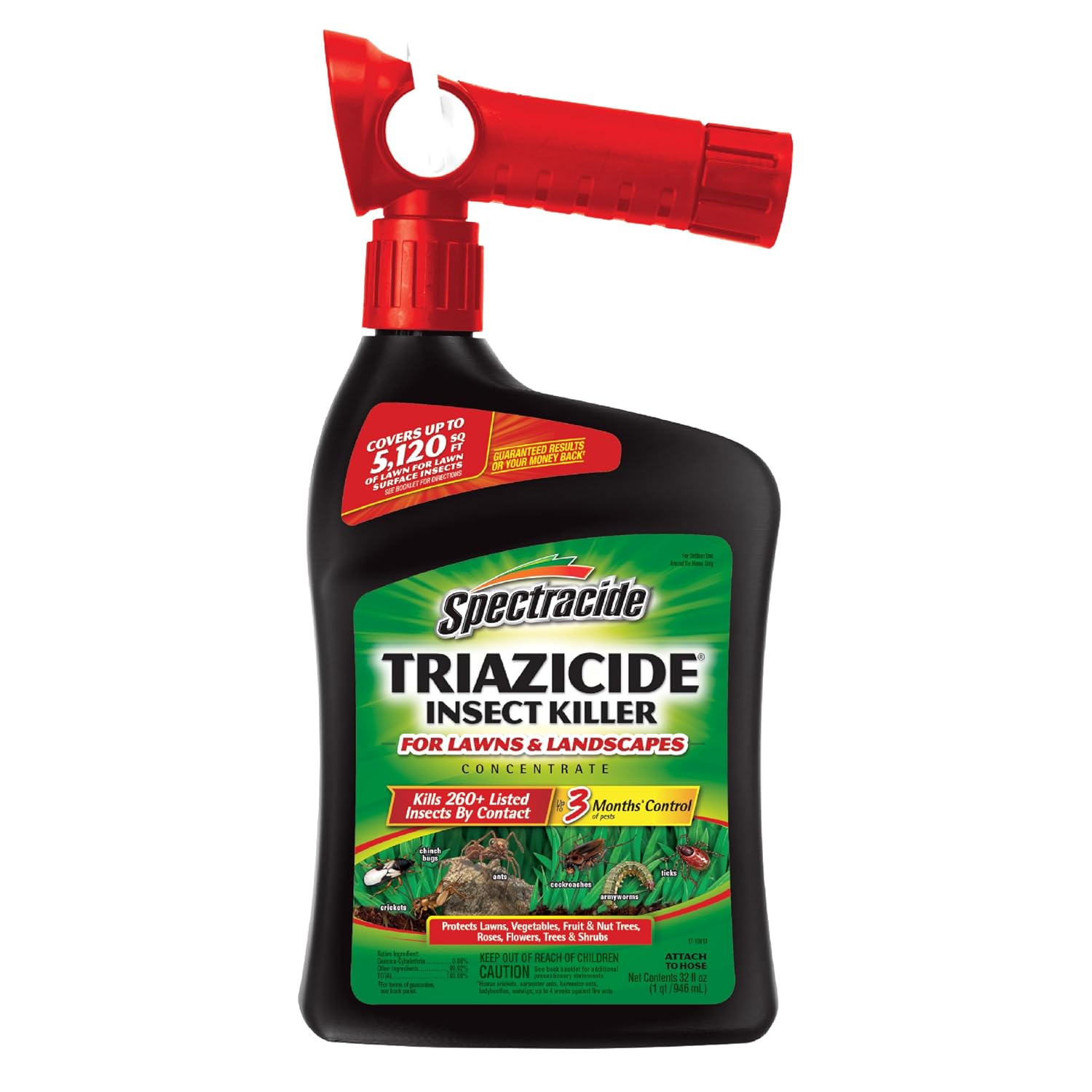
Spectracide Triazicide Insect Killer for Lawns & Landscapes, 32 oz
| Unit Count | 32 Ounce |
|---|---|
| Item Form | Spray |
| Target Species | Insects |
| Active Ingredients | Gamma-Cyhalothrin (0.08%) |
Spectracide Triazicide is a 32-ounce concentrate formulated to control more than 260 listed insects on lawns, flower beds, trees, shrubs and around vegetables. You mix the concentrate with water and apply it with a tank or hose-end sprayer; the ready-to-spray variant can attach to a garden hose for quicker application. The active ingredient, gamma-cyhalothrin, delivers fast contact kill for pests such as fleas, ticks, Japanese beetles and many surface insects, and the label claims protection for up to three months in some uses. It is non-staining when used as directed and can treat large areas, making it practical for whole-yard applications and targeted mound treatments like fire ants. Important limitations include toxicity to fish and bees, so it must not be applied near water or blooming plants, and the product requires careful handling and adherence to safety directions. Follow mixing rates and timing recommendations for best results and to minimize environmental risk.
Best for: Buyers who need an affordable, large-area solution to knock down common lawn and landscape pests and prefer a concentrate that stretches coverage when mixed.
Less Ideal for: People with small ornamental gardens near ponds, homeowners who prioritize pollinator-safe products, or those unwilling to follow pesticide safety precautions should consider gentler or targeted alternatives.
- Concentrate covers large areas so a single bottle treats many square feet when mixed correctly
- Fast-acting contact kill for a wide range of listed insects including fleas, ticks and Japanese beetles
- Versatile use on lawns, flower beds, trees, shrubs and around vegetables
- Non-staining when used as directed and available in hose-end ready-to-spray format for easier application
- Highly toxic to aquatic life and bees so it cannot be used near water or blooming plants
- Requires careful mixing and protective handling due to chemical toxicity
Verdict: A cost-effective, fast-acting concentrate for treating broad lawn and landscape pest problems when used with care and proper precautions.
Talstar One Insecticide Concentrate, 1 Gallon

| Active ingredient | Bifenthrin 7.9% |
|---|---|
| Formulation | Concentrate, water-based |
| Coverage intent | Perimeter and structural applications |
| Pest range | Controls 75+ pests including ticks |
Talstar One is a professional-strength bifenthrin concentrate designed to provide broad-spectrum control of ants, spiders, roaches, fleas, ticks, mosquitoes, and many other pests. You mix the concentrate with water and apply it as a perimeter spray around foundations, doors, and windows or to targeted cracks and crevices indoors. Notable features include a water-based, low-odor formula that dries clear and a residual effect that reduces the need for frequent reapplications on lawns, ornamentals, shrubs, and structural surfaces. For yards with tick pressure, treating perimeters and vegetation provides a dependable barrier that helps reduce tick encounters when applied according to label directions. The product is concentrated so one gallon treats large areas, which makes it efficient for seasonal maintenance across multiple structures. Important limitations are that it is a pesticide that requires careful handling and strict adherence to label rates and application restrictions, and it is not a ready-to-use spray so you will need appropriate mixing and application equipment for safe, effective coverage.
Best for: Buyers who prioritize reliable, residual pest control for yards and perimeters and who are comfortable using concentrated pesticides with proper safety practices.
Less Ideal for: Casual users who want a ready-to-use product or those unwilling to follow pesticide label precautions and use appropriate application equipment.
- Broad-spectrum control that includes ticks and common yard pests
- Concentrated formula covers large areas and is cost-efficient for seasonal treatments
- Water-based, low-odor formula dries clear and is suitable for outdoor living spaces
- Suitable for both perimeter and targeted indoor/structural applications
- Concentrate requires proper mixing and application equipment for safe use
- Contains bifenthrin so users must follow label precautions to protect people, pets, and beneficial insects
Verdict: Choose Talstar One when you need a concentrated, long-lasting perimeter treatment that reliably reduces tick pressure across yards and structures.
Ortho Home Defense Insect Killer for Indoor & Perimeter, 1.33 gal. with Comfort Wand

| Item Form | Spray |
|---|---|
| Target Species | Insects |
| Liquid Volume | 1.33 gallons |
| Active Ingredients | Bifenthrin 0.05%, Zeta-Cypermethrin 0.0125% |
This 1.33 gallon Ortho Home Defense spray is designed to treat both indoor problem spots and the outdoor perimeter of a home to reduce ants, roaches, spiders and many other crawling and flying insects. It comes with a battery-powered Comfort Wand that delivers a continuous spray so you can apply a uniform band around foundations, patios and entry points without bending or pumping. The formula with bifenthrin and zeta-cypermethrin is intended to kill on contact and establish a barrier that the manufacturer says lasts up to 12 months for ants, roaches and spiders on non-porous indoor surfaces. In real-world use that means fewer repeat treatments in busy yard perimeters and around doors and windows. The spray dries clear with minimal fumes which helps for indoor use near kitchens and living areas. Limitations are that this is a chemical insecticide so users should follow safety directions around children, pets and plants and it is not a specific solution for pests not listed on the label. For homeowners focused on strong, perimeter-level protection this product simplifies application and covers a large area per container.
Best for: Homeowners who want a performance-focused perimeter treatment to reduce recurring yard and entry-point insect problems and prefer a ready-to-use product that is easy to apply.
Less Ideal for: People seeking organic or non-chemical control methods or those who need a targeted solution for pests not listed on the label should consider alternative products.
- Includes battery-powered Comfort Wand for continuous, fatigue-free application
- Ready-to-use 1.33 gallon container covers large perimeters without mixing
- Formula creates a barrier claimed to provide up to 12 months protection against ants, roaches and spiders on non-porous indoor surfaces
- Dries clear and gives off minimal fumes, making indoor use more practical
- Contains synthetic insecticides so precautions are required around children, pets and ornamentals
- Protection claims are specific to certain species and surfaces so results vary by pest and conditions
Verdict: A powerful, ready-to-use perimeter and indoor spray for homeowners who want long-lasting, performance-oriented protection against common yard and household insects.
Atticus Talak 7.9% Bifenthrin Indoor/Outdoor Insecticide Concentrate, 32 oz

| Active Ingredient | Bifenthrin |
|---|---|
| Formulation | Suspension Concentrate |
| Liquid Volume | 32 fluid ounces |
| Length of Control | Up to three months |
| Target Species | Insects |
Talak 7.9% is a liquid concentrate for treating lawns, landscaping, outdoor living areas and indoor perimeter spots like baseboards and cabinets. You dilute the concentrate with water to create a spray for barrier treatments, spot applications or lawn mixes; label rates explain how much to mix per gallon depending on the use. The product uses bifenthrin, a proven broad-spectrum active ingredient, and the manufacturer states it controls over 75 species and can give residual control for as long as three months. Its water-based formula dries clear, leaves no odor or visible residue, and is not phytotoxic on plants when used per label. Practical benefits include flexible indoor and outdoor use, clear drying, and a bottle designed for easier pouring. Important limitations are that solutions should be mixed only for same-day use, it is not registered for sale in a few states, and it is not approved for fogger application, so professional-style misting methods are not appropriate.
Best for: Buyers who want a single, reliable product to protect yards, patios and building perimeters from a wide range of common pests and prefer conservative, label-driven application practices.
Less Ideal for: People seeking ready-to-use sprays or fogger-compatible products or those in states where this formulation is not registered should look at alternatives.
- Broad-spectrum control listed for 75+ indoor and outdoor pest species
- Water-based formula that dries clear and leaves no odor or residue
- Flexible label directions for lawns, landscapes, hardscapes and indoor perimeter treatments
- Long residual activity up to three months when applied at recommended rates
- Mixed spray solutions cannot be stored and must be used the same day
- Not approved for fogger application and not available for sale in some states
Verdict: A versatile, water-based bifenthrin concentrate that delivers long-lasting, broad-spectrum outdoor (and perimeter indoor) control when used according to the label.
Choosing the Right Mosquito Killer Pesticide: Key Factors to Consider
Target Species and Life Stage
Different mosquito species behave differently and may require distinct strategies. Some pesticides are formulated to kill adult mosquitoes on contact, while others include larvicidal ingredients that interrupt the life cycle in standing water. Knowing whether you are dealing with container-breeding species, floodwater mosquitoes, or saltmarsh types helps determine whether you need a product labeled for larval habitats, an adulticide with strong knockdown, or a combination approach.
Choosing a product labeled for the relevant life stage improves effectiveness and reduces wasted effort. For example, using an adulticide alone will not prevent new batches of adults emerging from untreated breeding sites, so pairing adult control with targeted larvicides is often necessary in persistent infestations.
Application Method and Equipment
Pesticide formulations vary between ready-to-use sprays, concentrates for hose-end sprayers, aerosol cans, or equipment-based applications like thermal foggers and ULV cold foggers. Each method has distinct reach, droplet size, and drift characteristics that affect how well the treatment penetrates vegetation and covers resting sites.
Select a product that matches the equipment you already have or are comfortable using. For small patios, a handheld pump sprayer with a low-volume broadcast spray may be sufficient. Larger yards may require a backpack sprayer or a fogger for quick perimeter treatments. Match droplet recommendations on the label to the intended use to avoid ineffective application or unnecessary drift.
Residual Activity and Reapplication Interval
Residual duration refers to how long treated surfaces remain lethal to mosquitoes. Some products provide hours of knockdown but little residual protection, while others leave a film that offers days or weeks of control under the right conditions. Outdoor factors such as sunlight, rain, mowing, and irrigation can shorten residual activity dramatically.
Plan applications around weather and expected outdoor use. If you need multi-week protection in a high-traffic yard, choose a product with demonstrated residual activity and follow label intervals for reapplication. For event-based short-term control, fast-acting, short-residual sprays may be preferable to minimize environmental exposure.
Safety Labeling and Personal Protective Equipment
Clear safety instructions on the label are essential for protecting applicators, household members, and pets. Labels should specify required personal protective equipment, buffer distances from water and pollinator-attractive plants, and reentry intervals after application. Products that have explicit, practical PPE guidance reduce the chance of misuse.
Evaluate how realistic the PPE requirements are for your use scenario. A product requiring heavy-duty respirators or long reentry times may be impractical for routine homeowner applications. Conversely, overly lax labeling can indicate an insufficient safety assessment, so balance practicality with conservative handling instructions.
Environmental and Non-target Considerations
Outdoor pesticide use comes with responsibility to limit harm to pollinators, aquatic life, and beneficial predators. Look for formulations and application instructions that minimize drift and avoid direct treatment of flowering plants and open water unless the product is specifically labeled for those uses. Products with labeled restrictions around aquatic organisms or bees require careful placement and timing.
Choose tactics that reduce non-target exposure, such as treating low vegetation and under-eaves rather than broadflower beds, applying during low pollinator activity times, and following buffer zone directions around ponds and streams.
Mixing, Storage, and Disposal Practicalities
Ease of mixing and straightforward storage instructions make routine applications safer and more likely to be done correctly. Concentrates should have clear dilution tables and marked measuring tools to prevent overconcentration. Storage guidance matters for seasonal users who may keep product on hand between mosquito seasons.
Responsible disposal instructions for leftover concentrate or empty containers protect the environment and keep household waste streams compliant with local regulations. Products with simple, labeled disposal steps reduce the risk of accidental misuse or improper dumping.
Matching Treatment Goals to Application Styles
Decide whether you want perimeter protection, spot treatment of mosquito resting sites, or larval control in breeding sources. Perimeter sprays focus on creating a barrier around structures and high-use areas, while spot treatments target dense vegetation, eaves, and shaded refuges where adults rest. Larvicides are applied directly to standing water to break the life cycle.
Your intended goal drives formulation choice and equipment. For quick event suppression, handheld aerosol or fogging options provide fast knockdown. For ongoing seasonal control, residual sprays applied to vegetation and structural surfaces often work best when used as part of an integrated plan.
- Perimeter sprays reduce host-seeking mosquitoes near patios and seating areas.
- Spot treatments focus control where mosquitoes rest during the day.
- Larvicides treat water sources to prevent future adult emergence.
Timing Applications for Best Results
Mosquitoes are most active at dawn and dusk, and many control products are more effective when applied during low wind and cooler temperatures. Applying treatments late in the day reduces ultraviolet breakdown and drift, improving residual performance. Avoid spraying if rain is expected within 24 hours unless the label permits.
For larvicides, timing relative to mosquito development matters. Treat standing water when larvae are present but before heavy emergence windows. Regular inspection of known breeding spots after rains helps determine whether follow-up treatments are needed.
- Apply adulticides during calm, low-light conditions for best coverage.
- Reassess treated areas after rain, mowing, or heavy foot traffic.
- Schedule larvicide applications based on observed larvae, not just routine dates.
Integrating Chemical Control with Nonchemical Methods
Chemical controls work best when combined with source reduction and habitat modification. Remove stagnant water from containers, maintain gutters, and repair screens to reduce breeding and reduce reliance on pesticides. Vegetation management that reduces dense shade and humidity lowers mosquito resting habitat and improves spray coverage.
Use baits, traps, or biological controls where appropriate to reduce population pressure. Nonchemical tactics reduce the number of applications needed and lower environmental exposure while stretching the effectiveness of chosen pesticide products.
- Eliminate standing water in containers and gutters.
- Thin dense plantings and trim groundcover near seating areas.
- Use larval control in permanent water sources alongside physical management.
Preparing for Safe Application
Read and follow label directions fully before mixing or applying any pesticide. Wear the recommended personal protective equipment and keep bystanders and pets away from treated areas for the time specified on the label. Measure concentrates carefully and avoid overapplication, which does not improve control but increases exposure risks.
Mix only the amount you will use in a single application when possible, and store any remaining concentrate in its original, clearly labeled container away from children and animals. Clean application equipment after use following label guidance to prevent cross-contamination.
- Follow label PPE and reentry time requirements.
- Measure and mix precisely to match labeled rates.
- Keep children and pets away from treated zones until safe.
Addressing Common Resistance and Efficacy Concerns
Some mosquito populations develop reduced sensitivity to certain classes of insecticides when the same active ingredient is used repeatedly. Rotate between products with different active ingredients and modes of action when long-term control is needed. Rotation helps maintain effectiveness without increasing chemical loads.
Combine adulticide applications with larval control and habitat modification to reduce selective pressure on mosquito populations. If control seems poor despite correct application, verify timing, application coverage, and product selection before assuming resistance.
- Rotate active ingredient classes when using repeated seasonal applications.
- Verify labeled application rates and target species to rule out misuse.
- Pair chemical control with habitat changes to limit selection pressure.
How We Chose the Best Mosquito Killer Pesticide
We prioritized products that deliver reliable mosquito knockdown while minimizing risks to people, pets, and beneficial insects. Our selection criteria focused on application method suitability, labeled target species and life stages, residual duration outdoors, and user safety features such as clear PPE guidance and low off-target drift. We also weighed formulation practicality, including ease of mixing, compatibility with common sprayers or foggers, and whether a product is licensed for residential outdoor use. Excluded items included products labeled only for indoor use, those lacking clear residential application instructions, and non-chemical controls presented as pesticides. We favored formulations whose residual activity and labeled use patterns match typical backyard scenarios: perimeter spraying, localized site treatment, and broadcast application from a distance. The same filters were used to ensure we compared options appropriate for small yards through larger properties, with attention to minimizing exposure and environmental impact.
FAQ
Can mosquito killer pesticides be used safely around children and pets?
Often yes, when applied according to the label. Products intended for residential outdoor use include specific reentry intervals and instructions to keep children and pets away until treated surfaces are dry. Choose formulations with conservative safety guidance if you have frequent outdoor activity.
How soon after application will I see fewer mosquitoes?
Many adulticides provide noticeable knockdown within hours, but the speed depends on formulation and application thoroughness. Larvicides will not reduce adult numbers immediately because they act on immature stages; expect results over several days as breeding cycles are interrupted.
Is it better to treat water sources or spray vegetation?
Both approaches target different points in the mosquito life cycle. Treating water with larvicides prevents new adults but does not remove existing adults. Vegetation sprays and perimeter applications reduce adult activity near living spaces. Use a mix of tactics based on where mosquitoes are breeding and resting.
How often should I reapply a mosquito control product?
Reapplication intervals depend on the product's labeled residual duration and environmental factors like rain or mowing. Some products need weekly repeat applications for sustained suppression, while others offer multiweek residual control. Always follow label directions for timing.
Will fogging remove mosquitoes from a large yard?
Fogging can provide fast, temporary reduction of adult mosquitoes in open areas, but its effect is typically short-lived and may not reach sheltered resting sites. For larger properties, combine fogging with perimeter treatments and larval control for longer-term suppression.
Can using pesticides increase harm to beneficial insects?
Yes, broad application can affect pollinators, predators, and aquatic organisms. To reduce non-target harm, avoid spraying flowering plants, follow buffer recommendations around water, and apply during times when pollinators are least active.
Final Verdict
Choosing the right mosquito killer pesticide depends on where mosquitoes breed and rest, the scale of the area you need to protect, and how much residual control you require. Prioritize products with clear safety instructions, appropriate labeled uses for the life stage you are targeting, and application methods that match your equipment and site layout. Combine chemical options with habitat reduction and larval control to get the best, longest-lasting results while minimizing environmental impact.
