

Note: This article contains affiliate links. If you click on these links and make a purchase, I may earn a small commission at no extra cost to you. This helps support my research and content. Read my full affiliate disclosure here.
If you manage several acres of pasture, woodland edge, or large yard, ordinary personal sprays are often impractical. You need solutions that protect wide areas, last through peak insect hours, and are safe around livestock, gardens, and children. This guide covers five top-picked mosquito repellents for acreage and explains how each type behaves in rural outdoor settings. We evaluate options by effective coverage, longevity, and practical use considerations so you can match a repellant strategy to your property layout and daily routines. Read on to understand the tradeoffs of area treatments, devices, and application schedules before picking the best fit for your land.
Top Picks at a Glance
| Best Overall The best all-around choice for most situations | SPARTAN MOSQUITO Pro Tech Tubes — 4‑Count 1‑Acre Mosquito Control |  |
| Best Quality Built to a higher standard if you want something more solid | Mosquito Magnet Patriot Plus Propane Mosquito Trap |  |
| Best Value The sweet spot between price and what you get | BioAdvanced Lawn Party Mosquito and Tick Control Concentrate, 1 Gallon |  |
| Highest Rated A top-rated pick with lots of positive feedback | Talstar One Insecticide Concentrate, 1 Gallon |  |
| Best Seller A high-volume bestseller chosen again and again | Summit Mosquito Dunk Tablets (20 Count) |  |
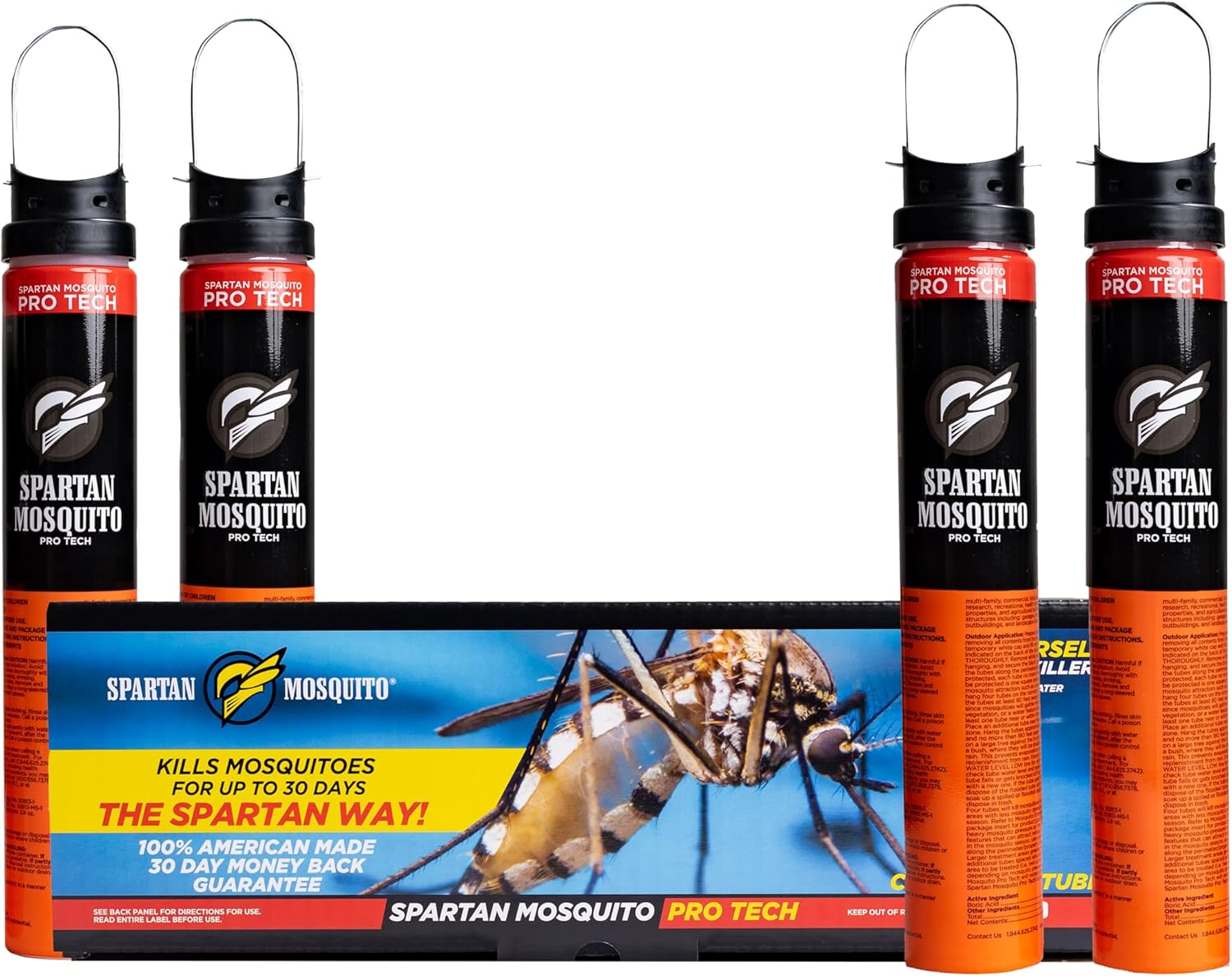
SPARTAN MOSQUITO Pro Tech Tubes — 4‑Count 1‑Acre Mosquito Control
| Unit Count | 4 Count |
|---|---|
| Item Form | Stick |
| Target Species | Mosquito |
| Specification Met | Epa Registered Solution |
| Active Ingredients | Sucrose, Yeast, Sodium Chloride |
The SPARTAN MOSQUITO Pro Tech tubes are a simple, no-power mosquito control option designed for perimeter protection of yards and large outdoor spaces. Each pack contains four sealed tubes that you activate by adding warm water and shaking, then hang in shaded locations roughly six feet high and spaced per label guidance. The active formula is EPA registered and lists sucrose, yeast, and sodium chloride among its ingredients; the product claims up to 30 days of continuous mosquito control and is intended to treat up to one acre with four tubes under moderate pressure. Practical benefits include fast setup, no electricity or batteries, and low maintenance beyond monthly replacement and water-level checks. Limitations are that effectiveness drops in heavy mosquito pressure or wooded, water-featured sites where more tubes are required, and the tubs must be positioned away from gathering areas. Also this approach provides area-wide suppression rather than immediate knockdown at a single spot, so expect gradual reduction rather than instant relief.
Best for: Buyers who want a low-effort, perimeter-focused mosquito suppression method for large yards and prioritize easy deployment and monthly maintenance over instant spot treatments.
Less Ideal for: People needing immediate knockdown for small patios, or those with very high mosquito pressure or dense wooded properties who should consider higher-capacity or professional treatments.
- Easy DIY setup—activate with warm water, shake, and hang; no tools or power required
- EPA registered formulation aimed at continuous control for up to 30 days
- Designed coverage of up to one acre with four tubes under normal mosquito pressure
- Low ongoing maintenance—monitor water level and replace monthly
- May require additional tubes and more frequent replacement in heavy mosquito pressure or complex landscapes
- Placement constraints—must be hung in shaded areas about 6 feet high and kept well away from people
Verdict: A straightforward, battery-free perimeter system that gives month-long mosquito suppression for up to one acre with minimal setup and upkeep.
Mosquito Magnet Patriot Plus Propane Mosquito Trap

| Target Species | Fly |
|---|---|
| Power Source | Corded Electric |
| Recommended Uses For Product | Outdoor |
| Manufacturer Warranty Description | 1 year warranty |
The Mosquito Magnet Patriot Plus is a propane-powered mosquito trap designed to reduce flying insect populations around yards of roughly one acre. It uses CounterFlow Technology to emit carbon dioxide, heat, and moisture that mimic human cues, then pulls mosquitoes and similar pests into a rigid net with a continuous vacuum. Typical use is simple: place the unit outdoors, connect a standard propane tank, plug into an outlet and run continuously; the manufacturer says noticeable reductions appear within 7 to 10 days. Notable features include a 50-foot power cord for flexible placement, a stable non-tipping base that holds the propane tank, and replaceable attractant packs and nets that each last about 21 days. The system is best for owners committed to continuous operation to break breeding cycles rather than occasional spot treatments. Important limitations are the need for ongoing propane, attractant and net replacements and reliance on electrical power, so running costs and periodic maintenance should be expected.
Best for: Homeowners who prioritize performance and want a long-term, hands-off method to reduce mosquitoes across a yard rather than short-term repellents; suitable for those willing to run and maintain a continuous control system.
Less Ideal for: People who need a portable or short-term solution, or those unwilling to manage recurring supply replacements and electrical hookups.
- CounterFlow Technology that emits CO2, heat, and moisture to effectively lure flying insects
- Continuous vacuum capture into a rigid net to remove breeding females rather than just repelling bugs
- 50-foot power cord for flexible outdoor placement
- Sturdy, non-tipping design that securely holds a propane tank for stable operation
- Requires ongoing propane, attractant packs, and replacement nets, which add running costs
- Needs continuous electrical power and propane to be effective so it is not a one-time solution
Verdict: Choose this trap if you want a performance-focused, continuous propane-powered system that actively reduces mosquito populations across a yard rather than temporary relief.
BioAdvanced Lawn Party Mosquito and Tick Control Concentrate, 1 Gallon

| Volume | 1 gallon concentrate |
|---|---|
| Coverage potential | Makes up to 42 gallons of spray |
| Active ingredients | Cinnamon oil 2.0%, Peppermint oil 2.0%, Clove oil 2.0% |
BioAdvanced Lawn Party is a concentrated, plant‑based lawn spray designed to reduce mosquitoes, ticks, flies and adult Japanese beetles across large yards. You mix 3 fl oz per gallon of water in a tank or dial sprayer to treat turf, ornamentals, fruit trees and vegetable areas; one gallon of concentrate yields up to 42 gallons of finished spray so a single bottle covers a lot of acreage. Its active formulation uses cinnamon, clove and peppermint oils and is advertised to start working immediately and dry in about an hour, which makes it practical for prepping bug‑free outdoor gatherings. The product is positioned as safe for kids and pets once the spray is dry when directions are followed. Important limitations are that effectiveness will vary with pest pressure and weather and that essential‑oil repellents generally provide shorter residual control than synthetic options, so you may need more frequent applications on heavy‑infestation acres.
Best for: Buyers who want a concentrated, lower‑toxicity lawn spray that covers large areas and prefer to use botanical ingredients while balancing practicality and cost per treated acre.
Less Ideal for: People who need long residual control with infrequent applications or who require guaranteed commercial‑grade pest suppression over extensive acreage should consider other specialized products.
- High concentrate yield: 1 gallon makes up to 42 gallons of spray for broad coverage
- Uses botanical actives (cinnamon, clove, peppermint) rather than synthetic pyrethroids
- Dries quickly and is intended to be safe for family and pets after drying
- Works on multiple listed pests including mosquitoes, ticks, flies and adult Japanese beetles
- Botanical oils typically give shorter residual protection than synthetic insecticides
- Performance can be weather dependent and may require reapplication on larger or heavily infested properties
Verdict: If you want a high‑yield, plant‑based concentrate to treat large yards with a quick‑drying spray, this product delivers broad coverage using botanical actives.
Talstar One Insecticide Concentrate, 1 Gallon

| Active ingredient | Bifenthrin 7.9% |
|---|---|
| Formulation | Concentrate, water-based |
| Coverage intent | Perimeter and structural applications |
| Pest range | Controls 75+ pests including ticks |
Talstar One is a professional-strength bifenthrin concentrate designed to provide broad-spectrum control of ants, spiders, roaches, fleas, ticks, mosquitoes, and many other pests. You mix the concentrate with water and apply it as a perimeter spray around foundations, doors, and windows or to targeted cracks and crevices indoors. Notable features include a water-based, low-odor formula that dries clear and a residual effect that reduces the need for frequent reapplications on lawns, ornamentals, shrubs, and structural surfaces. For yards with tick pressure, treating perimeters and vegetation provides a dependable barrier that helps reduce tick encounters when applied according to label directions. The product is concentrated so one gallon treats large areas, which makes it efficient for seasonal maintenance across multiple structures. Important limitations are that it is a pesticide that requires careful handling and strict adherence to label rates and application restrictions, and it is not a ready-to-use spray so you will need appropriate mixing and application equipment for safe, effective coverage.
Best for: Buyers who prioritize reliable, residual pest control for yards and perimeters and who are comfortable using concentrated pesticides with proper safety practices.
Less Ideal for: Casual users who want a ready-to-use product or those unwilling to follow pesticide label precautions and use appropriate application equipment.
- Broad-spectrum control that includes ticks and common yard pests
- Concentrated formula covers large areas and is cost-efficient for seasonal treatments
- Water-based, low-odor formula dries clear and is suitable for outdoor living spaces
- Suitable for both perimeter and targeted indoor/structural applications
- Concentrate requires proper mixing and application equipment for safe use
- Contains bifenthrin so users must follow label precautions to protect people, pets, and beneficial insects
Verdict: Choose Talstar One when you need a concentrated, long-lasting perimeter treatment that reliably reduces tick pressure across yards and structures.
Summit Mosquito Dunk Tablets (20 Count)

| Unit Count | 20 Count |
|---|---|
| Item Form | Tablets |
| Target Species | Insects |
| Specification Met | EPA |
| Active Ingredients | Bacillus thuringiensis subspecies israelensis |
These Summit Mosquito Dunks are small tablet blocks impregnated with Bacillus thuringiensis israelensis (BTI) that you drop into any standing water to target mosquito larvae before they become biting adults. Typical use is simple: place one dunk in birdbaths, rain barrels, ponds, planters with pooled water, or other stagnant water and replace roughly monthly. The active BTI targets only mosquito larvae so it is safe around people, pets, birds and fish when used as directed, making it well suited for gardens where wildlife safety matters. Each dunk treats an area of surface water and remains effective for about 30 days, which reduces the need for frequent reapplication. Limitations are that they only work where larvae develop in standing water so they will not affect adult mosquitoes or sources that drain quickly, and you need to monitor water levels and replace drowns when they dissolve or are removed by weather. For gardeners who want a low-impact, targeted way to cut local mosquito populations, these are an easy, hands-off option.
Best for: Gardeners who prioritize low-risk, wildlife‑friendly mosquito control and want a simple, hands‑off way to reduce larvae in standing water around their yard.
Less Ideal for: People needing rapid relief from adult mosquito bites or those whose mosquito problems originate from nonstanding water breeding sites.
- Targets mosquito larvae specifically using BTI, minimizing harm to other wildlife
- Each dunk remains effective for about 30 days, reducing application frequency
- Easy to use—simply place in standing water without mixing or measuring
- Suitable for use in birdbaths, ponds, rain barrels and other garden water features
- Does not kill adult mosquitoes so additional measures are needed for immediate biting control
- Ineffective in flowing or frequently emptied water where larvae do not persist
Verdict: Use these BTI mosquito dunks for an easy, wildlife-safe monthly treatment to prevent mosquito larvae in garden standing water.
Choosing the Right Mosquito Repellent for Acreage: Key Factors to Consider
Coverage Area and Placement
How far a single treatment or device protects matters most on acreage. A product that claims effective perimeter control for a few hundred square feet will not scale well to multiple acres. Consider whether the method creates a treated zone, such as a misted perimeter, or a distributed effect, like multiple bait stations or repellent-emitting devices. Think about natural features too. Trees, tall grass, and buildings create mosquito habitat pockets where treatment needs to be focused.
Placement affects both efficacy and material needs. Devices mounted on posts or trees should be positioned to create overlapping zones rather than relying on a single unit. For liquid or granular treatments, plan where runoff or water bodies may reduce effective coverage and adjust quantities accordingly.
Duration and Reapplication Schedule
On acreage you want treatments that last through the critical evening and early morning feeding times to reduce application frequency. Duration varies by active ingredient and delivery method. Some area sprays provide a few days of knockdown, while other systems use slow-release formulations or continuous-emission devices to give weeks of protection per refill.
Factor in the labor and cost of reapplication. Products that require daily or weekly attention may be impractical on large properties unless you have an automated system or a regular maintenance plan. Also account for seasonal shifts when mosquitoes surge, which may require more frequent applications during peak months.
Safety for People, Pets, and Livestock
When treating acres that include pastures, gardens, or family spaces, safety is essential. Active ingredients differ in their toxicity profiles and recommended buffer zones around water, food crops, and animal areas. Choose products with clear label instructions about exposure risk and reentry intervals for treated zones.
Consider ways to limit non-target exposure. For example, targeted perimeter treatments reduce chemical contact with interior paddocks, and stationary devices with directed outputs can be mounted away from feeding or resting areas. For livestock handling and children's play areas, prefer methods with lower systemic risk and documented safe-use guidance.
Weather Resistance and Environmental Impact
Wind, rain, temperature, and UV exposure all influence how well a repellent holds up across acreage. Sprays and mists can drift or wash away in rain, reducing effectiveness and potentially creating uneven control. Slow-release systems may be designed to withstand weather better, but extreme conditions still shorten their useful life.
Environmental impact matters on larger properties because runoff or drift affects nearby ponds and beneficial insects. Review product labels for restrictions near water and for guidance on protecting pollinators. Choosing lower-toxicity formulations or placement strategies that avoid sensitive habitats helps balance control with stewardship.
Ease of Application and Maintenance
Large properties benefit from solutions that minimize hands-on time. Consider whether the product requires manual backpack spraying, mechanical misting rigs, periodic refills, or simple battery changes. Ease of application affects how often you will need to tend the system and whether you will need extra equipment or professional help.
Maintenance also includes storage and safe handling of active materials. Products with simple cartridge swaps or pre-measured refills reduce the chance of dosing errors. If the system uses electricity or fuel, check accessibility to power and the logistics of servicing remote parts of the property.
Cost of Coverage Over Time
Upfront price is only part of the equation when protecting acreage. Calculate ongoing costs like replacement cartridges, chemical refills, fuel for powered sprayers, or professional reapplications. Some approaches have higher initial investment but lower recurring expenses, while others are cheap to start but expensive to maintain during an active mosquito season.
Budget realistically for peak months and factor in potential savings from reduced nuisance and disease risk. Also consider non-monetary costs such as time spent applying treatments and the effort to monitor and adjust placements across diverse terrain.
Types of Area Repellent Strategies
There are several broad approaches to controlling mosquitoes across acreage, each suited to different land layouts and maintenance preferences. Thermal fogging and ULV misting apply a cloud of insecticide over an area and are useful for rapid knockdown but often require equipment and careful timing.
Passive bait stations and lure-and-kill devices attract and remove mosquitoes over time with minimal intervention. Stationary repellent emitters or propane-powered devices create a continuous barrier that reduces mosquito activity near gathering areas. Each strategy has tradeoffs in terms of labor, coverage consistency, and non-target impact.
- Misting systems: deliver broad coverage quickly but need pumps and tanks
- Bait or lure stations: low maintenance, gradual population reduction
- Continuous emitters: provide steady protection around patios or cabins
- Targeted sprays: flexible placement for problem spots like wetlands
Planning a Perimeter and Hotspot Treatment
Start by mapping where people and animals spend time and where mosquitoes breed. Focus treatments on perimeter zones and habitat edges rather than blanket-applying across the entire property. This conserves product and reduces non-target exposure.
Hotspots such as marshy drainages, dense brush, and irrigation ditches deserve concentrated attention. Combining a perimeter barrier with targeted intervention at these hotspots often yields better results than trying to cover every square foot equally.
- Sketch usual activity areas and locate nearby water or shade
- Treat edges and concentrated breeding sites first
- Use overlapping zones rather than single-point reliance
Seasonal Timing and Integrated Management
Mosquito pressure changes through the season, so schedule heavier interventions during peak emergence and scale back to maintenance afterward. Early-season habitat reduction, such as clearing clogged ditches and removing standing containers, reduces the number of mosquitoes that need chemical control.
Integrated management pairs habitat modification with area repellents to reduce reliance on any single method. Regular monitoring helps you adjust strategies and avoid unnecessary applications when populations fall naturally.
- Do habitat cleanup in spring to reduce breeding
- Increase area treatments at peak summer emergence
- Monitor and taper interventions in late season
Safety Best Practices for Large-Scale Use
When applying repellents across acres, follow label directions for buffer zones, reentry times, and approved application methods. Wear appropriate protective gear when handling concentrated products and keep chemicals locked in proper storage.
Communicate with family, workers, and neighbors about scheduled treatments so people and animals can avoid treated areas during the specified intervals. Also consider weather windows to avoid applications just before rain or strong crosswinds that cause drift.
- Read and follow label restrictions near water and food crops
- Post notices for scheduled large-area treatments
- Avoid applications in high wind or before heavy rain
Maintaining Long-Term Control Without Overuse
Rotate strategies to reduce the chance of reduced effectiveness from repeated single-method reliance. For example, combine source reduction and physical barriers with periodic area treatments only when monitoring indicates a need. This reduces environmental loading and prolongs the useful life of any chemical or device.
Keep records of application dates, treated zones, and observed results. Over time you will refine placement and schedule so you use fewer products while maintaining comfortable, usable outdoor space.
- Combine non-chemical and chemical tactics
- Log treatments and outcomes to refine timing
- Adjust density of devices rather than increasing dose
How We Chose the Best Mosquito Repellent for Acreage
We shortlisted products that are designed to protect large outdoor spaces and that offer realistic, repeatable coverage for acreage settings. The editorial filters prioritized agents and delivery methods with documented field-style performance for area control rather than only personal protection. We focused on durability of effect, measured coverage area per treatment, and how easy each option is to apply or maintain across acres. Safety around people, pets, and nearby planting was a determining factor, as was the availability of clear reapplication intervals and instructions for use in farm or homestead settings. We excluded treatments meant only for small patios or single-person use and any products without explicit outdoor-area guidance. Final considerations included weather resistance, refill and supply logistics for ongoing control, and the presence of clear labels or guidance about non-target impacts.
FAQ
How large an area can a single treatment protect on acreage?
Coverage varies widely by delivery method. A single misting application might protect a few hundred to a few thousand square feet temporarily, while continuous emitter systems protect a defined perimeter around themselves. On acreage, expect to need multiple units or repeat treatments to cover all activity areas.
Are continuous-emission devices safe around livestock and bees?
Safety depends on the active ingredients and label instructions. Some devices use attractants and insecticides that are targeted and have low non-target impacts when used as directed. Always follow buffer recommendations near water and flowering plants to reduce risks to pollinators.
Can I rely on timed fogging or misting alone for season-long control?
Timed fogging can give rapid reductions but usually does not provide season-long suppression by itself. Integrating habitat changes, targeted interventions at breeding sites, and monitoring populations offers more reliable long-term control.
What weather conditions reduce effectiveness?
Rain can wash away recent applications and strong wind can disperse sprays beyond intended zones. Hot, dry conditions can reduce mosquito activity but also affect how some formulations volatilize. Plan treatments for calm, dry periods when labels recommend doing so.
How often should I check or refill passive stations on large properties?
Check intervals depend on the device design but a practical approach is to inspect stations every 2 to 4 weeks during peak season. More frequent checks may be necessary after heavy rain or if you notice increased mosquito activity.
Final Verdict
On acreage, prioritize methods that give broad, reliable coverage with manageable reapplication needs and clear safety guidance. Focus first on mapping high-use areas and breeding hotspots, then choose strategies that match your labor capacity and stewardship goals. Balance rapid knockdown options with slower-release or passive systems to reduce hands-on time while keeping control effective. With careful placement, regular monitoring, and attention to label instructions, you can create usable outdoor space across multiple acres while minimizing non-target impacts.
