

Note: This article contains affiliate links. If you click on these links and make a purchase, I may earn a small commission at no extra cost to you. This helps support my research and content. Read my full affiliate disclosure here.
If you spend time entertaining, gardening, or relaxing on a large property, the wrong repellent solution can leave mosquitoes dictating when you go outside. Mosquito repellent choices differ by how much area they cover, how long they work, and how they fit into yard layout and vegetation. This guide compares seven shortlisted options that are suited to larger lawns and acreage and explains the practical tradeoffs you will face. We evaluated products based on how far a unit protects, how long protection lasts, and how it integrates into a real yard. Read on to find which features matter most for preserving outdoor time after dusk.
Top Picks at a Glance
| Best Overall The best all-around choice for most situations | SPARTAN MOSQUITO Pro Tech Tubes — 4‑Count 1‑Acre Mosquito Control |  |
| Best Quality Built to a higher standard if you want something more solid | Wondercide Flea, Tick & Mosquito Yard Spray Refill Starter Kit (32 oz RTU + 16 oz Concentrate) |  |
| Best Value The sweet spot between price and what you get | Cutter Backyard Bug Control Spray Concentrate, 32 oz (2 pack) |  |
| Best Budget The cheapest option that still gets the job done reliably | Summit Mosquito and Gnat Barrier Spray, 64 oz (covers 10,000 sq ft) |  |
| Highest Rated A top-rated pick with lots of positive feedback | Talstar One Insecticide Concentrate, 1 Gallon |  |
| Most Popular A crowd favorite that many people choose with confidence | Mighty Mint Peppermint Oil Insect Repellent Spray, 1 Gallon |  |
| Best Seller A high-volume bestseller chosen again and again | Atticus Talak 7.9% Bifenthrin Indoor/Outdoor Insecticide Concentrate, 32 oz |  |
SPARTAN MOSQUITO Pro Tech Tubes — 4‑Count 1‑Acre Mosquito Control
| Unit Count | 4 Count |
|---|---|
| Item Form | Stick |
| Target Species | Mosquito |
| Specification Met | Epa Registered Solution |
| Active Ingredients | Sucrose, Yeast, Sodium Chloride |
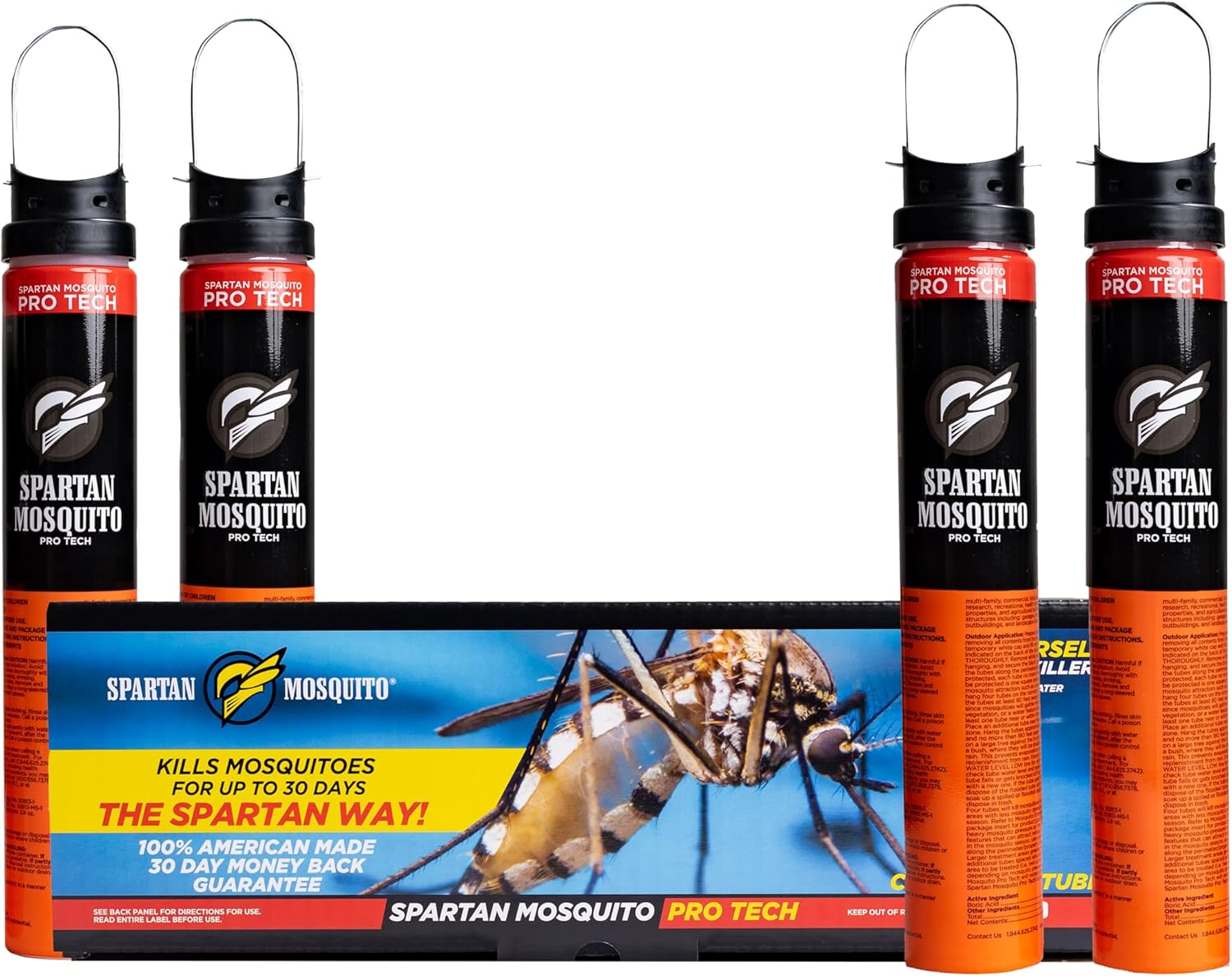
The SPARTAN MOSQUITO Pro Tech tubes are a simple, no-power mosquito control option designed for perimeter protection of yards and large outdoor spaces. Each pack contains four sealed tubes that you activate by adding warm water and shaking, then hang in shaded locations roughly six feet high and spaced per label guidance. The active formula is EPA registered and lists sucrose, yeast, and sodium chloride among its ingredients; the product claims up to 30 days of continuous mosquito control and is intended to treat up to one acre with four tubes under moderate pressure. Practical benefits include fast setup, no electricity or batteries, and low maintenance beyond monthly replacement and water-level checks. Limitations are that effectiveness drops in heavy mosquito pressure or wooded, water-featured sites where more tubes are required, and the tubs must be positioned away from gathering areas. Also this approach provides area-wide suppression rather than immediate knockdown at a single spot, so expect gradual reduction rather than instant relief.
Best for: Buyers who want a low-effort, perimeter-focused mosquito suppression method for large yards and prioritize easy deployment and monthly maintenance over instant spot treatments.
Less Ideal for: People needing immediate knockdown for small patios, or those with very high mosquito pressure or dense wooded properties who should consider higher-capacity or professional treatments.
- Easy DIY setup—activate with warm water, shake, and hang; no tools or power required
- EPA registered formulation aimed at continuous control for up to 30 days
- Designed coverage of up to one acre with four tubes under normal mosquito pressure
- Low ongoing maintenance—monitor water level and replace monthly
- May require additional tubes and more frequent replacement in heavy mosquito pressure or complex landscapes
- Placement constraints—must be hung in shaded areas about 6 feet high and kept well away from people
Verdict: A straightforward, battery-free perimeter system that gives month-long mosquito suppression for up to one acre with minimal setup and upkeep.
Wondercide Flea, Tick & Mosquito Yard Spray Refill Starter Kit (32 oz RTU + 16 oz Concentrate)

| Item Volume | 32 fluid ounces |
|---|---|
| Scent Name | Cedarwood |
| Item Form | Aerosol |
| Material Features | Natural |
| Brand Name | Wondercide |
This Wondercide starter kit combines a 32 oz ready-to-use hose-attach spray with a 16 oz concentrate to treat yards for fleas, ticks, and mosquitoes using cedarwood and other plant-derived essential oils. You attach the RTU bottle to a garden hose and spray patios, lawns, kennels, flower beds and other outdoor surfaces; the concentrate can be mixed with warm water to refill the sprayer and extend coverage. The formula is marketed as natural and safe for outdoor use around people, dogs and cats when directions are followed, and the label emphasizes no wait time to reenter treated areas. In practice the product is convenient for routine perimeter treatments and spot applications across large areas and is easy to apply without special equipment. Limitations are that effectiveness will depend on correct application, water pressure and coverage patterns, and results for heavy infestations may require repeat treatments or complementary approaches. The kit is best for homeowners wanting a plant-based, easy-to-use yard treatment rather than a professional-grade pesticide.
Best for: Homeowners who prioritize a reliable, easy-to-use outdoor pest treatment and prefer plant-based ingredients for routine perimeter spraying around lawns, patios, and pet areas.
Less Ideal for: People who need an immediate knockdown for severe indoor infestations or who require professional-grade chemical control should consider alternative or supplemental products.
- Includes both a ready-to-use hose-attach spray and a concentrate for refilling
- Plant-powered formula using cedarwood essential oil and no artificial dyes or fragrances
- Quick application with no wait time to reenter treated outdoor areas
- Advertised safe for use around people and pets when directions are followed
- Performance depends on water pressure, walking speed, and application coverage
- May require repeated treatments or additional control methods for heavy infestations
Verdict: A convenient, plant-powered yard spray kit that delivers dependable, easy perimeter protection against fleas, ticks, and mosquitoes for routine home use.
Cutter Backyard Bug Control Spray Concentrate, 32 oz (2 pack)

| Unit Count | 64 Fluid Ounces |
|---|---|
| Item Form | Spray |
| Target Species | Insects |
| Active Ingredients | Lambda Cyhalothrin |
This Cutter Backyard Bug Control Spray Concentrate is a hose‑end applicator concentrate designed to treat lawns, shrubs and other outdoor surfaces to reduce mosquitoes and a range of listed insects. You attach the QuickFlip hose‑end sprayer, walk the area and apply as a cover spray; the ready‑to‑mix nozzle meters water automatically so you do not need separate measuring. The formula lists lambda‑cyhalothrin as an active ingredient and claims up to 12 weeks of control and coverage for up to 5,000 sq ft per bottle, which makes it suitable for seasonal perimeter treatments and spot landscape applications. Practical benefits include easy application with the flip‑on nozzle, thorough foliar coverage when used as directed, and long residual control that reduces repeat treatments. Important limitations are that it is a pesticide so you must keep children and pets out of treated areas until dry, follow label restrictions for vegetables and sensitive areas, and avoid applications before rain or near drains or water bodies.
Best for: Buyers who want a simple, ready‑to‑use perimeter treatment to reduce mosquitoes and common yard insects across lawns and landscaped beds without frequent reapplication.
Less Ideal for: People who need an organic, pet‑safe, or water‑safe option for insect control or those who require frequent spot treatments in small container gardens.
- Hose‑end QuickFlip sprayer for fast, no‑mix application over large areas
- Claims up to 12 weeks of residual control, reducing the need for frequent reapplications
- Covers up to 5,000 sq ft per bottle for single‑treatment perimeter protection
- Works on lawns, shrubs and outdoor surfaces for flexible use around the yard
- Contains a synthetic pesticide ingredient and requires strict adherence to safety and label restrictions
- Not intended for use where runoff could reach water bodies or drains
Verdict: A convenient hose‑end concentrate that delivers broad yard coverage and long‑lasting mosquito and insect control with minimal setup.
Summit Mosquito and Gnat Barrier Spray, 64 oz (covers 10,000 sq ft)

| Item Volume | 0.5 gallons |
|---|---|
| Unit Count | 64 Ounce |
| Scent Name | Unscented |
| Item Form | Aerosol |
This Summit barrier spray applies as a hose-end aerosol and is formulated with permethrin to kill and repel mosquitoes, gnats, ticks, fleas and several other listed insects. It is typically used to treat perimeter vegetation, fences, decking and other outdoor resting sites to create a protective barrier that the manufacturer says lasts up to four weeks. The 64 ounce container is intended to cover roughly 10,000 square feet, which makes it a practical option for treating large yards without frequent reapplication. Practical benefits include broad-spectrum control, reasonably long residual activity, and the convenience of a hose-end applicator for fast coverage. Important limitations are that it is an insecticide requiring careful handling around people, pets and pollinators, and it is meant for outdoor surface application rather than direct fogging or indoor use. Also, like all chemical barriers, effectiveness depends on correct application and environmental conditions such as heavy rain or dense vegetation.
Best for: Homeowners with large yards who want an affordable, easy-to-apply chemical barrier to reduce mosquito and gnat activity across broad outdoor areas.
Less Ideal for: People seeking organic or pollinator-safe options, or those who need indoor or fogging-style mosquito control.
- Contains permethrin for residual control of mosquitoes and other listed pests
- 64 oz container formulated to cover up to 10,000 square feet for large-area treatment
- Hose-end aerosol design speeds application across fences, vegetation and decking
- Advertised residual activity up to four weeks, reducing reapplication frequency
- Contains a synthetic insecticide that requires careful use around people, pets and pollinators
- Effectiveness can be reduced by heavy rain, irrigation or dense foliage that blocks coverage
Verdict: A cost-effective, hose-end permethrin spray that treats up to 10,000 sq ft to create a multi-week outdoor barrier against mosquitoes and other pests.
Talstar One Insecticide Concentrate, 1 Gallon

| Active ingredient | Bifenthrin 7.9% |
|---|---|
| Formulation | Concentrate, water-based |
| Coverage intent | Perimeter and structural applications |
| Pest range | Controls 75+ pests including ticks |
Talstar One is a professional-strength bifenthrin concentrate designed to provide broad-spectrum control of ants, spiders, roaches, fleas, ticks, mosquitoes, and many other pests. You mix the concentrate with water and apply it as a perimeter spray around foundations, doors, and windows or to targeted cracks and crevices indoors. Notable features include a water-based, low-odor formula that dries clear and a residual effect that reduces the need for frequent reapplications on lawns, ornamentals, shrubs, and structural surfaces. For yards with tick pressure, treating perimeters and vegetation provides a dependable barrier that helps reduce tick encounters when applied according to label directions. The product is concentrated so one gallon treats large areas, which makes it efficient for seasonal maintenance across multiple structures. Important limitations are that it is a pesticide that requires careful handling and strict adherence to label rates and application restrictions, and it is not a ready-to-use spray so you will need appropriate mixing and application equipment for safe, effective coverage.
Best for: Buyers who prioritize reliable, residual pest control for yards and perimeters and who are comfortable using concentrated pesticides with proper safety practices.
Less Ideal for: Casual users who want a ready-to-use product or those unwilling to follow pesticide label precautions and use appropriate application equipment.
- Broad-spectrum control that includes ticks and common yard pests
- Concentrated formula covers large areas and is cost-efficient for seasonal treatments
- Water-based, low-odor formula dries clear and is suitable for outdoor living spaces
- Suitable for both perimeter and targeted indoor/structural applications
- Concentrate requires proper mixing and application equipment for safe use
- Contains bifenthrin so users must follow label precautions to protect people, pets, and beneficial insects
Verdict: Choose Talstar One when you need a concentrated, long-lasting perimeter treatment that reliably reduces tick pressure across yards and structures.
Mighty Mint Peppermint Oil Insect Repellent Spray, 1 Gallon

| Volume | 128 oz |
|---|---|
| Ingredients | Water, Glycerin, Polyglycerol Oleate, Soap, Peppermint Oil |
| Use areas | Indoor / Outdoor |
| Scent | Peppermint |
Mighty Mint’s 1-gallon peppermint oil spray is a plant-based insect repellent intended for broad indoor and outdoor use. The product is supplied as a large ready-to-use bottle with a detachable nozzle for spraying around entryways, baseboards, patios, and gardens or for refilling smaller spray bottles. Its formula lists peppermint oil along with water, glycerin, and soap, so it works by delivering a strong peppermint scent that repels spiders, ants, roaches and similar pests without synthetic pesticides. Practical benefits include the large 128 oz volume for extended coverage and a scent that many households find more pleasant than chemical sprays. The label notes it is safe for use around people and pets when used as directed, and the concentrate-style packaging simplifies repeat applications. Limitations to keep in mind are that it is a deterrent rather than a lethal insecticide, so it may not eliminate established infestations, and effectiveness can vary by pest and environmental conditions. Users should follow safety directions and reapply after heavy rain or watering for outdoor use.
Best for: Buyers who prioritize safer, plant-based pest control and want a proven, widely used product with visible social proof for routine outdoor and perimeter pest prevention.
Less Ideal for: People facing severe infestations who need a fast-acting, residual insecticide or professional pest control should consider stronger, targeted treatments instead.
- Large 128 oz ready-to-use gallon provides long-lasting coverage and value
- Plant-based formula using peppermint oil rather than synthetic pesticides
- Versatile for indoor and outdoor application and can refill smaller bottles
- Pleasant mint scent that is less intrusive than chemical alternatives
- Designed as a repellent and deterrent so it may not eradicate heavy or established infestations
- Performance can be inconsistent depending on pest type and weather conditions
Verdict: Choose this gallon peppermint spray if you want a plant-based, widely adopted repellent for routine outdoor perimeter and home pest prevention.
Atticus Talak 7.9% Bifenthrin Indoor/Outdoor Insecticide Concentrate, 32 oz

| Active Ingredient | Bifenthrin |
|---|---|
| Formulation | Suspension Concentrate |
| Liquid Volume | 32 fluid ounces |
| Length of Control | Up to three months |
| Target Species | Insects |
Talak 7.9% is a liquid concentrate for treating lawns, landscaping, outdoor living areas and indoor perimeter spots like baseboards and cabinets. You dilute the concentrate with water to create a spray for barrier treatments, spot applications or lawn mixes; label rates explain how much to mix per gallon depending on the use. The product uses bifenthrin, a proven broad-spectrum active ingredient, and the manufacturer states it controls over 75 species and can give residual control for as long as three months. Its water-based formula dries clear, leaves no odor or visible residue, and is not phytotoxic on plants when used per label. Practical benefits include flexible indoor and outdoor use, clear drying, and a bottle designed for easier pouring. Important limitations are that solutions should be mixed only for same-day use, it is not registered for sale in a few states, and it is not approved for fogger application, so professional-style misting methods are not appropriate.
Best for: Buyers who want a single, reliable product to protect yards, patios and building perimeters from a wide range of common pests and prefer conservative, label-driven application practices.
Less Ideal for: People seeking ready-to-use sprays or fogger-compatible products or those in states where this formulation is not registered should look at alternatives.
- Broad-spectrum control listed for 75+ indoor and outdoor pest species
- Water-based formula that dries clear and leaves no odor or residue
- Flexible label directions for lawns, landscapes, hardscapes and indoor perimeter treatments
- Long residual activity up to three months when applied at recommended rates
- Mixed spray solutions cannot be stored and must be used the same day
- Not approved for fogger application and not available for sale in some states
Verdict: A versatile, water-based bifenthrin concentrate that delivers long-lasting, broad-spectrum outdoor (and perimeter indoor) control when used according to the label.
Choosing the Right Mosquito Repellent for Large Yards: Key Factors to Consider
Coverage Area and Shape
How far a repellent system projects protection is the most fundamental factor for large yards. Open lawns require devices or treatments that create a wide-radius effect or that can be distributed in multiple zones. Coverage is influenced by wind, topography, and vegetation density, so quoted radii are starting points rather than guarantees.
Consider the shape of the areas you want protected. Linear pathways, a patio plus adjacent lawn, or multiple separate gathering spots may need several units or a treatment pattern rather than a single central device. Planning placement with wind and sightlines in mind reduces dead zones where mosquitoes will still congregate.
Duration of Effectiveness
Duration determines how often you must reapply or reactivate the repellent, which affects both convenience and season-long cost of ownership. Some approaches provide multi-hour protection per application, while others require continuous power or periodic refills to maintain effectiveness.
For large yards, prioritize solutions that sustain a protective envelope through common outdoor windows such as evening entertaining hours. Also consider how quickly protection ramps up after activation and whether repeated treatments are needed during a single evening.
Dispersion Method and Environmental Fit
Repellents use different dispersion mechanisms: misted sprays or fogs, thermal or propane-driven vaporizers, area sprays applied to vegetation, or spatial devices that use low-concentration repellents distributed over time. Each method behaves differently around plants, property structures, and in wind.
Think about proximity to garden beds, water features, and wildlife corridors. Some methods deposit residues on foliage while others remain airborne. Match the dispersion approach to your yard layout to avoid undesirable impacts on desirable plants or creatures.
Installation, Placement, and Power Needs
Large-yard systems vary from portable, battery-powered units to permanently mounted gear that needs electricity or fuel. Installation complexity influences whether you can set up the system yourself or need professional help. Consider access to power, line-of-sight for effective dispersion, and whether units must be anchored or elevated to work properly.
Also evaluate seasonal storage and winterizing requirements if you live in a region with freezing temperatures. Simpler setups reduce maintenance burden but may compromise on coverage or duration.
Maintenance, Refill Frequency, and Durability
Maintenance burden includes how often you refill consumables, clean nozzles or burners, and check seals. Products intended for continuous or seasonal outdoor use should resist rust, UV degradation, and animal interference.
A device that needs frequent attention can be impractical on large properties if it requires repeated visits to multiple units. Look for durable components and straightforward refill procedures to keep long-term upkeep manageable.
Safety and Nontarget Impact
Safety covers chemical exposure, flame or heat hazards, and effects on pets, pollinators, and other wildlife. The best choices minimize risk by delivering repellents at concentrations and distances that deter mosquitoes while limiting exposure to people and beneficial insects.
Read label guidance on application near edible plants or water features. For yards with active pollinator habitats, prefer approaches that avoid broad spraying of flowering plants or that can be timed to minimize impact.
Choosing Between Area Treatments and Spatial Devices
Area treatments such as perimeter sprays or vegetation-targeted applications create a barrier where mosquitoes contact foliage, while spatial devices focus on the airspace people occupy. For large lawns, area treatments can protect borders and breeding hotspots, whereas spatial devices are better for protecting tents, patios, and concentrated social zones.
Decide whether you need whole-yard suppression or targeted comfort in living spaces. Combining approaches often gives the best balance: suppress mosquito numbers broadly, then add spatial protection where people gather.
- Area treatments can reduce local mosquito populations when applied correctly.
- Spatial devices are portable and useful for temporary gatherings.
- Weather sensitivity differs: wind affects spatial devices more, rain impacts area sprays.
Placement Strategies for Large Properties
Map typical activity zones and likely mosquito habitat such as tall grass, shaded corners, and standing water. Position units or plan treatment lines to intercept mosquitoes travelling from these breeding sites to entertaining spaces. Elevating devices slightly can improve dispersion across uneven terrain.
For properties with multiple gathering areas, consider portable units that you can move to match events instead of permanently mounting multiple fixed devices. Keep backup refills accessible so you can maintain coverage without interruption.
- Target downwind edges of activity areas for best drift into occupied space.
- Create overlapping coverage zones rather than relying on a single unit.
- Avoid placing units directly over flowering plants to protect pollinators.
Seasonal Planning and Timing of Applications
Mosquito pressure changes through the season. Early season treatments can reduce population buildup, while mid-summer maintenance keeps evening comfort intact. Check the expected duration of each treatment type and schedule refills or reapplications to cover peak use times.
Time applications to avoid rain and heavy winds and consider evening activation schedules that match social activities. For long events, choose options that maintain protection for the full time without requiring frequent intervention.
- Start treatments before mosquito activity ramps up in spring.
- Plan refills for multi-hour events to prevent lapses.
- Account for local breeding cycles when scheduling repeated area treatments.
Minimizing Impact on Wildlife and Beneficial Insects
Large yards often host pollinators, birds, and small mammals. Use targeted placement and time applications to reduce exposure of beneficial insects. Where possible, limit sprays on flowering plants and choose dispersion methods that concentrate protection where people are rather than broadcasting across the entire landscape.
Run any quiet trial application to observe how nontarget animals respond before committing to a full-season schedule. Consider physical habitat management such as reducing standing water and trimming dense vegetation to lower mosquito numbers without relying solely on chemical measures.
- Avoid broad applications during peak pollinator foraging times.
- Combine habitat reduction with repellent strategies for longer-term control.
- Monitor wildlife activity after initial treatments and adjust placement.
Practical Tips for Installation and Maintenance
Label and map unit locations and refill schedules so upkeep is efficient across a large property. Keep spare consumables near storage areas and develop a winterizing plan for devices exposed to freezing conditions. Simple checklists reduce missed refills and extend unit lifespan.
Inspect devices periodically for leaks, clogged nozzles, or fuel degradation. Replace worn seals and clean external surfaces to prevent corrosion and animal damage. Routine, simple maintenance keeps systems reliable when you need them most.
- Document refill intervals and keep consumables in a weatherproof container.
- Perform a seasonal start-up check before peak mosquito months.
- Use protective housings or mounts where small animals or lawn equipment could damage units.
How We Chose the Best Mosquito Repellent for Large Yards
We focused on characteristics that matter for protecting large yards rather than small patios or personal repellents. Our primary filters emphasized effective coverage area, continuous duration of protection, and the method of dispersion that suits open lawns or grouped entertaining spaces. Durability and ease of maintenance were included so that systems intended for repeated seasonal use hold up under outdoor conditions. We also considered noise and wildlife impact to favor options that do not overly disturb the yard environment. Excluded from consideration were products designed solely for personal, wearable use and plug-in units intended only for small indoor rooms. We did not include items that require unrealistic placement density to cover larger properties. The result is a list of approaches and devices that genuinely scale to broad lawns, grouped by dispersion method, longevity, and practical garden use.
FAQ
How large an area can a single repellent unit realistically protect?
Coverage varies by dispersion method and environmental conditions, but most single units are best for protecting tens to a few hundred square feet of active space rather than entire acres. For expansive lawns you will usually need multiple devices or a perimeter treatment strategy to achieve reliable protection.
Are there repellent options that are safe near vegetable gardens and pollinators?
Yes. Choose methods that avoid spraying flowering plants and follow label instructions regarding proximity to edible crops. Spatial devices that concentrate protection in occupied zones and not directly on foliage reduce exposure to pollinators when placed carefully.
How often do I need to apply or refill treatments during peak mosquito season?
Frequency depends on the product: some area treatments last several weeks, while spatial devices or vaporizers may need refills every few hours or days. Plan based on the stated duration and match refill intervals to your typical outdoor use patterns.
Will wind or rain make yard repellents ineffective?
Wind can disperse airborne repellents and reduce local concentrations, while rain can wash away applied area treatments. Choose products with stable deposition for windy sites and avoid scheduling perimeter sprays before expected rain for best results.
Can I rely on a single method for season-long control in a large yard?
Relying on one approach often leaves gaps. Combining habitat management, targeted area treatments for breeding hotspots, and spatial protection for activity areas usually gives more consistent comfort over a season.
Are propane or thermal devices noisy or disruptive to outdoor gatherings?
Some thermal or fuel-powered devices produce low-level noise or heat that may be noticeable. Many modern units are designed to be quiet, but evaluate noise and placement relative to seating areas before relying on them for evening events.
Final Verdict
For large yards the most effective strategy balances broad reduction of mosquito populations with focused protection where people spend time. Prioritize coverage area and duration first, then match dispersion method to your landscape and wildlife concerns. Plan placement and maintenance to minimize gaps in protection and avoid unnecessary exposure to pollinators. Ultimately, combine habitat management with the right repellent approach for your layout and activities. That tradeoff between convenience and coverage will guide whether you use multiple portable units, perimeter treatments, or a mixed strategy to keep outdoor spaces comfortable.
