

Note: This article contains affiliate links. If you click on these links and make a purchase, I may earn a small commission at no extra cost to you. This helps support my research and content. Read my full affiliate disclosure here.
If you spend time outside with animals, selecting the right mosquito repellent for pets matters for both safety and comfort. Mosquito bites can irritate fur and skin, transmit parasites, and make outdoor time stressful for pets and owners alike. A carefully chosen repellent reduces biting pressure while fitting into your routine-whether you walk a dog, let cats explore a porch, or keep chickens in a run. This guide covers six shortlisted mosquito repellents for pets that perform well in common home and yard situations. We evaluated each option on safety profile, ease of application, protection duration, and suitability for different animal types. Read on to understand the tradeoffs so you can pick an approach that keeps your animals calm and protected outdoors.
Top Picks at a Glance
| Best Overall The best all-around choice for most situations | Wondercide Flea & Tick Yard Spray (Ready-to-Use, 32 oz) |  |
| Best Value The sweet spot between price and what you get | Wondercide Flea, Tick & Mosquito Spray for Pets & Home, Lemongrass, 32 oz |  |
| Best Budget The cheapest option that still gets the job done reliably | Vet's Best Mosquito Repellent Spray for Dogs & Cats, 8 oz |  |
| Highest Rated A top-rated pick with lots of positive feedback | Farnam Flys-Off Insect Repellent Spray for Dogs and Cats, 8 fl oz |  |
| Most Popular A crowd favorite that many people choose with confidence | Wondercide Flea, Tick & Mosquito Spray for Pets and Home, Lemongrass, 16 oz |  |
| Best Seller A high-volume bestseller chosen again and again | Vet's Best Flea & Tick Yard and Kennel Spray, 32 oz |  |
Wondercide Flea & Tick Yard Spray (Ready-to-Use, 32 oz)

| Liquid Volume | 946 ml |
|---|---|
| Item Form | Spray |
| Active ingredient | 12.63% Cedarwood Oil |
| Coverage (fleas/mosquitoes) | Up to 5,000 sq ft |
| Coverage (ticks/mosquito repel) | Up to 2,500 sq ft |
Wondercide Flea & Tick Yard Spray is a ready-to-use hose-end treatment that uses cedarwood and other plant-derived ingredients to kill and repel fleas, ticks, and mosquitoes in the yard. You attach the bottle to a garden hose, turn the sprayer on, and walk steady sweeping passes to treat up to 5,000 sq ft for fleas and mosquitoes or 2,500 sq ft for ticks and mosquito repellency. Notable features include a pre-mixed formula for quick application, a hose-powered sprayer for even coverage, and an ingredient list centered on cedarwood oil that the brand says is safe for pollinators when used as directed. In practice it is convenient for routine maintenance and for reducing pest pressure around foundations, patios, and pet areas without waiting for drying or reentry. Important limitations are sensitivity to high heat or direct sun which can cause plant foliage browning if applied above 90°F and reduced residual effect after heavy rain, which may require reapplication. The product is exempt from EPA registration under FIFRA and carries typical safety instructions to avoid eye contact and keep out of reach of children.
Best for: Buyers who want a convenient, natural-first yard repellent that treats broad outdoor areas and lowers pest pressure around pets and play spaces with minimal setup.
Less Ideal for: Those who need a product that holds up through heavy storms or who require a chemically registered pesticide for regulatory or commercial settings should consider other options.
- Pre-mixed hose-end bottle makes whole-yard treatment fast and easy
- Plant-based active (cedarwood oil) targets fleas, ticks, and mosquitoes
- Covers a large area per bottle (up to 5,000 sq ft for fleas and mosquitoes)
- Formulated to be safe for people, pets, and pollinators when used as directed
- Can cause phytotoxic browning if applied in direct sun or when temperatures exceed 90°F
- Heavy rain or intense irrigation can wash away residue and may require reapplication
Verdict: If you want an easy, plant-powered yard spray to reduce mosquitoes, fleas, and ticks over large lawns while prioritizing pet and pollinator safety, this ready-to-use option delivers fast, low-fuss coverage.
Wondercide Flea, Tick & Mosquito Spray for Pets & Home, Lemongrass, 32 oz
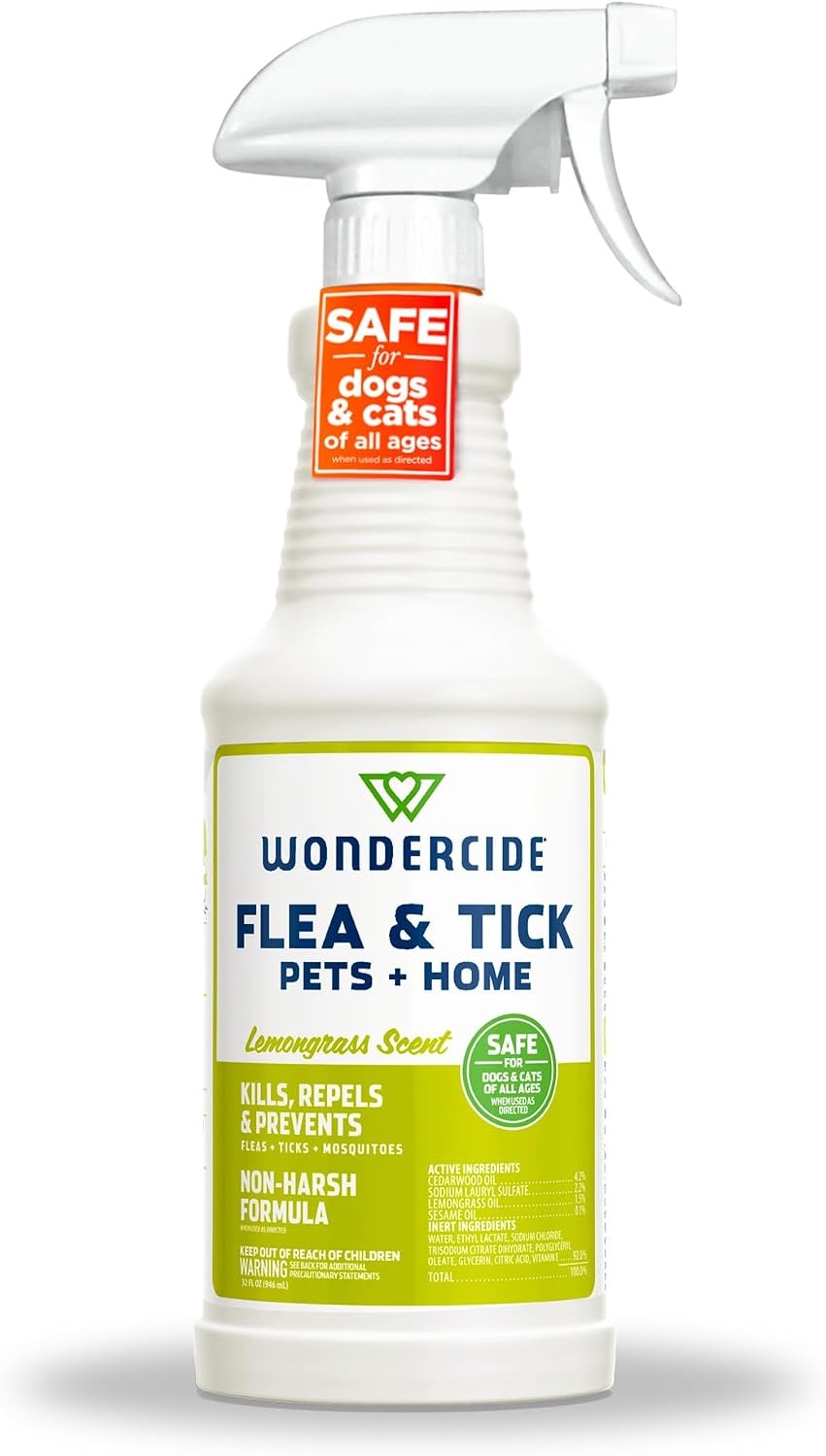
| Unit Count | 32 Ounce |
|---|---|
| Active Ingredients | Lemongrass Oil, Cedar Oil |
| Target Species | Dog |
| Age Range Description | All Life Stages |
Wondercide Lemongrass Flea, Tick & Mosquito Spray is a 32 oz plant-powered topical and household spray designed to kill by contact and repel common pests on dogs and cats and in pet environments. You use it like a conventional spray: mist pets (avoiding eyes and mucous membranes) for spot treatments or spray around bedding, carpets, kennels, and furniture to reduce fleas and ticks in the home. The formula lists cedar oil, lemongrass oil and mild surfactants and is labeled safe for all life stages when directions are followed, making it suitable for frequent use and for households with puppies or kittens. Practical benefits include a non-harsh scent that freshens rooms and a multiuse application that can break the flea life cycle by targeting eggs, larvae and adults. Limitations are that efficacy claims are based on lab testing rather than field guarantees, it is a topical/contact product so full-season control may require repeated applications, and users should follow label guidance and spot-test for skin sensitivity.
Best for: Buyers who want a practical, plant-based spray to manage fleas, ticks, and mosquitoes on pets and in the home and who prioritize a non-chemical alternative they can apply themselves.
Less Ideal for: Owners facing heavy or persistent infestations who need fast, guaranteed whole-animal or systemic control should consult veterinary options instead.
- Plant-based active ingredients (cedar oil and lemongrass) suitable for households preferring natural options
- Works as both a pet topical and household spray to target fleas, ticks, and mosquitoes
- Safe for use on all life stages when directions are followed, including puppies and kittens
- Large 32 oz size supports repeated applications around pets and the home
- Effectiveness is reported from laboratory testing and may require repeated applications in real-world infestations
- Not a systemic treatment so it may not replace monthly oral or topical veterinary preventives for heavy infestations
Verdict: A practical, plant-powered spray for pet owners who want a multiuse, gentle option to reduce fleas, ticks, and mosquitoes around pets and the home.
Vet's Best Mosquito Repellent Spray for Dogs & Cats, 8 oz

| Item Volume | 8 fluid ounces |
|---|---|
| Target Species | Dog |
| Scent Name | Citronella, Lemongrass |
| Item Form | Oil |
Vet’s Best Mosquito Repellent is a plant-based spray formulated for dogs and cats 12 weeks and older to repel mosquitoes during outdoor and indoor activities. You shake and mist the coat while avoiding the face and genital areas, focusing on exposed skin like the belly; directions recommend reapplying about every two hours. The formula uses certified essential oils such as lemongrass, geraniol and peppermint and is free of DEET, which makes it a gentler alternative for pet owners who prefer botanical ingredients. Practical benefits include a light scent, suitability for use on bedding and pet areas when used as directed, and simple application for walks, hikes, or backyard time. Limitations are that protection is short duration compared with chemical repellents so frequent reapplication is needed, and it is labeled for pets 12 weeks or older so it is not for very young or pregnant animals. Also the active oil concentrations mean you should avoid contact with eyes and mouths and follow label directions closely.
Best for: Buyers who want a budget-friendly, chemical-free mosquito repellent for routine outdoor use and who prioritize gentler, natural ingredients over long-lasting synthetic protection.
Less Ideal for: Pet owners who need all-day, low-maintenance protection or who treat very young or pregnant animals should choose a longer-lasting or veterinarian-prescribed option instead.
- Plant-based, DEET-free formula using certified essential oils
- Clear, simple spray application for coat and pet areas
- Safe for dogs and cats 12 weeks and older when used as directed
- Light, non-staining scent suitable for indoor and outdoor use
- Requires reapplication roughly every two hours for continued protection
- Not validated for species or animals younger than label age
Verdict: A affordable, plant-based spray that provides short-term, DEET-free mosquito protection for dogs and cats when reapplication is acceptable.
Farnam Flys-Off Insect Repellent Spray for Dogs and Cats, 8 fl oz

| Unit Count | 8 Fluid Ounces |
|---|---|
| Item Form | Liquid |
| Pet Type | Dog |
| Age Range Description | All Life Stages |
Farnam Flys-Off is a dual-action, ready-to-use spray for dogs and cats that combines short-term repellency with on-contact killing of fleas, ticks, and lice. It is applied as a fine mist to the coat until damp, directing spray against the natural lay of the hair for skin penetration; long-haired animals may require extra product. The label recommends repeating every nine days, making it useful for short-term protection during travel, outdoor activities, or as a supplement between regular preventative treatments. The formula is EPA-registered and also suitable for targeted indoor use around pet bedding and baseboards when areas are vacated and allowed to dry. Practical benefits include easy trigger-spray application and a larger 8 ounce bottle for extended use. Important limitations are that protection lasts up to nine days so it is not a long-term monthly solution, it must not be used on animals under 12 weeks, and careful application is needed to avoid over-wetting or improper coverage on very long-coated pets.
Best for: Buyers who prioritize dependable, EPA-registered short-term protection for pets and want an easy-to-apply spray for travel or supplemental control between regular treatments.
Less Ideal for: Owners seeking a single long-term monthly protection method or a product for puppies under 12 weeks should consider other options.
- Dual-action formula that both repels flies, mosquitoes, and gnats and kills fleas, ticks, and lice on contact
- EPA-registered for verified insect control
- Fine mist trigger spray allows easy, full-coat coverage and can be used on pets and in pet areas
- Larger 8 fl oz bottle provides more applications compared with smaller sizes
- Provides short-term protection only and requires reapplication every nine days
- Not for use on animals younger than 12 weeks
Verdict: Choose this spray if you need a reliable, EPA-registered short-term repellent and on-contact flea and tick treatment for dogs and cats.
Wondercide Flea, Tick & Mosquito Spray for Pets and Home, Lemongrass, 16 oz

| Unit Count | 16 Fluid Ounces |
|---|---|
| Item Form | Spray |
| Scent Name | Lemongrass |
| Target Species | Dog |
| Active Ingredients | Cedarwood Oil |
Wondercide Lemongrass spray is a topical and household spray that uses cedarwood and lemongrass oils to kill and repel fleas, ticks, and mosquitoes while also treating eggs and larvae to interrupt the pest life cycle. It is typically used by misting the pet coat from several inches away or by spraying bedding, carpets, and furniture to target pests in the environment. Key features include a plant-powered active blend, directions for spot-testing light fur and fabrics, and guidance to avoid soaking the animal. In practice the formula offers a gentler alternative to synthetic spot-on or oral treatments and can be applied more frequently for situational protection. Important limitations are that essential-oil products can temporarily discolor very light fur and fabrics and may require more frequent reapplication than long-lasting prescription products; this spray is best suited for direct-contact control and environmental spraying rather than systemic protection. Follow label directions closely for safe use on young or sensitive pets.
Best for: Buyers who prioritize safer, plant-based pest control and want a spray they can use directly on pets and around the home while relying on broad customer experience to validate effectiveness.
Less Ideal for: Owners needing long-duration, systemic flea control for heavy infestations or those who prefer vet-prescribed oral or topical medications as their primary defense.
- Plant-based active ingredients that kill and repel common pests on contact
- Suitable for use on pets and in the home when used as directed, including bedding and furniture
- Clear usage instructions and spot-test guidance to reduce risk of discoloration or irritation
- May require more frequent reapplication compared with systemic prescription treatments
- Contains essential oils that can temporarily discolor very light fur or fabrics
Verdict: If you want a vet-friendly feeling, plant-powered spray to kill and repel fleas, ticks, and mosquitoes on pets and in the home, this lemongrass formula is a dependable, user-friendly choice.
Vet's Best Flea & Tick Yard and Kennel Spray, 32 oz

| Unit Count | 32 Fluid Ounces |
|---|---|
| Item Form | Spray |
| Scent Name | Peppermint |
| Target Species | Dog |
| Active Ingredients | eugenol, peppermint oil |
This 32 oz Vet's Best yard and kennel spray is a plant-based, ready-to-use treatment designed to protect outdoor spaces from fleas, ticks, and mosquitoes. It connects to a garden hose via a built-in applicator so you can cover turf, patios, kennels, and other landscaping quickly and evenly without mixing. The active botanical ingredients are peppermint oil and eugenol from clove, which the maker says kill pests on contact while leaving a peppermint scent rather than strong synthetic odors. Practical benefits include easy application with a hose attachment, coverage suitable for large areas, and a formula safe to use around dogs 12 weeks and older when directions are followed. Important limitations are that it is for outdoor use only, requires reapplication after heavy rain or for severe infestations, and can cause eye or skin irritation in sensitive people or pets if not rinsed promptly. For owners looking for a natural, vet-formulated option to add to a multi-pronged flea control plan, this spray is a convenient outdoor tool, but it should be used as directed and paired with pet treatments for best results.
Best for: Pet owners who want an easy, plant-based yard spray to reduce outdoor flea and tick pressure and who prefer solutions backed by vet formulation and broad customer use.
Less Ideal for: People who need an all-in-one single-treatment solution for severe indoor infestations or who require products safe for pregnant or nursing animals should look at other specialized options.
- Ready-to-use hose attachment for fast, even coverage of yards and kennels
- Plant-based active ingredients (peppermint oil and eugenol) that kill fleas, flea eggs, ticks, and mosquitoes on contact
- Formulated for use around dogs 12 weeks and older when used according to label
- Leaves a natural peppermint scent instead of strong synthetic fragrances
- Outdoor use only and not designed to replace on-pet treatments
- Requires reapplication after heavy rain and for ongoing infestations
- Contains ingredients that can cause eye or skin irritation in sensitive individuals or animals
Verdict: A convenient, vet-formulated plant-based yard spray for pet owners who want a ready-to-use outdoor tool to reduce fleas, ticks, and mosquitoes without harsh chemicals.
Choosing the Right Mosquito Repellent for Pets: Key Factors to Consider
Active Ingredient Safety
Knowing which active ingredients are safe for different animal species is the first priority. Dogs, cats, birds, and small mammals metabolize chemicals differently, so an ingredient that is safe for one species can be harmful to another. Check whether an ingredient is labeled as pet-safe and whether exposure warnings apply to ingestion, topical contact, or inhalation.
Also consider life stage and health conditions. Young, old, pregnant, or medically fragile animals may require milder options or veterinary guidance. For multi-pet households, choose solutions with broad safety margins across species or separate approaches per animal type.
Protection Duration And Efficacy
How long a repellent works determines how often you need to reapply or replace it. Some formulations provide several hours of deterrence while others rely on continuous-release devices. In real garden conditions, heat, humidity, and activity level influence performance, so look for products with realistic duration claims and independent or manufacturer-provided test conditions.
Think about peak mosquito activity times where you live. If evening protection is most important, prioritize options with reliable multi-hour coverage during dusk and early night. For short walks or supervised patio time, shorter-duration products with quick application may be adequate.
Application Method And Practicality
Application style affects how likely you are to use the repellent consistently. Topical sprays or wipes let you target specific animals but require restraint and drying time. Wearable devices, clip-on diffusers, and area treatments reduce handling but may offer less direct protection for animals that roam. Consider how often you can realistically reapply and whether the method suits your pet's temperament.
Also evaluate preparation and cleanup. Some topical formulas can soil bedding or require separate storage. Devices that need batteries or refills add maintenance steps. Choose methods that fit your daily routine so protection is consistent.
Compatibility With Fur, Feathers, And Skin
Animals vary in coat type and grooming behavior, so a product's physical form matters. Oily sprays may mat long fur, powders can create dust issues, and oils can transfer during grooming. For birds and small mammals with delicate respiratory systems, aerosolized products or strong fragrances may pose risks.
Assess how a given formulation will interact with bathing, natural oils, and grooming. For animals that groom frequently, prioritize options with low systemic absorption risk. For outdoor poultry or rabbits, choose repellents that do not contaminate feed or nesting areas.
Environmental And Household Safety
Repellents used outdoors can affect non-target wildlife and pollinators. Volatile ingredients may drift and expose beneficial insects, or run off into soil during watering. If you keep bees, wildlife, or a wildlife-friendly yard, pick lower-impact approaches and place area treatments away from flowering plants.
Also consider family members with allergies, small children, or indoor-outdoor flow. Some devices release repellents into the shared airspace and may be unsuitable in confined areas where humans and animals breathe the same air.
Regulatory Guidance And Labeling
Clear labeling and regulatory approval provide useful information about proper use and limitations. Look for products with detailed pet-specific instructions, contraindications, and first-aid guidance. Regulatory registration or published safety summaries increase confidence that the product was evaluated for intended uses.
Absence of labeling or vague instructions should be treated as a red flag. When in doubt, consult a veterinarian before using a new active ingredient or application method on vulnerable animals.
Common Application Scenarios
Different outdoor routines call for different repellent strategies. Short supervised walks need fast-acting, portable options you can apply before heading out. For free-roaming pets in a yard, long-duration devices or spatial repellents that protect an area may be more practical. For pets that spend time in covered porches or runs, choose methods that work in semi-enclosed spaces without creating strong odors or residues.
- Short walks: quick-dry topicals or wipes
- Backyard play: wearable devices or perimeter treatments
- Runs and coops: low-residue options placed away from feed and water
Using Repellents Around Multiple Species
If you care for different kinds of animals, avoid a one-size-fits-all approach. A product safe for dogs might be unsafe for cats or birds. Consider separate, species-appropriate methods or choose options with broad safety margins. Keep treated animals separated until topical products dry or settle to reduce cross-exposure from grooming or close contact.
- Read labels for species restrictions
- Let topical products dry before mixing animals
- Use physical barriers or scheduled use when necessary
Integrating Repellents With Habitat Management
Repellents are most effective when combined with habitat controls that reduce mosquito breeding. Remove standing water, fix gutter drainage, and keep dense vegetation trimmed to lower local mosquito populations. Using repellents alongside these measures reduces overall dependence on chemical deterrents and often yields better comfort for pets and humans alike.
- Eliminate standing water and clogged drains
- Replace dense groundcover near pet areas with gravel or mulch
- Maintain airflow in covered runs to reduce humidity
Handling Sensitive Animals And Reactions
Monitor animals after first use. Watch for signs of skin irritation, excessive drooling, sneezing, respiratory distress, or behavioral changes such as increased grooming. If you see concerning signs, wash off topical products with mild pet-safe soap and consult your veterinarian. Keep emergency contact information for a veterinarian or animal poison control available, and follow label first-aid guidance. For animals with known allergies or skin issues, trial a small area first and increase coverage only after a waiting period with no reaction.
- Test a small area before full application
- Observe for 24 hours after initial use
- Have vet contact details handy
How We Chose the Best Mosquito Repellent for Pets
Our selection focused on options appropriate for animals kept in home, yard, patio, or small-farm settings. We prioritized products and formulations with clear safety information for common companion animals, effective mosquito deterrence under typical outdoor conditions, and practical application methods that pet owners can use without specialized equipment. Key evaluation criteria included active ingredient safety and toxicity for different species, documented duration of repellency in real-world exposure, ease and reliability of application or placement, and formulation suitability for fur, feathers, or sensitive skin. We excluded products with unclear ingredient lists, no safety guidance for common pets, or reliance on unproven anecdotal claims. Also removed were approaches intended only for agricultural or commercial-scale vector control rather than everyday pet care. The filters produced a set of solutions that balance measurable repellency, user safety, and suitability for routine outdoor use in homes, small yards, and shared spaces with animals.
FAQ
Are pet-safe repellents effective against all mosquito species?
Effectiveness varies by formulation and mosquito species. Many repellents reduce biting pressure broadly, but no option eliminates all species. Local mosquito habits and pressure influence real-world results.
Can I use human mosquito repellent on my pet?
You should avoid using human-only products unless the label explicitly allows use on animals. Human formulations can contain ingredients or concentrations poorly tolerated by pets, especially cats and small mammals.
How often should I reapply a topical repellent to a dog?
Reapplication frequency depends on product claims and outdoor conditions. In hot or wet weather you may need to refresh protection more often. Follow the product label and observe how long the animal remains comfortable.
Are wearable devices safe for all pets?
Wearable devices reduce handling but may not suit every animal. Some pets will try to remove or chew them, and birds or small mammals may be sensitive to emitted substances. Choose devices designed for the specific species and supervise initial use.
Can repellents harm pollinators or wildlife in my yard?
Some repellents can affect non-target insects if they drift onto flowering plants or into nesting areas. Place area devices away from pollinator habitat and use targeted applications rather than broad broadcast treatments when pollinator protection is a concern.
What should I do if my pet licks a topical repellent?
If licking is minor, wipe the area and monitor for signs of upset. If ingestion is significant or you see vomiting, lethargy, or unusual behavior, contact a veterinarian or poison control resource promptly and follow label first-aid instructions.
Final Verdict
Prioritize safety and practicality when choosing a mosquito repellent for pets. Match the active ingredient and application method to the species you care for, the amount of outdoor time, and your ability to reapply or maintain devices. Combine repellents with habitat controls to lower mosquito pressure and reduce reliance on chemicals. Ultimately, opt for an approach that you will use consistently and that minimizes risk to animals, household members, and beneficial wildlife. When in doubt about an ingredient or method for a specific pet, consult your veterinarian for tailored advice.
