

Note: This article contains affiliate links. If you click on these links and make a purchase, I may earn a small commission at no extra cost to you. This helps support my research and content. Read my full affiliate disclosure here.
Moss on driveways and paved surfaces grows in shaded, damp areas and creates slippery patches that can damage surfaces and raise safety concerns. Choosing the right moss killer for drives matters because treatment speed, surface compatibility, and how long protection lasts determine whether the patch returns or your paved surface weakens. This guide covers the top shortlisted options suited to driveways and other paved areas, and we evaluate each by how easy it is to apply, how quickly moss dies, and how long the treatment prevents regrowth. Read on to see the evaluation criteria and practical use considerations gardeners and homeowners need when treating moss on drives.
Top Picks at a Glance
| Best Overall The best all-around choice for most situations | Lilly Miller Moss Out Concentrate for Roofs and Walks, 54 oz |  |
| Best Quality Built to a higher standard if you want something more solid | Resolva Path & Drive Weedkiller RTU 3 L |  |
| Best Value The sweet spot between price and what you get | BioAdvanced 2-in-1 Moss & Algae Killer and Cleaner, Ready-to-Spray, 32 oz |  |
| Best Budget The cheapest option that still gets the job done reliably | Safer Brand Moss and Algae Killer and Surface Cleaner, 32 oz Hose Sprayer |  |
| Highest Rated A top-rated pick with lots of positive feedback | Wet and Forget Moss, Mold, and Mildew Control (1 gal) |  |
| Most Popular A crowd favorite that many people choose with confidence | Wet & Forget Outdoor Cleaner Ready-to-Use, 64 oz |  |
| Best Seller A high-volume bestseller chosen again and again | 30 SECONDS Outdoor Cleaner 2-Pack with Hose-End Sprayer |  |
Lilly Miller Moss Out Concentrate for Roofs and Walks, 54 oz
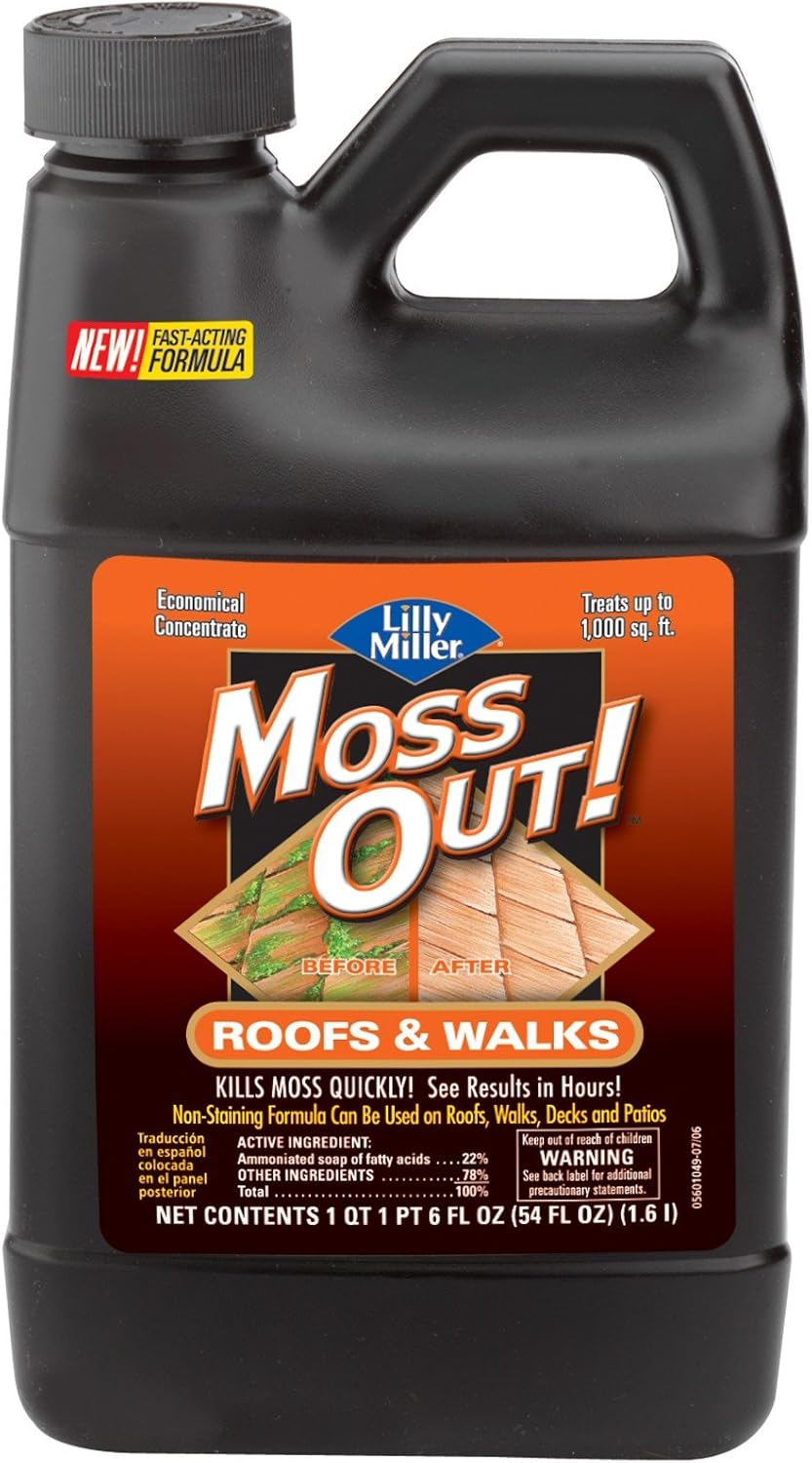
| Item Form | Liquid |
|---|---|
| Coverage | 1000 square feet |
| Liquid Volume | 54 fluid ounces |
| Active Ingredients | Ammonium soaps of fatty acids |
Lilly Miller Moss Out is a liquid concentrate designed to kill and help prevent moss on roofs, sidewalks, decks and patios. You dilute the concentrate, apply it to the affected surface, let it work and then rinse off any residue; one 54 oz jug claims coverage up to about 1,000 square feet. The active ingredient is ammonium soaps of fatty acids, a nonbleaching formula that the maker says will not stain concrete, stucco or wood, so it is suited for mixed outdoor surfaces including drives and walkways. Its concentrate form makes it economical for larger areas compared with ready-to-use sprays, and the directions and safety notes are straightforward for typical homeowner use. Limitations are that it requires proper dilution and safe handling around children and pets, and you may need repeat treatments in heavily shaded or persistently damp locations where moss returns. For routine maintenance on drives and paths this product provides a practical, nonstaining option.
Best for: Homeowners who want an economical, nonstaining concentrate to treat moss on drives and mixed hardscape surfaces and who are comfortable diluting and applying a liquid treatment.
Less Ideal for: People who prefer ready-to-use sprays or who need an instant kill with no mixing or safety precautions should consider simpler, pre-mixed options.
- Concentrated formula covers up to 1000 sq ft, making it economical for larger areas
- Nonstaining on concrete, pavement, stucco and wood when used as directed
- Suitable for multiple outdoor surfaces including roofs, walks, decks and patios
- Requires dilution and safe handling which adds prep time compared with ready-to-use products
- May need repeat applications in persistently shaded or damp areas
Verdict: A concentrated, nonstaining moss treatment that gives balanced, economical coverage for drives and other outdoor hardscapes when you are willing to dilute and apply it properly.
Resolva Path & Drive Weedkiller RTU 3 L

| Unit Count | 101.44 Fluid Ounces |
|---|---|
| Item Form | Liquid |
| Coverage | Broad-spectrum coverage |
| Active Ingredients | Pelargonic acid |
| Liquid Volume | 3 liters |
Resolva Path & Drive is a ready-to-use liquid herbicide designed to kill moss, algae and a wide range of unwanted weeds on hard surfaces such as drives, paths, patios and gravel. It is applied by spraying to thoroughly wet foliage and stems, with visible effects often appearing within hours and repeat treatments possible every 2 to 4 weeks where regrowth occurs. The formulation uses pelargonic acid rather than glyphosate and is labelled for broad-spectrum coverage and year-round use on non-vegetated hard surfaces, with clear dosage guidance (maximum 100 ml per m2) and limits on annual treatments. Practical benefits include fast action, suitability for multiple surface types and avoidance of systemic herbicides, but it requires careful application to avoid run-off into water, adherence to seasonal application windows, and repeated use for persistent growth. Users should follow safety directions closely and keep children and pets away until treated areas have dried.
Best for: Homeowners who need a fast, no-mix solution to clear moss and weeds from drives, paths and patios and who prioritize quick visible results and straightforward application.
Less Ideal for: Those who need a long-term systemic soil treatment for deeply rooted weeds or want a solution safe for use around established ornamental plantings should consider alternative products or localized mechanical control.
- Fast visible results within hours on moss and many common weeds
- Ready-to-use liquid requires no mixing or measuring for straightforward application
- Broad-spectrum activity that also affects algae on hard surfaces
- Clear application guidance and limits to manage frequency and coverage
- Not systemic so persistent weeds may need repeated treatments
- Must avoid contamination of water and follow seasonal restrictions for application
Verdict: A fast-acting, ready-to-use spray that clears moss and surface weeds on drives and paths with visible results within hours.
BioAdvanced 2-in-1 Moss & Algae Killer and Cleaner, Ready-to-Spray, 32 oz

| Unit Count | 32 Fluid Ounces |
|---|---|
| Coverage | 500 square_feet |
| Item Form | Spray |
| Active Ingredients | fatty acid formula |
This ready-to-spray BioAdvanced formula is designed to kill moss and algae across lawns and hardscapes with minimal fuss. The bottle connects to a hose and sprays a potassium salts of fatty acids solution that the manufacturer says kills growth within hours and offers protection for months. It works on lawns plus patios, decks, roofs, fences, driveways and other exterior surfaces so you can treat multiple problem areas with one product. The no-odor, non-staining formula is convenient for visible surfaces and will turn moss yellow then brown, but dead moss typically needs to be raked or removed for a clean finish. Coverage is listed at about 500 sq ft from the 32 oz bottle, making it suitable for small to medium treatment areas; for larger lawns you will need additional bottles. The product is fast acting and simple to use, but results depend on thorough application and physical removal of thick patches after treatment.
Best for: Buyers who prioritize straightforward, evidence-backed solutions and want a single, easy-to-use product to treat moss and algae on lawns and nearby hard surfaces without complex mixing or specialized equipment.
Less Ideal for: Homeowners with large lawns or heavy, established moss infestations who need high-volume treatment or mechanical removal solutions should consider concentrated products or professional services.
- Kills moss, algae, lichen, mold and mildew with a single ready-to-spray formula
- No-odor and non-staining so it is suitable for visible hard surfaces and roofs
- Hose-attachment design makes application quick and easy for spot treatments
- Multi-surface use lets you treat lawns and hardscapes with one product
- 32 oz covers about 500 sq ft so larger properties require multiple bottles
- Does not remove dead moss mechanically so raking or cleaning is still required
Verdict: A convenient ready-to-spray option for quickly killing moss and algae across lawns and hard surfaces when you need a simple, low-odour treatment.
Safer Brand Moss and Algae Killer and Surface Cleaner, 32 oz Hose Sprayer

| Unit Count | 32 Fluid Ounces |
|---|---|
| Item Form | Spray |
| Coverage | 500 square feet |
This ready-to-use moss and algae killer connects to a garden hose and sprays a potassium-salts formula meant for roofs, decks, siding, walkways, lawns and other exterior surfaces. Typical use is simple: attach the bottle to a hose, apply to affected areas, wait for the product to kill visible growth, then rinse if desired. Notable features include the hose-sprayer delivery for quick coverage, OMRI listing for organic-compliant use, and a claimed coverage of about 500 square feet per 32 oz bottle. In practice the product is convenient for spot treatments and for users who want a chemical option that fits organic guidelines. Limitations are that it is a one-shot RTU volume that may not be enough for large roofs and it can irritate skin or eyes so protective gear is needed during application. Also, because it attaches to a hose the spray pattern and pressure depend on your water supply, so achieving even coverage on steep roof sections may require care.
Best for: Homeowners looking for an affordable, easy-to-apply solution to remove moss and algae on small roof areas or for spot treatments who prefer an OMRI-listed product and minimal prep work.
Less Ideal for: Those needing to treat large roof surfaces in a single application or professional roof cleaners who require concentrated formulations and higher-volume coverage.
- Ready-to-use hose sprayer makes application quick and does not require mixing
- OMRI listed formulation suitable for organic gardening contexts
- Covers up to 500 square feet from a single 32 oz bottle
- Effective active ingredient (potassium salts of fatty acids) targets moss and algae
- 32 oz volume may be insufficient for full roof treatments on medium to large homes
- Spray pattern and pressure vary with household water supply, affecting coverage consistency
- Can cause skin or eye irritation and requires protective equipment during use
Verdict: A budget-friendly, ready-to-use hose sprayer that makes spot and small-area roof moss removal fast while remaining OMRI-listed for organic use.
Wet and Forget Moss, Mold, and Mildew Control (1 gal)

| Item Form | Spray |
|---|---|
| Brand Name | Bloranda |
| Item Volume | 1 gallons |
| Unit Count | 128 Ounce |
This one-gallon Wet and Forget solution is a liquid spray product intended to remove and slow the return of moss, mold, and mildew on exterior surfaces such as roofs, siding, and hardscape. It is applied as a spray and left to work without heavy scrubbing, which makes it useful for large or hard-to-reach areas where rinsing or mechanical removal is difficult. The product volume is convenient for tackling whole-roof jobs without frequent refills, and the nonabrasive application reduces the risk of damaging shingles compared with pressure washing. Practical benefits include time savings and easier maintenance cycles because treatments are applied and allowed to break down unwanted growth over days to weeks. Important limitations are that visible results take time and it relies on weather conditions to distribute and activate the formula, so it is not an instant fix and may require repeat applications in very persistent cases.
Best for: Homeowners who prioritize a reliable, low-impact method to clear and control roof moss and mildew and who prefer treatments that minimize roof disturbance.
Less Ideal for: People needing instant removal or a one-time immediate clean for sale or inspection preparations should consider mechanical removal or professional soft washing instead.
- Large 1-gallon volume suitable for treating entire roofs without frequent refills
- Spray application lets you treat wide areas and hard-to-reach spots without scrubbing
- Nonabrasive method lowers risk of shingle damage compared with pressure washing
- Formulated to kill and slow regrowth of moss, mold, and mildew
- Requires days to weeks to show visible results rather than immediate removal
- Effectiveness depends on weather and proper application, so results can vary
Verdict: Choose this gallon spray if you want a dependable, nonabrasive treatment to kill and help prevent moss and mildew on roofs with minimal labor.
Wet & Forget Outdoor Cleaner Ready-to-Use, 64 oz

| Unit Count | 64 Ounce |
|---|---|
| Item Form | Liquid |
| Coverage | 60 – 180 square feet |
| Included Components | Remote Trigger |
Wet & Forget Outdoor Cleaner is a ready-to-use spray intended for treating green and black stains from moss, mold, mildew, and algae on small outdoor surfaces. You apply it with the included trigger sprayer to a dry surface on a cool, calm day and then let weather do the work; green stains often fade in 1 to 2 weeks while heavier black stains can take several months to a year. The formula is bleach-free and non-acidic, which makes it safe for many materials such as concrete, planters, statues, headstones, and outdoor furniture when used as directed. Its practical benefits are ease of use and low physical effort since there is no scrubbing, rinsing, or pressure washing required, and a single treatment can keep surfaces cleaner for up to a year. Important limitations are the slow cleanup time on roofs and heavily stained areas and the need to avoid runoff into water bodies and to rinse plants nearby before and after application. Coverage varies widely with severity and porosity, so expect to repeat applications for large or long-established infestations.
Best for: Buyers who prioritize an easy, low-effort solution to reduce moss and algae on roof surfaces and other outdoor features and who prefer proven user-accepted products that are gentle on surfaces.
Less Ideal for: Homeowners who need an immediate or fast-acting roof treatment or who require a product with explicit roofing certification and rapid kill times.
- Ready-to-use trigger sprayer for quick, no-mixing application
- Bleach-free, non-acidic formula safe for many surfaces when used properly
- Requires no scrubbing, rinsing, or pressure washing
- Can keep treated surfaces cleaner for up to a year with periodic re-application
- Works slowly on heavy or long-established stains, sometimes taking months to fully clear
- Coverage range is broad and depends heavily on surface porosity and stain severity
- Requires careful application to avoid runoff into ponds, lakes, or plants
Verdict: Choose this bottle if you want a gentle, no-scrub outdoor cleaner that gradually removes moss and algae with simple spray-and-wait application.
30 SECONDS Outdoor Cleaner 2-Pack with Hose-End Sprayer

| Unit Count | 128 Fluid Ounces |
|---|---|
| Included Components | 64oz bottles with hose-end attachment (2 pack) |
| Item Form | Spray |
| Coverage | 600 square feet |
| Active Ingredients | Vinyl |
30 SECONDS Outdoor Cleaner is a spray concentrate sold as a two-bottle pack with a hose-end sprayer for easy application. It is designed to clean algae, mold, mildew and moss stains on hard surfaces such as asphalt driveways, concrete, brick, siding and decks. To use you mix the concentrate 1:1 with water in the refill bottle, attach the included hose-end sprayer, spray the affected area, let it sit briefly, then rinse with water—no pressure washer or heavy scrubbing required. The formula is marketed as safe for lawns and plants when used as directed, and the labeled coverage of about 600 square feet per bottle makes it practical for treating medium-sized driveways and repeat touch-ups. Limitations to note are that this is a chemical surface cleaner rather than a long-term moss prevention system and results can vary with moss thickness and weather; heavily rooted moss may need repeat treatments or mechanical removal first. Follow label directions and safety guidance to protect skin and eyes.
Best for: Buyers who want a low-effort way to remove moss and surface staining from an asphalt driveway without renting or using a pressure washer and who prefer clear label instructions and predictable application steps.
Less Ideal for: People seeking a preventative long-term moss control program or those who prefer entirely non-chemical or manual-only solutions for heavy moss infestations.
- Includes hose-end sprayer for quick, one-person application from a garden hose
- Ready-to-use concentrate that covers about 600 sq ft per bottle for efficient treatment
- Formulated to remove moss, algae, mold and mildew from many outdoor hard surfaces
- Label guidance states it is safe for lawns and plants when used as directed
- Not a one-time fix for deeply rooted moss; dense infestations may require repeat treatments or physical removal
- Contains active chemicals so protective gear and careful handling are required
Verdict: A convenient, hose-applied cleaner that removes moss stains on driveways quickly for homeowners who want an easy, low-effort fix.
Choosing the Right Moss Killer for Drives: Key Factors to Consider
Application Method and Coverage
How the product is applied affects time spent treating a driveway. Sprays and ready-to-use bottles let you treat narrow or awkward areas precisely, while concentrates that require dilution plus a garden sprayer are better for larger drives because they stretch further per litre. Consider whether the applicator produces a fan spray, coarse droplets, or a stream; finer sprays can be useful for even coverage on textured paving but may drift in wind.
Coverage numbers on the label matter for driveway planning. A product that claims broad coverage per litre reduces refill trips and lowers total application time. Also check whether the manufacturer specifies coverage for porous or non-porous surfaces since actual spread can vary with surface texture.
Kill Speed and Visible Results
Speed of kill matters for safety and aesthetics. Faster-acting treatments reduce the time the surface remains slippery and make follow-up cleaning or rinsing simpler. Some active ingredients cause visible darkening first and decay over days, while others bleach or crumble the moss within hours. Expect variable timelines depending on moss thickness and weather conditions.
When planning treatment, account for the time between application and when the area is safe for foot or vehicle traffic. Faster contact kill can let you sweep or pressure-rinse sooner, but very rapid action may require care to avoid staining on pale surfaces.
Residual Protection and Reapplication Interval
Residual protection determines how often you will need to retreat the drive. Products with longer-lasting residual action reduce maintenance frequency, which is valuable for large drives or properties where repeated treatments are impractical. Residual activity may come from ingredients that prevent regrowth for weeks or months, depending on exposure to weather and traffic.
Understand that heavy shade, persistent moisture, and adjacent vegetation increase re-infestation risk. Even products with good residual claims will perform differently under these conditions, so match the expected reapplication interval to your site conditions and maintenance capacity.
Surface Compatibility and Staining Risk
Driveway surfaces vary: concrete, block paving, natural stone, tarmac, and sealed surfaces respond differently to chemical treatments. Some moss killers can cause temporary darkening or permanent staining on porous stones or light-coloured surfaces. Check label guidance for safe use on your specific material and whether rinsing or neutralization is recommended after the product works.
If you have delicate or historic paving, test a small, inconspicuous patch first. Also consider runoff: treatments applied on drives can wash into adjacent soil or planting beds, so look for instructions about protecting plants and preventing contamination.
Environmental and Plant Safety
The active ingredients and formulation determine environmental impact and how you protect nearby plants. Some moss control agents are non-selective and can harm nearby turf, shrubs, or groundcover if runoff occurs, while others have lower toxicity to plants when used as directed. Read guidance on buffer zones, rinsing, and timing to avoid damage to desirable plants.
If you have pollinator habitat or nearby watercourses, choose products with labeled instructions for minimizing environmental exposure and follow disposal directions carefully. Protective equipment recommendations are also part of safe application practice.
Timing, Weather, and Seasonal Considerations
Weather affects efficacy and safety. Apply moss killers on dry days without imminent rain to prevent dilution and runoff. Temperatures and daylight can influence active ingredient activity; some products work best in cool, damp conditions while others need warmer weather to activate fully.
Seasonality matters because moss thrives in winter and early spring in many climates. Treating at the start of a dry, mild period gives the best chance for both quick kill and lasting protection. Also plan applications when traffic disruption is manageable so you can leave the treated area undisturbed for the recommended contact time.
Preparing a Drive for Treatment
Clear loose debris, leaves, and excess dirt before applying any moss killer. Mechanical removal with a stiff broom or a low-pressure wash improves chemical contact with the moss and reduces the amount of product needed.
Protect adjacent plants and soils by covering beds or creating temporary barriers. If the drive slopes toward planting areas, avoid applying product up to the edge or plan for rinsing that directs runoff to a safe area.
- Sweep or blow loose matter first to expose moss.
- Test an inconspicuous patch on porous paving.
- Cover or dampen nearby plants to limit exposure.
Safe Post-Treatment Cleaning and Disposal
After moss has died, most gardeners will remove the dead material by sweeping or low-pressure rinsing. Some treatments recommend waiting until the moss dries and becomes brittle to reduce smearing and staining. Follow label guidance about rinsing; unnecessary rinsing can reduce residual protection.
Dispose of sweepings responsibly. Do not compost material that contains concentrated chemical residues. Check local guidance for household chemical disposal if you need to rinse containers or leftover product.
- Wait the recommended interval before pressure washing.
- Avoid discharging rinse water into storm drains or sensitive soil.
- Use protective gloves and eyewear when handling residues.
Dealing with Persistent or Recurrent Patches
Persistent moss often indicates ongoing moisture and shade problems. Address drainage, trim back overhanging branches, and improve sunlight exposure where possible to reduce conditions that favor regrowth.
For recurring spots, a combined approach works best: remove the bulk of moss mechanically, treat with a suitable moss killer, then follow up with periodic inspections and spot treatments. Increasing the interval between heavy treatments by improving site conditions reduces chemical use over time.
- Improve drainage and reduce shade to limit regrowth.
- Use spot treatments for small returns rather than blanket applications.
- Record the date of treatment to plan future maintenance windows.
Choosing Equipment for Application
Match the applicator to the product and driveway size. For small areas, a handheld spray bottle or pump sprayer is convenient. For larger drives, a backpack or tow-behind sprayer gives more consistent coverage and reduces fatigue.
Ensure the sprayer is compatible with the formulation. Some concentrates require a chemical-resistant tank and appropriate nozzle to deliver an even fan pattern. Clean equipment thoroughly after use to avoid cross-contamination with other garden chemicals.
- Use chemical-resistant sprayers for concentrates.
- Calibrate nozzle for even coverage on textured paving.
- Rinse sprayers away from desirable plants and water sources.
Non-Chemical Alternatives and Complementary Methods
Physical removal, improved site management, and regular sweeping can reduce moss pressure and extend the time between treatments. Manual scraping or using a stiff brush on small patches is effective but labour-intensive.
Solarization or improving sunlight access by pruning can alter the microclimate and discourage moss growth. Combining mechanical control with targeted chemical treatment often gives the best long-term results with lower chemical reliance.
- Use mechanical removal for small, isolated patches.
- Change microclimate with pruning and drainage improvements.
- Consider alternating mechanical and chemical strategies for persistent areas.
How We Chose the Best Moss Killer for Drives
We selected products that target moss on hard, paved surfaces and that have application methods appropriate for drives such as spray, ready-to-use, or diluted concentrate. Our editorial filters prioritized clear directions for surface use, coverage per unit, and documented residual activity to assess how long treated areas stay clear. We also considered compatibility with common driveway materials, including concrete, block paving, and asphalt, and looked for guidance on timing relative to rain and foot or vehicle traffic. Key evaluation criteria included ease of application and coverage rate to judge how simple treatments are on longer driveways; contact kill speed to estimate how soon surfaces are safe and no longer slippery; residual protection duration to understand return intervals; and surface safety instructions to reduce the risk of staining or surface damage. We excluded products meant only for lawns, ornamental beds, or aquatic environments, and we did not include general household cleaning products that lack documented moss control efficacy. The result is a focused list of options that meet real driveway treatment needs and match the scoring dimensions used in our product cards.
FAQ
Can I use a lawn moss killer on my driveway?
Many lawn moss products are formulated for turf and may not be suitable for hard surfaces. Lawn treatments may leave residues or require different application rates. Use products labeled for hard surfaces to avoid staining and ensure correct coverage guidance.
How long after treatment is my drive safe to walk or drive on?
It depends on the product and weather. Some treatments allow light foot traffic within a few hours, while others recommend waiting until the moss has browned and dried, which can take days. Check label instructions for safe re-entry times.
Will a moss killer damage the driveway surface?
Some formulations can darken or stain porous materials if not rinsed or if left to concentrate. Products labeled for your specific surface type are less likely to cause damage. Testing a small area first reduces the risk of unexpected staining.
How often should I reapply a moss killer on a shaded drive?
Reapplication intervals vary by product and conditions. In heavily shaded, damp drives you may need treatments more frequently, sometimes seasonally. Improving drainage and light exposure can lengthen periods between applications.
Do I need to protect plants and grass nearby when treating the drive?
Yes. Many moss killers can harm nearby vegetation if runoff occurs. Cover or water-in sensitive plants before treatment, create barriers, and avoid applying product upslope toward beds. Follow label recommendations for buffer zones and rinsing.
Is rain after application a problem?
Rain soon after application can dilute or wash away the product and reduce effectiveness. Apply on dry days and check label guidance for the minimum dry window required after treatment to achieve full activity.
Final Verdict
For paved drives the best choice balances quick visible kill, safe compatibility with your surface, and a reasonable residual period so you are not treating constantly. Prioritize products with clear hard-surface instructions, appropriate application methods for the area you manage, and documented residual protection that matches how often you want to maintain the drive. Also consider site improvements such as better drainage, reduced shade, and regular mechanical cleaning to reduce reliance on chemical treatments. With those tradeoffs in mind, pick an applicator style and residual profile that fit your driveway size and maintenance schedule so you can treat efficiently and minimize repeat work.
