

Note: This article contains affiliate links. If you click on these links and make a purchase, I may earn a small commission at no extra cost to you. This helps support my research and content. Read my full affiliate disclosure here.
Choosing the right mulch for a rose garden changes how your plants handle water, winter cold, and nutrient cycling. The wrong material can hold too much moisture against crowns or fail to suppress weeds, while the right mulch moderates soil temperature, reduces evaporative loss, and adds organic matter over time. This guide covers six top mulch options that suit rose beds in different climates and maintenance styles. We shortlisted materials that balance moisture control, disease risk, and soil improvement so you can pick a practical option for your planting situation. Read on to see the criteria we used and which mulch types match common rose-garden needs.
Top Picks at a Glance
| Best Overall The best all-around choice for most situations | Back to the Roots Organic Mulch, 1 Cubic Foot |  |
| Best Quality Built to a higher standard if you want something more solid | Hull Farm Cocoa Bean Shell Mulch, 2 Cubic Feet |  |
| Best Value The sweet spot between price and what you get | Halatool Coco Coir Chips Brick Pack (2-Pack) – Compressed Organic Coconut Husk Growing Medium |  |
| Highest Rated A top-rated pick with lots of positive feedback | Doter Pine Bark Orchid & Garden Mulch (10 qt) |  |
| Most Popular A crowd favorite that many people choose with confidence | Plantonix Coco Chips Mulch Brick (10 lb) – Compressed Coconut Husk Chips |  |
| Best Seller A high-volume bestseller chosen again and again | Legigo 2-Quart Organic Pine Orchid Bark Potting Mix |  |
Back to the Roots Organic Mulch, 1 Cubic Foot

| Brand Name | Back to the Roots |
|---|---|
| Item Highlight | Premium organic garden mulch; peat-free; 25.7 quart bag |
| Unit Count | 16 Ounce |
| Volume | 23 cubic centimeters |
This organic mulch from Back to the Roots is a peat-free, upcycled plant-matter blend intended for beds, containers, and around shrubs and trees. It includes dolomitic limestone to help balance pH, yucca extract to improve moisture control, and gypsum to aid water absorption, so it both conserves moisture around root zones and contributes modest nutrients. Typical use is spreading a 2–3 inch layer around bushes, avoiding direct trunk contact, or mixing into the topsoil when planting. Its organic base and added plant food make it a good choice for supporting healthy growth and reducing watering frequency. Limitations to keep in mind are the bag size and volume relative to larger beds and that it is formulated as a general mulch rather than a heavy-duty long-lasting bark product, so it may break down faster and need replenishing more often.
Best for: Gardeners who want an eco-conscious, peat-free mulch that improves moisture retention and supports plant health around bushes and in raised beds.
Less Ideal for: People looking for a coarse, long-lasting decorative bark mulch or a single large bag solution for extensive shrub beds.
- Peat-free organic blend made from upcycled plant matter and wood fines
- Contains yucca extract for improved moisture retention and gypsum for better water absorption
- Includes dolomitic limestone to help adjust and stabilize soil pH
- Formulated with all-purpose plant food to support growth of vegetables, herbs, and shrubs
- Bag volume is relatively small for large or multiple bush beds so more bags may be needed
- Breaks down faster than coarse bark mulches and will require periodic replenishment
Verdict: Choose this peat-free organic mulch when you want an eco-friendly, moisture-saving soil cover that also supplies mild nutrients to bushes and raised beds.
Hull Farm Cocoa Bean Shell Mulch, 2 Cubic Feet
| Brand Name | Hull Farm |
|---|---|
| Model Name | 50150 |
| Material | Plastic |
| Package Weight | 12.72 kg |
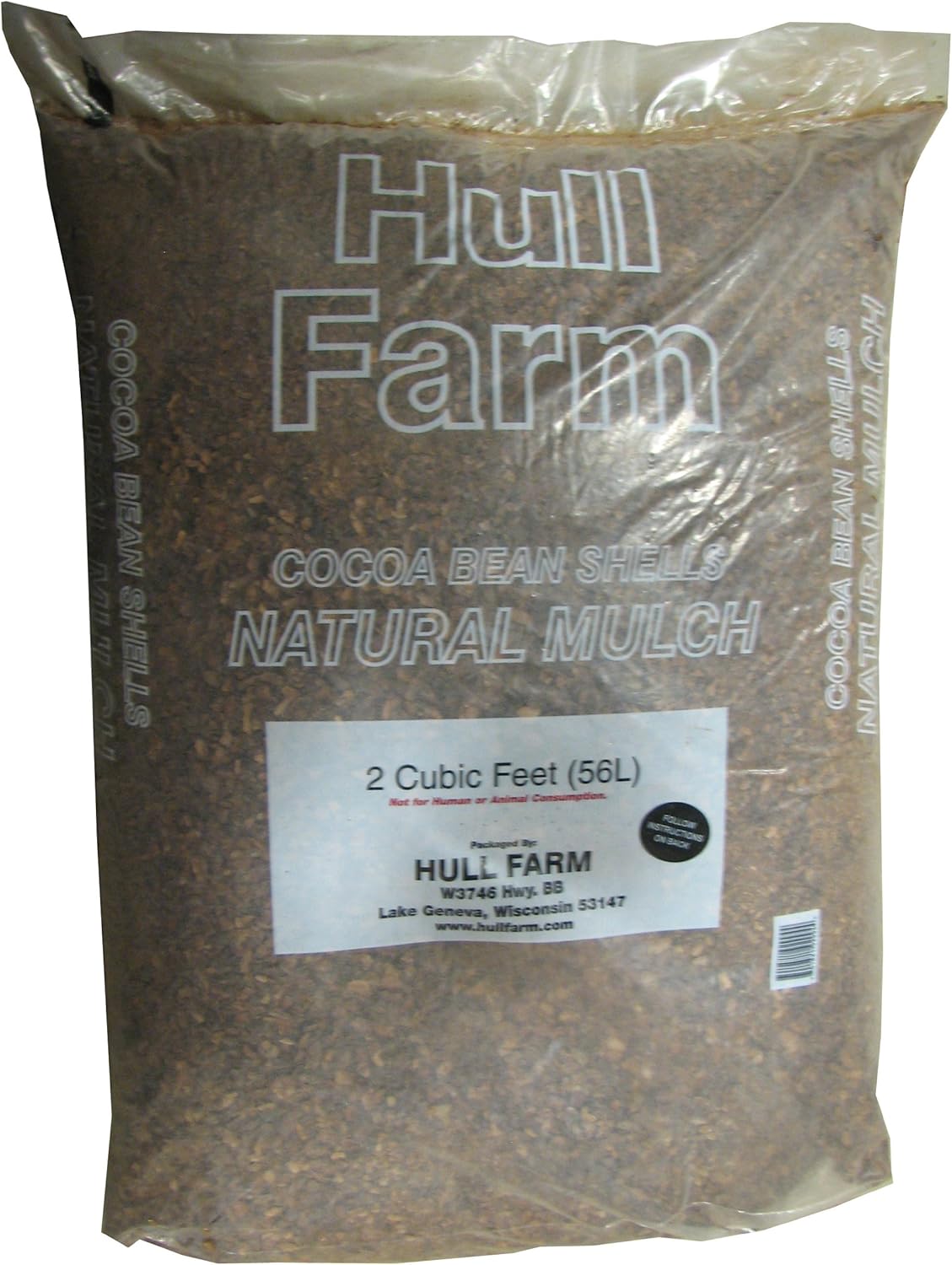
Hull Farm Cocoa Bean Shell Mulch is a bagged organic mulch made from cocoa bean shells marketed for landscape beds. It is typically applied as a 1 to 3 inch layer around ornamentals or edibles to suppress weeds, conserve soil moisture, and improve appearance; the shells also slowly break down and provide a small nutrient contribution with an approximate analysis near 2.5-1-3. The product is easy to spread from the 2 cubic foot bag and leaves a fine, attractive textured surface that is less likely to mat than some other fine mulches. Because it is organic it will decompose over time, so plan to replenish annually or as needed. Note that cocoa shell mulch can attract pets if they are tempted to eat it and should be used with care around animals and children; also its small particle size means it can compact in heavy rain and may require light fluffing. For gardeners looking for an attractive, nutrient-contributing mulch that supports moisture retention and weed suppression, this is a practical option for tomato beds when used correctly.
Best for: Gardeners who prioritize plant performance and want a decorative organic mulch that also contributes modest nutrients and conserves moisture for productive beds such as tomatoes.
Less Ideal for: Those with pets that scavenge mulch or gardeners who prefer an inert, longlasting inorganic mulch that will not decompose over a season.
- Adds a mild, slow-release nutrient contribution (approx. 2.5-1-3) as it breaks down
- Fine, attractive texture that spreads evenly and helps retain soil moisture
- Sold in a manageable 2 cubic foot bag for easy handling and targeted application
- Less likely to mat compared with very fine composts, maintaining surface airflow
- Can attract pets or wildlife that may chew or eat the shells
- Small particles can compact after heavy rain and may need occasional fluffing
Verdict: Choose this cocoa shell mulch when you want an attractive organic mulch that helps retain moisture and gives tomatoes a light nutrient boost as it decomposes.
Halatool Coco Coir Chips Brick Pack (2-Pack) – Compressed Organic Coconut Husk Growing Medium

| Number of Packs | 2 |
|---|---|
| Unit Count | 35.2 Ounce |
| Material | coconut husk |
| Volume (expanded) | 7 quarts per brick |
These Halatool coco coir chip bricks are compressed coconut husk pieces sold as a 2-pack that expand to about 7 quarts per brick when rehydrated. You soak the bricks in water to break them apart, then mix the resulting chips into potting mixes, use them as a mulch layer, or add them to containers to improve aeration and drainage. The material is low in salts and has balanced pH, so it is suitable for sensitive vegetable roots and for improving heavy soils without altering soil chemistry. The chips hold moisture while still allowing oxygen to reach roots, which helps prevent waterlogging in containers and raised beds. Because they are lightweight and compressed, storage and transport are easy, but you will need a container and time for full expansion before planting. Also they are sold in small unit counts, so larger vegetable beds will require multiple packs or mixing with other bulk amendments. For gardeners looking to improve root health and drainage in vegetable containers or to top-dress small beds, these coir chips are a convenient organic option.
Best for: Gardeners who prioritize practical solutions to improve root health in containers and small vegetable beds and who prefer an easy-to-store organic medium to mix with potting soil or use as mulch.
Less Ideal for: Those needing bulk mulch for large in-ground vegetable rows or landscapers who require ready-to-use loose material without rehydration work.
- Low electrical conductivity and balanced pH suitable for sensitive plants
- Improves aeration and drainage while retaining some moisture for roots
- Compressed bricks are compact for storage and expand quickly with water
- 100% natural organic coconut husk, usable as mulch or mixed into potting soil
- Sold in small packs that may not be economical for large vegetable beds
- Requires soaking and manual breakup before use which adds prep time
Verdict: A compact, low-salt organic coir chip option that improves drainage and root oxygenation for containers and small vegetable beds.
Doter Pine Bark Orchid & Garden Mulch (10 qt)

| Brand | Doter |
|---|---|
| Manufacturer Part Number | PB-001 |
| Volume | 10 quarts |
Doter Pine Bark is a chunky, processed pine bark sold as a gardening mulch and potting medium amendment. It is typically used as a top dressing for acid-loving shrubs or mixed into potting mixes for orchids, succulents, and container plants to increase porosity and prevent compaction. Notable features are its porous structure for good aeration and drainage, slight natural acidity that favors rhododendrons and azaleas, and long-lasting durability so it holds form instead of breaking down quickly. In practice it reduces waterlogging, helps root development, moderates soil temperature, and suppresses some weed growth when used as a mulch layer. Limitations are its coarse texture, which makes it less suitable as a sole growing medium for seedlings and may require blending with finer components for seed starting or full potting mixes, and the need to handle dust carefully to avoid irritation during application.
Best for: Gardeners who prioritize reliable, low-maintenance mulch for acid-loving shrubs and container orchids and want a product that maintains structure over multiple seasons.
Less Ideal for: Growers needing a fine seed-starting mix or a ready-to-use, uniform potting soil for seedlings should choose a blended, finer medium instead.
- Improves soil aeration and drainage to reduce root rot risk
- Naturally slightly acidic, compatible with rhododendrons and other acid-loving plants
- Durable chunks that resist rapid breakdown so mulch layer lasts longer
- Versatile: usable as top dressing, soil amendment, or component in orchid mixes
- Coarse texture is not ideal for seed starting or as a fine potting medium
Verdict: Choose this pine bark when you want a durable, well-draining mulch that reliably supports rhododendrons and other acid-loving plants.
Plantonix Coco Chips Mulch Brick (10 lb) – Compressed Coconut Husk Chips

| Unit Count | 160 Ounce |
|---|---|
| Item Type Name | Soil and Soil Amendments |
| Brand Name | plantonix |
| Volume | 15 gallons |
Plantonix Coco Chips arrive as a compact 10 pound brick that hydrates and expands into lightweight coconut husk chips for use as mulch, soil amendment, or terrarium bedding. You soak or wet the block to break it apart, then spread the chips over garden beds, containers, orchid pots, or raised beds to reduce evaporation and moderate soil temperature. The product is pre-screened, washed, and aged to remove dirt and rocks, and the low electrical conductivity and near-neutral pH make it safe to mix with potting mixes. Practical benefits include improved drainage and aeration compared with heavy wood mulches, long-lasting moisture retention that can reduce watering frequency, and an attractive tropical look. Important limitations are that you must rehydrate and break up the compressed brick before use which adds prep time, and coco chips do not supply nutrients so you will still need to fertilize regularly. Also note the safety warning about dust and keeping it away from children and pets during handling.
Best for: Buyers who prioritize reliable, consistent mulch performance and want a sustainable, low-maintenance material that retains moisture and improves soil structure for beds and containers.
Less Ideal for: Gardeners who need a nutrient-rich soil amendment or who prefer a no-prep, ready-to-spread loose mulch should consider alternatives.
- Made from 100% recycled coconut husks, a renewable alternative to peat and wood mulches
- Pre-screened and washed to remove dirt, rocks, and excess fiber
- Excellent at retaining moisture while maintaining airflow and drainage
- Lightweight and long-lasting so it does not compact like some organic mulches
- Requires soaking and manual breakup of the compressed brick before use
- Does not provide plant nutrients and should be used with a fertilizer plan
Verdict: A dependable, renewable mulch solution that holds moisture and improves aeration without compacting, ideal for gardeners who want consistent performance.
Legigo 2-Quart Organic Pine Orchid Bark Potting Mix

| Unit Count | 64 Ounce |
|---|---|
| Material | Pine bark |
| pH | 5.0-6.5 |
| Application | Soil mix & planting media |
Legigo's orchid bark is a simple, single‑ingredient potting medium made from screened pine bark chips intended for orchids and other epiphytic houseplants. Use it alone for plants that need excellent air circulation around roots or mix it with coir, perlite, or potting soil to create a freer‑draining custom mix. The chips are sized to stay chunky in pots so they reduce compaction, speed drainage and help prevent root rot while still holding some moisture to slow evaporation. For gardeners, that means fewer repots and lower watering frequency for tropical potted plants. Packaging is practical for storage and the product is described as slow to decompose, making it suitable as a longer‑lasting mulch or top dressing. Important limits: the 2‑quart bag is small for large collections or outdoor beds, and bark alone does not provide nutrients so regular feeding or mixing with a more complete potting medium is necessary for long‑term growth.
Best for: Buyers who prefer low‑risk, no‑fuss growing media that reduce overwatering problems and mimic natural orchid conditions, especially those with a small indoor collection or who mix their own potting blends.
Less Ideal for: Gardeners needing large volumes for beds, those who want a nutrient‑complete potting soil out of the bag, or growers who prefer finer, moisture‑retentive media for seedlings.
- 100% natural pine bark that mimics orchids' natural growing medium
- Chunky chips maintain aeration and reduce potting mix compaction
- Drains quickly to help prevent root rot in epiphytic plants
- Slow decomposition makes it useful as a longer‑lasting mulch or top dressing
- Small 2‑quart volume which is insufficient for many pots or garden beds
Verdict: A compact, natural pine bark mix that reliably improves aeration and drainage for orchids and indoor tropicals, ideal for gardeners who want a low‑maintenance substrate.
Choosing the Right Mulch for Rose Garden: Key Factors to Consider
Moisture Control
Mulch affects how quickly the soil beneath roses dries and how evenly roots access water. Too little retention leads to frequent drought stress and smaller blooms, while too much retention can keep crowns wet and invite fungal disease.
Consider local rainfall patterns and irrigation practices. In hot, dry climates choose a mulch that retains moisture but also allows surface drying. In humid climates favor a looser, well-draining material that reduces splash but does not form a waterlogged layer. Layer thickness and replenishment frequency also change a mulch's moisture behavior, so plan maintenance accordingly.
Disease and Crown Safety
Roses are vulnerable at the crown and low canes; some mulches trap moisture against stems or create a persistent wet microclimate that encourages fungal pathogens.
Choose materials that do not compact into a dense mat and avoid piling mulch against canes. Organic mulches that decompose slowly and maintain structure are generally safer than fine-textured materials that cake. Consider winter behavior too: mulches that insulate crowns but still allow airflow help prevent winter rot and crown heaving.
Soil Improvement and Nutrient Contribution
Some mulches break down and add organic matter to the soil, improving texture, water-holding capacity, and microbial activity important for rose roots. Others are largely inert and mainly serve physical functions like weed suppression.
If your soil is low in organic matter, favor mulches that contribute humus over time. Be aware of decomposition rates: very high-carbon, slow-decomposing materials will add structure gradually, while very green or fresh materials can temporarily immobilize nitrogen and require attention to companion fertilization.
Weed Suppression and Maintenance Needs
A good mulch reduces weed pressure, lowering hand-weeding time and competition for water and nutrients. Dense, long-lasting materials usually suppress weeds best but may be harder to refresh or remove.
Balance the level of suppression with how often you want to top up beds. Also consider whether the mulch encourages weed seeds to germinate on its surface or prevents light from reaching soil. Ease of raking, replacing, and composting removed mulch should factor into your choice.
Appearance and Garden Fit
Mulch contributes to the overall look of a rose bed and should complement plant color, mulch depth, and pathway interfaces. While aesthetics are secondary to plant health, a finish that you like makes proper maintenance more likely.
Choose a color and texture that hides debris without hiding pests or disease signs. Also consider how the mulch interacts with nearby lawn or beds and whether it demands edging or specific installation techniques to maintain a tidy border.
Durability and Cost of Upkeep
Different mulches last different lengths of time before needing replacement. Durable materials reduce labor but may break down into fine particles that change drainage and aeration over years.
Factor in how often you can realistically refresh mulch and whether decomposition by soil organisms fits your soil improvement goals. Consider local availability and whether you will source bulk material or smaller bags; that affects handling and long-term maintenance planning.
How Mulch Affects Rose Blooming and Root Health
Mulch moderates soil temperature, which influences root activity and the timing of flushes of bloom. Even temperatures and steady moisture encourage roots to grow deeper and support consistent flowering.
The right mulch also reduces soil compaction and surface crusting, making it easier for water and air to move into the root zone. Over time, organic mulches feed soil life that mobilizes nutrients essential for repeated bloom cycles.
- Even moisture promotes steady bloom production
- Insulating winters protect feeder roots from freeze-thaw cycles
- Decomposing mulches feed beneficial microbes that support root health
Practical Installation Tips for Rose Beds
Start with a clean bed by removing weeds and composting old mulch if it is disease-free. Lay mulch in a donut shape around the cane base rather than up against stems to keep crowns dry.
Aim for a mulch depth of 2 to 3 inches in most situations. Thinner layers may not suppress weeds effectively and thicker layers can impede water penetration and oxygen exchange. Rake mulch gently each season to break up any crust and to check for pests or disease debris.
- Avoid piling mulch against canes
- Refresh in spring and late fall rather than constant top-ups
- Lightly fork compacted areas to restore aeration
Seasonal Management and Winter Considerations
Mulch practices should change with the season. In winter, a bit more insulation can protect roots from deep freezes, but avoid heavy mulching that keeps crowns wet through thaws.
In spring remove any compacted layers and replace with a fresh, breathable material if necessary. Also inspect for signs of rodent activity under thick mulch and reduce cover near the crown if needed to deter nesting.
- Insulate roots in cold climates but maintain airflow
- Reduce mulch thickness before warm, wet seasons in humid areas
- Inspect and refresh mulch after severe weather
Composting and Reusing Old Mulch Safely
Organic mulch can often be composted and reused, but only if it is disease-free and free of persistent weed seeds. Wood chips and bark that have been in place for several seasons may be ideal for composting into soil amendment after a proper hot compost cycle.
Avoid reusing mulch that shows signs of black spot, powdery mildew, or other fungal residues without composting thoroughly. Proper composting kills many pathogens and weed seeds, making the material safe to return to beds as an amendment rather than a surface layer.
- Hot composting reduces pathogen and seed risks
- Screen aged mulch before reapplication
- Use aged, composted material more as soil amendment than surface mulch
Matching Mulch Choice to Irrigation Style
Drip irrigation and soaker hoses change how a mulch performs. Finer mulches can wick water away from emitters, while coarser materials allow water to reach soil more directly. Place irrigation under the mulch layer where possible for efficient delivery.
If you hand-water frequently, choose a mulch type that allows quick percolation to avoid surface pooling. Gardeners using overhead watering may prefer mulches that limit splash to reduce foliar contamination.
- Place irrigation beneath mulch for efficiency
- Choose pervious mulches for frequent hand-watering
- Use mulches that minimize splash if using overhead irrigation
How We Chose the Best Mulch for Rose Garden
We focused on practical, garden-tested properties that matter for roses and excluded materials that are purely decorative or engineered for non-garden uses. Evaluation emphasized moisture management and disease risk because roses are sensitive to both standing wet conditions and crown rot. Soil benefits and nutrient contribution were weighed to favor mulches that improve structure and feed roots over time. Durability and maintenance were included to reflect how often gardeners must replenish material and whether the mulch compacts or mats. A final filter considered weed suppression and how a mulch affects aeration around canes. Excluded items included nonmulch landscape fabrics, fresh green trimmings that can produce heat and nitrogen drawdown, and materials that contain contaminants or strong odors that discourage beneficial soil life. The criteria we applied mirror the scoring labels below and helped narrow the field to mulches that perform reliably across typical rose-garden situations.
FAQ
How deep should mulch be around rose plants?
Aim for about 2 to 3 inches of mulch. This depth balances moisture retention and weed suppression without creating a barrier to water or air. Pull the material back from the immediate cane bases to avoid trapping moisture against crowns.
Will mulch attract pests or rodents to my roses?
Thick, continuous mulch layers can provide shelter for rodents or insects. Keep mulch away from the crown, avoid overly dense piles, and check under mulch periodically. If you have rodent problems, reduce thickness near the base and maintain good sanitation.
Can I use fresh green trimmings as mulch around roses?
Fresh green trimmings can generate heat and temporarily draw nitrogen during decomposition. This can stress roses if used in thick layers. If you use green material, compost it first or mix it thinly with more stable materials to avoid nutrient lockup and overheating.
How often should I replace or top up mulch in rose beds?
Most organic mulches need topping once a year, typically in spring. More durable materials may last longer before replenishment. Inspect beds annually and refresh thin or decomposed areas to maintain consistent protection and weed control.
Does mulch change soil pH and affect rose health?
Some mulches can influence soil pH slightly as they break down, but changes are usually gradual. If your soil is already marginal for roses, monitor pH over time and choose mulch materials that do not introduce extreme acidity or alkalinity. Regular soil testing helps guide adjustments.
Is dyed or colored mulch safe for rose gardens?
Dyed mulches are primarily aesthetic. Quality products are usually stable once cured, but gardeners concerned about chemical residues or dye transfer should choose undyed, natural materials. Check that any colored mulch is well-aged and not releasing strong odors before use.
Final Verdict
When choosing mulch for a rose garden prioritize moisture control and crown safety above all else. A material that balances water retention with good drainage, resists compaction, and contributes organic matter will support strong roots and consistent blooms. Consider maintenance rhythm, local climate, and irrigation style when selecting and installing mulch so the benefits persist season after season. Ultimately pick a mulch that you can maintain correctly: the best option is the one that matches your climate, your bed management plan, and your willingness to refresh or compost material as it decomposes.
