

Note: This article contains affiliate links. If you click on these links and make a purchase, I may earn a small commission at no extra cost to you. This helps support my research and content. Read my full affiliate disclosure here.
Choosing the right natural bloom fertilizer matters because flowering plants respond to precise nutrient timing and soil biology, not just a big dose of nitrogen. If you want stronger bloom set, longer-lasting color, and soil that supports repeat blooms, selecting a product made for the flowering phase makes a real difference. This guide presents six shortlisted natural bloom fertilizers chosen for real garden use, with attention to nutrient ratios, source materials, and how easy they are to apply in beds, containers, and raised planters. Below we summarize practical strengths and tradeoffs and explain the criteria used to evaluate each option before the product list.
Top Picks at a Glance
| Best Quality Built to a higher standard if you want something more solid | Dr. Earth 707P Organic Bud and Bloom Fertilizer, 4 lb |  |
| Best Value The sweet spot between price and what you get | Bloom City Organic Seaweed & Kelp Liquid Fertilizer, 32 oz |  |
| Best Budget The cheapest option that still gets the job done reliably | Down To Earth Organic Rose & Flower Mix Fertilizer 4-8-4, 1 lb |  |
| Highest Rated A top-rated pick with lots of positive feedback | FoxFarm Big Bloom Liquid Plant Food, 16 fl oz |  |
| Most Popular A crowd favorite that many people choose with confidence | FoxFarm Soil Liquid Trio Pack (Big Bloom, Grow Big, Tiger Bloom) |  |
| Best Seller A high-volume bestseller chosen again and again | Burpee Organic Rose & Bloom Granular Plant Food, 4 lb |  |
Dr. Earth 707P Organic Bud and Bloom Fertilizer, 4 lb

| Item Form | Granules |
|---|---|
| Specific Uses For Product | Plant Growth |
| Coverage | Medium |
| Target Species | Bulbs, tubers, corms and rhizomes |
| Mixing Ratio | 3-9-4 |
Dr. Earth 707P is an all-natural granular fertilizer designed to supply steady phosphorus-heavy nutrition from fish bone meal, alfalfa and feather meals plus rock phosphate and potassium sulfate. It is applied to the soil around plants and watered in, where nutrients release gradually to support sustained flowering and root development for several months. The formula includes multiple mycorrhizal strains to improve nutrient uptake and drought tolerance, and the product labels itself pet- and people-safe and free of GMOs and chicken manure. For rose growers this fertilizer offers dependable bloom and root support without synthetic chemicals, making it suitable for organic beds and mixed borders. Limitations are that the packaging is relatively small for larger rose gardens and the product contains phosphorus, which may be restricted by local regulations and can contribute to runoff if overapplied. Follow the stated application rates and local guidance to avoid environmental issues.
Best for: Gardeners who prefer proven organic inputs and want a steady, flower-focused feed for roses without synthetic chemicals; suited to conscientious home growers who follow label directions.
Less Ideal for: Those managing very large rose plantings who need bulk fertilizer or gardeners restricted by local rules on phosphorus application.
- 100% organic ingredients with no GMOs or chicken manure
- Contains a phosphorus-rich 3-9-4 formula aimed at improving bloom and root development
- Includes ecto and endo mycorrhizae to enhance nutrient uptake and drought tolerance
- Granular form releases nutrients over several months for steady feeding
- Small 4 lb bag may require multiple purchases for larger rose beds
- Contains phosphorus which may be regulated in some areas due to runoff concerns
Verdict: A reliable organic granular fertilizer that supports stronger blooms and root health for rose growers who prioritize natural, slow-release nutrition.
Bloom City Organic Seaweed & Kelp Liquid Fertilizer, 32 oz

| Item Form | Liquid |
|---|---|
| Specific Uses For Product | Lawn,Organic |
| Application Method | watering, root dips, foliar sprays, compost teas |
| Unit Count | 31.79 Fluid Ounces |
| Mixing Ratio | 5mL per gallon (veg), 5-10mL per gallon (bloom) |
Bloom City Seaweed and Kelp is an organic liquid fertilizer you mix with water for use as a watering drench, root dip, foliar spray, or in compost teas. It is typically used at low dilution during the vegetative phase and slightly higher during bloom, with an option for stronger foliar feeds for rapid uptake. The formula is made from multiple kelp species and is intended to promote stronger roots, improve nutrient absorption, and help plants tolerate transplant shock and environmental stress. Practical features include a clear mixing guide for every watering, compatibility with hose-end sprayers for larger areas, and versatility across pots, garden beds, and indoor plants. Limitations are that it is a nutritional supplement rather than a complete N-P-K bloom fertilizer, so growers seeking higher phosphorus for heavy flowering will want to combine it with a bloom-specific feed. Users should also measure carefully because the product is concentrated and instructions differ between soil and foliar applications.
Best for: Gardeners who want a natural, easy-to-use supplement to strengthen roots and improve plant resilience across containers, beds, and indoor plants while keeping routines simple and low-risk.
Less Ideal for: Growers focused on maximizing bloom size with high-phosphorus feedings who need a complete N-P-K bloom fertilizer as their primary nutrient source.
- Organic kelp-based formula that supports root growth and stress tolerance.
- Multiple application methods including soil drench, foliar spray, root dips, and compost teas.
- Simple, published mixing ratios for vegetative and bloom phases to make dosing straightforward.
- Works with watering cans and hose-end sprayers for both small and larger plantings.
- Not a complete bloom fertilizer on its own since it does not list specific N-P-K values.
- Concentrated formula requires careful measuring to avoid overapplication.
Verdict: Pick this organic kelp concentrate if you want a versatile, low-effort supplement that boosts root strength and plant resilience during vegetative and bloom cycles.
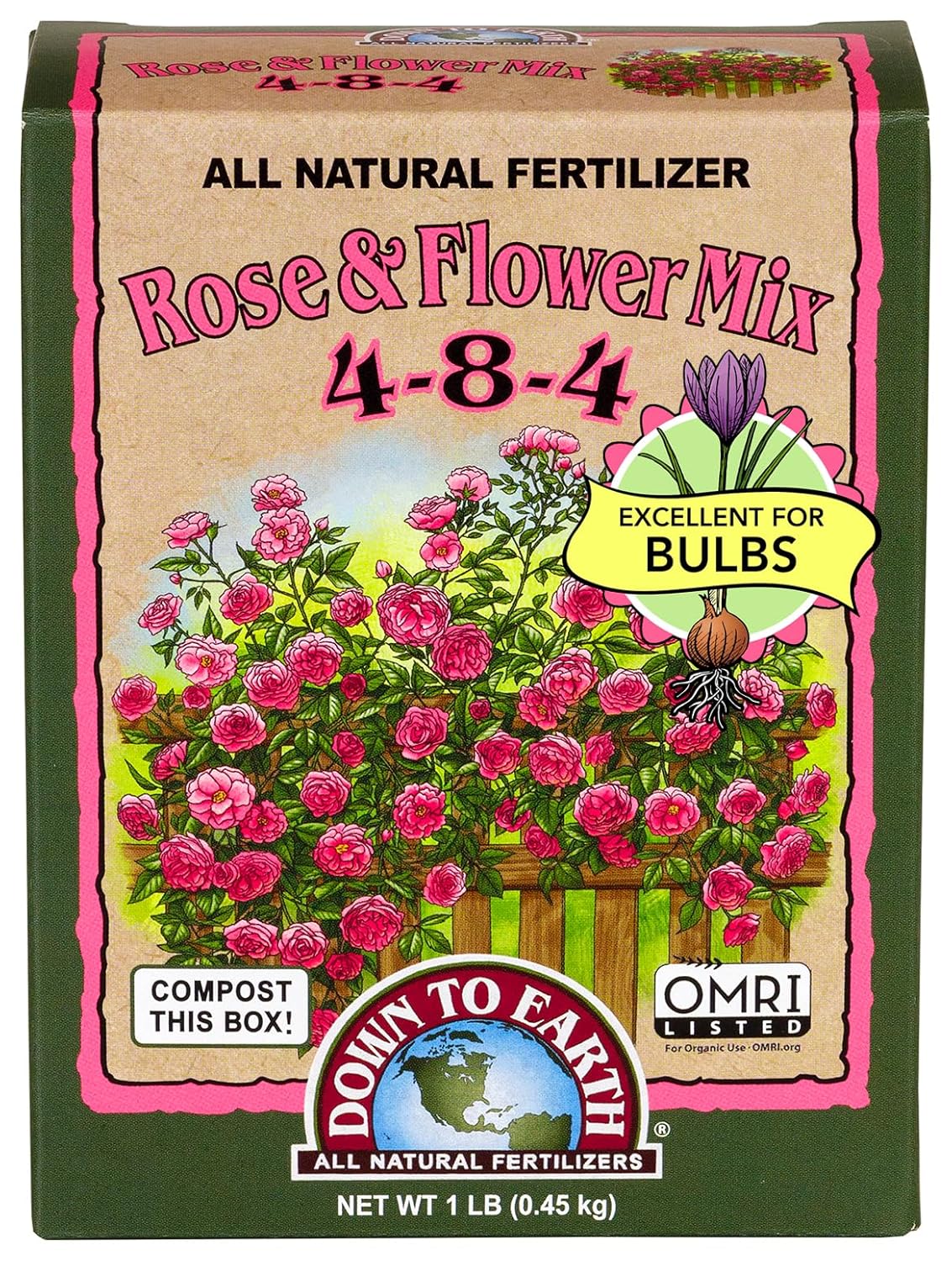
Down To Earth Organic Rose & Flower Mix Fertilizer 4-8-4, 1 lb
| NPK | 4-8-4 |
|---|---|
| Item Form | Granules |
| Specific Uses For Product | Plant Growth |
| Coverage | Medium |
| Mixing Ratio | 2 tbsp per gallon of soil |
This 1 lb box of Down To Earth Organic Rose & Flower Mix is a granular, OMRI-listed fertilizer designed specifically to encourage flowering and healthier root systems in roses and other ornamentals. Gardeners typically work it into the soil around established plants or use the brand mixing guidance for containers and small beds to provide periodic feeding. The relatively high middle number (phosphorus) helps stimulate prolific blooms while the balanced nitrogen and potassium support foliage and overall plant vigor. Because it is derived from natural plant, animal, and mineral resources it also contributes organic matter that supports soil microorganisms over time. The mini box size is convenient for trialing on a few plants or for container and patio gardens, but it means frequent reorders or multiple boxes are needed for larger beds. Users should follow the recommended mixing ratio and avoid overapplication since organic granules release nutrients more slowly than synthetic feeds and are best used as part of a regular feeding schedule.
Best for: Practical gardeners who prioritize organic inputs and want a bloom-focused feed for a few roses, containers, or small flower beds and who prefer predictable, soil-building nutrition over quick synthetic fixes.
Less Ideal for: Gardeners managing large rose borders or commercial plantings who need fast-acting, high-volume feeding or a single large-bag supply.
- Phosphorus-forward 4-8-4 formula supports larger and more frequent blooms
- OMRI-listed organic formulation suitable for organic rose care
- Granular form adds organic matter that benefits soil microbial activity
- Compact 1 lb size is convenient for containers, patio gardens, and small beds
- Small package size requires multiple purchases for larger rose gardens
- Slower nutrient release compared with synthetic fertilizers, so results take longer to appear
Verdict: A compact, OMRI-listed granular fertilizer that favors bloom production and soil health, making it a sensible organic choice for home rose growers with small gardens or containers.
FoxFarm Big Bloom Liquid Plant Food, 16 fl oz

| Item Form | Liquid |
|---|---|
| Specific Uses For Product | Organic |
| Application Method | watering can, sprayer, or drip system |
| Unit Count | 16 Fluid Ounces |
| Mixing Ratio | 4 |
Big Bloom is a ready-to-mix liquid plant food intended for flowering and fruiting plants; you dilute 4 tablespoons per gallon of water and apply with a watering can, sprayer, or through drip systems. The formula centers on natural inputs such as bat guano and earthworm castings and is OMRI listed for organic gardening, so it supplies readily available nutrients that can boost blooms and help struggling plants recover quickly. Because it is a low-NPK, bloom-focused concentrate it is useful through multiple growth stages without overwhelming foliage with high nitrogen. Practical benefits include easy integration into existing irrigation, fast uptake for visible response, and suitability for organic beds, containers, and fruiting ornamentals. Important limits are that it contains phosphorus, which some local regulations restrict for turf or lawns, and the small 16 fl oz bottle means frequent refills for larger plantings. Users should follow dilution guidance and local rules to avoid runoff issues.
Best for: Buyers focused on maximizing blooms and fruit on ornamentals, container plants, and small fruiting crops who prefer organic, fast-acting feeding and want a product that fits existing watering systems.
Less Ideal for: People managing large turf areas, large-scale vegetable plots, or those who need a high-nitrogen general-purpose fertilizer should look for formulations designed specifically for those uses.
- Organic certified and OMRI listed, suitable for certified organic gardens
- Natural nutrient sources (bat guano and earthworm castings) that support flowering and fruit set
- Versatile application: watering can, sprayer, hose-end, or drip irrigation compatible
- Low-NPK bloom-focused formula that can be used throughout flowering stages without excessive foliage growth
- Contains phosphorus, which may be restricted by local regulations for some lawn or turf applications
- Smaller 16 fl oz bottle may require frequent repurchasing for medium to large gardens
Verdict: Choose Big Bloom if you want an OMRI-listed, easy-to-use liquid fertilizer that reliably boosts flowering and fruiting in small to medium organic gardens.
FoxFarm Soil Liquid Trio Pack (Big Bloom, Grow Big, Tiger Bloom)

| Brand | FoxFarm |
|---|---|
| Item Form | Liquid |
| Unit Count | 48 Fluid Ounces |
| Specific Uses For Product | Plant Food |
| Coverage | Organic |
The FoxFarm Soil Liquid Trio Pack combines Big Bloom, Grow Big, and Tiger Bloom into a simple program for indoor gardeners who want strong vegetative growth followed by bigger blooms and fruit. Typical use is stage-based: Grow Big during vegetative growth to push leafy development, Big Bloom as an all-purpose supplement across cycles, and Tiger Bloom once buds form to encourage multiple bud sites and fuller flowers. The liquids are concentrated and greenhouse-tested for consistency, so measured feedings integrate easily with regular watering schedules. Practical benefits include a complete, complementary nutrient progression and formulations designed to keep micronutrients available in storage. Important limitations are that these are general-purpose concentrates rather than precision NPK formulations for specialty crops, and users who want exact nutrient ratios or automated dosing systems will need extra equipment and testing. Safety precautions such as keeping away from children and pets and wearing protective clothing are required when handling concentrated liquids.
Best for: Indoor growers who prioritize measurable performance and want a simple, stage-based feeding plan to push vigorous growth and larger blooms without building their own nutrient lineup.
Less Ideal for: Growers seeking exact NPK control, automated dosing integration, or a fertilizer tailored to a single specialist crop should consider lab-formulated or hydroponic-specific options instead.
- Three complementary formulas cover vegetative growth, bloom support, and fruiting in one kit
- Concentrated liquid form mixes readily for regular indoor feedings
- Greenhouse-tested formulations deliver consistent performance across batches
- Suitable for a wide range of indoor plants including houseplants, herbs, and vegetables
- Not a precision nutrient program for specialty or hydroponic crops
- Concentrated liquids require careful measuring and handling to avoid overfeeding
Verdict: For indoor gardeners who want a proven, stage-based liquid feeding program to boost vegetative growth and maximize blooms, this trio delivers a ready-made performance pathway.
Burpee Organic Rose & Bloom Granular Plant Food, 4 lb

| Item Form | Granules |
|---|---|
| Specific Uses For Product | Plant Food |
| Coverage | 213 Square Feet |
| Target Species | roses and other flowering plants |
| Mixing Ratio | 1:1:1 |
Burpee Organic Rose & Bloom is a granular, OMRI-listed plant food made for roses and other flowering plants in containers, beds, or individual bushes. It delivers a quick flush of nutrients for fast green-up and flower production while also including slow-release components that keep feeding for up to three months. The granules are fine and easy to spread by hand or with a small spreader, and the formula includes beneficial microbes intended to support root health. Typical use is an application around established plants every two months during the growing season followed by thorough watering. Practical benefits are straightforward: predictable, sustained feeding without liquid mixing, suitability for organic gardens, and easy handling for routine maintenance. Limitations are that it is a general bloom food rather than a precision, analysis-specific fertilizer for correcting identified soil deficiencies and it requires repeat applications through the season to maintain results.
Best for: Gardeners who prefer low-risk, organic products and want a simple, reliable bloom fertilizer for roses and flowering plants in containers or established beds.
Less Ideal for: Growers who need tailored soil correction based on test results or those who prefer single-application synthetic fertilizers with higher immediate nutrient concentration.
- OMRI-listed organic formula suitable for organic gardening
- Provides both immediate nutrients and slow-release feeding up to three months
- Includes beneficial microbes to support root health and bloom production
- Fine granular texture makes for easy, even spreading in containers or beds
- Not formulated to correct specific nutrient deficiencies because guaranteed analysis is not listed
- Requires reapplication every two months during the growing season to maintain feeding
Verdict: A dependable OMRI-listed granular bloom fertilizer that offers easy application and sustained feeding for gardeners who want organic, low-risk bloom support.
Choosing the Right Natural Bloom Fertilizer: Key Factors to Consider
Nutrient Ratios for Flowering
Flowering plants typically need a different balance of nutrients than leafy growth. A bloom-focused fertilizer leans toward higher phosphorus and potassium relative to nitrogen to promote bud formation and flower longevity. Too much nitrogen encourages foliage at the expense of blooms, while too little can weaken overall plant vigor.
When evaluating products, look for clear N-P-K numbers and consider how those ratios align with the stage of growth you are targeting. For repeat-blooming perennials and many annuals, moderate nitrogen with elevated phosphorus and potassium encourages both tight bud set and strong petals.
Source Materials and Soil Health
Natural bloom fertilizers can come from a range of organic sources: bone meal and rock phosphate provide phosphorus, kelp and fish emulsion supply trace elements and growth hormones, while composted manures and humates boost microbial activity. These ingredients not only supply nutrients but also influence soil structure and biology.
Choosing products with materials that feed soil life helps sustain blooms over time rather than offering a short-term spike. Consider whether the product lists guaranteed analysis for micronutrients and whether it contains carbon-rich material that will integrate into your existing soil organic matter.
Release Rate and Timing
Release predictability affects how long a product supports flowering and how often you need to reapply. Rapid-release liquid feeds show quick results useful for imminent blooms, while slow-release granules or organic powders feed steadily over weeks. The wrong timing can either waste nutrients or miss a critical flowering window.
Match release profile to your planting schedule. For container plants or short-season annuals, quicker feeds are often preferred. For perennials and established beds, slower-release formulations reduce maintenance and lower the risk of nutrient burn.
Application Method and Garden Workflow
How you apply a fertilizer matters for consistent results. Granular products are easy to broadcast over beds or top-dress containers but require incorporation or watering to make nutrients available. Water-soluble concentrates give fast uptake through foliar or root feeding but need mixing and more frequent application. Pelleted or spike forms are low-effort but can concentrate nutrients unevenly if placed too close to roots.
Consider the scale of your garden and how often you want to work. If you care for many containers, a soluble concentrate may be worth the extra mixing. For a flower border, a granular or slow-release option often fits standard seasonal maintenance.
Crop Compatibility and Safety
Not every natural bloom fertilizer is suitable for all flowering plants. Some formulas are stronger and better for heavy feeders like roses or annuals, while gentler blends fit native wildflowers and delicate ornamentals. Also assess safety for pollinators, pets, and children; many natural ingredients are safer than synthetics but can still be irritating or attract animals.
Check product directions for application rates, pre-bloom and post-bloom guidance, and any warnings about contact with petals or leaves. Choose options that balance plant needs with safety for your garden users.
Timing Fertilizer Applications for Best Bloom
Timing is as important as what you apply. Many flowering plants benefit from an initial feeding at early bud development and a follow-up mid-bloom to sustain color and size. Avoid heavy feeding immediately after planting; give roots time to establish before adding concentrated bloom fertilizers.
- Start with a soil test or baseline soil amendment in spring.
- Apply a bloom-focused feed when buds first form, then repeat per label instructions.
- Stop high-phosphorus feeding after main flushes to prevent salt buildup in soil.
Using Natural Fertilizers in Containers Vs Beds
Containers warm and dry faster than in-ground beds, so nutrients can concentrate more quickly. Use lower rates or more frequent, light applications in pots. In beds, organic materials have more soil volume to buffer salts and deliver nutrients slowly over time.
- Top-dress containers with light granular or compost and water in thoroughly.
- For beds, mix slow-release amendments into the top few inches at planting.
- Monitor watering frequency because nutrient availability changes with soil moisture.
Combining Natural Amendments Safely
Layering several organic inputs can be effective but requires attention. For example, pairing a bone-based phosphorus source with a high-carbon amendment like compost helps integrate nutrients without creating hotspots. Avoid stacking multiple strong amendments at full strength; instead, reduce rates to prevent nutrient burn or imbalanced soil chemistry.
- Factor in existing soil organic matter before adding more carbon-rich products.
- Use compost teas or kelp extracts as gentle complements to granular phosphate sources.
- Space applications several weeks apart when trying new combinations.
Quick Fixes for Lackluster Blooms
If blooms are sparse, start with a quick diagnosis: check light levels, water stress, and pest damage before reaching for fertilizer. When the issue is nutrient-related, a mild soluble bloom feed can coax buds within days, especially on annuals and potted plants. For persistent problems, build soil structure with organic matter rather than relying solely on repeat feeding.
- Inspect plant health and environmental conditions first.
- Use fast-acting feeds for immediate correction and slow-release for long-term support.
- Adjust pruning and deadheading to direct energy into new blooms.
Seasonal Care and Overwintering Considerations
Late-season feeding has tradeoffs. While some blooms respond to fall feeds, heavy phosphorus or nitrogen late in the season can push tender growth that is vulnerable to frost. For perennials, favor soil-building amendments in autumn and reserve bloom-focused feeding for the following spring.
- Finish major bloom feeding several weeks before expected frost.
- Add organic matter in fall to improve soil structure and nutrient cycling.
- Save higher-rate bloom applications for active growing seasons only.
How We Chose the Best Natural Bloom Fertilizer
We focused on attributes that directly affect bloom performance and long-term soil health in real garden conditions. Evaluation emphasized nutrient composition tailored for flowering, including balanced phosphorus and potassium levels and modest nitrogen so foliage does not outcompete blooms. We prioritized organic and naturally derived nutrient sources such as bone, rock, kelp, and composted manures that release nutrients steadily and support microbial life. Application practicality was another key filter. Products had to be suitable for common garden workflows: granular spreaders, water-soluble concentrates, or slow-release pellets that work in containers and beds. We also considered safety for pollinators and pets, odor and handling, and the potential for salt buildup in repeated use. Longevity and release profile mattered because gardeners need predictable timing for bloom cycles rather than a single flush. We excluded synthetic or chemically enhanced fertilizers and blends lacking clear nutrient analysis or application instructions. We also filtered out products intended only for lawns or large-scale agriculture rather than home flower beds. The final picks reflect a balance of nutrient strategy, source transparency, and real-world usability.
FAQ
How often should I apply a natural bloom fertilizer to annuals?
It depends on the product release rate. Fast-acting soluble feeds are often applied every 2 to 4 weeks during active bloom. Slow-release granules typically last 6 to 12 weeks. Follow label rates and reduce concentration for containers.
Can I use bone meal and kelp together for flowering plants?
Yes often those ingredients complement each other because bone meal supplies phosphorus and kelp provides micronutrients and growth stimulants. Apply at recommended rates and avoid over-application that could create nutrient imbalances.
Will natural bloom fertilizers attract pests or pets?
Some organic ingredients, such as manures or fish-based products, can have odors that attract animals. Many dry, mineral-based options are less attractive. Read product guidance about handling and keep applications covered or incorporated into soil to reduce attraction.
Is a soil test necessary before using a bloom-focused fertilizer?
A soil test is helpful but not always required. Tests reveal existing phosphorus and pH levels that affect bloom nutrient availability. If you have unknown soil history or persistent bloom problems, testing helps target the right amendment rather than guessing.
Can I use natural bloom fertilizer on native wildflowers?
Native wildflowers often prefer leaner soils, so use light or no bloom feeding and choose low-strength formulas if needed. Strong bloom fertilizers can favor aggressive garden plants over delicate natives and alter site conditions over time.
Final Verdict
Prioritize the bloom nutrient profile and the product release pattern when choosing a natural bloom fertilizer. Decide whether you need quick corrective feeding for containers and annuals or slower soil-building support for perennial beds. Balance phosphorus and potassium with modest nitrogen, and favor source materials that build soil life if long-term floral performance matters. The right choice depends on planting type, application frequency, and safety concerns. Use the evaluation criteria above to match a formula to your garden routine, and favor predictable release and clear labeling for reliable bloom results.
