

Note: This article contains affiliate links. If you click on these links and make a purchase, I may earn a small commission at no extra cost to you. This helps support my research and content. Read my full affiliate disclosure here.
Picking the right natural fertilizer for outdoor plants changes how your garden feeds itself over a season. The right choice improves soil biology, supplies slow-release nutrients, and reduces dependence on synthetic inputs so plant roots and beneficial microbes thrive. This guide covers a shortlisted group of top natural fertilizers suited to outdoor beds, containers, lawns, and landscape plantings. Each entry was evaluated for how it performs in real garden conditions, how easy it is to apply, and how it affects soil health over time. Read on to see which products match your planting style and maintenance rhythm.
Top Picks at a Glance
| Best Overall The best all-around choice for most situations | Espoma Plant-Tone Organic All-Purpose Plant Food, 4 lb |  |
| Best Quality Built to a higher standard if you want something more solid | Brut Organic Worm Castings, 5 lb |  |
| Best Value The sweet spot between price and what you get | Burpee All-Purpose Organic Granular Plant Food, 4 lb |  |
| Best Budget The cheapest option that still gets the job done reliably | 2nd Nature Organic BSFL Frass Pellets 3-3-2 Shake-n-Spread 2.2 lb |  |
| Highest Rated A top-rated pick with lots of positive feedback | Earth Science Premium Earthworm Castings, 3 lb |  |
| Most Popular A crowd favorite that many people choose with confidence | FoxFarm Big Bloom Liquid Plant Food, 16 fl oz |  |
| Best Seller A high-volume bestseller chosen again and again | Neptune's Harvest Fish & Seaweed Liquid Fertilizer (2-3-1) 36 oz |  |
Espoma Plant-Tone Organic All-Purpose Plant Food, 4 lb

| Item Form | Granules |
|---|---|
| Specific Uses For Product | Organic,Plant Food |
| Coverage | Medium |
| Target Species | flowers, vegetables, trees and shrubs |
| Mixing Ratio | 5-3-3 |
Espoma Plant-Tone is a ready-to-use granular organic fertilizer designed to feed a broad range of garden plants from perennials and shrubs to vegetables and roses. It supplies a balanced 5-3-3 nutrient mix plus calcium in an organic base that breaks down slowly, so you get extended feeding without frequent reapplication. Typical use is to sprinkle around the drip line of plants in spring and fall for trees and shrubs and monthly for flowering perennials and vegetables during the growing season, then water it in. Notable features include an organic formula approved for organic gardening and a medium coverage profile that makes one 4 lb bag useful for small beds and several shrubs. Practical benefits are steady nutrient release, suitability for organic beds, and simple application with no mixing required. Limitations are that a single 4 lb bag covers only limited area, so larger gardens need multiple bags, and granular slow-release formulas act more gradually than soluble feeds when you want a rapid boost.
Best for: Gardeners who want a dependable organic, all-purpose feed for perennials and shrubs and prefer a low-maintenance slow-release product that fits into seasonal feeding routines.
Less Ideal for: People managing large landscapes or needing fast corrective feeding for nutrient deficiencies should consider higher-coverage or soluble fertilizers instead.
- Organic 5-3-3 formula with added calcium suitable for certified organic gardens
- Granular slow-release form provides steady feeding over time without mixing
- Ready-to-use application applied around the drip line with easy watering-in
- Suitable for a wide range of plants including perennials, shrubs, and vegetables
- 4 lb bag offers limited coverage for larger beds or multiple shrubs
- Slower acting than liquid or soluble fertilizers when immediate nutrient uptake is needed
Verdict: A reliable organic slow-release fertilizer ideal for gardeners who want steady seasonal feeding for perennials and shrubs.
Brut Organic Worm Castings, 5 lb

| Item Form | Granules |
|---|---|
| Specific Uses For Product | Gardening,Organic |
| Target Species | All plants |
| Mixing Ratio | 1:5 |
Brut Organic Worm Castings function as a concentrated, natural soil amendment you mix into potting mixes or top-dress garden beds and raised beds. Typical use is mixing at the recommended 1:5 ratio for new indoor plants, sprinkling a cup around established houseplants, or working into outdoor planting holes and beds according to the brand directions. The product is OMRI/CDFA listed and produced in controlled conditions, which supports consistent nutrient content and beneficial microbial life that help roots establish, improve soil structure, and increase moisture retention without burning plants. Practical benefits for raised garden beds include improved aeration, slow-release nutrients, and a boost in microbial activity that supports long-term fertility. Limitations are that it is not a complete NPK fertilizer for immediate heavy feeding needs and larger beds require significant quantities to hit the suggested per-square-foot rates, so frequent applications or bulk purchases may be needed for big projects.
Best for: Gardeners who prioritize dependable, organic soil improvement for raised beds and container gardens and prefer predictable, low-risk amendments that support long-term soil health.
Less Ideal for: Those needing immediate, high-NPK feeding for heavy-feeding crops or gardeners who want to amend very large beds without buying supplemental bulk material.
- Certified organic and produced indoors for consistent purity
- Rich in beneficial microbes that improve soil structure and plant vigor
- Easy-to-use granular form suitable for mixing or top-dressing
- Not a standalone high-NPK fertilizer for rapid nutrient correction
- Five-pound bag may be small for large raised beds and repeated seasonal use
Verdict: Use this OMRI/CDFA-listed worm castings product to reliably build long-term fertility and microbial health in raised beds and containers.
Burpee All-Purpose Organic Granular Plant Food, 4 lb

| Item Form | Granules |
|---|---|
| Specific Uses For Product | Gardening,Plant Growth,Root Development |
| Coverage | 213 Square Feet |
| Target Species | Herba |
Burpee All-Purpose Organic Granular Plant Food is a ready-to-use organic fertilizer designed for vegetable gardens, flower beds, herbs and container plants. The granules supply major and minor nutrients plus calcium and beneficial microbes that begin releasing nutrients quickly and continue feeding plants for up to three months, so you can apply less frequently during the growing season. It is OMRI-listed, which makes it suitable for gardeners who prefer organic-approved inputs, and the coverage figure on the package helps plan application for small to medium beds. Typical use is a surface application worked lightly into the soil or mixed into potting media for containers and seed starting. Practical advantages include straightforward application, multi-month nutrient release, and compatibility with a wide range of garden plants. Limitations are the small bag size for larger plots and the lack of detailed N-P-K numbers on the listing, which means gardeners wanting precise nutrient ratios or high- rate corrective feeding may need a supplemental product.
Best for: Gardeners who prefer low-risk, organic-approved inputs and want a simple, multi-purpose fertilizer that reduces the need for frequent feeding in small to medium vegetable beds and container gardens.
Less Ideal for: Large-scale vegetable growers or gardeners who need exact N-P-K values and high-strength corrective applications should consider more concentrated or bulk fertilizers.
- OMRI-listed organic formula suitable for certified-organic and home organic gardens
- Granular form releases nutrients immediately and continues feeding for up to three months
- Suitable for seed starting, vegetables, herbs, flowers, trees, shrubs and containers
- Clear coverage guidance provided for planning applications to small and medium beds
- Bag is only 4 lb so not economical for large vegetable plots
- Product listing does not show explicit N-P-K ratio for precision nutrient planning
Verdict: A small, OMRI-listed granular fertilizer that gives low-risk, multi-month feeding for home vegetable beds and container gardens.
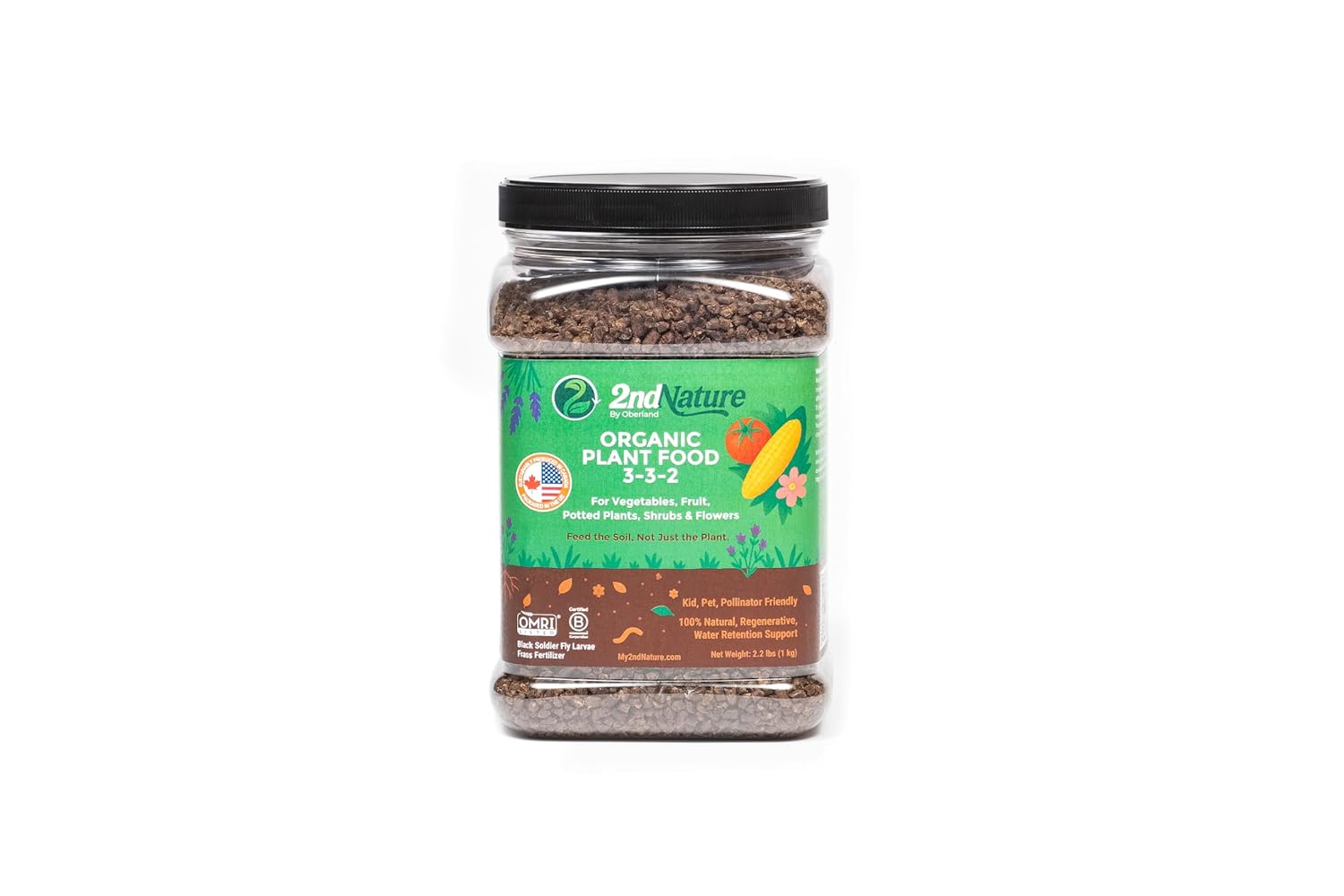
2nd Nature Organic BSFL Frass Pellets 3-3-2 Shake-n-Spread 2.2 lb
| Item Form | Pellet |
|---|---|
| Application Method | Shake-n-Spread |
| Unit Count | 35.2 Ounce |
| Ingredients | 100% Black Soldier Fly Larvae |
| Mixing Ratio | 3:3:2 |
This product is a bagged pellet fertilizer made from black soldier fly larvae frass and packaged in a resealable 2.2 pound Shake-n-Spread container for easy application. You use it by opening the lid and shaking the pellets over soil, potting mix, or around established plants; it is intended as a gentle, slow-release feed that supports foliage, roots, blooms and soil conditioning. Notable features include the organic 3-3-2 NPK profile, chitin content for natural pest support, and an OMRI-listed formulation that replaces or complements worm castings. Practical benefits are straightforward: it improves root strength, helps moisture retention, provides a broad micronutrient mix, and is safe around pets and pollinators. Limitations are that the 2.2 lb container is a modest size for larger beds and that results are gradual rather than instant, so it is best used as part of routine feeding rather than a quick fix for nutrient-deficient plants.
Best for: Gardeners who want an easy-to-apply, organic, pet- and pollinator-safe fertilizer to support steady growth and soil health in outdoor beds and containers while keeping costs moderate.
Less Ideal for: Large-scale gardeners who need bulk quantities or growers seeking rapid corrective feeding for acute nutrient deficiencies should consider higher-volume or faster-acting alternatives.
- OMRI-listed organic frass with a balanced 3-3-2 NPK profile suitable for many garden plants
- Resealable Shake-n-Spread container makes distribution quick and low-mess
- Contains chitin and a range of micronutrients that support root health and natural pest defense
- Pet- and pollinator-friendly formulation safe for mixed outdoor plantings
- Small 2.2 lb container may need frequent replenishing for medium to large gardens
- Slow-release action means not ideal when immediate nutrient correction is required
Verdict: A compact, easy-to-use OMRI-listed frass fertilizer that gives outdoor plants steady organic nutrition and soil benefits without synthetic chemicals.
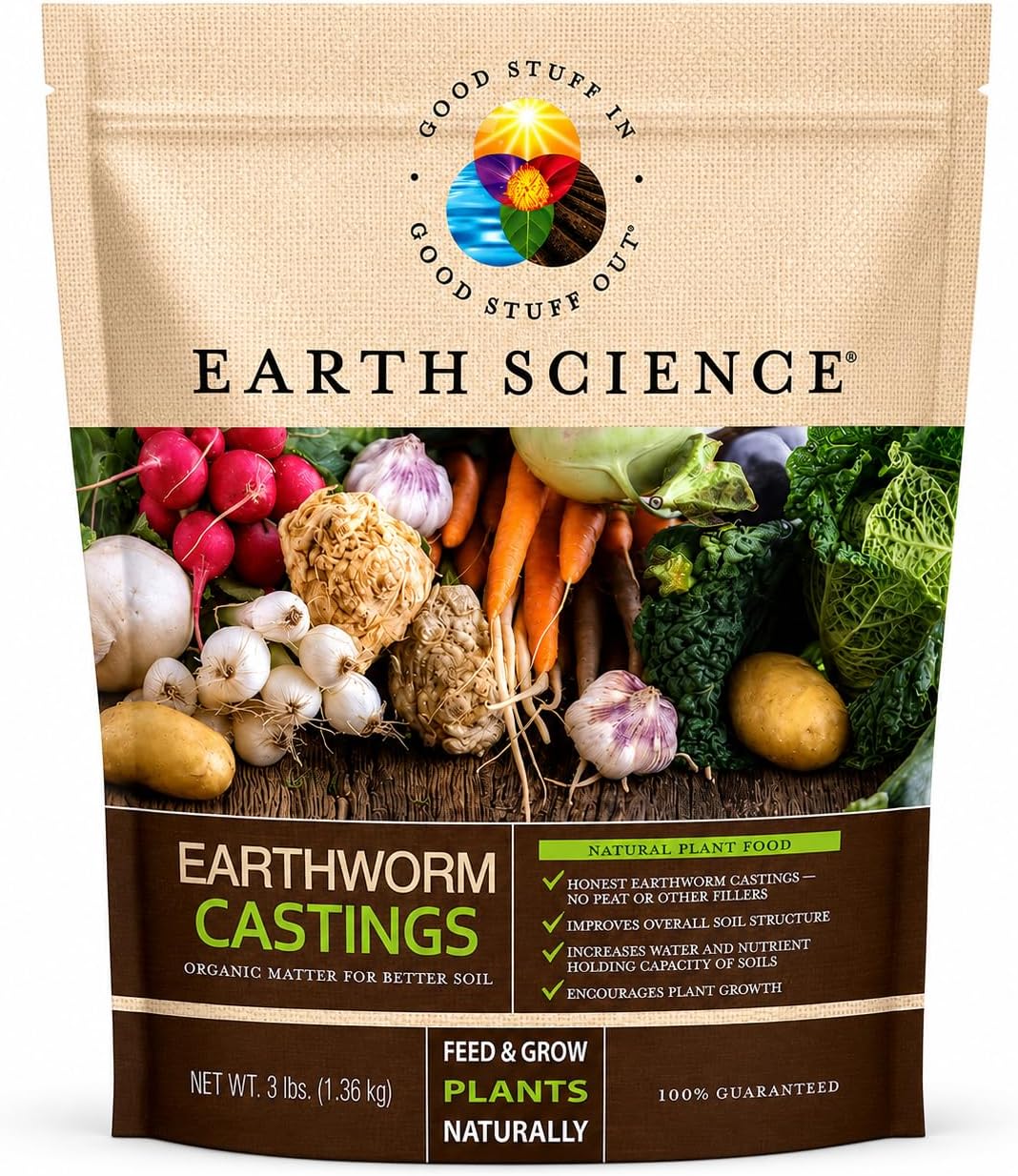
Earth Science Premium Earthworm Castings, 3 lb
| Item Form | Granules |
|---|---|
| Specific Uses For Product | Organic,Plant Food,Plant Growth |
| Coverage | Medium |
| Target Species | gardens, flower beds, fruits, trees, shrubs |
| Mixing Ratio | 1:4 |
Earth Science Premium Earthworm Castings are a pure vermicompost product intended to enrich garden and potting soils. Gardeners typically use it as a top dressing, mixed into potting mixes at about 1:4 castings to soil, or incorporated into garden beds at 1/4 to 1/2 inch and watered in; it can also be brewed as compost tea. The castings add organic matter that helps soil retain moisture, supports beneficial microbes, and can reduce compaction by improving aggregation. Practical benefits include a straightforward application for vegetables, flower beds, trees, and shrubs and the flexibility to use in pots, compost piles, or on lawns. The product is free of fillers and presented as a slow-release, natural fertilizer rather than a quick synthetic boost, so expect gradual improvements over weeks to months rather than immediate greening. Because this is a small, concentrated pouch, frequent reapplication during the growing season is recommended for larger beds or heavy-feeding crops.
Best for: Gardeners who prioritize dependable, natural soil improvement for organic vegetable beds and potted edibles and prefer steady, biology-driven results over quick chemical fixes.
Less Ideal for: Growers who need rapid, high-N fertilizer responses for a single fast-growing crop or who require large-volume amendments for extensive beds without frequent reapplication.
- 100% vermicompost with no peat or fillers
- Versatile uses: top dressing, potting mix amendment, compost tea, and compost layering
- Improves soil structure and water retention while feeding beneficial microbes
- Slow-acting nutrient release not suited for immediate greening or fast corrective feeding
Verdict: Use this pure earthworm castings product when you want a reliable, natural soil conditioner that builds long-term fertility for an organic vegetable garden.
FoxFarm Big Bloom Liquid Plant Food, 16 fl oz

| Item Form | Liquid |
|---|---|
| Specific Uses For Product | Organic |
| Application Method | watering can, sprayer, or drip system |
| Unit Count | 16 Fluid Ounces |
| Mixing Ratio | 4 |
Big Bloom is a ready-to-mix liquid plant food intended for flowering and fruiting plants; you dilute 4 tablespoons per gallon of water and apply with a watering can, sprayer, or through drip systems. The formula centers on natural inputs such as bat guano and earthworm castings and is OMRI listed for organic gardening, so it supplies readily available nutrients that can boost blooms and help struggling plants recover quickly. Because it is a low-NPK, bloom-focused concentrate it is useful through multiple growth stages without overwhelming foliage with high nitrogen. Practical benefits include easy integration into existing irrigation, fast uptake for visible response, and suitability for organic beds, containers, and fruiting ornamentals. Important limits are that it contains phosphorus, which some local regulations restrict for turf or lawns, and the small 16 fl oz bottle means frequent refills for larger plantings. Users should follow dilution guidance and local rules to avoid runoff issues.
Best for: Buyers focused on maximizing blooms and fruit on ornamentals, container plants, and small fruiting crops who prefer organic, fast-acting feeding and want a product that fits existing watering systems.
Less Ideal for: People managing large turf areas, large-scale vegetable plots, or those who need a high-nitrogen general-purpose fertilizer should look for formulations designed specifically for those uses.
- Organic certified and OMRI listed, suitable for certified organic gardens
- Natural nutrient sources (bat guano and earthworm castings) that support flowering and fruit set
- Versatile application: watering can, sprayer, hose-end, or drip irrigation compatible
- Low-NPK bloom-focused formula that can be used throughout flowering stages without excessive foliage growth
- Contains phosphorus, which may be restricted by local regulations for some lawn or turf applications
- Smaller 16 fl oz bottle may require frequent repurchasing for medium to large gardens
Verdict: Choose Big Bloom if you want an OMRI-listed, easy-to-use liquid fertilizer that reliably boosts flowering and fruiting in small to medium organic gardens.
Neptune's Harvest Fish & Seaweed Liquid Fertilizer (2-3-1) 36 oz

| Item Form | Liquid |
|---|---|
| Mixing Ratio | 2:3 |
| Specific Uses For Product | Plant Growth |
| Liquid Volume | 946 ml |
Neptune's Harvest Fish & Seaweed Liquid Fertilizer is a concentrated organic plant food that mixes with water for use as a soil drench or foliar feed. It is typically diluted (manufacturer directions give roughly 1 fl oz per gallon for outdoor use and 1 tablespoon per gallon for houseplants) and applied every 1 to 3 weeks depending on the crop. The formula combines hydrolyzed fish and seaweed to deliver nitrogen, micronutrients, and seaweed-derived growth compounds in a plant-ready form, which helps green growth, flowering color, and vegetable flavor. Because it is a liquid concentrate it is easy to measure and applies evenly, and regular use can improve soil biology and structure over time. Limitations are that it is low in phosphorus and potassium relative to some specialty bloom or fruit formulas and it has an odor typical of fish-based fertilizers that some users may find strong. This product suits gardeners who want an effective, organic regular feed that supports both potted houseplants and garden beds.
Best for: Gardeners seeking a reliable, organic everyday fertilizer that simplifies feeding for a mixture of houseplants, vegetables, flowers and shrubs and who value soil health as well as plant vigor.
Less Ideal for: Growers who need a high-phosphorus bloom booster or a fertilizer formulated specifically for fruit set or lawns should look for a targeted specialty product instead.
- Organic concentrate blending hydrolyzed fish and seaweed for plant-ready nutrients
- Versatile application as soil drench or foliar feed for indoor and outdoor plants
- Supports soil biology and structure with regular use
- Easy-to-measure mixing ratios for routine feeding
- Has a strong fish odor that some users may find unpleasant
- Lower phosphorus and potassium compared with specialized bloom or fruit formulas
Verdict: A dependable organic liquid concentrate that provides balanced, plant-ready nutrients and improves soil health for routine feeding of mixed garden and houseplants.
Choosing the Right Natural Fertilizer for Outdoor Plants: Key Factors to Consider
Nutrient Profile and Release Pattern
Outdoor plants need a balance of nitrogen, phosphorus, and potassium along with secondary nutrients and micronutrients. Different natural fertilizers supply these at varying ratios. A high-nitrogen input will push leafy growth, while phosphorus supports root development and flowering. Equally important is how quickly nutrients become available. Compost and well-aged manures release nutrients slowly over weeks to months as microbes break them down. Fast-acting options like certain blood meals or fish emulsions provide a quick nutrient boost but can be short-lived. Consider what your plants need now and over the season, and match the fertilizer's release pattern to your crop and timing.
Soil Structure and Organic Matter Contribution
Natural fertilizers often do more than supply nutrients; many add organic matter that improves soil structure and water retention. Materials high in carbon and humus help sandy soils hold moisture and improve drainage in heavy clay by increasing porosity. Peat-free composts, well-rotted manures, and finished leaf mulch contribute living and decaying organic matter that feeds soil organisms. Over repeated applications these changes can reduce watering needs and make nutrients more available to plants. When choosing, evaluate how much bulk organic material the product adds per application and whether it will help correct existing soil texture problems.
Application Method and Labor
How you apply a natural fertilizer affects the time and effort required. Granular or bagged amendments are easy to spread and incorporate into beds with a fork or tiller. Liquid concentrates and emulsions require mixing, may need multiple applications during the season, and are better for quick corrections or foliar feeding. Mulch-like products can be top-dressed to protect soil and feed slowly but may need occasional turning or replenishing. Choose a format that matches how often you want to work in the garden and the tools you have available.
Suitability for Plant Type and Growing Situation
Different outdoor plantings have distinct nutritional demands. Vegetables and annuals often respond to regular feeding and may benefit from faster-release organics early in the season. Established shrubs and trees need less frequent, deeper-feeding approaches that avoid stimulating excessive soft growth. Containers have limited soil volume and require more regular, balanced nutrient inputs to avoid deficiencies. Match the fertilizer type and application frequency to the plant group, planting density, and whether you are growing for harvest, display, or long-term landscape health.
Environmental Impact and Runoff Risk
Natural does not automatically mean harmless. Some organic fertilizers are highly soluble and can contribute to nutrient runoff if applied before heavy rain. Manures must be well-aged to avoid pathogens and weed seeds. Products with high salt content can harm sensitive plants and soil life. Look for materials with low soluble nutrient spikes and follow recommended rates to reduce leaching into waterways. Consider placement and timing to protect nearby streams, ponds, and pollinator habitat.
Consistency, Certification, and Ingredient Transparency
Because natural materials vary by source and processing, consistency matters. A well-blended, labeled product gives predictable results compared with a mixed batch of variable compost. Certifications such as organic program listings or clear laboratory analysis can provide confidence about nutrient content and contaminants. Ingredient transparency lets you avoid materials incompatible with your garden practices, such as fresh manures for edible beds or fish-based products near certain ponds. Favor suppliers that publish analysis or processing details so you can match applications to your soil test and planting needs.
When to Use Slow-Release Organics Vs Fast-Acting Feeds
Slow-release organics, like finished compost or well-composted manures, build soil over time and are ideal for beds you tend throughout the season. They help maintain steady growth and reduce nutrient fluctuations that stress plants.
Fast-acting feeds, such as liquid seaweed or fish emulsions, are useful for correcting immediate deficiencies or giving a quick growth push, especially in established vegetables and flowering annuals. Use them sparingly and follow label directions to avoid nutrient burn or water quality issues.
- Top-dress compost in spring for season-long benefits.
- Use liquid feeds during active growth for quick correction.
- Combine approaches: build soil structure with organics, supplement with targeted liquids when needed.
Applying Natural Fertilizers to Containers and Raised Beds
Containers and raised beds need more frequent attention because they hold less soil and nutrients wash out faster. Incorporate a balanced organic amendment into the potting mix at planting and plan for light feedings through the season.
Solid slow-release materials can be mixed into the media at the start, while water-soluble or liquid organics provide midseason boosts. Monitor plants for signs of deficiency and adjust frequency rather than increasing dose.
- Mix bulk organic matter into raised-bed soil before planting.
- Use diluted liquid feeds for container top-ups every few weeks.
- Avoid heavy side-dressing in small pots to reduce root burn risk.
How to Read Organic Fertilizer Labels and Analyses
Labels on natural fertilizers vary in clarity. Look for guaranteed nutrient analysis when available and check for additional information like percent organic matter or carbon-to-nitrogen ratio. A clear ingredient list helps you understand the source of nutrients and any potential contaminants.
If a product lists only general terms without analysis, treat recommendations as approximate and err on the conservative side with application rates. When in doubt, adjust based on plant response and soil test results.
- Prioritize products with nutrient percentages and organic matter content.
- Note application rates per square foot or per gallon of soil.
- Compare C:N ratios for compost-like materials to judge how quickly they will release nitrogen.
Storing and Preparing Natural Fertilizers Safely
Proper storage preserves effectiveness and reduces pest or odor problems. Keep bagged materials dry and sealed; moist organic matter can heat up, lose nutrients, or attract rodents. Stack bags off the ground and in a ventilated, shaded area if possible.
For raw materials like manures or bone meals, follow handling guidelines to avoid contamination of edible crops. Wash hands and tools after use and avoid applying fresh manures to beds that will be harvested soon.
- Store in a cool, dry place away from pets and children.
- Label and date homemade compost or aged manure to track maturity.
- Use gloves and masks if handling dusty powders or concentrated meals.
Timing Applications Around Plant Life Cycles
Match fertilizer timing to the plant's growth stage. Apply higher-nitrogen feeds during active vegetative growth and switch to formulations that support flowers and fruit as plants begin to bud. For perennials and shrubs, late-winter or early-spring applications support new leaf and shoot development.
Avoid heavy fertilization late in the season for woody plants, which can encourage tender growth vulnerable to frost. Use slow-release organics in autumn to build soil reserves without forcing new shoots.
- Feed vegetables at planting and again midseason.
- Apply slow organics to perennials in early spring.
- Avoid high-nitrogen applications in late summer for woody plants.
How We Chose the Best Natural Fertilizer for Outdoor Plants
We shortlisted options that reliably support outdoor plantings without relying on synthetic nutrients. Evaluation prioritized concrete, gardener-focused dimensions: nutrient profile and release pattern, soil-building benefits, ease and flexibility of application, and environmental safety for pollinators and water runoff. We also assessed material consistency and predictability in the bag, and suitability for common outdoor uses such as flower beds, vegetable plots, container gardens, and established landscape trees and shrubs. Excluded were any products that depend primarily on proprietary chemical additives or that lack transparent ingredient listings. Our selection favored materials with documented nutrient content, demonstrable organic matter contribution, and practical application rates for typical backyard gardeners.
FAQ
How often should I apply natural fertilizer to outdoor flower beds?
It often depends on the material. Finished compost or aged manure can be applied once or twice a year as a top-dressing. Faster-release liquids may be applied every 3 to 6 weeks during active growth. Monitor plant vigor and soil tests to adjust frequency.
Can I use the same natural fertilizer for vegetables and ornamental shrubs?
Sometimes, but needs differ. Vegetables usually benefit from more regular feeding and slightly higher available nitrogen. Established shrubs and trees prefer less frequent, deeper applications. Choose a balanced product or vary application timing to match each planting type.
Is fresh manure safe to use in vegetable gardens?
Fresh manure is usually too strong and can contain pathogens or weed seeds. Use only well-aged or composted manure for edible beds and allow enough time between application and harvest. Follow recommended waiting periods for safety.
Will natural fertilizers attract pests or wildlife?
Some organic materials such as fish products or fresh manures can attract animals. Well-composted materials and dry, inert formulations are less likely to draw pests. Store supplies securely and apply during times when animals are less active if this is a concern.
How do I avoid nutrient runoff when using natural fertilizers?
Apply at recommended rates, avoid working material into bare soil before heavy rain, and use slow-release organics where possible. Buffer strips, mulch, and proper timing reduce the risk of nutrients washing into waterways.
Can I rely on natural fertilizer alone or should I test my soil first?
Soil testing is a smart first step. Natural fertilizers improve structure and supply nutrients, but a soil test reveals specific deficiencies or pH issues so you can select amendments that address actual needs rather than guessing.
Final Verdict
Choosing the right natural fertilizer for outdoor plants comes down to matching the product's nutrient delivery and soil-building qualities to your planting style and timing. Prioritize amendments that improve soil organic matter and offer a nutrient release pattern appropriate for the plants you grow. Balance convenience and labor with long-term soil health tradeoffs, and use soil tests to guide targeted applications. With a clear plan you can build resilient soil and reliable plant performance using natural fertilizers.
