

Note: This article contains affiliate links. If you click on these links and make a purchase, I may earn a small commission at no extra cost to you. This helps support my research and content. Read my full affiliate disclosure here.
Choosing the right natural home fertilizer changes how your garden grows, affecting soil life, plant resilience, and long-term fertility. If you prefer organic sources and gentler nutrient delivery, the right natural fertilizer can feed plants while supporting earthworms and microbes you want in your beds and containers. This guide shortlists seven top natural home fertilizers suited for a range of garden situations from indoor pots to backyard raised beds. We evaluated how each product performs in real gardening tasks like feeding, soil building, and easy application. Below we explain what mattered in our selections and what to expect from the different types.
Top Picks at a Glance
| Best Overall The best all-around choice for most situations | FoxFarm Big Bloom Liquid Plant Food, 16 fl oz |  |
| Best Quality Built to a higher standard if you want something more solid | GS Plant Foods Liquid Fish & Kelp Fertilizer (5 gal) |  |
| Best Value The sweet spot between price and what you get | Scotts Natural Lawn Food, 29.1 lb (covers 4,000 sq. ft.) |  |
| Best Budget The cheapest option that still gets the job done reliably | Down To Earth Organic Vegetable Garden Fertilizer, 4-4-4, 1 lb |  |
| Highest Rated A top-rated pick with lots of positive feedback | Brut Organic Worm Castings, 5 lb |  |
| Most Popular A crowd favorite that many people choose with confidence | FoxFarm Soil Liquid Trio Pack (Big Bloom, Grow Big, Tiger Bloom) |  |
| Best Seller A high-volume bestseller chosen again and again | Jobe's Organics All-Purpose Granular Fertilizer (16 lb) |  |
FoxFarm Big Bloom Liquid Plant Food, 16 fl oz

| Item Form | Liquid |
|---|---|
| Specific Uses For Product | Organic |
| Application Method | watering can, sprayer, or drip system |
| Liquid Volume | 16 fluid ounces |
| Mixing Ratio | 4 |
Big Bloom is a concentrated liquid bloom fertilizer aimed at boosting flowers and fruit by supplying readily available organic nutrients. It mixes into water (manufacturer recommends 4 tablespoons per gallon) and can be applied with a watering can, sprayer, hose-end siphon, or through drip systems, so you can feed potted plants, beds, or containers without changing your routine. Notable features are its OMRI listing for organic use and the inclusion of bat guano and earthworm castings, which provide phosphorus and organic matter to encourage blooms and seed set. Because it is liquid and fast-acting, you can expect visible perk-up within a short time after feeding, and it is suitable for regular use at watering times to extend flowering. Limitations to consider are the small 16 fl oz size for larger gardens and the presence of phosphorus, which may be restricted in some locales and requires careful application to avoid runoff.
Best for: Gardeners focused on maximizing blooms and fruit who want an organic, fast-acting feed they can add to routine watering for container and bed-grown flowering plants.
Less Ideal for: Large-scale landscapers or very large perennial beds who need bulk fertilizer solutions or want to avoid phosphorus-based products due to local regulations.
- OMRI-listed organic formula with natural inputs like bat guano and earthworm castings
- Liquid concentrate allows fast nutrient uptake and flexible application methods
- Works with watering cans, sprayers, hose-end siphons, and drip systems for easy integration
- Small 16 fl oz bottle may require frequent repurchasing for larger flower beds
- Contains phosphorus so local restrictions on phosphorus fertilizers may apply
Verdict: Choose Big Bloom when you want an OMRI-listed, easy-to-apply liquid fertilizer that delivers fast organic nutrients to boost flowering and fruiting.
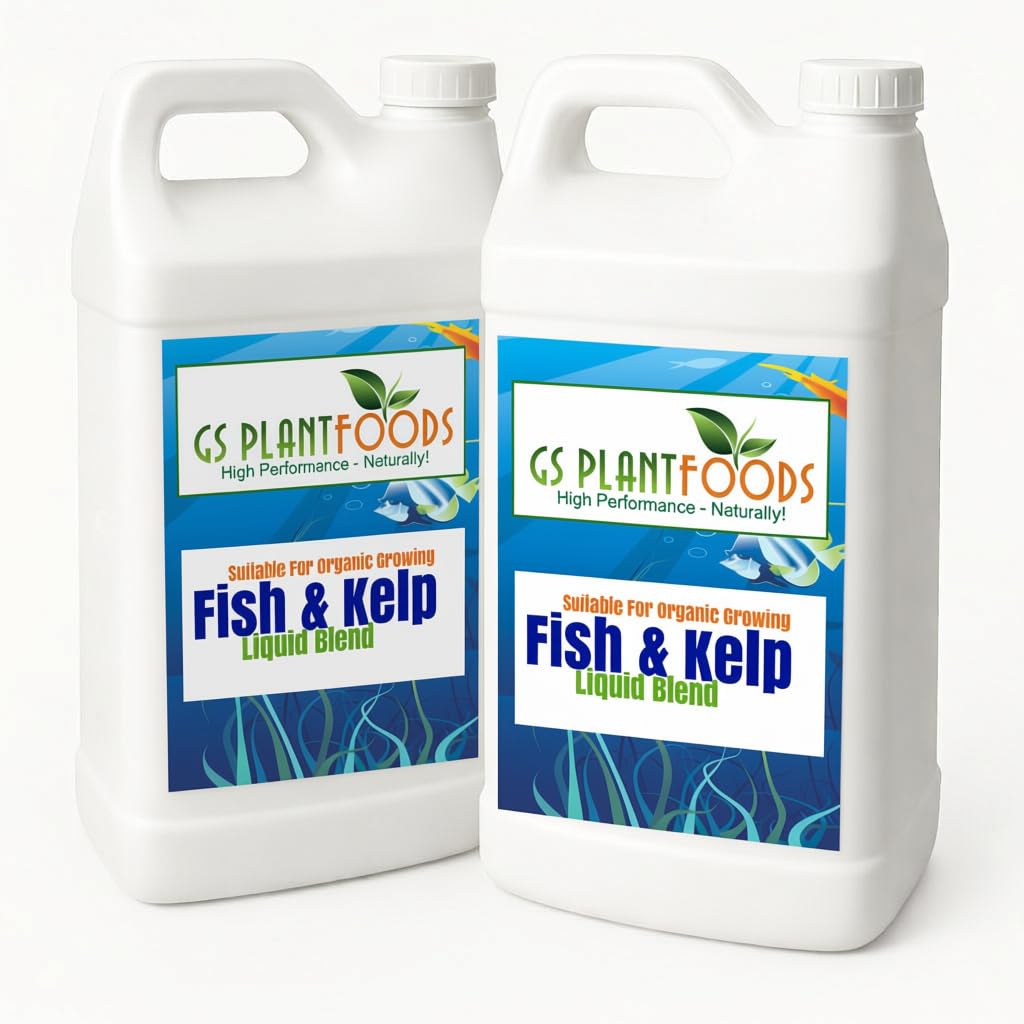
GS Plant Foods Liquid Fish & Kelp Fertilizer (5 gal)
| Item Form | Liquid |
|---|---|
| Application Method | foliar spray or soil drench |
| Specific Uses For Product | Lawns,Organic |
| Liquid Volume | 5 gallons |
| Mixing Ratio | 1:64 |
GS Plant Foods Liquid Fish & Kelp is a cold-processed organic concentrate that supplies plant- and soil-friendly nutrition from fresh fish hydrolysate and North Atlantic seaweed. It is mixed at about 2 oz per gallon (mixing ratio 1:64) and can be applied as a foliar spray or soil drench every 2 to 4 weeks, making it suitable for vegetables, ornamentals, turf, and houseplants. Notable features include OMRI listing for organic use, a formulation aimed at supporting soil microbiology and root development, and a low-odor processing claim that eases handling. The 5 gallon volume suits gardeners who want to feed many plants or prep for a full season without frequent repurchasing. Limitations are that it is a general organic tonic rather than a targeted complete NPK fertilizer, so it works best alongside a balanced fertility plan rather than as the sole source for specific nutrient corrections. Also the concentrate requires correct dilution and storage to avoid overapplication or degradation over time.
Best for: Gardeners who prioritize natural, biology-focused feeding and want a dependable organic concentrate to boost overall vigor across vegetables, flowers, and shrubs.
Less Ideal for: Growers seeking a tailored, single-application NPK fix or those with very small balcony or apartment plant collections who prefer smaller containers.
- OMRI-listed formulation suitable for certified organic gardens
- Seaweed and fish hydrolysate blend that supports soil biology and root health
- Versatile application as foliar spray or soil drench for many plant types
- Concentrated 5 gallon supply reduces frequency of repurchase for larger gardens
- Not formulated as a precise NPK corrective so may not address specific deficiencies
- Large 5 gallon container may be cumbersome for small-space gardeners to handle
Verdict: Choose this OMRI-listed fish and kelp concentrate when you want a proven, biology-friendly organic feed to strengthen roots and overall plant vigor across a home garden.
Scotts Natural Lawn Food, 29.1 lb (covers 4,000 sq. ft.)

| Item Form | Powder |
|---|---|
| Application Method | spreader |
| Coverage | 4,000 square feet |
| Specific Uses For Product | Lawn |
| Target Species | grass |
Scotts Natural Lawn Food is a granular lawn fertilizer designed to thicken and green turf with a mostly natural formulation and OMRI listing. It is applied with a spreader and is intended for use any season on any grass type; Scotts recommends up to four applications per year and feeding every 6 to 8 weeks during the growing season. In real-world use it delivers noticeable greening within one to three weeks and is safe to walk on immediately after application, which makes it convenient for yards with kids and pets. The bag covers 4,000 square feet and has no strong odor, so application is straightforward and unobtrusive. Limitations to consider are that it is intended as lawn food rather than a weed or pest solution and you should avoid applying before heavy rain and sweep product off hard surfaces to prevent runoff. For best distribution use a compatible Scotts drop or rotary spreader to get even coverage across the lawn.
Best for: Homeowners who prioritize pet and child safety and want a straightforward, season-round lawn food that promotes greener, thicker grass with minimal fuss.
Less Ideal for: People needing an all-in-one weed or insect control product or those with very large lawns who want less frequent, higher-coverage bags.
- OMRI listed formulation suitable for natural lawn care practices
- Safe to walk on immediately after application and labeled for use around kids and pets when used as directed
- Covers up to 4,000 sq. ft. from a single 29.1 lb bag
- No strong odor and easy to apply with standard spreaders
- Not formulated to control weeds or pests so additional products may be required
- Requires proper spreader use and care to avoid uneven application or runoff
Verdict: Choose this if you want a pet-friendly, OMRI-listed lawn food that reliably greens and thickens turf with simple spreader application.
Down To Earth Organic Vegetable Garden Fertilizer, 4-4-4, 1 lb

| Item Form | Granules |
|---|---|
| Specific Uses For Product | Organic Gardening, Transplating, Vegetable Gardens |
| Coverage | Full |
| Target Species | vegetable gardens |
| Mixing Ratio | 4-4-4 |
This is a compact, all-natural granular fertilizer designed for vegetable beds, herbs and container-grown edibles. It supplies a balanced 4-4-4 NPK from ingredients like fish bone meal, alfalfa meal, feather meal and seaweed, so it feeds plants gradually and helps build soil biology rather than forcing fast leaf growth. Typical use is top-dressing or incorporating into planting holes and mixing at the suggested ratio for transplants and ongoing feedings. The slow-release nature reduces the chance of nutrient burn and limits leaching, which is practical for small to medium gardens and raised beds. Because it is OMRI-listed and made from recognizable organic inputs it is suitable for gardeners who prioritize natural approaches and pollinator safety. The 1 lb size is convenient to store and reduces waste for hobby plots, but gardeners with larger plots will need larger bags or frequent replenishment. There is no synthetic quick-release boost for urgent corrections, so expect steady improvements over weeks rather than immediate greening.
Best for: Practical home vegetable gardeners on a budget who grow in raised beds, containers, or small plots and prefer an organic, slow-release feed that supports steady, healthy growth.
Less Ideal for: Large-scale growers or anyone needing fast corrective feeding for nutrient-deficient soil should consider bulk or quick-release alternatives.
- Balanced 4-4-4 NPK tailored for vegetables and herbs
- Made from natural ingredients and listed for organic use
- Slow-release granules reduce risk of burn and nutrient leaching
- Small 1 lb package is easy to store and minimizes waste for small gardens
- 1 lb size is too small for larger gardens and requires frequent repurchasing
- Not formulated for rapid nutrient corrections or instant greening
Verdict: A small, organic slow-release fertilizer that fits budget-minded home vegetable gardeners who want steady, natural feeding rather than instant fixes.
Brut Organic Worm Castings, 5 lb

| Item Form | Granules |
|---|---|
| Specific Uses For Product | Gardening,Organic |
| Target Species | All plants |
| Mixing Ratio | 1:5 |
Brut Organic Worm Castings function as a concentrated, natural soil amendment you mix into potting mixes or top-dress garden beds and raised beds. Typical use is mixing at the recommended 1:5 ratio for new indoor plants, sprinkling a cup around established houseplants, or working into outdoor planting holes and beds according to the brand directions. The product is OMRI/CDFA listed and produced in controlled conditions, which supports consistent nutrient content and beneficial microbial life that help roots establish, improve soil structure, and increase moisture retention without burning plants. Practical benefits for raised garden beds include improved aeration, slow-release nutrients, and a boost in microbial activity that supports long-term fertility. Limitations are that it is not a complete NPK fertilizer for immediate heavy feeding needs and larger beds require significant quantities to hit the suggested per-square-foot rates, so frequent applications or bulk purchases may be needed for big projects.
Best for: Gardeners who prioritize dependable, organic soil improvement for raised beds and container gardens and prefer predictable, low-risk amendments that support long-term soil health.
Less Ideal for: Those needing immediate, high-NPK feeding for heavy-feeding crops or gardeners who want to amend very large beds without buying supplemental bulk material.
- Certified organic and produced indoors for consistent purity
- Rich in beneficial microbes that improve soil structure and plant vigor
- Easy-to-use granular form suitable for mixing or top-dressing
- Not a standalone high-NPK fertilizer for rapid nutrient correction
- Five-pound bag may be small for large raised beds and repeated seasonal use
Verdict: Use this OMRI/CDFA-listed worm castings product to reliably build long-term fertility and microbial health in raised beds and containers.
FoxFarm Soil Liquid Trio Pack (Big Bloom, Grow Big, Tiger Bloom)

| Brand | FoxFarm |
|---|---|
| Item Form | Liquid |
| Unit Count | 48 Fluid Ounces |
| Specific Uses For Product | Plant Food |
| Coverage | Organic |
The FoxFarm Soil Liquid Trio Pack combines Big Bloom, Grow Big, and Tiger Bloom into a simple program for indoor gardeners who want strong vegetative growth followed by bigger blooms and fruit. Typical use is stage-based: Grow Big during vegetative growth to push leafy development, Big Bloom as an all-purpose supplement across cycles, and Tiger Bloom once buds form to encourage multiple bud sites and fuller flowers. The liquids are concentrated and greenhouse-tested for consistency, so measured feedings integrate easily with regular watering schedules. Practical benefits include a complete, complementary nutrient progression and formulations designed to keep micronutrients available in storage. Important limitations are that these are general-purpose concentrates rather than precision NPK formulations for specialty crops, and users who want exact nutrient ratios or automated dosing systems will need extra equipment and testing. Safety precautions such as keeping away from children and pets and wearing protective clothing are required when handling concentrated liquids.
Best for: Indoor growers who prioritize measurable performance and want a simple, stage-based feeding plan to push vigorous growth and larger blooms without building their own nutrient lineup.
Less Ideal for: Growers seeking exact NPK control, automated dosing integration, or a fertilizer tailored to a single specialist crop should consider lab-formulated or hydroponic-specific options instead.
- Three complementary formulas cover vegetative growth, bloom support, and fruiting in one kit
- Concentrated liquid form mixes readily for regular indoor feedings
- Greenhouse-tested formulations deliver consistent performance across batches
- Suitable for a wide range of indoor plants including houseplants, herbs, and vegetables
- Not a precision nutrient program for specialty or hydroponic crops
- Concentrated liquids require careful measuring and handling to avoid overfeeding
Verdict: For indoor gardeners who want a proven, stage-based liquid feeding program to boost vegetative growth and maximize blooms, this trio delivers a ready-made performance pathway.
Jobe's Organics All-Purpose Granular Fertilizer (16 lb)

| Item Form | Granules |
|---|---|
| Specific Uses For Product | Plant Growth, Root Development, Seed Development, Soil Conditioning |
| Mixing Ratio | 4-4-4 |
| Coverage | Resealable |
This is a straightforward organic granular fertilizer designed for regular feeding of vegetable gardens and other ornamentals. With an NPK of 4-4-4 and ingredients like feather meal, bone meal, and processed poultry manure, it supplies balanced nutrients and some calcium and sulfur for steady growth and improved root development. You apply it to soil every 2 to 3 weeks during the growing season; as a slow-to-release granular it reduces the need for daily attention and lowers the risk of burning when used as directed. The product is OMRI listed for organic gardening and is presented in a resealable bag for tidy storage. Limitations to be aware of are the modest NPK numbers, which mean it is best for maintenance feeding rather than rapidly correcting severe nutrient deficiencies, and the need to reapply frequently compared with longer-term slow-release formulations. For growers wanting an easy, certified-organic feed for vegetables and mixed beds, this covers most bases without complex application methods.
Best for: Home vegetable gardeners and practical growers who prioritize organic inputs and want a simple, repeatable feeding routine to maintain steady plant growth.
Less Ideal for: Growers who need a high-concentration or targeted corrective fertilizer for severe nutrient deficiencies or for single-crop intensive production should consider specialized formulas instead.
- OMRI listed and made from organic-derived sources suitable for certified organic vegetable production
- Balanced 4-4-4 NPK supports foliage, flowers, and fruit development without strong spikes
- Granular, slow-to-release form reduces immediate burn risk and simplifies feeding schedule
- Resealable packaging helps keep product dry and minimizes mess during storage
- Lower nutrient concentrations mean more frequent application or higher volumes are needed for nutrient-poor soils
- Not formulated for a single crop nutrient correction so may be insufficient for plants with specific high-demand deficiencies
Verdict: A reliable, OMRI-listed all-purpose granular fertilizer that gives practical, balanced organic feeding for vegetable gardens with minimal fuss.
Choosing the Right Natural Home Fertilizer: Key Factors to Consider
Nutrient Profile and Transparency
A clear nutrient profile tells you how much nitrogen, phosphorus, and potassium a fertilizer provides and whether it includes secondary nutrients like calcium, magnesium, or sulfur. For home gardeners this matters because different plants and growth stages need different ratios. Vegetables typically need higher nitrogen during leaf growth and more phosphorus around fruiting, while flowering plants may benefit from different balances.
Beyond the N-P-K numbers, transparency about sourcing and guaranteed analysis helps predict how a product will behave in your soil. Organic amendments vary in nutrient concentration, so knowing the numbers reduces the guesswork when calculating application rates.
Effect on Soil Life and Structure
Natural fertilizers can feed not just plants but the microbes, fungi, and soil fauna that build healthy structure. Materials that encourage microbial activity and improve aggregation will help with water infiltration and root penetration over seasons. Compost, well-aged manures, and certain mineral amendments contribute organic matter that boosts long-term fertility.
Consider whether a product actively supports mycorrhizal associations or simply supplies soluble nutrients. Building soil biology often means choosing amendments that decompose slowly and provide a food source for microorganisms rather than only quick-release nutrients.
Release Pattern and Timing
Different natural fertilizers release nutrients at different rates. Some provide a quick flush suitable for a growth spurt, while others break down slowly to feed plants over weeks or months. Timing matters for planting schedules: fast-release feeds can risk burning tender roots if applied too heavily, whereas slow-release materials are safer for containers and continuous-feeding crops.
Understand how temperature, moisture, and soil biology affect breakdown rates so you can match the fertilizer to your season and crop cycle. This affects how often you need to apply and whether the product fits into your maintenance rhythm.
Application Method and Convenience
Ease of application affects how likely you are to use a fertilizer correctly. Granular top dressings, soil-incorporated amendments, and tea or liquid extracts each have different labor and equipment needs. For balcony or indoor gardeners, liquid feeds or soluble powders may be more practical than bulky amendments.
Consider storage space, dust and odor levels, and how easy it is to measure and distribute the product evenly. Some natural fertilizers require pre-composting or brewing, which adds time and steps that not every gardener wants.
Suitability for Containers Versus In-Ground Beds
Containers dry faster and have limited buffering capacity, so fertilizers for pots should be gentle and predictable to avoid salt buildup. In-ground beds with active soil life can tolerate and benefit from bulk organic matter that breaks down over time. When choosing, think about handling and reapplication frequency specific to containers, raised beds, or large garden plots.
Also account for root confinement and drainage. Products that retain moisture and slowly release nutrients suit drier containers, while loose, fast-draining amendments may be better for heavy beds.
Safety, Odor, and Household Considerations
Because these fertilizers will be used around people, pets, and edible plants, safety and low odor are important. Fresh manures or certain fish-based fertilizers can smell strong and may require composting before use. Packaged concentrates should include clear handling instructions to avoid accidental over-application.
Assess allergen concerns and whether the product requires specialized protective gear. For indoor use, select formulations designed for low odor and minimal mess.
Types of Natural Home Fertilizers and How They Work
Natural home fertilizers fall into a few functional categories: compost and composted manures, plant-based meals and powders, mineral amendments, and liquid concentrates or teas. Each works differently in the soil. Compost and aged manures add organic matter and feed soil organisms while releasing nutrients slowly over time. Plant meals such as alfalfa or kelp provide a mix of macro and micro nutrients plus compounds that can stimulate root growth.
Mineral amendments correct specific deficiencies and alter soil physical properties. Liquids and teas offer a quicker way to deliver nutrients, often fitting seasonal feeding schedules or rescuing a stressed plant. Choosing a type depends on whether you need immediate nutrient correction, soil building, or a combination of the two.
- Compost and aged manures: soil-building, slow-release
- Plant meals and seaweed: nutrient-dense, may stimulate growth
- Mineral amendments: targeted fixes for pH and micronutrients
- Liquid feeds: faster uptake, useful for foliar feeding or quick boosts
Preparing and Applying Natural Fertilizers Safely
Follow label or extension guidance for application rates and timing. Over-applying organic materials can still lead to nutrient imbalances or salt buildup, especially in containers. Spread granular amendments evenly and avoid piling material against stems to reduce rot risk.
When using teas or liquid extracts, strain solids to prevent clogging equipment and apply in the early morning or late afternoon to reduce leaf burn risk. For materials with a strong odor, allow them to age or compost further before applying near living spaces.
- Measure by weight or volume rather than guessing
- Water in granular applications to start nutrient release
- Avoid applying high-nitrogen materials right before fruiting unless needed
Matching Fertilizer Choice to Common Garden Situations
Different garden contexts favor different fertilizers. For container veggie gardens, choose gentle, soluble feeds or small, well-composted amendments to avoid salt stress. For new raised beds or vegetable rows, bulk compost or aged manure helps build long-term fertility and structure.
Indoor houseplants prefer low-odor, predictable liquid feeds on a regular schedule. For flower borders, blended plant meals or slow-release organic blends can maintain steady bloom performance without intensive reapplication.
- Containers: soluble feeds, fine composts
- New beds: bulk compost, composted manures
- Houseplants: low-odor liquids, mild diluted teas
- Flower beds: balanced, slow-release organics
Common Mistakes and How to Avoid Them
A frequent error is assuming natural means no risk. Organic fertilizers can still cause nutrient burn if applied too heavily or at the wrong time. Another mistake is skipping soil testing; without a basic soil test you cannot target deficiencies accurately and may over-apply certain minerals.
Avoid mixing multiple concentrated amendments at once without understanding cumulative nutrient effects. Storing organic materials in damp, poorly ventilated areas can lead to mold and pest problems, so keep supplies dry and sealed.
- Do a soil test before major applications
- Start with lower application rates and monitor plant response
- Store materials in cool, dry places away from direct sunlight
Seasonal Feeding Calendar for Natural Fertilizers
Timing fertilizer applications to plant life cycles maximizes benefits. In early spring, apply compost or slow-release organics to beds to prime soils before planting. Use higher nitrogen feeds sparingly during leaf-out for vigorous growth, then switch to more balanced or phosphorus-rich inputs as plants set flowers and fruit.
Late season, reduce nitrogen-heavy feeding to allow plants to harden off. In colder climates, autumn is an ideal time to add bulky organic matter that will break down over winter and be ready for spring planting.
- Spring: soil amendments and early feeds
- Summer: targeted liquid feeds during active growth
- Fall: add bulk organic matter for winter decomposition
- Winter: minimal feeding, focus on planning and soil tests
How We Chose the Best Natural Home Fertilizer
We prioritized products that support sustainable, home-based gardening without relying on synthetic inputs. Selection focused on practical gardener needs: steady nutrient release, measurable nutrient ratios, soil biology benefits, and straightforward application methods for common garden situations. Evaluation criteria included nutrient profile clarity so gardeners know N-P-K and secondary elements, the fertilizer's effect on soil structure and microbial activity, and release behavior to match feeding schedules for vegetables, ornamentals, and container plants. Ease of use was important for diverse users, so we favored materials that are simple to store and apply, whether as a soil amendment, top dressing, or liquid feed. Safety and low odor were considered for households with pets, children, or indoor use. We excluded any inputs that relied on synthetic chemicals or ambiguous sourcing claims. Products that required complex pre-treatment or specialized equipment were deprioritized. The final list balances immediate feeding needs with long-term soil improvement, matching the scoring dimensions used in our per-product assessments.
FAQ
How often should I apply natural fertilizer to vegetable beds?
It depends on the type. Slow-release amendments like compost can be added once or twice a season, while liquid feeds may be applied every two to four weeks during active growth. Adjust frequency based on plant response and soil test results.
Can I use natural fertilizers in indoor potted plants?
Yes. Choose low-odor, soluble formulations or dilute teas and apply at gentler rates than outdoor gardens. Containers have less buffering capacity so monitor for salt buildup and flush pots occasionally with water.
Will natural fertilizers change my soil pH?
Some do. Mineral amendments and certain organic materials can alter pH over time, but most composts are neutral or mildly buffering. If pH is a concern, test the soil and choose amendments aimed at raising or lowering pH as needed.
Are fish-based fertilizers safe around children and pets?
Fish-based feeds are effective but often have strong odors and can attract animals. Aged, well-composted fish products are safer and less smelly. Always follow handling guidance and consider application timing to reduce exposure.
How can I tell if my plants need a fertilizer boost?
Look for signs like pale or yellowing leaves, slow growth, or poor flowering that are not caused by pests or water issues. A soil test is the most reliable way to confirm nutrient deficiencies before adding amendments.
Final Verdict
Prioritize the fertilizer attributes that match how you garden. If your goal is long-term soil health, favor bulky organics and compost that build structure and feed microbes. If you need a predictable, controlled feeding for containers or indoor plants, choose gentler, soluble natural feeds with clear labeling. Balance immediate plant needs with long-term soil improvement and use soil tests to guide applications. With those tradeoffs in mind, you can select a natural home fertilizer that supports steady growth, healthy soil life, and predictable results in your garden.
