

Note: This article contains affiliate links. If you click on these links and make a purchase, I may earn a small commission at no extra cost to you. This helps support my research and content. Read my full affiliate disclosure here.
Picking the right natural shrub fertilizer matters because shrubs respond differently to nutrient sources, release rates, and application methods. Using the wrong product can stress foliage, shorten bloom windows, or leave soil imbalance that takes seasons to correct. This guide covers five top-rated natural shrub fertilizers shortlisted for typical garden and landscape conditions. We evaluate how each option performs in supplying steady nutrients, improving soil biology, and fitting common application routines. Read on to see which natural approaches to feeding shrubs suit your site, timing, and maintenance style.
Top Picks at a Glance
| Best Overall The best all-around choice for most situations | Espoma Plant-Tone Organic All-Purpose Plant Food, 36 lb bag |  |
| Best Quality Built to a higher standard if you want something more solid | Espoma Organic Plant-Tone 5-3-3 All-Purpose Granular Plant Food (2 × 4 lb.) |  |
| Best Value The sweet spot between price and what you get | Jobe's Organics All-Purpose Granular Fertilizer (16 lb) |  |
| Best Budget The cheapest option that still gets the job done reliably | Jobe's Organics Granular All Purpose Fertilizer, 4 lb |  |
| Highest Rated A top-rated pick with lots of positive feedback | EB Stone Tree & Shrub Food, Organic, 4 lb. |  |
Espoma Plant-Tone Organic All-Purpose Plant Food, 36 lb bag

| Item Form | Bagged |
|---|---|
| Specific Uses For Product | Organic,Plant Food |
| Application Method | Apply to soil |
| Target Species | flowers, vegetables, trees, shrubs |
| Mixing Ratio | No mixing ratio required |
Espoma Plant-Tone is a ready-to-use, slow-release organic fertilizer designed to feed a wide range of garden plants. Packaged in a large 36 lb bag, it supplies nutrition through natural ingredients and the brand's Bio-tone formula with an N-P-K of 5-3-3 plus calcium. Typical use is applying the granules to the soil around the plant drip line and watering in; directions recommend seasonal applications for trees and shrubs and monthly feedings for roses, flowers, and vegetables during the growing season. The no-mix, bagged form makes it easy to spread by hand or with a broadcast spreader for medium coverage areas. As an organic input material it is suitable for certified organic gardens and provides a steady nutrient reservoir rather than a quick burst of growth. Limitations are the low nutrient numbers for gardeners seeking fast, high-nitrogen green-up or for very large lawns where a higher concentration product would be more efficient to apply.
Best for: Gardeners who want a reliable, organic all-purpose fertilizer for mixed beds and shrubs and prefer steady, soil-friendly nutrition over quick chemical boosts.
Less Ideal for: People who need immediate, high-nitrogen results for large turf areas or commercial-scale plantings should consider concentrated synthetic options instead.
- Ready-to-use, no mixing required for easy application
- Slow-release organic formula that feeds plants over time
- Appropriate for a wide range of plants including shrubs, trees, flowers, and vegetables
- Contains calcium and Bio-tone amendments to support soil biology
- Lower N-P-K numbers than synthetic fertilizers so results are slower for rapid greening
Verdict: A dependable organic, slow-release fertilizer that is ideal for feeding shrubs and mixed garden beds throughout the season.
Espoma Organic Plant-Tone 5-3-3 All-Purpose Granular Plant Food (2 × 4 lb.)

| Item Form | Granules |
|---|---|
| Specific Uses For Product | Organic,Plant Food |
| Coverage | All-purpose |
| Target Species | all flowers, vegetables, trees and shrubs |
| Mixing Ratio | 5-3-3 |
Espoma Plant‑Tone is a ready‑to‑use granular organic fertilizer designed to feed a wide range of garden plants, from roses and perennials to shrubs and vegetables. You broadcast it around the drip line and water it in; because it is slow‑releasing, it builds a steady nutrient reservoir rather than delivering a quick burst. Notable features include its 5-3-3 NPK formulation with added calcium and the Bio‑Tone microbial blend that aids nutrient breakdown and uptake. Practical benefits are improved bloom and foliage development with monthly applications for flowers and vegetables and spring/fall feeding for trees and shrubs, plus certification for organic gardening. Limitations are that results are gradual compared with synthetic quick‑release fertilizers and the product is sold in multiple small bags, which may require more frequent replenishing for larger beds. Also it is a general all‑purpose formula, so gardeners seeking highly specific high‑nitrogen or bloom‑boost mixes will need to supplement or choose a specialized product.
Best for: Gardeners who prioritize steady, plant‑friendly performance and organic inputs for shrubs and flowering beds and who plan regular seasonal or monthly feedings.
Less Ideal for: Growers who need immediate, high‑intensity nutrient boosts for rapid vegetative growth or who prefer single large bulk bags for extensive acreage.
- Organic, slow‑release granules that feed plants steadily over time
- Includes Bio‑Tone microbes to help break down organics and improve nutrient availability
- Versatile all‑purpose formula suitable for flowers, vegetables, trees and shrubs
- Slower visible results compared with fast‑acting synthetic fertilizers
- Packaging is in 4 lb. bags which may be small for very large gardens
Verdict: Choose Espoma Plant‑Tone when you want a proven organic, slow‑release fertilizer that reliably improves shrubs and flowering plants over the season.
Jobe's Organics All-Purpose Granular Fertilizer (16 lb)

| Item Form | Granules |
|---|---|
| Specific Uses For Product | Plant Growth, Root Development, Seed Development, Soil Conditioning |
| Mixing Ratio | 4-4-4 |
| Coverage | Resealable |
This is a straightforward organic granular fertilizer designed for regular feeding of vegetable gardens and other ornamentals. With an NPK of 4-4-4 and ingredients like feather meal, bone meal, and processed poultry manure, it supplies balanced nutrients and some calcium and sulfur for steady growth and improved root development. You apply it to soil every 2 to 3 weeks during the growing season; as a slow-to-release granular it reduces the need for daily attention and lowers the risk of burning when used as directed. The product is OMRI listed for organic gardening and is presented in a resealable bag for tidy storage. Limitations to be aware of are the modest NPK numbers, which mean it is best for maintenance feeding rather than rapidly correcting severe nutrient deficiencies, and the need to reapply frequently compared with longer-term slow-release formulations. For growers wanting an easy, certified-organic feed for vegetables and mixed beds, this covers most bases without complex application methods.
Best for: Home vegetable gardeners and practical growers who prioritize organic inputs and want a simple, repeatable feeding routine to maintain steady plant growth.
Less Ideal for: Growers who need a high-concentration or targeted corrective fertilizer for severe nutrient deficiencies or for single-crop intensive production should consider specialized formulas instead.
- OMRI listed and made from organic-derived sources suitable for certified organic vegetable production
- Balanced 4-4-4 NPK supports foliage, flowers, and fruit development without strong spikes
- Granular, slow-to-release form reduces immediate burn risk and simplifies feeding schedule
- Resealable packaging helps keep product dry and minimizes mess during storage
- Lower nutrient concentrations mean more frequent application or higher volumes are needed for nutrient-poor soils
- Not formulated for a single crop nutrient correction so may be insufficient for plants with specific high-demand deficiencies
Verdict: A reliable, OMRI-listed all-purpose granular fertilizer that gives practical, balanced organic feeding for vegetable gardens with minimal fuss.
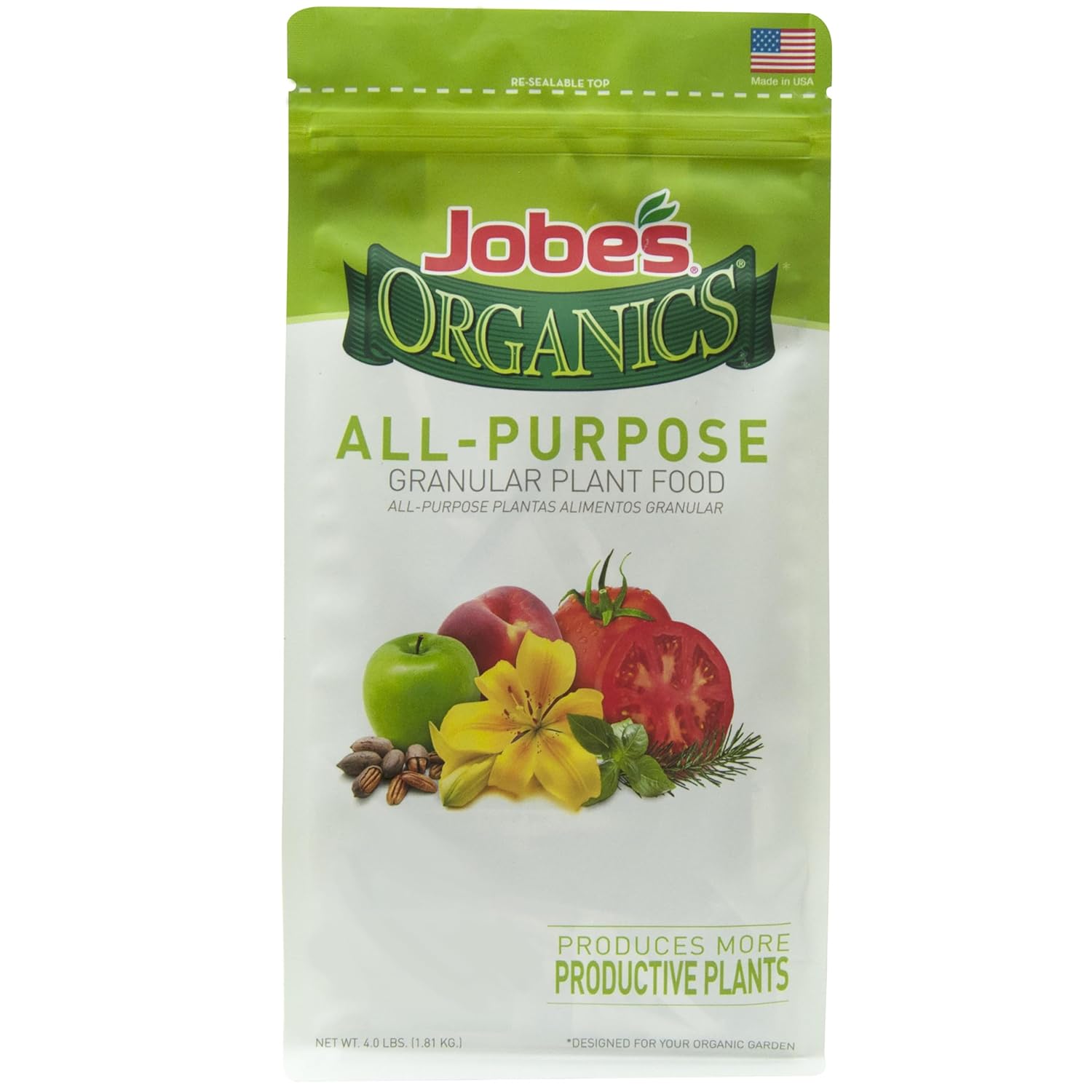
Jobe's Organics Granular All Purpose Fertilizer, 4 lb
| Item Form | Granules |
|---|---|
| Specific Uses For Product | Gardening |
| Coverage | Resealable |
| Mixing Ratio | 4-4-4 |
Jobe's Organics Granular All Purpose Fertilizer is a slow-release, OMRI-listed granular fertilizer designed for routine feeding of garden plants including young trees. You apply measured amounts around the root zone, water it in, and repeat every 2 to 3 weeks during the growing season. The 4-4-4 NPK balance with added calcium, magnesium, and sulfur supplies steady, mild nourishment without the burn risk of high-strength synthetic feeds, and the organic feedstocks encourage soil microbial activity that helps young root systems access nutrients. The resealable bag and granular form make it easy to portion and store, and directions are straightforward for gardeners who prefer repeat, low-effort applications. Limitations are that it is a light-strength general feed, so very nutrient-deficient soils or trees with established nutrient needs may require supplemental feeding or a specialized tree formula for faster correction. Also, granular organics act more slowly than soluble fertilizers, so expect gradual improvement rather than immediate greening.
Best for: Gardeners who prioritize safe, repeatable organic feeding and want a low-risk, easy-to-use fertilizer to support establishing root systems in young trees and mixed garden beds.
Less Ideal for: Users seeking fast, dramatic nutrient correction or a tree-specific high-nitrogen formulation for rapid canopy growth should consider more targeted or soluble products.
- USDA OMRI-listed organic formula suitable for organic gardening
- Balanced 4-4-4 NPK plus calcium, magnesium, and sulfur for steady, mild feeding
- Granular slow-release form reduces burn risk and supports soil microbes
- Resealable bag and simple application instructions make dosing and storage easy
- Lower NPK strength means slower visible results compared with soluble or high-N fertilizers
- Not targeted specifically to young trees so may need supplemental fertilization for deficient soils
Verdict: A gentle OMRI-listed granular fertilizer that is a practical, low-risk choice for regularly feeding young trees and maintaining soil health.
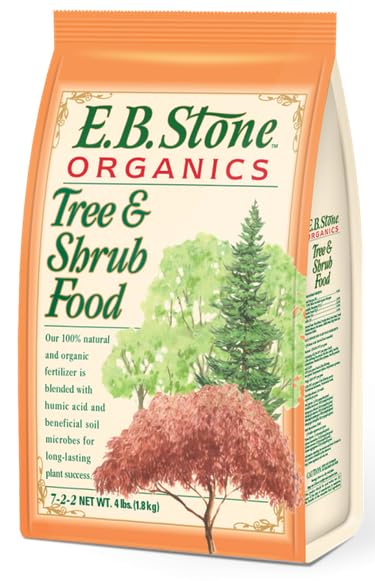
EB Stone Tree & Shrub Food, Organic, 4 lb.
| Item Form | Granules |
|---|---|
| Specific Uses For Product | Landscape, Organic |
| Coverage | Medium |
| Target Species | trees and shrubs |
| Mixing Ratio | 7-2-2 |
This granular tree and shrub food is designed as a maintenance feed for woody landscape plants. You broadcast or apply it around the root zone of trees, shrubs, and ornamental vines to deliver a nitrogen-forward formula that encourages green growth while supplying phosphate and potash to support flowering and vigor. The blend includes humic acid and mycorrhizae, which can help improve soil structure and root nutrient uptake over time. Typical use is seasonal or as-directed applications following the product mixing ratio for concentrated needs. The practical benefits are straightforward: easy-to-spread granules, organic ingredients for gardeners seeking natural inputs, and a nutrient profile suited to leafy and flowering performance. Limitations to expect are a small 4 pound package that covers only medium areas, so larger landscapes will need multiple bags, and the product description does not list exact N-P-K numbers beyond the stated mixing ratio which may require careful reading of instructions for specific dosing.
Best for: Gardeners who prioritize dependable, natural maintenance feeding for established trees and shrubs and who prefer products that support soil biology.
Less Ideal for: Those managing large properties who need high-coverage, bulk fertilizer or users who require clear, labeled N-P-K percentages for precise fertilization plans.
- Organic granular formula suitable for trees, shrubs, and ornamental vines.
- Contains humic acid and mycorrhizae to support soil health and root uptake.
- Easy-to-apply granules for broadcast or targeted feeding.
- Balanced support for foliage and flowering through added phosphate and potash.
- Small 4 lb. package may require multiple bags for larger landscapes.
- Product listing does not state explicit N-P-K percentages on the displayed specs.
Verdict: Choose this organic tree and shrub food if you want a soil-friendly granular fertilizer that reliably promotes leafy growth and flowering for established woody plants.
Choosing the Right Natural Shrub Fertilizer: Key Factors to Consider
Nutrient Ratio and Form
Shrubs need a balanced supply of nitrogen, phosphorus, and potassium tailored to their growth stage. A fertilizer with an appropriate N-P-K ratio for shrubs supports leaf growth without overstimulating soft shoots. Pay attention to the form of nutrients. Organic nitrogen often arrives as amino acids or slowly mineralizing proteins and feeds plants over weeks, while some natural sources still release faster. Matching the ratio and form to the season matters: higher nitrogen in spring supports leafing and renewed growth, while a more balanced formula heading into late summer and fall helps harden wood and support root storage.
Release Rate and Longevity
How quickly nutrients become available affects both plant response and maintenance frequency. Slow-release natural fertilizers supply steady nutrition that reduces the risk of foliage scorch and minimizes flushing that attracts pests. Faster-acting natural amendments can be useful when you need a quick green-up, but they often require repeat applications. Consider the typical growing season length in your area and whether you prefer a single early-season application or multiple light feedings. Release characteristics also influence the timing relative to pruning and bloom periods.
Soil Biology and Organic Matter
Good shrub care starts with soil, not just the top dressing. Fertilizers that include organic matter, humic substances, or microbial inoculants help build soil structure and nutrient cycling. These improvements increase water retention, root growth, and long-term fertility, especially in established beds. If your soil is compacted, low in organic content, or depleted from prior feeding, selecting a fertilizer that supports microbial activity will pay off over seasons rather than producing only short-term color.
Application Method and Timing
Different formats-granular, pelletized, liquid concentrate, or water-soluble organic extracts-fit different routines. Granular slow-release products are convenient for broadcast or ring application around shrubs and often require less frequent attention. Liquids can give quick uptake for foliar feeding or soil drench but need regular reapplication. Timing the feed matters: apply in early spring as growth starts and avoid heavy nitrogen applications late in the season that can delay hardening. Also consider compatibility with mulches and irrigation systems to ensure even distribution.
Safety for Plants and Landscape
Natural does not always mean risk-free. Excessive application of any fertilizer can cause root damage or alter soil salinity. Look for formulas with clear usage rates to avoid overfeeding, and choose low-salt options for shallow-rooted or drought-stressed shrubs. If you have pets, children, or edible plants nearby, consider how the product behaves when it contacts foliage or runs off during watering. Safety also includes the potential for attracting wildlife; some high-organic-content amendments may draw animals if aromatic.
Compatibility with Soil Tests and Existing Practices
A soil test is the best starting point for shrub feeding. Choose a product that lets you correct specific deficiencies indicated in the test rather than applying a generic blanket feed. Compatibility also means matching your irrigation schedule, mulching habits, and pruning calendar. For example, slow-release granulars pair well with spring mulching and infrequent irrigation, while soluble organics need regular moisture to move nutrients into the root zone. Selecting a fertilizer that fits your existing maintenance reduces the chance of misuse and improves results.
When to Feed Shrubs
Feed established shrubs in the early spring as buds swell and new shoots begin to emerge. A single, measured application of a slow-release natural fertilizer at that time supports early-season leaf development without causing a late-season flush of tender growth.
Supplemental light feedings can be useful for flowering shrubs right after bloom to replenish nutrients used in bloom production. Avoid heavy nitrogen applications in late summer or fall because they can delay the plant's transition into dormancy.
- Spring application supports leaf and shoot development
- Light post-bloom feeding replenishes reserves used in flowering
- Avoid high-nitrogen feeds late in the season to promote hardening
How to Apply Around Shrub Roots
For granular products, apply in a ring that reaches the dripline rather than concentrating fertilizer at the base. This directs nutrients where feeder roots are most active. Gently work the granules into the top inch of soil or apply on top of existing mulch if labeled safe for mulched beds.
Liquids and water-soluble organics are best applied as a soil drench evenly around the root zone. Follow product dilution guidance and water after application to move nutrients into the root zone. Avoid disturbing roots with deep cultivation when applying fertilizers.
- Apply fertilizer across the root zone, not just at the trunk
- Work granules lightly into the surface or apply on compatible mulch
- Water after application to move nutrients into the root zone
Reading Labels and Ingredient Lists
Labels for natural fertilizers should list sources of nutrients and typical analysis. Look for descriptions like feather meal, blood meal, bone meal, kelp, composted manures, or rock minerals and expect guidance on timing and rates for shrubs.
Pay attention to salt index if provided and to any instructions about integrating the product with soil amendments or biological inoculants. Clear concentration and application rates help you match the product to your shrub size and soil conditions.
- Check ingredient sources and expected analysis
- Note salt index and application rates for shrubs
- Follow label timing relative to pruning and irrigation
Organic Matter and Long-Term Soil Strategy
Treat fertilizer as one part of a longer-term soil improvement plan. Adding compost or well-rotted organic matter alongside a feeding program improves water retention and cation exchange capacity, making subsequent fertilizer applications more effective.
If your beds are low in organic content, plan for periodic topdresses of compost or mulching with shredded leaves to build a healthier root environment. Over several seasons, this reduces reliance on repeated feeding and improves shrub resilience to stress.
- Combine feeding with compost topdressing for lasting benefit
- Mulch and organic inputs reduce the frequency of feeding over time
- Monitor soil texture and structure annually to adjust strategy
Adjusting Feeding for Common Shrub Types
Evergreen shrubs often benefit from lower, steady nitrogen levels that support year-round foliage without encouraging soft late-season growth. Deciduous flowering shrubs may need a boost of nitrogen in spring and a balanced feed after bloom to support next season's flowers.
For acid-loving shrubs, prefer natural sources that do not raise pH, and pair feeding with soil tests to avoid unintended shifts. Drought-prone sites call for low-salt, slow-release choices to reduce scorch risk.
- Evergreens: steady low-to-moderate nitrogen
- Flowering deciduous shrubs: spring plus post-bloom balance
- Acid lovers: choose pH-neutral or acid-friendly sources
How We Chose the Best Natural Shrub Fertilizer
We focused on products that rely primarily on naturally derived ingredients and that demonstrably support shrub health without synthetic salts. Our editorial filters prioritized consistent nutrient profiles suitable for woody ornamentals, clear application guidance for shrubs and hedges, and ingredient transparency so gardeners can match products to soil test results. We evaluated nutrient release behavior, looking for options that provide steady feeding rather than quick, high-salt spikes. Soil-building benefits were important, so we favored fertilizers containing organic matter, beneficial microbes, or humates that improve structure and nutrient availability. Application practicality was another filter: ease of spreading, compatibility with common timings, and low risk of foliage burn when used as directed. We excluded any product that relied on synthetic osmotic salts as the primary nitrogen source or lacked clear ingredient labeling. Final picks reflect a balance of nutrient reliability, soil-health contribution, application simplicity, and plant safety for typical shrub care.
FAQ
How often should I apply natural fertilizer to established shrubs?
Often a single early-spring application of a slow-release natural fertilizer is sufficient for established shrubs. Depending on the product release rate and shrub vigor, some gardeners add a light midseason or post-bloom top-up, especially for heavy bloomers.
Can I use compost instead of a commercial natural fertilizer?
Compost is an excellent soil builder and can supply many nutrients over time, but it may not correct specific deficiencies quickly. Use compost as a regular amendment and pair it with targeted natural fertilizers when a soil test indicates a need for particular nutrients.
Will natural fertilizers attract pests or wildlife?
Some organic amendments with strong odors, such as certain manures or fish-based products, can attract wildlife. Choosing lower-odor options or incorporating the material into the soil or mulch reduces attractiveness to animals.
Are liquid natural fertilizers better for quick results?
Liquids and soluble organics provide faster nutrient availability and can correct short-term deficiencies, but they require more frequent application. For longer-term steady feeding and lower risk of burn, slow-release granular or pelletized natural products are usually preferable.
How does soil pH affect the effectiveness of a natural shrub fertilizer?
Soil pH influences nutrient availability more than the fertilizer itself. If pH is outside the ideal range for your shrub, certain nutrients may become locked up. Test soil pH and amend as needed so the natural fertilizer's nutrients are accessible to roots.
Final Verdict
Choose a natural shrub fertilizer that matches your soil test and the growth habits of your shrubs. Prioritize balanced nutrient ratios and a release pattern that fits your maintenance rhythm. Pair feeding with organic matter and proper timing to improve long-term soil health and reduce the need for frequent applications. With those tradeoffs in mind, gardeners can select a feeding approach that supports steady growth, strong roots, and reliable blooms without stressing the plants.
