

Note: This article contains affiliate links. If you click on these links and make a purchase, I may earn a small commission at no extra cost to you. This helps support my research and content. Read my full affiliate disclosure here.
If you spend time in your lawn, garden, or play areas, choosing the right natural tick repellent for yards matters for family safety and plant health. Natural options can reduce tick activity without introducing harsh chemicals, but effectiveness depends on product concentration, application method, and how you maintain treated areas. This guide covers seven shortlisted natural repellents selected for yard use and compares them across practical factors gardeners care about, such as how much area a single treatment covers and how often you need to reapply. Read on for clear guidance to match a repellent to your yard size, landscape features, and seasonal needs.
Top Picks at a Glance
| Best Overall The best all-around choice for most situations | Wondercide Outdoor Pest Control Spray — 32 oz Ready-to-Use |  |
| Best Quality Built to a higher standard if you want something more solid | Cedarcide Outdoor Bug Spray Gallon (Natural Cedar & Lemongrass) |  |
| Best Value The sweet spot between price and what you get | Trifecta Ready-to-Use Flea & Tick Yard Spray, 32 oz |  |
| Best Budget The cheapest option that still gets the job done reliably | TropiClean Flea and Tick Yard Spray, 32 oz |  |
| Highest Rated A top-rated pick with lots of positive feedback | NatureShield Outdoor Insect & Pest Repellent, 64 fl oz (2-Pack) |  |
| Most Popular A crowd favorite that many people choose with confidence | Wondercide Flea & Tick Yard Spray (Ready-to-Use, 32 oz) |  |
| Best Seller A high-volume bestseller chosen again and again | Mighty Mint Peppermint Oil Insect Repellent Spray, 1 Gallon |  |
Wondercide Outdoor Pest Control Spray — 32 oz Ready-to-Use
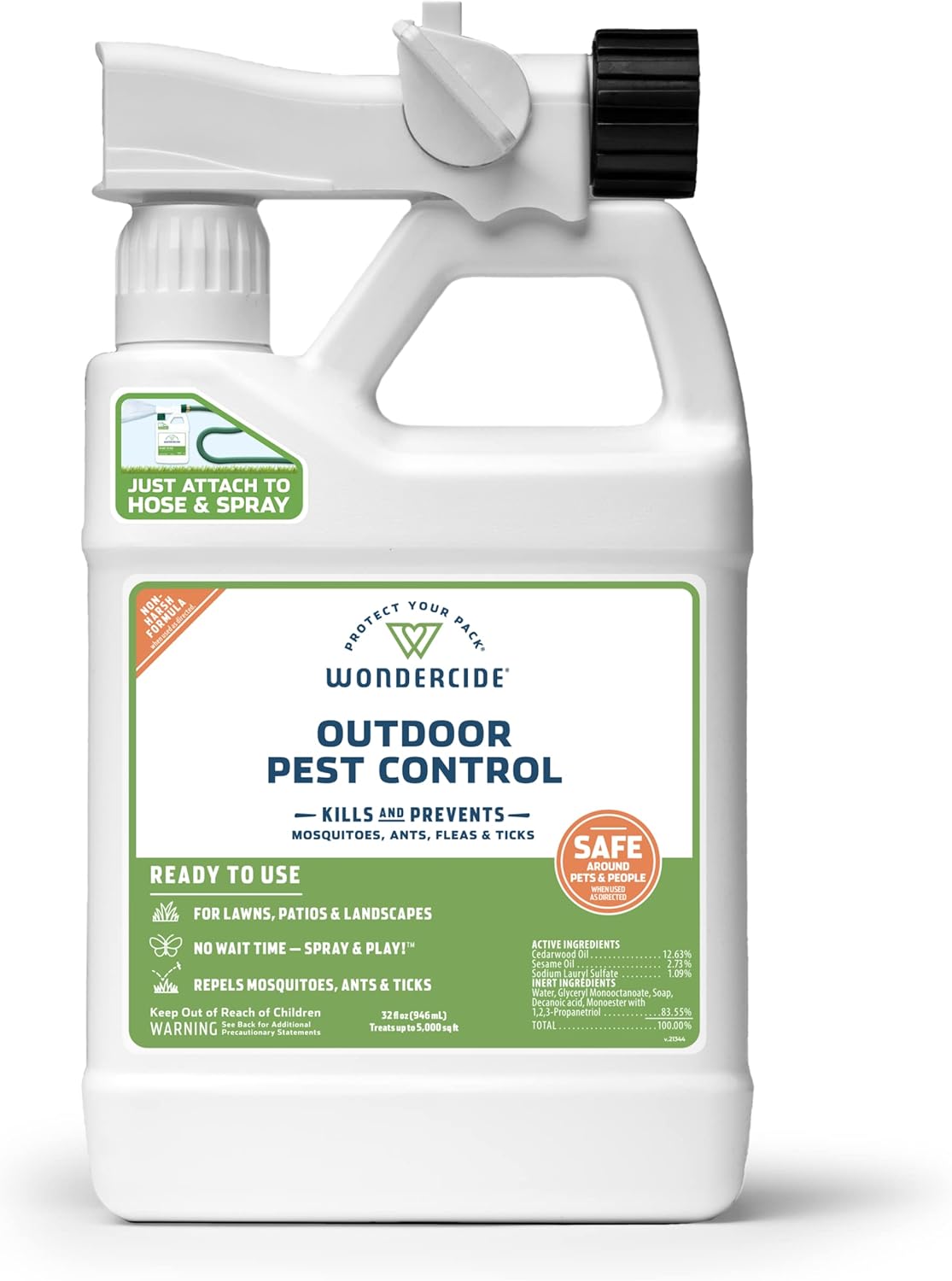
| Format | Pre-mixed, hose-end spray |
|---|---|
| Active ingredients | Cedarwood Oil 12.63%, Sesame Oil 2.73% |
| Coverage | Up to 5,000 sq ft (general); 2,500 sq ft (ticks/mosquito repel) |
Wondercide Ready-to-Use Outdoor Pest Control is a hose‑end spray designed for treating yards up to 5,000 sq ft for general pests and 2,500 sq ft for ticks and mosquito repellency. You attach the bottle to a garden hose, sweep the nozzle across lawns, patios, and foundation lines, and the cedarwood‑based formula delivers quick coverage with no dry time required. Notable features include plant-powered active ingredients (cedarwood and sesame oils), ready-to-use convenience, and instructions for both active infestations and preventative maintenance. Practical benefits are that it is safe to use around people and pets when directions are followed, residues are reported to be non-harmful to pollinators, and the hose attachment makes treating large areas fast. Important limitations are that effectiveness depends on water pressure, walking speed, and weather, heavy rain may require reapplication, and spraying in temperatures above 90°F or direct sun can cause plant burn. Users who need an all‑season, high‑durability pesticide for heavy infestations should plan on repeated applications and follow label precautions to protect sensitive plants.
Best for: Buyers who prioritize effective, plant‑based mosquito and tick control for medium to large yards and want a fast hose‑attached solution that is safe around families and pets when used as directed.
Less Ideal for: Gardeners who need a single, long‑lasting professional‑grade pesticide for severe, persistent infestations or who cannot reapply after rain should consider alternative, heavier‑duty treatments.
- Ready-to-use hose-end applicator for fast coverage of large yards
- Plant-based active ingredients (cedarwood and sesame oils) that target common yard pests
- No dry time required so kids and pets can re-enter treated areas quickly
- Covers up to 5,000 sq ft for general pest control and 2,500 sq ft for ticks/mosquito repellency
- May cause phytotoxic burning if applied in direct sun or temperatures above 90°F
- Performance depends on water pressure and user walking speed which can lead to uneven coverage
- Heavy rain can wash it away and requires reapplication
Verdict: If you want a fast, family- and pet-friendly plant‑based spray to reduce mosquitoes and ticks across a medium to large yard, this ready‑to‑use hose‑end formula delivers practical, repeatable results.
Cedarcide Outdoor Bug Spray Gallon (Natural Cedar & Lemongrass)

| Ingredients | Natural essential oils including Cedarwood and Lemongrass |
|---|---|
| Coverage | Treats up to 4 acres |
| Intended use | Lawns, landscaping, patios, perimeter of home |
Cedarcide Outdoor Bug Spray is a plant-based perimeter treatment designed for yard-scale pest control. It is applied with a pump or hose-end sprayer to lawns, landscaping, patios, and around home foundations and is labeled to treat up to four acres. The formula relies on natural essential oils, primarily cedarwood and lemongrass, which provide a strong scent that deters ticks, mosquitoes, fleas, chiggers, and similar pests without synthetic pesticides. Practical benefits include a large one-gallon volume suited to treating large areas, a family- and pet-friendly ingredient list, and clear directions for perimeter and landscape use. Performance-minded buyers should note that efficacy depends on thorough coverage and repeat applications; natural oil repellents often require more frequent reapplication than synthetic alternatives and may be less persistent after heavy rain. This product is best used as part of an integrated yard program where safety around people and pets is a priority and where users accept a maintenance schedule to sustain protection.
Best for: Buyers who prioritize a safer, pet-friendly yard solution and want a product capable of treating large outdoor areas while avoiding synthetic pesticides.
Less Ideal for: Gardeners who need long-lasting, low-maintenance control or immediate knockdown comparable to conventional chemical pesticides should consider other options.
- Large one-gallon container suitable for treating up to 4 acres
- Uses natural cedarwood and lemongrass essential oils considered safe around people and pets
- Designed for perimeter and landscaping application to reduce yard pest populations
- Clear directions for use on lawns, patios, and around homes
- Natural oil-based formula typically requires more frequent reapplication than synthetic pesticides
- Effectiveness can be reduced by rain and requires good coverage for best results
Verdict: Choose this gallon natural spray when you want a pet-safe, yard-scale tick and mosquito repellent that prioritizes safety over long-lasting chemical persistence.
Trifecta Ready-to-Use Flea & Tick Yard Spray, 32 oz

| Coverage (RTU) | Up to 5,000 Sq Ft |
|---|---|
| Format | Ready To Use (hose‑end) |
| Active approach | Powered by essential oils |
| Kills | Fleas, ticks, and eggs |
| Made in | U.S.A. |
This ready-to-use Trifecta yard spray uses a blend of essential oils to kill and repel fleas, ticks, and their eggs across lawns, patios, and landscaped areas. It attaches to a hose as an RTU sprayer and is designed to cover up to about 5,000 sq ft per bottle, making it a straightforward option for routine yard treatments or targeting known problem zones. Key ingredients such as cedarwood, peppermint, citronella, geraniol, and thyme oil provide a natural scent that fades after application while delivering contact kill and repellent action. Practical benefits include pet- and family-friendly marketing when used as directed, no mixing for the RTU format, and the convenience of a hose-end application for even coverage. Limitations to note are the reliance on essential oils rather than synthetic actives, which may require more frequent reapplication in heavy infestation areas, and the RTU bottle covers less area than concentrated options if you have very large properties. Users should follow label directions for timing and avoid applying during rain or to edible plants.
Best for: Buyers who want an easy, lower‑toxicity yard treatment that is simple to apply with a hose and suitable for regular maintenance around pets and family.
Less Ideal for: Landowners with several acres or persistent heavy infestations who need long residual control or larger coverage per bottle should consider concentrated or professional-strength alternatives.
- Ready-to-use hose-end format for fast, even coverage without mixing
- Plant-based formula that is marketed as safe for pets and family when used as directed
- Claims to kill fleas, ticks, and their eggs on contact while also repelling pests
- Natural scent from essential oils that fades after application
- Less long-lasting residual compared with many synthetic insecticides, so treatments may need to be repeated
- RTU bottle covers less area than concentrated formulations for very large yards
Verdict: A convenient, pet‑friendly ready‑to‑use yard spray that makes routine flea and tick prevention simple for typical suburban yards.
TropiClean Flea and Tick Yard Spray, 32 oz

| Volume | 32 oz |
|---|---|
| Application | Hose-attachable spray |
This TropiClean yard spray is a hose-end treatment designed to protect lawns and outdoor spaces from fleas, ticks, larvae, eggs, and mosquitoes using a blend of natural essential oils with a lemongrass and cedarwood scent. You attach the specialty nozzle to a garden hose, turn water on, and apply the spray with even sweeping passes across lawns, playgrounds, landscape beds, campsites, and perimeter areas. Its practical strengths are ease of use from the hose attachment, a formulation that emphasizes plant-derived active ingredients, and a pleasant citrus aroma instead of harsh chemical smells. The product claims contact kill plus up to two weeks of repellent effect, which can reduce the frequency of reapplication compared with very short-lived sprays. Limitations to expect are that botanical treatments typically need more frequent repeat applications than some synthetic professional products and may be less effective under heavy pest pressure or after heavy rain. This is best used as a homeowner-friendly, lower-toxicity option for routine yard maintenance and seasonal pest reduction.
Best for: Homeowners who prefer lower-toxicity, plant-based pest control and want an easy hose-attachment solution for routine yard protection.
Less Ideal for: People managing severe, persistent infestations or those who need longer-lasting, professional-grade control should consider stronger targeted options.
- Hose-end nozzle for quick, even coverage without mixing or measuring
- Formulated with natural essential oils that leave a lemongrass and cedarwood scent
- Claims contact kill of fleas, ticks, larvae and eggs plus up to two weeks of repellent effect
- Suitable for many outdoor locations including lawns, landscaping, playgrounds and campsites
- Botanical formulas are generally less persistent than some synthetic professional treatments
- Protection may be reduced after heavy rain and require reapplication
Verdict: A convenient, plant-based hose-end spray that provides homeowner-friendly flea and tick reduction with a natural scent.
NatureShield Outdoor Insect & Pest Repellent, 64 fl oz (2-Pack)

| Item Form | Liquid |
|---|---|
| Scent Name | Cedarwood |
| Indoor Outdoor Usage | Outdoor |
| Material Features | Natural plant oils blend |
| Number of Items | 2 |
NatureShield is a concentrated, plant-oil based repellent intended for yard-scale pest control and automatic application through irrigation feeder systems or manual sprayers. It is typically used by diluting and injecting into a ProFeeder, Green Feeder Mini, Stow N' Flow, or applied with pump, tank, boom, or hose-end sprayers to create a perimeter barrier over lawns, gardens, and outdoor surfaces. The formula contains cedar and cinnamon oils and is EPA exempt and labeled safe for people, pets, and plants when used as directed. Practical benefits include broad pest coverage that lists mosquitoes, fleas, fire ants, and no-see-ums, and one gallon treats about 500 square feet which makes coverage planning straightforward. The product comes in two 64-ounce bottles so you have enough for repeated treatments; reapplication every five days is suggested for sustained protection. Limitations to note are that effectiveness depends on correct application and environmental factors like water pressure and wind, and it requires a compatible feeder or sprayer for the easiest, most consistent results.
Best for: Homeowners who prioritize a reliable, plant-based perimeter treatment for yards and want a product that can be applied automatically through irrigation systems or with common sprayers for consistent repeat protection.
Less Ideal for: People who need a simple ready-to-use handheld spray for spot treatments or those who do not have access to a feeder or sprayer system.
- Plant-oil formula (cedar and cinnamon oils) that is EPA exempt and labelled safe for people, pets, and plants when used as directed
- Compatible with irrigation feeder systems and a variety of sprayers for automatic or manual application
- Covers about 500 square feet per gallon, helping with predictable yard coverage
- Includes two 64 fl oz bottles to supply multiple treatments
- Requires a feeder or sprayer for easiest use and consistent coverage
- Effectiveness and coverage can vary with water pressure, walking speed, and environmental conditions
Verdict: Buy this if you want a dependable, plant-oil repellent that can be applied automatically through irrigation or with sprayers to protect yard-sized areas.
Wondercide Flea & Tick Yard Spray (Ready-to-Use, 32 oz)

| Liquid Volume | 946 ml |
|---|---|
| Item Form | Spray |
| Active ingredient | 12.63% Cedarwood Oil |
| Coverage (fleas/mosquitoes) | Up to 5,000 sq ft |
| Coverage (ticks/mosquito repel) | Up to 2,500 sq ft |
Wondercide Flea & Tick Yard Spray is a ready-to-use hose-end treatment that uses cedarwood and other plant-derived ingredients to kill and repel fleas, ticks, and mosquitoes in the yard. You attach the bottle to a garden hose, turn the sprayer on, and walk steady sweeping passes to treat up to 5,000 sq ft for fleas and mosquitoes or 2,500 sq ft for ticks and mosquito repellency. Notable features include a pre-mixed formula for quick application, a hose-powered sprayer for even coverage, and an ingredient list centered on cedarwood oil that the brand says is safe for pollinators when used as directed. In practice it is convenient for routine maintenance and for reducing pest pressure around foundations, patios, and pet areas without waiting for drying or reentry. Important limitations are sensitivity to high heat or direct sun which can cause plant foliage browning if applied above 90°F and reduced residual effect after heavy rain, which may require reapplication. The product is exempt from EPA registration under FIFRA and carries typical safety instructions to avoid eye contact and keep out of reach of children.
Best for: Buyers who want a convenient, natural-first yard repellent that treats broad outdoor areas and lowers pest pressure around pets and play spaces with minimal setup.
Less Ideal for: Those who need a product that holds up through heavy storms or who require a chemically registered pesticide for regulatory or commercial settings should consider other options.
- Pre-mixed hose-end bottle makes whole-yard treatment fast and easy
- Plant-based active (cedarwood oil) targets fleas, ticks, and mosquitoes
- Covers a large area per bottle (up to 5,000 sq ft for fleas and mosquitoes)
- Formulated to be safe for people, pets, and pollinators when used as directed
- Can cause phytotoxic browning if applied in direct sun or when temperatures exceed 90°F
- Heavy rain or intense irrigation can wash away residue and may require reapplication
Verdict: If you want an easy, plant-powered yard spray to reduce mosquitoes, fleas, and ticks over large lawns while prioritizing pet and pollinator safety, this ready-to-use option delivers fast, low-fuss coverage.
Mighty Mint Peppermint Oil Insect Repellent Spray, 1 Gallon

| Volume | 128 oz |
|---|---|
| Ingredients | Water, Glycerin, Polyglycerol Oleate, Soap, Peppermint Oil |
| Use areas | Indoor / Outdoor |
| Scent | Peppermint |
Mighty Mint’s 1-gallon peppermint oil spray is a plant-based insect repellent intended for broad indoor and outdoor use. The product is supplied as a large ready-to-use bottle with a detachable nozzle for spraying around entryways, baseboards, patios, and gardens or for refilling smaller spray bottles. Its formula lists peppermint oil along with water, glycerin, and soap, so it works by delivering a strong peppermint scent that repels spiders, ants, roaches and similar pests without synthetic pesticides. Practical benefits include the large 128 oz volume for extended coverage and a scent that many households find more pleasant than chemical sprays. The label notes it is safe for use around people and pets when used as directed, and the concentrate-style packaging simplifies repeat applications. Limitations to keep in mind are that it is a deterrent rather than a lethal insecticide, so it may not eliminate established infestations, and effectiveness can vary by pest and environmental conditions. Users should follow safety directions and reapply after heavy rain or watering for outdoor use.
Best for: Buyers who prioritize safer, plant-based pest control and want a proven, widely used product with visible social proof for routine outdoor and perimeter pest prevention.
Less Ideal for: People facing severe infestations who need a fast-acting, residual insecticide or professional pest control should consider stronger, targeted treatments instead.
- Large 128 oz ready-to-use gallon provides long-lasting coverage and value
- Plant-based formula using peppermint oil rather than synthetic pesticides
- Versatile for indoor and outdoor application and can refill smaller bottles
- Pleasant mint scent that is less intrusive than chemical alternatives
- Designed as a repellent and deterrent so it may not eradicate heavy or established infestations
- Performance can be inconsistent depending on pest type and weather conditions
Verdict: Choose this gallon peppermint spray if you want a plant-based, widely adopted repellent for routine outdoor perimeter and home pest prevention.
Choosing the Right Natural Tick Repellent for Yards: Key Factors to Consider
Coverage Area and Treatment Rate
How much ground a single container or mix will treat affects cost and convenience. For yards, look at the labeled coverage per gallon or per bottle and compare that to your lawn and border acreage so you can plan the number of applications needed.
Treatment rate also ties into equipment choice. Hose-end applicators and pump sprayers deliver different flow rates and overlap patterns, so understand how the labeled coverage translates to real-world application with your gear. Overlapping sprays waste product and can stress plants, while undercoverage leaves gaps where ticks persist.
Duration Between Treatments
Natural active ingredients tend to break down faster than synthetic alternatives, so reapplication frequency matters. Check product guidance for how many days or weeks of protection you can expect under normal conditions.
Also consider seasonal tick pressure and rainfall. Products that last longer reduce labor, but shorter-duration treatments can be fine if you plan a maintenance schedule around peak tick months. Choose a repellent that matches how often you will realistically apply it.
Plant and Pet Safety
Yards are mixed-use spaces with lawns, ornamental plants, edible gardens, and pets. A natural label does not guarantee harmlessness to all plants or animals. Look for clear instructions on how soon pets can re-enter treated areas and any crop or plant restrictions.
Some botanicals can cause leaf burn on tender foliage or stress newly established plants. If you have pollinator plantings or vegetable beds nearby, prioritize formulations with low toxicity to pollinators and specific guidance for buffer distances.
Application Method and Equipment Compatibility
Consider how you will apply the repellent: hand-pump sprayer, backpack sprayer, hose-end, or granular spreader. Liquids, concentrates, and granules each have pros and cons for coverage and ease of use.
Concentrates require mixing accuracy and clean water, while ready-to-use sprays are simpler but often cost more per treated area. Granules can be convenient for borders and underbrush but may not coat vegetation where ticks quest. Match the formulation to your typical application tools.
Weather Resistance and Residual Performance
Rain, irrigation, and UV exposure all shorten how long a treatment remains effective. Understand the product's tolerance to rain and whether it needs a dry window after application.
Residual performance interacts with where you apply the product. Areas with heavy foot traffic or irrigation will need more frequent treatments than shaded, dry perimeters. Pick a repellent whose expected durability aligns with your yard conditions.
Local Tick Species and Site Conditions
Different tick species have different behaviors and habitat preferences. Evaluate where ticks are most likely to occur on your property: leaf litter, tall grass, shrub edges, or brushy fence lines.
Site conditions also influence choice. Sandy soil, steep slopes, or dense shade affect application uniformity and runoff risk. Select a product suited to treating the specific microhabitats where ticks hide on your property.
Where to Treat in Your Yard
Target treatment zones where ticks are most likely to contact people or pets. Focus on perimeter areas, shady edges next to woods, brushy fence lines, and transitions between lawn and naturalized plantings. Treating only tidy turf in the middle of an open lawn is rarely sufficient because ticks concentrate in humid, vegetated margins.
Create a buffer strip by treating a 3- to 6-foot band along the edges of play areas, patios, and paths. Use granular products or low-volume sprays under shrubs and along mulch lines where tall grass and leaf litter harbor ticks.
- Prioritize shaded, moist microhabitats and leaf-litter zones
- Treat borders and perimeter bands near wooded areas
- Avoid direct application to edible gardens or pollinator beds
Timing Treatments Through the Season
Plan application timing around peak tick activity in your region. Early spring and late spring months are common windows for many tick species, with a second pulse in late summer or fall in some areas. Start treatments before ticks become active and follow label intervals for reapplication.
For persistent tick pressure, schedule follow-up treatments at the product's recommended interval rather than waiting for visible ticks. Shorter-acting natural repellents may require repeats every few weeks during high-risk months.
- Begin treatments before peak activity
- Space reapplications according to labeled residual duration
- Consider spot treatments after heavy rains if the product is not rainfast
Combining Yard Management With Repellents
Cultural practices reduce tick habitat and improve repellent performance. Keep grass mowed, remove piles of leaves and brush, and create gravel or woodchip barriers between lawn and wooded areas to limit tick migration. Reducing leaf litter and controlling tall grass lowers humidity at ground level where ticks thrive.
Use repellents as one layer in an integrated approach rather than the sole measure. Targeted cleaning and landscape modification reduce the area that needs repeated chemical or botanical treatment and can make shorter-duration natural repellents more practical.
- Mow and edge regularly to reduce questing zones
- Clear brush and leaf piles to cut tick habitat
- Establish nonvegetated buffer zones along woodlines
Application Tips to Protect Plants and Pollinators
Avoid spraying flowering plants that attract pollinators unless the label explicitly allows it. Apply treatments in early morning or evening when pollinator activity is lower, and keep a safe distance from nectar sources. Use targeted low-volume sprays under shrub canopies and directly along mulch lines to limit contact with desirable plants.
When treating near vegetables or herbs, use a physical barrier or hand-apply products to perimeter zones only. Rinse produce after any nearby treatments and follow label directions about buffer distances and reentry intervals to ensure safety.
- Apply during low pollinator activity times
- Target mulch lines and undergrowth rather than blossoms
- Rinse edible harvests exposed to drift and follow buffer guidance
How to Measure and Reapply Effectively
Mark treated zones and keep a log of application dates to maintain consistent reapplication intervals. Use a measuring wheel or tape to calculate treated area so you can estimate how much product is necessary and avoid over- or underapplying.
Inspect treated areas for ticks and track performance across the season. If tick sightings remain high despite proper application, consider adjusting treatment frequency, switching application method, or integrating additional habitat controls.
- Measure and map treatment areas before mixing product
- Keep an application calendar to track reapplications
- Do spot checks and adjust strategy based on observed tick activity
How We Chose the Best Natural Tick Repellent for Yards
We screened natural yard repellents using criteria that reflect real garden use and seasonal tick pressure. Primary evaluation focused on coverage area per application and effective duration between treatments, because these determine how frequently you need to reapply and how large an area one product will protect. We also assessed application method and equipment compatibility to ensure treatments are realistic for homeowners who use sprayers, hose-end applicators, or handheld pumps. Safety around plants, pets, and children was a central filter, so we prioritized formulations with low plant-phytotoxic risk and clear use instructions. Ease of storage and mixing convenience were included because bulky concentrates or complex dilution rates often discourage proper use. Finally, we considered label clarity for outdoor use and timing guidance to match seasonal tick activity. We excluded products that rely on synthetic pesticides not marketed as natural, and we filtered out items intended only for clothing or personal use rather than yard broadcast or perimeter applications. The end list emphasizes options suited to treating lawns, garden beds, mulched borders, and yard perimeters while keeping plant safety, coverage, and reapplication cadence front and center.
FAQ
Are natural yard repellents safe to use around pets and children?
Many natural repellents are formulated to be safer than synthetic pesticides, but safety varies by active ingredient and formulation. Read the label for reentry intervals, pet restrictions, and whether treated areas need to be dry before allowing access.
How often will I need to reapply a natural tick repellent?
Reapplication frequency depends on the product's residual duration, rainfall, and site conditions. Natural options often require reapplication every few weeks during peak season, while some formulations last longer. Follow the product guidance and adjust based on observed tick pressure.
Can I use natural repellents near vegetable gardens or pollinator plants?
Avoid spraying blooms and edible plants directly. Use targeted perimeter treatments and maintain buffers between treated zones and pollinator plantings or vegetable beds. If accidental contact occurs, follow label cleanup instructions and rinse produce before use.
Will treating my yard eliminate tick problems completely?
Treatments reduce tick activity but rarely eliminate ticks entirely, especially if wildlife or neighboring properties harbor ticks. Combine repellents with habitat modification and perimeter treatments to reduce exposure risk rather than expecting total eradication.
Is one application enough for an entire season?
Usually not. Most natural repellents degrade over time and require scheduled reapplications during peak tick months. The product label indicates recommended intervals and should be followed for consistent protection.
Final Verdict
Prioritize coverage area, treatment duration, and safety when choosing a natural tick repellent for yards. Match the formulation to your application tools and the microhabitats where ticks are most likely to occur on your property. Expect to combine repellents with landscape management like mowing and leaf removal to lower overall tick pressure. Decide based on how much area you need to treat and how often you can reapply. For many gardeners, a plant-safe formulation with clear application instructions and reasonable residual activity is the best compromise between protection and practicality.
