

Note: This article contains affiliate links. If you click on these links and make a purchase, I may earn a small commission at no extra cost to you. This helps support my research and content. Read my full affiliate disclosure here.
If you want to remove roaches without insecticides, the right non chemical cockroach killer makes a big difference in safety, cleanup, and long-term control. These options rely on traps, desiccants, baits that use mechanical action, and physical barriers rather than synthetic chemicals, so they are a better fit where pets, children, or indoor plants are a concern. This guide covers six top non chemical cockroach killers shortlisted for home use and explains the practical strengths and limitations of each approach. We evaluated them for real-world effectiveness, speed of action, ease of placement, and household safety. Read on to match a control method to your home layout and infestation level before the product reviews below.
Top Picks at a Glance
| Best Overall The best all-around choice for most situations | Harris Diatomaceous Earth Crawling Insect Killer, 8 oz |  |
| Best Quality Built to a higher standard if you want something more solid | Garden Safe Crawling Insect Killer Diatomaceous Earth, 4 lb |  |
| Best Value The sweet spot between price and what you get | Safer Home Diatomaceous Earth 4 lb (OMRI Listed) |  |
| Highest Rated A top-rated pick with lots of positive feedback | NCSIFDD Roach Away Repellent gel, 6-Pack |  |
| Most Popular A crowd favorite that many people choose with confidence | Mighty Mint Peppermint Oil Insect Repellent Spray, 16 oz |  |
| Best Seller A high-volume bestseller chosen again and again | Jqely Ultrasonic Indoor Pest Repeller, 6-Pack (3-Mode) |  |
Harris Diatomaceous Earth Crawling Insect Killer, 8 oz

| EPA registration | No. 3-18 |
|---|---|
| Active ingredient | 100% freshwater diatomaceous earth |
| Intended use | Indoor & outdoor |
This ready-to-use diatomaceous earth product provides a non-chemical way to control ants and other crawling pests around the home. You apply the fine powder in cracks, along baseboards, near entry points, or in crawlspaces using the included puffer tip for targeted placement. The diatomaceous earth works mechanically by abrading insect exoskeletons and causing dehydration, so insects that contact the dust typically die within 48 hours. Because the material is 100% freshwater diatomaceous earth with no additives and is EPA registered, it is a good fit when you want a low-toxicity option usable near people and pets when directions are followed. It stays effective indefinitely as long as it stays dry, making it a convenient barrier treatment in attics, basements, garages, and around foundations. Limitations are that it must remain dry to work and it is a contact-only control method, so heavy infestations or nesting insects may require repeated application or combined methods for faster results.
Best for: Practical households that prioritize low-toxicity, long-lasting ant control and want a simple, targeted treatment they can apply themselves around entry points and inside cracks.
Less Ideal for: People facing severe or widespread infestations who need rapid knockdown or prefer liquid chemical treatments should consider professional services or a different product.
- 100% freshwater diatomaceous earth with no additives for a non-chemical control option
- Built-in puffer tip allows precise application into cracks and crevices
- Remains effective indefinitely when kept dry, providing long-lasting barrier protection
- Mechanically kills a wide range of crawling insects including ants, roaches, fleas, and bed bugs
- Only effective on insects that contact the powder and must stay dry to work
- Not a fast-acting spray alternative for large, established infestations
Verdict: Choose this product if you want a low-toxicity, long-lasting mechanical barrier to control ants and other crawling insects around the home.
Garden Safe Crawling Insect Killer Diatomaceous Earth, 4 lb

| Item Form | Powder |
|---|---|
| Target Species | Insects |
| Active Ingredients | Silicon Dioxide |
| Specification Met | EPA |
Garden Safe Crawling Insect Killer is a powdered diatomaceous earth formulation intended for outdoor, plant-side use to control crawling pests. It is applied as a thin dust to soil around plants or directly onto insects where the fine granules abrade and absorb oils from exoskeletons, causing dehydration and death. Typical uses include edging vegetable beds, dusting under potted plants, and treating areas where ants, fleas, cockroaches, beetles, and mealybugs are active. The product is labeled for organic gardening and meets EPA specification guidance, so it is a low-chemical option for routine garden pest control. Practical benefits are persistence in dry, calm conditions and a non-spray, hands-on application that targets contact exposures. Important limitations are that it must stay dry to remain effective, can be dusty to apply so ventilation and a mask are advised, and it is not effective against insects that are not contacted by the dust or for wood-destroying beetles and certain ant species listed on the label. Follow label directions and reapply after heavy rain or disturbance for continued protection.
Best for: Gardeners who prefer practical, low-chemical pest control and want a contact-based solution for crawling insects around plants and beds.
Less Ideal for: People seeking a fast-acting, systemic treatment for flying pests or infestations inside structures should consider other control methods.
- Works by physical action so no chemical insecticides are required
- Approved for use in organic gardening and meets EPA specification guidance
- Can be applied directly to soil and plants to target crawling pests
- Long-lasting when kept dry and undisturbed
- Ineffective if the treatment area becomes wet or is washed away
- Creates airborne dust during application so respiratory protection is recommended
Verdict: A practical, organic-friendly diatomaceous earth powder for gardeners who want a non-chemical contact treatment for crawling garden pests.
Safer Home Diatomaceous Earth 4 lb (OMRI Listed)

| Unit Count | 67.2 Ounce |
|---|---|
| Item Form | Powder |
| Target Species | Insects |
| Specification Met | OMRI |
| Active Ingredients | Silicon Dioxide 85.0% |
Safer Home Diatomaceous Earth is a fine powder that kills a broad range of crawling insects by abrading their exoskeletons and causing dehydration rather than using chemical toxins. It is applied dry to cracks, crevices, along baseboards, or as a perimeter barrier outside and can also be placed directly on visible insects. The product is OMRI listed so it is compliant for use in organic gardening and leaves no odor or stains, which makes it safe for use around planted beds when directions are followed. Because the mechanism is mechanical, insects cannot build resistance and you can expect affected pests to die within about 48 hours of contact, although large infestations will take longer for individuals to encounter the powder. Reapplication is necessary after rain or watering since the powder washes away. Note that this formulation is not food grade, so avoid applying where it might contaminate edible produce or food preparation surfaces.
Best for: Buyers who prefer low-toxicity, nonchemical pest control and want an organic-compliant option for managing crawling insects around the home and garden.
Less Ideal for: People who need rapid knockdown of very large infestations or require a product safe to apply directly on food or inside food-preparation areas.
- OMRI listed for use in organic gardening, suitable for beds and around plants when applied correctly
- Kills by physical action so insects do not develop resistance
- Odorless and non-staining, suitable for indoor use along baseboards and in cracks
- Versatile for indoor or outdoor application and can be used directly on crawling insects
- Not food grade so must be kept away from areas where it could contaminate food or edible crops
- Loses effectiveness when wet and requires reapplication after rain or watering
- Works slowly on individuals so may take several days to reduce large infestations
Verdict: Choose this OMRI-listed diatomaceous earth if you want a low-toxicity, nonchemical way to reduce crawling insects in and around the home and garden.
NCSIFDD Roach Away Repellent gel, 6-Pack

| Item model number | ROACH |
|---|---|
| Date First Available | June 3, 2026 |
| Manufacturer | NCSIFDD |
| Package quantity | 6 Pcs per box |
This Roach Away Repellent is a gel tube system intended for indoor use around kitchens, cabinets, appliances, and plumbing lines. You cut the nozzle, attach the included applicator, and apply small drops into cracks and crevices where roaches travel. The formula is designed to attract roaches so they pick up the gel and carry it back to the nest, which can reduce the colony rather than only killing visible insects. The package contains six tubes and the manufacturer says a single application can provide protection for up to 60 days. Practical benefits include precise placement with the applicator and an approach that addresses hidden infestations rather than just surface sightings. Expect to see increased roach activity in the first few days as insects are drawn to the bait before the colony impact becomes apparent. The product is marketed as family and pet safe when used as directed, but you should follow label instructions and avoid placing gel where pets or children can access it. This works best as part of an overall sanitation and exclusion plan rather than a lone long-term solution.
Best for: Buyers who want a reliable indoor bait product that focuses on eliminating roach colonies rather than just killing stray individuals and who will apply treatments carefully in targeted areas.
Less Ideal for: People needing an immediate knockdown for a large visible infestation without follow-up measures or those who cannot keep baited areas inaccessible to pets or children.
- Targets hidden nests by attracting roaches to carry bait back to colony
- Includes applicator for precise application in cracks and tight spaces
- Single application claimed to last up to 60 days
- Six tubes per box provide multiple treatment points around the home
- Initial increase in visible roaches as bait attracts them before colony suppression takes effect
- Effectiveness depends on proper placement and concurrent sanitation measures
Verdict: Choose this gel if you want a targeted, colony-focused indoor bait that is applied precisely and designed for longer-lasting control.
Mighty Mint Peppermint Oil Insect Repellent Spray, 16 oz
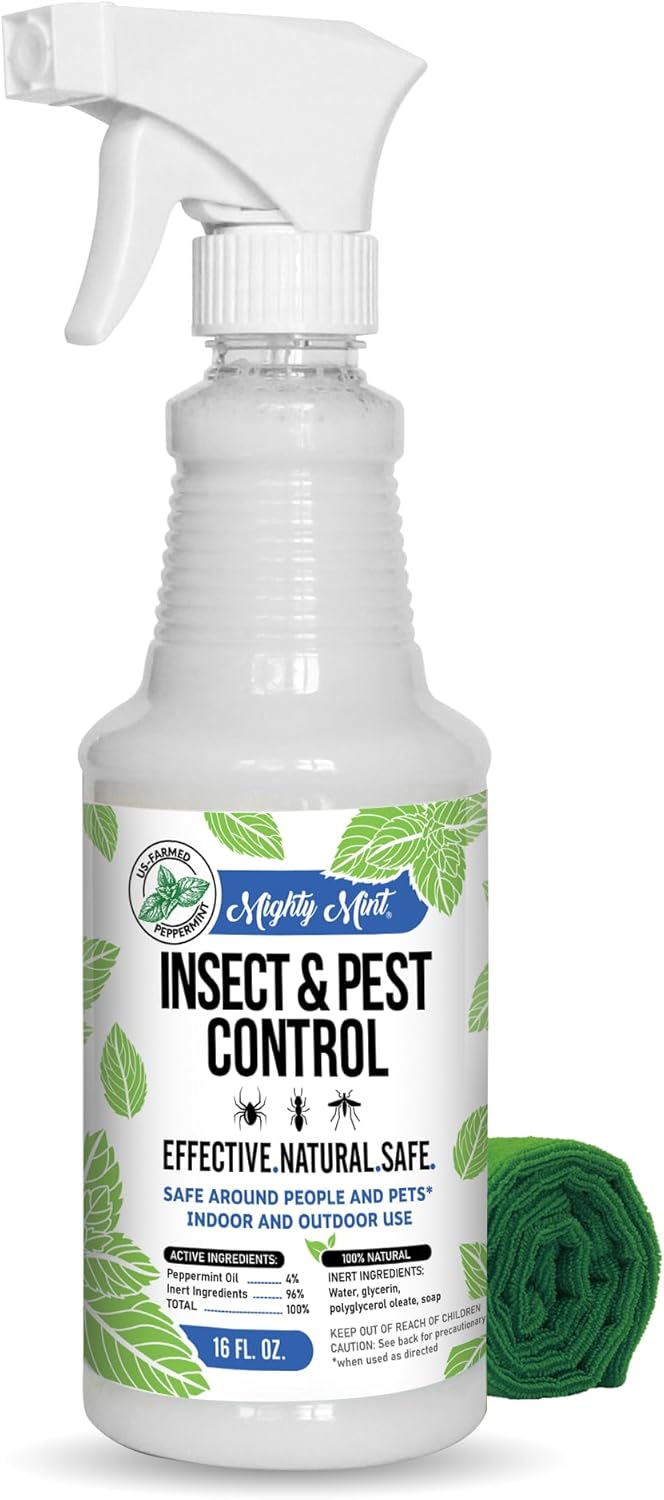
| Ingredients | Water, Glycerine, Polyglycerol oleate, Soap, Peppermint oil |
|---|---|
| Use Areas | Indoor / Outdoor |
| Size | 16 oz |
Mighty Mint is a plant-based, ready-to-use spray that uses concentrated peppermint oil to repel a broad range of household and patio pests. You apply it directly to problem areas such as baseboards, entryways, patios and around outdoor seating; the manufacturer recommends shaking and spraying until surfaces are covered and repeating applications two or more times per week for best results. Notable features include a peppermint-only scent profile, a formulation that avoids synthetic fragrances and the convenience of a 16 oz spray bottle for targeted spot treatments. Practical benefits are that it is safe to use around people and pets when dry and does not leave obvious stains on most surfaces, and the scent can make treated areas smell fresher than chemical alternatives. Important limitations are that it is a repellent rather than a pesticide so it works by discouraging pests rather than killing them, effectiveness depends on regular reapplication and it should not be applied when pollinators are present or to skin or food-contact surfaces.
Best for: Buyers who prioritize natural, low-toxicity solutions and want a targeted spray to reduce insects around patios and entryways while keeping family and pets in mind.
Less Ideal for: Anyone needing a one-time extermination or long-term residual pesticide for severe infestations should consider professional treatments or products formulated to kill pests rather than repel them.
- Plant-based peppermint formula that avoids synthetic fragrances
- Ready-to-use spray for quick, targeted indoor and outdoor applications
- Safe for people and pets when used as directed and allowed to dry
- Nonstaining on most surfaces and leaves a fresh mint scent
- Repels rather than kills insects so regular reapplication is needed to maintain protection
- Strong peppermint concentration may bother scent-sensitive individuals and requires keeping children and pets away until dry
Verdict: Choose Mighty Mint when you want a pet-friendly, plant-based spray to reduce patio and entryway insects with a fresh peppermint scent.
Jqely Ultrasonic Indoor Pest Repeller, 6-Pack (3-Mode)

| Unit Count | 6 Count |
|---|---|
| Power Source | Electric |
| Frequency Range | 10kHz–65kHz |
| Coverage | Up to 1600 sq ft (open space) |
The Jqely six-pack ultrasonic repellers are plug-in devices intended to provide continuous, chemical-free pest deterrence around the home. Each unit offers three modes that emit different ultrasonic frequency bands so you can choose quieter operation for overnight use or higher frequencies intended for larger infestations when the home is empty. Typical use is to install one unit per room at recommended height and keep them running 24/7; the maker claims coverage up to 1600 sq ft in open space but notes walls and furniture reduce effectiveness. Practical benefits include a mess-free alternative to traps and sprays, very low power draw, and simple one-button operation. Important limitations are that ultrasonic devices depend on line of sight to pests, some modes can produce audible noise for people or pets, and results vary by pest species and room layout, so they work best as part of a layered approach rather than a guaranteed single solution.
Best for: A cautious homeowner who prefers non-chemical, low-maintenance pest control and wants a ready supply of units to place in several rooms for ongoing deterrence.
Less Ideal for: People seeking a guaranteed, immediate knockout of an active infestation or who need a single-room loud mechanical solution; not the best choice for outdoor mosquito control.
- Three selectable ultrasonic modes to target different pests and activity levels.
- Sold as a six-pack for room-by-room coverage without frequent repurchasing.
- Plug-in, low power design supports 24/7 operation with no batteries or messy cleanup.
- Chemical-free and silent in the lowest mode, making it suitable for occupied rooms at night.
- Effectiveness is reduced by walls and large furniture so multiple units are often required.
- Higher-intensity mode can produce audible noise and should not be used around people or pets.
Verdict: Buy this six-pack if you want a low-maintenance, chemical-free set of plug-in repellers to provide continuous, room-by-room deterrence as part of a cautious, layered approach to indoor mosquito and pest control.
Choosing the Right Non Chemical Cockroach Killer: Key Factors to Consider
Capture or Kill Speed
How quickly a non chemical method interrupts visible roach activity matters because faster control reduces opportunity for breeding and spread. Traps that lure and hold insects can show results within days, while desiccants or mechanical baits may take longer as they depend on contact and secondary transfer. Consider whether you need immediate reduction in sightings or a slower, steady decline when choosing a method.
Speed also affects where you place devices. Fast-acting devices are useful near entry points and high-traffic food areas, while slower methods can be positioned in less accessible harborage sites to reduce reproduction over weeks.
Residual Control and Persistence
Some non chemical options provide ongoing suppression, while others only capture or kill at the point of contact. Sticky traps work until they fill or lose tackiness, and desiccant powders can remain effective until they are cleaned up or wetted. Assess how long a solution continues to protect an area without reapplication.
Persistence influences maintenance rhythm. If a household wants low-intervention solutions, choose options with longer active periods. For high-moisture areas, plan for more frequent reapplication or replacement to maintain effectiveness.
Household Safety and Non-Target Risk
A main reason for choosing non chemical cockroach killers is reducing exposure to toxic active ingredients. Even so, some mechanical or physical methods can pose risks. Sticky traps can trap small pets or beneficial insects if left in accessible spots, and desiccant dusts may irritate respiratory systems if applied improperly.
Read product labels for placement guidance, use tamper-resistant housings for traps in homes with children and pets, and avoid dust applications in areas where food is prepared. Safety influences both where you deploy controls and how often you check them.
Ease of Use and Placement
Homeowners need solutions that fit normal cleaning patterns and furniture layouts. Low-profile traps that slide under appliances, prefilled bait stations that require no mixing, or granular products that can be applied into voids all reduce setup time.
Consider whether the control requires repeated handling, whether it can be hidden from sight, and if placement interferes with regular cleaning. The less invasive the method, the more likely it will be used consistently.
Compatibility With Household Routines
Controls that demand frequent removal for cleaning or that lose function when surfaces are wiped down may clash with typical household chores. For example, sticky boards in kitchens often get discarded by mistake during routine tidying, while long-lasting mechanical traps can be left undisturbed for weeks.
Pick options that align with how you clean and maintain living spaces. If you mop floors daily, avoid floor-level powder treatments that are easily removed. If you vacuum often, use enclosed traps that are not affected by routine vacuuming.
Potential for Reinfestation and Integrated Use
A single product rarely eliminates roach problems forever. Physical exclusion, sanitation, and reducing food and water sources matter as much as the control method. Some non chemical approaches lower local populations but do not block reentry from neighboring units or outdoor harborage.
Plan to pair your chosen killer with seam sealing, door sweeps, and improved sanitation. Consider whether the product supports integrated pest management by allowing targeted placement and monitoring so you can track trends and adapt strategies.
How Non Chemical Methods Work
Non chemical cockroach killers rely on mechanical capture, desiccation, starvation, or physical exclusion instead of neurotoxic or growth-regulating chemicals. Common formats include sticky traps, boric-free desiccant powders that abrade the insect cuticle, mechanical snap or glue devices, and traps that exploit roach behavior patterns like pheromone-guided movement or aggregation.
These methods are often slower than a chemical spray for an immediate knockdown, but they reduce toxic exposure around food prep areas and sleeping spaces. Understanding the mechanism helps you place devices where roaches travel and hide, such as along baseboards, behind appliances, inside cabinets, and in wall voids.
- Sticky and glue-based traps capture by adhesion for easy monitoring.
- Desiccant powders cause gradual dehydration after contact; they work best in dry, undisturbed voids.
- Mechanical traps and enclosed sticky stations reduce non-target risk and are easy to check.
Best Placement Strategies
Placement decides success more than brand. Focus on likely travel lanes: along baseboards, at the back of cupboards, under sinks, behind refrigerators, and near drains. Roaches prefer dark, warm, humid crevices, so target those microhabitats rather than open floor areas.
Place multiple small devices rather than a single large one. Check traps every few days during the first two weeks, then weekly once activity drops. For powders or granular materials, apply in thin lines inside voids and behind appliances where foot traffic and cleaning will not remove them.
- Use hidden, tamper-resistant housings when children or pets are present.
- Combine perimeter placements with targeted indoor spots for better coverage.
- Replace or refresh devices on a schedule tied to the product's expected life.
Integrating Non Chemical Options With Sanitation and Exclusion
Non chemical killers perform best when combined with improved sanitation and exclusion. Eliminate food crumbs, store dry goods in sealed containers, fix leaks, and ventilate damp spaces. Small behavioral changes reduce available food and increase the relative impact of traps and desiccants.
Seal cracks around pipes, install door sweeps, and screen vents to reduce reentry. Use monitors to detect hotspots and move devices accordingly. Treating infested areas and then maintaining those gains with ongoing sanitation helps prevent rebounds.
- Keep counters and floors free of pet food and spilled crumbs.
- Store garbage in sealed bins and empty regularly.
- Inspect and seal gaps around utilities and baseboards.
When to Call a Professional
If you see heavy, continuous activity despite using multiple non chemical methods and following sanitation steps, the infestation may be too large for over-the-counter physical controls alone. Professionals can assess structural entry points, wall void infestations, and conditions that permit large populations to persist.
Also consider professional help if roaches are spreading from neighboring units or if there are inaccessible harborage sites. A technician can advise on targeted physical exclusion and monitoring strategies that work alongside non chemical products.
- Seek help for persistent sightings at all hours and presence of egg cases or molts.
- Ask a professional about structural repairs that reduce long-term reintroduction risk.
How We Chose the Best Non Chemical Cockroach Killer
We prioritized solutions that work without synthetic insecticides and that gardeners and homeowners can use indoors around families and pets. Selection focused on real-world control in domestic settings rather than professional fumigation techniques. We tested for usable placement options, compatibility with kitchens and living areas, and whether the method can be integrated with routine cleaning and exclusion work. Evaluation criteria included speed of knockdown or capture, residual control or persistence, safety for people and pets, ease of use and placement, and maintenance or cleanup burden. We excluded products that rely primarily on chemical active ingredients, aerosol foggers, or techniques requiring professional licensing. Also excluded were unproven home remedies lacking consistent evidence of effectiveness. The final shortlist emphasizes approaches that are repeatable, easy to adopt, and that minimize exposure risks while still offering meaningful reductions in roach activity. Where a method has clear tradeoffs, we noted practical mitigation steps a homeowner can take.
FAQ
Are non chemical cockroach killers effective for big infestations?
They can reduce visible activity but are often slower and less complete for large infestations. For heavy populations, combine non chemical controls with exclusion, sanitation, and possibly professional assessment to achieve meaningful reduction.
Will sticky traps harm pets or wildlife?
Sticky boards can trap small animals or beneficial insects if placed in reach. Use enclosed traps or tamper-resistant housings and place devices out of pet pathways to reduce non-target risk.
How often should I check or replace traps and powders?
Check sticky traps every few days during active control, then weekly as activity drops. Replace traps when they fill or lose stickiness. Powders should be refreshed after wetting or heavy cleaning, typically every few weeks in high-traffic or humid areas.
Can these methods be used in kitchens and near food?
Yes, but place devices so they do not contact food or food-prep surfaces. Use enclosed stations and avoid dust applications directly on countertops or pantry shelves. Store bulk foods in sealed containers to reduce attraction.
Do non chemical options prevent reinfestation from outside?
They help reduce indoor populations but do not stop reinvasion through gaps and openings. Pairing control devices with exclusion measures like sealing cracks and installing door sweeps is necessary to limit reentry.
Are there health risks from desiccant powders?
Some powders can irritate eyes or respiratory systems if inhaled or applied liberally. Use targeted, minimal applications inside voids or behind appliances and avoid airborne dust. Keep children and pets away during application and clean up excess material.
Final Verdict
Non chemical cockroach killers are a sensible choice when you want to reduce toxic exposure while still addressing indoor infestations. Prioritize methods that match your infestation size and household routines: fast-acting traps for quick reduction, persistent powders for undisturbed voids, and enclosed stations for safety around children and pets. Plan on combining a chosen non chemical product with sanitation and exclusion to prevent reinfestation. Accept that tradeoffs exist between speed, persistence, and convenience, and choose the approach that balances these factors for your home and lifestyle.
