

Note: This article contains affiliate links. If you click on these links and make a purchase, I may earn a small commission at no extra cost to you. This helps support my research and content. Read my full affiliate disclosure here.
If you need to clear patches of unwanted vegetation quickly, a non selective weed killer can be the most efficient tool in the shed. These products kill most plants they contact, so they are best used where you want broad dieback rather than selective spot control. Choosing the right formula and delivery method affects how well weeds die back, how long you must keep people and pets away, and how much risk there is to desirable plants nearby. This guide covers seven top-rated non selective weed killers that were shortlisted for general garden use. We evaluated each option for how quickly and thoroughly it controls established weeds and for how easy and accurate it is to apply. Read on to learn the practical differences that matter in a backyard, patio, or utility area, then go to the product list to compare specific choices.
Top Picks at a Glance
| Best Overall The best all-around choice for most situations | Roundup Weed & Grass Killer with Comfort Wand, 1.33 gal. |  |
| Best Quality Built to a higher standard if you want something more solid | Roundup Pro Weed Killer, 2.5 Gallon |  |
| Best Value The sweet spot between price and what you get | Compare-N-Save 75324 Glyphosate Herbicide, 1 Gallon |  |
| Best Budget The cheapest option that still gets the job done reliably | Spectracide Weed & Grass Killer Concentrate, 16 fl oz |  |
| Highest Rated A top-rated pick with lots of positive feedback | Roundup QuickPro Herbicide Powder |  |
| Most Popular A crowd favorite that many people choose with confidence | Spectracide Weed & Grass Killer with AccuShot Power Sprayer, 1.33 Gal |  |
| Best Seller A high-volume bestseller chosen again and again | Roundup Weed & Grass Killer4 Refill, 1.25 gal |  |
Roundup Weed & Grass Killer with Comfort Wand, 1.33 gal.

| Item Form | Liquid |
|---|---|
| Coverage | 400 sq. ft. |
| Liquid Volume | 1.33 gallons |
This 1.33 gallon Roundup formula is a non-selective weed and grass killer designed to remove broadleaf weeds and grasses down to the root. It comes in a jug with an attached Comfort Wand that offers one-touch continuous spray, making it easier to treat edges, walkways, driveways, and beds without repeatedly refilling a separate sprayer. The product advertises visible browning in hours and becomes rainproof in about 30 minutes, which helps maintenance schedules during uncertain weather. It is suitable for spot treatments around foundations, fences, and gravel or mulch areas and allows replanting within the window specified on the label. Important limitations are that it is non-selective so it will damage desirable plants if sprayed or if drift occurs, and treated areas should remain off-limits to people and pets until dry. Also, follow label directions closely for safe use and proper wait times before replanting.
Best for: Buyers who want a straightforward, ready-to-use non-selective herbicide for spot removal and clearing of weeds around paved areas, beds, and edges with minimal setup and effort.
Less Ideal for: Gardeners who need a selective weed control for lawns or who prefer organic or non-chemical methods should consider other options.
- Integrated Comfort Wand with one-touch continuous spray for easier, controlled application
- Fast visible results and becomes rainproof in about 30 minutes
- Covers up to 400 sq. ft. from a single 1.33 gallon container
- Kills a wide range of broadleaf weeds and grasses to the root
- Non-selective formula that will harm desirable plants if contacted
- Requires careful application to avoid drift and reentry restrictions
Verdict: A convenient, ready-to-use non-selective herbicide with an integrated spray wand that makes fast, effective spot clearing around hardscapes and beds easy.
Roundup Pro Weed Killer, 2.5 Gallon

| Item Form | Liquid |
|---|---|
| Liquid Volume | 2.5 gallons |
| Coverage | non-selective broad spectrum coverage |
| Active Ingredients | Glyphosate |
Roundup Pro is a high-concentration glyphosate herbicide sold as a 2.5 gallon liquid intended for broad-spectrum, non-selective weed control. It is mixed with water in handheld or vehicle-mounted sprayers and is commonly used for agricultural fields, industrial sites, right-of-way management, and large residential properties. The formula (about 50.2% glyphosate) delivers quick kill of grasses, annual and perennial weeds, and woody brush when applied at label rates, and the product becomes rainfast in roughly one hour. Key practical benefits are economical coverage for large areas and flexibility in application rates for different targets. Important limitations are that it is non-selective so it will kill desirable plants on contact, it requires careful mixing and appropriate sprayer materials, and it demands strict safety precautions to avoid skin or eye exposure and to comply with label directions.
Best for: Buyers who need a high-performance, economical herbicide for treating large areas or tough vegetation and who prioritize efficacy and predictable results over selective control.
Less Ideal for: Casual gardeners with small beds, container growers, or anyone who needs selective weed control near desirable plants should choose a targeted or selective product instead.
- High glyphosate concentration for fast, reliable control of tough weeds and woody brush
- Large 2.5 gallon container provides economical coverage suitable for multi-acre applications
- Works across a wide range of targets with label-adjusted mix rates from annual weeds to woody plants
- Rainfast in about one hour, reducing loss from light post-application rainfall
- Non-selective action will damage or kill desirable vegetation if contacted
- Requires careful handling, proper protective equipment, and strict adherence to label mixing and application instructions
- Not suited for spot treatments near sensitive plants without careful shielding
Verdict: Choose Roundup Pro when you need a powerful, cost-effective glyphosate concentrate to quickly clear large areas of weeds and tough vegetation.
Compare-N-Save 75324 Glyphosate Herbicide, 1 Gallon

| Active Ingredients | glyphosate |
|---|---|
| Liquid Volume | 1 gallons |
| Item Form | Spray |
| Coverage | 25000 square_feet |
This 1-gallon Compare-N-Save concentrate uses glyphosate to kill a wide range of annual and perennial weeds and grasses by foliar uptake down to the roots. It is mixed with water to make a spray solution and is typically applied to driveways, walkways, fence lines, beds, and areas targeted for lawn renovation where nonselective control is desired. Notable features include a high active ingredient level (41 percent), clear mix rates for general and tougher weeds, rainproofing in about two hours, and guidance for quick replanting in ornamental areas. The product makes a large volume of ready-to-use spray, so one container covers substantial area and reduces the need for frequent repurchases. Important limitations are its nonselective action that will kill desirable vegetation if contacted and safety precautions required for handling around people, pets, and edible gardens. It also offers no residual weed prevention, so repeat treatments or follow-up maintenance will be needed for new seedlings.
Best for: Buyers who want a cost-effective, high-strength nonselective herbicide to clear large areas, rehab lawns, or spot-treat persistent weeds and who prioritize coverage and systemic knockdown over selective plant safety.
Less Ideal for: Gardeners who need selective weed control around desirable plants or who prefer organic, residual-free management methods should choose alternative, targeted options.
- High glyphosate concentration (41%) for effective, systemic weed and grass control
- Concentrated formula makes a large amount of ready-to-use spray, covering extensive areas
- Rainproof in about two hours so treated areas resist light rainfall shortly after application
- Clear mixing rates and usage guidance for different weed types and situations
- Nonselective formulation will kill any green plant it contacts, requiring careful application
- Contains hazardous active ingredient and requires protective clothing and safe handling
- No residual activity so it does not prevent new weed germination
Verdict: A concentrated, high-strength glyphosate concentrate that delivers broad, cost-efficient nonselective weed control across large areas.
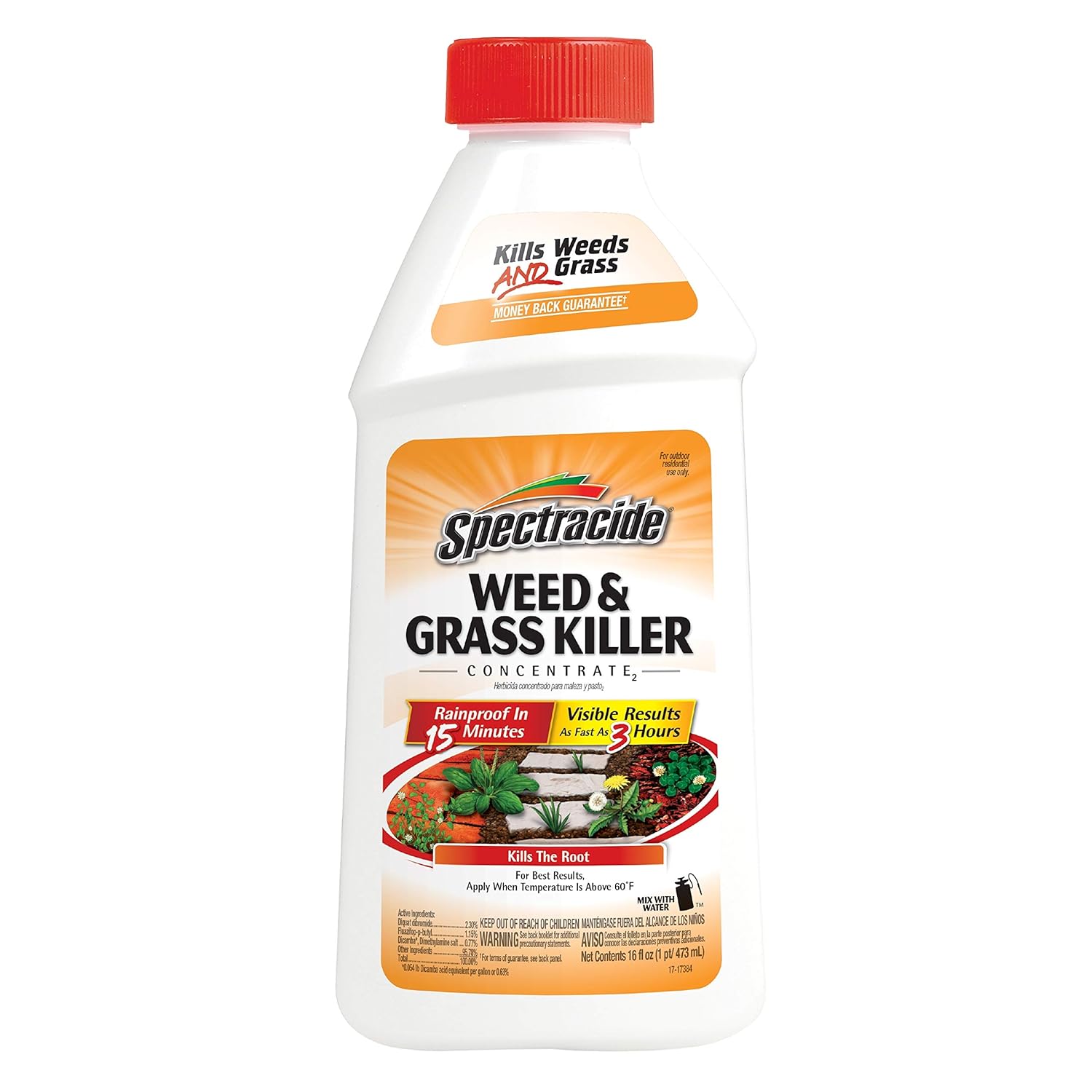
Spectracide Weed & Grass Killer Concentrate, 16 fl oz
| Unit Count | 16 Fluid Ounces |
|---|---|
| Item Form | Spray |
| Coverage | 7 fl oz per gallon treats up to 300 sq ft per treatment |
| Rainfast | 15 minutes |
| Visible Results | As fast as 3 hours |
Spectracide Weed & Grass Killer Concentrate is a liquid concentrate you mix with water and apply with a tank sprayer to kill unwanted weeds and grasses down to the root. It is intended for spot treatment on driveways, walkways, patios, along foundations and around fences or trees where you need fast removal of broadleaf weeds and grasses. The formula is rainproof in 15 minutes and can show visible dieback in as fast as three hours, allowing replanting in treated areas after about a day. The concentrate dosing (7 fl oz per gallon covers roughly 300 sq ft per treatment) keeps a small bottle useful for multiple spot jobs, which is budget friendly for homeowners. Important limitations are that it is nonselective so it will damage desirable plants if contacted and it requires careful mixing and protective measures when using near ornamentals or where overspray is possible. Follow label directions and apply only when temperatures are above 60°F for best results.
Best for: Homeowners and renters who need an inexpensive, fast-acting solution to clear weeds from driveways, walkways and other hardscape areas and who are comfortable following label mixing and safety instructions.
Less Ideal for: People who need a selective lawn weed control solution or who require a ready-to-use spray for very small, infrequent jobs should consider other products.
- Concentrate mixes with water so one bottle treats multiple spot areas
- Rainproof in 15 minutes so light rain soon after application will not reduce effectiveness
- Produces visible results quickly, often within a few hours, enabling faster replanting
- Designed to kill both broadleaf weeds and grasses down to the root
- Nonselective formula will injure or kill desirable plants if contacted
- Requires a tank sprayer and careful measuring to avoid over-application
Verdict: A cost-conscious, fast-acting concentrate for quickly clearing weeds and grasses from hardscape areas when used carefully to avoid desirable plants.
Roundup QuickPro Herbicide Powder

| Item Form | Powder |
|---|---|
| Coverage | Non-selective broad spectrum coverage |
| Active Ingredients | Glyphosate 73.3% and Diquat 2.9% |
| Mix Rate | 1.5 oz per gallon of water |
Roundup QuickPro is a concentrated powder herbicide designed to be mixed with water and applied with standard sprayers for broad-spectrum weed control. It pairs systemic glyphosate with the fast-acting contact agent diquat, so treated weeds absorb the product quickly and begin to show visible breakdown within about 24 hours while becoming rainfast in roughly one hour. Use involves dissolving the measured 1.5-ounce dose per gallon of water and spraying any unwanted vegetation while protecting desirable plants from drift. Practical benefits include reliable control of both annuals and many perennials, a formulation that reduces the chance of wash-off in light rain, and the convenience of a powdered product that stores and measures easily. Limitations are that it is non-selective so it will damage or kill desirable plants on contact, and it requires careful handling and protective measures because it contains glyphosate and diquat. This product is best suited for spot treatments, fence lines, driveways, and areas where you want complete vegetation removal rather than selective thinning.
Best for: Buyers who prioritize a dependable, fast-working solution for removing unwanted vegetation in non-crop areas and want a product that becomes rainfast quickly.
Less Ideal for: Gardeners seeking selective control inside beds, or anyone who needs an herbicide safe for use around desirable turf or ornamentals should consider alternatives.
- Combines systemic glyphosate and fast-acting diquat for quicker visible results
- Rainfast in about one hour, reducing loss from light rain after application
- Powder concentrate stores compactly and measures for flexible mixing
- Effective against a wide range of annual and perennial weeds
- Non-selective action will kill desirable plants if contacted
- Contains strong active ingredients that require protective gear and careful handling
Verdict: Choose Roundup QuickPro when you need a reliable, fast-acting non-selective herbicide that controls tough weeds and becomes rainfast quickly.
Spectracide Weed & Grass Killer with AccuShot Power Sprayer, 1.33 Gal

| Unit Count | 170 Fluid Ounces |
|---|---|
| Item Form | Spray |
| Coverage | 1 gallon |
| Active Ingredients | Diquat Dibromide 0.12%, Fluazifop-p-butyl 0.06%, Dicamba (dimethylamine salt) 0.04% |
Spectracide Weed & Grass Killer is a non-selective liquid herbicide sold with a battery-powered AccuShot sprayer and extendable wand for targeted application. It is used to clear weeds and grasses on driveways, patios, walkways and around fences or garden beds by spraying foliage so the active ingredients move to the root. The AccuShot sprayer provides continuous power without pumping, improves reach and reduces hand fatigue, and the formula delivers visible browning in as little as three hours and is rainproof within 15 minutes. Practical benefits include the convenience of a ready-to-use bottle plus an integrated sprayer you can reuse with the product, and the ability to replant treated areas after a short wait. Important limitations are that the product is non-selective so accidental drift or overspray will damage desirable plants, it requires careful PPE and handling because of toxicity and environmental hazards, and the sprayer uses four AA batteries which adds ongoing maintenance and potential downtime if batteries fail.
Best for: Buyers who want a fast, no-mix solution for spot-treating weeds around hardscapes and borders and who prioritize a sprayer that improves accuracy and reduces hand strain.
Less Ideal for: People looking to selectively treat lawns or sensitive garden beds where nearby desirable plants might be exposed, or those who prefer non-chemical weed control methods.
- Includes AccuShot battery-powered sprayer with extendable wand for accurate, continuous spraying
- Visible results in as fast as three hours and rainproof within 15 minutes
- Kills weeds and grasses down to the root for longer-lasting control
- Ready-to-use formulation with enough volume for multiple small jobs (1.33 gallon)
- Non-selective formula will damage any desirable plants if contacted
- Contains ingredients toxic to aquatic life and requires careful application and disposal
- AccuShot sprayer requires four AA batteries which are not included and will need periodic replacement
Verdict: Choose this kit when you want a fast-acting, ready-to-use non-selective herbicide with a powered wand for accurate spot control of weeds and grasses.
Roundup Weed & Grass Killer4 Refill, 1.25 gal

| Unit Count | 160 Fluid Ounces |
|---|---|
| Item Form | Spray |
| Coverage | 375 square feet |
| Active Ingredients | Triclopyr, Fluazifop P-Butyl, Diquat Dibromide |
This Roundup Weed & Grass Killer4 refill is a ready-to-pour herbicide intended to refill compatible spray containers and treat unwanted weeds and grasses around yards and hardscapes. It contains three active ingredients formulated to kill broadleaf weeds and tough grasses to the root and lists common targets such as dandelion, crabgrass and poison ivy. The product is rainproof in as little as 30 minutes and can show visible wilting within hours, which helps when you need quick, predictable results. One 1.25 gallon container covers roughly 375 square feet, making it suitable for spot treatments, beds, edging and driveways. Practical limitations include legal and safety precautions: treated areas should remain off-limits to people and pets until dry and label directions about replanting must be followed. Also this is a nonselective herbicide so care is required to avoid drift onto desirable plants. For gardeners seeking a straightforward, fast-acting refill for routine weed control, this formulation is effective, but users must handle and apply it carefully to protect nearby plants and follow all safety guidance.
Best for: Homeowners who want a reliable, fast-acting nonselective herbicide for spot treatments and hardscape edges and who prefer predictable, short-term results when controlling common weeds.
Less Ideal for: Gardeners who need selective weed control near delicate ornamentals or those who avoid chemical herbicides entirely should consider mechanical or targeted selective alternatives.
- Fast-acting with visible results in hours and rainproof in about 30 minutes
- Targets a broad range of common weeds and grasses including dandelion and crabgrass
- Large 1.25 gallon refill covers about 375 square feet for multiple spot treatments
- Formulated to kill to the root, reducing short-term regrowth
- Nonselective formula can damage desirable plants if it drifts or is misapplied
- Requires careful handling and adherence to safety and replanting instructions
Verdict: Buy this if you want a fast, dependable nonselective refill that produces quick, rain-resistant weed control for spot and edge treatments.
Choosing the Right Non Selective Weed Killer: Key Factors to Consider
Mode of Action and Persistence
Understanding how a non selective weed killer works helps you match the product to the task. Contact-only formulations scorch foliage fast but often allow regrowth from roots. Systemic formulations move into roots and crowns for longer control but can take longer to show visible effects.
Persistence determines when you can replant an area or expect non-target damage. Short-residual products let you re-seed sooner, while persistent herbicides may prevent planting for weeks or months. Always check the label for replanting intervals and be conservative in vegetable or ornamental beds where you plan to re-establish desirable plants.
Delivery Method and Application Precision
Spray formulations come as ready-to-use, concentrated liquids for dilution, or granules. Concentrates offer flexibility for larger areas but require correct measuring and mixing. Ready-to-use bottles are convenient for spot treatments but can be costlier per application.
Application precision matters because non selective products will injure any plant they contact. Narrow-cone nozzles, shielded wands, or wick applicators reduce drift and accidental contact. Consider the sprayer type you already own and whether the product label permits mixing with a pump sprayer.
Target Plants and Broadleaf Vs Grass Control
Not all non selective weed killers are equally effective on every species. Some formulations act faster on grasses, others on broadleaf weeds, and a few tackle woody regrowth or moss. Match the expected weed species in your area to the product claims to avoid repeated applications.
For perennial weeds with deep roots, systemic action will usually be necessary. Annual weeds and seedlings can often be handled with a fast-contact product applied before they set seed. Read label lists and recommended timings to align expectations with performance.
Safety, Drift Risk, and Buffering Desirable Plants
Because these herbicides are non selective, minimizing drift and accidental spray is critical. Windy conditions, spray drift, or overspray can damage neighboring lawns, ornamentals, or vegetable plots. Use low-drift nozzles, spray shields, and apply on calm days. Consider physical barriers or targeted wicks when working near desirable plants.
Personal protective equipment and careful storage also reduce risk. Check label first-aid instructions and re-entry intervals for areas used by people and pets. Proper handling and respecting buffer zones protect both your plants and family.
Timing and Weather Considerations
Application timing affects efficacy. Many products work best on actively growing weeds rather than dormant or drought-stressed plants. Apply when temperatures and sunlight fall within the label-recommended range for best uptake, and avoid applying before heavy rain that can wash contact products off foliage.
Morning applications after dew dries can improve uptake. Avoid application during heat extremes or when temperatures exceed recommended limits, as evaporation can increase drift and reduce active uptake into plant tissues.
Replanting Restrictions and Soil Impact
Some non selective herbicides leave residues that slow re-establishment of desirable plants. Labels will specify replanting windows for lawns, ornamentals, and vegetables. If you plan to re-seed or transplant soon after treatment, choose a product with short replant intervals.
Consider soil and water protection measures when using persistent chemistries. Avoid runoff into storm drains and prevent overspray into garden soil where future edible crops will be grown. When in doubt, select products with minimal soil activity.
When to Use a Non Selective Herbicide
Non selective herbicides are best for clearing driveways, gravel paths, fence lines, and areas where you want virtually no plant growth. They are also useful when you need to eliminate large patches of weeds prior to renovation or to remove invasive species that compete with desired plantings.
Avoid using these products in mixed beds where desirable plants are present unless you can protect them. For small clusters or single weeds near ornamentals, consider targeted application tools or physical removal instead.
- Utility areas and hardscape seams
- Pre-plant site preparation or renovation
- Invasive perennial control where root kill is needed
Application Tools That Improve Accuracy
Choosing the right applicator reduces wasted product and accidental damage. Pump sprayers with adjustable nozzles let you switch from a fine mist to a narrow jet. For very precise work, wick applicators and paintbrush-style applicators apply herbicide directly to leaves without aerosolizing it.
Using shields and drift-reducing nozzles keeps spray off nearby plants. Always rinse and clean spray equipment after use according to label directions to avoid cross-contamination.
- Pump sprayer with low-drift nozzle for moderate areas
- Wick or sponge applicator for spot treatment near ornamentals
- Shielded wand for edges and fence lines
Managing Regrowth and Follow-up Treatments
Even effective treatments sometimes require follow-up. For perennial weeds, allow treated plants to translocate herbicide to root systems; retreat only if new shoots emerge after the recommended interval. For vigorous annual flushes, a second timing in the same season may be necessary to catch late germinants.
Combine chemical control with cultural practices for longer-term suppression. Improving drainage, mulching bare soil, and overseeding bare patches reduce the open niches weeds exploit.
- Wait the full label interval before re-treating
- Use mechanical removal for large dead masses to improve appearance
- Follow chemical control with cultural steps to prevent return
Protecting Soil, Water, and Beneficial Plants
Minimizing environmental impact requires attention to runoff and buffer zones. Do not apply before heavy rain, and avoid spraying near storm drains or water features. Physical containment, such as using absorbent barriers, can prevent accidental runoff.
If you treat near beds with desirable plants, shield them or remove sensitive plants temporarily. Consider using mulch or landscape fabric after treatment to suppress regrowth and reduce the need for repeated herbicide use.
- Maintain buffer zones from water and desirable vegetation
- Avoid application before forecasted heavy rain
- Clean equipment away from garden beds to prevent contamination
Alternatives and Integrated Weed Management
Non chemical options remain useful complements. Hand pulling, hoeing, solarization, and targeted flame weeding are effective in certain situations and reduce chemical use. Combining methods lowers total herbicide needs and helps manage resistant populations.
Use herbicides as one component in a larger plan that includes improving soil health, proper mulching, and timely cultural maintenance to reduce the recurring weed seed bank.
- Physical removal for isolated plants
- Mulch and groundcover to prevent seedling establishment
- Rotate control methods to reduce resistance risk
How We Chose the Best Non Selective Weed Killer
We shortlisted products that reliably perform typical garden and landscape tasks where total plant kill is required. Editorial filtering prioritized effectiveness on common broadleaf and grassy weeds, consistency of results across repeat applications, and practical safety features for home and small-scale use. Evaluation criteria included contact speed and systemic control, application methods and nozzle precision, product residual and replanting intervals, formulation safety and label guidance for non-target plants, and packaging that supports accurate mixing and measuring. We favored options with straightforward dilution instructions and clear personal protective equipment guidance. Products lacking clear label directions for common use cases or those intended only for industrial or agricultural use were excluded. We also considered gardener-facing factors such as odor, tank compatibility for sprayers, and availability of targeted application accessories. The resulting list focuses on products suitable for backyard, garden bed, hardscape edge, and gravel area treatments where non selective control is appropriate.
FAQ
How long before I can plant vegetables after using a non selective weed killer?
Replanting intervals vary by formulation. Many contact-only products allow replanting within a few days to weeks, while systemic or persistent chemistries may require longer waits. Check the product label for exact timing and follow the longer interval if you plan to plant edibles.
Can I use non selective weed killers near ornamentals or shrubs?
You can if you protect desirable plants from spray and drift. Use shielded applicators, wick tools, or physical barriers. If the herbicide is systemic and contacts leaves of ornamentals, it can move into their roots and cause damage, so extra caution is needed.
What is the best time of day to apply these herbicides?
Apply on a calm, dry morning after dew has evaporated or in the late afternoon when temperatures are moderate. Avoid windy conditions and times of intense heat to reduce drift and evaporation and to improve plant uptake.
Will a single application kill perennial weeds?
Many perennials require systemic action and sometimes repeat treatments to fully deplete root reserves. One application can greatly weaken plants, but follow-up treatments or combining chemical control with physical removal often yields more reliable long-term control.
How do I reduce spray drift when treating near sensitive areas?
Use low-drift nozzles, lower pressure, shorter wands, and shielded attachments. Apply on calm days with little wind and avoid fine sprays. Wick applicators or spot treatments reduce airborne movement entirely.
Final Verdict
When you need broad, reliable plant control, pick a non selective weed killer that matches the weeds and site conditions. Prioritize products with the right balance of quick knockdown and systemic action for the species you are targeting, and choose an application method that limits drift to nearby desirable plants. Consider replanting restrictions and environmental safeguards when planning treatment. A thoughtful selection and careful application will give you the control you want while minimizing unintended damage and reducing the need for repeat treatments. Focus on timing, precision, and following label directions to get predictable results.
