

Note: This article contains affiliate links. If you click on these links and make a purchase, I may earn a small commission at no extra cost to you. This helps support my research and content. Read my full affiliate disclosure here.
If you want to control chewing and sucking pests without exposing your family, pets, or beneficial insects to harsh chemicals, choosing a non toxic insecticide matters. The right option reduces visible damage while leaving minimal residue on foliage and harvestable plants. This guide shortlists six top-rated non toxic insecticides that perform in real garden conditions. We evaluate each pick for safety profile, target pest range, ease of application, and how it fits into integrated pest management. Read on to find a product that balances plant protection with everyday safety in home gardens.
Top Picks at a Glance
| Best Overall The best all-around choice for most situations | Wondercide Indoor Pest Control Spray, Lemongrass, 32 oz |  |
| Best Quality Built to a higher standard if you want something more solid | EcoVenger Bed Bug Killer Spray, Plant-Based 16 oz (EcoRaider) |  |
| Best Value The sweet spot between price and what you get | Garden Safe Insecticidal Soap Ready-to-Use Spray, 32 oz |  |
| Best Budget The cheapest option that still gets the job done reliably | STEM Plant-Based Bug Spray — Ants, Roaches & Spiders, 10 oz |  |
| Highest Rated A top-rated pick with lots of positive feedback | Geomust Diatomaceous Earth with Peppermint Oil, Food Grade Insect Killer, 1 lb |  |
| Most Popular A crowd favorite that many people choose with confidence | Mighty Mint Peppermint Oil Insect Repellent Spray, 1 Gallon |  |
Wondercide Indoor Pest Control Spray, Lemongrass, 32 oz

| Unit Count | 32 Fluid Ounces |
|---|---|
| Item Form | Spray |
| Target Species | Ants, Roaches, Spiders, Flies, Fleas, Ticks, Mosquitoes, Silverfish, Moths, Gnats |
| Active Ingredients | 4.2% Cedar Oil; 1.5% Lemongrass Oil; 2.2% Sodium Lauryl Sulfate; 0.1% Sesame Oil |
Wondercide Indoor Pest Control is a ready-to-use, plant-powered spray intended for indoor use against ants, roaches, spiders, flies, fleas, ticks, mosquitoes, and other common household pests. It is typically used by spraying around entry points, baseboards, under sinks, inside cabinets, and on visible pests from about 8 to 12 inches. The formula relies on essential oils such as cedarwood and lemongrass plus a small amount of surfactant, so it doubles as a repellent and contact killer without relying on synthetic pesticides. Practical benefits include a pleasant lemongrass scent, multi-surface application, and labeling that says it is safe to use around pets and family when directions are followed. The spray also works as an indoor flea treatment for carpet and furniture and is convenient for routine preventive use. Important limitations are that it requires direct contact to kill flying insects and may need frequent reapplication for persistent infestations. The label warns it can irritate eyes and skin and that lemongrass may temporarily tint very light fabrics, so spot-testing sensitive surfaces is recommended.
Best for: Buyers who want an indoor pest treatment that leans on plant-based ingredients and family-safe labeling and who prefer a product backed by broad user adoption and clear usage instructions.
Less Ideal for: People facing a heavy or cryptic infestation who need long-lasting residual chemical control or professional-grade extermination methods should consider stronger targeted treatments.
- Plant-based active ingredients (cedarwood and lemongrass oils) that both repel and kill many common indoor pests
- Labeled as safe for use around people and pets when directions are followed
- Ready-to-use spray with adjustable nozzle for targeted or mist applications
- Works on multiple surfaces including carpet, furniture, and baseboards and is marketed as effective against fleas including eggs and larvae
- Requires direct spray contact to kill flying insects rather than providing a residual knockdown
- May cause eye or skin irritation in some users and can temporarily tint very light fabrics
Verdict: A pet-friendly, plant-powered indoor spray that repels and kills common household ants and other pests for everyday preventive use.
EcoVenger Bed Bug Killer Spray, Plant-Based 16 oz (EcoRaider)

| Volume | 16 oz |
|---|---|
| Active ingredients | Geraniol, Cedarwood oil, Sodium Lauryl Sulfate |
| Residual protection | Up to 14 days |
| Target pests | Bed bugs, eggs, nymphs, resistant strains |
EcoVenger Bed Bug Killer is a ready-to-use, plant-derived spray designed to eliminate all life stages of bed bugs, including pesticide-resistant adults and eggs. In typical use you shake the bottle, spray mattress seams, box springs, bed frames, cracks, and crevices, then repeat weekly until activity stops. The formula lists botanical actives such as geraniol and cedarwood oil and claims rapid knockdown with proven ovicidal activity; independent field studies cited by the brand report high efficacy and roughly two weeks of dry residual protection. Practical benefits include a non-staining, mild woody scent and a safety profile that allows use around bedding and in occupied spaces where children and pets are present. Important limitations are that it is a topical spray only and may require repeated treatments for heavy infestations or hidden harborage sites; nozzle parts are noted as delicate and could need replacement if mishandled. For best results pair targeted spray applications with laundering, vacuuming, and monitoring to break infestations completely.
Best for: Buyers who prioritize proven, high-efficacy solutions that are safe to use in occupied bedrooms and sensitive settings and who plan to apply focused, repeated treatments where bed bugs hide.
Less Ideal for: Users seeking a single-treatment, whole-house remediation service or those who prefer professional fumigation or non-spray control methods.
- Plant-based formula effective against adults, nymphs, and eggs according to studies
- Provides up to two weeks of residual protection after drying
- Safe for use on mattresses and around children and pets when used as directed
- Mild, non-staining formula with a pleasant natural scent
- Not a whole-home solution; repeated spot treatments and integrated housekeeping are needed for severe infestations
- Spray nozzle contains delicate parts that may break with rough handling
Verdict: Choose EcoVenger when you want a research-backed, plant-based spray that kills all bed bug life stages and gives up to two weeks of residual protection for in-room treatments.
Garden Safe Insecticidal Soap Ready-to-Use Spray, 32 oz

| Item Form | Spray |
|---|---|
| Target Species | Insects |
| Liquid Volume | 32 fluid ounces |
| Active Ingredients | Potassium Salts Of Fatty Acids |
Garden Safe Insecticidal Soap is a ready-to-use contact spray formulated with potassium salts of fatty acids to control aphids, mealybugs, mites, whiteflies and similar soft-bodied pests. You use it like a normal garden spray: thoroughly coat insects and all plant surfaces including undersides of leaves, ideally in calm weather and not in full sun. It is safe for use on vegetables, fruit trees, ornamentals, shrubs, flowers and in greenhouses and may be applied to edibles up to the day of harvest, which simplifies timing for vegetable growers. The spray works on direct contact so thorough coverage is essential and multiple applications may be needed for heavy infestations. The product is convenient because no mixing is required, but it can be washed off by rain and is hazardous to aquatic invertebrates so care is needed to avoid runoff into water. For routine control of common garden pests this soap is a practical, low-toxicity option when used as part of an integrated pest management approach.
Best for: Gardeners who prioritize practical, low-toxicity pest control and want a ready-made spray that can be used on edible crops without pre-harvest delays.
Less Ideal for: People needing a long-residual or systemic pesticide for heavy infestations or for pests hidden inside plant tissues should consider other control methods.
- Ready-to-use formula requires no mixing for quick spot treatments
- Labeled for use on vegetables and may be applied up to the day of harvest
- Controls a broad list of soft-bodied pests including aphids, mites and whiteflies
- Plant-safe when used as directed and usable indoors, outdoors and in greenhouses
- Only kills pests by direct contact so it has limited residual or systemic activity
- Can be washed off by rain and must be reapplied after watering or heavy rainfall
- Harmful to aquatic invertebrates so it requires careful application near water
Verdict: A convenient, low-toxicity ready-to-use soap spray that gives effective contact control of common soft-bodied garden pests and is safe to use up to harvest.
STEM Plant-Based Bug Spray — Ants, Roaches & Spiders, 10 oz

| Item Form | Aerosol |
|---|---|
| Target Species | Ants, Roaches, Spiders |
| Unit Count | 10 Ounce |
| Active Ingredients | Geraniol 6.0%, Lemongrass Oil 0.5% |
This STEM plant-based bug spray is an aerosol insecticide formulated with geraniol and lemongrass oil to kill ants, roaches, and spiders while avoiding strong chemical odors or added fragrances. It is used like a conventional spray: aim at visible insects, crevices, or likely harborages and apply short bursts for spot treatments inside or around entry points outdoors. The botanical active ingredients make it suitable for households looking to reduce synthetic pesticide exposure and the product is labeled for use around people and pets when directions are followed. Practical benefits include a fresh, low-odor application, entomologist testing noted by the brand, and a compact 10 oz size that is convenient to store in a utility closet. Limitations are that it is a spot-treatment aerosol rather than a long‑lasting residual solution and botanical actives can require more frequent reapplication than some conventional synthetic insecticides for ongoing control of heavy infestations.
Best for: Buyers who want an inexpensive, low-odor spray for quick indoor and perimeter spot treatments and prefer plant-based formulations over conventional chemicals.
Less Ideal for: Those facing a heavy or persistent infestation who need a long‑lasting professional‑strength residual treatment should consider alternative products or professional services.
- Plant-based active ingredients (geraniol and lemongrass oil) that reduce harsh chemical odors
- Suitable for indoor and outdoor spot treatments when used as directed
- Compact 10 oz aerosol is easy to store and handy for quick use
- Formulation is marketed as safe around people and pets when directions are followed
- Provides spot control rather than long-lasting residual protection
- May require more frequent applications than stronger synthetic insecticides
Verdict: A budget-friendly, low-odor plant-based aerosol for quick spot control of ants, roaches, and spiders around the home.
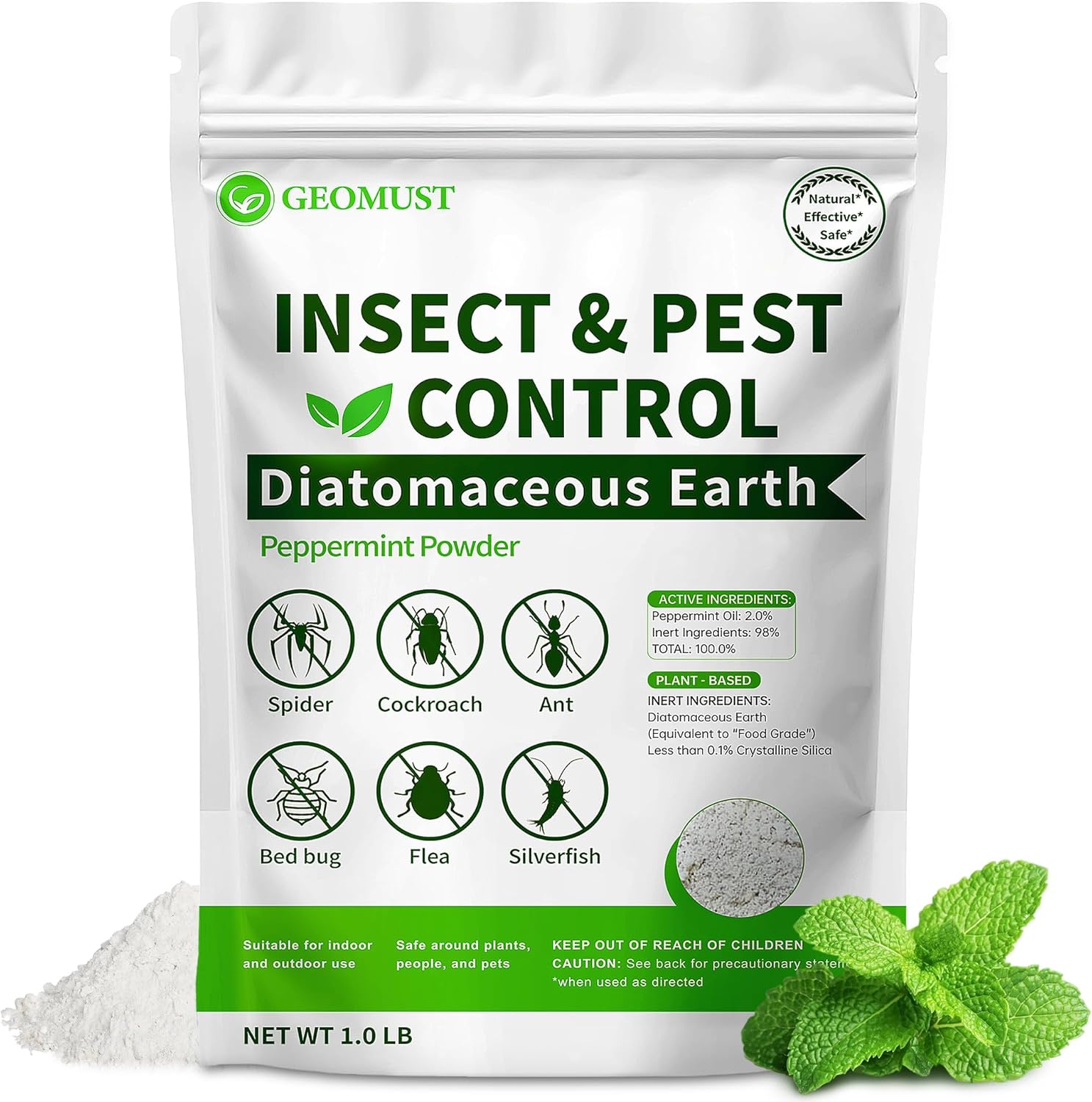
Geomust Diatomaceous Earth with Peppermint Oil, Food Grade Insect Killer, 1 lb
| Item Form | Powder |
|---|---|
| Target Species | Ants; Cockroaches; Fleas; Bed Bugs; Silverfish; Insects |
| Unit Count | 16 Ounce |
| Ingredients | Diatomaceous Earth; Peppermint Oil |
This Geomust product is a food-grade diatomaceous earth powder mixed with peppermint oil intended to control ants, roaches, fleas, bed bugs, silverfish and other crawling pests. You apply the dry powder to cracks, baseboards, entry points and around foundations or garden areas where insects travel; it works by dehydrating and abrading insect exoskeletons rather than poisoning them. The added peppermint oil gives a fresh scent and may help deter insects in treated zones. Because the formula is inert and labeled food grade it is suitable for use where households want a nonchemical option and safer handling around people and pets when used as directed. It must be kept dry to remain effective and its effects are contact-based, so it requires placement where insects will cross and occasional reapplication after cleaning or moisture exposure. For heavy, established infestations you may need repeated treatments or to combine this with exclusion and sanitation measures.
Best for: Homeowners who prioritize a low-toxicity, maintenance-friendly approach to crawling pests and want a straightforward, preventive product to use around living spaces and garden edges.
Less Ideal for: People needing a fast-acting or broad-spectrum solution for large, active infestations where immediate reduction is required.
- Food-grade diatomaceous earth provides a nonchemical, physical mode of kill safe for many home environments when used as directed
- Peppermint oil adds a pleasant scent and may increase deterrent effect in treated areas
- Versatile for indoor and outdoor use around baseboards, entry points, and garden perimeters
- Long-lasting when kept dry and simple to apply as a powder barrier
- Needs to stay dry and only works on insects that contact the powder, so wet areas reduce effectiveness
- Not an instant knockdown for heavy infestations and may require repeated applications or complementary controls
Verdict: Choose this if you want a simple, food-grade, nonchemical powder to prevent and reduce crawling pests with safe indoor and outdoor use when kept dry.
Mighty Mint Peppermint Oil Insect Repellent Spray, 1 Gallon

| Volume | 128 oz |
|---|---|
| Ingredients | Water, Glycerin, Polyglycerol Oleate, Soap, Peppermint Oil |
| Use areas | Indoor / Outdoor |
| Scent | Peppermint |
Mighty Mint’s 1-gallon peppermint oil spray is a plant-based insect repellent intended for broad indoor and outdoor use. The product is supplied as a large ready-to-use bottle with a detachable nozzle for spraying around entryways, baseboards, patios, and gardens or for refilling smaller spray bottles. Its formula lists peppermint oil along with water, glycerin, and soap, so it works by delivering a strong peppermint scent that repels spiders, ants, roaches and similar pests without synthetic pesticides. Practical benefits include the large 128 oz volume for extended coverage and a scent that many households find more pleasant than chemical sprays. The label notes it is safe for use around people and pets when used as directed, and the concentrate-style packaging simplifies repeat applications. Limitations to keep in mind are that it is a deterrent rather than a lethal insecticide, so it may not eliminate established infestations, and effectiveness can vary by pest and environmental conditions. Users should follow safety directions and reapply after heavy rain or watering for outdoor use.
Best for: Buyers who prioritize safer, plant-based pest control and want a proven, widely used product with visible social proof for routine outdoor and perimeter pest prevention.
Less Ideal for: People facing severe infestations who need a fast-acting, residual insecticide or professional pest control should consider stronger, targeted treatments instead.
- Large 128 oz ready-to-use gallon provides long-lasting coverage and value
- Plant-based formula using peppermint oil rather than synthetic pesticides
- Versatile for indoor and outdoor application and can refill smaller bottles
- Pleasant mint scent that is less intrusive than chemical alternatives
- Designed as a repellent and deterrent so it may not eradicate heavy or established infestations
- Performance can be inconsistent depending on pest type and weather conditions
Verdict: Choose this gallon peppermint spray if you want a plant-based, widely adopted repellent for routine outdoor perimeter and home pest prevention.
Choosing the Right Non Toxic Insecticide: Key Factors to Consider
Safety Profile and Toxicology
Understand the active ingredient's toxicity to people and pets. Low-toxicity insecticides are preferable for backyard vegetable beds, play areas, and patios where children and animals may contact treated surfaces. Look for products with low acute oral and dermal toxicity, minimal inhalation risk, and short reentry intervals so you can safely use treated spaces sooner.
Also consider safety for pollinators and beneficial insects. Some materials that are safe for mammals still harm bees or predatory insects. Favor options with low persistence and apply them during times when pollinators are not active to reduce non-target impacts.
Target Pest Spectrum
Match the insecticide to the pests you commonly see. Some non toxic products only control soft-bodied insects like aphids, mealybugs, or whiteflies, while others provide broader activity that includes caterpillars, beetles, or spider mites. Knowing whether you need contact knockdown or a repellent/antifeedant action will guide selection.
Consider life stages as well. Products that only affect adults will need repeat applications to address eggs and larvae. Integrated approaches that combine physical removal, cultural controls, and targeted non toxic treatments are often most effective for persistent infestations.
Residue and Environmental Breakdown
Look for materials that break down quickly on foliage and in soil. Rapid degradation reduces the risk of buildup on edible crops and lowers long-term impacts on soil life. Water-based formulations and botanical extracts often have shorter half-lives than synthetic persistent chemistries.
Also consider runoff and aquatic toxicity. Even short-lived compounds can harm aquatic invertebrates if they wash into ponds or streams, so avoid treating near water and follow label instructions about application setbacks.
Application Method and Coverage
Application ease matters for thorough coverage and consistent results. Spray-ready formulas, hose-end applicators, and concentrates for small pump sprayers each have tradeoffs. Good coverage is essential for contact materials; poor spray technique often causes treatment failure even when using a suitable product.
Consider nozzle type, droplet size, and plant architecture. Dense foliage or tall shrubs may require higher-pressure sprayers or a different wand to reach undersides of leaves where many pests hide.
Compatibility With Edible Gardens
If you grow vegetables, herbs, or fruit, check label allowances for application to edible foliage and harvest intervals. Non toxic does not automatically mean safe for harvest the same day. Some organic or botanical insecticides may require a short pre-harvest interval.
Also think about post-application taste and scent. Residues from oily botanical sprays can cling to leaves and may need a rinse before harvest in some cases.
Impact on Beneficials and IPM Integration
Protecting beneficial insects is a key goal when choosing a non toxic insecticide. Options that spare predatory beetles, parasitic wasps, and native bees help maintain natural pest suppression. Use materials that are contact-limited and apply them selectively to infested areas to reduce non-target mortality.
Plan treatments as one part of an integrated pest management strategy that includes monitoring, cultural controls, and mechanical removal to minimize reliance on repeated applications.
When to Use Non Toxic Insecticides
Non toxic insecticides are ideal for light to moderate pest pressure, targeted spot treatments, and situations where children, pets, or pollinators are present. They work well as part of an integrated program rather than as a sole long-term control for heavy infestations.
Use these products after confirming the pest and damage type. For example, a quick aphid outbreak on tender new shoots is a good candidate for a gentle contact spray, while a heavy caterpillar infestation may require combined tactics such as handpicking and repeated applications.
- Best for spot treatments and early-stage outbreaks
- Useful in edible gardens with appropriate harvest intervals
- Best timed to avoid pollinator activity
Application Tips for Better Results
Coverage is the most common reason treatments fail. Apply sprays to the undersides of leaves, along stems, and at infestation hotspots. For contact materials, thorough wetting of the insect is necessary for reliable knockdown.
Follow label dilution rates and reapplication intervals. Overdiluting reduces effectiveness while overly frequent applications can stress plants. Rotate application timing to mornings or evenings to avoid harming active pollinators.
- Target undersides of leaves and new growth
- Use proper spray equipment and nozzle for fine coverage
- Observe reapplication interval on the product label
Combining Non Toxic Options With Cultural Controls
Non toxic insecticides are most effective when paired with cultural practices that reduce pest habitat and pressure. Regular sanitation, removing infested leaves, and maintaining plant vigor through proper watering and feeding lower pest susceptibility.
Introduce and encourage beneficial insects by planting nectar and pollen sources and avoiding blanket applications across the whole garden. Physical barriers such as row covers and hand removal remain valuable companions to chemical-free or low-toxicity sprays.
- Sanitation and pruning reduce overwintering pests
- Use nectar plants to support beneficial predators
- Handpick or hose off heavy localized infestations before spraying
Safety Precautions and PPE
Even non toxic insecticides can irritate skin or eyes. Wear basic protective gear such as gloves and eye protection when mixing and applying concentrates. Avoid inhaling spray mist by using a low-drift nozzle and keeping a safe distance.
Store products away from children and pets and keep containers tightly closed. Follow label first-aid instructions and keep the product label with application notes in case of exposure events.
- Wear gloves and eye protection during mixing
- Avoid application when windy or near water
- Keep treated areas dry until spray has settled
Timing Treatments to Protect Pollinators
Apply treatments in the early morning or late evening when bees and other pollinators are less active. Avoid spraying open flowers unless the product specifically states low toxicity to pollinators.
Consider treating only affected plant parts rather than whole beds to preserve foraging resources. Mechanical and biological controls can reduce the need for broad applications that threaten pollinator health.
- Spray before flowers open or after they finish blooming when possible
- Spot treat instead of blanket spraying
- Delay irrigation after application if label advises
How We Chose the Best Non Toxic Insecticide
We prioritized products that demonstrate a clear safety advantage for home and edible gardens while still controlling common garden pests. Editorial filters favored formulations with low mammalian toxicity, rapid environmental breakdown, and minimal residual persistence on leaves and soil. We also evaluated the spectrum of pest control, looking for options that handle common chewing, sucking, and soft-bodied insects without requiring repeated heavy applications. Ease of use was a practical metric: ready-to-use sprays, simple dilution rates, and compatibility with hand sprayers scored higher. Coverage and contact effectiveness were important for gardeners who need visible, quick knockdown as well as ongoing suppression. We excluded products that rely on restricted-use ingredients, high acute toxicity ratings, or labeling that prohibits use on fruit or edible foliage. Synthetic neurotoxic chemistries and long-persistence soil drenches were filtered out. Final selections represent a range of application methods and active modes suited to home vegetable beds, flower borders, container gardens, and ornamental shrubs.
FAQ
Are non toxic insecticides safe to use on vegetables?
Often they are, but it depends on the active ingredient and label instructions. Many non toxic products are permitted for edible gardens but may require a short pre-harvest interval or rinsing of produce. Always check the label for edible crop directions and harvest timing.
Will non toxic insecticides harm bees and other beneficial insects?
They can if applied when pollinators are active or if the material has broad contact toxicity. Choosing materials with low residual activity, timing applications for low pollinator activity, and targeting treatments only to affected areas reduces risks to beneficials.
How often should I reapply a non toxic insecticide?
Reapplication intervals vary by formulation and pest pressure. Many botanical or microbial options need more frequent applications than persistent synthetics. Follow label guidance and reapply at recommended intervals or after heavy rain if the product is water-sensitive.
Can I use non toxic insecticides with biological controls?
Usually yes, but compatibility depends on the product and the biological agents you are using. Select materials that are less harmful to predators and parasitoids and apply them in a targeted manner to preserve biological control populations.
Do non toxic insecticides work against all garden pests?
No. Some non toxic options are effective against soft-bodied insects but perform poorly against hard-bodied beetles or heavily armored pests. Identify the pest and choose a product with a matching mode of action or combine tactics for better control.
Final Verdict
Choose a non toxic insecticide based on the specific pests you face, the safety profile for people and pets, and how the product integrates with cultural and biological controls. Prioritize thorough coverage, correct timing to protect pollinators, and formulations that fit your application equipment. By balancing targeted treatments with habitat management and beneficial insect conservation, you can reduce pest damage while keeping your garden safe.
