

Note: This article contains affiliate links. If you click on these links and make a purchase, I may earn a small commission at no extra cost to you. This helps support my research and content. Read my full affiliate disclosure here.
If you want fewer mosquito bites without harsh chemicals, picking the right non toxic mosquito repellent for yards matters. Outdoors you need something that reduces biting pressure across the areas you use most, while staying safe for children, pets, and garden plants. This guide shortlists six top non toxic options and explains how they perform in real yard conditions. We evaluated coverage, safety, and application ease so you can match a repellent to your lawn, patio, or play area. Read on to see which features matter most and how each shortlisted product meets those needs.
Top Picks at a Glance
| Best Overall The best all-around choice for most situations | Wondercide Outdoor Pest Control Spray Concentrate, 16 oz |  |
| Best Quality Built to a higher standard if you want something more solid | Cedarcide Yardsafe Ready-to-Use Outdoor Bug Spray, 1 Quart |  |
| Best Value The sweet spot between price and what you get | Wondercide Outdoor Pest Control Spray — 32 oz Ready-to-Use |  |
| Best Budget The cheapest option that still gets the job done reliably | Bonide Mosquito Beater Granules 20.8 oz Ready-to-Use |  |
| Highest Rated A top-rated pick with lots of positive feedback | SCFKAOF Mosquito Repellent Balls (8 Pack) |  |
| Most Popular A crowd favorite that many people choose with confidence | Wondercide Flea & Tick Yard Spray (Ready-to-Use, 32 oz) |  |
Wondercide Outdoor Pest Control Spray Concentrate, 16 oz

| Unit Count | 16 Ounce |
|---|---|
| Item Form | Spray |
| Liquid Volume | 16 fluid ounces |
| Active Ingredients | Cedarwood Oil 40.42%, Sesame Oil 8.74% |
Wondercide Outdoor Pest Control Concentrate is a cedarwood- and sesame-oil based concentrate designed for treating yards and outdoor living areas. You mix the concentrate with water in a hose-end or refillable sprayer and apply a sweeping pattern across lawns, foundation perimeters, patios and garden beds. The formula is intended both for prevention and active infestations and the label gives clear dilution rates and coverage estimates for different applicators. Notable features include plant-derived active ingredients, guidance to avoid spraying in direct midday sun to prevent plant browning, and claims that residue is safe for pollinators when used as directed. Practical benefits are straightforward: an alternative to synthetic pesticides that lets you treat large areas and re-enter treated spaces immediately without wait time. Limitations are that effectiveness depends on application thoroughness, may require repeat treatments for heavy infestations, and heavy rain can reduce residual activity necessitating reapplication. Also the concentrate requires a compatible sprayer and correct dilution to reach the listed coverage figures.
Best for: Buyers who want a non-synthetic, plant-based yard spray to manage mosquitoes and ticks across larger outdoor spaces and who prioritize safety around family and pets when treating the yard.
Less Ideal for: Gardeners seeking a single, long-lasting season treatment for severe infestations or those who prefer ready-to-use aerosols for small spot treatments should consider other options.
- Plant-powered active ingredients (cedarwood and sesame oils) offer a non-synthetic alternative to conventional pesticides.
- Concentrate format treats large areas when diluted, making it suitable for whole-yard applications.
- Mix-and-spray use with common hose-end or refillable sprayers and no reentry wait time after application.
- Label includes clear dilution instructions and coverage estimates for different applicators.
- May require more frequent applications or higher concentration under heavy pest pressure or after heavy rain.
- Can cause leaf browning if applied in direct hot sunlight, so timing of application matters.
Verdict: A plant-powered concentrate that lets you treat large outdoor areas with a safer alternative to synthetic yard pesticides.
Cedarcide Yardsafe Ready-to-Use Outdoor Bug Spray, 1 Quart

| Ingredients | Cedarwood Oil |
|---|---|
| Coverage | Approx. 5,000 sq. ft. per quart |
| Application | Hose-end spray |
| Family Safe | Yes |
| Pet Safe | Yes |
Cedarcide Yardsafe is a plant-oil based, ready-to-use hose-end spray formulated to control and repel mosquitoes, ticks, fleas and many other yard pests without harsh synthetic insecticides. You screw the spray top onto a garden hose, set full pressure, and apply in slow even strokes over lawns and vegetation; one quart treats roughly 5,000 square feet with repeat applications recommended two weeks after the first treatment and then monthly. The product’s cedarwood (and available lemongrass) formula makes it family- and pet-friendly when used as directed, so you can treat active outdoor spaces without long re-entry waits. Practical benefits include simple hose-attachment application, broad pest coverage backed by third-party testing, and a scent profile that some users prefer over chemical sprays. Important limitations are that efficacy depends on application frequency and weather (rain may require reapplication), and as a botanical-based repellent it may not provide the same residual power as conventional chemical treatments for high pest pressure.
Best for: Buyers who prioritize effective, non-toxic yard protection and want a simple hose-end solution to reduce mosquitoes and ticks while keeping treated areas safe for family and pets.
Less Ideal for: People needing a single, season-long residual treatment for very high pest infestations or those who require immediate, long-term suppression without monthly reapplication should consider stronger professional options.
- Ready-to-use hose-end spray for quick coverage of lawns and vegetation
- Plant-based cedarwood formula that is family- and pet-friendly when used as directed
- Treats approximately 5,000 sq ft per quart for single-application coverage
- Third-party tested for a wide range of pests including mosquitoes, ticks, fleas and ants
- Requires repeat applications and reapplication after heavy rain to maintain protection
- May offer less long-lasting residual control than synthetic chemical treatments
Verdict: Choose Cedarcide Yardsafe when you want an effective, non-toxic hose-end spray to control mosquitoes and ticks across a typical yard while keeping treated areas safe for family and pets.
Wondercide Outdoor Pest Control Spray — 32 oz Ready-to-Use
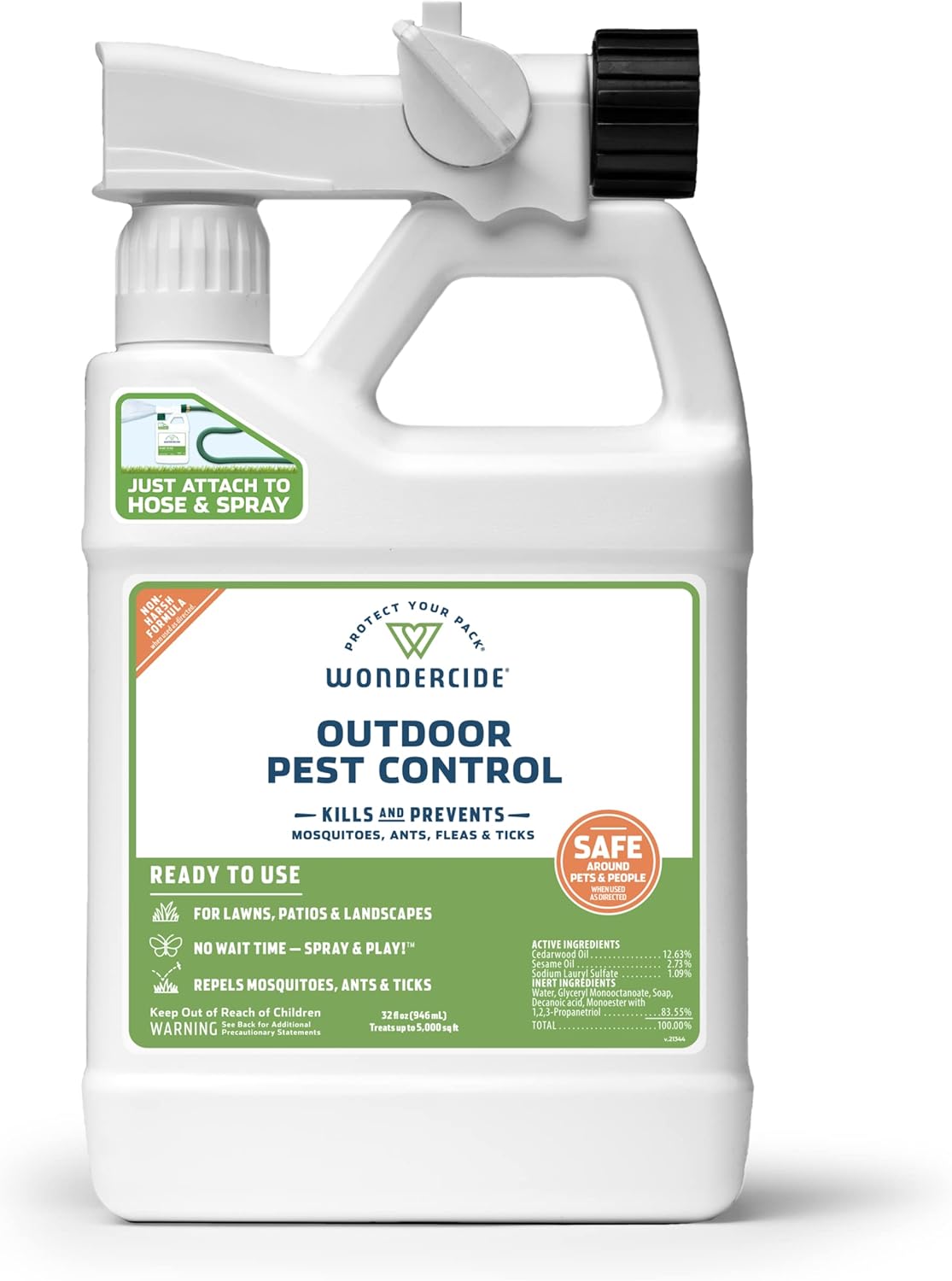
| Format | Pre-mixed, hose-end spray |
|---|---|
| Active ingredients | Cedarwood Oil 12.63%, Sesame Oil 2.73% |
| Coverage | Up to 5,000 sq ft (general); 2,500 sq ft (ticks/mosquito repel) |
Wondercide Ready-to-Use Outdoor Pest Control is a hose‑end spray designed for treating yards up to 5,000 sq ft for general pests and 2,500 sq ft for ticks and mosquito repellency. You attach the bottle to a garden hose, sweep the nozzle across lawns, patios, and foundation lines, and the cedarwood‑based formula delivers quick coverage with no dry time required. Notable features include plant-powered active ingredients (cedarwood and sesame oils), ready-to-use convenience, and instructions for both active infestations and preventative maintenance. Practical benefits are that it is safe to use around people and pets when directions are followed, residues are reported to be non-harmful to pollinators, and the hose attachment makes treating large areas fast. Important limitations are that effectiveness depends on water pressure, walking speed, and weather, heavy rain may require reapplication, and spraying in temperatures above 90°F or direct sun can cause plant burn. Users who need an all‑season, high‑durability pesticide for heavy infestations should plan on repeated applications and follow label precautions to protect sensitive plants.
Best for: Buyers who prioritize effective, plant‑based mosquito and tick control for medium to large yards and want a fast hose‑attached solution that is safe around families and pets when used as directed.
Less Ideal for: Gardeners who need a single, long‑lasting professional‑grade pesticide for severe, persistent infestations or who cannot reapply after rain should consider alternative, heavier‑duty treatments.
- Ready-to-use hose-end applicator for fast coverage of large yards
- Plant-based active ingredients (cedarwood and sesame oils) that target common yard pests
- No dry time required so kids and pets can re-enter treated areas quickly
- Covers up to 5,000 sq ft for general pest control and 2,500 sq ft for ticks/mosquito repellency
- May cause phytotoxic burning if applied in direct sun or temperatures above 90°F
- Performance depends on water pressure and user walking speed which can lead to uneven coverage
- Heavy rain can wash it away and requires reapplication
Verdict: If you want a fast, family- and pet-friendly plant‑based spray to reduce mosquitoes and ticks across a medium to large yard, this ready‑to‑use hose‑end formula delivers practical, repeatable results.
Bonide Mosquito Beater Granules 20.8 oz Ready-to-Use

| Item Form | Granule |
|---|---|
| Scent Name | Unscented |
| Target Species | Insects |
| Unit Count | 20.8 Ounce |
Bonide Mosquito Beater Granules are a simple, ready-to-use granular repellent intended to reduce mosquitoes around patios, lawns, pools and campsites. You apply by sprinkling the granules from the shaker-style container onto the ground or around activity areas; the product uses citronella oil as the active ingredient and starts working about an hour after application. The practical benefits are its ease of use with no mixing required, a fragrance-free/pleasant scent profile compared with some chemical sprays, and a claimed residual effect lasting up to three weeks under ideal conditions. Because the formula is biodegradable and formulated for people and pet areas, it suits routine backyard use where a quick perimeter treatment is needed. Limitations to expect are sensitivity to weather and airflow so heavy rain, strong wind or open areas will reduce protection time, and granules treat areas rather than individual people so they are best paired with personal protection for close-up use.
Best for: Buyers wanting an inexpensive, low-effort yard perimeter treatment that uses a plant-based active ingredient and fits into routine seasonal mosquito control.
Less Ideal for: People who need immediate personal protection in close quarters or who require long-lasting control in exposed, windy, or rainy conditions.
- Ready-to-use shaker makes application quick with no mixing or equipment
- Citronella oil formulation provides a more natural scent profile
- Claims up to three weeks of protection per treatment in normal conditions
- Biodegradable formula suitable for use around people and pets
- Effectiveness is reduced by rain, wind, and open breezy areas
- Granules protect an area rather than providing direct personal repellency
Verdict: A budget-friendly, ready-to-use citronella granular option for treating yards and patios when you want a simple area repellent with minimal fuss.
SCFKAOF Mosquito Repellent Balls (8 Pack)

| Number of Items | 8 |
|---|---|
| Unit Count | 8 Ounce |
| Size | 1 Ounce (Pack of 8) |
| Coverage | 120 Sq. Ft |
| Duration | Up to 60 Days |
These mosquito repellent balls are small, plant-based disks sold in an eight-pack that you place where you need protection. They are designed for simple, no-setup use indoors or on covered patios: put a ball in a room, near a doorway, or inside a tent and the manufacturer says a single ball helps deter mosquitoes within roughly 120 square feet. The product emphasizes plant-derived ingredients and a scent-based deterrent rather than sprays or open flames, which makes them easy to move and suitable for living rooms and bedrooms. Each ball is intended to last up to 60 days, reducing the need for frequent replacement. Limitations to expect are that scent-based repellents depend on air movement and room layout, so coverage can be uneven in larger or open-plan spaces and may need multiple balls for reliable protection. Also, while marketed for indoor use, people sensitive to fragrances should test one in a small area first.
Best for: Buyers who want a low-effort, plant-based indoor mosquito option they can place around living spaces and who prioritize ease of use and milder ingredients over industrial-strength control.
Less Ideal for: People needing rapid knockdown in heavily infested rooms or large open-plan interiors should consider more powerful or active control methods instead.
- Plant-based formula suitable for families preferring non-chemical options
- Simple place-and-forget application with no mixing or power source
- Each ball is rated to last up to 60 days, lowering replacement frequency
- Claims to cover about 120 square feet, useful for single rooms or small indoor spaces
- Effectiveness can vary with room ventilation and layout, requiring multiple balls for larger areas
- Contains fragrances that may bother people with scent sensitivities
Verdict: A convenient, plant-based place-and-forget option for reducing indoor mosquito presence in single rooms without sprays or devices.
Wondercide Flea & Tick Yard Spray (Ready-to-Use, 32 oz)

| Liquid Volume | 946 ml |
|---|---|
| Item Form | Spray |
| Active ingredient | 12.63% Cedarwood Oil |
| Coverage (fleas/mosquitoes) | Up to 5,000 sq ft |
| Coverage (ticks/mosquito repel) | Up to 2,500 sq ft |
Wondercide Flea & Tick Yard Spray is a ready-to-use hose-end treatment that uses cedarwood and other plant-derived ingredients to kill and repel fleas, ticks, and mosquitoes in the yard. You attach the bottle to a garden hose, turn the sprayer on, and walk steady sweeping passes to treat up to 5,000 sq ft for fleas and mosquitoes or 2,500 sq ft for ticks and mosquito repellency. Notable features include a pre-mixed formula for quick application, a hose-powered sprayer for even coverage, and an ingredient list centered on cedarwood oil that the brand says is safe for pollinators when used as directed. In practice it is convenient for routine maintenance and for reducing pest pressure around foundations, patios, and pet areas without waiting for drying or reentry. Important limitations are sensitivity to high heat or direct sun which can cause plant foliage browning if applied above 90°F and reduced residual effect after heavy rain, which may require reapplication. The product is exempt from EPA registration under FIFRA and carries typical safety instructions to avoid eye contact and keep out of reach of children.
Best for: Buyers who want a convenient, natural-first yard repellent that treats broad outdoor areas and lowers pest pressure around pets and play spaces with minimal setup.
Less Ideal for: Those who need a product that holds up through heavy storms or who require a chemically registered pesticide for regulatory or commercial settings should consider other options.
- Pre-mixed hose-end bottle makes whole-yard treatment fast and easy
- Plant-based active (cedarwood oil) targets fleas, ticks, and mosquitoes
- Covers a large area per bottle (up to 5,000 sq ft for fleas and mosquitoes)
- Formulated to be safe for people, pets, and pollinators when used as directed
- Can cause phytotoxic browning if applied in direct sun or when temperatures exceed 90°F
- Heavy rain or intense irrigation can wash away residue and may require reapplication
Verdict: If you want an easy, plant-powered yard spray to reduce mosquitoes, fleas, and ticks over large lawns while prioritizing pet and pollinator safety, this ready-to-use option delivers fast, low-fuss coverage.
Choosing the Right Non Toxic Mosquito Repellent for Yards: Key Factors to Consider
Coverage Area and Yard Layout
How far a repellent reduces mosquito activity determines whether it will protect the spaces you actually use. A product that lists square footage or shows a treated radius helps you plan placement for patios, seating areas, and play zones. Coverage also affects how many units or applications you need to treat a whole yard.
Think about common mosquito harborage spots like standing water, dense shrubs, and shady corners. Products that combine perimeter treatment with targeted spot treatment let you adapt to irregular layouts, rather than relying on blanket coverage that misses problem areas.
Duration and Reapplication Schedule
Duration per application influences convenience and total product use over a season. Some non toxic options protect for a few hours, which works for short gatherings, while others provide several weeks of reduced mosquito activity after a single treatment.
Consider how often you host outdoor activities and whether you want a maintenance schedule or an on-demand solution. Longer-duration treatments reduce labor and frequent reapplication but may require specific timing to be most effective against peak mosquito activity at dusk.
Safety Around Children, Pets, and Plants
Safety is the primary reason to choose non toxic repellents for yards. Look for clear ingredient lists and usage instructions that describe exposure risks. Products intended for yards should avoid ingredients known to be harmful to pets or pollinators and should state whether treated surfaces are safe for play after drying.
Also factor in spray drift, runoff after rain, and any contact restrictions. Even natural ingredients can irritate sensitive skin or be toxic to small animals if misused, so labeling and conservative application practices matter.
Application Method and Practicality
How a product is applied affects coverage consistency and user effort. Options include perimeter sprays, granules, plug-in diffusers, and torch or candle-based repellents. Spray and granular systems are useful for treating vegetation and ground cover, while passive devices are better for focused seating areas.
Consider storage, mixing requirements, and whether the method is compatible with common yard features like pavers, raised beds, or ornamental plantings. Ease of application also ties into safety: simpler methods reduce the chance of overapplication or accidental exposure.
Effectiveness in Weather and Seasonal Conditions
Outdoor repellents face sunlight, rain, humidity, and temperature swings. Some formulations break down quickly in sunlight or wash away after rain, while others maintain repellency through evening hours. Choose products rated for the typical weather in your area and for the season when mosquitoes are most active.
Also consider local mosquito species and breeding cycles. A product that performs well in one climate may be less effective elsewhere, so prioritize options with realistic claims about weather resilience and instructions for reapplication after adverse conditions.
Non Target Impact and Environmental Considerations
Non toxic does not automatically mean harmless to every organism. Evaluate whether a repellent affects beneficial insects, aquatic life, or soil health, especially if you water-treated areas or have a pond. Products with biodegradable ingredients and minimal persistence reduce the chance of unintended ecological effects.
Check for guidance about application near pollinator plantings and water features. Where possible, select methods that concentrate treatments on human-use zones rather than blanket-spraying the entire yard, which reduces environmental load and targets mosquito activity more efficiently.
How Non Toxic Options Actually Reduce Mosquitoes
Non toxic repellents work in several ways: some change the scent profile of the treated area to make it less attractive to mosquitoes, others physically block or trap mosquitoes, and a few use naturally derived compounds that interfere with biting behavior. Understanding the mechanism helps you choose the right tool for your yard.
Scent-based treatments and plant-derived oils are commonly used for short-term personal comfort around seating areas. Perimeter sprays and barrier treatments can reduce mosquito numbers across a larger yard when applied correctly. Passive devices and traps may lower local populations but usually need to be positioned and maintained thoughtfully.
- Scent-based repellents are best for immediate, small-area protection.
- Barrier treatments treat vegetation and edges to reduce mosquito entry into living spaces.
- Traps and physical devices can reduce local populations but require upkeep.
Placement Strategies for Best Results
Placement determines whether a repellent protects the zones you use. For perimeter treatments, focus on shrub lines, tall grass, and areas where shade and moisture create mosquito habitat. For seating areas, position passive devices and scented repellent sources upwind so the treated air reaches people rather than being blown away.
Avoid treating flowering plants that attract pollinators unless the product is explicitly labeled as safe. Instead, concentrate on low-traffic ornamental beds, fence lines, and drainage edges where mosquitoes rest.
- Treat edges and transitions between yard and natural habitat.
- Place devices upwind of seating areas for effective coverage.
- Reapply after heavy rain if the product label advises.
Combining Methods for Seasonal Control
No single non toxic approach eliminates mosquitoes completely. Combining source reduction, habitat modification, and non toxic repellents gives the best seasonal control. Start by removing standing water and improving drainage, then add perimeter treatments during peak activity months and use targeted devices for evening gatherings.
Rotating or layering different low-toxicity approaches can extend protection while minimizing overall chemical burden on the yard. For example, use traps to lower population while relying on short-duration scented repellents during active events.
- Eliminate standing water to reduce breeding.
- Use barrier treatments for ongoing yard protection.
- Supplement with short-term devices during outdoor events.
Safety Practices for Application and Storage
Follow label directions closely even for non toxic products. Keep children and pets away from treated areas until residuals have dried or the recommended waiting period has passed. Store products in their original containers, out of reach and away from extreme temperatures.
When mixing concentrates, do so outdoors and avoid inhaling sprays. Rinse application equipment after use and dispose of empty containers according to local guidance.
- Wait for drying times before allowing play in treated zones.
- Store out of sunlight and away from curious animals.
- Clean equipment to prevent cross-contamination with garden products.
Maintenance Tips to Keep Mosquito Pressure Low
Regular yard maintenance reduces mosquito habitat and improves repellent performance. Keep gutters clear, trim dense vegetation, and refresh mulch in damp beds. Periodic inspections to find new standing water sites prevent population rebounds after treatments.
Reapply or reposition repellents on a schedule that matches the product's claimed duration. Track when you treat high-use areas so that protection is active during evening gatherings or other peak use times.
- Inspect yard weekly during high mosquito season.
- Address new water-holding objects promptly.
- Coordinate reapplication with local weather forecasts.
How We Chose the Best Non Toxic Mosquito Repellent for Yards
We focused on solutions that reduce mosquito activity in yards while minimizing exposure to harsh synthetic pesticides. Our selection criteria prioritized real-world yard performance rather than lab-only claims. We looked for products that offer measurable coverage area, have clear safety profiles for households with children and pets, and use ingredients or mechanisms that are known to deter mosquitoes outdoors. Key evaluation dimensions included application method and ease, effective coverage area in typical yard layouts, duration of protection per treatment, and demonstrated safety for non-target users and plants. We also considered weather resilience, such as how well the repellent holds up to light rain or evening dew. Products were excluded if they relied on restricted-use insecticides, lacked transparent ingredient information, or had safety warnings that conflict with normal backyard use. The final list balances practical efficacy with low environmental and household risk.
FAQ
Are non toxic mosquito repellents effective in large yards?
They can be effective when used strategically. Large yards often require perimeter treatments plus targeted spot treatments. Coverage area and product duration determine how many applications or units are needed.
How soon after application is a treated area safe for children and pets?
Safety timing depends on the product. Many non toxic formulations are safe once surfaces are dry, which can take 15 to 60 minutes. Always follow label instructions and keep children and pets away during application and drying.
Will natural repellents harm beneficial insects or plants?
Some natural ingredients can affect pollinators or sensitive plants if applied directly to blooms. Target treatments to non-flowering areas and follow guidance about application near pollinator-attracting plants to reduce impact.
How do weather conditions affect repellent performance?
Sunlight, rain, and humidity can shorten the effective duration of many non toxic repellents. Light rain or heavy dew may wash away treatments, so reapply after significant precipitation when recommended.
Can traps replace repellents for yard protection?
Traps can reduce local mosquito numbers but rarely eliminate biting pressure on their own. They work best as part of an integrated approach that includes habitat reduction and targeted repellents for human-use zones.
How often should I reapply perimeter treatments during peak season?
Reapplication frequency varies by product but commonly ranges from every few days for short-duration sprays to several weeks for longer-lasting barrier treatments. Match reapplication to the product label and local mosquito activity levels.
Final Verdict
Focus on matching coverage and safety to how you use your yard. Prioritize options that clearly state coverage area and have explicit guidance for children, pets, and pollinator-safe application. Balance longer-duration perimeter treatments with short-term devices for gatherings. Your final choice should trade off convenience and labor against the level of protection you need. For most homeowners, a combination of habitat reduction, well-placed barrier treatments, and on-demand repellents for seating areas provides predictable, low-risk mosquito relief while keeping the yard safe for family and wildlife.
