

Note: This article contains affiliate links. If you click on these links and make a purchase, I may earn a small commission at no extra cost to you. This helps support my research and content. Read my full affiliate disclosure here.
Choosing the right NPK fertilizer for fruit trees changes how well trees flower, set fruit, and recover after harvest. Fruit trees need a careful balance of nitrogen, phosphorus, and potassium through different stages of growth, and the wrong ratio or release type can produce too much leafy growth or weak fruiting. This guide covers seven shortlisted NPK fertilizer options selected for fruit-tree use and explains the practical differences you will notice in an orchard, backyard, or patio tree. We evaluate nutrient ratios, release profiles, and ease of application to help you pick the right product for your trees and gardening style.
Top Picks at a Glance
| Best Overall The best all-around choice for most situations | Farmer's Secret Fruit Tree Booster Liquid Fertilizer (32 oz) |  |
| Best Quality Built to a higher standard if you want something more solid | Dr. Earth Natural Wonder Fruit Tree Fertilizer, 4 lb |  |
| Best Value The sweet spot between price and what you get | Southern Ag All Purpose Granular Fertilizer 10-10-10 (5 lb) |  |
| Best Budget The cheapest option that still gets the job done reliably | Jobe's Organics Granular Fruit & Citrus Fertilizer, 4 lb |  |
| Highest Rated A top-rated pick with lots of positive feedback | Miracle-Gro Shake 'N Feed Citrus, Avocado, Mango Plant Food, 4.5 lb |  |
| Most Popular A crowd favorite that many people choose with confidence | Miracle-Gro Water Soluble All Purpose Plant Food, 10 lb |  |
| Best Seller A high-volume bestseller chosen again and again | TPS Nutrients Lemon Tree Fertilizer Liquid, 8 fl oz |  |
Farmer's Secret Fruit Tree Booster Liquid Fertilizer (32 oz)

| Item Form | Liquid |
|---|---|
| Specific Uses For Product | Fruit Tree Care |
| Coverage | 1 teaspoon per gallon |
| Target Species | Apple, Banana, Peach |
| Unit Count | 32 Fluid Ounces |
This concentrated liquid fertilizer is formulated to strengthen roots and push fruit production for a wide range of fruit trees, including banana. It is mixed at 1 teaspoon per gallon and applied weekly as a soil drench around the drip line or as a foliar feed, which makes it easy to use with a watering can, sprayer, or irrigation system. The formula emphasizes higher phosphorus and includes macronutrients and trace minerals to support root expansion, disease resistance, and quicker nutrient uptake compared with granular products. One 32 oz bottle is highly concentrated so a small volume treats a full season for a mature tree, and the brand notes compatibility with young trees at higher per-feed rates. Practical limitations are that results depend on timing, tree age, and local conditions, and weekly applications may be more maintenance than slow-release granules. Also the label gives general guidance rather than crop-specific feeding charts for bananas, so growers wanting precise macronutrient ratios may prefer a product with an explicit NPK breakdown.
Best for: Growers focused on boosting fruit production and root development who are willing to follow a regular liquid feeding schedule and want quick nutrient availability for banana trees.
Less Ideal for: People who prefer low-maintenance, infrequent feeding or who need a fertilizer with an exact NPK label for tailored nutrient management.
- Highly concentrated formula stretches a 32 oz bottle across many feedings
- Phosphorus-rich blend aimed at improving root development and fruit set
- Usable as soil drench or foliar spray and compatible with irrigation systems
- Contains trace minerals in addition to NPK to support overall tree health
- No explicit NPK ratio listed on the provided specs for precise nutrient planning
- Requires weekly applications which can be more work than slow-release options
Verdict: A concentrated, phosphorus-forward liquid that gives banana growers a fast, professional-style boost to roots and fruit when used weekly.
Dr. Earth Natural Wonder Fruit Tree Fertilizer, 4 lb

| Item Form | Powder |
|---|---|
| Specific Uses For Product | Organic |
| Target Species | fruit trees & berries |
| Mixing Ratio | 2 tablespoons per gallon or 1/2 cup per cubic foot |
Dr. Earth Natural Wonder is an organic powdered fertilizer designed to feed fruit trees, berries, and fruiting vines both in the ground and in containers. It supplies a balanced 5-5-2 NPK and is intended for use at planting or as a regular feed during the growing season, with directions for 1 lb per 10 square feet or periodic container applications every six weeks. The formula is certified organic and non-GMO, so it suits gardeners who prefer sustainable inputs and want a product labeled safe around people and pets when used as directed. Practical benefits include easy spreading or mixing into potting soil, the ability to make compost tea for a soil drench or foliar spray, and a coverage claim that a 4 lb bag will feed multiple containers or a modest planting area. Limitations are typical of dry organic fertilizers: nutrient release is slower than synthetic feeds and you may need repeat applications for heavy-feeding or large trees, and precise results depend on timing, soil biology, and correct application rates.
Best for: Gardeners looking for an all-purpose, organic feed for fig trees who prioritize balanced nutrition and sustainable inputs over rapid synthetic gains.
Less Ideal for: Growers who need very fast, targeted nutrient correction or those managing large mature trees that require high-dose applications may prefer a concentrated synthetic or professional program.
- Balanced 5-5-2 NPK suitable for general fruit tree nutrition
- Certified organic and non-GMO for sustainable gardening
- Versatile use in-ground, in containers, or as compost tea
- Clear application guidance for planting area and containers
- Slower nutrient release compared with synthetic fertilizers, so more frequent applications may be needed for quick growth
Verdict: A balanced organic fertilizer that makes a reliable, sustainable baseline feed for fig trees in pots or backyard beds.
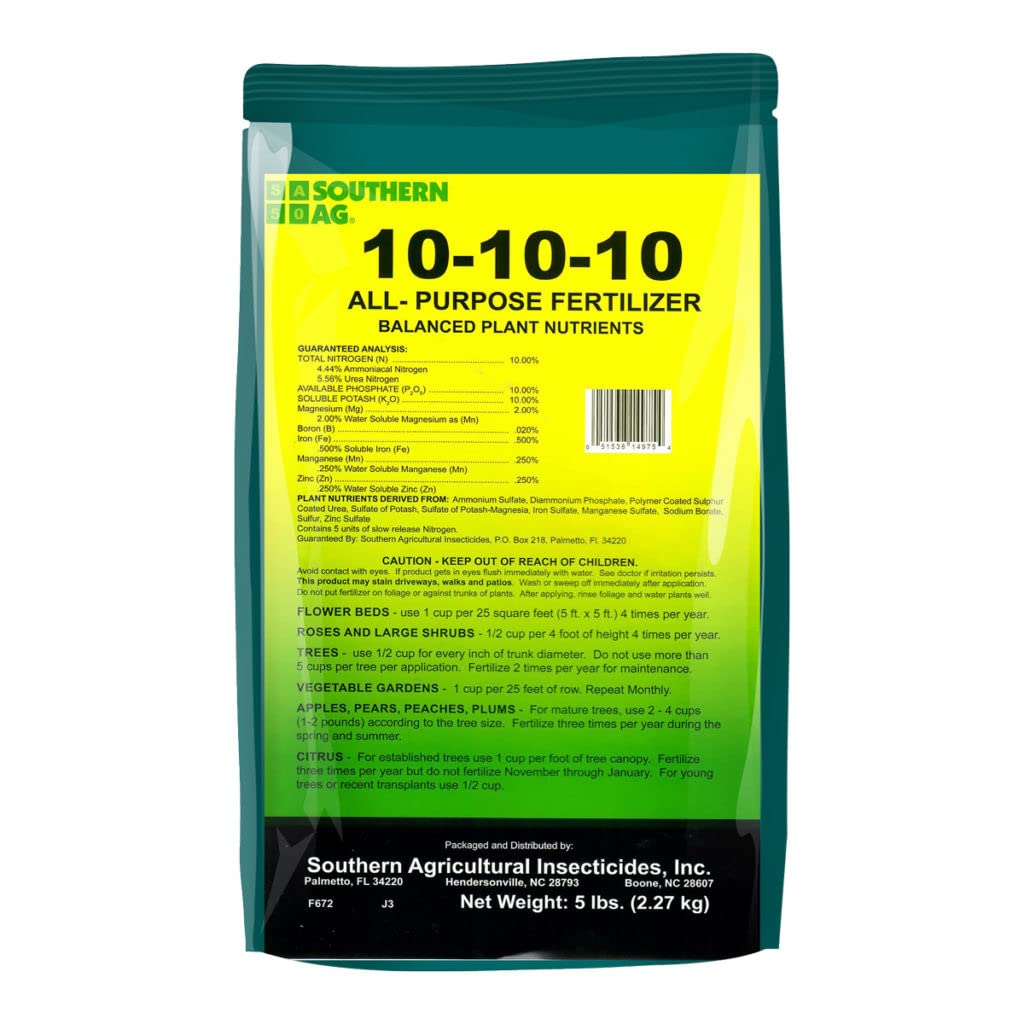
Southern Ag All Purpose Granular Fertilizer 10-10-10 (5 lb)
| Item Form | Granules |
|---|---|
| Specific Uses For Product | Citrus and Fruit Trees, Flowerbeds, Roses, and Large Shrubs, Vegetable Gardens |
| Application Method | Broadcast evenly over area and water in. |
| Mixing Ratio | 10:10:10 |
This 5 lb bag of Southern Ag 10-10-10 granular fertilizer is a straightforward, balanced all-purpose feed for vegetable beds, fruit trees, roses, and shrubs. You spread the granules uniformly over soil or beds and water them in; directions and recommended cup measurements are printed for common uses so dosing is easy. The formula supplies equal parts nitrogen, phosphorus, and potassium plus trace minerals like magnesium, iron, manganese, zinc, and boron, which supports steady vegetative growth and overall plant health. For asparagus specifically it can be used as a periodic maintenance feed during the growing season to support fern growth and energy storage in crowns. The product is simple to store and apply, and the small bag size is convenient for trialing on a single bed or patch. Limitations are that it is a general blend rather than a tailored asparagus formula, so heavy feeders or soils needing specific nutrient correction may require additional amendments, and granular broadcast feedings require careful placement to avoid contact with foliage or runoff risks described on the label.
Best for: Gardeners on a budget who want a simple, balanced fertilizer to maintain small asparagus patches and other mixed beds without buying specialty formulas.
Less Ideal for: Growers managing large asparagus plantings, or who need a targeted high-potassium or soil-specific amendment, should choose a crop-specific or soil-test-driven fertilizer.
- Balanced 10-10-10 N-P-K supports general growth and root development.
- Includes micronutrients (iron, manganese, zinc, boron) for broader plant nutrition.
- Clear application instructions and coverage rates for common garden uses.
- Small 5 lb size is convenient for testing on a single asparagus bed or small garden.
- Not formulated specifically for asparagus so may lack the higher potassium or phosphorus some heavy beds benefit from.
- Granular broadcast application can stain hard surfaces and requires watering after application to activate nutrients.
Verdict: A low-cost, easy-to-use balanced granular fertilizer that is a practical maintenance feed for small asparagus beds and mixed gardens.
Jobe's Organics Granular Fruit & Citrus Fertilizer, 4 lb

| Item Form | Granules |
|---|---|
| Specific Uses For Product | Plant Growth, Root Development, Seed Development, Soil Conditioning |
| Application Method | Spread evenly around base |
| NPK | 3-5-5 |
| OMRI Listed | Yes |
This granular Jobe's Organics fertilizer is designed to feed fruit and citrus trees with a slow-release, root-targeted NPK of 3-5-5. It is typically applied by measuring and spreading the granules evenly around the base of the tree, then watering in; applications are recommended every 4 to 8 weeks during the growing season. Notable features include OMRI listing for organic gardening, a blend of feather meal, bone meal and processed poultry manure for organic nutrient sources, and a resealable bag for convenient storage. In practice the formula supports root development and fruit set without synthetic chemicals, and the slow-release nature reduces the need for very frequent feeding. Limitations are that the lower nitrogen level makes it better suited for fruiting and flowering stage nutrition rather than rapid leafy growth, and larger trees will require repeated applications or larger quantities. For gardeners aiming for an organic, low-fuss feed for citrus, this provides predictable, targeted nutrition, but it is not a quick-fix soluble feed for immediate green-up.
Best for: Gardeners who prefer organic, low-maintenance feeding for citrus and fruit trees and want a slow-release product that focuses on fruit and root health.
Less Ideal for: Growers needing fast, high-nitrogen correction or a soluble foliar feed; landscapers managing many mature trees who need bulk quantities more often.
- OMRI listed organic formula suitable for certified organic gardens
- Balanced 3-5-5 NPK aimed at improving flowering and fruit production
- Slow-release granules that feed roots over time and reduce application frequency
- Resealable packaging keeps product fresh between uses
- Lower nitrogen content means it will not rapidly promote leafy growth
- 4 lb bag may be insufficient for mature trees or larger plantings
Verdict: A reliable OMRI-listed granular fertilizer that delivers slow-release, fruit-focused nutrition for organic citrus gardeners.
Miracle-Gro Shake 'N Feed Citrus, Avocado, Mango Plant Food, 4.5 lb

| Item Form | Granules |
|---|---|
| Application Method | Shake evenly onto soil |
| Target Species | citrus, avocado, mango |
| Mixing Ratio | 8-2-10 |
| Coverage | Medium |
This Shake 'N Feed formula is a granular, slow-release fertilizer made for citrus, avocado and mango trees in containers or in-ground. You shake the granules evenly onto the soil within the branch spread or mix into potting mix at planting, then water to start feeding; one application feeds plants for up to three months. The N-P-K listed (8-2-10) and added micronutrients such as potassium, magnesium, sulfur and iron help correct common deficiencies and support root development through microbes in the mix. It is practical for seasonal feeding and reduces the frequency of applications compared with quick-release fertilizers. Limitations include that it is a general fruit-tree feed rather than a lemon-specific formula and needs correct placement to avoid contact with trunks or foliage. For established trees you must follow label rates to avoid overfeeding and reapply every three months to maintain nutrition through the growing season.
Best for: Practical gardeners who want an easy, low-maintenance feeding schedule for lemon and other citrus trees and prefer a single product that works in pots and beds.
Less Ideal for: Growers who need a custom nutrient program based on soil tests or who want a fast-acting liquid feed for quick corrections should consider more targeted products.
- Slow-release formula provides up to 3 months of feeding per application
- Contains N-P-K 8-2-10 plus micronutrients to address common deficiencies
- Works for both container and in-ground citrus and other fruit trees
- Easy shake-and-feed application that reduces application frequency
- Not a lemon-specific formulation so may lack tailor-made ratios for particular soil tests
- Requires careful placement and incorporation to avoid trunk or foliage contact
Verdict: Use this to keep lemon trees consistently fed with a convenient, three-month slow-release granular fertilizer.
Miracle-Gro Water Soluble All Purpose Plant Food, 10 lb

| Item Form | Granules, Powder |
|---|---|
| Application Method | watering can |
| Target Species | For all flowers, vegetables, trees, shrubs and houseplants |
| Fertilizer Analysis | 24-8-16 |
Miracle-Gro Water Soluble All Purpose Plant Food is a fast-acting granular formula that dissolves in water to feed shrubs, flowers, vegetables and houseplants. You mix measured scoops into a watering can or garden feeder and apply at the soil line every 1 to 2 weeks; the water-soluble format delivers nutrients quickly to roots, which can produce visibly fuller growth compared with unfed plants. The product is labeled safe for all common plant types when used as directed and includes guidance for indoor and outdoor dilution rates. Notable features are the broad target list (shrubs included), the 24-8-16 NPK balance that favors leafy growth, and a large 10 lb container that covers extensive garden area. Practical benefits for shrub care are rapid nutrient availability during the growing season and easy application with routine watering. Important limitations are the relatively high nitrogen proportion, which is ideal for leaf development but may be less suitable when the goal is to limit vegetative growth or to force blooms or fruit without adjusting timing or concentration. Follow the package directions to avoid overfeeding and protect nearby sensitive plants.
Best for: Gardeners who want a reliable, quick-feed fertilizer to boost shrub vigor and see noticeable growth within weeks and who value products with extensive customer use and guidance.
Less Ideal for: Growers seeking a low-nitrogen bloom booster or a slow-release, low-maintenance fertilizer for seasonal feeding should consider more specialized formulas.
- Water-soluble formula delivers nutrients quickly to roots for faster response
- Broadly labeled for indoor and outdoor use including shrubs, trees, flowers and vegetables
- Clear dilution and application instructions for watering can or garden feeder
- High-coverage 10 lb container suitable for large gardens
- High nitrogen ratio may encourage leafy growth over blooms or fruiting if used during flowering
- Requires regular reapplication every 1–2 weeks rather than long-term slow feeding
Verdict: A dependable, fast-acting water-soluble fertilizer that reliably boosts shrub growth when used as directed.
TPS Nutrients Lemon Tree Fertilizer Liquid, 8 fl oz

| Item Form | Liquid |
|---|---|
| Application Method | Watering can, hose end sprayer, or leaf misting |
| Target Species | Lemon Trees |
| Mixing Ratio | 1:200 |
| Liquid Volume | 8 fluid ounces |
This 8 fl oz liquid fertilizer from TPS Nutrients is made specifically for lemon and other citrus trees and is used by diluting at the recommended 1:200 ratio and applying with a watering can, hose‑end sprayer, or by leaf misting. It is designed to promote fruit production, support healthy leaves and shoots, and build stronger roots so trees absorb water and nutrients more effectively. The liquid form delivers nutrients quickly for potted trees on patios as well as in-ground specimens, and the medium coverage makes it suitable for individual trees or small groups. Practical benefits include fast absorption, simple dilution and multiple application methods that fit common garden routines. Limitations are the small 8 ounce bottle size, which means frequent repurchasing for larger citrus collections, and lack of detailed NPK values on the label for gardeners who prefer exact nutrient ratios. Overall this is a convenient, citrus-focused supplement for home growers seeking straightforward feeding for Meyer and dwarf varieties.
Best for: Home gardeners who want a ready-to-use, citrus-specific feed for one or a few lemon trees and prefer simple dilution and flexible application methods.
Less Ideal for: Growers managing larger orchards or multiple mature trees who need bulk quantities or exact NPK formulations should consider commercial‑scale fertilizers instead.
- Formulated specifically for lemon and citrus so nutrients suit citrus needs.
- Liquid concentrate with 1:200 mixing for quick uptake and flexible application.
- Multiple application methods: watering can, hose‑end sprayer, or foliar misting.
- Suitable for both potted and in‑ground citrus, useful for patios and small orchards.
- Small 8 fl oz bottle may not last for multiple trees or large plantings.
- Product listing does not provide explicit NPK numbers for precise nutrient planning.
Verdict: A convenient liquid concentrate tailored to lemon and citrus that makes regular feeding easy for home growers with one or a few trees.
Choosing the Right NPK Fertilizer for Fruit Trees: Key Factors to Consider
Nutrient Ratio and Tree Stage
Fruit trees need different N-P-K balances through their life cycle. Young trees often benefit from formulations higher in nitrogen to encourage root and shoot development, while mature, fruiting trees need reduced nitrogen with more phosphorus and potassium to promote flowering and fruit set.
Choosing a ratio that matches the tree stage reduces unwanted leafy growth and supports fruit quality. Always compare the listed percentages rather than vague terms like "balanced" to make a deliberate match to your orchard or backyard trees.
Release Type and Timing
How a fertilizer releases nutrients determines how often you apply it and how consistent supply is to the tree. Fast-release formulations provide an immediate nutrient boost but can cause rapid vegetative growth and risk leaching after heavy rain. Slow- or controlled-release types feed over weeks to months, reducing application frequency and smoothing nutrient availability.
Consider your climate and watering routine: in rainy regions you may favor controlled-release products to limit nutrient loss, while dry climates or quick corrective feeds can justify water-soluble forms.
Micronutrients and Fruit Quality
Beyond N, P, and K, micronutrients influence fruit size, flavor, and shelf life. Elements like magnesium and calcium help cell strength and reduce disorders such as blossom-end rot. Iron and zinc support healthy leaf function, which indirectly supports fruit production.
Look for formulations that list secondary and trace elements if your soil test indicates deficiencies. If you do not have a soil test, choose a balanced option that includes common micronutrients suitable for fruit trees.
Soil Type and Leaching Risk
Soil texture and organic matter change how nutrients behave. Sandy soils with low organic content leach soluble nitrogen more quickly, making controlled-release fertilizers or split applications more effective. Clay soils hold nutrients but can lock them up if pH is off.
Match fertilizer choice to your soil and adjust the application rate or schedule to minimize runoff and groundwater risk, especially in heavy rainfall areas.
Application Method and Labor
Different NPK fertilizers are formulated for broadcast spreading, banding near the root zone, soil incorporation, or foliar feeding. Granular products vary in particle size, which affects evenness when spreading. Water-soluble or foliar formulations require mixing and more frequent applications.
Assess how much time you want to spend feeding trees and whether you need a low-labor, slow-release granular or a more hands-on soluble product for targeted correction.
Compatibility with Mulch and Organic Practices
Mulch layers and organic management influence nutrient availability. Organic mulches slowly release nutrients and can affect soil temperature and moisture, changing fertilizer uptake timing. Organic-approved NPK sources often have slower release and lower nutrient concentration per application.
If you manage trees organically or use heavy mulching, choose fertilizers that work well with that system and avoid surface-applied soluble forms that sit on top of thick mulch without reaching the root zone.
Feeding Schedules by Tree Age
Young trees and newly planted specimens require a different feeding cadence than mature fruiting trees. For establishment, gardeners typically give small, regular doses to support root development without forcing excessive top growth that can destabilize a young graft or rootstock.
Mature trees benefit from a seasonal feeding rhythm tied to bud break, post-bloom, and post-harvest periods. Timing feeds to the tree's growth cycle-lighter in dormant season, targeted during fruit set-improves flowering and reduces vegetative overgrowth.
- Nursery to 3 years: focus on root-building nutrient balance and modest nitrogen.
- Bearing trees: reduce nitrogen, increase phosphorus and potassium around bloom and fruit set.
- After harvest: light maintenance feed to support recovery without spurring new late-season growth.
Interpreting Soil and Leaf Tests
Soil tests tell you available macro- and micronutrients and pH, while leaf tissue analysis reveals what the tree actually translocated during the growing season. Use both to tailor NPK selection rather than guessing from symptoms alone.
If tests show adequate phosphorus but low potassium, choose a formulation that supplies more potassium without adding unnecessary nitrogen. Testing prevents wasted fertilizer and avoids fueling problems such as excessive vegetative growth or nutrient antagonisms.
- Collect soil samples from the root zone and test every 2 to 4 years.
- Do leaf analysis mid-season for a snapshot of nutrient uptake and to refine foliar or soil applications.
Using Foliar Feeds Vs Soil Applications
Foliar feeding delivers nutrients directly to leaves and can correct micronutrient deficiencies quickly. However, it is not a substitute for soil nutrition that supports root health and long-term tree vigor.
Soil-applied NPK fertilizers maintain the foundational supply trees need for flowering and fruiting. Use foliar sprays as a targeted supplement when rapid correction of a deficiency is necessary or when root uptake is limited by cold or waterlogged soils.
- Reserve foliar sprays for micronutrient top-ups or quick corrective action.
- Apply soil fertilizers in the dripline rather than at the trunk to encourage root uptake.
Container Fruit Trees and Restricted-Root Situations
Trees grown in containers or tight root spaces need more frequent, lower-dose feeding because potting mixes have limited nutrient buffering capacity. Choose formulations designed for container culture or water-soluble options you can apply at regular intervals.
Be cautious with high-nitrogen feeds in containers as excess can burn roots or encourage leggy growth. Regular monitoring and smaller, repeat doses prevent nutrient imbalances in confined root zones.
- Use slow-release pellets for low-maintenance containers, or water-soluble feeds for precise control.
- Flush containers occasionally to prevent salt buildup from concentrated fertilizers.
Environmental Best Practices
Apply fertilizers at recommended rates and avoid broadcasting before heavy rain. Use targeted banding under the canopy or near the dripline to reduce runoff risks. Buffer zones and proper timing minimize environmental impact and preserve groundwater quality.
Consider split applications to supply nitrogen gradually and lower leaching potential. Match fertilizer form to site conditions to keep nutrients where roots can access them.
- Calibrate spreaders and follow label application rates to avoid over-application.
- Store fertilizers safely and handle according to local guidelines to prevent accidental spills.
How We Chose the Best NPK Fertilizer for Fruit Trees
We focused on selection criteria that matter in real-world fruit-tree care. First, nutrient ratio clarity: formulations that list exact N-P-K percentages and secondary nutrients help match fertilizer to tree age and seasonal demand. Second, release profile: we prioritized options with clear slow-release, controlled-release, or fast-release designations so gardeners can plan feeding and avoid nitrogen flushes that suppress fruiting. Third, application practicality: spreading method, granule size, and compatibility with top-dressing or soil incorporation affect how evenly the tree receives nutrients. Fourth, presence of beneficial secondary elements and micronutrients such as magnesium, calcium, and iron that support fruit quality and reduce blossom drop. Fifth, environmental considerations including leaching risk and suitability for mulched or container-grown trees. We excluded fertilizers lacking transparent labeling on N-P-K values or release behavior, and products that are strictly micronutrient mixes rather than balanced NPK formulations. Our shortlist reflects options that match common fruit-tree scenarios: young plant establishment, mature bearing trees, heavy feeders, and container fruiting. The scoring emphasized measurable, gardener-relevant specs rather than brand reputation alone.
FAQ
How often should I fertilize my mature fruit trees with an NPK product?
It depends on the release type. Controlled-release or slow-release formulations often need feeding once per season or twice per year, while fast-release or soluble products are typically applied in smaller doses multiple times during the growing season. Adjust frequency for soil type and tree vigor.
Can I use the same NPK ratio for all fruit tree species?
Usually not. While many fruit trees share general needs, stone fruits and pome fruits can have different preferences for phosphorus and potassium at bloom and fruit set. Tailor the ratio to the species and tree age, and use soil or leaf tests to guide adjustments.
Is a slow-release NPK always better than a quick-release product?
Not always. Slow-release fertilizers reduce labor and leaching risk and are ideal for steady nutrition, but quick-release products are useful for correcting immediate deficiencies or stimulating growth in specific situations. Choose based on timing needs and environmental conditions.
Do mulches affect how I should apply NPK fertilizers?
Yes. Thick organic mulches can slow nutrient movement to the root zone, so surface-applied fertilizers may sit above the mulch. Apply fertilizer beneath or around the mulch or choose forms that penetrate through watering to reach roots.
Should container-grown fruit trees get different NPK care than those in the ground?
Yes. Containers require more frequent, lower-dose feeding because potting mixes have limited nutrient reserves. Use container-suitable slow-release or soluble formulations and monitor for salt buildup, flushing pots occasionally as needed.
Final Verdict
Pick an NPK fertilizer that matches your tree's life stage, soil test results, and the local climate. Prioritize clear N-P-K labeling, an appropriate release profile, and relevant micronutrients to support flower and fruit development. Balance convenience against environmental risk: slow- or controlled-release options reduce labor and leaching, while soluble feeds give rapid correction when needed. With those tradeoffs in mind, choose the formulation that aligns with your feeding schedule and site conditions to support consistent yields and long-term tree health.
