

Note: This article contains affiliate links. If you click on these links and make a purchase, I may earn a small commission at no extra cost to you. This helps support my research and content. Read my full affiliate disclosure here.
Ants can be persistent in vegetable beds, potted plants, and around foundations, and choosing the right organic ant killer matters for plant health and household safety. You want something that eliminates the colony without harming beneficial insects, upsetting soil life, or leaving toxic residues on edible crops. This guide shortlists six top organic ant control options and explains how they perform in real garden situations. Below we outline the practical tradeoffs – how quickly baits and contact sprays work, how safe a formula is for pets and pollinators, and which methods are best near food gardens. Read on to match an option to your setting and control goals.
Top Picks at a Glance
| Best Overall The best all-around choice for most situations | EcoVenger Ant Killer & Nest Treatment, 64 oz |  |
| Best Quality Built to a higher standard if you want something more solid | EcoVenger Ant & Crawling Insect Killer Spray, 16 oz (Plant-Based) |  |
| Best Value The sweet spot between price and what you get | Mighty Mint Peppermint Oil Insect Repellent Spray, 1 Gallon |  |
| Best Budget The cheapest option that still gets the job done reliably | STEM Plant-Based Bug Spray for Ants, Roaches and Flies, 12 fl oz |  |
| Highest Rated A top-rated pick with lots of positive feedback | Orange Guard Home Pest Control Spray, Natural d-Limonene Formula, 32 fl oz (2 Pack) |  |
| Most Popular A crowd favorite that many people choose with confidence | Mighty Mint Peppermint Oil Insect Repellent Spray, 16 oz |  |
EcoVenger Ant Killer & Nest Treatment, 64 oz

| Item Form | Spray |
|---|---|
| Target Species | Odorous House Ants, Fire Ants, Roaches, Fleas, Spiders |
| Liquid Volume | 64 fluid ounces |
EcoVenger Ant Killer & Nest Treatment is a plant-powered spray meant to eliminate active ant infestations and provide weeks of residual protection around homes and yards. You use it like a conventional spray: spot-treat visible ants, spray along trails and entry points, and saturate fire ant mounds with the wand to reach tunnels and target the queen. The formula lists botanical actives such as geraniol, citronella and cedarwood oils and claims fast kill times on house ants and fire ants plus a repellent residual that can last up to four weeks. Practical benefits include a non-staining finish suitable for carpets and fabrics, a light citrus/woody scent that dissipates quickly, and safety testing for use around children and pets when directions are followed. Limitations are that effectiveness will depend on thorough application to nest openings for colony control and that delicate nozzle parts require some care to avoid damage. For someone seeking a greener alternative to synthetic pesticides, this offers strong, user-friendly performance in a large 64 ounce size.
Best for: Buyers who want an effective, greener ant treatment that works indoors and outdoors and prefer a ready-to-use botanical spray with multiweek residual protection.
Less Ideal for: People who need instant professional-grade application tools or who prefer dry baits and traps rather than a liquid spray treatment.
- Plant-based formula with geraniol, citronella and cedarwood oils for insecticidal action
- Fast on-contact kill claims for house ants and fire ants with residual protection up to four weeks
- Suitable for indoor and outdoor use and formulated to be non-staining on carpets and fabrics
- Large 64 fl oz container reduces how often you need to repurchase for whole-yard or repeated treatments
- Requires careful targeting of nests and tunnels for full colony elimination rather than simple surface spraying
- Spray nozzle contains delicate parts that can be damaged if not handled properly
Verdict: A large, university-validated botanical spray that delivers quick ant knockdown and weeks of residual protection for homeowners seeking an effective organic alternative.
EcoVenger Ant & Crawling Insect Killer Spray, 16 oz (Plant-Based)

| Unit Count | 16 Fluid Ounces |
|---|---|
| Item Form | Spray |
| Target Species | Odorous House Ants, Fire Ants, Roaches, Fleas, Spiders |
| Active Ingredients | Citronella Oil, Geraniol, Cedarwood Oil, Sodium Lauryl Sulfate |
| Liquid Volume | 480 ml |
EcoVenger Ant & Crawling Insect Killer is a ready-to-use, botanical spray designed to eliminate ants and other crawling pests quickly while leaving a light citrus/woody scent. In practice you spray active ants and their trails for immediate knockdown and treat entry points, baseboards, and mounds to create a residual barrier that the manufacturer says lasts up to four weeks. The formula lists plant-derived actives such as geraniol, citronella and cedarwood oils rather than traditional neurotoxic insecticides, which makes it suitable for use around homes with pets when directions are followed. Notable features include fast kill times (claims of house ants in about a minute and fire ants in minutes), a non-staining finish safe for carpets and fabrics, and a fine spray nozzle for targeted treatment. Limitations: botanical products can require thorough application to reach nests and deep queen chambers, so severe infestations may need repeat or professional intervention; effectiveness versus every species and in every environment will vary compared with conventional synthetics. For pet-safe indoor control and perimeter work this provides a practical, lower-toxicity option with measurable residual effects.
Best for: Buyers who prioritize effective, lower-toxicity pest control for indoor use around pets and family and want a product that acts fast and leaves a short-lived pleasant scent.
Less Ideal for: People facing very large or established colonies who need a single heavy-duty chemical solution or those who prefer synthetic pesticides for guaranteed uniform efficacy across all pest species.
- Plant-based active ingredients suitable for homes with children and pets when used as directed
- Fast on-contact knockdown of ants and other crawling pests according to product claims
- Leaves no oily residue and is labelled non-staining for use on carpets and fabrics
- Provides residual repellency for up to four weeks when applied to trails and entry points
- May require thorough application into nest chambers for complete colony elimination, which can be labor-intensive
- Performance can vary by species and infestation severity compared with conventional chemical pesticides
Verdict: A fast-acting, plant-based spray that delivers pet-friendly indoor ant control with several weeks of residual protection.
Mighty Mint Peppermint Oil Insect Repellent Spray, 1 Gallon

| Volume | 128 oz |
|---|---|
| Ingredients | Water, Glycerin, Polyglycerol Oleate, Soap, Peppermint Oil |
| Use areas | Indoor / Outdoor |
| Scent | Peppermint |
Mighty Mint’s 1-gallon peppermint oil spray is a plant-based insect repellent intended for broad indoor and outdoor use. The product is supplied as a large ready-to-use bottle with a detachable nozzle for spraying around entryways, baseboards, patios, and gardens or for refilling smaller spray bottles. Its formula lists peppermint oil along with water, glycerin, and soap, so it works by delivering a strong peppermint scent that repels spiders, ants, roaches and similar pests without synthetic pesticides. Practical benefits include the large 128 oz volume for extended coverage and a scent that many households find more pleasant than chemical sprays. The label notes it is safe for use around people and pets when used as directed, and the concentrate-style packaging simplifies repeat applications. Limitations to keep in mind are that it is a deterrent rather than a lethal insecticide, so it may not eliminate established infestations, and effectiveness can vary by pest and environmental conditions. Users should follow safety directions and reapply after heavy rain or watering for outdoor use.
Best for: Buyers who prioritize safer, plant-based pest control and want a proven, widely used product with visible social proof for routine outdoor and perimeter pest prevention.
Less Ideal for: People facing severe infestations who need a fast-acting, residual insecticide or professional pest control should consider stronger, targeted treatments instead.
- Large 128 oz ready-to-use gallon provides long-lasting coverage and value
- Plant-based formula using peppermint oil rather than synthetic pesticides
- Versatile for indoor and outdoor application and can refill smaller bottles
- Pleasant mint scent that is less intrusive than chemical alternatives
- Designed as a repellent and deterrent so it may not eradicate heavy or established infestations
- Performance can be inconsistent depending on pest type and weather conditions
Verdict: Choose this gallon peppermint spray if you want a plant-based, widely adopted repellent for routine outdoor perimeter and home pest prevention.
STEM Plant-Based Bug Spray for Ants, Roaches and Flies, 12 fl oz

| Active ingredients | Geraniol 6.2%, Lemongrass Oil 0.5% |
|---|---|
| Other ingredients | White Mineral Oil, Isopropyl Myristate, (+)-Ethyl Lactate 93.9% |
| Form | Trigger spray |
| Use | Indoor and outdoor spot treatments |
This STEM bug spray is a trigger-spray insecticide formulated with plant-derived actives such as geraniol and lemongrass oil to kill ants, roaches and flies on contact. It is intended for targeted indoor and outdoor spot treatments: shake, hold about a foot from the insect and spray directly on or where insects congregate. The product’s botanical formula and absence of added dyes or strong chemical fragrances make it a reasonable choice for homes where users prefer less synthetic-smelling options. The trigger bottle gives control for spot application and repeated short bursts, and the directions note it is oil-based so spills should be cleaned promptly. Important limitations are that it is not for spraying on people, pets or plants and requires direct hits for best effect rather than long-range fogging. For persistent infestations you may need supplemental measures because this is designed for surface and contact kills rather than residual baiting or area-wide control.
Best for: Buyers who want an affordable, low-odor botanical spray for quick spot control of common household pests and who prioritize a simple, easy-to-use trigger bottle for targeted treatments.
Less Ideal for: People facing large or hidden infestations who need long-lasting residual control or bait-style solutions should consider professional products or integrated pest control approaches.
- Plant-based active ingredients (geraniol and lemongrass oil) that reduce strong chemical odor
- Trigger-spray bottle for controlled, targeted application
- Labeled for both indoor and outdoor spot treatments when used as directed
- No added dye or fragrance listed, which minimizes residue and scent
- Oil-based formula can leave slippery residue if spilled
- Requires direct spraying of insects for effectiveness and offers limited residual control
- Not safe to spray on people, pets or plants
Verdict: A budget-friendly, low-odor plant-based trigger spray that provides quick, targeted kills of ants, roaches and flies for everyday spot treatments.
Orange Guard Home Pest Control Spray, Natural d-Limonene Formula, 32 fl oz (2 Pack)

| Active ingredient | d-Limonene 5.8% |
|---|---|
| Formula type | Water-based, non-toxic |
| Volume | 32 fl oz per bottle (pack of 2) |
| EPA status | EPA-registered |
Orange Guard is a ready-to-use, water-based pest control spray that relies on d-limonene from orange peel to kill and repel ants, roaches, fleas and other common household pests. It is typically used as a contact spray on infestations and as a perimeter or spot treatment around baseboards, entry points and pet areas. Notable features include an EPA registration, a natural citrus active ingredient, and a low-odor formula that is marketed as safe for use around children, pets, and food prep areas. In practice it delivers a pleasant scent instead of harsh chemical smells and can be applied indoors without heavy ventilation. Limitations are that it is primarily a contact and short-term repellent product rather than a long-lasting residual insecticide, so repeat applications may be needed for ongoing control, and it may be less effective against large or established infestations that require integrated measures.
Best for: Buyers who prioritize a non-toxic, low-odor solution for routine household pest control and want a product they can use safely around family and pets.
Less Ideal for: People facing large, established infestations or who need a long-lasting residual treatment should consider professional services or products formulated for extended residual control.
- Uses natural d-limonene (orange peel extract) as the active ingredient
- Water-based, low-odor formula suitable for indoor use
- EPA-registered product with clear labeling
- Safe for use around kids, pets, and food prep areas when used as directed
- Provides mainly contact kill and short-term repellent action rather than long-lasting residual control
- May require frequent reapplication for heavy or recurring infestations
Verdict: Choose this natural d-limonene spray if you want a reliable, low-odor indoor pest control option that is safe for family and pets for routine spot and perimeter treatments.
Mighty Mint Peppermint Oil Insect Repellent Spray, 16 oz
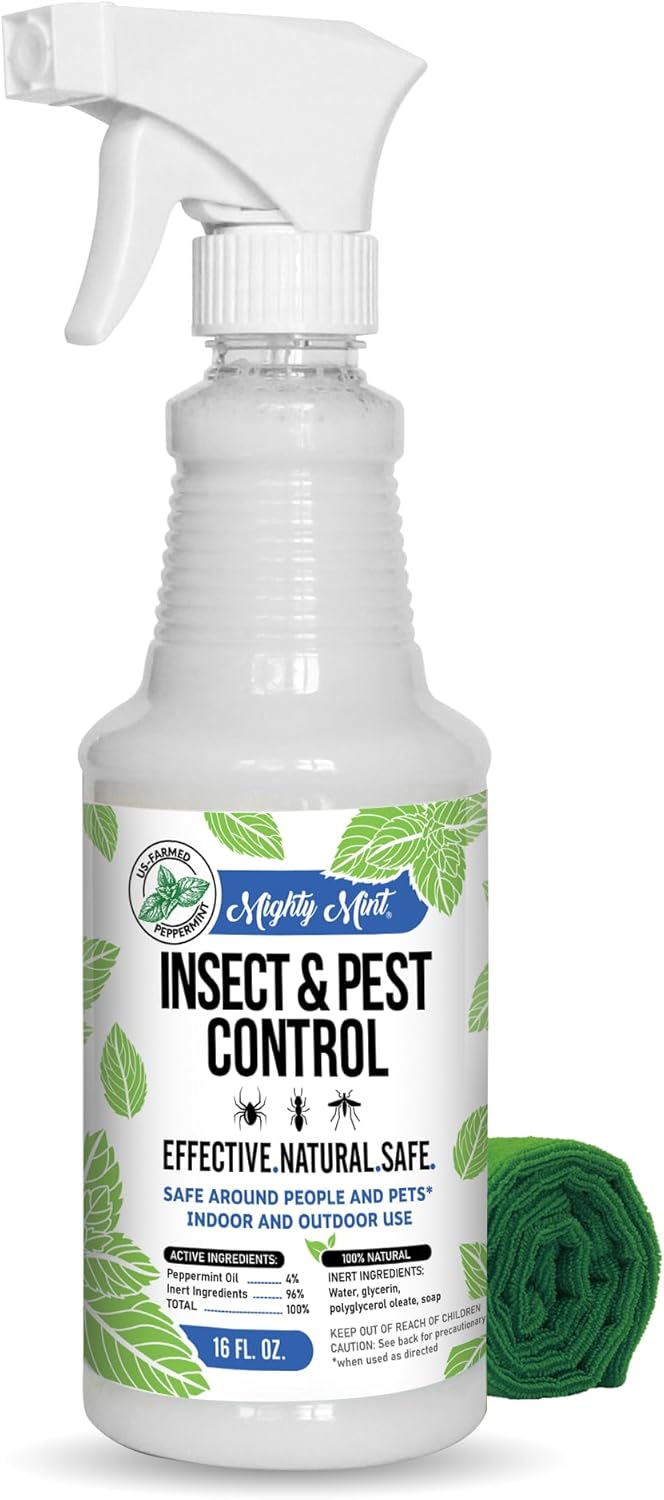
| Ingredients | Water, Glycerine, Polyglycerol oleate, Soap, Peppermint oil |
|---|---|
| Use Areas | Indoor / Outdoor |
| Size | 16 oz |
Mighty Mint is a plant-based, ready-to-use spray that uses concentrated peppermint oil to repel a broad range of household and patio pests. You apply it directly to problem areas such as baseboards, entryways, patios and around outdoor seating; the manufacturer recommends shaking and spraying until surfaces are covered and repeating applications two or more times per week for best results. Notable features include a peppermint-only scent profile, a formulation that avoids synthetic fragrances and the convenience of a 16 oz spray bottle for targeted spot treatments. Practical benefits are that it is safe to use around people and pets when dry and does not leave obvious stains on most surfaces, and the scent can make treated areas smell fresher than chemical alternatives. Important limitations are that it is a repellent rather than a pesticide so it works by discouraging pests rather than killing them, effectiveness depends on regular reapplication and it should not be applied when pollinators are present or to skin or food-contact surfaces.
Best for: Buyers who prioritize natural, low-toxicity solutions and want a targeted spray to reduce insects around patios and entryways while keeping family and pets in mind.
Less Ideal for: Anyone needing a one-time extermination or long-term residual pesticide for severe infestations should consider professional treatments or products formulated to kill pests rather than repel them.
- Plant-based peppermint formula that avoids synthetic fragrances
- Ready-to-use spray for quick, targeted indoor and outdoor applications
- Safe for people and pets when used as directed and allowed to dry
- Nonstaining on most surfaces and leaves a fresh mint scent
- Repels rather than kills insects so regular reapplication is needed to maintain protection
- Strong peppermint concentration may bother scent-sensitive individuals and requires keeping children and pets away until dry
Verdict: Choose Mighty Mint when you want a pet-friendly, plant-based spray to reduce patio and entryway insects with a fresh peppermint scent.
Choosing the Right Organic Ant Killer: Key Factors to Consider
Mode of Action
Understanding how an organic ant killer works is essential for setting expectations. Some options are baits that worker ants carry back to the nest and feed to the queen, which can suppress or eliminate an entire colony over days or weeks. Other products are contact treatments that kill ants on sight but do not reach the nest, offering rapid visible reduction but higher risk of reinfestation.
Knowing the mode of action helps you choose between fast short-term knockdown and slower but deeper colony control. It also affects placement and timing: baits need to be attractive and placed along foraging trails, while contact sprays are best for creating barriers or treating visible trails and entry points.
Toxicity to Beneficials and Pets
Organic formulations are often gentler than conventional insecticides but still vary widely in their non-target impacts. Some natural oils and botanicals can be irritating to pollinators if applied to open flowers, while desiccant dusts can harm ground-dwelling beneficial insects if overused.
Assess where you will apply treatment relative to pollinator activity and where pets and children play. Choose options with labeled guidance for avoiding blossoms, keep application zones narrow, and consider using targeted bait stations instead of broadcast sprays to reduce exposure risk.
Suitability for Edible Gardens
If you garden vegetables, herbs, or fruit, residue and re-entry intervals matter. Some organic active ingredients are approved for use on edible crops but still require washing harvests or avoiding application shortly before harvest.
Read product directions for pre-harvest intervals and allowed uses. For container-grown edibles, prefer products explicitly labeled for use on food plants or choose bait strategies placed away from direct contact with produce to limit residue concerns.
Environmental Persistence and Soil Health
How long an active ingredient persists in soil influences both safety and long-term effects on soil organisms. Short-lived compounds minimize lingering impacts but might require repeat treatments. Materials that bind tightly to soil reduce runoff risk but can accumulate with frequent use.
Consider whether you want a quick, low-residue option for areas near waterways or a more persistent control for structural infestations. Where soil health is a priority, favor products that break down rapidly and avoid repeated blanket applications that could disrupt microbial communities.
Attractiveness to Local Ant Species
Ant species differ in feeding preferences. Some prefer sweet baits, others prefer protein- or oil-based foods. An effective organic solution matches the bait type or attractant to the species you are targeting.
Observe foraging behavior to identify whether ants are visiting sugary spills, protein-rich crumbs, or greasy residues. Using the wrong bait type can mean workers ignore stations and the colony remains intact, so be prepared to switch bait types if initial attempts fail.
Practicality of Application
Gardeners need solutions that fit their routines and sites. Baits in tamper-resistant stations are convenient for busy yards and near children or pets. Granules and dusts may be better for hard-to-reach nest entrances. Sprays serve well for treating trails and foundation perimeters.
Also consider weather and labor. Rain can wash away surface treatments and reduce effectiveness, while compact nest entrances may require targeted soil treatments. Choose formulations and application methods that match the time you can commit and the environmental exposure in your garden.
Identifying Ant Activity and Nest Location
Detecting where ants originate and what they are foraging on makes treatment far more effective. Follow trails back to entry points on foundations, gaps in mortar, or bare soil near plant pots to find nest entrances. In turf and beds, nests may be shallow and visible as soil mounds or loose sand; in landscape mulch, look for concentrated traffic paths.
Record whether ants are clustered on blossoms, near irrigation lines, or around pet food dishes. That tells you the bait type likely to be attractive and whether you should remove competing food sources before deploying a treatment.
- Map trails and major activity times to place baits effectively
- Remove spills, exposed food, and fallen fruit to increase bait acceptance
- Check hidden spots like potted plant saucers and under stone pavers for nests
Timing Treatments for Best Results
Ant activity is temperature dependent. Early morning or late afternoon tends to be peak foraging in many climates. Place baits during active foraging windows so workers find and carry them back to the colony. Avoid applying contact sprays during the heat of the day when volatility is higher and residual efficacy can drop.
Consider seasonal behavior as well. In cooler months colonies slow down and baits may be taken less readily. For structural infestations, treat in spring and late summer when colonies are expanding and workers are actively foraging.
- Apply baits when ants are actively moving along trails
- Avoid spraying during pollinator foraging periods
- Repeat bait placements weekly until activity subsides
Non-Chemical Cultural Controls
Simple changes in garden management reduce ant pressure. Keep mulch layers moderate and avoid piling organic material directly against foundations. Seal small entry gaps in walls and use door sweeps. Removing standing water and pet food outdoors reduces attractants that sustain high ant populations.
For potted plants, elevate pots on stands and clean saucers regularly. Where ants farm aphids or scale, focus on controlling those honeydew-producing pests by pruning or using biological controls so the mutualistic ant relationship is severed.
- Thin mulch and inspect under stones where nests start
- Maintain clean outdoor dining areas and store pet food indoors
- Control honeydew-producing pests to reduce ant tending
Integrated Approaches for Long-Term Control
A single treatment rarely solves persistent ant issues. Integrated management pairs targeted baits for colony suppression with exclusion measures and environmental changes that reduce future re-infestation risk. Monitor activity after treatment and reapply baits or spot-treat nest openings only as needed.
Rotate strategies if one approach fails: switch bait types based on observed preferences and complement baits with non-chemical barriers at entry points. This reduces reliance on any single method and helps preserve beneficial insects.
- Combine baiting with sealing entry points and habitat modification
- Monitor and adapt bait types based on field observations
- Limit blanket broadcast treatments to avoid harming soil biology
How We Chose the Best Organic Ant Killer
We focused on products and methods that provide effective colony control while minimizing harm to people, pets, and garden ecosystems. Selection criteria prioritized materials and formulations commonly used by gardeners who avoid synthetic insecticides. We evaluated each option for kill speed against worker ants and colony suppression, non-target safety around pollinators and beneficial soil fauna, suitability for use on or near edible plants, and ease of application in common garden settings such as raised beds, containers, lawns, and patios. Excluded from consideration were broad-spectrum synthetic insecticides and unproven home remedies lacking clear efficacy. We also filtered out products with unclear labeling about pet safety or restrictions for edible crops. The resulting shortlist reflects choices that balance measurable control, clear application instructions, and lower environmental impact. These dimensions align with our scoring criteria so gardeners can compare tradeoffs between speed, safety, and convenience.
FAQ
Are organic ant killers safe to use around vegetable plants?
Often yes, but it depends on the active ingredient and label directions. Many organic baits and certain botanical sprays are approved for use near edibles when used as directed, but you should avoid applying sprays directly onto open flowers or harvestable produce unless labeled safe. Washing harvested produce is a good precaution.
How long does it take for a bait to eliminate an ant colony?
It usually takes several days to a few weeks for bait strategies to impact a colony because workers must find the bait and distribute it within the nest. Persistence and correct bait placement along foraging trails are key to success; rapid visible declines may not mean the queen has been eliminated.
Can I use natural remedies like diatomaceous earth or vinegar instead of commercial products?
Some natural remedies have a place. Food-grade diatomaceous earth can be effective as a desiccant when applied directly to trails or nest entrances and kept dry, while vinegar works as a short-term repellent on hard surfaces. These methods may not reliably suppress an entire colony on their own and often work best as part of an integrated approach.
Will organic ant treatments harm pollinators like bees?
Some organic treatments can be hazardous to pollinators if applied to flowering plants or used during bloom. To reduce risk, avoid spraying when flowers are open, use targeted baits instead of broadcast sprays, and follow label precautions about pollinator safety.
How do I choose the right bait type for my ant species?
Observe what the ants are feeding on. If they prefer sweets, a sugar-based bait will be more attractive. If they scavenge proteins, use protein-based or greasy baits. If you are uncertain, try a small array of bait types placed along trails and note which one gets the most attention before committing to wider placement.
Can I use organic granular treatments in potted plants?
Granules can work in container settings if they are labeled for use in pots and applied carefully to avoid contact with root crowns. For edibles, prefer baits or targeted options with explicit labeling for container-grown food plants to minimize residue on harvestable parts.
Final Verdict
Choose an organic ant control based on how deeply you need to suppress colonies and where you will apply the treatment. Prioritize bait strategies when your goal is colony elimination in garden settings and select targeted, low-residue options near edible plants and pollinator habitat. Balance application convenience with safety for pets and soil life, and be prepared to monitor and repeat treatments until activity falls to acceptable levels. Ultimately, match your choice to the local ant species, site constraints, and whether you need immediate knockdown or long-term suppression. A modest integrated plan combining baits, exclusion, and cultural changes usually gives the most durable, garden-safe results.
