

Note: This article contains affiliate links. If you click on these links and make a purchase, I may earn a small commission at no extra cost to you. This helps support my research and content. Read my full affiliate disclosure here.
Choosing the right organic fertilizer for olive trees changes how those trees grow, set fruit, and resist stress. Olive trees thrive on steady, balanced feeding that supports soil life rather than forcing rapid leafy growth. In this guide we shortlisted seven top organic fertilizer options suited for olive trees in gardens, orchards, and containers. You will find products chosen for their nutrient balance, slow-release behavior, and compatibility with typical Mediterranean-style soils. We also explain practical application timing, rates, and what to watch for so you can match a product to your trees and site conditions.
Top Picks at a Glance
| Best Overall The best all-around choice for most situations | Espoma Tree‑Tone 6-3-2 Organic Fertilizer, 4 lb. Bag (Pack of 2) |  |
| Best Quality Built to a higher standard if you want something more solid | Down To Earth Organic Fruit Tree Fertilizer, 6-2-4, 5 lb |  |
| Best Value The sweet spot between price and what you get | TPS Nutrients Olive Tree Fertilizer Liquid Plant Food, 32 oz |  |
| Best Budget The cheapest option that still gets the job done reliably | GrowThrive Olive Tree Liquid Fertilizer, 10 oz |  |
| Highest Rated A top-rated pick with lots of positive feedback | Gardenera Organic Liquid Kelp Spray for Olive Trees, 8 oz (Ready-to-Use) |  |
| Most Popular A crowd favorite that many people choose with confidence | TPS Nutrients Olive Tree Liquid Fertilizer, 8 fl oz |  |
| Best Seller A high-volume bestseller chosen again and again | Jobe's Organics Granular Fruit & Citrus Fertilizer, 4 lb |  |
Espoma Tree‑Tone 6-3-2 Organic Fertilizer, 4 lb. Bag (Pack of 2)

| Item Form | Powder |
|---|---|
| Specific Uses For Product | Plant Growth |
| Coverage | Medium |
| Target Species | trees |
| Mixing Ratio | No mixing required |
Espoma Tree‑Tone is a ready‑to‑use organic fertilizer made for trees and larger woody plants. It delivers a balanced 6-3-2 NPK formulation with 5% calcium and organic inputs that feed roots slowly while improving soil biology. Typical use is in spring and fall: spread around the root zone according to label guidance and leave it on the soil surface since no mixing is required. The product comes in two 4 lb. bags that make treating multiple small trees convenient. Notable benefits are its organic certification and the inclusion of Bio-tone to support microbial activity, which helps sustained plant growth rather than a quick surge of foliage. Because it is granular and medium coverage, it is easy to apply precisely around drip lines. Limitations are its lower NPK numbers compared with synthetic fertilizers, so results are steady rather than dramatic, and you may need larger quantities for mature trees or fast corrective feeding. For gardeners prioritizing long-term soil health and consistent growth, Tree‑Tone performs reliably as a regular maintenance fertilizer.
Best for: Gardeners who want reliable, soil‑friendly feeding for shade, fruit, and ornamental trees and who prioritize steady, long‑term plant health over rapid foliage boosts.
Less Ideal for: People seeking fast, high‑nitrogen corrective feeding for heavy feeders or large mature trees that require concentrated, immediate nutrient correction.
- Organic formula approved for organic gardening and made with natural ingredients
- Contains 6-3-2 NPK plus 5% calcium to support steady tree growth and fruiting
- Ready to use granular form requires no mixing and is easy to apply
- Includes Bio-tone to encourage soil microbial activity and long-term soil health
- Lower nutrient concentration means larger or repeated applications may be needed for large or nutrient‑depleted trees
Verdict: Choose Tree‑Tone if you want an organic, easy‑to‑apply fertilizer that promotes steady tree growth and long‑term soil health.
Down To Earth Organic Fruit Tree Fertilizer, 6-2-4, 5 lb

| Item Form | Powder |
|---|---|
| Specific Uses For Product | Plant Growth,Potting |
| Target Species | fruit trees |
| Mixing Ratio | 6:2:4 |
This Down To Earth fruit tree mix is a dry, soil-applied organic fertilizer designed to support flowering and fruit set on backyard fruit trees. With a 6-2-4 NPK ratio and added calcium sources, it is meant to be broadcast around the root zone, lightly worked into the topsoil or covered with mulch, then watered in so nutrients reach feeder roots. The formula combines bone and fish meals, blood meal, alfalfa and kelp to supply both quick-release and slower-release nitrogen and a spectrum of micronutrients that help fruit development. Practical benefits for fig growers include steady nitrogen for leaf and shoot growth early in the season and calcium to support fruit quality. Because it is not water soluble and is OMRI-listed, it fits organic systems but requires correct placement and watering rather than foliar feeding. Expect a slower, soil-driven response compared with synthetic fertilizers and plan on seasonal reapplication per label rates for sustained production.
Best for: Fig growers who prioritize organic, soil-focused fertility and want a balanced, fruiting-focused feed to encourage consistent yields in backyard trees.
Less Ideal for: Gardeners needing rapid, soluble corrections or liquid feed options for greenhouse figs or container plants should consider a soluble fertilizer instead.
- OMRI-listed organic blend suitable for organic orchards
- 6-2-4 NPK with added calcium to support fruit set and quality
- Contains a mix of fast and slow-release organic ingredients for season-long feeding
- Shelf-stable dry formula that can be broadcast and worked into soil
- Not water-soluble so slower to correct acute nutrient deficiencies
- Requires proper incorporation and watering to be effective
Verdict: Choose this product if you want an OMRI-listed, calcium-fortified organic fertilizer that feeds figs through the soil for better fruit development.
TPS Nutrients Olive Tree Fertilizer Liquid Plant Food, 32 oz

| Size | 32 oz |
|---|---|
| Made in | USA |
This 32 oz liquid fertilizer is formulated for olive trees and aims to provide balanced, gentle nutrition for both potted and landscape specimens. You mix and apply it as a regular feed to encourage steady growth and greener leaves without forcing excessive, weak growth. The label highlights suitability for indoor, container, and outdoor olive trees and emphasizes root health and nutrient uptake, which is useful if you want strong established trees rather than fast top-heavy shoots. Practical benefits include an easy-to-use liquid format that distributes nutrients evenly and a formulation meant to avoid buildup or stressing the plant. Limitations to note are that the product listing does not include a guaranteed analysis or specific N-P-K numbers, so you cannot precisely match it to a feeding schedule based on nutrient percentages. Also, liquid feed requires more frequent applications than slow-release granular options, and you will need to track dilution and timing for best results.
Best for: Buyers who want a straightforward feed to maintain healthy olive trees and prefer a product tailored to olive physiology rather than a generic houseplant fertilizer.
Less Ideal for: Gardeners who need a precise nutrient breakdown for strict fertilization programs or those who prefer low-maintenance, slow-release granular fertilizers for seasonal feeding.
- Formulated specifically for olive trees, so plant needs are considered
- Liquid format delivers nutrients evenly and is easy to apply to containers or soil
- Marketed to support root health and steady, non-excessive foliage growth
- Suitable for indoor and outdoor use, including potted trees made for small spaces
- No guaranteed analysis or N-P-K breakdown provided in the product information
- Requires regular applications since it is a liquid rather than a slow-release formula
Verdict: A purpose-built liquid feed that makes regular, gentle nutrition simple for potted or landscape olive trees.
GrowThrive Olive Tree Liquid Fertilizer, 10 oz

| Item Form | Liquid |
|---|---|
| Application Method | foliar spray, root drench, direct application |
| Specific Uses For Product | Plant Growth, Root Development, Seed Development, Soil Conditioning |
| Target Species | Olive Tree, Apple Tree, Mango Tree, Citrus, Avocado |
| Mixing Ratio | 1:400 |
This GrowThrive liquid fertilizer is a concentrated, organic formula aimed at improving soil microbial activity, root development, and fruit set for olive trees and similar fruit trees. It is mixed at a low dilution (mixing ratio 1:400) and can be applied as a foliar spray or root drench, which makes it useful for both potted specimens and in-ground trees. The product emphasizes a gentle, microbial probiotic approach to reduce risk of over-fertilization and seedling burn while feeding soil biology to increase nutrient availability. Practical benefits include easy measuring instructions, multiple application options, and compatibility with citrus and other fruit trees. Limitations are the small 10 oz bottle size, which means frequent repurchasing for larger trees or orchards, and the absence of a full nutrient analysis on the label so exact N-P-K strengths are unclear. For gardeners wanting a low-risk, organic liquid feed for olives, this delivers convenient, biology-focused nutrition but is best for small trees or trial use before scaling up.
Best for: Home gardeners on a tight budget who need a gentle, organic liquid feed for one or a few olive trees or other container fruit trees and prefer an easy-to-apply product that supports soil microbes.
Less Ideal for: Owners of large orchards or many mature in-ground trees who need high-volume, fully specified commercial fertilizers.
- Organic microbial probiotic formula that supports soil biology and reduces risk of over-fertilization
- Can be applied as foliar spray or root drench, offering flexible use for pots and garden trees
- Concentrated mixing ratio (1:400) stretches the product for multiple applications
- Designed specifically for olive and other fruit trees to encourage flowering and fruit set
- Small 10 oz bottle may not be economical for larger trees or multiple specimens
- No detailed N-P-K values provided, so exact nutrient content is unclear
Verdict: A small, budget-friendly organic liquid feed that gently boosts soil biology and fruit production for a few olive trees or container fruit specimens.
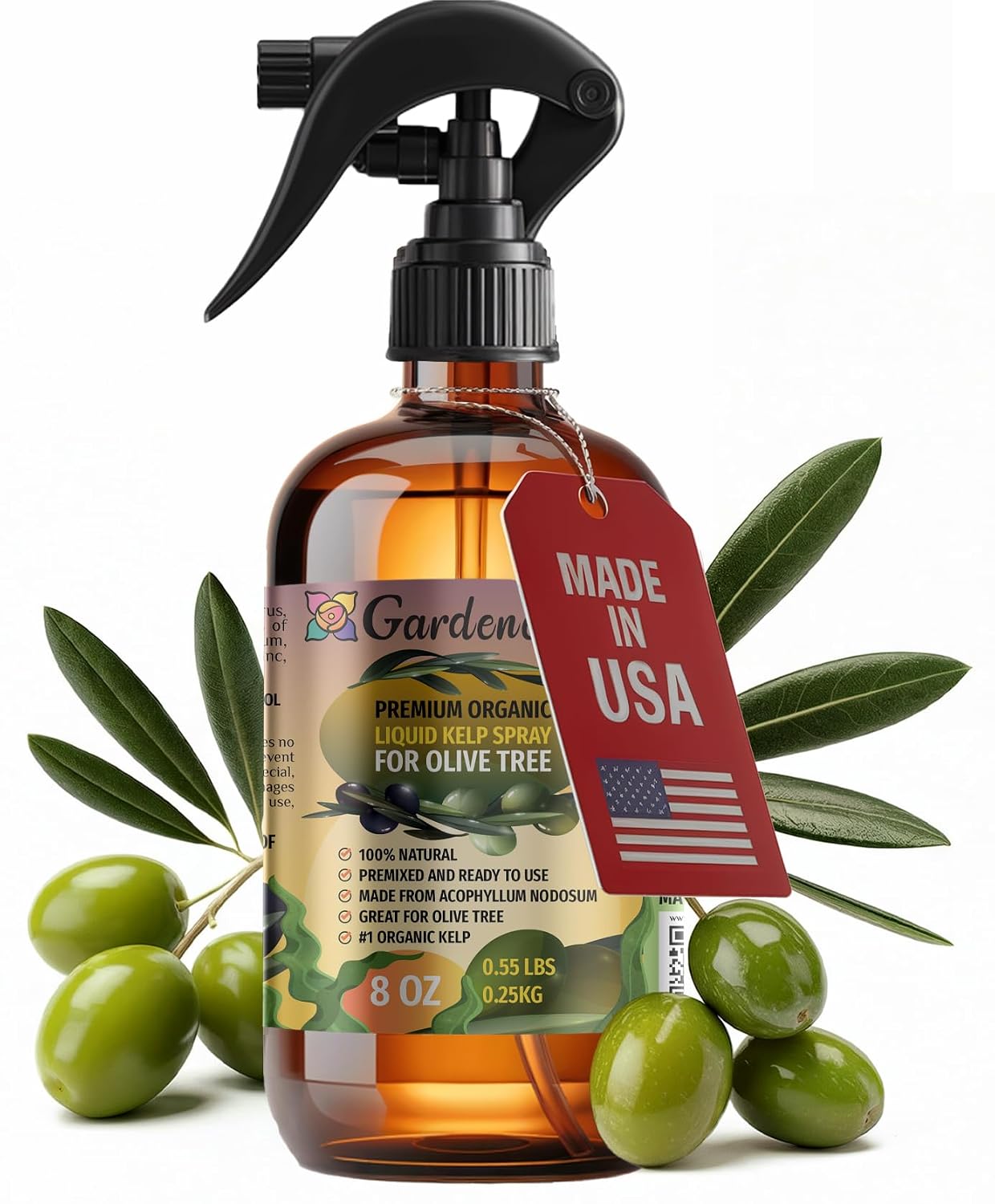
Gardenera Organic Liquid Kelp Spray for Olive Trees, 8 oz (Ready-to-Use)
| Item Form | Liquid |
|---|---|
| Application Method | Spray |
| Coverage | Full |
| Target Species | Olive Tree |
| Liquid Volume | 8 fluid ounces |
This ready-to-use liquid kelp spray delivers seaweed-derived micronutrients and natural growth factors specifically for olive trees. It is applied as a foliar mist every 2–3 weeks during active growth and fruiting to encourage leaf shine, stronger branching, more flowers, and improved fruit set. Notable features include cold-processed Ascophyllum nodosum extract, a pre-diluted formula that requires no mixing, and guidance to avoid spraying fruit directly. Practical benefits are quick uptake through the leaves, suitability for container and in-ground olives including bonsai, and support for root vigor and drought resilience in Mediterranean climates. Limitations are the small 8 oz bottle size, which will cover only a few trees or several applications on a single specimen, and the product is single-purpose for olive trees rather than a broad-spectrum fertilizer. For gardeners seeking an organic foliar boost to maintain healthy foliage and improve flowering, this kelp spray is a convenient option; those needing comprehensive NPK feeding should pair it with an appropriate soil fertilizer.
Best for: Gardeners who prioritize consistent, organic care for olive trees and want an easy, low-effort foliar treatment to maintain healthy leaves, encourage blooms, and support root resilience.
Less Ideal for: Growers looking for an all-in-one NPK fertilizer for feeding multiple fruiting trees or large orchards should consider concentrated or bulk soil fertilizers instead.
- Ready-to-use foliar spray requires no mixing and is simple to apply
- Made from cold-processed Ascophyllum nodosum seaweed, supplying natural micronutrients and growth hormones
- Formulated specifically for olive trees, including common varieties and bonsai
- Supports foliage health, flowering, fruit set, and root strength for better drought tolerance
- Small 8 oz volume limits number of applications for larger trees or multiple specimens
- Designed as a foliar seaweed supplement and does not replace a balanced soil fertilizer
Verdict: A convenient, organic foliar kelp spray that reliably boosts olive tree foliage, flowering, and root strength with no mixing required.
TPS Nutrients Olive Tree Liquid Fertilizer, 8 fl oz

| Item Form | Liquid |
|---|---|
| Application Method | watering can, hose end sprayer, or leaf mister |
| Target Species | Olive Trees |
| Unit Count | 8 Fluid Ounces |
| Mixing Ratio | 1:0 |
This liquid fertilizer is designed for olive trees and delivers balanced nutrition in an easy pour formula that can be applied with a watering can, hose‑end sprayer, or leaf mister. Typical use is regular feeding during routine watering for potted patio trees or landscape plantings to support steady growth, healthy foliage, and root development without excessive vegetative push. The product highlights gentle, targeted nutrients that claim to encourage fruit set and reduce buildup or root stress, which is helpful for maintaining long‑term tree health. The compact 8 ounce bottle is convenient for small containers or trial use; application is simplified by a 1:0 mixing ratio stated in the guide. Limitations include the small unit size if you have multiple plants or larger specimens, and the formula and labeling are targeted to olives so growers should check nutrient balance before applying to other species. For someone optimizing routine care, it is a practical, easy option for occasional feeding of individual potted or young olive trees.
Best for: Buyers who prioritize simple, low‑risk feeding routines for single potted trees or small landscape olives and want a product that is easy to apply during watering.
Less Ideal for: Gardeners managing many plants, larger landscape trees, or those seeking a fertilizer formulated specifically for lavender or other non‑olive species.
- Liquid formula works with watering can, hose‑end sprayer, or leaf mister for flexible application
- Designed to support steady growth, foliage health, and root development in olive trees
- Gentle mix claimed to avoid nutrient buildup or root stress
- Compact 8 fl oz size is convenient for potted trees or trialing a new fertilizer
- Small 8 ounce bottle may not be cost effective for multiple plants or larger trees
- Formulation and labeling are specific to olive trees and not tailored to lavender or other species
Verdict: A handy, easy‑to‑apply liquid fertilizer for gardeners who want straightforward, gentle feeding for a single potted or young olive tree.
Jobe's Organics Granular Fruit & Citrus Fertilizer, 4 lb

| Item Form | Granules |
|---|---|
| Specific Uses For Product | Plant Growth, Root Development, Seed Development, Soil Conditioning |
| Application Method | Spread evenly around base |
| NPK | 3-5-5 |
| OMRI Listed | Yes |
This granular Jobe's Organics fertilizer is designed to feed fruit and citrus trees with a slow-release, root-targeted NPK of 3-5-5. It is typically applied by measuring and spreading the granules evenly around the base of the tree, then watering in; applications are recommended every 4 to 8 weeks during the growing season. Notable features include OMRI listing for organic gardening, a blend of feather meal, bone meal and processed poultry manure for organic nutrient sources, and a resealable bag for convenient storage. In practice the formula supports root development and fruit set without synthetic chemicals, and the slow-release nature reduces the need for very frequent feeding. Limitations are that the lower nitrogen level makes it better suited for fruiting and flowering stage nutrition rather than rapid leafy growth, and larger trees will require repeated applications or larger quantities. For gardeners aiming for an organic, low-fuss feed for citrus, this provides predictable, targeted nutrition, but it is not a quick-fix soluble feed for immediate green-up.
Best for: Gardeners who prefer organic, low-maintenance feeding for citrus and fruit trees and want a slow-release product that focuses on fruit and root health.
Less Ideal for: Growers needing fast, high-nitrogen correction or a soluble foliar feed; landscapers managing many mature trees who need bulk quantities more often.
- OMRI listed organic formula suitable for certified organic gardens
- Balanced 3-5-5 NPK aimed at improving flowering and fruit production
- Slow-release granules that feed roots over time and reduce application frequency
- Resealable packaging keeps product fresh between uses
- Lower nitrogen content means it will not rapidly promote leafy growth
- 4 lb bag may be insufficient for mature trees or larger plantings
Verdict: A reliable OMRI-listed granular fertilizer that delivers slow-release, fruit-focused nutrition for organic citrus gardeners.
Choosing the Right Organic Fertilizer for Olive Trees: Key Factors to Consider
Nutrient Balance and Ratios
Olive trees need a balance of nitrogen, phosphorus, and potassium rather than heavy single-nutrient doses. A moderate nitrogen level supports steady canopy growth without encouraging soft, frost-prone shoots. Phosphorus helps root development and flowering, while potassium supports fruit sizing and drought tolerance.
When choosing an organic fertilizer, look at the guaranteed analysis and whether nutrients are supplied from whole-organic sources or mineral amendments. The ratio matters more than a single high number because olives respond to long-term balance across seasons rather than short bursts of growth.
Release Rate and Longevity
Slow-release behavior is central to feeding olive trees. Fast-acting fertilizers can cause rapid vegetative growth that reduces fruiting and stresses trees during drought or cold spells. Organic materials that release nutrients over several months or with microbial mediation tend to align with an olive tree's seasonal needs.
Consider how often you want to apply fertilizer and whether the product holds up through rainfall or irrigation. Granular, composted, or pelletized organics often provide steadier nutrition than liquid foliar feeds, making them a safer choice for long-term orchard health.
Soil Structure and Microbial Benefits
Organic fertilizers should ideally do more than feed; they should improve soil structure and biology. Materials that add organic matter increase water retention in sandy soils and improve drainage in heavy clays. Beneficial microbes or composted inputs help mineralize nutrients over time and support root health.
For olive trees planted in marginal soils, a fertilizer that contributes humus or microbial inoculants can reduce the need for corrective amendments later and promote more resilient trees during heat and drought.
Salt Levels and Purity
Olives are tolerant of some salinity, but repeated applications of high-salt fertilizers can build up salts in the root zone and impair water uptake. Organic options with low soluble salt content protect root function and are especially important in containers or poorly drained sites.
Check whether the product is described as low-salt or suitable for trees and shrubs. Purity also means minimal contaminants and clear ingredient sourcing, which reduces risk of heavy metals or inert fillers accumulating in the soil.
Application Method and Timing
Application convenience affects how consistently you will feed olive trees. Granules, spikes, slow-release pellets, and compost topdressings all require different labor and timing considerations. Choose a method you will reliably repeat at the recommended seasonal intervals.
Timing matters: feed in early spring as active growth begins and consider a lighter follow-up in late spring or early summer. Avoid heavy late-season nitrogen that can interfere with hardening off before cold weather.
Suitability for Containers Versus Ground
Container-grown olive trees have different nutritional dynamics than in-ground specimens. Potting media hold less reserve and salts accumulate faster, so container fertilizers should be lower in soluble salts and easier to leach with periodic watering. In-ground trees can tolerate larger, slower-acting soil amendments and benefit more from bulk compost or mulch incorporation.
Match the fertilizer form and application rate to the planting context to avoid underfeeding containers or overapplying to established ground trees.
When to Feed Olive Trees
Feed olive trees in the active growth window. In most climates that means a dosing in early spring as new shoots emerge and a lighter feed after the initial flush if the tree shows slow growth or poor fruit set. Avoid high-nitrogen applications late in the season when trees should be hardening off.
Consider local climate and the tree's age. Young trees need more frequent, smaller doses to support root establishment, while mature trees benefit from annual or biannual soil-building applications. Monitor canopy vigor and fruiting rather than sticking rigidly to a calendar when deciding on follow-up applications.
- Early spring: primary feeding when soil warms
- Late spring or early summer: optional light follow-up
- Avoid heavy late-season nitrogen
Applying Fertilizer to Established Trees
For in-ground mature trees, spread granular or composted fertilizer evenly under the canopy dripline and water it in. This distributes nutrients to the majority of the root zone where feeder roots are active. For best results, avoid piling fertilizer against the trunk.
Work product into the topsoil lightly if the material is bulky, or topdress with compost and mulch to lock in moisture. Repeat applications should be modest and based on tree response and soil tests rather than fixed high-dose schedules.
- Spread under dripline for even root uptake
- Avoid trunk contact and concentrated piles
- Topdress with compost to improve organic matter
Feeding Olive Trees in Containers
Container olives need more regular feeding because potting mixes hold fewer nutrients. Choose low-salt, slow-release granular formulas or diluted organic liquid feeds on a schedule that reflects faster nutrient depletion. Flush containers periodically to prevent salt buildup.
Reduce application rates compared with in-ground trees and increase monitoring for leaf discoloration or root-bound stress. Repotting with fresh media every few years paired with a conservative fertilizer program yields better long-term health than heavy fertilization alone.
- Use low-salt products and smaller, more frequent doses
- Flush pots occasionally to prevent salt accumulation
- Combine feeding with periodic repotting and fresh media
Interpreting Soil Tests and Leaf Symptoms
A simple soil test is the most reliable way to determine which nutrients your olive trees lack. Tests reveal pH, available phosphorus, potassium, and overall fertility so you can choose a fertilizer that corrects specific deficits.
Leaf symptoms can guide quick decisions: pale new leaves often indicate nitrogen deficiency, while marginal browning or small fruit can point to potassium shortages. Use symptoms as a prompt for testing rather than a sole diagnostic method.
- Soil test before major amendments
- Use foliar symptoms as a diagnostic clue
- Adjust nutrient ratios based on test results
Combining Fertilizers with Cultural Practices
Fertilizer is one tool among many. Proper irrigation, pruning, pest control, and mulching interact with nutrition to shape tree performance. Overwatering often mimics nutrient deficiency by reducing root oxygen and nutrient uptake, so coordinate feeding with irrigation practices.
Mulch helps conserve moisture, moderate soil temperature, and slowly add organic matter. Pair mulch and compost applications with a lighter granular fertilizer to maintain both immediate and long-term soil fertility.
- Coordinate feeding with irrigation schedules
- Use mulch to build organic matter and conserve moisture
- Integrate nutrition with pruning and pest management
How We Chose the Best Organic Fertilizer for Olive Trees
Our selection prioritized fertilizers that support olive tree physiology and the soils they grow in. We tested editorial criteria that matter to gardeners managing olives: nutrient profile and ratios tailored to fruit trees; release rate and longevity to avoid excessive vegetative flushes; soil-building attributes such as organic matter and beneficial microbes; ease and flexibility of application across soils and container situations; and material purity, including low-salt formulations and limited contaminants. We excluded any formulations designed only for lawns or high-nitrogen vegetable blends that drive too much leafy growth. We also ruled out products with vague ingredient lists or unverified nutrient claims. The remaining candidates scored well on the concrete dimensions listed above, which match the per-product scoring labels used throughout the guide. Editorial picks favor reliable, repeatable performance in real garden and orchard conditions rather than speculative or one-off treatments.
FAQ
How often should I apply organic fertilizer to an olive tree?
Often once in early spring and optionally a lighter application in late spring or early summer. Frequency depends on tree age, soil fertility, and the fertilizer's release rate; containers typically need more frequent feeding.
Can I use compost alone to feed olive trees?
Yes. Compost supplies slow-release nutrients and improves soil structure, making it a good baseline amendment. In some cases a targeted organic fertilizer may still be needed to correct specific nutrient imbalances identified by a soil test.
Will organic fertilizer prevent pests and diseases on olive trees?
Organic fertilizer improves tree vigor and soil health, which can make trees more resilient. It is not a direct pesticide; managing pests and diseases still requires proper monitoring and cultural controls alongside nutrition.
Are foliar feeds useful for olive trees?
Foliar feeds can provide a quick nutrient boost, particularly for micronutrients or to correct short-term deficiencies. They are best used as a supplement to soil applications rather than as the sole feeding method.
What should I do if leaves turn yellow after fertilizing?
Yellowing can indicate several issues including overwatering, salt buildup, or mismatched nutrients. Stop additional feeding, flush the root zone with water if salts are suspected, and conduct a soil test to pinpoint the cause.
Final Verdict
Prioritize fertilizers that supply balanced nutrition slowly and build soil organic matter when choosing for olive trees. Match the product form and rate to planting context: bulk compost and long-lasting granules for established in-ground trees, and low-salt, repeatable feeds for containers. Keep decisions guided by soil testing, seasonal timing, and tree response. Favor steady, soil-focused approaches over quick fixes to support fruiting, drought tolerance, and long-term health.
