

Note: This article contains affiliate links. If you click on these links and make a purchase, I may earn a small commission at no extra cost to you. This helps support my research and content. Read my full affiliate disclosure here.
Choosing the right organic fertilizer for pole beans matters because these vining legumes need a balance of nutrients to set pods without producing excessive leafy growth. In the garden, the wrong feed can push vines into leafy growth at the expense of flowers and beans or fail to support consistent pod development. This guide covers seven top candidates shortlisted for use with pole beans, explaining how we evaluated nutrient ratios, ease of application, and effects on soil biology. Read on for practical advice on matching feed type to your soil, planting stage, and production goals.
Top Picks at a Glance
| Best Overall The best all-around choice for most situations | Down To Earth Organic Vegetable Garden Fertilizer 4-4-4, 5 lb |  |
| Best Quality Built to a higher standard if you want something more solid | Neptune's Harvest Fish & Seaweed Liquid Fertilizer (2-3-1) 36 oz |  |
| Best Value The sweet spot between price and what you get | Jobe's Organics Granular All Purpose Fertilizer, 4 lb |  |
| Best Budget The cheapest option that still gets the job done reliably | True Organic All Purpose Liquid Plant Food (16 fl oz) |  |
| Highest Rated A top-rated pick with lots of positive feedback | Tank's Green Stuff 100% Organic SuperMix Fertilizer, 10 lb |  |
| Most Popular A crowd favorite that many people choose with confidence | FoxFarm Big Bloom Liquid Plant Food, 16 fl oz |  |
| Best Seller A high-volume bestseller chosen again and again | Dr. Earth Organic Tomato, Vegetable & Herb Fertilizer (64 oz) |  |
Down To Earth Organic Vegetable Garden Fertilizer 4-4-4, 5 lb

| Item Form | Granules |
|---|---|
| Specific Uses For Product | Vegetables, greens, tomatoes, herbs |
| Application Method | Apply directly to the soil or mix into garden beds |
| Mixing Ratio | 4-4-4 |
This granular fertilizer is formulated to feed vegetables, herbs and greens with a balanced 4-4-4 NPK and a slow-release profile that supplies nutrients over time. It is applied by distributing into the planting hole, mixing into topsoil, or working into raised beds at planting and during the season for maintenance. Notable features include all-natural ingredients sourced from plant, marine and mineral resources and OMRI-friendly formulation that supports organic gardening and beneficial soil life. Practically, the slow-release granules reduce the need for frequent feeding and help avoid nutrient spikes that can stress plants. The 5 lb unit is convenient for small to medium beds but means frequent repurchasing for larger plots. While it is versatile across vegetables and herbs, gardeners who need rapid corrective feeding for a specific deficiency will still need a targeted amendment or foliar feed in addition to this product.
Best for: Gardeners who prioritize steady, reliable plant performance and want an organic, low-maintenance fertilizer for raised beds and small plot vegetable production.
Less Ideal for: Growers managing large acreage or those needing immediate corrective nutrient treatments should look for bulk or fast-acting specialty products instead.
- Balanced 4-4-4 NPK suitable for overall vegetable development
- Slow-release granular formula for sustained feeding
- Made from all-natural ingredients and compatible with organic systems
- Easy to apply directly to soil or mix into raised beds
- Small 5 lb size may require frequent replacement for larger gardens
- Not formulated for quick correction of specific nutrient deficiencies
Verdict: Choose this product when you want an organic, slow-release 4-4-4 fertilizer that delivers steady nourishment for productive vegetable beds.
Neptune's Harvest Fish & Seaweed Liquid Fertilizer (2-3-1) 36 oz

| Item Form | Liquid |
|---|---|
| Mixing Ratio | 2:3 |
| Specific Uses For Product | Plant Growth |
| Liquid Volume | 946 ml |
Neptune's Harvest Fish & Seaweed Liquid Fertilizer is a concentrated organic plant food that mixes with water for use as a soil drench or foliar feed. It is typically diluted (manufacturer directions give roughly 1 fl oz per gallon for outdoor use and 1 tablespoon per gallon for houseplants) and applied every 1 to 3 weeks depending on the crop. The formula combines hydrolyzed fish and seaweed to deliver nitrogen, micronutrients, and seaweed-derived growth compounds in a plant-ready form, which helps green growth, flowering color, and vegetable flavor. Because it is a liquid concentrate it is easy to measure and applies evenly, and regular use can improve soil biology and structure over time. Limitations are that it is low in phosphorus and potassium relative to some specialty bloom or fruit formulas and it has an odor typical of fish-based fertilizers that some users may find strong. This product suits gardeners who want an effective, organic regular feed that supports both potted houseplants and garden beds.
Best for: Gardeners seeking a reliable, organic everyday fertilizer that simplifies feeding for a mixture of houseplants, vegetables, flowers and shrubs and who value soil health as well as plant vigor.
Less Ideal for: Growers who need a high-phosphorus bloom booster or a fertilizer formulated specifically for fruit set or lawns should look for a targeted specialty product instead.
- Organic concentrate blending hydrolyzed fish and seaweed for plant-ready nutrients
- Versatile application as soil drench or foliar feed for indoor and outdoor plants
- Supports soil biology and structure with regular use
- Easy-to-measure mixing ratios for routine feeding
- Has a strong fish odor that some users may find unpleasant
- Lower phosphorus and potassium compared with specialized bloom or fruit formulas
Verdict: A dependable organic liquid concentrate that provides balanced, plant-ready nutrients and improves soil health for routine feeding of mixed garden and houseplants.
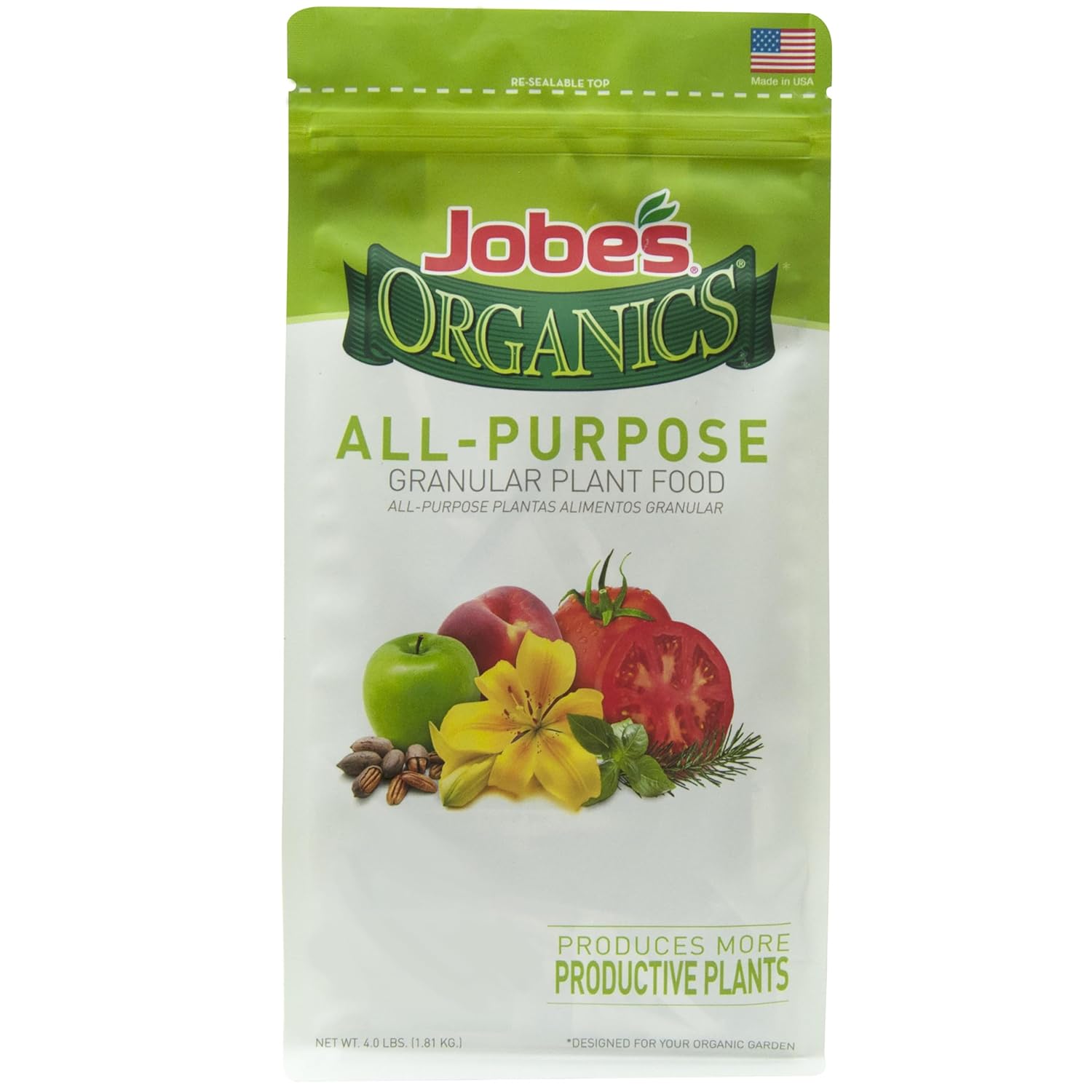
Jobe's Organics Granular All Purpose Fertilizer, 4 lb
| Item Form | Granules |
|---|---|
| Specific Uses For Product | Gardening |
| Coverage | Resealable |
| Mixing Ratio | 4-4-4 |
Jobe's Organics Granular All Purpose Fertilizer is a slow-release, OMRI-listed granular fertilizer designed for routine feeding of garden plants including young trees. You apply measured amounts around the root zone, water it in, and repeat every 2 to 3 weeks during the growing season. The 4-4-4 NPK balance with added calcium, magnesium, and sulfur supplies steady, mild nourishment without the burn risk of high-strength synthetic feeds, and the organic feedstocks encourage soil microbial activity that helps young root systems access nutrients. The resealable bag and granular form make it easy to portion and store, and directions are straightforward for gardeners who prefer repeat, low-effort applications. Limitations are that it is a light-strength general feed, so very nutrient-deficient soils or trees with established nutrient needs may require supplemental feeding or a specialized tree formula for faster correction. Also, granular organics act more slowly than soluble fertilizers, so expect gradual improvement rather than immediate greening.
Best for: Gardeners who prioritize safe, repeatable organic feeding and want a low-risk, easy-to-use fertilizer to support establishing root systems in young trees and mixed garden beds.
Less Ideal for: Users seeking fast, dramatic nutrient correction or a tree-specific high-nitrogen formulation for rapid canopy growth should consider more targeted or soluble products.
- USDA OMRI-listed organic formula suitable for organic gardening
- Balanced 4-4-4 NPK plus calcium, magnesium, and sulfur for steady, mild feeding
- Granular slow-release form reduces burn risk and supports soil microbes
- Resealable bag and simple application instructions make dosing and storage easy
- Lower NPK strength means slower visible results compared with soluble or high-N fertilizers
- Not targeted specifically to young trees so may need supplemental fertilization for deficient soils
Verdict: A gentle OMRI-listed granular fertilizer that is a practical, low-risk choice for regularly feeding young trees and maintaining soil health.
True Organic All Purpose Liquid Plant Food (16 fl oz)

| Item Form | Liquid |
|---|---|
| Specific Uses For Product | Agriculture, Gardening |
| Coverage | Full |
| Mixing Ratio | 2 fl oz per gallon, every two weeks |
True Organic All Purpose Liquid Plant Food is a ready-to-mix liquid fertilizer intended for regular feeding of vegetables, herbs, flowers and houseplants. You shake and dilute 2 fl oz per gallon of water and soak the soil every two weeks during the growing season, which makes it easy to add into an existing watering routine. The formula uses farm-grade organic inputs such as fish solubles, kelp extract and molasses designed to supply macronutrients and support microbial activity in soil rather than synthetic salts. The bottle size and mixing rate suit small beds, containers or indoor collections where you need frequent light feedings. Because it is concentrated and OMRI listed for organic gardening, it is a good choice for gardeners who prioritize organic inputs. Expect slower, steadier nutrient release compared with fast-release synthetic fertilizers and plan for repeated applications to see sustained results across a season.
Best for: Gardeners who want an easy-to-use, certified organic liquid fertilizer for containers, small beds, or indoor plants and who prefer steady, biology-friendly feeding.
Less Ideal for: Large-scale vegetable plots or landscapers who need bulk, fast-release fertilizers for one-off applications should consider higher-volume or synthetic options.
- OMRI listed and made with organic inputs suitable for organic gardens
- Concentrated liquid formula is easy to mix and apply with a regular watering schedule
- Contains multiple nutrient sources and kelp to support both plants and soil biology
- Made in the USA with farm-grade ingredients and clear mixing instructions
- Smaller 16 fl oz bottle requires frequent repurchasing for larger gardens
Verdict: A concentrated, OMRI-listed liquid fertilizer that makes regular organic feeding simple for containers and small garden plots.
Tank's Green Stuff 100% Organic SuperMix Fertilizer, 10 lb

| Item Form | Powder |
|---|---|
| Specific Uses For Product | Organic |
| Unit Count | 160 Ounce |
| Mixing Ratio | 1:0 |
Tank's Green Stuff SuperMix is a powdered, OMRI-listed organic fertilizer intended for broad garden use from vegetables to ornamentals. You sprinkle or mix it into potting media or topdress established beds and it is marketed for vegetables including beans, plus flowers, trees and cacti. Notable features include its organic formulation and a 10 pound unit count that gives enough product for multiple applications across a small vegetable patch. Practical benefits are ease of use and flexibility: it can be worked into soil, added to potting mixes, or used as a top dressing to support nitrogen and nutrient needs of heavy-feeding crops like pole beans. Important limitations are that specific nutrient analysis and recommended application rates are not provided in the product information so users must follow label directions carefully or calculate rates conservatively for young plants. Also the powder form can be dusty when applied and requires storage out of reach of children and pets.
Best for: Gardeners who prioritize organic, reliable nutrition for edible crops and want a multipurpose fertilizer they can apply to pole beans, veggies, and other garden plants.
Less Ideal for: Growers who need precise, label-listed nutrient analysis or measured feed schedules for commercial production should consider products with full guaranteed analysis and application rates.
- OMRI-listed organic formulation suitable for organic vegetable gardens
- Powder form allows mixing into potting media or topdressing beds
- 10 lb bag provides enough product for repeated applications across a small to medium garden
- No complete N-P-K or guaranteed analysis listed in the available product details
- Powder can be dusty during application and needs careful handling
Verdict: Pick this product if you want a straightforward OMRI-listed organic powder that can be mixed or topdressed to support pole beans and general vegetable garden fertility.
FoxFarm Big Bloom Liquid Plant Food, 16 fl oz

| Item Form | Liquid |
|---|---|
| Specific Uses For Product | Organic |
| Application Method | watering can, sprayer, or drip system |
| Liquid Volume | 16 fluid ounces |
| Mixing Ratio | 4 |
Big Bloom is a concentrated liquid bloom fertilizer aimed at boosting flowers and fruit by supplying readily available organic nutrients. It mixes into water (manufacturer recommends 4 tablespoons per gallon) and can be applied with a watering can, sprayer, hose-end siphon, or through drip systems, so you can feed potted plants, beds, or containers without changing your routine. Notable features are its OMRI listing for organic use and the inclusion of bat guano and earthworm castings, which provide phosphorus and organic matter to encourage blooms and seed set. Because it is liquid and fast-acting, you can expect visible perk-up within a short time after feeding, and it is suitable for regular use at watering times to extend flowering. Limitations to consider are the small 16 fl oz size for larger gardens and the presence of phosphorus, which may be restricted in some locales and requires careful application to avoid runoff.
Best for: Gardeners focused on maximizing blooms and fruit who want an organic, fast-acting feed they can add to routine watering for container and bed-grown flowering plants.
Less Ideal for: Large-scale landscapers or very large perennial beds who need bulk fertilizer solutions or want to avoid phosphorus-based products due to local regulations.
- OMRI-listed organic formula with natural inputs like bat guano and earthworm castings
- Liquid concentrate allows fast nutrient uptake and flexible application methods
- Works with watering cans, sprayers, hose-end siphons, and drip systems for easy integration
- Small 16 fl oz bottle may require frequent repurchasing for larger flower beds
- Contains phosphorus so local restrictions on phosphorus fertilizers may apply
Verdict: Choose Big Bloom when you want an OMRI-listed, easy-to-apply liquid fertilizer that delivers fast organic nutrients to boost flowering and fruiting.
Dr. Earth Organic Tomato, Vegetable & Herb Fertilizer (64 oz)

| Unit Count | 64 Ounce |
|---|---|
| Item Form | Granules |
| Specific Uses For Product | Organic |
| Target Species | Herb |
| Coverage | Medium |
This granular organic fertilizer is designed to boost vegetable and herb production by supplying balanced nutrients and soil biology support. It is typically broadcast into beds, mixed into potting mixes, or applied at planting and midseason for a nutritional lift; the manufacturer recommends reapplying every six weeks for containers. Notable features include a fully organic ingredient list, fast but sustained nutrient release, and a blend of probiotic microbes plus ecto and endo mycorrhizae intended to improve nutrient uptake and drought tolerance. In practice that means healthier root systems and potentially better yields and flavor in crops like cucumbers when used as part of an organic program. Limitations are that it is a medium coverage product in a 64 ounce bag so larger plots will need more frequent purchases, and it contains phosphorus so local runoff rules should be checked before use. Follow the directions for pH and application timing to avoid overapplication in small containers.
Best for: Gardeners who prioritize organic soil health and want a single, biology‑focused fertilizer to support vegetables like cucumbers in beds or containers.
Less Ideal for: Large‑scale growers seeking a bulk, high‑coverage fertilizer or those who must avoid phosphorus due to local regulations should consider other options.
- 100 percent organic formula suitable for certified organic gardens
- Contains beneficial microbes and eight strains of mycorrhizae to support root health and nutrient uptake
- Granular form releases nutrients quickly and continues feeding for several months
- Works for beds, raised planters and containers and can be used at planting, transplanting or midseason
- Bag is medium coverage so not economical for very large vegetable plots
- Includes phosphorus which may be restricted in some local jurisdictions
Verdict: Choose this product if you want an organic, microbe‑rich granular fertilizer that supports root health and steady feeding for cucumber and other vegetable plantings.
Choosing the Right Organic Fertilizer for Pole Beans: Key Factors to Consider
Nutrient Balance and Ratio
Pole beans need a balance that supports flowering and pod set rather than just leafy growth. Too much nitrogen early on can produce lush vines but poor yields, while insufficient phosphorus and potassium can limit flower production and pod development.
Check the stated N-P-K and consider slow-release organic sources that supply phosphorus and potassium during bloom. Also look for micronutrients like calcium and magnesium that play roles in pod quality and plant resilience.
Release Profile and Timing
How quickly nutrients become available matters for each growth stage. Seedlings and early vines typically need a gentle, readily available nutrient boost without a big nitrogen spike. During flowering and pod set, steadier release of phosphorus and potassium helps sustain fruiting.
Organic fertilizers vary from fast-acting meals and extracts to slow-release composted materials. Choose a release profile that matches your planting schedule and the crop's phase so you avoid flushes of vegetative growth when you want blooms.
Soil Biology and Microbial Support
Pole beans benefit from healthy soil biology that promotes nutrient cycling and root health. Fertilizers that feed soil microbes, include organic matter, or contain mycorrhizal partners can improve nutrient uptake and drought resilience.
Avoid inputs that temporarily lock up nitrogen or harm microbial communities. Products that increase organic matter or supply food for microbes will often pay dividends over the season by improving structure and nutrient availability.
Application Method and Practicality
Consider how you will apply the fertilizer around trellised vines. Granular top-dressings, side-dressing, root drenches, and foliar feeds each have tradeoffs in labor, precision, and speed of uptake.
For narrow rows or tight trellises, concentrated granular bands or liquid feeds that can be targeted to the root zone are often more practical than broadcast applications. Look for formats that match how much time you spend maintaining the garden.
Suitability for Edible Crops and Food Safety
Because pole beans are eaten fresh or dried, fertilizers must be safe for food production. Choose materials with low heavy-metal risk and clear organic sourcing, and follow label guidance on pre-harvest intervals for high-salinity amendments.
Compost and plant-based meals are usually safe options. Avoid untreated manures applied close to harvest unless they have been composted to safe temperatures.
Compatibility with Crop Rotation and Interplanting
Pole beans are often grown with other vegetables or in rotation to manage soil fertility and pests. Select fertilizers that do not create nutrient imbalances for following crops and that work well with cover crops or companion plants.
A product that builds organic matter and supports microbial diversity will fit more easily into diverse planting schemes than one focused only on quick nutrient supply.
When to Feed Pole Beans
Timing fertilizer applications to plant growth stages helps avoid wasted nutrients and poor pod set. Apply a light, balanced feed at planting or transplanting to support root establishment, then focus on bloom-time nutrients when flowers form.
If using a slow-release soil amendment, application at planting and a single side-dress at early bloom is often sufficient. For liquid or quick-release feeds, smaller, more frequent applications during flowering can sustain pod development without forcing excessive leaf growth.
- Planting to early vegetative: low-strength starter feed or compost worked into the root zone.
- Pre-bloom and bloom: increase phosphorus and potassium relative to nitrogen.
- Post-harvest: apply organic matter to rebuild soil and support next rotation.
Organic Sources That Support Pod Set
Different organic fertilizers deliver nutrients in different forms. Bone meal and rock phosphate supply phosphorus slowly and are useful when soil tests show low phosphorus. Wood ash provides potassium but should be used cautiously because it raises pH.
Fish emulsion and seaweed extracts supply quick-acting nutrients and trace elements and can be used as foliar or root drenches to support flowering. Compost and well-aged manure build structure and feed microbial life, providing long-term fertility that benefits successive crops.
- Bone meal or rock phosphate for phosphorus.
- Kelp or seaweed for trace elements and bloom stimulation.
- Compost for steady nutrient supply and structure.
Soil Testing and Adjusting Feeds
A soil test is the most reliable way to target nutrient shortfalls. Tests reveal pH, phosphorus, potassium, and organic matter levels so you can select the right amendment rather than guessing.
Adjust applications based on test results. For example, if soil phosphorus is adequate, favor amendments that supply potassium and micronutrients. If pH is off, correct it first since extreme pH can lock up nutrients irrespective of fertilizer choice.
- Test pH and macronutrients before major amendments.
- Follow label or extension guidance for application rates based on test results.
Application Tips for Trellised Vines
Trellised pole beans concentrate root activity near the base of the plants, so target fertilizer to the root zone rather than the foliage. Side-dressing along the row just outside the drip line reduces leaf contact and helps roots access nutrients.
When using liquid feeds, apply with a watering can or hose-end injector at the base of plants. Avoid heavy applications close to flowering that could favor vegetative regrowth over pod set.
- Place granular feeds just outside the vine drip line.
- Use low-strength foliar feeds if you need a quick nutrient correction during bloom.
Maintaining Long-Term Soil Fertility
Incorporate organic matter each season to maintain structure and nutrient-holding capacity. Cover crops, compost, and mulches help stabilize nutrients and feed soil life so pole beans perform better year after year.
Rotate planting locations and include green manures to restore nitrogen and suppress pests. A regimen focused on building soil health reduces dependence on frequent corrective fertilization and promotes steady yields.
- Apply compost annually to build organic matter.
- Use legume cover crops in off-seasons to boost nitrogen and break pest cycles.
How We Chose the Best Organic Fertilizer for Pole Beans
We focused on fertilizers that are appropriate for climbing, nitrogen-fixing legumes and that support pod formation without encouraging excessive foliage. Key evaluation criteria included nutrient balance and release profile, how the product affects soil biology and beneficial microbes, ease and flexibility of application for trellised plants, impact on flower and pod set, and safety for edible crops including origin of inputs. We also considered suitability for different soil types and for gardeners who practice crop rotation or interplanting. Products that relied on synthetic, non-organic inputs or that posed clear risks to seedling roots were excluded. Overall, selections favor stable nutrient sources, inputs that feed soil life, and formats practical for home or small-scale vegetable plots. These criteria align with the scorecard metrics used throughout the guide.
FAQ
How often should I fertilize pole beans during the season?
Often a single application of slow-release organic material at planting plus one side-dress at early bloom is enough. If using liquid feeds, apply lower-strength solutions every two to three weeks during flowering.
Can pole beans get too much nitrogen from organic fertilizers?
Yes. High-nitrogen feeds can push vines into leafy growth and reduce flowering and pod set. Favor balanced feeds and timing that shifts nutrients toward bloom support rather than continuous nitrogen boosts.
Is foliar feeding useful for supporting pod set?
Foliar feeding can quickly correct micronutrient deficiencies and support flowering when used sparingly. It is best used as a complement to root-applied fertility rather than the main nutrient source.
Should I use compost or a specific organic amendment for pole beans?
Compost is an excellent baseline because it builds soil structure and provides a broad array of nutrients. Specific amendments like bone meal or kelp are useful when a soil test shows particular deficiencies.
Are there any organic inputs I should avoid near harvest?
Avoid high-salt or fresh manures too close to harvest as they can affect plant uptake and food safety. Use well-composted materials and follow recommended intervals before consuming produce.
Final Verdict
Prioritize a fertility plan that matches pole beans' needs for bloom and pod development rather than constant leafy growth. Use soil testing to target phosphorus and potassium when needed, favor products that support soil biology, and time applications to flowering for the best returns. Balancing release profile, ease of application, and the product's effect on soil life helps you choose an organic fertilizer that delivers steady yields from trellised vines. Focus on long-term soil-building solutions alongside targeted feeds for confident results.
