

Note: This article contains affiliate links. If you click on these links and make a purchase, I may earn a small commission at no extra cost to you. This helps support my research and content. Read my full affiliate disclosure here.
Roses respond quickly to fertilizers that supply steady nutrients and support soil biology rather than just a quick nutrient spike. Choosing the right organic food fertilizer for roses matters because roses need predictable nitrogen for foliage, available phosphorus and potassium for blooms and roots, and organic matter that encourages beneficial microbes. This guide covers seven shortlisted organic food fertilizers for roses that perform well in beds, borders, and containers. We evaluate each option on nutrient balance, how easy it is to apply in a typical garden, effects on soil life, and how long benefits last. Read on to see which styles and feeding schedules suit your planting situation.
Top Picks at a Glance
| Best Overall The best all-around choice for most situations | Down To Earth Organic Rose & Flower Mix, 4-8-4 (5 lb) |  |
| Best Quality Built to a higher standard if you want something more solid | Dr. Earth Total Advantage Rose & Flower Fertilizer, 4 lb |  |
| Best Value The sweet spot between price and what you get | Espoma Rose-tone Organic Rose and Flower Fertilizer, 4 lb |  |
| Best Budget The cheapest option that still gets the job done reliably | Jobes Organic Rose Fertilizer Spikes, 10 Pack |  |
| Highest Rated A top-rated pick with lots of positive feedback | Espoma Organic Rose-Tone 4-3-2 Organic Fertilizer, 18 lb. Bag (2-Pack) |  |
| Most Popular A crowd favorite that many people choose with confidence | Jobe's Organics Granular Rose & Flower Fertilizer, 4 lb |  |
| Best Seller A high-volume bestseller chosen again and again | BuildASoil Organic Fertilizer for Vegetable Garden (10 lb) |  |
Down To Earth Organic Rose & Flower Mix, 4-8-4 (5 lb)

| Item Form | Granules |
|---|---|
| Specific Uses For Product | Plant Growth |
| Coverage | Medium |
| Mixing Ratio | 4-8-4 |
Down To Earth Organic Rose & Flower Mix is a granular, OMRI-listed fertilizer designed to encourage bigger blooms and stronger roots in roses, perennials, and container flowers. You spread it into planting holes at transplanting or work it into the topsoil and reapply when new growth appears; the 4-8-4 NPK favors flowering and root development while still supporting foliage. As an all-natural formula it relies on animal, marine, plant, and mineral resources rather than synthetic chemicals, which suits certified organic beds and gardeners who prefer natural inputs. The granules make it easy to measure and apply to beds or containers, and the package guidance simplifies timing and rates. Limitations are that it is not a quick synthetic boost, so results build over weeks rather than days, and gardeners needing a liquid feed or an exact soluble concentration may prefer other formats. Also users must follow safety directions and wear protection when handling the concentrated product.
Best for: Gardeners who prioritize organic, proven products and want a granular fertilizer that steadily encourages larger blooms and healthier roots in roses and flowering beds.
Less Ideal for: If you need rapid, soluble feeds for quick color or foliar feeding or prefer liquid fertilizers for drip systems, this granular organic mix is not the best match.
- OMRI-listed organic formula suitable for certified organic gardens
- 4-8-4 NPK focused on promoting strong blooms and root growth
- Granular form is easy to apply to beds and containers with clear package directions
- Uses high-quality natural ingredients rather than poultry litter or municipal waste
- Not a fast-acting synthetic feed so visible results take weeks rather than days
- Granules are not soluble for immediate foliar or drench applications
Verdict: Choose this organic 4-8-4 granular mix when you want a certified natural fertilizer that reliably promotes bigger roses and stronger root systems.
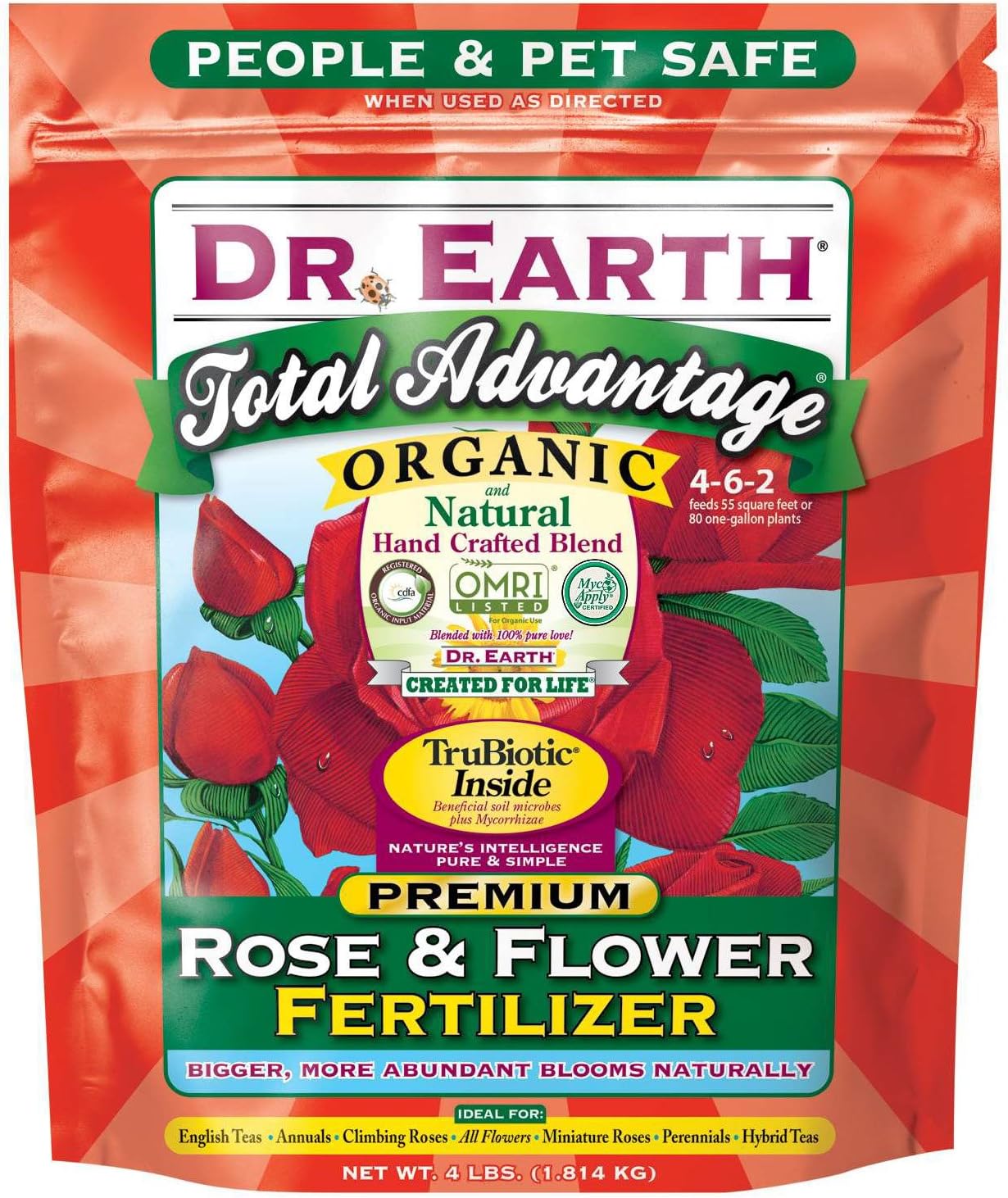
Dr. Earth Total Advantage Rose & Flower Fertilizer, 4 lb
| Item Form | Granules |
|---|---|
| Specific Uses For Product | Organic |
| Coverage | Medium |
| Target Species | flowers, roses, flowering trees, shrubs, annuals & perennials |
| Unit Count | 64 Ounce |
This Dr. Earth granular fertilizer is formulated specifically for roses and flowering plants and is intended to encourage larger, more frequent blooms by supplying a steady organic nutrient source. Typical use is sprinkling or incorporating into beds at planting, adding mid-season feeds, or using as a compost-tea drench or foliar spray; the product notes container feeding every six weeks. Notable features include an organic ingredient list with added humic acids, trace minerals and proteins, Non-GMO Project verification and multiple organic certifications that support clean, soil-building nutrition. Practically, it promotes healthier soil biology rather than quick synthetic feeding so results appear over weeks as plants respond with fuller growth and improved bloom set. Limitations are that it is not a fast-release synthetic fertilizer so gardeners seeking immediate, dramatic color boosts or rapid green-up will see slower changes, and application near water sources should be avoided to prevent runoff. Follow the package directions for timing and mixing ratios to get the intended steady feeding effect.
Best for: Roses and flower gardeners who prioritize organic, soil-building nutrition and steady bloom improvement over rapid synthetic results.
Less Ideal for: Gardeners who need quick, immediate feeding responses or instant visual changes after application should consider faster-acting alternatives.
- Formulated specifically for roses and flowering plants to promote bigger blooms
- Certified organic and Non-GMO Project verified for clean inputs
- Contains humic acids and trace minerals to support soil health and microbial activity
- Versatile application methods including broadcast, compost tea drench, foliar spray and container feeding
- Slow-release organic formula produces gradual results rather than immediate color or growth spikes
- Instructions caution against applying near water sources to avoid runoff
Verdict: Choose this product when you want a certified organic, soil-focused fertilizer built to improve rose blooms through steady, long-term nourishment.
Espoma Rose-tone Organic Rose and Flower Fertilizer, 4 lb

| Item Form | Granules |
|---|---|
| Specific Uses For Product | Gardening, Organic, Plant Food |
| Coverage | Medium |
| Target Species | Roses, Flowering Plants |
| Unit Count | 64 Ounce |
Espoma Rose-tone is an organic granular fertilizer formulated specifically for roses and other flowering ornamentals. It is applied around the plant drip line and watered in, and is intended for monthly use through the growing season to support leaf vigor and more prolific blooms. The 4-3-2 N-P-K formula with added calcium and Espoma’s Bio-tone mix uses natural ingredients and requires no mixing, so it is straightforward for routine maintenance feeding. Because it is an organic registered input, it fits gardeners who prefer natural fertility and steady nutrient release rather than fast-release synthetic boosts. Expect gradual improvements in color, flower set, and overall plant health over several weeks rather than instant greening. The product comes in a manageable 4 lb bag suited to medium coverage and is labeled for roses and other flowering shrubs. If you need a quick corrective for a specific deficiency or want a high-phosphorus bloom booster, this steady-release organic option may not replace targeted treatments.
Best for: Gardeners who prioritize organic, low-maintenance feeding schedules for roses and flowering shrubs and want a reliable monthly fertilizer during the growing season.
Less Ideal for: Growers who need fast-acting corrections, concentrated bloom boosters, or who manage very large rose plantings where bulk packaging would be more economical.
- Organic formulation approved for organic gardening
- Ready-to-use granular form requires no mixing and is easy to apply
- Balanced 4-3-2 N-P-K with added calcium supports foliage and bloom development
- Designed specifically for roses and other flowering plants
- Provides slow, steady nutrient release rather than rapid correction of deficiencies
- Sold in a single 4 lb bag which may be small for large rose gardens
Verdict: A dependable organic monthly fertilizer that steadily improves rose vigor and bloom production without mixing or synthetic inputs.
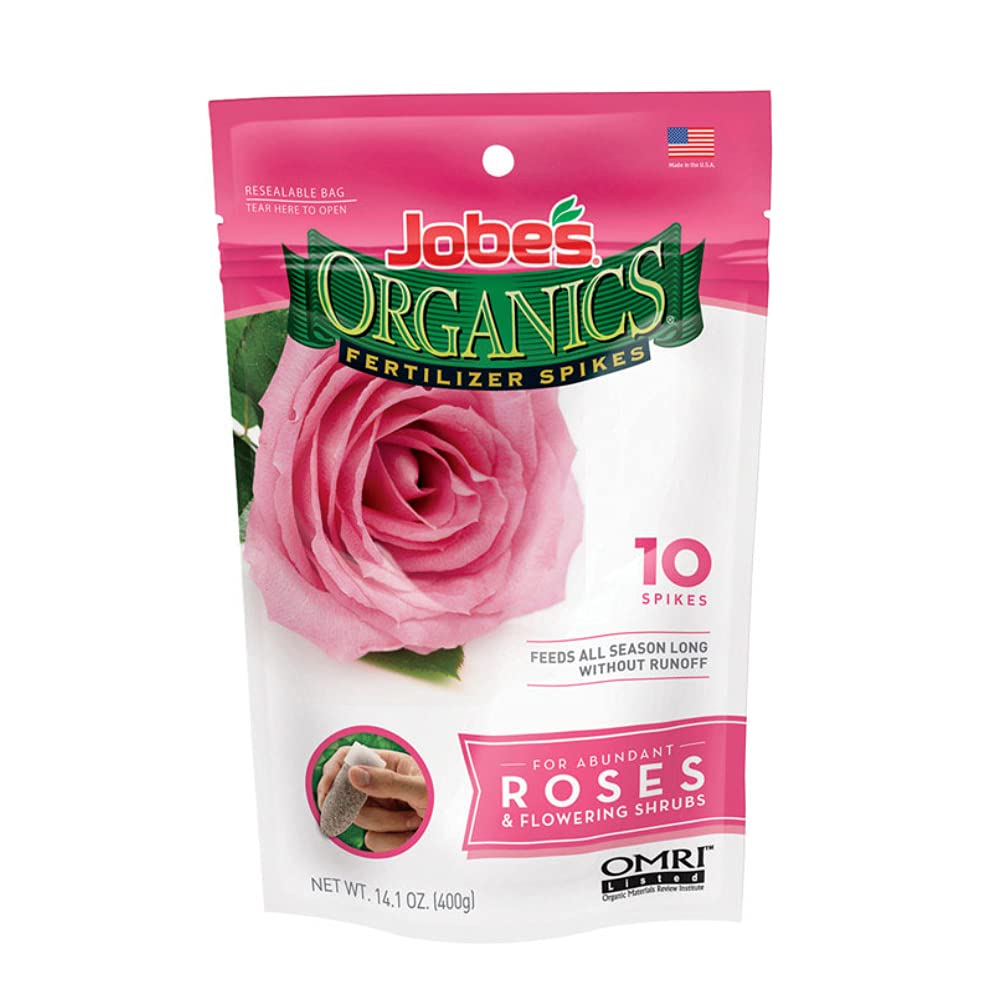
Jobes Organic Rose Fertilizer Spikes, 10 Pack
| Item Form | Sticks |
|---|---|
| Application Method | Insert into soil |
| Target Species | Roses and Flowering Shrubs |
| Unit Count | 10 Count |
| Mixing Ratio | 3-5-3 |
These Jobes organic fertilizer spikes are a low-effort way to feed roses and other flowering shrubs during the growing season. You push the premeasured sticks into the root zone and they release nutrients slowly, following a 3-5-3 NPK ratio intended for blooming plants. The stick format makes application fast and eliminates measuring or mixing liquid fertilizers, so they are convenient for regular upkeep and for gardeners who want a tidy, no-mess solution. The product is labeled organic and comes in a ten-count pack that covers a medium area, which suits small beds or a few Knock Out roses. Limitations to expect are coverage and frequency: spikes cover a moderate area so dense plantings will need multiple sticks, and larger shrubs may require repeat applications. The simple design also means there is no granular spreading option for broader lawns or beds.
Best for: Budget-minded gardeners who want a simple, low-effort way to feed a few Knock Out roses or other flowering shrubs without measuring or mixing fertilizers.
Less Ideal for: Those managing large rose borders, mass plantings, or lawns who need broad coverage or a product that can be broadcast over many plants.
- Premeasured spikes for easy, no-mess application
- Slow-release 3-5-3 formula targeted for blooms
- Organic formulation suitable for gardeners preferring organic inputs
- Ten spikes per pack works well for small beds or a few shrubs
- Medium coverage means multiple spikes required for larger or dense plantings
- Not suitable for treating large areas quickly since there is no broadcast option
Verdict: A simple, affordable organic spike fertilizer that takes the guesswork out of feeding a few Knock Out roses.
Espoma Organic Rose-Tone 4-3-2 Organic Fertilizer, 18 lb. Bag (2-Pack)

| Item Form | Granules |
|---|---|
| Specific Uses For Product | Organic Plant Food for flowers |
| Coverage | Medium |
| Target Species | roses |
| Mixing Ratio | 4-3-2 |
Espoma Rose-Tone is a ready-to-use granular organic fertilizer designed for roses and other flowering shrubs like viburnum. You apply it around the plant drip line and water in monthly during the growing season to encourage green growth and abundant blooms. The 4-3-2 N-P-K balance with added calcium and the company s Bio-tone blend provides gentle, slow-release nutrition suited to established shrubs and repeat feeding without mixing. Being an approved organic input makes it a dependable choice for gardeners who want predictable, soil-friendly feeding that supports long-term plant health. The product is medium coverage per bag and comes in a large unit suited to multiple plants or repeat monthly applications. It does not dissolve instantly like a liquid feed, so results build over weeks rather than days, and it requires correct placement and watering to be effective. For reliability-focused gardeners this fertilizer reduces guesswork by using a proven formula, but those needing rapid correction of severe deficiencies may prefer a soluble supplement.
Best for: Gardeners who prioritize consistent, low-risk feeding for flowering shrubs and want an organic, easy-to-apply fertilizer they can use monthly through the growing season.
Less Ideal for: Growers who need a fast corrective feed for acute nutrient deficiencies or who prefer liquid concentrates for quick uptake should consider alternative products.
- Organic formulation approved for organic gardening and soil-friendly feeding
- Balanced 4-3-2 N-P-K with added calcium supports flowering and overall plant vigor
- Ready-to-use granular form that requires no mixing and is easy to apply around the drip line
- Suitable for repeat monthly applications through the growing season for steady nutrition
- Slow-acting granular formula means results accumulate over weeks rather than delivering an immediate boost
- Coverage is described as medium so very large plantings may require multiple bags
Verdict: A reliable, organic granular fertilizer that delivers steady monthly nutrition to support flowering shrubs like viburnum and roses.
Jobe's Organics Granular Rose & Flower Fertilizer, 4 lb

| Item Form | Granules |
|---|---|
| Specific Uses For Product | Plant Growth,Root Development,Seed Developmen,tSoil Conditioning |
| Target Species | roses, hydrangeas, hibiscus, azaleas, and other flowering shrubs |
| Mixing Ratio | 3-5-3 |
| Unit Count | 64 Ounce |
This granular organic fertilizer is designed for roses, hydrangeas and other flowering shrubs and supplies balanced nutrients in a 3-5-3 NPK formula. It is OMRI listed so it can be used in organic gardens and is supplied as easy-to-scatter granules that you work into the soil or apply around the drip line every six weeks during the blooming season. Key ingredients listed include nitrogen, phosphate, potash and essential secondary nutrients like calcium and magnesium, which help blooms and overall plant vigor. The packaging size and medium coverage make it practical for small to medium beds or several container hydrangeas, and the granular form reduces mess and runoff compared with liquid feeds. Limitations are that the bag is only 4 pounds so larger hydrangea plantings will require frequent repurchase, and the fixed 3-5-3 ratio may not match specialty needs for acid-loving hydrangea color manipulation. Follow the product directions and wear gloves when handling.
Best for: Gardeners who want a straightforward, organically approved granular feed for hydrangeas and other flowering shrubs and prefer simple, scheduled applications during the bloom season.
Less Ideal for: Growers managing large beds or commercial plantings who need bulk fertilizer or gardeners seeking a product specifically formulated to alter hydrangea flower color.
- OMRI listed and suitable for certified organic gardening
- Balanced 3-5-3 NPK tailored to promote flowering and root development
- Granular form is easy to measure and apply with reduced runoff and mess
- Contains secondary nutrients like calcium and magnesium to support plant vigor
- 4 lb bag provides limited coverage for larger gardens
- Fixed NPK ratio limits flexibility for gardeners who need different nutrient balances
Verdict: A small, OMRI-listed granular fertilizer that reliably feeds hydrangeas and other flowering shrubs with a bloom-focused 3-5-3 formula for easy, organic seasonal applications.
BuildASoil Organic Fertilizer for Vegetable Garden (10 lb)

| Item Form | Granules |
|---|---|
| Specific Uses For Product | Plant Growth, Soil Conditioning |
| Mixing Ratio | 1:400 (nutrient tea); 1:12 to 1:6 (soil amendment) |
| Coverage | Full |
BuildASoil Organic Fertilizer is a hand-crafted granular blend designed to boost vegetable garden performance by improving soil fertility and feeding plants. It is typically used as a top-dress, soil amendment, or brewed into a nutrient tea using the provided mixing ratios. Notable features include a 2-4-2 NPK ratio, rock dust and calcium for mineral support, and a multi-ingredient organic formulation aimed at improving vigor and flavor. In practice you can sprinkle 1/4 to 1 cup per plant as a top dressing or mix 2 to 4 cups per cubic foot to recondition depleted soil; the product also recommends 1/4 to 1 cup per 5-gallon bucket for teas. Benefits you will see are steadier, more balanced growth in vegetable crops and improved soil conditioning over time rather than a sudden chemical push. Limitations are that precise NPK needs for specific crops like potatoes may require complementary potassium-heavy inputs at certain stages, and results depend on existing soil conditions and proper application rates rather than instant corrective action.
Best for: Gardeners who prioritize steady, low-risk soil improvement and prefer organic, multi-mineral fertilizers for home vegetable plots, including those who want a simple top-dress or tea recipe.
Less Ideal for: Growers who need aggressive, fast-acting single-nutrient feeds or those growing potatoes in intensive commercial systems that require precise, high-K formulations.
- Organic granular formula suitable for top-dressing or soil amendment.
- Balanced 2-4-2 NPK with added rock dust and calcium to support overall plant and soil health.
- Clear mixing and application guidance for nutrient tea, top dress, and soil re-amendment.
- Not specialized for high-potassium feeding that some potato growers use during tuber bulking.
- Effects are gradual and rely on repeated application and good soil management rather than immediate visible change.
- Single bag size may be bulky for very small container growers.
Verdict: A dependable organic granular fertilizer that improves soil health and supports steady vegetable growth, making it a safe choice for risk-averse potato gardeners who want gradual, long-term improvement.
Choosing the Right Organic Food Fertilizer for Roses: Key Factors to Consider
Nutrient Ratio And Source
Roses need a steady supply of nitrogen for healthy foliage and active growth, phosphorus for bud set and bloom development, and potassium for overall hardiness. Organic fertilizers vary widely in both the N-P-K numbers and the form of those nutrients. Some use animal manures, bone meal, and fish derivatives that release over weeks to months. Others rely on plant meals and alfalfa that feed microbes first, with nutrients becoming available as the soil biology breaks them down.
Understanding the source helps you predict how fast a rose will respond. Fast-acting organic feeds like fish emulsion give a quick green-up but require more frequent applications, while compost-based or pelletized organic foods release slowly and provide longer-term support. Match the ratio and release speed to your rose type and the season-heavier feeding in spring and early summer, lighter or no feeding late in the season to avoid tender growth before frost.
Soil Biology And Organic Matter
Organic fertilizers that add organic matter and beneficial microbes improve soil structure, water retention, and long-term nutrient cycling-factors that matter for roses which prefer deep, friable soil around their roots. Ingredients like composted manure, kelp, humic substances, and mycorrhizal inoculants support a living soil and can reduce reliance on repeat feedings.
If your soil is compacted or low in organic content, choosing a fertilizer that contributes organic matter will pay off over seasons by increasing root health and drought resilience. Conversely, in already rich loamy beds, a lighter food focused on bloom-promoting nutrients may be sufficient without adding excessive bulk.
Release Rate And Predictability
Organic fertilizers differ in how predictably they deliver nutrients. Soluble organics and liquid feeds act quickly and offer predictable short-term responses, useful for correcting a midseason deficiency or stimulating bloom. Pelletized or granular organics rely on microbial activity and temperature to break down, making their release rate variable across climates and seasons.
Consider your local temperature and soil life when choosing a product. In cooler climates or early spring, slow-release organics may act sluggishly, requiring supplemental liquid feeds. In warm, biologically active soils, a granular organic may release steadily and reduce application frequency. Predictability affects scheduling and the risk of overfeeding.
Application Method And Timing
Ease of application determines how consistently you will feed roses. Granular top-dressings are convenient for beds and large shrub roses, while water-soluble or liquid feeds are preferable for container-grown roses or quick foliar boosts. Some organic products are designed for side-dressing, others for incorporation at planting, and a few are intended as foliar sprays.
Timing also matters: apply heavier feeds in early spring and after pruning to support new growth and again at first bloom. Avoid high-nitrogen applications late in the season so new tender shoots do not suffer frost damage. Choose a product whose labeled application method fits how you garden to ensure consistent results.
Compatibility With Containers And Small Spaces
Container roses and patio plantings have different nutrient dynamics than in-ground roses. Containers hold less soil and nutrients can leach quickly, so a fertilizer suited to containers will have a predictable soluble portion or a gentle slow-release profile that avoids salt buildup. Organic foods that are bulky or require frequent incorporation are less practical for small pots.
If you garden in limited space, prioritize products that specify container use or offer water-soluble options. Also consider rootbound conditions and repotting frequency, since these influence how often a container rose needs feeding and how concentrated each application should be.
Scent, Handling, And Garden Safety
Some organic fertilizers made from fish or manures can have strong odors, which matters for patio or near-house plantings. Handling considerations include whether the product is dusty, messy, or requires gloves. Safety for children and pets also varies; fully composted materials and plant-derived meals tend to be safer and less likely to contain viable weed seeds or pathogens.
Check product form and required handling steps. If you garden near living spaces, choose low-odor, low-dust formulations. For family gardens, favor well-composted or certified organic materials with clear safety guidance.
Feeding Schedules For Different Rose Types
Hybrid teas, floribundas, shrub roses, and climbing varieties have different growth rhythms and nutrient demands. A heavier-feeding hybrid tea bed responds well to a feeding schedule that includes a spring application, a midseason boost at first bloom, and a late summer maintenance feed if needed.
For shrub and landscape roses that are more forgiving, a single slow-release organic application in early spring combined with a midseason compost top-dress can sustain plants through the season. Container roses need smaller, more frequent feeds because watering leaches nutrients faster.
- Spring: apply a balanced organic food as growth begins.
- First bloom: consider a bloom-focused or soluble feed to encourage repeat flowering.
- Late summer: reduce nitrogen to harden plants for fall.
How To Apply Organic Food Fertilizer Safely
Follow label rates and spread evenly around the root zone, not against the crown. For granular products, scatter in a donut-shaped band outside the crown to reach feeder roots. Water in after applying to start nutrient release and reduce dust.
For liquid organics, dilute as directed and avoid foliar burning by feeding in cooler parts of the day. When using manures or fish-based products, wear gloves to reduce exposure to odors and potential irritants.
- Avoid piling any fertilizer against the stem.
- Apply on dry soil if a rainstorm is expected to prevent runoff.
- Rinse equipment promptly after use to avoid clogging or smell buildup.
Adjusting Feeding For Soil Tests And Seasonal Conditions
A soil test is the most reliable way to fine-tune fertilizer choices. Tests reveal pH, available phosphorus and potassium, and organic matter percentage. If a test shows low phosphorus, choose an organic food with bone or rock phosphate; for low potassium, seek kelp or sulfate-based organic sources.
Seasonal conditions also influence need. Drought reduces nutrient uptake so avoid heavy feeding during extended dry spells. In cool springs, use more soluble organics to get plants moving; in hot summers, prioritize soil conditioners and water retention over heavy nitrogen.
- Retest soil every 2 to 4 years for long-term gardens.
- Calibrate application rates to soil fertility rather than following a fixed schedule.
Mixing Organic Foods With Compost And Mulch
Combining a chosen organic food with a compost top-dress and a mulch layer gives complementary benefits. Compost adds microbial life and slow-release nutrients while mulch conserves moisture and moderates soil temperature. Apply fertilizer, then a thin layer of compost, and finish with a 2 to 3 inch mulch, keeping mulch away from the stems.
When using concentrated organics, allow a short interval before adding mulch so surface microbes can begin processing the material. Regular annual compost additions reduce the need for heavier fertilizer applications over time.
- Apply compost annually to maintain soil structure.
- Use coarse organic mulches to improve aeration and reduce compaction.
Organic Options For Quick Bloom Boosts Versus Long-Term Health
Liquid organics and soluble feeds can deliver quick visible results and are useful when you need a short-term bloom boost for an event or to recover from a stress period. They are typically lower in long-term soil-building ingredients and need repeating.
Granular or pelletized organic foods, composts, and soil conditioners build long-term fertility and improve structure. Use these as the foundation of your feeding plan, with occasional soluble supplements if a quick response is needed.
- Use soluble feeds sparingly to avoid over-stimulation.
- Prioritize soil-building products for multi-year planting health.
How We Chose the Best Organic Food Fertilizer for Roses
We selected products using criteria that reflect how gardeners actually feed roses. First, nutrient profile and balance were essential: fertilizers had to provide usable nitrogen, phosphorus, and potassium levels or reliable slow-release organic sources that match rose needs. Second, soil-building ingredients mattered; we favored formulas with compost, humates, or microbial inoculants that improve structure and long-term fertility. Third, application practicality was assessed: options had to be realistic for beds, borders, and containers in terms of frequency and ease of spreading or watering in. Fourth, release behavior and longevity were considered so gardeners can plan feeding schedules and avoid nutrient burn. We excluded synthetic NPK salts, indoor-only potting mixes, and products intended primarily as seed-starting fertilizers. We also filtered out formulas aimed solely at lawns or general-purpose trees without rose-specific nutrient or soil amendments. The listed criteria align with measurable attributes such as guaranteed analysis, organic matter content, particle size or solubility, labeled application rates, and documented inclusion of soil biological enhancers.
FAQ
How often should I feed roses with organic food?
It depends on the product. Slow-release granular organics are often applied once or twice per season, while liquid organics may be used every two to four weeks during active growth. Adjust frequency for containers, which typically need more frequent feeding.
Can I use compost alone instead of an organic fertilizer?
Compost is excellent for improving soil life and supplying modest nutrients, but compost alone may not provide the specific N-P-K balance roses need for abundant blooms. Combining compost with a targeted organic food often gives the best results.
Will organic fertilizers change soil pH around roses?
Most organic foods have only a modest effect on pH and rarely shift it dramatically. If pH adjustment is required, address it based on a soil test using lime or sulfur amendments rather than relying on general organic fertilizers.
Are liquid organic feeds safe for foliar application?
Many liquid organics are labeled for foliar use and can provide rapid nutrient uptake, but they should be applied at recommended dilutions and not in hot sun to avoid leaf burn. Foliar feeding is best used as a supplement rather than a sole feeding method.
How do I avoid salt buildup with organic fertilizers?
True organic fertilizers are less likely to cause salt buildup than synthetic salts, but concentrated manures or high-soluble feeds can accumulate. Prevent buildup by flushing containers with extra water occasionally and rotating in compost or slow-release products.
Can I use the same organic food for roses and other flowering shrubs?
Often yes. Many organic foods formulated for flowering shrubs provide balanced nutrients suitable for roses. Check the nutrient ratio and application guidance to ensure it meets the specific needs of roses versus other shrubs.
Final Verdict
Choose an organic food fertilizer that matches your soil condition, planting style, and schedule. If you want predictable, frequent responses-especially in containers-pair a gentle soluble feed with a feeding rhythm. If long-term soil health and fewer applications are the priority, favor granular organics and regular compost additions. Balance short-term bloom goals against soil-building priorities. Prioritize nutrient balance, release predictability, and ease of application for the best seasonal performance, and adjust as needed based on soil tests and how your roses respond.
