

Note: This article contains affiliate links. If you click on these links and make a purchase, I may earn a small commission at no extra cost to you. This helps support my research and content. Read my full affiliate disclosure here.
Picking the right organic garden soil for raised beds changes how well your vegetables, herbs, and flowers establish and produce. A good mix balances drainage, water retention, and steady nutrient release so roots get oxygen and food without waterlogging. This guide shortlists seven top choices suited specifically for raised bed planting and evaluates them on the things gardeners notice in the first season and over time. We'll explain the measurement criteria used and what each factor means for your planting goals. Read on for practical guidance that gets your raised beds off to a strong start.
Top Picks at a Glance
| Best Overall The best all-around choice for most situations | Coast of Maine Castine Blend Organic Raised Bed Soil (2 cu ft) |  |
| Best Quality Built to a higher standard if you want something more solid | Coast of Maine Castine Blend Raised Bed Mix, 4-Pack (1 cu ft each) |  |
| Best Value The sweet spot between price and what you get | FoxFarm Raised Bed Planting Mix, 1.5 cu ft |  |
| Best Budget The cheapest option that still gets the job done reliably | Back to the Roots Organic Expanding Coco Coir Potting Soil Brick |  |
| Highest Rated A top-rated pick with lots of positive feedback | E.B. Stone Organics Raised Bed & Potting Mix, 2 cu ft |  |
| Most Popular A crowd favorite that many people choose with confidence | Miracle-Gro Organic Outdoor Potting Mix, 16 qt. |  |
| Best Seller A high-volume bestseller chosen again and again | Espoma Organic Vegetable & Flower Garden Soil, 1 cu ft |  |
Coast of Maine Castine Blend Organic Raised Bed Soil (2 cu ft)

| Brand | Coast of Maine |
|---|---|
| Volume | 2 cubic feet |
| Main ingredients | Compost, worm castings, mycorrhizae, biochar, shell meal |
| Made in | USA |
Coast of Maine Castine Blend is a ready-to-use raised bed soil formulated for home vegetable, herb and flower beds. The bag lists a mix of fully cured compost, peat moss, worm castings, mycorrhizae, biochar and shell meals that supply nutrients and beneficial microbes while improving aeration and moisture retention. In practice it performs like a premium organic blend: it holds moisture without becoming waterlogged, drains well in containers and raised beds, and provides a biologically active medium that supports healthier root development. The inclusion of mycorrhizae and biochar can help plants access nutrients and stabilize soil life over time. Because it is a blended, finished product there is no need to amend or mix before use, which saves time on planting days. Limitations are typical of peat-containing mixes: it is a bagged product with a finite volume per bag so larger beds require multiple bags and regular topdressing to maintain long-term fertility.
Best for: Gardeners who want a convenient, biologically rich organic soil for raised beds or containers and prefer a plug-and-play mix that supports vegetables, herbs and flowers without extra amendments.
Less Ideal for: Large-scale gardeners seeking bulk soil by the cubic yard or those who avoid peat-based products for environmental reasons should consider alternatives.
- Ready-to-use formulation eliminates the need for on-site mixing
- Contains mycorrhizae and worm castings to support root health and soil biology
- Balanced ingredients (compost, biochar, shell meals) improve drainage and moisture retention
- Designed specifically for raised beds and containers
- Sold in 2 cu ft bags so multiple bags are needed for larger beds
- Contains peat moss which some gardeners avoid for sustainability reasons
Verdict: A convenient, nutrient-rich organic raised bed mix that jump-starts healthy plant growth with built-in biology and drainage benefits.
Coast of Maine Castine Blend Raised Bed Mix, 4-Pack (1 cu ft each)

| Number of Packs | 4 |
|---|---|
| Unit Count | 4 Count |
| Volume | 3 liters |
| Made in | United States |
Coast of Maine Castine Blend is a ready-to-use organic mix made for raised beds and containers that combines compost, peat moss, biochar, worm castings, shell meals and mycorrhizae to support steady vegetable growth. In practice you fill or top up raised beds and planter boxes with the mix and plant directly into it without needing to blend in other amendments. Notable features include a variety of natural nutrient sources for slow-release feeding, ingredients that help balance moisture retention and drainage, and the addition of mycorrhizae to aid root establishment. For gardeners focused on consistent performance, the mix saves time and reduces guesswork when preparing beds for vegetables and herbs. Limitations are that peat-based mixes can compress over time and may require occasional top dressing or loosening, and gardeners who prefer a completely peat-free product will need a different formula. Overall the Castine Blend is a practical, organic option when you want a reliable, ready-made base for productive raised bed vegetable growing.
Best for: Gardeners who prioritize reliable, performance-driven results in raised beds and container vegetable gardens and want a ready-made organic mix that reduces prep work and supports steady yields.
Less Ideal for: Growers seeking a peat-free or custom-blend soil to tune exact nutrient levels and texture should consider other specialized mixes or build their own blend.
- OMRI-listed organic ingredients support living soil and slow-release nutrition
- Formulated for raised beds and containers so it can be used without additional mixing
- Includes mycorrhizae and worm castings to improve root health and nutrient uptake
- Blend of biochar, shell meals and greensand helps water retention while maintaining aeration
- Contains sphagnum peat moss which some gardeners avoid for sustainability reasons
- May compact or settle over time and require periodic top dressing or loosening
Verdict: Buy this if you want a ready-to-use organic raised bed mix that reliably supports steady vegetable and herb growth with minimal preparation.
FoxFarm Raised Bed Planting Mix, 1.5 cu ft

| Brand | FoxFarm |
|---|---|
| Volume | 1.5 cubic feet |
| Style Name | Raised Bed |
| Ingredients | Aged forest products, sphagnum peat moss, earthworm castings, oyster shell, dolomite lime |
FoxFarm Raised Bed Planting Mix is a pre-mixed garden soil designed to simplify filling raised beds and containers. The bag combines aged forest products and sphagnum peat moss for a balance of moisture retention and aeration, while added earthworm castings, oyster shell, and dolomite lime supply slow-release nutrients and help maintain soil pH for healthy root development. Typical use is straightforward: pour into a raised bed or large container, plant, and water; no on-the-spot mixing or amendments are required for many common vegetables and ornamentals. Practical benefits include consistent texture that encourages root growth, ingredients that reduce the need for immediate fertilizing, and a formulation aimed at good drainage to avoid waterlogging. Limitations are the 1.5 cubic foot bag size, which means multiple bags are needed for larger beds, and the peat-based formula may not align with gardeners seeking strictly peat-free mixes. Also this mix is a starter medium rather than a long-term fertilizer source, so seasonal feeding may still be necessary for heavy-feeding crops.
Best for: Gardeners who want a convenient, no-mix soil to quickly fill raised beds or containers and prefer a nutrient-ready medium that supports vegetables, herbs, and flowers with minimal prep.
Less Ideal for: Large-scale growers or those filling many raised beds who need bulk soil cost-efficiency or gardeners seeking a peat-free certified substrate.
- Ready-to-use blend eliminates the need for on-site mixing
- Contains earthworm castings and oyster shell for slow-release nutrients
- Good balance of moisture retention and drainage for raised beds and containers
- Helps create a loose, airy medium that supports strong root development
- Small 1.5 cu ft bag means multiple bags are required for larger raised beds
- Contains sphagnum peat moss which some gardeners avoid for sustainability reasons
Verdict: A convenient, nutrient-rich ready mix that gets raised beds and containers planted quickly while promoting healthy root growth.
Back to the Roots Organic Expanding Coco Coir Potting Soil Brick

| Item Highlight | 10 lb compressed coco coir brick; peat-free; OMRI Listed |
|---|---|
| Item Type Name | Coconut Coir |
| Volume | 2 cubic feet |
This compressed coco coir brick is a lightweight, peat-free growing medium that expands to roughly 2 cubic feet when you add water, making it a compact way to store and mix fresh potting soil for raised beds and containers. Use it alone for seed starting and container crops or blend it with compost and existing garden soil to improve drainage, aeration, and water retention. Notable features include OMRI listing for organic use and a balanced pH that suits vegetables, herbs, and flowers. For gardeners on a budget the brick reduces storage and shipping bulk compared with bagged mixes and lets you control mix ratios when amending raised beds. Important limitations are that coco coir is largely inert so it needs nutrients from compost or fertilizer for long-term container crops, and you must hydrate and fluff it properly to avoid compressed clumps. If you want a ready-to-use, nutrient-rich soil out of the bag this is not it, but as a low-cost, peat-free base or amendment it is practical and versatile.
Best for: Gardeners fitting raised beds or containers who want a low-cost, peat-free base to mix with compost or fertilizer and prefer to buy compact, easy-to-store materials.
Less Ideal for: Buyers who need a ready-to-use, nutrient-rich potting mix straight from the bag or those unwilling to amend a base medium with organic inputs.
- Expands to about 2 cubic feet from a 10 lb compressed brick for compact storage
- Peat-free and OMRI listed for organic gardening and raised beds
- Neutral pH and good aeration and water retention when rehydrated
- Versatile use: can be used alone for seed starting or mixed into garden soil and compost
- Inert medium that provides little nutritional value without added compost or fertilizer
- Requires thorough rehydration and fluffing to reach usable texture
Verdict: A compact, peat-free coco coir brick that expands into an affordable organic base for amending raised beds and containers.
E.B. Stone Organics Raised Bed & Potting Mix, 2 cu ft

| Brand Name | E.B. Stone Organics |
|---|---|
| Unit Count | 1536 Ounce |
| Manufacturer | E.B. Stone & Son, Inc. |
| Volume | 2 cubic feet |
This E.B. Stone Organics mix is formulated as a turnkey soil for raised beds and large containers, so you can fill beds straight from the bag without additional amendments. The blend of compost, coir and pumice gives it a balance of moisture retention and drainage while earthworm castings and mycorrhizae contribute living fertility that supports root health and nutrient uptake. Typical uses are filling new raised beds, topping up containers, or mixing into tired native soil to improve structure and biology. Because it is organic and free of synthetic chemicals it is suitable for vegetable gardens and family food crops. The 2 cubic foot bag covers a useful area for small to medium beds but heavier users will want multiple bags or bulk orders. Expect consistent, reliable performance in season-long plant growth, though very large installations may be more economical with bulk soil deliveries.
Best for: Gardeners who want a dependable, organic soil that performs straight from the bag for raised beds, containers, and vegetable plots without frequent fertilizer inputs.
Less Ideal for: People establishing very large or commercial-scale beds who need bulk quantities or a lower per-cubic-foot cost should consider bulk soil or custom blends.
- Ready-to-use formulation for raised beds and large containers
- Contains compost, earthworm castings and mycorrhizae to build living soil
- Coir and pumice balance moisture retention with good drainage
- Organic and free of synthetic chemicals, safe for vegetable growing
- 2 cubic foot bag size means multiple bags are needed for larger beds
Verdict: Choose this packable organic mix when you need a reliable, ready-to-use raised bed soil that supports healthy vegetable and container plant growth.
Miracle-Gro Organic Outdoor Potting Mix, 16 qt.

| Item Highlight | Plant Soil For Outdoor Container Plants, Contains Quick-Release Natural Fertilizer, OMRI Listed |
|---|---|
| Brand Name | Miracle-Gro |
| Volume | 1 cubic feet |
| Unit Count | 1 Count |
This 16 qt bag of Miracle-Gro Organic Outdoor Potting Mix is designed for use in outdoor containers and is blended to help plants establish quickly. It contains responsibly sourced peat, upcycled green waste, and a quick-release natural fertilizer that the brand says feeds for up to two months. Typical use is straightforward: partially fill a pot, loosen the root ball, set the plant in place, top up with mix, press lightly and water. The mix holds moisture better than plain garden soil while still allowing drainage appropriate for pots, which makes it useful for flowers, herbs, vegetables and perennials grown in raised containers. Because it is OMRI listed you can use it in organic setups. Important limitations are volume and longevity: a single 16 qt bag fills roughly one 12-inch pot so larger raised beds will require many bags, and nutrients are short-term so periodic repotting or additional amendments are needed for long-season crops. For raised beds specifically, this product is best used as a container-focused amendment rather than a wholesale raised-bed soil replacement.
Best for: Buyers who want an organic-certified potting mix for outdoor containers and raised-bed edges and who value easy-to-use blends that give a quick nutrient boost.
Less Ideal for: Gardeners looking to fill large raised beds or build long-term in-ground soil should choose bulk garden soil or a compost-rich mix instead.
- OMRI listed for use in organic gardening
- Includes quick-release natural fertilizer that feeds up to two months
- Formulated to retain moisture while providing drainage for outdoor containers
- Made with responsibly sourced peat and upcycled green waste
- Small 16 qt volume makes it impractical as the sole soil for large raised beds
- Fertilizer effect is short-term so extras or repotting are needed for long-season plants
Verdict: A convenient OMRI-listed potting mix that gives outdoor container plants a quick organic nutrient boost, ideal for small raised beds and pots.
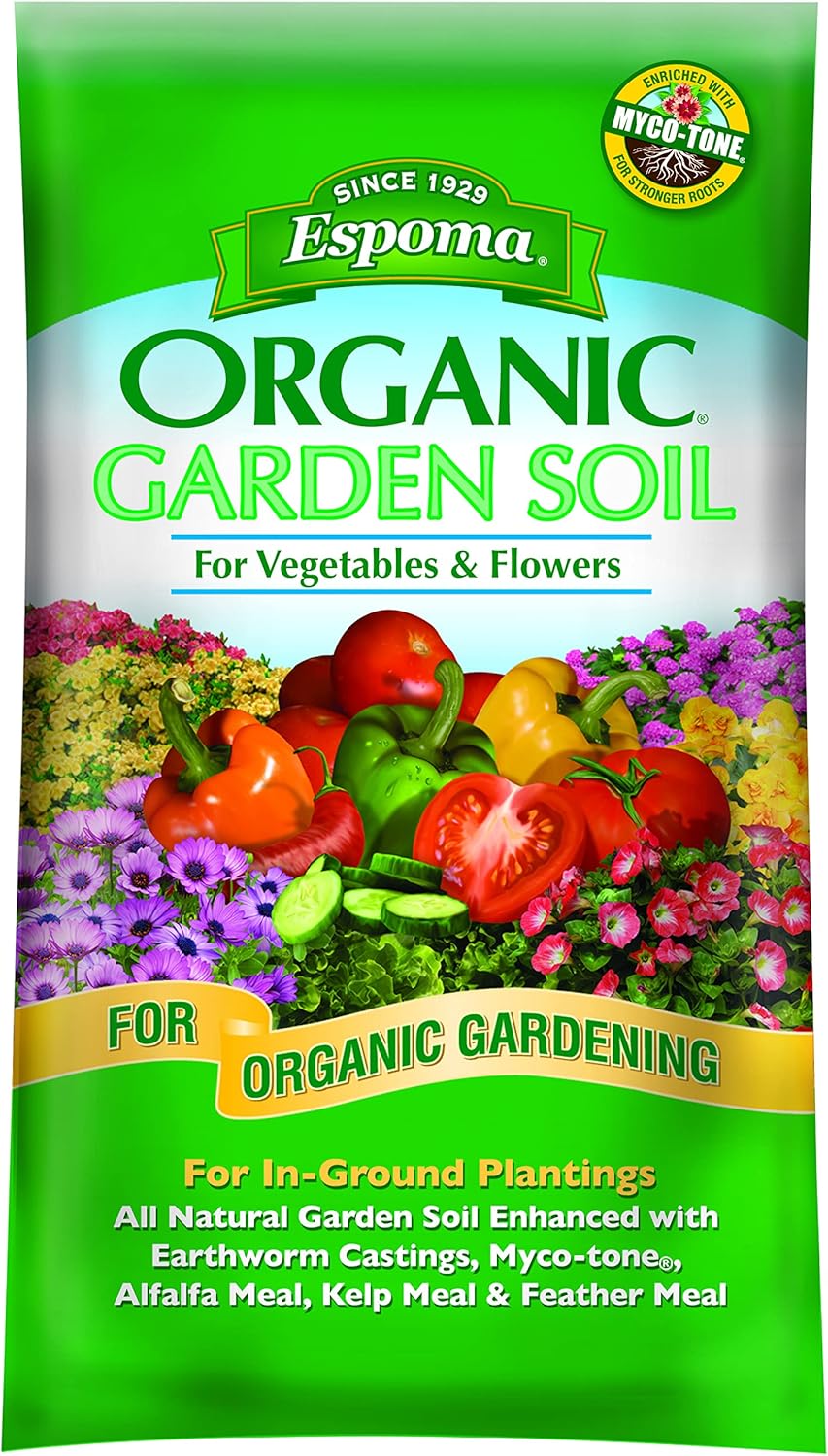
Espoma Organic Vegetable & Flower Garden Soil, 1 cu ft
| Volume | 1 cubic feet |
|---|---|
| Style Name | Peat Moss |
| Ingredients | Peat moss, aged forest products/composted rice hulls, limestone, earthworm castings, alfalfa meal, kelp meal, feather meal, yucca extract |
Espoma Organic Vegetable & Flower Garden Soil is a one-cubic-foot, organic planting mix intended to be blended into native soil when planting or transplanting in raised beds. It contains peat moss, aged organic materials, earthworm castings and a mix of organic meals and kelp that add organic matter and slow-release nutrients. The product also includes a proprietary mycorrhizal blend to help root establishment. Typical use is to mix this soil into the top few inches of bed soil to improve texture, water retention and nutrient availability for seedlings, transplants and annuals. For gardeners wanting an organic option, it reduces the need for immediate fertilization and helps fragile transplants get established. Because it is a small one-cubic-foot bag, it is most practical for topping up or amending individual beds rather than filling large raised beds from scratch. The peat-based formula improves moisture retention but may compress over time, so occasional re-amendment is advisable.
Best for: Gardeners who prioritize organic inputs and want an easy-to-mix soil amendment to improve transplant success and top-dress raised beds.
Less Ideal for: Those building or filling large raised beds from scratch or gardeners seeking a peat-free blend should consider bulk soil or alternative mixes instead.
- Formulated with organic ingredients including peat moss, earthworm castings and plant meals for slow nutrient release
- Includes endo and ecto mycorrhizae to support root development and transplant establishment
- Designed to be mixed with native soil to improve texture and moisture retention in beds
- Clearly labeled for organic gardening with no synthetic fertilizers listed
- Small 1 cubic foot bag makes it inefficient for filling large raised beds
- Peat moss content can compact over time and may require periodic re-amendment
Verdict: A convenient organic amendment that helps transplants establish and improves raised bed soil when used to top-dress or mix into native soil.
Choosing the Right Organic Garden Soil for Raised Beds: Key Factors to Consider
Texture and Drainage
Texture determines how easily roots push through the soil and how freely excess water moves out of the root zone. In raised beds you want a mix that is loose and friable, with a balance of fine particles that hold moisture and larger particles that create air space.
Poor drainage leads to anaerobic conditions and root rot in many vegetables, while overly sandy soil drains too fast and stresses plants between irrigations. Look for mixes that list a blend of compost, peat or coir, and coarse mineral components like perlite, pumice, or screened sand. Those components create the macropores needed for healthy root growth.
Nutrient Content and Balance
Starting fertility matters because it affects early growth and how soon you need to add amendments. Organic mixes vary from low-nitrogen, low-phosphorus bases to those precharged with compost and natural fertilizer sources.
Consider what you plan to grow: heavy feeders such as tomatoes and squash will need more available nitrogen and potassium early on. Check whether the product lists guaranteed analysis or describes the types of organic inputs used. A mix with a modest, slow-release nutrient profile reduces the risk of burning seedlings and gives time to layer in targeted amendments.
Water Retention
Raised beds can dry out faster than in-ground beds because of exposed sides and shallower root zones. Water retention is how well a soil holds plant-available moisture between waterings while still allowing excess to drain.
Look for organic components that hold water without compacting, such as well-aged compost and coir. Avoid mixes that rely solely on peat if you want sustainable options, but recognize peat-heavy blends often hold water well. The ideal mix combines moisture-holding fines with structural elements that prevent compaction under repeated wet-dry cycles.
Organic Matter Quality and Longevity
Not all organic matter behaves the same through the seasons. Fresh, unaged manures or uncomposted green waste can temporarily immobilize nitrogen as microbes break them down, while well-matured compost provides steady nutrient release and supports soil biology.
For raised beds aim for stable organic matter that improves aggregation and feeds soil life without causing short-term nutrient swings. Consider how the mix will change over one to three seasons and whether it needs periodic replenishment or topdressing to maintain structure and fertility.
Weed Seed and Contaminant Risk
Imported organic inputs sometimes carry weed seeds or high salt levels that become problems in a confined raised bed. Because beds concentrate plantings, a few persistent weed seeds can rapidly become a maintenance headache.
Choose soils produced with proper heat-treatment or clean, screened compost and inspect any documentation about contaminant testing. Avoid mixes without clear sourcing for composted materials if you want to minimize weeding and the risk of undesirable plant escapes.
pH and Mineral Availability
Soil pH controls nutrient availability and affects which plants will thrive without extra amendment. Raised beds often need a neutral to slightly acidic pH for most vegetables.
Check whether a mix lists expected pH or includes lime or sulfur adjustments. If pH is not stated, be ready to test after filling the bed and correct with lime to raise pH or sulfur to lower it depending on crop needs. Proper pH reduces the need for corrective foliar feeds and keeps nutrients accessible.
Preparing Your Raised Bed Before Filling
Take time to prepare the bed base before adding new organic soil. Remove perennial weeds and existing roots, and consider laying a breathable weed barrier only if you have a serious perennial rhizome problem. Avoid impermeable barriers that trap water and prevent drainage.
If the bed is over a hard surface, add a coarse drainage layer of well-aged wood chips or gravel only where you experience chronic waterlogging. For beds on garden soil, rough the surface to encourage mixing and avoid creating a hard line between the native soil and the new organic mix.
- Clear debris and perennial roots
- Avoid impermeable liners that block drainage
- Rough up native soil to encourage integration
Filling Strategy and Layering
How you fill the bed affects settling and root access to nutrients. Mix native topsoil with purchased organic garden soil at a ratio that matches your existing ground conditions. For brand-new beds over non-soil bases, use a full depth of organic mix and plan to top up as it settles.
Layering in amendments such as compost or slow-release organic fertilizer at the time of filling gives a steady nutrient supply. Avoid high concentrations of fresh manure on the surface where seedlings are planted.
- Use a heavier mix for deep-rooted crops
- Topdress annually with finished compost
- Allow at least one week between filling and planting if heavy amendments were added
Seasonal Watering and Mulch Tips
Watering practices interact with soil mix choices. Soils that drain well may require more frequent but shorter waterings, while higher-retention mixes benefit from deeper, less frequent applications. Adjust irrigation based on the crop and weather, not a fixed schedule.
Apply a 2- to 3-inch layer of organic mulch to reduce evaporation and moderate soil temperature. Mulch also adds slowly available organic matter as it breaks down and helps suppress surface weeds that can compete in confined beds.
- Water deeply and less frequently for root development
- Use organic mulch to conserve moisture
- Monitor soil moisture below the surface before watering
Adjusting Soil Over Multiple Seasons
Raised-bed soil evolves as organic matter decomposes and settles. Expect to add a few inches of material over one to three years to maintain depth and fertility. Annual topdressing with compost restores structure and microbial life.
If compaction becomes an issue, work in coarse organic amendments like chopped straw or perlite during the dormant season. Periodic testing of nutrient levels and pH helps you make precise corrections and avoid blanket fertilizer applications.
- Topdress with finished compost each year
- Test pH and nutrients every 1-2 years
- Loosen compacted beds in the off-season
Sourcing and Sustainability Considerations
Consider the sustainability of ingredients when choosing an organic soil. Coir, composted yard waste, and responsibly harvested bark are generally preferable to nonrenewable peat. Local compost sources also reduce transport impact and support circular waste use.
Look for transparent sourcing statements and, when possible, request material origin. Using locally produced compost makes it easier to verify weed seed control and input quality.
- Prefer locally made compost where available
- Balance sustainability with the functional needs of the bed
- Ask sellers about heat-treatment and screening practices
How We Chose the Best Organic Garden Soil for Raised Beds
We focused on factors that actually affect plant health in raised beds rather than marketing claims. Selection began with mixes formulated for raised beds or container-style planting and those labeled organic or made from identifiable organic inputs. We prioritized physical properties, such as texture and drainage profile, because raised beds depend on air-filled pore space to prevent compaction. Nutrient retention and starting fertility were measured by ingredient transparency and typical nitrogen-phosphorus-potassium ranges reported by manufacturers or test data where available. Long-term structure and amendment potential were evaluated by presence of stable organic matter and materials that support earthworms and microbial life. Ease of use and safety were considered by checking for weed seed levels and any undisclosed synthetic additives. We excluded blends intended solely for topdressing, decorative mulch, or heavy clay field soil not amended for raised-bed systems. Final picks balance immediate planting readiness, season-long water behavior, and capacity to improve over multiple seasons with standard garden amendments.
FAQ
How deep should I fill a raised bed with organic soil for vegetables?
Most vegetables do well with 10 to 12 inches of quality organic soil, while deep-rooted crops like carrots and potatoes benefit from 12 to 18 inches. If starting over a hard surface, aim for at least 12 inches to give roots room to develop.
Can I mix my own organic soil for a raised bed?
Yes. A common approach is one part compost, one part quality topsoil or screened loam, and one part aeration material such as perlite or coarse sand. Adjust ratios based on your native soil and the water retention you need.
How often should I replenish or topdress raised bed soil?
Topdress with 1 to 2 inches of finished compost each year to replace lost organic matter and refresh nutrients. More frequent additions may be needed in intensively cropped beds or where you remove a lot of biomass.
Is coconut coir a good alternative to peat in raised-bed mixes?
Coconut coir holds water well and is a more renewable option than peat. It may require supplemental calcium or potassium depending on the source, so monitor plant response and amend accordingly.
Should I test my raised bed soil, and what should I test for?
Testing for pH and basic nutrient levels every one to two years gives actionable information for amendments. A composite sample that represents the whole bed will help you correct deficiencies or pH imbalances without guesswork.
How can I avoid weed seeds in purchased organic garden soil?
Choose soils made from fully composted and screened inputs and check product documentation for weed-seed control. When in doubt, spread new soil thinly and solarize or allow it to rest before planting to reduce viability of stray seeds.
Final Verdict
For raised beds prioritize a soil that balances drainage, moisture-holding capacity, and stable organic matter. Tradeoffs are inevitable: mixes that drain exceptionally well may need more frequent watering, while high-retention blends require careful irrigation to avoid soggy roots. Focus on texture and organic matter quality first, then address nutrient needs and pH with targeted amendments. With the right mix and a simple plan for topdressing and testing, you can keep raised-bed soils productive season after season.
