

Note: This article contains affiliate links. If you click on these links and make a purchase, I may earn a small commission at no extra cost to you. This helps support my research and content. Read my full affiliate disclosure here.
Choosing the right organic granular fertilizer matters because it affects plant vigor, soil life, and how often you need to feed. In real gardens, a product that supplies balanced nutrients and feeds gradually reduces stress on plants and supports soil biology. This guide covers seven shortlisted organic granular fertilizer options chosen for common garden situations from vegetables and annuals to established shrubs and container plants. We evaluate each pick for nutrient profile, release behavior, ease of application, and soil-health benefits so you can pick something that fits your soil test and maintenance preferences. Read on to see how these picks compare across the key decision points.
Top Picks at a Glance
| Best Overall The best all-around choice for most situations | Down To Earth Organic Vegetable Garden Fertilizer 4-4-4, 5 lb |  |
| Best Quality Built to a higher standard if you want something more solid | MicroLife Multi-Purpose 6-2-4 Granular Organic Fertilizer, 40 lb |  |
| Best Value The sweet spot between price and what you get | Jobe's Organics All-Purpose Granular Fertilizer (16 lb) |  |
| Best Budget The cheapest option that still gets the job done reliably | Jobe's Organics Granular Fruit & Nut Fertilizer, 4 lb |  |
| Highest Rated A top-rated pick with lots of positive feedback | Espoma Organic Plant-Tone All-Purpose 5-3-3 Organic Plant Food, 50 lb Bag |  |
| Most Popular A crowd favorite that many people choose with confidence | Jobe's Organics Granular Fruit & Citrus Fertilizer, 4 lb |  |
| Best Seller A high-volume bestseller chosen again and again | Burpee All-Purpose Organic Granular Plant Food, 4 lb |  |
Down To Earth Organic Vegetable Garden Fertilizer 4-4-4, 5 lb

| Item Form | Granules |
|---|---|
| Specific Uses For Product | Vegetables, greens, tomatoes, herbs |
| Application Method | Apply directly to the soil or mix into garden beds |
| Mixing Ratio | 4-4-4 |
This granular fertilizer is formulated to feed vegetables, herbs and greens with a balanced 4-4-4 NPK and a slow-release profile that supplies nutrients over time. It is applied by distributing into the planting hole, mixing into topsoil, or working into raised beds at planting and during the season for maintenance. Notable features include all-natural ingredients sourced from plant, marine and mineral resources and OMRI-friendly formulation that supports organic gardening and beneficial soil life. Practically, the slow-release granules reduce the need for frequent feeding and help avoid nutrient spikes that can stress plants. The 5 lb unit is convenient for small to medium beds but means frequent repurchasing for larger plots. While it is versatile across vegetables and herbs, gardeners who need rapid corrective feeding for a specific deficiency will still need a targeted amendment or foliar feed in addition to this product.
Best for: Gardeners who prioritize steady, reliable plant performance and want an organic, low-maintenance fertilizer for raised beds and small plot vegetable production.
Less Ideal for: Growers managing large acreage or those needing immediate corrective nutrient treatments should look for bulk or fast-acting specialty products instead.
- Balanced 4-4-4 NPK suitable for overall vegetable development
- Slow-release granular formula for sustained feeding
- Made from all-natural ingredients and compatible with organic systems
- Easy to apply directly to soil or mix into raised beds
- Small 5 lb size may require frequent replacement for larger gardens
- Not formulated for quick correction of specific nutrient deficiencies
Verdict: Choose this product when you want an organic, slow-release 4-4-4 fertilizer that delivers steady nourishment for productive vegetable beds.
MicroLife Multi-Purpose 6-2-4 Granular Organic Fertilizer, 40 lb
| Item Form | Granules |
|---|---|
| Specific Uses For Product | Fertilizing |
| Coverage | Full |
| Target Species | all plants |
| Mixing Ratio | 6:2:4 |
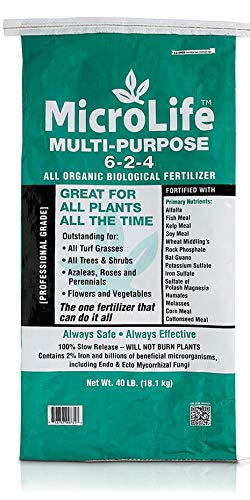
MicroLife Multi-Purpose 6-2-4 is a slow-release, granular organic fertilizer designed to improve plant vigor and soil health across lawns, ornamentals, vegetables, trees, and shrubs. It is typically spread with a broadcast or drop spreader and worked into beds or turf where its blend of fish, kelp, humates, rock phosphate and protein meals releases nutrients over months. Notable features include a biological inoculant package claimed to contain beneficial microbes and a broad mix of minerals, amino acids, and trace elements that support strong root development and stress tolerance. For gardeners focused on performance, the formula promotes steady growth without synthetic salts so it will not burn when applied at recommended rates and repeats every 3 to 4 months. The trade-offs are that results are slower to appear than synthetic quick-release fertilizers and you must store and handle a large 40 pound bag. For someone prioritizing sustained, biologically driven lawn and landscape performance, this product offers a reliable organic route to bigger roots and improved soil structure.
Best for: Gardeners and lawn stewards who prioritize long-term performance and soil health and want an organic, slow-release fertilizer to support robust root systems and sustained growth.
Less Ideal for: People seeking immediate greening or rapid nutrient correction or those who prefer lightweight, small-quantity packaging for occasional use.
- All-organic, slow-release 6-2-4 formula that reduces burn risk
- Contains a range of natural inputs (fish, kelp, humates, meals) for broad nutrient and soil-building benefits
- Includes a biological inoculant package intended to boost beneficial soil microbes
- Long coverage interval with recommended reapplication every 3 to 4 months
- Slower visible nutrient response compared with synthetic quick-release fertilizers
- Large 40 lb bag can be heavy to handle and store for casual users
Verdict: Choose this product if you want a proven organic, slow-release fertilizer that builds soil biology and delivers sustained performance across lawns and landscapes.
Jobe's Organics All-Purpose Granular Fertilizer (16 lb)

| Item Form | Granules |
|---|---|
| Specific Uses For Product | Plant Growth, Root Development, Seed Development, Soil Conditioning |
| Mixing Ratio | 4-4-4 |
| Coverage | Resealable |
This is a straightforward organic granular fertilizer designed for regular feeding of vegetable gardens and other ornamentals. With an NPK of 4-4-4 and ingredients like feather meal, bone meal, and processed poultry manure, it supplies balanced nutrients and some calcium and sulfur for steady growth and improved root development. You apply it to soil every 2 to 3 weeks during the growing season; as a slow-to-release granular it reduces the need for daily attention and lowers the risk of burning when used as directed. The product is OMRI listed for organic gardening and is presented in a resealable bag for tidy storage. Limitations to be aware of are the modest NPK numbers, which mean it is best for maintenance feeding rather than rapidly correcting severe nutrient deficiencies, and the need to reapply frequently compared with longer-term slow-release formulations. For growers wanting an easy, certified-organic feed for vegetables and mixed beds, this covers most bases without complex application methods.
Best for: Home vegetable gardeners and practical growers who prioritize organic inputs and want a simple, repeatable feeding routine to maintain steady plant growth.
Less Ideal for: Growers who need a high-concentration or targeted corrective fertilizer for severe nutrient deficiencies or for single-crop intensive production should consider specialized formulas instead.
- OMRI listed and made from organic-derived sources suitable for certified organic vegetable production
- Balanced 4-4-4 NPK supports foliage, flowers, and fruit development without strong spikes
- Granular, slow-to-release form reduces immediate burn risk and simplifies feeding schedule
- Resealable packaging helps keep product dry and minimizes mess during storage
- Lower nutrient concentrations mean more frequent application or higher volumes are needed for nutrient-poor soils
- Not formulated for a single crop nutrient correction so may be insufficient for plants with specific high-demand deficiencies
Verdict: A reliable, OMRI-listed all-purpose granular fertilizer that gives practical, balanced organic feeding for vegetable gardens with minimal fuss.
Jobe's Organics Granular Fruit & Nut Fertilizer, 4 lb

| NPK | 3-5-5 |
|---|---|
| Target Species | Fruit and nut |
| Item Form | Granules |
| Unit Count | 64 Ounce |
| Specific Uses For Product | Plant Growth, Root Development, Seed Development, Soil Conditioning |
Jobe's Organics Granular Fruit & Nut Fertilizer is a small-bag, slow-release granular designed to feed the roots of fruit and nut trees, including pears. It supplies a balanced 3-5-5 NPK plus calcium, magnesium, and sulfur derived from organic sources such as feather meal and bone meal. Typical use is to broadcast or side-dress around the root zone every 4 to 8 weeks during the growing season; granules release nutrients gradually so you do not need frequent reapplication. Benefits include organic certification for use in organic gardens, straightforward measuring and application, and nutrients aimed at improving bloom and fruit set rather than quick leafy growth. Important limitations are the small 4 lb bag size, which means multiple bags will be needed for larger orchards, and the lower nitrogen ratio compared with general-purpose fertilizers if you want foliage-heavy growth. It is safe to use around people and pets when directions are followed, but users should avoid applying in windy conditions to prevent drift.
Best for: Home gardeners and small-plot fruit growers who prioritize organic inputs and want an easy-to-apply fertilizer to support fruit set and steady production in pear trees.
Less Ideal for: Commercial orchards or large properties that need bulk fertilizer or fast-acting high-nitrogen feed to drive rapid vegetative growth.
- OMRI listed organic formula suitable for certified organic gardens
- Balanced 3-5-5 NPK geared toward flowering and fruit production
- Slow-release granules that feed roots over weeks reducing application frequency
- Includes secondary nutrients like calcium and magnesium to support fruit quality
- 4 lb bag is small for multiple or mature trees
- Lower nitrogen percentage may be insufficient when rapid vegetative growth is desired
Verdict: A small, OMRI-listed granular fertilizer that reliably supports flowering and fruit production in pear trees for gardeners who prefer organic, slow-release nutrition.
Espoma Organic Plant-Tone All-Purpose 5-3-3 Organic Plant Food, 50 lb Bag

| Item Form | Fertilizer |
|---|---|
| Specific Uses For Product | Gardening |
| Target Species | all flowers, vegetables, trees and shrubs |
| Mixing Ratio | 1:1:1 |
Plant-Tone is designed to feed a range of garden plants by releasing nutrients slowly from natural ingredients and a proprietary Bio-tone microbial formula. In practice you apply it around the drip line of flowers, vegetable plants, shrubs or trees in spring and fall, and for annuals and vegetables you can top-dress monthly during the season. The 5-3-3 analysis with 5% calcium supports balanced growth and blossom set while the organic base builds soil biology over time rather than giving an immediate synthetic spike. A 50 lb bag covers large beds and landscape plantings so it is convenient for serious flower-bed upkeep. Limits are that it is not a quick-fix for severe nutrient deficiency and results accumulate over weeks to months, so impatient gardeners may need a faster-acting supplement for rescue feeding. Also being granular, it requires spreading and watering in rather than foliar application.
Best for: Gardeners focused on steady, reliable performance who maintain multiple flower beds or mixed plantings and prefer improving soil health while feeding blooms and foliage.
Less Ideal for: People needing immediate corrective feeding for yellowing or severely deficient plants or those who only want small-quantity, single-plant solutions.
- Organic, slow-release formula that builds soil biology over time
- Broadly suitable for flowers, vegetables, trees and shrubs
- Includes 5% calcium to support bloom and fruit development
- Large 50 lb bag is practical for maintaining multiple flower beds or landscape areas
- Not a rapid corrective feed for acute nutrient deficiencies
- Requires spreading and watering in; not suitable for foliar feeding
Verdict: Choose this if you want a proven organic, slow-release fertilizer that steadily feeds flower beds and builds soil health while supporting blooms.
Jobe's Organics Granular Fruit & Citrus Fertilizer, 4 lb

| Item Form | Granules |
|---|---|
| Specific Uses For Product | Plant Growth, Root Development, Seed Development, Soil Conditioning |
| Application Method | Spread evenly around base |
| NPK | 3-5-5 |
| OMRI Listed | Yes |
This granular Jobe's Organics fertilizer is designed to feed fruit and citrus trees with a slow-release, root-targeted NPK of 3-5-5. It is typically applied by measuring and spreading the granules evenly around the base of the tree, then watering in; applications are recommended every 4 to 8 weeks during the growing season. Notable features include OMRI listing for organic gardening, a blend of feather meal, bone meal and processed poultry manure for organic nutrient sources, and a resealable bag for convenient storage. In practice the formula supports root development and fruit set without synthetic chemicals, and the slow-release nature reduces the need for very frequent feeding. Limitations are that the lower nitrogen level makes it better suited for fruiting and flowering stage nutrition rather than rapid leafy growth, and larger trees will require repeated applications or larger quantities. For gardeners aiming for an organic, low-fuss feed for citrus, this provides predictable, targeted nutrition, but it is not a quick-fix soluble feed for immediate green-up.
Best for: Gardeners who prefer organic, low-maintenance feeding for citrus and fruit trees and want a slow-release product that focuses on fruit and root health.
Less Ideal for: Growers needing fast, high-nitrogen correction or a soluble foliar feed; landscapers managing many mature trees who need bulk quantities more often.
- OMRI listed organic formula suitable for certified organic gardens
- Balanced 3-5-5 NPK aimed at improving flowering and fruit production
- Slow-release granules that feed roots over time and reduce application frequency
- Resealable packaging keeps product fresh between uses
- Lower nitrogen content means it will not rapidly promote leafy growth
- 4 lb bag may be insufficient for mature trees or larger plantings
Verdict: A reliable OMRI-listed granular fertilizer that delivers slow-release, fruit-focused nutrition for organic citrus gardeners.
Burpee All-Purpose Organic Granular Plant Food, 4 lb

| Item Form | Granules |
|---|---|
| Specific Uses For Product | Gardening,Plant Growth,Root Development |
| Coverage | 213 Square Feet |
| Target Species | Herba |
Burpee All-Purpose Organic Granular Plant Food is a ready-to-use organic fertilizer designed for vegetable gardens, flower beds, herbs and container plants. The granules supply major and minor nutrients plus calcium and beneficial microbes that begin releasing nutrients quickly and continue feeding plants for up to three months, so you can apply less frequently during the growing season. It is OMRI-listed, which makes it suitable for gardeners who prefer organic-approved inputs, and the coverage figure on the package helps plan application for small to medium beds. Typical use is a surface application worked lightly into the soil or mixed into potting media for containers and seed starting. Practical advantages include straightforward application, multi-month nutrient release, and compatibility with a wide range of garden plants. Limitations are the small bag size for larger plots and the lack of detailed N-P-K numbers on the listing, which means gardeners wanting precise nutrient ratios or high- rate corrective feeding may need a supplemental product.
Best for: Gardeners who prefer low-risk, organic-approved inputs and want a simple, multi-purpose fertilizer that reduces the need for frequent feeding in small to medium vegetable beds and container gardens.
Less Ideal for: Large-scale vegetable growers or gardeners who need exact N-P-K values and high-strength corrective applications should consider more concentrated or bulk fertilizers.
- OMRI-listed organic formula suitable for certified-organic and home organic gardens
- Granular form releases nutrients immediately and continues feeding for up to three months
- Suitable for seed starting, vegetables, herbs, flowers, trees, shrubs and containers
- Clear coverage guidance provided for planning applications to small and medium beds
- Bag is only 4 lb so not economical for large vegetable plots
- Product listing does not show explicit N-P-K ratio for precision nutrient planning
Verdict: A small, OMRI-listed granular fertilizer that gives low-risk, multi-month feeding for home vegetable beds and container gardens.
Choosing the Right Organic Granular Fertilizer: Key Factors to Consider
Nutrient Profile and Balance
A clear N-P-K ratio and the presence of secondary nutrients matter because they determine how well the fertilizer matches your crop needs. Vegetables and annuals often benefit from a balanced or slightly higher nitrogen blend for leaf and fruit production, while bulbs and flowering perennials may need different proportions. Also consider whether nutrients come from whole-organic sources like bone meal, blood meal, rock phosphate, or kelp. Those ingredient sources influence release speed and long-term soil mineral content.
Understanding the nutrient profile helps you avoid overfeeding and prevents nutrient lockup or deficiency. Match the product to your soil test results and plan to reapply at the frequency consistent with the fertilizer's release behavior.
Release Behavior and Longevity
Granular organic fertilizers vary from quick-acting to very slow-release. Fast-release organics provide a noticeable boost within weeks, which is useful for transplant recovery or spring green-up. Slow-release granular formulas break down over months and reduce the need for frequent reapplication, which is helpful for low-maintenance beds and established shrubs.
Consider your maintenance routine and planting schedule. For containers and fast-growing annuals, you may prefer a product with some quick availability. For landscape beds and perennials, a longer-lasting option that feeds steadily is usually better because it supports sustained growth and minimizes the risk of nutrient spikes.
Soil-Building Ingredients
Organic fertilizers that include composted organics, humates, seaweed, or microbial inoculants do more than feed plants; they actively improve soil structure and biology. These additions increase water-holding capacity, promote beneficial microorganisms, and help plants access bound minerals. Over time, soil-building elements reduce reliance on frequent feeding and improve resilience to drought and pests.
If your garden has poor structure or low organic matter, prioritize fertilizers with clear soil-building components. In healthier soils, a focused nutrient blend without heavy bulking agents can still perform well while avoiding unnecessary carbon inputs.
Application Rate and Ease
Granule size, consistency, and recommended spread rates affect how easily you can apply a fertilizer evenly. Fine, uniform granules distribute more predictably with a hand spreader or by hand, while coarse or irregular granules may clump and cause uneven feeding. Clear instructions for per-area or per-plant rates are important to prevent overapplication and plant burn.
Also consider whether the product mixes well into potting soil or top-dresses beds effectively. For container growers, look for products with specific container application guidance and safe dosing to avoid salt build-up.
Compatibility With Plant Types
Different plants have different nutrient demands. A formula ideal for leafy greens may be too high in nitrogen for blooming ornamentals. Conversely, a bloom-boosting mix might not support vigorous vegetative growth in young vegetable starts. Some organic granules are labeled as general-purpose, while others are targeted for fruits, vegetables, or acid-loving plants.
Match the fertilizer's intended use to the dominant plants in your garden, or choose a truly balanced general-purpose option if you rotate crops frequently.
Label Transparency and Safety Guidance
A readable guaranteed analysis and clear application instructions are essential. Look for precise N-P-K figures, listing of ingredient sources, and guidance on timing and frequency of application. Safety notes on pets, children, and edible crops matter, especially if you grow food. Transparent labels help you calculate how much product you need and how often to reapply without guessing.
Avoid products with vague ingredient lists or missing application rates. Proper labeling reduces the risk of misuse and protects plants, soil, and people.
Matching Fertilizer to Garden Goals
Decide whether your primary goal is rapid growth, improved flavor, more blooms, or long-term soil health. That choice narrows the field quickly. For example, if you want larger leafy harvests, prioritize a product with readily available nitrogen sources and moderate release. If your goal is to build soil organic matter over seasons, choose a granular mix that includes composted materials and microbial stimulants.
- Rapid growth: quicker-release organics plus repeat applications
- Continuous feeding: slow-release mixes for low-maintenance beds
- Soil building: compost-based granules with humates or kelp
Timing Applications Through the Season
Plan your granular feedings around planting, peak growth, and root development. Spring applications support early growth, while midseason top-dressings replenish nutrients during flowering and fruit set. For perennials and shrubs, a single spring feeding from a slow-release granule often covers the growing season. Containers usually need more frequent attention because potting mixes lose nutrients faster and leach more easily.
- Spring: base application to encourage leafy growth
- Midseason: supplemental feed for peak bloom or fruiting
- Fall: choose conservative feeding for established perennials
Using Granular Fertilizer in Containers
Containers have limited soil volume and higher leaching rates, so dosing must be precise. Use lower rates or split applications rather than a single heavy dose. Mix granules into fresh potting mix at planting for steady release, or top-dress established pots and lightly work the granules into the surface soil. Monitor plant response and flush containers occasionally if salts build up.
- Incorporate at planting for slow release
- Top-dress for established pots with measured amounts
- Flush periodically to prevent salt accumulation
Environmental Considerations and Runoff Prevention
Because organic granules release nutrients as microbes break them down, they generally pose less immediate runoff risk than soluble synthetics. However, overapplication or spreading before heavy rain can still leach nutrients into waterways. Apply according to label rates, avoid fertilizing before storms, and use buffer strips or mulch near water features to reduce runoff risk.
Practices that limit erosion and increase soil organic matter also reduce nutrient loss. Pick products with slow-release characteristics if water protection is a priority in your landscape.
- Avoid application before heavy rain
- Use mulch and buffer zones near water
- Prefer slower-release formulas where runoff is a concern
Pairing Granular Feed with Soil Tests
A recent soil test is the best way to target deficiencies. Use the test to choose a granular blend that supplies lacking nutrients while avoiding excesses. For example, if phosphorus is already adequate, avoid high-phosphate granules even if they are marketed for blooms. Soil tests also guide application rates so you do not overapply nitrogen or other elements.
Regular testing every two to three years helps you track changes from amendments and crop rotation and prevents cumulative imbalances.
- Base fertilizer choice on soil test results
- Adjust application rates to correct only measured deficiencies
- Retest periodically to monitor long-term changes
How We Chose the Best Organic Granular Fertilizer
We focused on practical, garden-tested attributes that matter for long-term plant health and manageable feeding routines. Primary evaluation criteria included nutrient profile and balance to ensure appropriate N-P-K ratios for common garden uses; release control and longevity to gauge how steadily nutrients become available; soil-building ingredients to assess organic matter, microbial stimulants, and mineral sources; ease of application and granule consistency so gardeners can spread accurately and avoid uneven feeding; suitability across planting situations including containers, vegetable beds, perennials, and established shrubs; and label clarity with clear nutrient guaranteed analysis and application rates. We excluded products that relied on synthetic additives, had unclear guaranteed analysis, or lacked guidance for typical garden uses. We also filtered out formulations designed only for turf or specialty crops that do not suit mixed vegetable and ornamental gardens. The remaining selections were chosen for transparent labels, practical release characteristics, and ingredients that support both plant nutrition and soil health. These criteria align with the scoring metrics used in the guide and reflect what gardeners actually look for in an organic granular fertilizer.
FAQ
How often should I apply organic granular fertilizer to a vegetable garden?
It often depends on the product's release rate and crop needs. Fast-acting organics may be applied every 4 to 6 weeks during the season, while slow-release granules can suffice once or twice per season. Always follow the label rates and adjust based on plant response.
Can I use the same granular fertilizer on containers and landscape beds?
You can use the same basic product, but adjust rates and frequency. Containers need smaller, more frequent doses because nutrients leach faster. Landscape beds tolerate longer-release formulas and less frequent application.
Will organic granular fertilizers improve poor soil quickly?
They help, but change is usually gradual. Organic granules add nutrients and, when they contain composted materials or soil conditioners, gradually build organic matter and microbial activity over seasons rather than immediately transforming soil structure.
Are all granular organic fertilizers safe for edible crops?
Most are safe when used according to label instructions, but check for any restrictions or waiting periods. Choose products with food-crop guidance and clear application rates to avoid residues and ensure safe produce.
How do I avoid overfertilizing with granular products?
Prevent overfertilizing by using a recent soil test, following label application rates, spreading granules evenly, and erring on the side of lower rates for containers and small beds. Monitor plants for signs of excess, like leaf burn or excessive leafy growth at the expense of flowers.
Final Verdict
Choose a granular organic fertilizer that matches your garden goals and soil test results. Prioritize a clear nutrient profile and release behavior that fits how much you want to feed and how often you can work the beds. For long-term improvement, favor products with soil-building ingredients; for quick growth, select formulas with some readily available nitrogen. Balancing those tradeoffs and following label guidance will reduce reapplications and limit nutrient loss. With the right match to your plants and maintenance routine, an organic granular fertilizer can support productive beds while building healthier soil over time.
