

Note: This article contains affiliate links. If you click on these links and make a purchase, I may earn a small commission at no extra cost to you. This helps support my research and content. Read my full affiliate disclosure here.
Starting seeds in a purpose-formulated organic seed compost changes how quickly and reliably seedlings emerge. The right mix gives tender roots a fine, disease-resistant medium with steady moisture and just enough nutrition to avoid leggy growth. In this guide we shortlisted seven top organic seed composts suited to different starting methods and container types. We evaluate mixes for water retention, drainage, texture, and nutrient balance so you can pick the option that fits your sowing style and growing space. Read on to see which compost characteristics matter most and which mixes match common seed-starting scenarios.
Top Picks at a Glance
| Best Overall The best all-around choice for most situations | Espoma Organic Seed Starter Premium Potting Soil Mix (8 qt, pack of 2) |  |
| Best Quality Built to a higher standard if you want something more solid | Espoma Organic Land and Sea Gourmet Compost with Lobster & Crab Meal, 1 cu ft |  |
| Best Value The sweet spot between price and what you get | Espoma Organic Seed Starter Premium Potting Mix, 16 qt |  |
| Best Budget The cheapest option that still gets the job done reliably | Back to the Roots 3-in-1 Seed Starting Mix, 6 Quart, Organic Peat-Free |  |
| Highest Rated A top-rated pick with lots of positive feedback | Vermont Compost Company Fort Vee Organic Potting Soil Mix, 40 Quart (2 Pack) |  |
| Most Popular A crowd favorite that many people choose with confidence | Back to the Roots Organic Seed Starting Mix — Expanding 12 Quart Block |  |
| Best Seller A high-volume bestseller chosen again and again | Back to the Roots Organic Expanding Coco Coir Potting Soil Brick (10 lb) |  |
Espoma Organic Seed Starter Premium Potting Soil Mix (8 qt, pack of 2)

| Number of Packs | 2 |
|---|---|
| Unit Count | 512 Ounce |
| Volume | 8 quarts |
| Brand Name | Espoma |
This Espoma Organic Seed Starter mix is designed specifically for germinating seeds and rooting cuttings. It combines mostly sphagnum peat moss with perlite for light aeration, limestone to adjust pH, and yucca extract to help moisture distribution, plus a myco-tone blend of endo and ecto mycorrhizae to support early root establishment. You use it in flats, cell packs or small containers; the loose, well-draining texture helps delicate roots avoid compaction while holding enough moisture to keep seed cores consistently damp. Because it contains no synthetic fertilizers, it is appropriate for organic gardening and won't burn young seedlings. Important practical limits are that peat-based mixes can be acidic without amendment and the mix offers no long-term nutrient supply, so seedlings will need fertilizing after their first true leaves. Also handle with care in enclosed spaces due to dust and irritation risk. For starting a wide range of flowers, vegetables and herbs this mix makes getting healthy transplants simpler and more reliable.
Best for: Gardeners who want an organic, ready-to-use seed-starting mix that makes germination and early root growth reliable for vegetables, herbs and flowers.
Less Ideal for: Growers seeking a complete potting soil with long-term nutrients or those who prefer peat-free or fully compost-based seed mixes should look elsewhere.
- Formulated for seedlings with light, airy texture that promotes root development
- Includes mycorrhizae to support stronger early root systems
- Contains yucca extract to improve moisture distribution and reduce dry spots
- Organic ingredients with no synthetic fertilizers suitable for organic gardening
- No added nutrients for later growth so seedlings require fertilizer after establishment
- Peat-based composition can be acidic and may need pH adjustment for some plants
Verdict: A dependable organic seed starter that makes germination and early root development easier for home gardeners.
Espoma Organic Land and Sea Gourmet Compost with Lobster & Crab Meal, 1 cu ft

| Item Form | Granules |
|---|---|
| Specific Uses For Product | Soil Conditioning, Plant Growth, Seed Development, Root Development |
| Included Components | Lobster and crab meal |
| Ingredients | Aged forest products, sphagnum peat moss, humus, limestone, lobster meal & crab meal |
Espoma Organic Land and Sea is a premium, ready-to-use compost intended for amending garden beds, planters, and transplant holes. The mix combines aged forest products, sphagnum peat moss, humus, limestone for pH adjustment, and lobster and crab meal to deliver organic nutrients and slow-release nitrogen. It also includes a mycorrhizae blend to help root establishment and nutrient uptake. In practice this product is mixed into native soil when planting or used to refresh container mixes, and it noticeably improves moisture retention and soil texture while adding a food source for vegetables, flowers, trees, and shrubs. Because it is a finished compost you do not need to wait for further decomposition before planting. Limitations are typical of peat-containing mixes: it is somewhat bulky to handle and not a concentrated fertilizer for rapid greening, so heavy feeders may still need supplemental feedings during the season. Overall it is a convenient, performance-focused soil amendment for gardeners who want an organic, biologically active boost at planting time.
Best for: Gardeners who prioritize reliable, organic soil improvement at planting time and want a biologically active amendment that supports root development and steady plant performance.
Less Ideal for: Buyers seeking an instant, high-nitrogen fertilizer or those who strictly avoid peat-based products should consider alternatives.
- Finished, ready-to-use compost suitable for immediate planting
- Contains lobster and crab meal for slow-release organic nutrients
- Includes endo and ecto mycorrhizae to support root growth and nutrient uptake
- Improves soil texture and moisture retention for containers and beds
- Contains peat moss which some gardeners avoid for sustainability reasons
- Not formulated as a high-concentration fertilizer for rapid greening
Verdict: A ready-to-use organic compost that boosts soil biology and root performance at planting for gardeners focused on steady, long-term results.
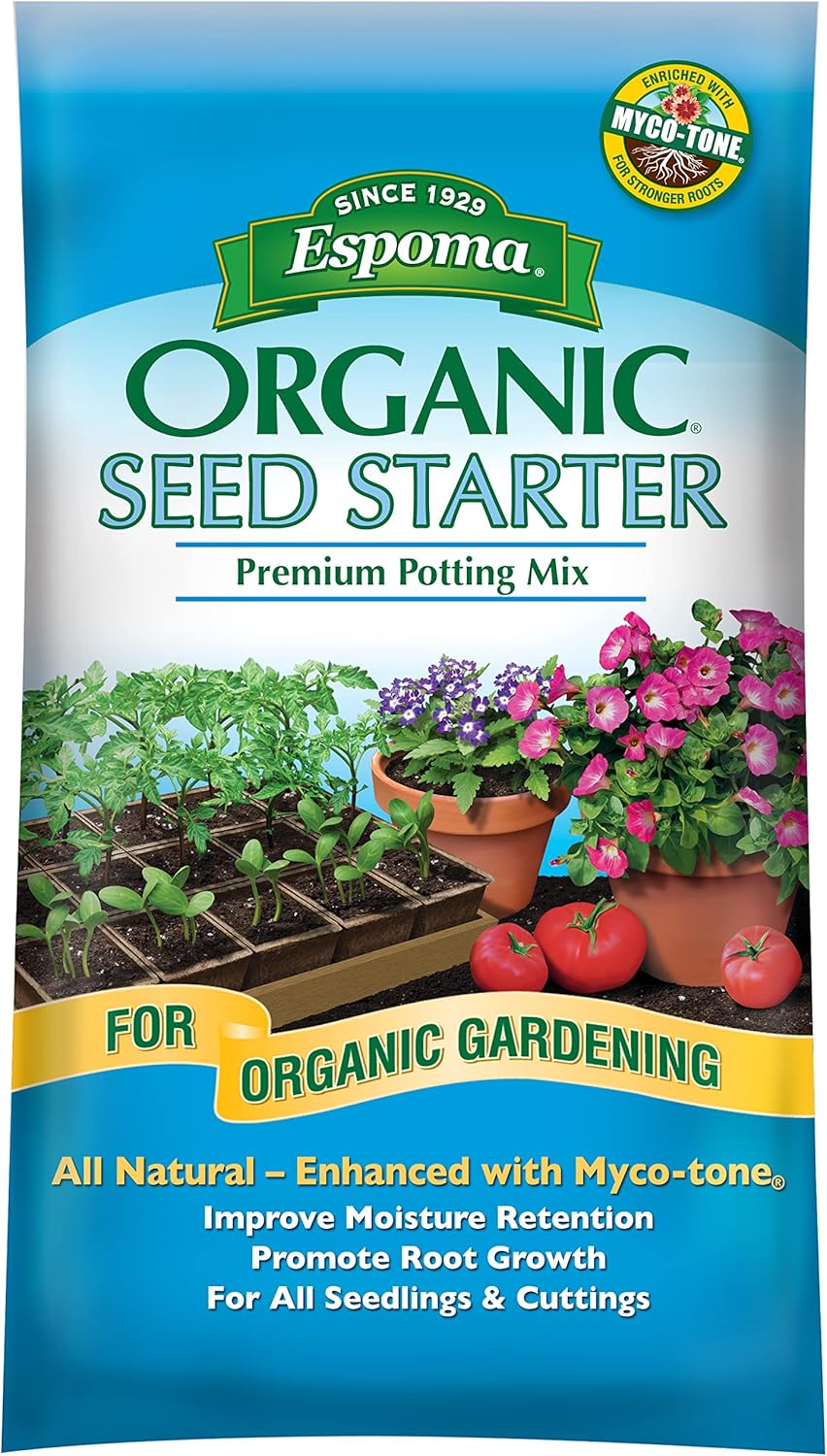
Espoma Organic Seed Starter Premium Potting Mix, 16 qt
| Brand Name | Espoma |
|---|---|
| Volume | 16 quarts |
| Unit Count | 598.4 Ounce |
| Model Number | SS16 |
Espoma Organic Seed Starter is a peat-based, lightweight potting mix designed specifically for germinating seeds and rooting cuttings. The blend of sphagnum peat moss and perlite gives good aeration and drainage while the formula includes yucca extract to improve wetting and lime to balance pH. It also contains Myco-tone mycorrhizae to help early root establishment and improve nutrient access during the seedling stage. Typical use is filling trays, cells, or small pots for seeds and softwood cuttings; its fine texture and moisture retention reduce damping-off risk when used with proper sanitation and watering. Because it contains no synthetic fertilizers, it is appropriate for organic growing but you will need to begin light feeding once true leaves form or when transplanting. The bag size covers routine home-seed-starting needs, and the product is straightforward to handle and mix for small-scale propagation projects.
Best for: Gardeners focused on reliable seed germination and strong early root development who want an organic, ready-to-use mix for trays and small pots.
Less Ideal for: Growers wanting a peat-free or pre-fertilized seed mix or those starting very large volumes commercially should consider alternatives tailored to those needs.
- Formulated for seedlings with peat and perlite for balanced aeration and moisture retention
- Includes Myco-tone mycorrhizae to support early root development
- Organic ingredients with no synthetic fertilizers, suitable for organic growing
- Contains yucca extract to improve wetting and lime to help stabilize pH
- No starter nutrients included so plants need feeding after true leaves appear
- Peat-based mix is not the most sustainable choice for gardeners preferring peat-free media
Verdict: Choose this organic seed starter when you want a ready-to-use mix that promotes rapid root development and reliable germination for home seedlings and cuttings.
Back to the Roots 3-in-1 Seed Starting Mix, 6 Quart, Organic Peat-Free

| Unit Count | 192 Fluid Ounces |
|---|---|
| Style Name | 3-in-1 Seed Starting Mix |
| Brand Name | Back to the Roots |
| UPC | 810667035822 |
This 6-quart Back to the Roots 3-in-1 Seed Starting Mix is a peat-free, organic blend aimed at making seed starting and early potting simple. You use it straight from the bag to fill trays, small pots, or starter cells; the mix includes coconut coir for water retention, dolomitic limestone to balance pH, mycorrhizae to support root uptake, and yucca extract for moisture control. Practically, that means fewer extra amendments for a new gardener and a more forgiving environment for delicate seedlings. The formula is designed to drain well while retaining enough moisture for even watering, and the included nutrients and worm castings can reduce early feeding. Limits to note are the small 6-quart volume, which is best for hobby-scale starting rather than large beds, and a lighter texture that may dry faster in very hot, exposed conditions. For budget growers who want an all-in-one starter mix without experimenting with multiple additives, this is a convenient choice.
Best for: Great for budget-minded home gardeners who want a single, ready-to-use seed starting mix that reduces extra amendments and simplifies starting herbs, vegetables, and flowers.
Less Ideal for: Not the best fit for landscapers or gardeners starting large numbers of plants or filling large containers where bulk bagged mixes would be more economical.
- Peat-free organic formula with coconut coir for moisture retention and aeration
- Includes mycorrhizae and worm castings to support early root development and nutrient uptake
- pH balancing with dolomitic limestone reduces the need for corrective amendments
- Ready-to-use blend suitable for seed trays, small pots, and indoor container starts
- Only 6 quarts per bag, so multiple bags are needed for larger projects
- Light, fast-draining texture can require more frequent watering in hot or windy conditions
Verdict: A convenient, peat-free all-in-one starter mix that saves time and extra purchases for home gardeners starting small batches of seeds.
Vermont Compost Company Fort Vee Organic Potting Soil Mix, 40 Quart (2 Pack)

| Brand | Vermont Compost Company |
|---|---|
| Volume | 40 quarts |
| Style Name | Garden,Peat Moss,Potting,Potting Soil Mix,Soil Mix,Vermiculite |
| Unit Count | 1280 Ounce |
This Fort Vee organic potting soil is a compost-heavy mix designed for seed starting, transplants, and container vegetables that need a nutrient boost. It is intended for indoor and outdoor use in trays, soil blocks, and pots and is blended from composted manure and plant materials with sphagnum peat moss, vermiculite, coconut coir, and mineral amendments to improve structure and nutrients. In practice the mix holds its form well for transplanting and gives heavy-feeding crops like tomatoes and peppers a strong start thanks to added blood meal, kelp meal, and bone meal. It is easy to use straight from the bag with no extra amendments required for short-term container growth, and the composition should help with moisture retention while still draining better than plain compost. Important limitations are typical of rich mixes: it is a starter or container medium rather than a final garden topsoil, and the nutrient level may require adjustment or dilution before long-term use in beds or for very young seedlings sensitive to strong fertilizer salts.
Best for: Gardeners who want a reliable, ready-made organic potting mix to start and grow nutrient-hungry vegetables in containers or for transplanting to the garden.
Less Ideal for: People seeking a low-nutrient seed-starting medium for delicate micro-seedlings or gardeners who need bulk topsoil for bed building rather than a concentrated potting mix.
- Compost-based formula supplies organic nutrients useful for heavy-feeding vegetables
- Includes moisture-holding and aeration components like vermiculite and coconut coir
- Pre-mixed with mineral and biological amendments (bone meal, blood meal, kelp) for immediate plant support
- Designed to hold form for soil blocks, trays, and pots which eases transplanting
- High nutrient content makes it stronger than basic seed mixes and may be too rich for very small seedlings
- Formulated as a potting/starting mix rather than a finished garden soil for permanent beds
Verdict: A dependable, nutrient-rich organic potting mix that gives tomato seedlings and other heavy feeders a strong, ready-to-use start in containers.
Back to the Roots Organic Seed Starting Mix — Expanding 12 Quart Block

| Volume | 12 quarts |
|---|---|
| Item Type Name | Seed Starting Mix |
| Unit Count | 384 Fluid Ounces |
| OMRI Listed | Yes |
| Peat Free | Yes |
This compressed seed starting mix is a coir-based block that expands to 12 quarts of loose, ready-to-use seedling soil after adding water. It is designed for starting seeds, potting up seedlings, and amending small pots for herbs, vegetables, and flowers. Notable features include an OMRI-listed organic formulation, balanced pH and low electrical conductivity to support nutrient uptake, and compact storage compared with bulky soil bags. In practice the block is easy to hydrate and fluffs up quickly, producing a light, airy medium with good water retention and aeration for root development. The convenience of a single expanding block and beginner-friendly handling makes it a reliable choice for cautious gardeners who want predictable results without mixing multiple ingredients. Limitations are that it is a single-purpose starter mix rather than an all-in-one fertilized potting soil and larger projects will need multiple blocks, so plan quantities ahead.
Best for: Practical gardeners who want a reliable, easy-to-use organic starter medium for small-scale seed trays, pots, and indoor seedlings and who prioritize predictable, low-fuss results.
Less Ideal for: Gardeners needing a ready-to-use, fertilized all-purpose potting soil for large container gardens or immediate long-term container plantings should consider an enriched potting mix instead.
- Expands to 12 quarts from a compact compressed block for easy storage and transport
- OMRI-listed organic and peat-free formulation suitable for organic growing
- Neutral pH and low electrical conductivity support seedling nutrient uptake
- Light, fluffy texture promotes good aeration and root development
- Simple to hydrate and use, friendly for beginners and low-effort setups
- Sold as a bare starting mix without added fertilizer for later stages
- Single block size requires purchasing multiple units for larger seed batches
Verdict: A compact, OMRI-listed organic seed starter that reliably expands into a light, neutral-pH medium for predictable, beginner-friendly seed starting.
Back to the Roots Organic Expanding Coco Coir Potting Soil Brick (10 lb)

| Item Highlight | 10 lb compressed coco coir brick; peat-free; OMRI Listed |
|---|---|
| Item Type Name | Coconut Coir |
| Volume | 2 cubic feet |
| Ingredients | Coconut Coir |
| Style Name | Expanding Potting Soil |
This compressed coco coir brick provides a lightweight, peat-free potting medium that expands when you add water to create loose, airy substrate for containers and seed flats. It is typically used by hydrating the 10 lb block to about 2 cubic feet of coir and then using it alone for potted plants, mixing it into garden soil to improve drainage and aeration, or blending with compost for starting seeds. Notable features include OMRI listing for organic use, a balanced pH suited to a wide range of plants, and compact storage before expansion which saves space. Practical benefits are improved root aeration and water retention compared with heavy garden loam, easier handling than bulky bags, and versatility across vegetables, herbs, and ornamentals. Important limitations are that coco coir is a soilless substrate and does not supply significant nutrients on its own so you will need to add fertilizer or compost for long-term potted herbs like rosemary, and the product requires time and a water source to expand before use.
Best for: Buyers who prioritize low-risk, easy-to-handle, organic potting media and want a versatile base for container herbs and seed starting without dealing with heavy bags.
Less Ideal for: Gardeners who want a ready-to-plant, nutrient-rich potting mix out of the box or those who prefer soil with built-in slow-release fertilizer.
- Peat-free OMRI listed organic coco coir suitable for organic growing
- Expands from a compact brick to about 2 cubic feet for easy storage and transport
- pH balanced and airy texture that improves drainage and root aeration
- Versatile use: can be used alone, for seed starting, or mixed into existing soil
- Provides little inherent fertility so supplemental feeding or compost is needed for nutrient-hungry plants
Verdict: A compact, peat-free coco coir brick that expands into an airy, pH-balanced base ideal for low-risk organic container gardening and seed starting when paired with fertilizer or compost.
Choosing the Right Organic Seed Compost: Key Factors to Consider
Particle Size and Texture
Seedlings need a fine, even medium that lets tiny roots push through without encountering large clods or coarse chunks. A consistent particle size helps with firming around seeds for good seed-to-soil contact, which improves moisture uptake during germination.
Too coarse a mix drains quickly and can desiccate the seed, while a mix that compacts risks poor air flow around roots and increased damping-off. Look for descriptions that reference fine composted material, sieved fines, or a homogenous texture rather than bulky components.
Water Retention Balanced With Drainage
Successful germination requires steady moisture at the seed level without waterlogging. A seed compost should hold enough water to remain moist between mistings yet allow excess to drain away; this balance prevents both drying out and prolonged saturation.
Materials like coir, fine compost, or well-composted bark can retain moisture while maintaining porosity. Avoid mixes that are either peat-heavy and sponge-like without drainage, or overly gritty with minimal moisture-holding capacity.
Low Disease Risk and Sanitation
Young seedlings are especially vulnerable to fungal diseases, so seed composts should minimize pathogen presence. Many seed mixes are heat-treated or come from fully composted inputs that reduce microbial risks. Sterile or pasteurized components lower the chance of damping-off and root rot during the critical first weeks.
Always consider how the compost was processed and whether it mentions pathogen control or pasteurization. Good sanitation in the medium reduces the need for chemical interventions and increases early survival rates.
Starter Nutrient Level
Seed compost should provide a light nutrient boost sufficient for cotyledons and the first true leaves without pushing rapid, weak shoot growth. High early fertility can produce leggy seedlings that require early hardening off or repotting.
A modest, slow-release organic nutrient charge or a low level of available nitrogen helps young plants establish until they are ready for transplant and feeding. Look for mixes that state 'low starter nutrients' or specify a gentle organic feed level for seedlings.
pH and Chemical Balance
pH affects nutrient availability and seedling vigor. Many seeds prefer a slightly acidic to neutral range, and extreme pH can impede germination or encourage nutrient lock-up. A reliable seed compost will aim for a balanced pH suitable for most vegetable and flower seeds.
Also be mindful of salinity from some composted amendments. High soluble salts can damage delicate seedlings. Choose mixes with stated low-salt characteristics or those formulated for seed starting to avoid chemical stress.
Sustainability and Ingredient Sourcing
As gardeners, you may prefer composts that use renewable or recycled inputs rather than nonrenewable peat. Peat-free or reduced-peat formulas that use coir, composted green waste, or well-composted wood fines can provide comparable structure while reducing environmental impact.
Transparent sourcing and clear labeling of organic inputs help you assess long-term soil outcomes. Consider whether the mix will be used only for seed starting or also for potting on, and choose materials that align with your sustainability goals.
Preparing Seed Trays and Containers
Fill clean seed trays and pots loosely with the seed compost and firm gently so seeds have consistent contact without compacting the medium. Use shallow containers for fine seeds and deeper cells for larger vegetable seeds that need more root space.
Moisten compost before sowing to the point where it is evenly damp but not dripping. This makes it easier to achieve even sowing depth and avoids disturbing tiny seeds when watering after placement.
- Pre-wet to avoid dragging tiny seeds when watering.
- Leave a small air gap under lids or domes to prevent condensation build-up.
- Label trays clearly with sown variety and date.
Sowing Depths and Germination Tips
Follow packet instructions for sowing depth but remember that most small seeds only need a dusting of compost over them. Large seeds generally require two to three times their own depth. Firm the surface lightly after covering to ensure good contact.
Maintain even warmth and humidity. A gentle bottom heat or a bright, warm spot speeds germination for many vegetables and flowers, while a clear cover or humidity dome helps retain moisture without saturating the compost.
- Use a spray bottle for gentle watering during the early days.
- Remove covers when seedlings develop true leaves to reduce fungal risk.
Potting On and When to Feed
Transplant seedlings into a larger potting mix when roots begin to show through the cell or when the first true leaves are developed. The seed compost usually contains limited nutrients, so potting on into a more richly structured potting medium will support further growth.
Delay strong feeding until seedlings are established in their new pots to avoid nutrient shock. A light organic feed applied after potting on helps steady growth without forcing weak elongation.
- Handle seedlings by leaves or root ball to avoid stem damage.
- Harden off gradually before moving outdoors to prevent transplant shock.
Peat-Free and Sustainable Options
Peat-free seed composts can match peat-based mixes for water retention and structure if they contain well-processed coir, composted green waste, or stabilized wood fines. These components must be finely sifted to provide the smooth texture seedlings need.
If sustainability matters, check for clearly stated origins and composting processes. Properly composted inputs reduce the risk of high salt or unstable nitrogen that can harm seedlings.
- Look for 'finely sifted' or 'seed sowing' labels on peat-free mixes.
- Consider local compost sources if available and well-processed.
Troubleshooting Common Seedling Problems
Damping-off, leggy growth, and yellowing are common early issues. Damping-off is often linked to over-wet conditions and poor air circulation. Leggy seedlings usually indicate insufficient light or excess initial nutrients.
Address problems by adjusting water practices, improving light, and using a clean, seed-specific compost. Repotting into a less rich medium and reducing humidity can often rescue seedlings showing early stress.
- Increase airflow and reduce humidity if fungal issues appear.
- Provide more light or move seedlings closer to a bright window or grow light to prevent legginess.
How We Chose the Best Organic Seed Compost
We prioritized mixes that are explicitly formulated for starting seeds or very young plants and that use organic inputs suitable for sensitive seedlings. Our selection process emphasized physical structure first: fine, stable texture with good drainage prevents damping-off while still holding moisture for even germination. We also looked at nutrient profile, favoring low to moderate initial fertility that supports cotyledon growth without causing rapid, weak shoot elongation. Sterility and disease risk were considered by preferring blends made from heat-treated or pasteurized components and using composted organic materials rather than raw manures. Water management mattered: components that help retain moisture without becoming waterlogged are essential, so we favored mixes with balanced proportions of peat alternatives, composted bark, coir, or fine bark fines. Sustainability and ingredient transparency guided our choices, with preference for clearly labeled organic inputs and minimal synthetic additives. We excluded general garden composts, potting composts formulated for established plants, and mixes aimed solely at long-term nutrient release. The final short list reflects a balance of seed-friendly texture, moisture control, low-disease formulation, and appropriate starter nutrients. These evaluation points align with the scoring metrics used in individual product summaries.
FAQ
Is seed compost the same as potting compost?
Not usually. Seed compost is finer-textured and lower in initial nutrients to suit delicate seedlings. Potting compost is often coarser and richer to support established plants.
Can I make my own organic seed compost at home?
You can blend well-composted fine green waste or composted bark with coir or sieved garden compost to create a seed-friendly mix. Ensure components are fully composted and free of contaminants to limit disease risk.
How long can seedlings stay in seed compost before potting on?
Seed compost supports seedlings through germination and the first true leaves. Most seedlings benefit from potting on once roots fill the cell or when true leaves appear, typically after two to six weeks depending on species.
Do peat-free seed composts work as well as peat-based ones?
Well-formulated peat-free mixes can perform similarly if they use finely processed coir or composted fines to provide the right texture and moisture balance. Check for seed-specific formulation rather than the presence or absence of peat alone.
Should I sterilize seed compost before use?
Commercial seed mixes are often treated to reduce pathogens, but if you are uncertain about homemade or locally sourced compost, a gentle pasteurization can lower disease risk. Proper sanitation of trays and tools is also important.
Final Verdict
Choosing the right organic seed compost comes down to balancing texture, moisture management, and a gentle nutrient level that supports early growth without promoting weak shoots. Prioritize a fine, stable structure and low-disease processing, and match the mix to your sowing method and light conditions. With those tradeoffs in mind, pick a seed compost that emphasizes fine particle size and balanced water retention for reliable germination. That focus will give you the strongest start before potting on into a richer medium for continued growth.
