

Note: This article contains affiliate links. If you click on these links and make a purchase, I may earn a small commission at no extra cost to you. This helps support my research and content. Read my full affiliate disclosure here.
Picking the right organic soil fertilizer affects plant health, harvest size, and long-term soil fertility. Whether you grow vegetables in raised beds, maintain containers on a balcony, or manage a backyard landscape, the fertilizer you add should support soil organisms, supply balanced nutrients, and suit your application style. This guide covers six shortlisted organic soil fertilizers that perform well across common garden situations. We evaluate each option for nutrient content, how it affects soil biology, ease of application, and suitability for edible plants and ornamentals. Read on to understand the tradeoffs so you can select the best fit for your garden.
Top Picks at a Glance
| Best Overall The best all-around choice for most situations | Down To Earth Organic Vegetable Garden Fertilizer 4-4-4, 5 lb |  |
| Best Quality Built to a higher standard if you want something more solid | BuildASoil Organic Fertilizer for Vegetable Garden (10 lb) |  |
| Best Value The sweet spot between price and what you get | Brut Organic Worm Castings, 5 lb |  |
| Best Budget The cheapest option that still gets the job done reliably | Dr. Earth Organic Tomato, Vegetable & Herb Fertilizer (64 oz) |  |
| Highest Rated A top-rated pick with lots of positive feedback | Wiggle Worm Pure Worm Castings Organic Fertilizer, 30 lb |  |
| Most Popular A crowd favorite that many people choose with confidence | Miracle-Gro Organic Outdoor Potting Mix, 16 qt. |  |
Down To Earth Organic Vegetable Garden Fertilizer 4-4-4, 5 lb

| Item Form | Granules |
|---|---|
| Specific Uses For Product | Vegetables, greens, tomatoes, herbs |
| Application Method | Apply directly to the soil or mix into garden beds |
| Mixing Ratio | 4-4-4 |
This granular fertilizer is formulated to feed vegetables, herbs and greens with a balanced 4-4-4 NPK and a slow-release profile that supplies nutrients over time. It is applied by distributing into the planting hole, mixing into topsoil, or working into raised beds at planting and during the season for maintenance. Notable features include all-natural ingredients sourced from plant, marine and mineral resources and OMRI-friendly formulation that supports organic gardening and beneficial soil life. Practically, the slow-release granules reduce the need for frequent feeding and help avoid nutrient spikes that can stress plants. The 5 lb unit is convenient for small to medium beds but means frequent repurchasing for larger plots. While it is versatile across vegetables and herbs, gardeners who need rapid corrective feeding for a specific deficiency will still need a targeted amendment or foliar feed in addition to this product.
Best for: Gardeners who prioritize steady, reliable plant performance and want an organic, low-maintenance fertilizer for raised beds and small plot vegetable production.
Less Ideal for: Growers managing large acreage or those needing immediate corrective nutrient treatments should look for bulk or fast-acting specialty products instead.
- Balanced 4-4-4 NPK suitable for overall vegetable development
- Slow-release granular formula for sustained feeding
- Made from all-natural ingredients and compatible with organic systems
- Easy to apply directly to soil or mix into raised beds
- Small 5 lb size may require frequent replacement for larger gardens
- Not formulated for quick correction of specific nutrient deficiencies
Verdict: Choose this product when you want an organic, slow-release 4-4-4 fertilizer that delivers steady nourishment for productive vegetable beds.
BuildASoil Organic Fertilizer for Vegetable Garden (10 lb)

| Item Form | Granules |
|---|---|
| Specific Uses For Product | Plant Growth, Soil Conditioning |
| Mixing Ratio | 1:400 (nutrient tea); 1:12 to 1:6 (soil amendment) |
| Coverage | Full |
BuildASoil Organic Fertilizer is a hand-crafted granular blend designed to boost vegetable garden performance by improving soil fertility and feeding plants. It is typically used as a top-dress, soil amendment, or brewed into a nutrient tea using the provided mixing ratios. Notable features include a 2-4-2 NPK ratio, rock dust and calcium for mineral support, and a multi-ingredient organic formulation aimed at improving vigor and flavor. In practice you can sprinkle 1/4 to 1 cup per plant as a top dressing or mix 2 to 4 cups per cubic foot to recondition depleted soil; the product also recommends 1/4 to 1 cup per 5-gallon bucket for teas. Benefits you will see are steadier, more balanced growth in vegetable crops and improved soil conditioning over time rather than a sudden chemical push. Limitations are that precise NPK needs for specific crops like potatoes may require complementary potassium-heavy inputs at certain stages, and results depend on existing soil conditions and proper application rates rather than instant corrective action.
Best for: Gardeners who prioritize steady, low-risk soil improvement and prefer organic, multi-mineral fertilizers for home vegetable plots, including those who want a simple top-dress or tea recipe.
Less Ideal for: Growers who need aggressive, fast-acting single-nutrient feeds or those growing potatoes in intensive commercial systems that require precise, high-K formulations.
- Organic granular formula suitable for top-dressing or soil amendment.
- Balanced 2-4-2 NPK with added rock dust and calcium to support overall plant and soil health.
- Clear mixing and application guidance for nutrient tea, top dress, and soil re-amendment.
- Not specialized for high-potassium feeding that some potato growers use during tuber bulking.
- Effects are gradual and rely on repeated application and good soil management rather than immediate visible change.
- Single bag size may be bulky for very small container growers.
Verdict: A dependable organic granular fertilizer that improves soil health and supports steady vegetable growth, making it a safe choice for risk-averse potato gardeners who want gradual, long-term improvement.
Brut Organic Worm Castings, 5 lb

| Item Form | Granules |
|---|---|
| Specific Uses For Product | Gardening,Organic |
| Target Species | All plants |
| Mixing Ratio | 1:5 |
Brut Organic Worm Castings function as a concentrated, natural soil amendment you mix into potting mixes or top-dress garden beds and raised beds. Typical use is mixing at the recommended 1:5 ratio for new indoor plants, sprinkling a cup around established houseplants, or working into outdoor planting holes and beds according to the brand directions. The product is OMRI/CDFA listed and produced in controlled conditions, which supports consistent nutrient content and beneficial microbial life that help roots establish, improve soil structure, and increase moisture retention without burning plants. Practical benefits for raised garden beds include improved aeration, slow-release nutrients, and a boost in microbial activity that supports long-term fertility. Limitations are that it is not a complete NPK fertilizer for immediate heavy feeding needs and larger beds require significant quantities to hit the suggested per-square-foot rates, so frequent applications or bulk purchases may be needed for big projects.
Best for: Gardeners who prioritize dependable, organic soil improvement for raised beds and container gardens and prefer predictable, low-risk amendments that support long-term soil health.
Less Ideal for: Those needing immediate, high-NPK feeding for heavy-feeding crops or gardeners who want to amend very large beds without buying supplemental bulk material.
- Certified organic and produced indoors for consistent purity
- Rich in beneficial microbes that improve soil structure and plant vigor
- Easy-to-use granular form suitable for mixing or top-dressing
- Not a standalone high-NPK fertilizer for rapid nutrient correction
- Five-pound bag may be small for large raised beds and repeated seasonal use
Verdict: Use this OMRI/CDFA-listed worm castings product to reliably build long-term fertility and microbial health in raised beds and containers.
Dr. Earth Organic Tomato, Vegetable & Herb Fertilizer (64 oz)

| Unit Count | 64 Ounce |
|---|---|
| Item Form | Granules |
| Specific Uses For Product | Organic |
| Target Species | Herb |
| Coverage | Medium |
This granular organic fertilizer is designed to boost vegetable and herb production by supplying balanced nutrients and soil biology support. It is typically broadcast into beds, mixed into potting mixes, or applied at planting and midseason for a nutritional lift; the manufacturer recommends reapplying every six weeks for containers. Notable features include a fully organic ingredient list, fast but sustained nutrient release, and a blend of probiotic microbes plus ecto and endo mycorrhizae intended to improve nutrient uptake and drought tolerance. In practice that means healthier root systems and potentially better yields and flavor in crops like cucumbers when used as part of an organic program. Limitations are that it is a medium coverage product in a 64 ounce bag so larger plots will need more frequent purchases, and it contains phosphorus so local runoff rules should be checked before use. Follow the directions for pH and application timing to avoid overapplication in small containers.
Best for: Gardeners who prioritize organic soil health and want a single, biology‑focused fertilizer to support vegetables like cucumbers in beds or containers.
Less Ideal for: Large‑scale growers seeking a bulk, high‑coverage fertilizer or those who must avoid phosphorus due to local regulations should consider other options.
- 100 percent organic formula suitable for certified organic gardens
- Contains beneficial microbes and eight strains of mycorrhizae to support root health and nutrient uptake
- Granular form releases nutrients quickly and continues feeding for several months
- Works for beds, raised planters and containers and can be used at planting, transplanting or midseason
- Bag is medium coverage so not economical for very large vegetable plots
- Includes phosphorus which may be restricted in some local jurisdictions
Verdict: Choose this product if you want an organic, microbe‑rich granular fertilizer that supports root health and steady feeding for cucumber and other vegetable plantings.
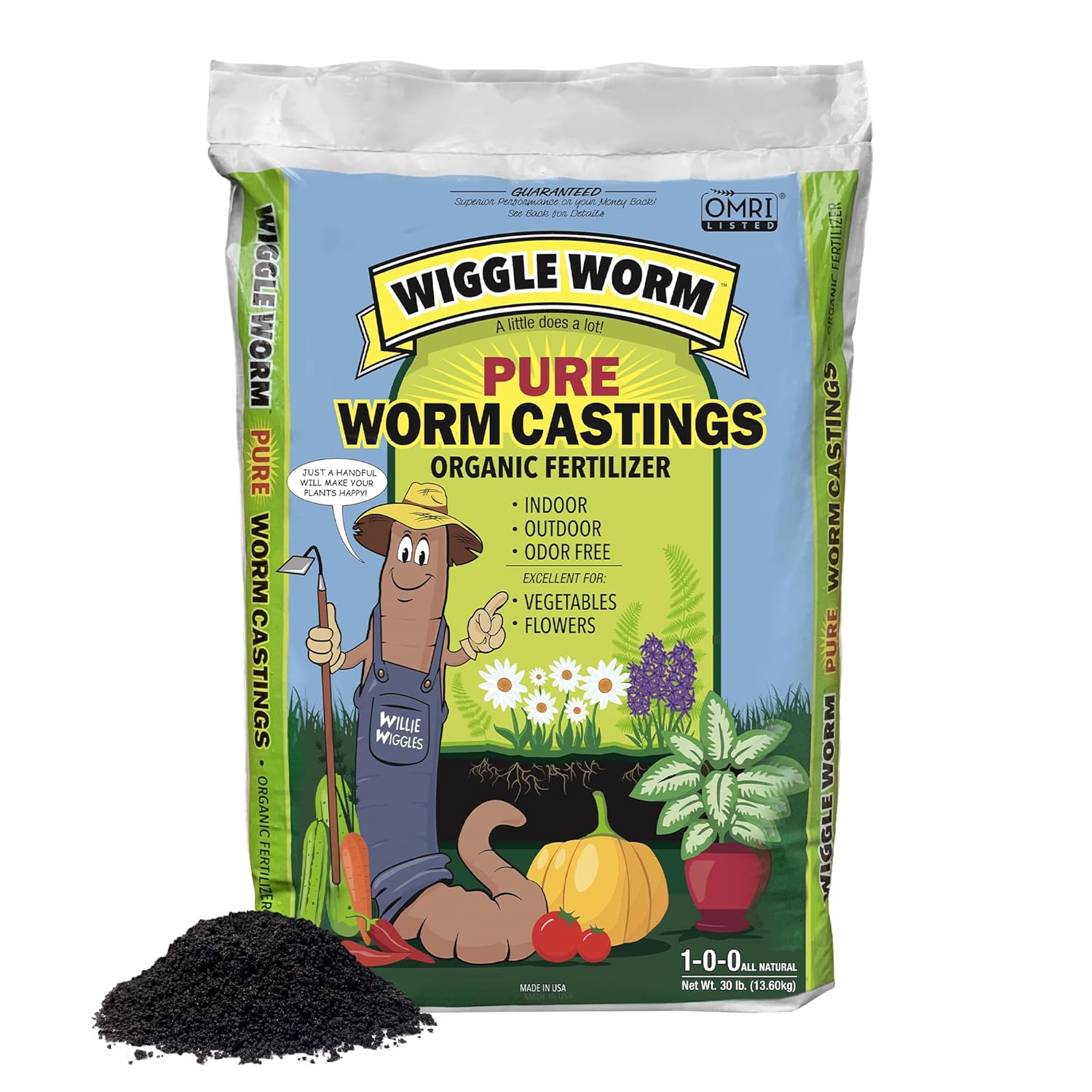
Wiggle Worm Pure Worm Castings Organic Fertilizer, 30 lb
| Item Form | Granules |
|---|---|
| Specific Uses For Product | Soil Conditioning |
| Application Method | Apply to soil |
| Unit Count | 480 Ounce |
Wiggle Worm Pure Worm Castings are a ready-to-use organic soil amendment made from concentrated earthworm castings. Gardeners typically mix a portion into potting mixes, top-dress established plants, work it into transplant holes, or brew it as a nutrient tea; the product page includes specific dosing for vegetables, containers, lawns, and roses. The castings are odorless, non-burning, and OMRI listed for organic use, so they supply water-soluble nutrients plus microbes that improve aeration, water retention, and root development without synthetic chemicals. Practical benefits include easy application, safe use on seedlings and mature plants, and versatility across raised beds, container gardens, and lawns. The main limitation is that this is a concentrated soil builder rather than an all-in-one fertilizer with NPK labels, so users seeking precise, fast-acting nutrient ratios may need to supplement for specific deficiencies; also a 30 lb bag is bulky to handle for small-space gardeners. For gardeners focused on long-term soil health and organic production, it functions as a low-risk, effective amendment.
Best for: Gardeners who prioritize building long-term soil health and want a safe, organic amendment for vegetables, ornamentals, and containers; buyers who value proven, low-risk inputs backed by strong user feedback.
Less Ideal for: Gardeners who need targeted, rapid nutrient correction based on precise NPK values or those who only want a lightweight product for very small balconies or indoor micro-gardens.
- OMRI listed organic and made from 100% worm castings
- Provides beneficial microbes that improve soil structure and water retention
- Odorless and non-burning so safe for seedlings and established plants
- Versatile dosing for containers, raised beds, lawns, and making worm casting tea
- No standard NPK nutrient label so not a precise standalone fertilizer for targeted feeding
- Large 30 lb bag can be heavy and awkward for gardeners with limited storage or mobility
Verdict: Choose this product when you want a proven, OMRI-listed worm casting that builds soil biology and improves plant health across beds and containers.
Miracle-Gro Organic Outdoor Potting Mix, 16 qt.

| Volume | 16 qt. |
|---|---|
| Item Highlight | Plant Soil For Outdoor Container Plants, Contains Quick-Release Natural Fertilizer, OMRI Listed |
| Manufacturer | Scotts Miracle Gro |
This 16 qt. Miracle-Gro Organic Outdoor Potting Mix is designed specifically for outdoor container plants and is useful for planting strawberries in pots. The mix contains responsibly sourced peat and upcycled green waste and includes a quick-release natural fertilizer that feeds for up to two months, which helps young strawberry plants establish and start producing. It is OMRI listed so it fits an organic container-gardening approach. Typical use is to partially fill a 12-inch pot, set the plant with a loosened root ball, add more mix, and water thoroughly; a single bag is sized to fill about one 12-inch container. Practical benefits include moisture retention suitable for exposed pots and a built-in starter nutrient charge so you may not need immediate additional feeding. Important limitations are that nutrients last about two months so plan a feeding schedule for fruiting plants and that peat-based mixes can compact over time, so repotting or refreshing the soil biannually is recommended for continued vigor.
Best for: Gardeners who want an organic-ready potting mix for outdoor container strawberries and prefer a product that gives an initial nutrient boost while simplifying first-season care.
Less Ideal for: Growers who need a long-term, self-sustaining soil blend for mature strawberry beds or those who avoid peat entirely should consider alternatives.
- OMRI listed and made with responsibly sourced peat suitable for organic container gardening
- Includes quick-release natural fertilizer that feeds plants for up to two months
- Formulated to retain moisture for outdoor containers exposed to sun and wind
- Contains upcycled green waste and is locally crafted to reduce transport distance
- Fertilizer effect is limited to about two months so additional feeding is needed for ongoing fruiting
- Peat-based mix can compact over time and requires bi-annual repotting to refresh structure
Verdict: A convenient OMRI-listed container potting mix that gives outdoor strawberry starters an organic nutrient boost and good moisture retention for the first months.
Choosing the Right Organic Soil Fertilizer: Key Factors to Consider
Nutrient Profile and Balance
Understanding the fertilizer's nutrient profile matters because different plants and stages of growth need specific ratios of nitrogen, phosphorus, and potassium. A balanced product supports leafy growth, root development, and flowering without forcing one phase at the expense of another.
Look for clear labeling of N-P-K and information on secondary nutrients such as calcium, magnesium, and trace elements. Many organic materials release nutrients slowly; knowing the expected release pattern helps you plan supplemental feedings and prevent deficiencies during critical growth windows.
Effect on Soil Biology and Structure
Organic soil fertilizers should feed microbes and earthworms as much as they feed plants. Materials that add organic matter improve soil structure, water retention, and aeration over time. A fertilizer that encourages microbial activity can increase nutrient cycling and make native soil nutrients more available.
Consider whether the product contains composted matter, amendments like rock minerals, or bio-stimulants. Some inputs are high in carbon and need microbes to break them down before nutrients become plant-available, which affects timing and expected benefits.
Form and Ease of Application
Fertilizers come as granules, powders, pellets, liquid concentrates, or teas. Each form affects how you apply it and how fast plants can access nutrients. Granular or pelletized products are convenient for broadcast or side-dressing, while liquids and teas deliver faster uptake for top-growth responses.
Ease of application also covers compatibility with spreaders, hose-end applicators, and drip irrigation. If you garden in containers or on balconies, a concentrated liquid may be simpler. For larger beds, a broadcastable granular product often saves time.
Release Rate and Longevity
Release rate determines how often you need to reapply and how steady nutrient availability will be across a season. Fast-release organics deliver a quick boost but may require more frequent feeding. Slow-release materials or well-composted inputs provide steadier nutrition and reduce the risk of short-term nutrient spikes.
Match release characteristics to your cropping cycle: short-season annuals may benefit from quicker release, while perennials and soil-building programs favor longer-lasting amendments.
Compatibility With Edible Crops
If you are growing vegetables, herbs, or fruit, the fertilizer needs to be safe and appropriate for food crops. That includes being free from contaminants, low in excessive salts, and not presenting residues that transfer to harvestable parts of plants.
Check for guidance on pre-harvest intervals if the product suggests foliar or surface applications, and favor fertilizers that explicitly state suitability for edible gardening when safety and taste are priorities.
Storage, Handling, and Odor
Practical handling considerations affect whether a product fits your routine. Some organic fertilizers are dusty or have strong odors, which can be unpleasant, especially in small gardens or apartment balconies. Others clump when stored in humid conditions.
Evaluate how easy the product is to scoop, measure, and store between seasons. Good shelf stability reduces waste and ensures the product performs predictably when you next use it.
Matching Fertilizer to Garden Types
Different garden setups have distinct needs. Raised beds and native soil beds benefit from amendments that build long-term organic matter and improve drainage. Containers require readily available nutrients and careful attention to leaching from potting mixes.
When deciding on a fertilizer, consider the soil volume that roots explore. In pots, nutrients wash out faster and require formulations with steady, accessible release. In larger beds, choose amendments that support soil structure as well as nutrient availability.
- Containers: prefer liquids or fine granules that dissolve and distribute evenly.
- Raised beds: favor compost-rich, slow-release materials to build soil over seasons.
- Lawns and groundcovers: use broadcastable organics with predictable feed schedules.
Timing Applications for Best Results
Timing fertilizer applications to plant growth stages maximizes efficiency. Apply nitrogen-rich feeds when plants are putting on leafy growth and switch to phosphorus- or potassium-focused inputs when establishing roots and flowering.
For slow-release organics, apply before the main growing season so microbes can begin breaking material down. For quick-acting liquids, feed at early growth and repeat at intervals recommended for that product to avoid nutrient shortfalls.
- Pre-plant: incorporate soil-building organics to improve structure.
- Active growth: use balanced or nitrogen-forward feeds for leafy crops.
- Pre-flower and fruit set: emphasize phosphorus and potassium sources.
Incorporating Soil Testing Into Your Plan
A simple soil test informs what nutrients your soil already supplies and what is missing. Testing prevents over-application and helps you choose a fertilizer that addresses specific deficiencies instead of adding unnecessary nutrients.
Repeat tests every few years to track how amendments change soil chemistry. Small, targeted additions based on tests are more effective and environmentally responsible than blanket feeding.
- Test for pH, macronutrients, and organic matter content.
- Adjust fertilizer choice based on test results rather than assumptions.
Using Organic Fertilizers Safely Around Edibles
When applying near edible plants, avoid heavy surface deposits that can create salt spots or localized burn. Work granular materials into the soil when possible and water after application to move nutrients into the root zone.
For foliar applications, follow label guidance on dilution and timing to reduce residue risk. Compost teas and other biological extracts can be used carefully, but ensure they come from well-composted sources to minimize pathogen risk.
- Work granular amendments into soil surface for even distribution.
- Water after application to move nutrients into roots and reduce runoff.
Combining Fertilizers With Compost and Mulch
Compost and mulches are complementary to organic fertilizers. Compost supplies a broad spectrum of nutrients and microbial life, while targeted fertilizers fill specific gaps. Mulch helps conserve moisture and moderates temperature, which supports microbial activity needed to mineralize organic fertilizers.
Use fertilizers as part of a broader soil health program rather than a standalone fix. Over time, consistent composting and mulching can reduce the amount of external fertilizer needed.
- Top-dress compost annually to maintain organic matter.
- Use mulch to retain moisture and protect microbes that process organic inputs.
How We Chose the Best Organic Soil Fertilizer
We selected products that demonstrably support soil biology while providing predictable nutrient delivery for common garden crops. Primary evaluation criteria included nutrient profile accuracy, feed schedule flexibility, compatibility with edible gardening, and the material's effect on soil structure and microbial life. We also assessed ease of application across beds, containers, and lawns, plus persistence to determine how often gardeners must reapply. Exclusions included synthetic, chemically derived fertilizers and specialty formulations intended only for professional turf or commercial row crops. We focused on options that are widely usable by home gardeners and rooftop growers. For each product we checked ingredient transparency, typical N-P-K balance or slow-release behavior, particle form or liquid concentration, and whether the material supplies secondary nutrients and beneficial organic matter. Practical considerations such as odor, storage stability, and recommended application rates were also part of the selection filters. These criteria map directly to our scoring metrics and reflect what affects real-world garden outcomes.
FAQ
How often should I apply organic soil fertilizer to a vegetable bed?
It depends on the product's release rate. Fast-release organics may need feeding every 4 to 6 weeks during active growth, while slow-release materials often provide nutrients for several months. Use soil tests and plant responses to fine-tune frequency.
Can I use organic fertilizer in containers with potting mix?
Yes. Choose formulations that supply readily available nutrients and monitor leaching after watering. Liquids and fine granular options work well in containers because they distribute more evenly through a small root zone.
Will organic fertilizers change my soil pH?
Some organic amendments can affect pH over time, especially if they contain significant amounts of lime, sulfur, or acidic feedstocks. Most common organic fertilizers have only gradual effects, so check soil pH periodically if long-term changes are a concern.
Are organic fertilizers safe to use around children and pets?
Many organic fertilizers are safer than synthetic alternatives, but safety varies by ingredient. Keep products stored securely, follow label handling instructions, and avoid applying high-odor or untreated manures where children and pets play until material is fully integrated and stabilized.
Can I mix different organic fertilizers together when applying?
Mixing is often possible but depends on form and compatibility. Avoid combining materials that require very different application methods. When in doubt, apply different amendments at separate times or incorporate them into soil rather than layering them on the surface.
Final Verdict
Choose an organic soil fertilizer that matches your garden's needs: rapid-acting feeds for quick results in containers, or slow-release, compost-rich amendments for long-term soil building. Prioritize products that supply a clear nutrient profile, support soil biology, and suit your application method. Balance immediate crop needs with longer-term soil health. With a soil test and a plan for timing and form, you can select an organic soil fertilizer that boosts productivity while improving soil structure and resilience over time.
