

Note: This article contains affiliate links. If you click on these links and make a purchase, I may earn a small commission at no extra cost to you. This helps support my research and content. Read my full affiliate disclosure here.
Choosing the right organic veggie fertilizer matters because it affects both the short-term vigor of plants and the long-term health of your soil. The right formula delivers nutrients at the right pace, supports beneficial microbes, and helps vegetables resist common stresses like blossom end rot or slow fruit set. This guide presents six shortlisted organic veggie fertilizers selected for typical home vegetable gardens, from containers and raised beds to in-ground rows. Below you will find practical notes on how these products perform in real garden conditions and the evaluation criteria we used to compare them. Read on to find a feeding approach that fits your soil, crop mix, and gardening rhythm.
Top Picks at a Glance
| Best Overall The best all-around choice for most situations | Espoma Organic Tomato-tone 3-4-6 Organic Fertilizer (4 lb, Pack of 2) |  |
| Best Quality Built to a higher standard if you want something more solid | Dr. Earth Organic Tomato, Vegetable & Herb Fertilizer (64 oz) |  |
| Best Value The sweet spot between price and what you get | True Organic Tomato & Vegetable Food, Granular Organic Fertilizer (8 lb) |  |
| Best Budget The cheapest option that still gets the job done reliably | Down To Earth Organic All Purpose Tomato & Vegetable Mix 4-6-2, 1 lb |  |
| Highest Rated A top-rated pick with lots of positive feedback | Espoma Organic Garden-Tone 3-4-4 Organic Fertilizer (4 lb) — Pack of 2 |  |
| Best Seller A high-volume bestseller chosen again and again | Burpee Organic Tomato & Vegetable Granular Plant Food, 4 lb |  |
Espoma Organic Tomato-tone 3-4-6 Organic Fertilizer (4 lb, Pack of 2)

| Item Form | Powder |
|---|---|
| Specific Uses For Product | Gardening,Organic |
| Coverage | Full |
| Target Species | Tomatoes |
Espoma Tomato-tone is a ready-to-use organic fertilizer designed specifically to support tomato fruiting rather than excessive leaf growth. It contains a 3-4-6 N-P-K analysis and 8% calcium, which helps reduce blossom end rot when applied to soil around the plant drip line and watered in. Use it every two weeks during the growing season for potted tomatoes and other vegetables; the product is labeled for organic gardening and requires no on-site mixing. Practical benefits include consistent nutrient delivery tailored to fruit set, built-in calcium for common tomato disorders, and the convenience of a powder/granular form that is simple to apply in containers. Limitations are that feeding frequency and exact rates must be followed to avoid over-application in small pots, and as an organic product it releases nutrients more slowly than synthetic quick-release formulas. This fertilizer is best when paired with good potting mix and regular watering practices to get reliable, fruit-focused results in container tomato production.
Best for: Home gardeners who prioritize steady, reliable fruit production in potted tomatoes and prefer an organic, low-maintenance feeding plan.
Less Ideal for: Gardeners who need very fast, immediate nutrient boosts or who want an all-in-one liquid feed system for frequent foliar feeding.
- Formulated for tomatoes with a 3-4-6 N-P-K ratio to encourage blooms and fruit production.
- Contains 8% calcium to help prevent blossom end rot, a common issue for tomato growers.
- Ready-to-use granular/powder form requires no mixing and is easy to apply around container plants.
- Certified for organic gardening, suitable for organic potted vegetable production.
- Slower nutrient release compared with synthetic quick-release fertilizers, so results are not instantaneous.
- Regular biweekly applications are recommended which requires consistent attention for container plants.
Verdict: Choose this organic tomato fertilizer if you want a reliable, fruit-focused feed with built-in calcium to reduce blossom end rot in potted tomatoes.
Dr. Earth Organic Tomato, Vegetable & Herb Fertilizer (64 oz)

| Unit Count | 64 Ounce |
|---|---|
| Item Form | Granules |
| Specific Uses For Product | Organic |
| Target Species | Herb |
| Coverage | Medium |
This granular organic fertilizer is designed to boost vegetable and herb production by supplying balanced nutrients and soil biology support. It is typically broadcast into beds, mixed into potting mixes, or applied at planting and midseason for a nutritional lift; the manufacturer recommends reapplying every six weeks for containers. Notable features include a fully organic ingredient list, fast but sustained nutrient release, and a blend of probiotic microbes plus ecto and endo mycorrhizae intended to improve nutrient uptake and drought tolerance. In practice that means healthier root systems and potentially better yields and flavor in crops like cucumbers when used as part of an organic program. Limitations are that it is a medium coverage product in a 64 ounce bag so larger plots will need more frequent purchases, and it contains phosphorus so local runoff rules should be checked before use. Follow the directions for pH and application timing to avoid overapplication in small containers.
Best for: Gardeners who prioritize organic soil health and want a single, biology‑focused fertilizer to support vegetables like cucumbers in beds or containers.
Less Ideal for: Large‑scale growers seeking a bulk, high‑coverage fertilizer or those who must avoid phosphorus due to local regulations should consider other options.
- 100 percent organic formula suitable for certified organic gardens
- Contains beneficial microbes and eight strains of mycorrhizae to support root health and nutrient uptake
- Granular form releases nutrients quickly and continues feeding for several months
- Works for beds, raised planters and containers and can be used at planting, transplanting or midseason
- Bag is medium coverage so not economical for very large vegetable plots
- Includes phosphorus which may be restricted in some local jurisdictions
Verdict: Choose this product if you want an organic, microbe‑rich granular fertilizer that supports root health and steady feeding for cucumber and other vegetable plantings.
True Organic Tomato & Vegetable Food, Granular Organic Fertilizer (8 lb)

| Item Form | Granules |
|---|---|
| Mixing Ratio | 4:5:6 |
| Unit Count | 128 Ounce |
| Included Components | 100% Made in the USA with Organic Inputs |
True Organic Tomato & Vegetable Food is a granular, plant-focused fertilizer designed to feed in-ground beds and containers through the growing season. It supplies 4% nitrogen (3% slow-release), 5% phosphate, 6% potash and an extra 6% calcium so it both feeds plants and helps prevent blossom end rot in tomatoes and other fruiting vegetables. The formula uses organic inputs such as poultry manure, fish bone meal and shell meals, which support soil biology and release nutrients more slowly than synthetic salts. Application is straightforward: spread or top-dress and reapply monthly during the season following the mixing guidance. Practical benefits include a balanced nutrient profile for fruit set and development, built-in calcium for common tomato problems, and suitability for both containers and beds. Limitations are that nutrient levels are modest compared with concentrated synthetic fertilizers and results depend on regular monthly applications and active soil biology, so expect gradual improvement rather than immediate, high-release feeding.
Best for: Gardeners who prefer organic amendments and want a steady, soil-friendly fertilizer to improve yields and reduce blossom end rot in vegetable beds and containers.
Less Ideal for: Growers seeking fast, high-release nutrient boosts for immediate greening or commercial-scale production should consider more concentrated options.
- Balanced N-P-K with 3% slow-release nitrogen for steady feeding
- 6% calcium to help prevent blossom end rot in tomatoes and other fruiting crops
- Made from organic inputs that support soil microbial activity
- Works for both in-ground gardens and container plants with monthly applications
- Lower nutrient concentrations than synthetic fertilizers so more product or repeated applications may be needed
- Results develop gradually and rely on soil biology and regular use
Verdict: A steady, soil-friendly organic fertilizer that supplies balanced nutrients and extra calcium to support healthier, higher-yielding tomatoes and vegetables.
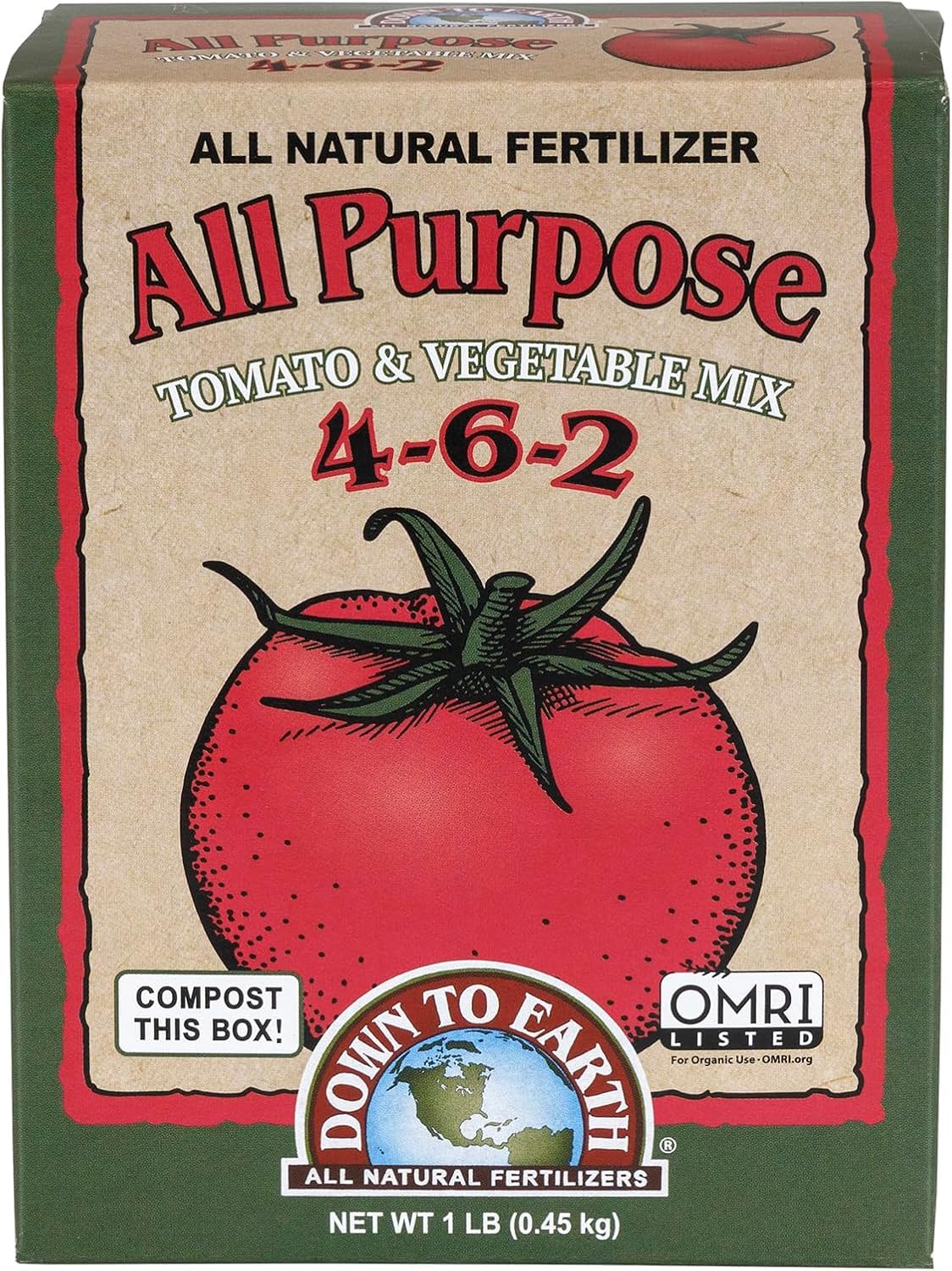
Down To Earth Organic All Purpose Tomato & Vegetable Mix 4-6-2, 1 lb
| Item Form | Granules |
|---|---|
| Specific Uses For Product | Plant Growth |
| Coverage | Medium |
| Target Species | Vegetables |
| Mixing Ratio | 4-6-2 |
This granular, all-purpose mix is designed to feed garden vegetables and tomatoes by releasing nutrients into the soil rather than acting as a quick soluble feed. You apply it by broadcasting or hand-applying to the soil surface and lightly working it in or covering with compost or mulch, then watering it well. Notable features are the 4-6-2 nutrient ratio aimed at root and fruit development, OMRI-friendly organic ingredients such as fish bone meal, and a shelf-stable dry blend that does not expire. In practice it works well for garden beds, raised beds and containers where you want steady, biologically mediated nutrient release and improved soil health over time. Limitations are that it is not water-soluble for immediate foliar or quick-release feeding and it relies on soil microbes to break down nutrients, so benefits appear more slowly than synthetic fertilizers. For gardeners who want certified organic inputs and long-term soil feeding, this is a practical, easy-to-use option, but it is not a rapid corrective for acute nutrient deficiencies.
Best for: Practical home vegetable growers on a budget who prioritize organic, soil-feeding fertilizers for steady crop development in garden beds or containers.
Less Ideal for: Gardeners who need a fast corrective feed or who rely on foliar or hydroponic feeding methods should look for a soluble or synthetic alternative.
- Organic and OMRI-listed ingredients suitable for certified organic vegetable gardens
- Balanced 4-6-2 NPK tailored for fruiting vegetables and root development
- Granular, shelf-stable formula that is easy to apply to beds, raised beds and containers
- Made from sustainably sourced natural inputs that support soil biology
- Not water soluble so it will not provide an immediate nutrient boost
- Requires active soil microbial activity to unlock nutrients, so uptake can be slower
Verdict: A budget-friendly, OMRI-listed granular fertilizer that delivers steady, organic nutrition tailored for productive tomato and vegetable gardens.
Espoma Organic Garden-Tone 3-4-4 Organic Fertilizer (4 lb) — Pack of 2

| Item Form | Granules |
|---|---|
| Specific Uses For Product | Plant Growth |
| Coverage | Medium |
| Target Species | Herbs |
| Mixing Ratio | 3:4:4 |
Espoma Garden-Tone is an organic granular fertilizer made for vegetable gardens and herb beds that you apply monthly around the plant drip line or planting rows. It supplies a moderate, balanced nutrient mix (3-4-4) plus 5% calcium to support leafy growth and fruit development without synthetic inputs. Being a ready-to-use formula in granules, it is simple to broadcast or side-dress and then water in, which fits routine monthly feeding during the growing season. The product is approved for organic production and contains natural ingredients enhanced with Espoma’s Bio-tone. Practical benefits include steady nutrient release appropriate for root and leafy crops and the convenience of pre-mixed bags so there is no measuring or dissolving. Limitations are that it is a medium-coverage granular product so heavy-feeding situations may require additional applications or complementary amendments, and granules require watering to activate nutrients rather than providing immediate foliar feed.
Best for: Gardeners who prioritize reliable, organic monthly feeding routines for root and leafy vegetables and want a no-fuss granular fertilizer that fits certified organic beds.
Less Ideal for: Growers who need fast-acting, soluble fertilizer for quick corrections or those managing very large acreages where concentrated commercial blends are preferred.
- Balanced 3-4-4 NPK suited to both leafy and fruiting vegetables
- Contains 5% calcium which helps reduce blossom end rot in susceptible crops
- Ready-to-use granules simplify monthly feeding with no mixing required
- Approved for organic gardening so it fits organic production systems
- Medium coverage may require more frequent applications for very nutrient-hungry or large plantings
- Granular form needs watering to activate nutrients and is slower than soluble fertilizers
Verdict: A dependable, ready-to-use organic granular fertilizer that delivers balanced monthly nutrition and extra calcium for healthier vegetable and root crops like turnips.
Burpee Organic Tomato & Vegetable Granular Plant Food, 4 lb

| Item Form | Granules |
|---|---|
| Specific Uses For Product | Gardening,Plant Growth,Root Development |
| Application Method | Sprinkle |
| Coverage | 160 Square Feet |
| Mixing Ratio | 3-6-4 |
This Burpee organic granular plant food is an all-purpose, OMRI-listed fertilizer designed for vegetable gardens, containers, and seed starting. You apply it by sprinkling the granules around the base of plants and watering in; the formula provides an initial boost of nutrients and a slow release that the manufacturer says lasts up to three months. The product lists a 3-6-4 mixing ratio and a coverage of about 160 square feet for the 4 lb bag, making it easy to estimate how much to use across beds or several containers. Practical benefits include simple dry application with no measuring or mixing required for spot feeding, organic certification for gardeners who prefer low-chemical inputs, and a nutrient blend that supports root development and steady growth through the season. Limitations are the fixed bag size and coverage, which may require multiple bags for larger plots, and the granular form means you must distribute it evenly and water thoroughly to activate nutrients. For cautious gardeners wanting organic, low-effort feeding for vegetables, this is a straightforward option.
Best for: Practical home gardeners who prioritize organic, low-chemical inputs and want a simple, no-fuss fertilizer to feed tomatoes and other vegetables through the season.
Less Ideal for: Gardeners managing large-scale vegetable beds who need higher-volume or custom nutrient programs should consider bulk or concentrated alternatives.
- OMRI-listed organic formula suitable for organic vegetable production
- Granular form is easy to apply by sprinkling around plants with no mixing
- Provides both immediate nutrients and slow release feeding for up to three months
- Clear application method and coverage guidance simplify use for new gardeners
- 4 lb bag covers a limited area and may not be economical for large vegetable plots
- Granules require even distribution and consistent watering to be effective
Verdict: A simple OMRI-listed granular fertilizer that gives organic gardeners an easy, season-long feed for tomatoes and vegetables.
Choosing the Right Organic Veggie Fertilizer: Key Factors to Consider
Nutrient Balance and Analysis
Vegetables need a predictable supply of nitrogen, phosphorus, and potassium plus secondary elements like calcium and magnesium. A fertilizer that lists a clear nutrient analysis helps you match feedings to crops and growth stages. For example, leafy greens benefit from higher available nitrogen while fruiting crops need more phosphorus and potassium to set and ripen fruit.
Beyond primary macronutrients, look for sources of calcium and magnesium when growing tomatoes, peppers, and brassicas because deficiencies show up quickly as blossom end rot, tip burn, or poor head development. Organic sources can vary widely in release rate, so knowing the percent N-P-K and whether nutrients are immediately available or slow-release clarifies how often you must apply.
Release Pattern and Longevity
Release timing determines whether a single feeding will carry plants through a critical period or whether repeated topdressings are needed. Some organic fertilizers feed quickly and boost new growth in days, while others provide a slow, steady supply over weeks. Slow-release options reduce the risk of nutrient spikes and leaching but may not correct an acute deficiency quickly.
Consider your garden rhythm: intensive, frequent harvest gardens often benefit from a mix of quick-acting and long-lasting sources. For container-grown vegetables, more frequent, lighter feedings are usually necessary because media holds less nutrient reserve than beds.
Support for Soil Biology
Healthy vegetable plots depend on active soil organisms that break down organic inputs and cycle nutrients. Fertilizers that include compost, beneficial microbes, or biologically active materials build soil structure and long-term fertility. These inputs improve water retention and nutrient availability, which is especially helpful in sandy soils or raised beds that dry quickly.
If you prioritize sustainable fertility, choose products that explicitly support microbial activity rather than only supplying soluble nutrients. Over time, biologically supportive fertilizers reduce the need for heavy feeding and help maintain balanced, resilient soils.
Application Method and Practicality
How you apply fertilizer affects convenience and uniformity. Granular products work well for pre-plant incorporation or topdressing, while liquid feeds and teas allow quick correction and are useful during the growing season. Foliar sprays can address micronutrient deficiencies fast but are not a substitute for soil fertility.
Think through the labor involved: hand-broadcasting across a large vegetable plot is different from measuring small doses for container tomatoes. Also consider whether instructions are clear about rates, timing, and compatibility with compost and other amendments to avoid over-application.
Suitability for Containers, Raised Beds, and In-Ground
Different growing environments change how fertilizers behave. Containers and small raised beds need formulations designed for limited volumes and frequent watering, otherwise nutrients leach quickly. In-ground beds can benefit more from bulk, slow-release organic materials that improve soil structure and hold nutrients longer.
Check product guidance for pot use versus in-ground use. Some organic materials are excellent soil builders but are bulky for pots, while concentrated organic liquids or soluble powders are formulated to feed containers without excess buildup.
Safety for Edible Crops and Residue Considerations
When feeding vegetables, safety matters. Choose products sourced from materials approved for edible use and follow withholding or harvest interval guidance if provided. Avoid raw manures on crops close to harvest unless they have been properly composted and applied well ahead of harvest time to reduce food-safety risks.
Consider residue potential for leafy greens that are harvested frequently. Water-soluble organic feeds with clear labeling reduce uncertainty about residues and help you time applications so produce is safe and palatable at harvest.
Timing Feedings to Crop Growth Stages
Vegetable nutrient needs shift during the season. Focus on higher nitrogen in early vegetative stages to build foliage, then transition to phosphorus and potassium when flowers form and fruit sets. A planned feeding schedule helps avoid wasted growth or poor fruiting.
For quick-turn crops like salad greens, light, frequent applications are more effective than heavy single doses. For longer-season crops, a combination of a slow-release pre-plant amendment and periodic side-dressings keeps plants supplied without spikes.
- Start with a soil test to set baseline nutrient choices.
- Use a quick-feed source at transplanting to reduce transplant shock.
- Switch to bloom-and-fruit feeding as flowers appear.
Amending Soil Versus Topdressing
Incorporating organic fertilizer into the soil at planting improves root access and helps build structure over time. Topdressing is less disruptive and is useful during the season for quick nutrient boosts or for established beds.
Topdressings of compost or granular organics can be worked in lightly by hand or left on the surface to slowly release nutrients with watering. For container gardens, mix a measured amount into potting media at potting or repotting.
- Amend heavy clay with organic matter plus mineral sources to improve drainage and nutrient retention.
- Topdress sandy beds more frequently to maintain nutrient levels.
Feeding Strategies for Containers and Small Spaces
Containers require more hands-on feeding because their small volume warms and dries faster and has less buffering capacity. Use soluble organic feeds or dilute compost teas at regular intervals and avoid heavy granular applications that can build up salts.
Select fertilizers labeled for pot use or those with clear dilution instructions. Monitoring plant vigor and adjusting feeding frequency is often faster than following a fixed calendar in these settings.
- Apply water-soluble feeds every 1 to 2 weeks for fast-growing container crops.
- Monitor leaf color and growth rate rather than relying solely on set schedules.
Integrating Organic Fertilizers with Compost and Mulch
Organic fertilizers work best as part of a broader soil-management plan. Compost supplies steady nutrients and improves structure, while mulch conserves moisture and moderates soil temperature. Combining targeted fertilizers with compost reduces the need for excessive feeding.
Think of fertilizers as targeted treatments and compost as the baseline fertility. Use mulch to reduce nutrient loss and to keep surface-applied materials from washing away during heavy rains.
- Topdress with compost in fall to build reserves for the next season.
- Use mulch around warm-season crops to stabilize soil moisture and slow nutrient leaching.
Managing Common Deficiencies in Vegetable Gardens
Recognizing and correcting nutrient deficiencies quickly prevents yield loss. Yellowing between leaf veins often indicates magnesium or iron issues, while pale new growth can be a sign of nitrogen shortfall. Blossom end rot in tomatoes is usually a calcium availability problem often linked to inconsistent watering.
Address deficiencies by choosing an appropriate organic corrective that supplies the lacking element and by adjusting cultural practices like watering and pH management to improve uptake.
- Test soil pH if micronutrients seem unavailable; many nutrients become less available outside the 6.0 to 7.0 range.
- Use targeted foliar feeds for rapid correction of micronutrient shortages when necessary.
How We Chose the Best Organic Veggie Fertilizer
We focused on criteria that matter in a working vegetable garden rather than marketing claims. Our selection prioritized nutrient profile clarity, delivery method and release timing, support for soil biology, suitability for common vegetable types, and ease of application. We checked that products list guaranteed nutrient analysis or clear ingredient sourcing and preferred fertilizers that included organic sources such as composted manures, rock minerals, or plant meals. Practical performance filters removed products that rely on vague ingredient descriptions, have awkward application requirements for small plots, or are unsuitable for container gardening. We also screened for material safety for edible crops and reasonable guidance for application rates. Exclusions included blends intended only for lawns, non-organic synthetic formulations, and products lacking clear usage instructions. The final list reflects options that suit a range of vegetable garden sizes and management styles while scoring well on nutrient balance, biological support, and user-friendly application.
FAQ
How often should I apply organic fertilizer to vegetable beds?
Frequency depends on product type and crop. Slow-release granular organics often only need reapplication every 6 to 8 weeks, while soluble feeds or teas may be used every 1 to 3 weeks. Monitor plant growth and leaf color to fine-tune timing.
Can I use the same fertilizer for leafy greens and fruiting vegetables?
You can use a base organic fertilizer across crops, but adjust timing and supplemental feeds. Leafy crops benefit from higher nitrogen during growth, while fruiting crops need extra phosphorus and potassium during bloom and fruit set. Layering a bloom-focused supplement when fruiting begins is a common approach.
Is compost enough, or should I add commercial organic fertilizer?
Compost provides steady, broad nutrition and improves soil structure, but it may not supply sufficient levels of specific nutrients for high-yield vegetable production. For targeted needs or quick corrections, adding a concentrated organic fertilizer complements compost.
Are liquid organic feeds safe for edible crops?
Most liquid organic feeds are safe when used according to label directions. They are useful for rapid nutrient delivery and are frequently used on edible crops. Avoid raw manures or unprocessed materials applied close to harvest unless they have been properly composted.
How does soil type affect my fertilizer choice?
Sandy soils drain quickly and benefit from frequent, smaller feedings and materials that improve water and nutrient retention. Clay soils hold nutrients but may need amendments to improve root penetration. Choose fertilizers that complement your soil's capacity to hold and release nutrients.
Should I worry about nutrient runoff with organic fertilizers?
Organic fertilizers generally release nutrients more slowly, reducing runoff risk compared with soluble synthetic inputs, but runoff can still occur. Apply at recommended rates, avoid feeding before heavy rains, and use mulches or groundcovers to reduce surface loss.
Final Verdict
Prioritize a fertilizer that matches your garden style and the crops you grow. Balance predictable nutrient analysis with materials that support soil biology so you get both immediate plant response and long-term fertility gains. Consider containers separately from in-ground beds because application frequency and product form differ. Focus on clear labeling for N-P-K and application guidance, choose a release pattern that fits your feeding routine, and combine targeted fertilizers with compost and mulching to keep vegetables productive season after season. That approach will help you choose confidently among organic options for healthier, more reliable harvests.
