

Note: This article contains affiliate links. If you click on these links and make a purchase, I may earn a small commission at no extra cost to you. This helps support my research and content. Read my full affiliate disclosure here.
If you care for planted flower beds, picking the right organic weed killer matters for plant health and long-term soil life. You want reliable weed suppression without harming perennials, bulbs, or the beneficial soil organisms that help flowers thrive. This guide shortlists seven top organic options suitable for flower beds and explains the traits that make them practical in real garden situations. We evaluated products across control speed, selectivity around ornamentals, application safety, and effects on soil and mulch so you can choose a solution that fits how you garden. Read on for clear guidance before you treat vulnerable planting areas.
Top Picks at a Glance
| Best Overall The best all-around choice for most situations | Green Gobbler Natural Total Control Weed & Grass Killer, 1 Gallon Trigger |  |
| Best Quality Built to a higher standard if you want something more solid | BioSafe Systems Weed & Grass Killer Concentrate, 1 Gallon |  |
| Best Value The sweet spot between price and what you get | Spruce Snap & Spray Weed & Grass Killer Starter Kit, 64 oz |  |
| Best Budget The cheapest option that still gets the job done reliably | Energen Carolina Vinegar Weed & Grass Killer, Quart |  |
| Highest Rated A top-rated pick with lots of positive feedback | Natures Wisdom 20% Vinegar Weed & Grass Killer, 1 Gallon |  |
| Most Popular A crowd favorite that many people choose with confidence | Ortho GroundClear Weed & Grass Killer with Comfort Wand, 1 gal. |  |
| Best Seller A high-volume bestseller chosen again and again | Spruce Weed & Grass Killer Refill, Ready-to-Use 64 fl oz |  |
Green Gobbler Natural Total Control Weed & Grass Killer, 1 Gallon Trigger

| Unit Count | 128 Fluid Ounces |
|---|---|
| Item Form | Spray |
| Coverage | Non-selective broad spectrum coverage |
Green Gobbler Natural Total Control is a 1-gallon trigger spray formulated to kill common broadleaf weeds and grasses using a concentrated salt-and-vinegar formula. It is typically used as a spot or area spray on driveways, sidewalks, mulch beds, pavers, and other hardscapes and landscaped areas where you want nonselective control. The product combines fast-acting vinegar that wilts foliage with salt that continues to dehydrate roots, so users often see wilting within hours and more complete plant death after repeated applications. Notable practical benefits are that it is OMRI-listed for organic use and made from familiar ingredients rather than synthetic herbicides, and the trigger-ready gallon is convenient for medium to large yards. Important limitations are that it is nonselective so it will damage desirable plants on contact and that repeated treatments may be needed for persistent perennials or deep-rooted species. Also follow safety directions carefully to avoid skin or eye exposure.
Best for: Homeowners who want an organic, pet-safe alternative to synthetic herbicides for knocking back common weeds on driveways, sidewalks, and around landscape edges.
Less Ideal for: Gardeners who need selective weed control near delicate ornamentals or those seeking a single-application solution for stubborn, deep-rooted perennials.
- Uses salt and vinegar for dual-action kill that affects foliage quickly and continues to dehydrate roots
- OMRI-listed formulation approved for organic use
- Ready-to-use 1-gallon trigger bottle suitable for medium to larger treatment areas
- Suitable for application on hard surfaces and landscaped beds where nonselective control is acceptable
- Nonselective formula will harm any desirable plants it contacts
- May require multiple applications for deep-rooted or persistent weeds
Verdict: Choose this product if you want a ready-to-use, organic-approved spray that quickly wilts and dehydrates common weeds using familiar ingredients.
BioSafe Systems Weed & Grass Killer Concentrate, 1 Gallon

| Unit Count | 128 Ounce |
|---|---|
| Item Form | Spray |
| Coverage | 200 square_feet |
| Active Ingredients | Herbicide |
BioSafe Systems Weed & Grass Killer is a concentrated, water-soluble herbicidal soap that provides fast contact burndown of annual and perennial broadleaf weeds and many grasses in outdoor areas. Mixed with water and applied as a spray, it destroys plant cells within hours and gives visible results quickly, which is useful for cleaning paths, patios, and vegetable garden edges. Notable features include OMRI listing and EPA registration for organic use, a concentrated gallon formulation that treats up to 200 square feet from 2 fl oz of concentrate, and a nonvolatile formula that the manufacturer says will not migrate through soil. Practical benefits for vegetable gardeners are the quick knockdown of unwanted plants and the ability to replant or reseed after four days because it leaves little to no persistent residue. Important limitations are that it is non-selective so it must be applied carefully to avoid desirable crops and that effectiveness depends on thorough, uniform coverage and is faster in warm weather, so cooler conditions may slow visible results.
Best for: Gardeners who prioritize fast, effective weed clearance in and around vegetable beds and want an organic-certified option that allows replanting within days.
Less Ideal for: People who need a selective product that targets specific weeds without risk to nearby crops or users who prefer granular or persistent residual herbicides.
- OMRI-listed and EPA-registered formulation suitable for organic gardening when used as directed
- Concentrated gallon formulation that treats up to 200 square feet from a small measured dose
- Fast acting contact burndown with visible results within hours
- Nonvolatile and water-soluble formula that the maker says will not migrate through soil
- Non-selective herbicide so accidental spray on desirable plants will damage them
- Requires thorough, uniform coverage for best results which can be time consuming on dense weeds
- Performance can be slower in cool weather compared with warmer conditions
Verdict: Choose this concentrated, OMRI-listed spray when you need a fast organic-approved contact herbicide for clearing weeds around vegetable gardens with quick replanting turnaround.
Spruce Snap & Spray Weed & Grass Killer Starter Kit, 64 oz

| Unit Count | 64 Fluid Ounces |
|---|---|
| Item Form | Spray |
| Coverage | 1 bottle treats up to 400 weeds |
| Active Ingredients | Sodium Lauryl Sulfate, Geraniol, Cornmint Oil |
This Spruce Snap & Spray starter kit pairs a 64 oz refill bottle with a reusable snap-on wand to deliver a no-mess, ready-to-use weed and grass killer for spot treatment. It works on contact, dehydrating plants so you can see darkening or wilting within an hour and complete dieback often by 24 hours. Use it on driveways, pavers, walkways, mulch beds and garden edges by holding the nozzle about a foot from the weed and thoroughly wetting leaves and stems. The formula is water-based and uses sodium lauryl sulfate, geraniol and cornmint oil instead of glyphosate, and the brand states it is safe around people and pets when used as directed. The powered wand and EZ-AIM options make precision spraying easier for cracks and tight spots, and one bottle claims coverage for up to 400 weeds. Limitations include the need to avoid desirable plants and lawns, follow temperature and dry-weather application guidance, and the spray may take extra priming on first use or between uses.
Best for: Buyers who prioritize a pet-conscious, practical approach to spot-treating weeds around yards and hardscapes and want an easy-to-use, ready-made spray system for targeted applications.
Less Ideal for: People looking for a lawn-wide systemic herbicide or a long-term preemergent solution should consider other products; those needing broadcast treatment of large turf areas will find this kit unsuitable.
- Ready-to-use kit with a reusable snap-on wand for no-mix, no-pour application
- Plant-based active ingredients reduce reliance on harsh synthetic herbicides
- Visible results often within one hour and full effect by 24 hours when used as directed
- Designed for precision spot treatments on hardscapes, mulch beds and garden edges
- One 64 oz bottle claims coverage up to about 400 weeds
- Not labeled for broadcast use on lawns so it is for spot treatment only
- Must be applied in dry, warm conditions and may require reapplication for persistent weeds
- Sprayer can take time to prime on first use or between applications
Verdict: A convenient, pet-conscious ready-to-use spray kit ideal for precise spot treatment of weeds on hardscapes and beds.
Energen Carolina Vinegar Weed & Grass Killer, Quart

| Unit Count | 32 Fluid Ounces |
|---|---|
| Item Form | Liquid |
| Coverage | non-selective broad spectrum |
| Active Ingredients | Acetic Acid |
This quart of vinegar-based weed and grass killer is a concentrated liquid contact herbicide that uses acetic acid to rapidly desiccate foliage on annual weeds and grasses. It is applied as a foliar spray to unwanted plants on driveways, sidewalks, mulch beds, flower beds, and other areas where nonselective control is acceptable. Notable features include its organic-acid active ingredient, label notes supporting use in organic production, and a formulation that degrades quickly in soil so treated areas can be used by pets and children once dry. Practical benefits are quick visible burndown of crabgrass, clover, dandelions, and similar broadleaf and grassy weeds, and the ability to spray near hard surfaces without systemic residues. Important limitations are that it is a contact herbicide so it will not control established perennial roots or provide long-term residual control, and multiple applications may be required for tougher or re-sprouting weeds. Follow label directions for safe use and avoid contact with desirable plants since it is nonselective.
Best for: Gardeners and homeowners who want a quick, organic-acid option to spot-treat visible annual weeds on hardscapes, paths, and beds without systemic herbicides. Ideal for buyers prioritizing simple, fast results on small to medium problem patches.
Less Ideal for: People needing long-term control of established perennial weeds or large-area lawn weed management should consider systemic or residual herbicide solutions instead.
- Uses acetic acid so residues break down quickly and is approved for organic production use
- Concentrated quart size suitable for treating multiple small areas
- Nonselective contact action gives fast visible burndown of annual weeds and grasses
- Does not provide systemic or long-term residual control of perennial weeds
- Nonselective formula will damage desirable plants on contact
Verdict: A fast-acting, vinegar-based contact herbicide that quickly burns back annual weeds and is suitable for spot treatment when you want an organic-acid alternative to systemic products.
Natures Wisdom 20% Vinegar Weed & Grass Killer, 1 Gallon

| Liquid Volume | 1 gallons |
|---|---|
| Item Form | Liquid |
| Active Ingredients | Herbicide, vinegar |
| Coverage | 1 gallon |
This 1 gallon bottle of Natures Wisdom 20% Vinegar Herbicide is a ready-to-use, non-glyphosate option for spot-treating unwanted weeds and grasses. It delivers a concentrated acetic acid formula intended to brown and desiccate foliage within hours and usually shows full effect in under 24 hours when applied in direct sunlight. Typical use is direct spraying with a single-nozzle sprayer or hand-gun applicator without dilution, making it straightforward for driveways, sidewalks, garden beds, and small agricultural patches. The product is certified organic and formulated from ethanol distilled from USA-grown corn, so it breaks down quickly in soil and avoids persistent chemical residues. It works well on a wide list of annual and perennial broadleaf weeds and many grasses, though tough perennial roots may require repeat applications. Users should avoid contact with desirable plants and follow safety guidance because the 20% acetic acid is harsh on skin and foliage. For someone prioritizing strong, fast performance from an organic herbicide, this is a practical, effective choice for spot control.
Best for: Buyers who want a fast-acting, organic alternative to synthetic herbicides for targeted spot treatments and who prioritize visible performance over convenience of broad broadcast use.
Less Ideal for: Those needing a long-term soil residual or a broadcast herbicide for very large lawns and fields should consider other solutions.
- High-strength 20% acetic acid formula acts quickly to desiccate foliage within hours
- Certified organic and glyphosate-free, formulated from USA-grown corn ethanol
- Ready-to-use liquid that requires no dilution for direct spot spraying
- Effective on a broad list of annual and perennial broadleaf weeds and many grasses
- May require repeated applications for deep-rooted perennial weeds
- Harsh on skin and non-target plants so careful application and PPE are required
Verdict: If you want a fast, organic spot-treatment that visibly kills weeds within a day without using glyphosate, this 20% vinegar formula delivers strong performance.
Ortho GroundClear Weed & Grass Killer with Comfort Wand, 1 gal.

| Item Form | Spray |
|---|---|
| Coverage | 5120 square feet |
| Unit Count | 128 Fluid Ounces |
| Active Ingredients | Ammonium Nonanoate |
Ortho GroundClear is a one-gallon ready-to-use weed and grass spray designed for spot and surface treatment on driveways, walkways, patios, and landscape beds. The formula absorbs on contact and shows visible browning in about 15 minutes, becoming rainproof roughly two hours after drying, which helps when weather is unpredictable. The included Comfort Wand makes it easy to aim at weeds growing between gravel and pavers without soaking surrounding surfaces. It is OMRI Listed, so it can fit into some organic-minded maintenance routines. Coverage is large for a single container, and the product lists ammonium nonanoate as the active ingredient, which works by contact so small or actively growing weeds are best treated. Because it is a contact herbicide, perennial or well-established weeds may need repeat applications or mechanical removal for full control, and care is required to avoid spray drift onto desirable plants. Follow safety directions and keep pets and children away until treated areas are dry.
Best for: Homeowners who want a practical, hands-on solution to remove weeds from gravel driveways and hardscapes and who prioritize quick, targeted results with minimal setup.
Less Ideal for: People seeking a long-term systemic control for deep-rooted perennial weeds or a total lawn herbicide should consider systemic products or integrated mechanical removal instead.
- Fast visible results on contact, often browning in about 15 minutes.
- Comfort Wand enables precise targeting in gravel joints and along edges.
- Becomes rainproof in approximately 2 hours, reducing loss from unexpected rain.
- OMRI Listed, compatible with some organic production standards.
- Contact-only action means deeper or perennial roots may require multiple applications.
- Spray can damage nearby desired plants if not applied carefully.
Verdict: A fast, ready-to-use contact spray with a comfort wand that makes quick, precise weed control on gravel driveways simple and practical.
Spruce Weed & Grass Killer Refill, Ready-to-Use 64 fl oz
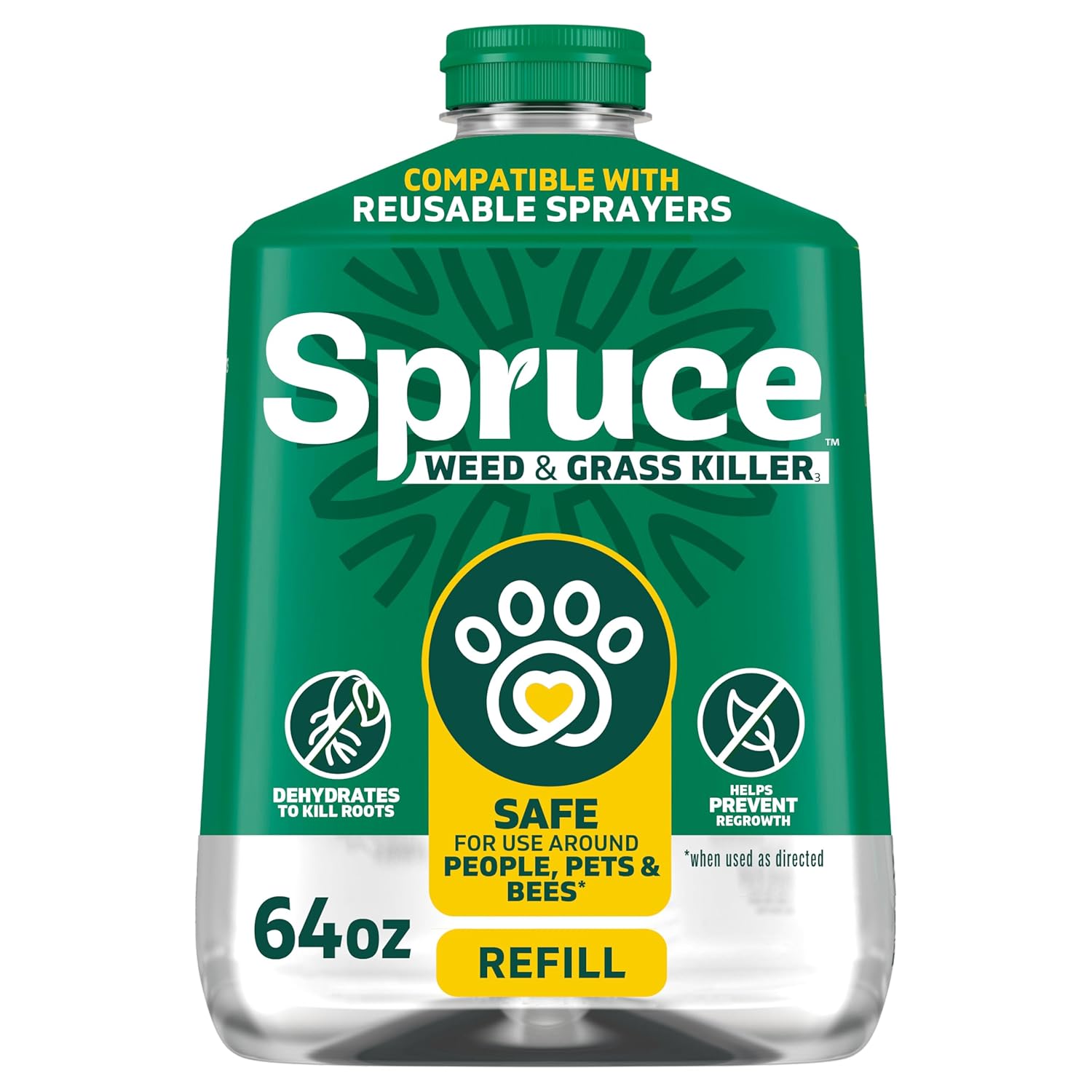
| Unit Count | 64 Fluid Ounces |
|---|---|
| Item Form | Spray |
| Coverage | 1 bottle treats up to 400 weeds |
| Active Ingredients | Sodium Lauryl Sulfate, Geraniol, Cornmint Oil |
This 64 fl oz Spruce refill is a no-mix replacement for the brand's Snap & Spray system that provides a convenient, ready-to-use weed and grass killer for spot treatments. It works on contact, dehydrating foliage with visible leaf darkening or wilting within an hour and complete plant death often by 24 hours. The formula relies on water, essential oils and sodium lauryl sulfate rather than synthetic herbicides, which makes it suitable for use around people and pets when directions are followed. One bottle is rated to treat up to about 400 weeds and is designed for hard surfaces, mulch beds, driveways and pavers rather than broadcast lawn application. Practical features include a snap-on refill top for the existing spray handle and a fast rainproof window of roughly 10 minutes. Be aware it is non-selective and must be applied carefully to avoid desirable plants, and it is most effective on young or small weeds rather than deep perennial roots where reapplication may be needed.
Best for: Buyers who want a low-fuss, pet-conscious spot weed killer for driveways, pavers and mulch beds and who prioritize convenience and visible speed of action.
Less Ideal for: Homeowners seeking a selective lawn treatment or long-term control of deeply rooted perennials should consider different systemic or professional options.
- Ready-to-use refill eliminates mixing and pouring
- Visible results in about one hour with full effect by 24 hours
- Formulated with water and essential oils for pet- and people-friendly use when directed
- Covers a high estimated count — one bottle treats up to 400 weeds
- Snap-on refill design fits the Spruce Snap & Spray handle for quick replacement
- Non-selective formula will damage desirable plants if oversprayed
- Less effective on large established perennial roots compared with systemic herbicides
Verdict: Choose this refill if you want a fast, ready-to-use, pet-conscious spot treatment that snaps into the Spruce spray handle for effortless weed control on hardscapes and beds.
Choosing the Right Organic Weed Killer for Flower Beds: Key Factors to Consider
Mode of Action and Target Weeds
Knowing how an organic weed killer controls plants helps set realistic expectations. Some products work by desiccating green foliage on contact, producing fast brown-out of young annual weeds but needing repeat treatments for established perennials. Others interfere with root systems or use naturally derived systemic ingredients that translocate within weed tissues. Choose a mode of action that matches the common weeds in your beds.
Match the product to your target species: contact products excel on small, tender weeds and seedlings, while systemic actions are better for deep-rooted perennials. For mixed weed populations in flower beds, plan for follow-up treatments and integrate mechanical control like hand-pulling for the toughest specimens.
Selectivity Near Ornamentals
Flower beds contain desirable plants that vary in sensitivity. Selectivity is the degree to which a product spares non-target ornamentals when properly applied. Some organic options are broadly non-selective and will damage any green tissue they contact, making them suitable only for spot treatment away from desired plants. Other formulations and application techniques reduce drift and contact risk, enabling safer use closer to flowers.
Consider the spacing and maturity of your ornamentals. Established, woody perennials tolerate drift better than tender seedlings. Use shields, shielded sprays, or targeted wicking methods when treating weeds close to sensitive plants. Read label instructions about safe distances and recommended application methods to protect your plantings.
Soil Health and Residual Effects
Organic does not always mean harmless to soil life. Some biologically active products can temporarily alter soil microbial activity or leave residues that affect germination. For flower beds where you plan to replant or overseed, choose products with low soil persistence to avoid delaying re-establishment of desirable species.
Evaluate how long a product remains active in the soil and whether it affects seedbeds or beneficial organisms like earthworms and mycorrhizae. For beds with frequent planting changes or sensitive native plantings, prioritize low-residual options and follow label guidance on replanting intervals.
Application Method and Timing
How you apply an organic weed killer determines both effectiveness and risk. Spot-sprays, wicking applicators, and hand-pulling all have different labor and accuracy profiles. Spray applicators can cover large areas quickly but require careful technique to avoid drift. Wicking or foam applicators provide targeted treatments with less risk to nearby flowers.
Timing matters too. Apply when weeds are actively growing and conditions favor uptake for systemic products. For contact desiccants, choose warm, dry days with little wind so foliage dries quickly. Consider seasonality of your ornamentals; avoid treating right before sensitive bloom or transplant windows.
Safety for Household and Pets
Gardeners must weigh human and pet exposure risks alongside efficacy. Organic options vary in toxicity and recommended re-entry times. Look for clear label directions on safe intervals before allowing people or animals back into treated areas, and whether rinsing or removal of mulch is advised after treatment.
Also assess storage and handling needs. Some products require dilution and careful measurement, while others come in ready-to-use formats that reduce mix-up risk. For gardens with children or roaming pets, prefer lower-toxicity choices and adopt physical barriers during drying periods.
Compatibility with Mulch and Planting Practices
Flower beds often include mulch, groundcovers, and companion plants that affect how a weed killer behaves. Mulch can block contact action to underlying weeds, requiring surface treatments or removal. Some organic products break down mulch or change its appearance, which may be undesirable in decorative beds.
Consider whether you will treat before or after mulching and whether the product can be applied around drip irrigation or porous mulches without runoff. For newly mulched or heavily planted beds, use targeted approaches to avoid disturbing the bed aesthetic and root zones of desirable plants.
When to Use Organic Treatments in Flower Beds
Organic weed killers are best used as part of an integrated approach when you need a quicker fix than hand-weeding but want to avoid synthetic herbicides. They are particularly useful for manageable infestations of young annuals, for spot treatment of persistent weeds between perennials, and in beds where soil biology or pollinator safety is a priority.
Reserve broad broadcast applications for times when beds are being renovated or temporarily cleared. For routine maintenance, combine targeted organic treatments with cultural controls like proper spacing, mulching, and timely hand removal to reduce repeat applications.
- Use spot applications around delicate plants using shields or wicks
- Treat on calm, dry days to reduce drift and improve uptake
- Follow up with manual removal of treated weed carcasses to prevent seed spread
Application Techniques for Safe Spot Control
Precision application reduces the chance of harming ornamental plants. Shielded spraying, foam or wick applicators, and paint-on formulas let you apply product directly to weed foliage while leaving nearby flowers untouched. For ground-hugging weeds, a small brush or sponge applicator can be more accurate than a spray wand.
Always allow treated foliage to dry before letting people or pets back into the area. Where possible, remove dead weed material after treatment so it does not smother seedlings or create aesthetic issues in beds.
- Use personal protective equipment as recommended on the label
- Apply only to actively growing weeds for best results
- Avoid treating during flowering periods to protect pollinators
Combining Organic Weed Control with Cultural Practices
Long-term weed management in flower beds depends more on prevention than repeated chemical fixes. Dense planting with appropriate spacing, timely mulching, and removal of weed seed sources reduce pressure and the need for repeat applications. Healthy, competitive ornamentals shade out many seedlings and reduce germination.
Rotate control tactics so weeds do not adapt to a single approach. For example, follow a season of spot organic treatments with increased mulch depth and targeted hand-weeding to catch any survivors before they set seed.
- Apply mulch after initial weed control to suppress new seedlings
- Inspect beds regularly and remove small weeds before they establish
- Encourage vigorous planting to reduce bare soil where weeds germinate
Dealing with Tough Perennials and Roots
Some perennial weeds resprout from extensive root systems and will require combined tactics. Mechanical removal of as much root mass as possible followed by targeted organic treatments to any regrowth increases the chance of control. Persistence and repeated monitoring are often necessary.
For deeply rooted species, consider seasonal timing: treat in spring or early summer when plants are moving sugars to roots for systemic uptake, or remove and amend soil if a bed renovation is planned.
- Hand-dig or fork out large root masses before applying treatment
- Treat regrowth early when plants have minimal carbohydrate reserves
- Use multiple short treatments rather than one heavy application for better control
Environmental and Pollinator Considerations
Even organic weed killers can affect non-target insects and pollinators if applied during bloom. Avoid treating flowering ornamentals and maintain buffer zones around pollinator-attractive plants. Consider spot treatments and physical removal when pollinator activity is high.
Protect nearby water features by avoiding application before heavy rain and by preventing runoff from treated areas. Choosing low-residue options helps reduce unintended environmental impacts.
- Do not spray on windy days to limit drift to flowering plants
- Delay irrigation for the time recommended on the product label
- Protect storm drains and waterways by treating away from slopes and edges
How We Chose the Best Organic Weed Killer for Flower Beds
We prioritized criteria that reflect real decisions gardeners make when treating planted flower beds. Effectiveness against common broadleaf and grassy weeds was a top filter, focusing on how reliably a product suppresses persistent species without requiring excessive repeat treatments. Selectivity and plant safety were essential; we favored options that minimize drift and contact damage to neighboring ornamentals and seedlings. Soil impact and residual persistence were judged so treatments do not undermine soil biology or prevent replanting. Application ease and equipment needs assessed whether the product fits hand-spraying, spot treatment, or broadcast routines used in typical flower beds. Safety for pets and humans during and after application was considered, including drying times and re-entry recommendations. We excluded products formulated only for turf or agricultural broadcasting where selectivity in mixed flower beds is poor. We also set aside products requiring professional licensing or industrial equipment. The remaining selections reflect a balance across the concrete dimensions above that gardeners can verify on product labels and use instructions.
FAQ
Are organic weed killers safe to use around newly planted flowers?
Often it depends on the product and application method. Many organic options are non-selective and can damage tender seedlings, so apply with a shield or use spot treatment techniques. Choose low-residue products and follow replanting intervals when labels specify them.
How long after application can I let pets and children back into a treated bed?
That usually depends on the product formulation and drying time. Some ready-to-use organic sprays dry quickly and allow re-entry within a few hours, while others recommend longer intervals. Always follow label directions for safe re-entry and keep pets off treated areas until the surface is dry.
Will organic weed killers affect soil life and future planting?
Some organic ingredients have transient effects on soil microbes, but many low-residue options are designed to minimize long-term impacts. If you plan to replant soon after treatment, select products with short persistence and adhere to any recommended wait times on the label.
Can I use organic weed killers on mulched flower beds?
You can, but mulch alters contact and uptake. Surface-applied desiccants may be blocked by thick mulch, so you might need to move mulch aside for effective treatment or use products formulated for surface application. Consider targeted methods to avoid disturbing the mulch too much.
How often will I need to reapply organic treatments to control weeds?
Reapplication frequency varies with weed type and product mode of action. Fast-acting contact solutions often need repeat treatments to catch new seedlings, while systemic controls may reduce reapplication frequency but can take longer to show results. Monitor treated areas and plan follow-up control as needed.
Final Verdict
Choose an organic weed control approach that matches the weeds you face and the sensitivity of your ornamentals. Prioritize selectivity and low soil persistence in planted flower beds, and use targeted application methods to protect blooms and beneficial organisms. Combine chemical-free tactics like mulching and manual removal with spot organic treatments for a balanced, sustainable strategy that reduces weed pressure while keeping your flower beds healthy.
