

Note: This article contains affiliate links. If you click on these links and make a purchase, I may earn a small commission at no extra cost to you. This helps support my research and content. Read my full affiliate disclosure here.
If spiders are building webs on your porch, patio, or around foundation gaps, the right outdoor spider insecticide makes a noticeable difference in comfort and maintenance. You want something that knocks down visible spiders quickly, leaves a residual barrier to limit return visits, and can be applied safely around people, pets, and beneficial insects when used correctly. This guide covers the seven shortlisted options that fit typical yard and patio needs, and explains the practical tradeoffs you should weigh. We evaluated each product for knockdown speed, residual protection, application ease, and safety considerations. Read on for the factors that matter in real outdoor settings and the additional tips for using these treatments effectively.
Top Picks at a Glance
| Best Overall The best all-around choice for most situations | Talstar One Insecticide Concentrate, 1 Gallon |  |
| Best Quality Built to a higher standard if you want something more solid | Envu Suspend PolyZone Insecticide Concentrate, 16 oz |  |
| Best Value The sweet spot between price and what you get | Ortho Home Defense Insect Killer Refill, 1.33 gal (Indoor & Perimeter) |  |
| Best Budget The cheapest option that still gets the job done reliably | Spectracide Triazicide Insect Killer for Lawns & Landscapes, 32 oz |  |
| Highest Rated A top-rated pick with lots of positive feedback | MGK Onslaught Fastcap 8 oz Spider and Scorpion Insecticide |  |
| Most Popular A crowd favorite that many people choose with confidence | Ortho BugClear Insect Killer for Lawns & Landscapes Ready-to-Spray, 32 oz |  |
| Best Seller A high-volume bestseller chosen again and again | Atticus Talak 7.9% Bifenthrin Indoor/Outdoor Insecticide Concentrate, 32 oz |  |
Talstar One Insecticide Concentrate, 1 Gallon

| Active ingredient | Bifenthrin 7.9% |
|---|---|
| Formulation | Concentrate, water-based |
| Coverage intent | Perimeter and structural applications |
| Pest range | Controls 75+ pests including ticks |
Talstar One is a professional-strength bifenthrin concentrate designed to provide broad-spectrum control of ants, spiders, roaches, fleas, ticks, mosquitoes, and many other pests. You mix the concentrate with water and apply it as a perimeter spray around foundations, doors, and windows or to targeted cracks and crevices indoors. Notable features include a water-based, low-odor formula that dries clear and a residual effect that reduces the need for frequent reapplications on lawns, ornamentals, shrubs, and structural surfaces. For yards with tick pressure, treating perimeters and vegetation provides a dependable barrier that helps reduce tick encounters when applied according to label directions. The product is concentrated so one gallon treats large areas, which makes it efficient for seasonal maintenance across multiple structures. Important limitations are that it is a pesticide that requires careful handling and strict adherence to label rates and application restrictions, and it is not a ready-to-use spray so you will need appropriate mixing and application equipment for safe, effective coverage.
Best for: Buyers who prioritize reliable, residual pest control for yards and perimeters and who are comfortable using concentrated pesticides with proper safety practices.
Less Ideal for: Casual users who want a ready-to-use product or those unwilling to follow pesticide label precautions and use appropriate application equipment.
- Broad-spectrum control that includes ticks and common yard pests
- Concentrated formula covers large areas and is cost-efficient for seasonal treatments
- Water-based, low-odor formula dries clear and is suitable for outdoor living spaces
- Suitable for both perimeter and targeted indoor/structural applications
- Concentrate requires proper mixing and application equipment for safe use
- Contains bifenthrin so users must follow label precautions to protect people, pets, and beneficial insects
Verdict: Choose Talstar One when you need a concentrated, long-lasting perimeter treatment that reliably reduces tick pressure across yards and structures.
Envu Suspend PolyZone Insecticide Concentrate, 16 oz

| Item Form | Liquid |
|---|---|
| Target Species | Ants, cockroaches, spiders, mosquitoes, and crawling insects |
| Liquid Volume | 16 fluid ounces |
| Active Ingredients | Deltamethrin |
Suspend PolyZone is a 16 oz suspension concentrate that uses deltamethrin and a polymer formulation to create a persistent barrier on exterior surfaces. It is mixed with water and applied around foundations, doorways, patios and other pest entry points to control ants, spiders, cockroaches and other crawling insects; the label also permits certain mosquito and bed bug applications when used as directed. The PolyZone technology helps the active ingredient adhere to surfaces and resist weathering, which extends residual control compared with non-polymer liquids. Typical use is a perimeter barrier spray from a pump sprayer or targeted crack-and-crevice spot treatments indoors in limited areas. Important trade-offs are that it is a professional-strength insecticide requiring careful mixing and strict label compliance and it contains a synthetic pyrethroid so homeowners who prefer non-chemical or lower-toxicity options will want alternatives. When used correctly it provides confident, long-lasting control on exterior surfaces but it must be handled and applied with appropriate protective measures.
Best for: Buyers looking for a dependable, long-residual perimeter insecticide to reduce reapplications around foundations and outdoor living spaces while accepting the need to follow professional-strength product precautions.
Less Ideal for: People who want non-chemical solutions, ready-to-use consumer sprays, or those unwilling to mix and apply concentrated insecticides should consider other options.
- PolyZone polymer formula increases adherence and extends residual activity on exterior surfaces
- Broad-spectrum control listed for ants, spiders, cockroaches, mosquitoes and other crawling insects
- Concentrated liquid mixes with water so one bottle covers multiple applications
- Label allows both outdoor perimeter use and limited indoor spot or crack-and-crevice treatments
- Contains deltamethrin, a synthetic pyrethroid that requires careful handling and strict label compliance
- Not a ready-to-use spray so a separate sprayer and correct dilution are required
Verdict: Choose Suspend PolyZone if you want a concentrated, polymer-enhanced deltamethrin treatment that delivers longer residual perimeter control for common outdoor pests.
Ortho Home Defense Insect Killer Refill, 1.33 gal (Indoor & Perimeter)

| Unit Count | 170.24 Fluid Ounces |
|---|---|
| Item Form | Spray |
| Target Species | Insects |
| Liquid Volume | 1.33 gallons |
This Ortho Home Defense refill is made for homeowners who want a high-capacity solution for indoor and perimeter pest control. The concentrate is intended to be poured into the reusable Comfort Wand applicator so you can treat entry points, baseboards, doorframes, and foundation perimeters without repeated small bottles. Its formula claims an invisible, fast-drying barrier that provides up to 12 months of residual control for ants, roaches, and spiders when applied on non-porous indoor surfaces, and it targets a broad list of common household insects. In practice the refill reduces trips to the store and lowers per-application cost compared with single-use sprayers, and the continuous-spray wand reduces user fatigue for larger jobs. Important limitations are that the long-residual claim applies mainly to certain pests and non-porous surfaces, and precise coverage requires following the spray distance and band-width directions to avoid overapplication. This product is best used as part of a preventive or follow-up treatment routine rather than a one-time knockdown for heavy infestations.
Best for: Homeowners who prioritize effective, long-lasting perimeter and indoor protection and who want a refillable, economical option for routine pest control.
Less Ideal for: People who need immediate, heavy-duty knockdown treatments or who prefer single-use ready-to-spray bottles for spot treatments.
- Large 1.33 gallon refill reduces frequency of repurchasing and is economical for whole-home or perimeter treatments
- Compatible with the Comfort Wand reusable applicator for continuous spray and less hand fatigue during larger jobs
- Invisi-Shield formula dries clear with no noticeable fumes, allowing people and pets to re-enter once dry
- Broad-spectrum label covers many common indoor and perimeter pests, including ants, roaches, spiders and mosquitoes
- Residual protection claim is specific to ants, roaches and spiders on non-porous indoor surfaces and may not apply equally to all listed insects
- Requires a compatible applicator wand or transfer container since it is a refill rather than a ready-to-use spray
Verdict: Buy this refill if you want an economical, high-capacity solution to maintain a long-lasting indoor and perimeter insect barrier using a reusable comfort-wand applicator.
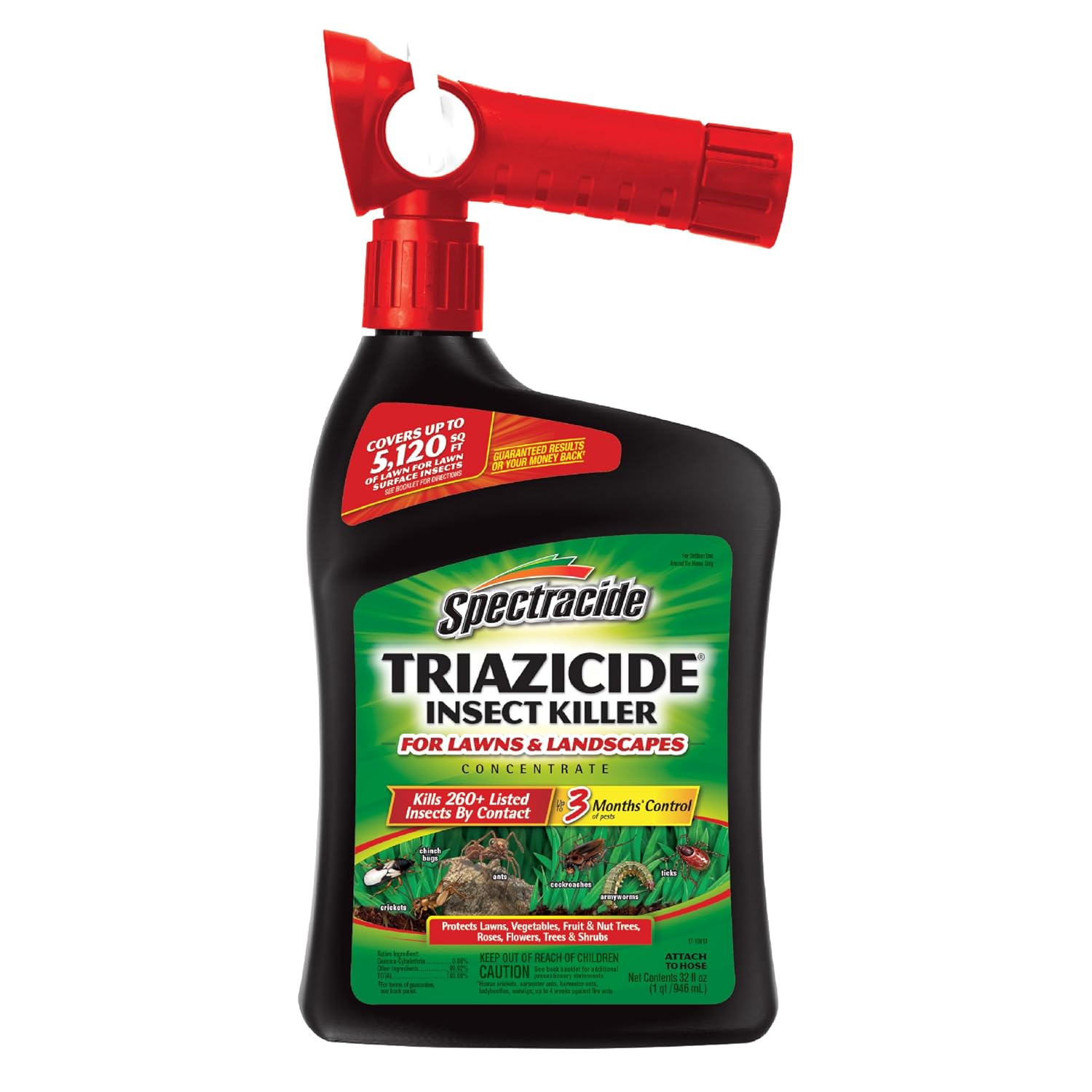
Spectracide Triazicide Insect Killer for Lawns & Landscapes, 32 oz
| Unit Count | 32 Ounce |
|---|---|
| Item Form | Spray |
| Target Species | Insects |
| Active Ingredients | Gamma-Cyhalothrin (0.08%) |
Spectracide Triazicide is a 32-ounce concentrate formulated to control more than 260 listed insects on lawns, flower beds, trees, shrubs and around vegetables. You mix the concentrate with water and apply it with a tank or hose-end sprayer; the ready-to-spray variant can attach to a garden hose for quicker application. The active ingredient, gamma-cyhalothrin, delivers fast contact kill for pests such as fleas, ticks, Japanese beetles and many surface insects, and the label claims protection for up to three months in some uses. It is non-staining when used as directed and can treat large areas, making it practical for whole-yard applications and targeted mound treatments like fire ants. Important limitations include toxicity to fish and bees, so it must not be applied near water or blooming plants, and the product requires careful handling and adherence to safety directions. Follow mixing rates and timing recommendations for best results and to minimize environmental risk.
Best for: Buyers who need an affordable, large-area solution to knock down common lawn and landscape pests and prefer a concentrate that stretches coverage when mixed.
Less Ideal for: People with small ornamental gardens near ponds, homeowners who prioritize pollinator-safe products, or those unwilling to follow pesticide safety precautions should consider gentler or targeted alternatives.
- Concentrate covers large areas so a single bottle treats many square feet when mixed correctly
- Fast-acting contact kill for a wide range of listed insects including fleas, ticks and Japanese beetles
- Versatile use on lawns, flower beds, trees, shrubs and around vegetables
- Non-staining when used as directed and available in hose-end ready-to-spray format for easier application
- Highly toxic to aquatic life and bees so it cannot be used near water or blooming plants
- Requires careful mixing and protective handling due to chemical toxicity
Verdict: A cost-effective, fast-acting concentrate for treating broad lawn and landscape pest problems when used with care and proper precautions.
MGK Onslaught Fastcap 8 oz Spider and Scorpion Insecticide

| Item Form | Liquid |
|---|---|
| Target Species | Insects |
| Liquid Volume | 8 fluid ounces |
| Included Components | 1 bottle |
MGK Onslaught Fastcap is a ready-to-dilute liquid insecticide designed for targeted treatments where spiders and scorpions are a concern. It is typically mixed and applied as a surface spray, spot treatment, crack-and-crevice application, or injected into voids to reach hiding pests. The label lists fast kill plus a lasting residual, and active ingredients (esfenvalerate, piperonyl butoxide, prallethrin) give combined quick knockdown and extended control. Practical benefits include a broad target spectrum that covers spiders and scorpions plus many household and perimeter pests, flexible application methods for indoor and structural perimeter use, and a measurable liquid volume for multiple spot treatments. Important limitations are that it is a concentrated insecticide requiring correct dilution and careful reading of label instructions for pet safety and indoor use, and it is not a repellent so placement and thorough coverage matter for best results.
Best for: Buyers who prioritize dependable, professional-strength control of spiders and scorpions around structures and want a product that delivers both quick knockdown and residual protection when applied correctly.
Less Ideal for: Casual users seeking a no-mix consumer aerosol or those uncomfortable handling concentrated insecticides should consider ready-to-use alternatives or professional services.
- Fast-acting formulation combined with residual control for longer protection
- Broad target list including spiders, scorpions, and common household pests
- Versatile application options: surface, spot, crack-and-crevice, and void injection
- Comes in an 8 fl oz liquid volume suitable for multiple spot or localized treatments
- Requires proper dilution and application handling; not a ready-to-use aerosol
- Contains multiple active ingredients that require following label directions for pet and household safety
Verdict: Choose this concentrated liquid when you need a reliable, professional-strength treatment that delivers fast knockdown and lasting control of spiders and scorpions.
Ortho BugClear Insect Killer for Lawns & Landscapes Ready-to-Spray, 32 oz

| Item Form | Aerosol |
|---|---|
| Target Species | Ant |
| Liquid Volume | 32 fluid ounces |
Ortho BugClear Ready-to-Spray is a hose‑end insecticide designed for homeowners who want a fast, no-mix solution to reduce mosquitoes and many other yard pests. You attach the 32 oz. bottle to a garden hose and apply across lawns, foundation perimeters and ornamentals; one bottle covers up to about a 5,300 sq ft lawn or targeted perimeter areas. The formula lists bifenthrin and zeta‑cypermethrin and is described as non‑staining and odor free, with knockdown that starts within minutes and protection that can last for months. Practical benefits include quick application without measuring, broad-spectrum control of dozens of species including mosquitoes and ticks, and compatibility with turf, shrubs and listed edibles when used as directed. Important limitations are that it is a contact/residual insecticide so timing matters for weather and pollinator safety, and hose-end coverage is fixed so very large properties may need multiple bottles; follow label precautions for pets, people and bloom protection.
Best for: Homeowners who want an affordable, easy-to-use mosquito and general yard pest treatment they can apply themselves without mixing concentrates.
Less Ideal for: People who prefer organic or non-chemical mosquito control methods or those managing very large properties who need professional-scale coverage.
- Ready-to-spray hose-end design for quick, no-mix application
- Claims fast knockdown and long-lasting residual control
- Broad-spectrum label lists many outdoor pests including mosquitoes and ticks
- Non-staining and low odor for outdoor use near living spaces
- Contains synthetic pyrethroids that require careful timing and avoidance of blooming plants to protect pollinators
- Single bottle covers limited area for very large yards
Verdict: A budget-friendly, ready-to-spray option that makes quick, DIY mosquito and yard pest control simple for typical residential lawns.
Atticus Talak 7.9% Bifenthrin Indoor/Outdoor Insecticide Concentrate, 32 oz

| Active Ingredient | Bifenthrin |
|---|---|
| Formulation | Suspension Concentrate |
| Liquid Volume | 32 fluid ounces |
| Length of Control | Up to three months |
| Target Species | Insects |
Talak 7.9% is a liquid concentrate for treating lawns, landscaping, outdoor living areas and indoor perimeter spots like baseboards and cabinets. You dilute the concentrate with water to create a spray for barrier treatments, spot applications or lawn mixes; label rates explain how much to mix per gallon depending on the use. The product uses bifenthrin, a proven broad-spectrum active ingredient, and the manufacturer states it controls over 75 species and can give residual control for as long as three months. Its water-based formula dries clear, leaves no odor or visible residue, and is not phytotoxic on plants when used per label. Practical benefits include flexible indoor and outdoor use, clear drying, and a bottle designed for easier pouring. Important limitations are that solutions should be mixed only for same-day use, it is not registered for sale in a few states, and it is not approved for fogger application, so professional-style misting methods are not appropriate.
Best for: Buyers who want a single, reliable product to protect yards, patios and building perimeters from a wide range of common pests and prefer conservative, label-driven application practices.
Less Ideal for: People seeking ready-to-use sprays or fogger-compatible products or those in states where this formulation is not registered should look at alternatives.
- Broad-spectrum control listed for 75+ indoor and outdoor pest species
- Water-based formula that dries clear and leaves no odor or residue
- Flexible label directions for lawns, landscapes, hardscapes and indoor perimeter treatments
- Long residual activity up to three months when applied at recommended rates
- Mixed spray solutions cannot be stored and must be used the same day
- Not approved for fogger application and not available for sale in some states
Verdict: A versatile, water-based bifenthrin concentrate that delivers long-lasting, broad-spectrum outdoor (and perimeter indoor) control when used according to the label.
Choosing the Right Outdoor Spider Insecticide: Key Factors to Consider
Knockdown and Contact Effectiveness
How quickly a product incapacitates spiders on contact matters for visible control and homeowner confidence. Fast knockdown reduces the chance that spiders will escape treated areas and rebuild webs nearby. Consider products with proven contact activity against common outdoor species such as wolf spiders and cellar spiders.
Keep in mind that some formulations deliver immediate paralysis while others rely more on residual exposure. If you need immediate visible reduction on a high-traffic patio, prioritize faster contact action; if you are treating perimeter gaps to reduce future activity, residual action becomes more important.
Residual Protection and Weather Resistance
Residual duration determines how often you will need to reapply and how well the treatment holds up to rain, irrigation, and UV exposure. Longer residuals reduce maintenance but depend on where you apply the product. Horizontal surfaces and porous stone can absorb treatments faster than painted siding or concrete.
Check label guidance about reapplication intervals and expected duration under outdoor conditions. Products formulated for outdoor residual control often include binding agents or microencapsulation to slow breakdown. In areas with frequent rain, choose a formulation with proven wash-off resistance to maintain protection between applications.
Application Method and Equipment Compatibility
How you intend to apply the insecticide shapes which formulation is practical. Ready-to-use sprays are convenient for spot treatments, whereas hose-end concentrates or concentrates mixed in sprayers are more efficient for perimeter and larger yard applications. Power-sprayer compatibility matters if you plan to treat larger properties.
Also consider nozzle options for creating a coarse spray to reach webbing in eaves or a finer mist for soil and crack treatments. Ease of mixing, clear label dilution instructions, and compatibility with common garden sprayers reduce the risk of application error and accidental overuse.
Surface Compatibility and Adherence
Different outdoor surfaces absorb and hold insecticides differently. Products that adhere well to vertical surfaces, such as siding and masonry, are better at interrupting spider pathways and web sites. Conversely, porous surfaces like untreated wood and rough stone may require higher rates or repeat applications to achieve similar coverage.
Look for label directions specifying treated surfaces and any required surface preparation. Some formulations include stickers or spreaders that improve adherence, which is helpful for treatments on eaves, rafters, and foundation crevices where spiders commonly establish webs.
Safety, Non‑Target Effects, and Reentry Instructions
Safety is central when treating outdoor spaces where children, pets, and pollinators may be present. Read label restrictions about reentry times, pet reaccess, and proximity to edible gardens. Products vary in their toxicity profile for beneficial insects and aquatic life, so buffer zones or application timing may be necessary to reduce non-target exposure.
Proper personal protective equipment and following label rates limit risk. Prefer products with clear guidance on safe use around landscaped areas and those that permit targeted application methods that avoid broad broadcast treatments near pollinator plants.
Environmental Persistence and Regulatory Guidance
Environmental persistence affects both efficacy and ecological impact. Some active ingredients break down quickly, which reduces long-term non-target risk but shortens control windows. Others persist longer and provide extended protection at the cost of greater environmental exposure.
Consult label statements about environmental fate, runoff risks, and whether restrictions apply near water bodies. Choose a product profile that matches your tolerance for frequent maintenance versus minimizing environmental persistence.
Where to Apply Treatments Outside the Home
Focus applications where spiders build webs and where they enter structures. Common target zones include eaves, soffits, porch ceilings, under decking, foundation perimeters, and around exterior light fixtures. Treat cracks and crevices around doors and windows where spiders and their prey travel.
For yard-level control, treat low shrubs, rock walls, and exposed fence lines where webs are common. Avoid broad broadcast sprays over flowering plants to reduce harm to pollinators. Instead use targeted band treatments or spot applications in non-flowering areas.
- Treat vertical surfaces where webbing is frequent, such as siding and porch rafters
- Apply to foundation gaps and door thresholds to reduce indoor incursions
- Avoid spraying open blooms and active pollinator foraging areas
Timing Treatments for Best Results
Apply treatments in the evening or early morning when spiders and their prey are active at ground level and when pollinator activity is lower. Cooler temperatures often increase contact activity for spiders. Avoid application before heavy rain and follow label rainfast claims to ensure residual retention.
Seasonal timing matters. Early spring perimeter treatments reduce population buildup, while mid-summer spot treatments address peak visible activity. Repeat application intervals should follow label guidance based on residual claims and local weather patterns.
- Aim for low-wind, low-pollinator periods like dusk or dawn
- Reapply according to label interval or after significant rainfall
- Combine spot treatments with habitat modification for longer-term reduction
Non-Chemical Steps to Reduce Spider Activity
Chemical control is most effective when paired with habitat modification. Reduce clutter near foundations, trim vegetation away from siding, seal cracks and gaps, and turn off or shield outdoor lights that attract insect prey. Removing web anchor points and reducing prey availability makes insecticide treatments more effective and reduces the need for frequent reapplications.
Regular sweeping of webs from eaves and porch ceilings also disrupts breeding and feeding sites. For heavy webbing, physically removing webs before treatment improves contact with residual deposits on the underlying surface.
- Seal gaps, screen vents, and weather-strip doors
- Keep vegetation trimmed away from structures
- Reduce outdoor lighting or use yellow bulbs that attract fewer insects
Safe Storage, Mixing, and Disposal Practices
Store concentrates in their original containers in a cool, dry place out of reach of children and pets. Follow label directions for mixing and use the recommended personal protective equipment when handling concentrates. Measure accurately to avoid overapplication and reduce environmental exposure.
Dispose of leftover diluted solution and empty containers according to label and local regulations. Never pour concentrates or unused mixes onto soil in vegetable beds or into storm drains. Proper disposal protects water quality and non-target organisms.
- Keep concentrates locked or high and away from living areas
- Use only approved containers and do not reuse pesticide bottles
- Follow local hazardous waste rules for disposal of excess product
Managing Expectations and Combining Strategies
Expect incremental reduction rather than immediate elimination of all spiders. Treatments reduce numbers and break activity cycles, but complete eradication is unlikely and not necessary for a comfortable outdoor space. Combining insecticide use with habitat changes and routine cleanup yields the best long-term results.
Monitor treated areas and adjust frequency based on observed rewebbing and season. If a particular location consistently shows activity, focus targeted treatments and exclusion work rather than increasing broadcast applications.
- Use monitoring to guide retreatment timing
- Prioritize barrier treatments at entry points over broad yard sprays
- Integrate physical exclusion and landscape adjustments for durable control
How We Chose the Best Outdoor Spider Insecticide
We prioritized products that combine reliable contact knockdown with measurable residual protection outdoors. Key evaluation criteria were documented effectiveness against common outdoor spider species, duration of residual control on typical surfaces like siding and stone, and the labeled application methods suited to yards, patios, and foundation perimeters. We also assessed formulation types for safety and non-target exposure risk, plus labeling clarity about reentry intervals and pet restrictions. Practical handling factors were important: ease of mixing and applying with common garden equipment, resistance to washout from rain, and whether the formulation adheres to vertical surfaces where spiders build webs. We excluded indoor-only aerosols, products lacking clear outdoor residual claims, and treatments requiring specialized commercial applicator licensing. The final shortlist reflects options that balance performance, homeowner-safe application, and realistic outdoor persistence under typical yard conditions.
FAQ
Are outdoor spider insecticides safe to use around pets and children?
Safety depends on the active ingredient and label directions. Many products permit reentry once residues dry, while others require longer wait times. Always follow label reentry and pet access instructions, keep treated areas off-limits until safe, and consider targeted spot treatments to reduce exposure.
How often should I reapply an outdoor spider insecticide?
Reapplication intervals depend on the product's residual claim and local weather. Some treatments last several weeks, while others break down faster in sun or rain. Follow the label's recommended schedule and retreat sooner if heavy rainfall or frequent rewebbing occurs.
Can I use the same insecticide for spiders and other outdoor pests?
Many perimeter products control a range of crawling insects, but label claims vary. Check the product label for the specific pests listed and for application rates appropriate to each target. Using a product outside its labeled scope risks poor efficacy and non-target harm.
Will outdoor insecticide treatments kill beneficial insects?
Broad application near flowering plants can harm pollinators and other beneficial insects. Targeted applications to non-flowering areas, timing treatments for low pollinator activity, and avoiding broadcast spraying over blooms all reduce non-target impacts.
Can I apply treatments before or after rain?
Applying just before heavy rain can wash away residues and reduce effectiveness. Choose products with label guidance for rainfastness and wait for dry windows to allow proper binding. If a heavy rain occurs soon after application, a follow-up treatment may be necessary.
Is it better to use a ready-to-use spray or a concentrate mixed in a sprayer?
Ready-to-use sprays are convenient for small areas and spot treatments, while concentrates are more efficient for treating perimeters and larger properties. Consider how much area you need to cover and whether you have compatible spraying equipment when deciding between formats.
Final Verdict
Prioritize treatments that match the area and intensity of spider activity. For visible webs and entry points, choose products with quick knockdown and good adherence to vertical surfaces. For perimeter protection, prefer formulations with documented residual duration and rain resistance. Balance efficacy with safety by using targeted applications, following label reentry instructions, and combining chemical treatments with habitat modification. That approach reduces repeated applications and delivers dependable control while minimizing non-target impacts.
