

Note: This article contains affiliate links. If you click on these links and make a purchase, I may earn a small commission at no extra cost to you. This helps support my research and content. Read my full affiliate disclosure here.
Picking the right pesticide for a vegetable garden matters because you are treating plants you will eat and you need to preserve beneficial insects, soil health, and flavor. The best options balance pest control with safety and minimal residue so you can protect yields without compromising garden ecology. This guide shortlists seven pesticides suited for vegetable gardens and explains the practical differences between them. We evaluated products on factors gardeners care about, such as how quickly they act, how safe they are around pollinators and people, and how persistent residues are in soil and on produce. Read on for clear, garden-tested decision points that lead into our top picks.
Top Picks at a Glance
| Best Overall The best all-around choice for most situations | Bonide Captain Jack's Deadbug Brew Concentrate, 32 oz |  |
| Best Quality Built to a higher standard if you want something more solid | Atticus Spliven Spinosad Organic Insecticide Concentrate (32 fl oz) |  |
| Best Value The sweet spot between price and what you get | BioAdvanced Fruit, Citrus & Vegetable Insect Control Concentrate, 32 oz |  |
| Best Budget The cheapest option that still gets the job done reliably | GardenTech Sevin Insect Killer Dust, 1 lb |  |
| Highest Rated A top-rated pick with lots of positive feedback | Sevin Insect Killer Concentrate II, 32 oz |  |
| Most Popular A crowd favorite that many people choose with confidence | Bonide Captain Jack's Ready-to-Use Neem Oil Spray, 32 oz |  |
| Best Seller A high-volume bestseller chosen again and again | Bonide Captain Jack's Bt Thuricide Ready-to-Use Spray, 32 oz |  |
Bonide Captain Jack's Deadbug Brew Concentrate, 32 oz

| Unit Count | 32 Ounce |
|---|---|
| Item Form | Liquid |
| Target Species | Insects |
| Active Ingredients | Spinosad |
Bonide Captain Jack's Deadbug Brew is a concentrated spinosad-based insecticide designed for use on vegetables, fruits, flowers, and ornamentals in organic gardens. You mix the concentrate with water and apply it with a trigger, hand-held, backpack, or hose-end sprayer to target caterpillars, beetles, borers, leaf miners, thrips, spider mites and other listed pests. Because the active ingredient is spinosad, the product targets many chewing and some sucking insects while having limited impact on predatory beneficials when used as directed. The concentrate format keeps storage and transport compact and lets you treat multiple beds or trees from one bottle. Important limitations are following label directions closely for application rates and timing and taking normal safety precautions; like all insecticides it will not selectively remove a single pest species and repeated use can require integrated pest management strategies. For gardeners seeking a broadly effective, organic-eligible spray, this is a practical go-to option.
Best for: Gardeners who want a single, broadly effective insecticide approved for organic use to protect vegetables, fruits and ornamental beds and who prefer a concentrate that treats multiple areas.
Less Ideal for: People seeking an immediate-contact knockdown spray for household pests or those unwilling to follow dilution and safety instructions should consider other options.
- Contains spinosad, an organic-approved active ingredient effective against many caterpillars, beetles, borers and leaf-feeding pests
- Concentrate mixes easily with water and works with common sprayers including trigger, backpack and hose-end models
- Approved for use on a wide range of edible and ornamental plants, including vegetables, fruits and ornamentals
- Formulation is designed to have limited impact on predatory beneficial insects when used according to the label
- Requires careful dilution and adherence to label directions for safe and effective use
- Not selective to a single pest species and may require integration with other IPM practices
Verdict: Choose this concentrated spinosad spray if you want a versatile, organic-approved insecticide to protect a wide range of garden plants.
Atticus Spliven Spinosad Organic Insecticide Concentrate (32 fl oz)

| Formulation | Liquid |
|---|---|
| Active Ingredients | Spinosad |
| Unit Count | 32 Fluid Ounces |
| Specification Met | OMRI |
| Target Species | Insects |
Spliven is a water-based spinosad concentrate designed for home fruit, vegetable, and ornamental gardens. You measure and mix small batches with water (rate guidance and simple tablespoon/tsp conversions are on the label) and apply with a trigger, backpack, or hose-end sprayer. Its OMRI listing and spinosad active ingredient make it a suitable organic option for knocking down more than 40 pests commonly found on edible plants and ornamentals. Practical benefits include a short harvest interval for many crops, no oily residue or lingering odor after spraying, and flexible application volumes so you can treat a few plants or larger beds. The label calls out effective control of caterpillars, thrips, leafminers, and certain worm pests that can damage squash. Important limitations are that Spliven is not labeled for every pest (for example Japanese beetle is excluded) and success against heavy infestations requires thorough coverage of upper and lower leaf surfaces and repeat applications per label timing. Also, as a contact/ingestion insecticide, it works best when applied while pests are actively feeding.
Best for: Gardeners who prioritize effective, organic-approved pest control for edible plants and want a concentrate they can mix to match small beds or larger areas.
Less Ideal for: People seeking a one-application systemic solution or wanting control of pests not listed on the label should consider alternative chemistries or targeted products.
- OMRI listed and suitable for organic fruit and vegetable gardens
- Controls a broad spectrum of 40+ garden pests including caterpillars and thrips
- Water-based formula leaves no oily residue or strong odor
- Easy to mix small or larger spray volumes with clear rate conversions
- Not labeled for every pest species so some garden problems need other products
- Requires thorough coverage and correct timing for best control; may need repeat applications
Verdict: Choose Spliven when you need a proven, organic-approved spinosad concentrate to control common squash pests and other garden insects with flexible, no-residue spray applications.
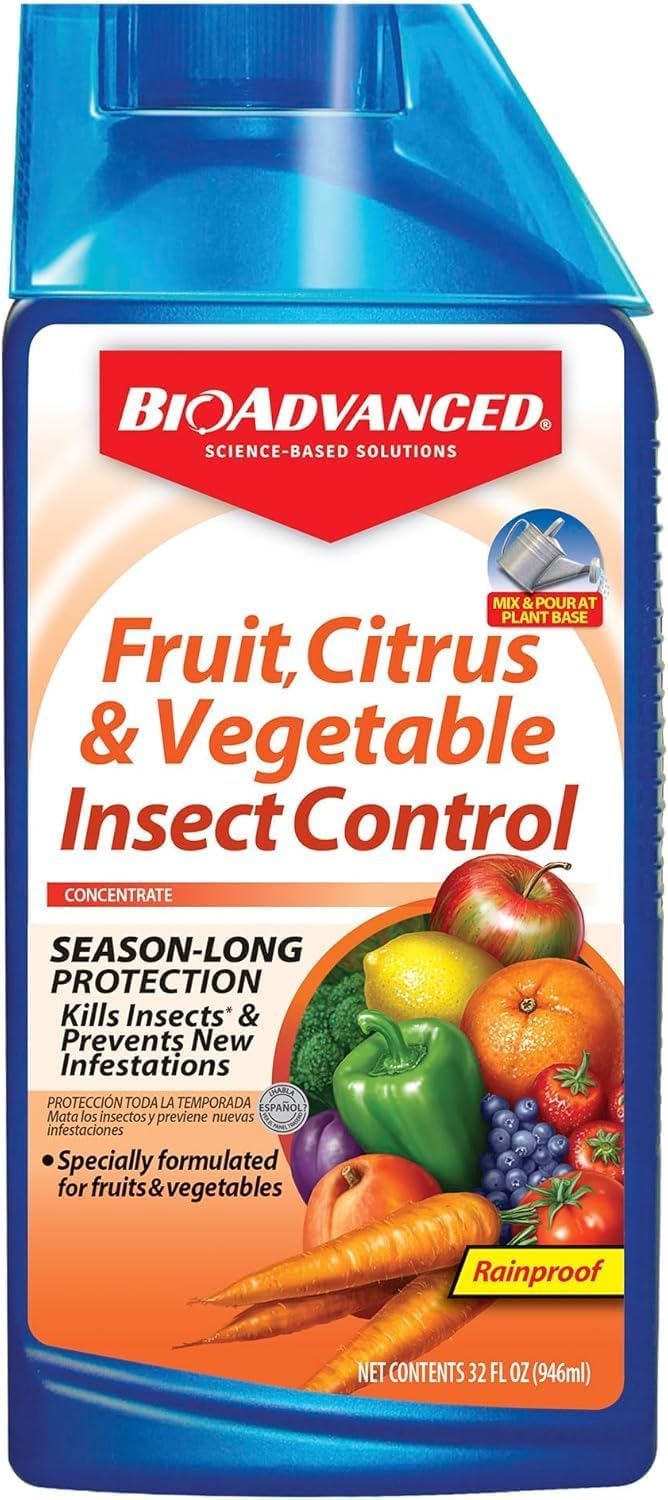
BioAdvanced Fruit, Citrus & Vegetable Insect Control Concentrate, 32 oz
| Item Form | Concentrate |
|---|---|
| Target Species | Aphid, Whiteflies, Japanese Beetles, Mealybugs, Asian Citrus Psyllid |
| Liquid Volume | 32 fluid ounces |
| Specification Met | EPA |
| Active Ingredients | avocado |
This 32 oz BioAdvanced concentrate is a pour-and-mix systemic insect control designed for edible gardens. You dilute the concentrate with water and apply to soil or use according to the label so the active ingredient is taken up by the plant and protects foliage and fruit without foliar spraying. It lists control for aphids, whiteflies, leafhoppers, mealybugs, Japanese beetles and Asian citrus psyllid and claims season-long protection that becomes rainproof about an hour after application. The bottle treats a substantial area and is convenient for gardeners who prefer one application that protects multiple edible crops. Important limitations are regulatory restrictions in several states and counties and the fact that it is a systemic insecticide, so it will be present in treated plants until it breaks down and you must follow label harvest intervals for edibles. Also it targets listed pests rather than being broad spectrum against every garden insect.
Best for: Gardeners who want a low-effort, season-long preventive solution for insect problems in vegetable and small fruit plots and who prioritize convenience and reliable systemic control.
Less Ideal for: Organic growers or anyone who wants to avoid systemic insecticides should choose non-systemic or organic pest control options instead.
- Systemic concentrate delivers season-long, rainproof protection after application
- Formulated specifically for use on fruit, citrus and many vegetables so label includes edible-plant directions
- Covers a large area from one bottle when mixed per label instructions
- Controls several common and damaging pests including aphids, whiteflies and Japanese beetles
- Not permitted for sale or use in several states and some New York counties, limiting availability
- Contains a systemic neonicotinoid active ingredient requiring adherence to label harvest intervals for edibles
Verdict: Choose this concentrate if you want a single, season-long systemic treatment to protect vegetable and fruit plants from a defined list of common pests.
GardenTech Sevin Insect Killer Dust, 1 lb

| Item Form | Dust |
|---|---|
| Target Species | Insects |
| Active Ingredients | Bifenthrin |
| Unit Count | 1 Count |
Sevin Insect Killer Dust is a handheld dust formulation of bifenthrin for spot and perimeter treatment of garden pests, including Japanese beetles. You apply it by shaking a thin, uniform layer onto leaves, stems and around plants as a preventative or when you first see damage. The product kills by contact and lists more than 150 target insects, so it works across vegetables, fruit, ornamentals and turf. Practical features include a flip-open cap for easy dispensing and a 1 pound container sized for small-to-medium beds; the manufacturer states one pound treats about 2,000 sq. ft. The dust does not require mixing and settles quickly so treated areas can be reoccupied after it dries. Important limitations are typical for contact insecticides: it should not be applied to open blooms to protect pollinators and it provides little residual control if plants are watered or receive heavy rain within 24 hours of application. Users must follow label safety steps like avoiding the eyes and washing hands after use.
Best for: Gardeners who want a straightforward, no-mix contact treatment to quickly reduce visible beetle and chewing insect pressure in mixed vegetable, fruit and ornamental plantings.
Less Ideal for: People prioritizing pollinator-safe or long-residual biological controls should choose targeted or non-chemical methods instead.
- Kills by contact a wide range of garden pests including Japanese beetles and aphids
- Ready-to-use dust needs no mixing and is simple to apply with a flip-open cap
- Label lists use on vegetables, fruits, ornamentals and lawns so it fits mixed garden beds
- Contains bifenthrin which can harm beneficial insects if applied to open blooms or overused
Verdict: If you need a simple, ready-to-use contact treatment to quickly knock down Japanese beetles and other common garden pests, Sevin dust delivers fast, broad-spectrum control.
Sevin Insect Killer Concentrate II, 32 oz

| Item Form | Liquid |
|---|---|
| Target Species | Insects |
| Liquid Volume | 32 fluid ounces |
| Active Ingredients | Zeta Cypermethrin |
Sevin Insect Killer Concentrate II is a garden spray concentrate you mix with water and apply with a handheld, tank, or hose-end sprayer to control insects on lawns, vegetables, fruits, shrubs, and ornamentals. The label rate (for example 4 fl oz per gallon) and included measuring cap make mixing straightforward for routine applications. It kills by contact more than 500 listed pests and claims residual control for up to three months on most insects, which reduces how often you need to reapply. The formula lists zeta-cypermethrin as the active ingredient, so it is fast acting against chewing and sap-sucking pests but you must avoid spraying open blooms to protect pollinators and follow label precautions for personal safety. It is versatile for spot treatments or broader landscape use, but users should follow label restrictions for certain pests and regional regulations. Practical gardeners will appreciate the concentrated format and multi-plant label, while those needing an organic or pollinator-safe option will want alternatives.
Best for: Gardeners who want a practical, no-nonsense concentrate to control a wide range of insect pests across vegetable beds, ornamentals, and lawns and who prioritize effective, infrequent applications.
Less Ideal for: People seeking organic, pollinator-safe, or aquatic-friendly pest control should consider non-synthetic or targeted biological options instead.
- Concentrated formula lets you treat large areas from a single bottle when mixed as directed
- Kills over 500 listed insect pests by contact, covering many common garden problems
- Measuring cap and clear mixing instructions make preparation simple and consistent
- Works on both ornamental and edible plants so one product covers multiple garden zones
- Contains a synthetic pyrethroid (zeta-cypermethrin) which can harm pollinators and aquatic life if misused
- Not registered for certain pests or regions so users must check local label restrictions
Verdict: A versatile, concentrated insecticide that gives practical gardeners broad-spectrum, long-lasting control when used according to the label.
Bonide Captain Jack's Ready-to-Use Neem Oil Spray, 32 oz

| Item Form | Liquid |
|---|---|
| Target Species | Insects |
| Liquid Volume | 32 fluid ounces |
| Active Ingredients | Clarified Hydrophobic Extract of Neem Oil |
This ready-to-use neem oil spray is a multipurpose garden treatment that kills insects at all life stages while also serving as a miticide and preventative fungicide. Packaged in a 32-ounce trigger bottle, it is applied by shaking and thoroughly spraying plant surfaces, including leaf undersides, at the first sign of pests or disease and reapplying every 7 to 14 days as needed. The active ingredient is a clarified hydrophobic extract of neem oil, which is approved for organic gardening and labeled safe to use on vegetables up to the day of harvest. Practical benefits include broad pest coverage (aphids, whiteflies, spider mites and others), disease suppression such as powdery mildew, and convenience from a ready-to-use sprayer. Important limitations are that results are slower than synthetic contact insecticides and application timing matters to avoid leaf burn in full sun; repeated applications may be needed for heavy infestations. Follow label safety directions and keep the product away from children and pets.
Best for: Gardeners who want a single, organic-approved product to manage common vegetable garden pests and fungal problems and who prefer products with strong user feedback.
Less Ideal for: Growers needing rapid knockdown of severe infestations or commercial producers who require fast-acting, high-throughput treatments.
- Kills multiple pest stages including eggs, larvae and adults for more complete control.
- Also acts as a fungicide and miticide so one product covers pests and common fungal issues.
- Ready-to-use trigger bottle requires no mixing and is easy to apply to leaves and undersides.
- Approved for organic gardening and can be used on vegetables up to day of harvest.
- Slower-acting than many synthetic contact insecticides, so it may take several applications to see control.
- Must avoid spraying in peak sunlight to reduce risk of leaf burn.
Verdict: A convenient, organic-approved all-in-one neem spray that controls common vegetable garden pests and fungal issues with minimal fuss.
Bonide Captain Jack's Bt Thuricide Ready-to-Use Spray, 32 oz

| Unit Count | 32 Ounce |
|---|---|
| Item Form | Spray |
| Target Species | Insects |
| Active Ingredients | Bacillus Thuringiensi,Lapidapteran Active Toxins |
Bonide Captain Jack's Bt Thuricide is a ready-to-use biological spray that delivers Bacillus thuringiensis (Bt) to control caterpillars and worm-stage insects. You apply it with the trigger sprayer directly to the tops and undersides of leaves when you first see feeding damage; it is labeled for use on vegetables, fruit, shade trees and ornamentals and can be used up to the day of harvest on edibles. Because it kills by ingestion, treated pests stop feeding within a couple of days while birds, earthworms and many beneficial insects are largely unharmed. The product is convenient for small-to-medium infestations since it needs thorough coverage and repeat applications for new larvae. It is approved for organic gardening and comes in a 32-ounce bottle that is easier to use than concentrates for spot treatments, but using a ready-to-use bottle across a large property can become time consuming compared with hose-end or pressurized sprayers.
Best for: Gardeners who prioritize proven, low-risk biological control and want an easy spray for spot treating caterpillars on edible and ornamental plants; ideal for those who value safety around beneficials and pets.
Less Ideal for: People needing fast-contact knockdown for a large-scale outbreak or who must treat many acres quickly should consider concentrates or professional application methods instead.
- Targets caterpillars and worm-stage pests with a proven Bt active ingredient
- Safe for use on edible plants up to day of harvest when label directions are followed
- Ready-to-use trigger bottle requires no mixing for quick spot treatments
- Labeled for a wide range of plants including vegetables, ornamentals and shade trees
- Requires insects to ingest product so results are not immediate and depend on good spray coverage
- Ready-to-use bottle is less efficient for treating large areas compared with concentrates or hose-end applicators
Verdict: A convenient, organic-ready Bt spray that reliably controls caterpillars and worm pests while protecting beneficials, ideal for careful gardeners treating spot infestations.
Choosing the Right Pesticide for Vegetable Gardens: Key Factors to Consider
Spectrum of Pests Controlled
Knowing which pests a product targets matters because vegetable gardens face a wide array of chewing and sucking insects plus fungal and mite problems. A broad-spectrum pesticide can simplify treatment when multiple pests appear, but it can also increase collateral damage to beneficial predators and pollinators.
Decide whether you need a targeted product for a single pest group or a broader option for mixed infestations. Read labels to confirm listed pests and life stages controlled; many products are effective only against certain instars or larval stages.
Toxicity to Pollinators and Beneficial Insects
Vegetables rely on pollinators for fruit set and on beneficial insects for ongoing pest suppression. Products vary widely in toxicity: some have low toxicity when applied late in the day or in contact-only formulations, while others can be highly toxic for days to weeks.
Consider timing applications to avoid sprays during bloom, choose contact materials that break down quickly, or select products with minimal systemic activity when you want to protect bees, predatory wasps, and lacewings.
Residue Persistence and Preharvest Intervals
Residue persistence determines how long chemical traces remain on foliage, fruit, and in soil. For vegetables you will eat, adhering to the product's preharvest interval is essential to meet safety guidelines and avoid off-flavors.
Look for products with short residual windows if you harvest frequently. Also consider how persistent active ingredients are in soil, especially for root crops where uptake or soil contact is a concern.
Application Method and Coverage
How you apply a pesticide affects effectiveness and safety. Spray concentrates, ready-to-use bottles, dusts, and drenches each have pros and cons for small vegetable plots and containers.
Good coverage is critical for contact products, while systemic options need uptake time. Choose an application form that matches your garden size, bed layout, and ability to reach undersides of leaves and dense foliage.
Impact on Soil Life and Crop Health
Soil organisms support nutrient cycling and plant resilience. Some pesticides, particularly certain fungicides and soil drenches, can disrupt beneficial microbes and earthworms if used repeatedly.
When choosing a product, consider the cumulative impact of repeated applications and whether rotating modes of action or integrating nonchemical controls can reduce long-term soil effects.
Label Restrictions and Safety Instructions
The label is legally binding and contains crucial safety information such as protective gear, re-entry intervals, and specific crop use directions. Ignoring label directions increases risks to people and crops and can lead to ineffective control.
Always match the product label to the specific vegetable being treated and follow recommended rates, timing, and any mixing restrictions to ensure both safety and efficacy.
When to Use Chemical Control in a Vegetable Garden
Chemical control is one tool among many and is most useful when pest pressure exceeds what cultural and physical methods can manage. Reach for a pesticide when damage is actively reducing yield or when a pest outbreak threatens a whole bed and quick action is needed.
- Scout regularly to confirm pest identity before treatment.
- Start with targeted, lower-toxicity options when possible.
- Reserve broader or systemic products for heavy or persistent infestations.
Integrating Pesticides with Cultural and Biological Methods
Pesticides work best when combined with crop rotation, resistant varieties, proper spacing, and encouraging beneficial insects. Using traps, handpicking, barriers, and selective pruning reduces the number of applications needed and helps maintain long-term pest balance.
- Plant companion species that attract predators.
- Use row covers early in the season to prevent entry by flying pests.
- Introduce or conserve predatory insects by avoiding blanket-spray approaches.
Safe Application Practices for Edible Crops
Protect yourself and others by wearing appropriate protective equipment and by observing re-entry and preharvest intervals. Avoid spraying on windy days or when rain is expected within the labeled rainfast period to prevent drift and runoff.
For small plots and containers, use low-pressure sprayers for even coverage and calibrate your sprayer so you apply the labeled rate rather than guessing.
- Spray late in the day to reduce pollinator exposure.
- Mix only what you need and dispose of leftover mixes per label guidance.
- Keep a written log of applications and observed pest responses.
Spot Treatment and Threshold-Based Spraying
Spot treating affected plants or sections of a bed reduces overall exposure to non-target organisms and slows resistance development. Establish action thresholds for common pests so you apply products only when damage or pest counts exceed the level that would reduce yield.
Thresholds depend on crop value, growth stage, and weather. For seedlings, even low pest numbers can justify treatment, while mature plants may tolerate higher pest presence without economic loss.
- Use a hand lens to inspect undersides of leaves where eggs and nymphs hide.
- Treat early-morning or late-evening for better contact and lower pollinator activity.
How We Chose the Best Pesticide for Vegetable Gardens
We filtered the market for products that are labeled for use on edible vegetables and that have clear application instructions for home garden scales. We prioritized evidence of efficacy against common vegetable pests such as aphids, caterpillars, beetles, and fungal issues, while also checking safety profiles and registered preharvest intervals. Evaluation criteria focused on measurable, garden-relevant dimensions: the spectrum of pests controlled, speed of knockdown, residual persistence on foliage and in soil, toxicity to beneficial insects and mammals, and ease of application for small-scale beds and containers. We excluded products intended only for lawns, non-edible ornamentals, or agricultural bulk use without home-garden labeling. Products that relied solely on unproven anecdote without labeled test data or clear safety guidance were not considered. Our selection favored options that give clear tradeoffs between control strength and safety, so gardeners can match a product to their crop stage, pest pressure, and risk tolerance.
FAQ
Can I spray pesticides on vegetables the same day I harvest?
Usually not. Most products list a preharvest interval, the minimum time between application and safe harvest. Intervals vary from a few hours to several days. Always follow the label to protect consumers and comply with safety guidance.
How can I reduce harm to bees when treating flowering vegetables?
Avoid spraying during bloom and apply treatments late in the evening when bees are least active. Choose products with low bee toxicity and prefer spot treatments or physical controls when flowers are present.
Are systemic pesticides safe for root vegetables?
Systemic products move within the plant and can reach roots, so check label allowances for root crops. If a systemic is approved, follow preharvest intervals carefully to avoid unwanted residues in edible roots.
How often can I reapply a pesticide if the pest persists?
Follow the label for minimum reapplication intervals and maximum seasonal applications. Many labels allow repeat treatments at set intervals but also limit the number of applications to reduce residue buildup and resistance risk.
Will washing vegetables remove pesticide residues?
Washing can remove some surface residues, dirt, and debris but it will not remove systemic residues absorbed into plant tissue. Peeling and cooking can reduce residues further depending on the product and crop.
Final Verdict
Prioritize safety and targeted control when choosing a pesticide for vegetable gardens. Match the product to the specific pest, crop, and growth stage, and balance fast, broad control with the goal of preserving pollinators and soil life. Use lower-residue or contact options for frequent-harvest crops, reserve systemic or longer-residual products for severe outbreaks, and always follow label directions for timing and protective measures. That approach lets you protect yield while keeping your vegetable garden productive and ecologically resilient.
