

Note: This article contains affiliate links. If you click on these links and make a purchase, I may earn a small commission at no extra cost to you. This helps support my research and content. Read my full affiliate disclosure here.
If pests are reducing yield or damaging foliage, choosing the right pesticide insect killer matters for the health of your garden. The wrong choice can stress plants, harm beneficial insects, or require repeated applications that cost time and effort. This guide gathers seven carefully shortlisted options suited to common home-garden situations, from vegetable beds to ornamentals. We focused on products that balance quick pest reduction with manageable safety steps and predictable plant compatibility. Below you will find concise evaluations based on efficacy, plant safety, application method, and ease of use to help you pick a suitable solution for your situation.
Top Picks at a Glance
| Best Overall The best all-around choice for most situations | Ortho Home Defense Max Indoor Insect Barrier, 1 gal. (Wand Ready) |  |
| Best Quality Built to a higher standard if you want something more solid | Envu Suspend SC Insecticide Concentrate, 16 oz |  |
| Best Value The sweet spot between price and what you get | Spectracide Triazicide Insect Killer for Lawns & Landscapes, 32 oz |  |
| Best Budget The cheapest option that still gets the job done reliably | GardenTech Sevin Insect Killer Dust, 1 lb |  |
| Highest Rated A top-rated pick with lots of positive feedback | Envu Tempo SC Ultra Insecticide Concentrate, 240 ml |  |
| Most Popular A crowd favorite that many people choose with confidence | Ortho Home Defense Insect Killer for Indoor & Perimeter, 1.33 gal. with Comfort Wand |  |
| Best Seller A high-volume bestseller chosen again and again | Atticus Talak 7.9% Bifenthrin Indoor/Outdoor Insecticide Concentrate, 32 oz |  |
Ortho Home Defense Max Indoor Insect Barrier, 1 gal. (Wand Ready)

| Unit Count | 128 Fluid Ounces |
|---|---|
| Item Form | Spray |
| Target Species | Insects |
| Liquid Volume | 1 gallons |
| Active Ingredients | bifenthrin 0.05% |
Ortho Home Defense Max is a one-gallon, ready-to-use indoor insect spray that creates a barrier to kill and prevent common household pests including spiders, ants, roaches and more. It is applied using the included Extended Reach Comfort Wand so you can treat baseboards, doorframes and hard-to-reach corners without bending. The formula is fast-drying, advertised as non-staining and low-odor so treated rooms are usable once surfaces dry. For indoor spider control it works as both a spot treatment where you see activity and as a preventative band along entry points; outdoor perimeter applications are also recommended every three months to reduce re-entry. The active ingredient is bifenthrin 0.05%, a standard synthetic pyrethroid effective on crawling insects. Important limitations are that it is for nonporous indoor surfaces and perimeter use only and it requires following label safety instructions around children and pets until dry. Expect reliable seasonal suppression rather than complete elimination of all spiders in heavily infested structures.
Best for: Homeowners who want a straightforward, long-lasting indoor perimeter treatment to reduce spider activity without frequent reapplication and who prefer an easy-to-use wand for spot and barrier treatments.
Less Ideal for: People seeking an organic or insecticide-free option or those needing rapid knockdown for very heavy indoor infestations should consider alternative products or professional services.
- Ready-to-use gallon with an Extended Reach Comfort Wand for easier application in corners and along baseboards
- Fast-drying, low-odor formula that claims no stains so rooms can be reoccupied soon after treatment
- Provides up to 12 months of protection against ants, roaches and spiders on treated nonporous indoor surfaces when used as directed
- Contains bifenthrin so it is a synthetic insecticide and must be used with care around children, pets and sensitive areas
- Not formulated for porous surfaces or as a direct fogging solution for heavy indoor infestations
Verdict: A convenient, wand-ready indoor barrier spray that delivers long-lasting, low-odor protection against spiders and other common household insects.
Envu Suspend SC Insecticide Concentrate, 16 oz

| Item Form | Spray |
|---|---|
| Target Species | Ants, Bed Bugs, Cockroaches, Fleas, Mosquitoes, Scorpions, Spiders, Ticks, Wasps, Yellow Jackets |
| Liquid Volume | 16 fluid ounces |
| Specification Met | EPA |
| Active Ingredients | Deltamethrin |
Suspend SC is a concentrated deltamethrin suspension concentrate designed for perimeter, crack-and-crevice and spot treatments to stop crawling pests before they enter structures. Mixed with water, the concentrate covers large areas around foundations, doors, windows, patios and landscaping and can also be used in garages, basements and crawl spaces. Its low-odor, water-based formulation and label flexibility allow indoor spot applications in tight areas and on some fabrics when used exactly as directed. The main practical benefit is the long residual control on treated surfaces, which reduces the need for frequent reapplication compared with short‑acting knockdown sprays. Because it targets a broad list of crawling pests, it fits into routine prevention programs aimed at cockroaches, ants, spiders and similar pests. Important limitations are that this is a professional‑strength insecticide that requires careful dilution and label-following for safe indoor use and that it does not provide immediate broad-area aerosol knockdown like ready-to-use sprays.
Best for: Buyers who prioritize reliable, long-lasting perimeter control and are willing to mix and apply a concentrated product correctly for ongoing cockroach prevention.
Less Ideal for: People who want simple ready-to-use aerosols or need instant knockdown across large indoor living spaces should consider alternative formulations.
- Concentrated formulation mixes with water to treat large perimeter and exterior areas
- Contains deltamethrin for long residual control on treated surfaces
- Low-odor, water-based formula suitable for indoor crack-and-crevice and spot use when label directions are followed
- Broad-spectrum efficacy against common crawling pests including cockroaches, ants and spiders
- Requires dilution and careful handling, so it is less convenient than ready-to-use sprays
- Not intended as an immediate aerosol knockdown product for open-area spraying
Verdict: Choose Suspend SC if you want a concentrated, long‑residual deltamethrin treatment to reliably protect perimeters and reduce repeat applications against cockroaches.
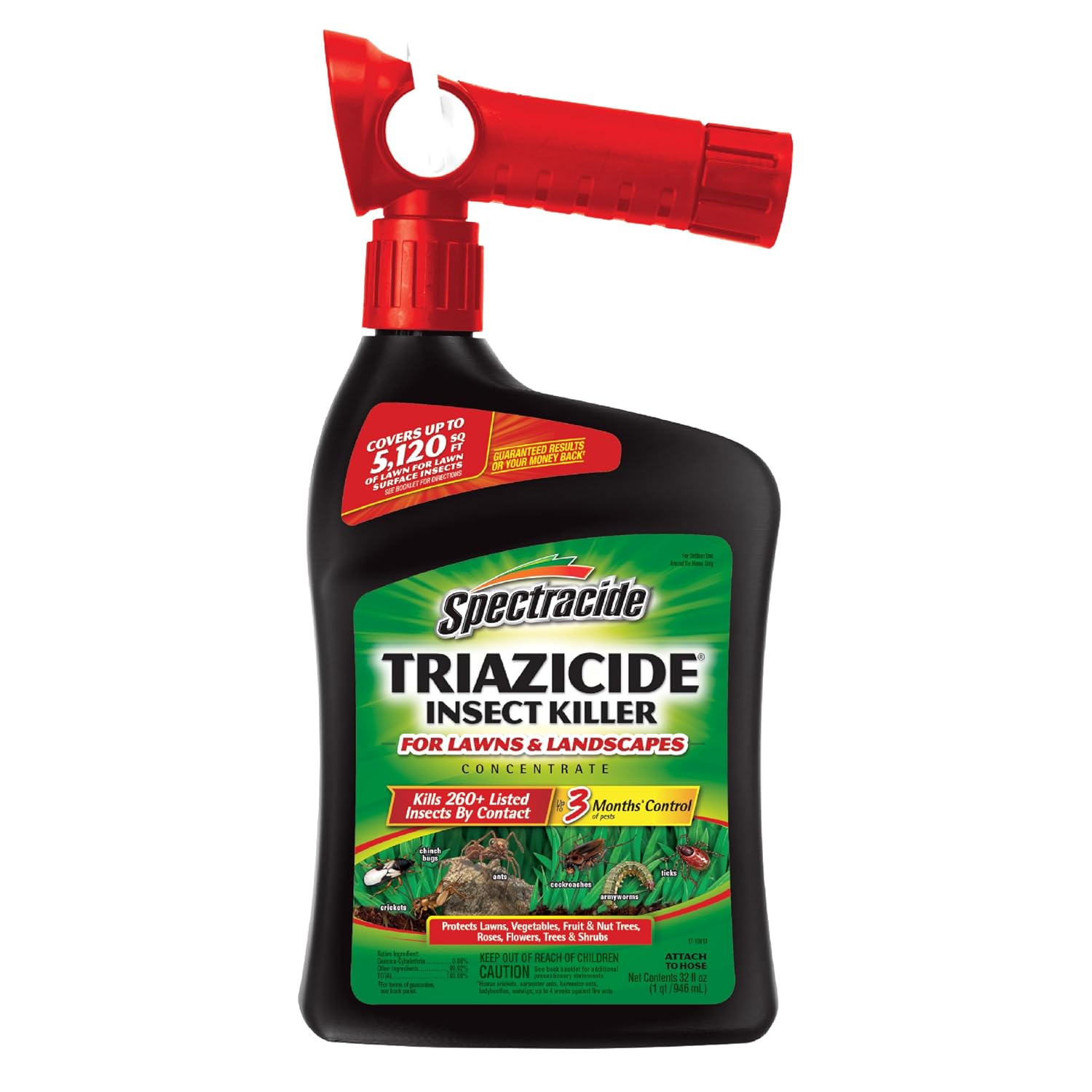
Spectracide Triazicide Insect Killer for Lawns & Landscapes, 32 oz
| Unit Count | 32 Ounce |
|---|---|
| Item Form | Spray |
| Target Species | Insects |
| Active Ingredients | Gamma-Cyhalothrin (0.08%) |
Spectracide Triazicide is a 32-ounce concentrate formulated to control more than 260 listed insects on lawns, flower beds, trees, shrubs and around vegetables. You mix the concentrate with water and apply it with a tank or hose-end sprayer; the ready-to-spray variant can attach to a garden hose for quicker application. The active ingredient, gamma-cyhalothrin, delivers fast contact kill for pests such as fleas, ticks, Japanese beetles and many surface insects, and the label claims protection for up to three months in some uses. It is non-staining when used as directed and can treat large areas, making it practical for whole-yard applications and targeted mound treatments like fire ants. Important limitations include toxicity to fish and bees, so it must not be applied near water or blooming plants, and the product requires careful handling and adherence to safety directions. Follow mixing rates and timing recommendations for best results and to minimize environmental risk.
Best for: Buyers who need an affordable, large-area solution to knock down common lawn and landscape pests and prefer a concentrate that stretches coverage when mixed.
Less Ideal for: People with small ornamental gardens near ponds, homeowners who prioritize pollinator-safe products, or those unwilling to follow pesticide safety precautions should consider gentler or targeted alternatives.
- Concentrate covers large areas so a single bottle treats many square feet when mixed correctly
- Fast-acting contact kill for a wide range of listed insects including fleas, ticks and Japanese beetles
- Versatile use on lawns, flower beds, trees, shrubs and around vegetables
- Non-staining when used as directed and available in hose-end ready-to-spray format for easier application
- Highly toxic to aquatic life and bees so it cannot be used near water or blooming plants
- Requires careful mixing and protective handling due to chemical toxicity
Verdict: A cost-effective, fast-acting concentrate for treating broad lawn and landscape pest problems when used with care and proper precautions.
GardenTech Sevin Insect Killer Dust, 1 lb

| Item Form | Dust |
|---|---|
| Target Species | Insects |
| Active Ingredients | Bifenthrin |
| Unit Count | 1 Count |
Sevin Insect Killer Dust is a handheld dust formulation of bifenthrin for spot and perimeter treatment of garden pests, including Japanese beetles. You apply it by shaking a thin, uniform layer onto leaves, stems and around plants as a preventative or when you first see damage. The product kills by contact and lists more than 150 target insects, so it works across vegetables, fruit, ornamentals and turf. Practical features include a flip-open cap for easy dispensing and a 1 pound container sized for small-to-medium beds; the manufacturer states one pound treats about 2,000 sq. ft. The dust does not require mixing and settles quickly so treated areas can be reoccupied after it dries. Important limitations are typical for contact insecticides: it should not be applied to open blooms to protect pollinators and it provides little residual control if plants are watered or receive heavy rain within 24 hours of application. Users must follow label safety steps like avoiding the eyes and washing hands after use.
Best for: Gardeners who want a straightforward, no-mix contact treatment to quickly reduce visible beetle and chewing insect pressure in mixed vegetable, fruit and ornamental plantings.
Less Ideal for: People prioritizing pollinator-safe or long-residual biological controls should choose targeted or non-chemical methods instead.
- Kills by contact a wide range of garden pests including Japanese beetles and aphids
- Ready-to-use dust needs no mixing and is simple to apply with a flip-open cap
- Label lists use on vegetables, fruits, ornamentals and lawns so it fits mixed garden beds
- Contains bifenthrin which can harm beneficial insects if applied to open blooms or overused
Verdict: If you need a simple, ready-to-use contact treatment to quickly knock down Japanese beetles and other common garden pests, Sevin dust delivers fast, broad-spectrum control.
Envu Tempo SC Ultra Insecticide Concentrate, 240 ml

| Item Volume | 240 ml |
|---|---|
| Item Form | Liquid |
| Target Species | Ants, flies, cockroaches, crawling pests, and ticks |
| Ingredients | Beta-Cyfluthrin |
Tempo SC Ultra is a liquid concentrate insecticide designed for perimeter and spot treatments where dependable, lasting control of ants, spiders, cockroaches and other crawling pests is needed. The product mixes with water and is applied as a general surface, spot, crack and crevice or mist treatment, so it works both indoors around entry points and outdoors along foundations and patios. Its active ingredient, beta-cyfluthrin, provides quick knockdown plus residual activity so treated areas remain protected between applications. The suspension concentrate formulation spreads evenly and the low-odor, non-staining claim makes it practical for use near garages and basements where smell and marks matter. Users should follow label dilution and safety directions carefully since concentrated insecticides require proper handling and mixing. This product is best used as part of regular perimeter maintenance rather than for one-off fumigation of large infested structures.
Best for: Homeowners who prioritize a reliable, long-lasting perimeter treatment to reduce crawling insect activity around entry points and common harborage areas and who are comfortable following label mixing and application steps.
Less Ideal for: People seeking immediate fumigation-style control for heavily infested interiors or those unwilling to handle concentrated pesticides should consider alternative application methods or professional services.
- Broad-spectrum control effective against ants, spiders, cockroaches and ticks
- Fast knockdown with residual activity that continues working after application
- Water-based concentrate mixes easily for even surface coverage
- Low odor and non-staining formula suitable for use near living areas
- Concentrate requires careful mixing and safe handling to avoid exposure
- Not formulated for airborne or fumigation treatments of whole structures
Verdict: Choose this concentrate when you need a dependable, low-odor perimeter insecticide that delivers quick knockdown plus lasting residual control.
Ortho Home Defense Insect Killer for Indoor & Perimeter, 1.33 gal. with Comfort Wand

| Item Form | Spray |
|---|---|
| Target Species | Insects |
| Liquid Volume | 1.33 gallons |
| Active Ingredients | Bifenthrin 0.05%, Zeta-Cypermethrin 0.0125% |
This 1.33 gallon Ortho Home Defense spray is designed to treat both indoor problem spots and the outdoor perimeter of a home to reduce ants, roaches, spiders and many other crawling and flying insects. It comes with a battery-powered Comfort Wand that delivers a continuous spray so you can apply a uniform band around foundations, patios and entry points without bending or pumping. The formula with bifenthrin and zeta-cypermethrin is intended to kill on contact and establish a barrier that the manufacturer says lasts up to 12 months for ants, roaches and spiders on non-porous indoor surfaces. In real-world use that means fewer repeat treatments in busy yard perimeters and around doors and windows. The spray dries clear with minimal fumes which helps for indoor use near kitchens and living areas. Limitations are that this is a chemical insecticide so users should follow safety directions around children, pets and plants and it is not a specific solution for pests not listed on the label. For homeowners focused on strong, perimeter-level protection this product simplifies application and covers a large area per container.
Best for: Homeowners who want a performance-focused perimeter treatment to reduce recurring yard and entry-point insect problems and prefer a ready-to-use product that is easy to apply.
Less Ideal for: People seeking organic or non-chemical control methods or those who need a targeted solution for pests not listed on the label should consider alternative products.
- Includes battery-powered Comfort Wand for continuous, fatigue-free application
- Ready-to-use 1.33 gallon container covers large perimeters without mixing
- Formula creates a barrier claimed to provide up to 12 months protection against ants, roaches and spiders on non-porous indoor surfaces
- Dries clear and gives off minimal fumes, making indoor use more practical
- Contains synthetic insecticides so precautions are required around children, pets and ornamentals
- Protection claims are specific to certain species and surfaces so results vary by pest and conditions
Verdict: A powerful, ready-to-use perimeter and indoor spray for homeowners who want long-lasting, performance-oriented protection against common yard and household insects.
Atticus Talak 7.9% Bifenthrin Indoor/Outdoor Insecticide Concentrate, 32 oz

| Active Ingredient | Bifenthrin |
|---|---|
| Formulation | Suspension Concentrate |
| Liquid Volume | 32 fluid ounces |
| Length of Control | Up to three months |
| Target Species | Insects |
Talak 7.9% is a liquid concentrate for treating lawns, landscaping, outdoor living areas and indoor perimeter spots like baseboards and cabinets. You dilute the concentrate with water to create a spray for barrier treatments, spot applications or lawn mixes; label rates explain how much to mix per gallon depending on the use. The product uses bifenthrin, a proven broad-spectrum active ingredient, and the manufacturer states it controls over 75 species and can give residual control for as long as three months. Its water-based formula dries clear, leaves no odor or visible residue, and is not phytotoxic on plants when used per label. Practical benefits include flexible indoor and outdoor use, clear drying, and a bottle designed for easier pouring. Important limitations are that solutions should be mixed only for same-day use, it is not registered for sale in a few states, and it is not approved for fogger application, so professional-style misting methods are not appropriate.
Best for: Buyers who want a single, reliable product to protect yards, patios and building perimeters from a wide range of common pests and prefer conservative, label-driven application practices.
Less Ideal for: People seeking ready-to-use sprays or fogger-compatible products or those in states where this formulation is not registered should look at alternatives.
- Broad-spectrum control listed for 75+ indoor and outdoor pest species
- Water-based formula that dries clear and leaves no odor or residue
- Flexible label directions for lawns, landscapes, hardscapes and indoor perimeter treatments
- Long residual activity up to three months when applied at recommended rates
- Mixed spray solutions cannot be stored and must be used the same day
- Not approved for fogger application and not available for sale in some states
Verdict: A versatile, water-based bifenthrin concentrate that delivers long-lasting, broad-spectrum outdoor (and perimeter indoor) control when used according to the label.
Choosing the Right Pesticide Insect Killer: Key Factors to Consider
Target Pest Spectrum
Different products are formulated to control different kinds of pests-chewing insects like caterpillars and beetles, sucking pests such as aphids and whiteflies, or larvae and eggs. Choose a product labeled for the specific pest groups you see in your garden to improve first-application success.
Using a pesticide with the wrong target spectrum wastes applications and increases risk to non-target organisms. If you frequently get multiple pest types, select a formulation that lists both chewing and sucking pests, or plan a rotation of products with different target spectra as part of integrated pest management.
Plant Safety and Phytotoxicity Risk
Some active ingredients or carrier formulations can cause leaf burn or other phytotoxic reactions, especially under hot, sunny conditions or on tender new growth. Check label guidance on temperature and timing restrictions and whether the product is safe for ornamentals, fruiting vegetables, and seedlings.
If you grow edible crops, prioritize products with explicit guidance for food plants and required pre-harvest intervals. When trying a new product, test it on a small, inconspicuous area first or apply in the evening to reduce stress on plants.
Application Method and Coverage
Products come as ready-to-use sprays, concentrate liquids, dusts, or granules. Spray formulations generally provide the most immediate contact with foliar pests but require good nozzle coverage and the right water volume. Dusts can be useful for confined spaces or crevices but may drift and are harder to measure.
Consider whether you have a pump sprayer, hose-end applicator, or handheld bottle and match the formulation to your equipment. Coverage matters more than product strength for contact pesticides: thorough leaf undersurface coverage often determines success against aphids and mites.
Residual Activity and Reapplication Frequency
Some pesticides act by quick contact kill and break down rapidly, requiring more frequent treatments, while others offer residual protection that keeps working for days to weeks. Longer residual control reduces labor but can also increase exposure risk to beneficial insects.
Balance the need for lasting control against preserving pollinators and predatory insects. For heavy infestations, short-acting contact treatments applied carefully can reduce pest numbers quickly and allow beneficials to recover.
Safety Requirements and Personal Protective Equipment
Garden pesticides vary widely in required personal protective equipment, mixing precautions, and buffer-zone instructions. Read labels for recommended gloves, eye protection, and respirators. Products requiring minimal PPE are easier for casual gardeners but may trade off some efficacy or residual control.
Also consider how easy the product is to mix and rinse. Clear label instructions and simple measurement reduce the chance of under- or over-application, which can affect control and safety.
Compatibility With Garden Ecology and IPM
Relying solely on pesticides can disrupt beneficial insect populations and lead to pest resurgence. Choose products that integrate easily into insect monitoring, physical controls, and biological approaches. Select formulations that break down quickly in the environment when preserving predators and parasitoids is a priority.
When possible, plan targeted spot treatments, time applications to avoid pollinator activity, and rotate modes of action to reduce resistance development. Compatibility with mulches, irrigation schedules, and crop rotations also affects long-term garden health.
Common Garden Pests and How Treatments Work
Understanding the pest biology helps match the right control. Contact pesticides kill on direct contact and work best when you can thoroughly spray pests. Systemic products move through plant tissues and can protect new growth from sap-feeding insects, while insect growth regulators interrupt development and reduce future generations.
Match the treatment mechanism to the problem. For example, rapid knockdown is useful for heavy adult infestations, whereas systemic control helps protect young transplants from persistent sap feeders. Observe pest life stages to plan timing for maximum effect.
- Contact sprays: immediate reduction but limited residual
- Systemics: protect new tissue, useful against sap feeders
- Growth regulators: reduce future generations with minimal adult mortality
Timing Applications for Best Results
Apply treatments when pests are vulnerable and conditions favor plant safety. Evening or early morning applications reduce leaf burn risk and avoid peak pollinator activity. For contact products, repeat treatments according to label intervals until pressure eases.
Watch for environmental factors. Avoid spraying in windy conditions to limit drift, and skip applications during extreme heat. Applying after rain may wash off contact residues, while soil-applied products depend on appropriate irrigation to move them into root zones.
- Spray evenings to protect pollinators
- Avoid windy or very hot conditions
- Follow label intervals for reapplication
Application Tips to Reduce Drift and Non-target Exposure
Use low-pressure sprayers and larger droplet sizes when possible to cut drift. Aim for direct coverage of affected foliage, especially the undersides of leaves where many pests congregate. Shield desirable plants and flowers when treating nearby infested areas.
Consider spot-treating concentrated infestations rather than blanket sprays. This reduces exposure to beneficial insects and minimizes overall chemical load in the garden.
- Use appropriate nozzle and pressure settings
- Target undersides of leaves and dense foliage
- Spot-treat when practical to protect beneficials
Using Pesticides With Edible Crops
If you grow vegetables or fruit, follow label pre-harvest intervals and application limits. Some pesticides are labeled for edible crops with specific restrictions, while others are not recommended. Washing produce can remove surface residues but does not change label safety requirements.
When possible, favor products with short pre-harvest intervals for quick-turn crops like salad greens. Also avoid treatments during bloom to protect pollinators and follow withholding periods before harvest to meet safety recommendations.
- Check pre-harvest interval on the label
- Avoid applications during bloom
- Prefer short withholding periods for quick crops
Integrating Non-Chemical Controls
Pesticides are one tool in an overall pest-management plan. Combine sanitation, physical barriers, sticky traps, and beneficial insect releases where appropriate to reduce reliance on chemical controls. Cultural practices like crop rotation, good airflow, and proper watering reduce pest pressure over time.
Using monitoring tools such as sticky cards and regular plant checks helps you apply treatments only when thresholds are met, which preserves beneficials and delays resistance.
- Use traps and monitoring to guide treatments
- Improve airflow and plant spacing to reduce pest habitat
- Rotate tactics to avoid resistance buildup
How We Chose the Best Pesticide Insect Killer
We selected products that demonstrably reduce common garden pests while offering clear label instructions and manageable safety requirements. Our editorial filters prioritized demonstrated knockdown or life-cycle disruption against chewing and sucking pests typical in home gardens, plus data on plant phytotoxicity and safe use on edible crops when applicable. We also considered formulation types and how they affect application accuracy and drift risk, as well as how easy the product is to measure and apply correctly. Excluded from consideration were products intended strictly for structural pest control, broad-spectrum treatments with prohibitive safety profiles for home gardens, and items without clear label guidance. The final picks reflect evaluation across efficacy against target pests, plant safety and phytotoxicity risk, application method and coverage, residual activity duration, safety and PPE guidance, and compatibility with integrated pest management practices.
FAQ
How soon will I see results after applying a pesticide insect killer?
Results vary by product and pest. Contact sprays often produce visible knockdown within hours, while systemic products may take several days to affect sap feeders. Repeated applications may be needed according to label directions for complete control.
Can I use the same product on vegetables and ornamentals?
That depends on the label. Some products are labeled for both edible and ornamental plants with specific instructions, while others are restricted. Always read label guidelines on crop types and pre-harvest intervals before applying to edible crops.
Will pesticides harm beneficial insects in my garden?
Many pesticides can affect beneficials, especially broad-spectrum contact sprays. To reduce harm, avoid spraying during bloom, use spot treatments when possible, and choose products with shorter residual activity or more targeted modes of action.
How do I minimize the chance of causing leaf burn or plant damage?
Follow label temperature and timing recommendations, avoid applying during extreme heat or direct midday sun, and test on a small area first if uncertain. Proper dilution and coverage also help reduce phytotoxicity risk.
How often should I rotate active ingredients?
Rotate modes of action when you need repeated treatments to reduce the risk of resistance. The frequency depends on pest pressure, but changing modes of action across treatment cycles is a common IPM practice.
Are granules or sprays better for a home vegetable patch?
Sprays generally provide faster contact control for foliar pests, while granules can be useful for soil-dwelling pests or systemic uptake. Choice depends on the target pest and your application equipment.
Final Verdict
Prioritize products that match the pests you commonly encounter, and weigh fast knockdown against plant safety and effects on beneficial insects. Match formulation to your equipment and planned application style, and pay close attention to label instructions, pre-harvest intervals, and PPE. A successful approach balances effective pest reduction with minimal disruption to garden ecology. When in doubt, start with targeted, well-timed applications and combine chemical control with cultural and biological strategies for longer-term success.
