

Note: This article contains affiliate links. If you click on these links and make a purchase, I may earn a small commission at no extra cost to you. This helps support my research and content. Read my full affiliate disclosure here.
Ant problems in the yard can quickly spoil outdoor time, but not all treatments are safe around curious pets. The right pet safe outdoor ant killer reduces visible trails and treats colonies while limiting hazards to dogs, cats, and livestock that share outdoor spaces. This guide covers the top shortlisted options for outdoor ant control that prioritize pet safety and real-world effectiveness. We evaluated how well each option controls colonies, how long protection lasts, and practical factors like placement flexibility and weather resistance. Read on to find the approach that fits your yard, pet habits, and tolerance for maintenance.
Top Picks at a Glance
| Best Overall The best all-around choice for most situations | EcoVenger Roach & Ant Killer, 64 oz — Botanical, Non-Toxic Indoor & Outdoor Spray |  |
| Best Quality Built to a higher standard if you want something more solid | EcoVenger Ant Killer & Nest Treatment, 32 oz |  |
| Best Value The sweet spot between price and what you get | Neudorff Outdoor Ant Killer Granules, 1 lb (Spinosad) |  |
| Highest Rated A top-rated pick with lots of positive feedback | NCSIFDD Ant Away Ant Repellent Gel, 6-Pack |  |
| Most Popular A crowd favorite that many people choose with confidence | Wondercide Outdoor Pest Control Spray — 32 oz Ready-to-Use |  |
EcoVenger Roach & Ant Killer, 64 oz — Botanical, Non-Toxic Indoor & Outdoor Spray

| Active ingredients | Geraniol, Cedarwood Oil, Peppermint Oil, Sodium Lauryl Sulfate |
|---|---|
| Intended use | Indoor & outdoor crawling insects |
| Residual protection | Up to 4 weeks |
| Safety | Formulated for use around children and pets |
EcoVenger Roach & Ant Killer is a large ready-to-use botanical spray designed for both indoor and outdoor perimeter use where pet safety is a priority. It works by knocking down insects on contact and leaves a residual barrier that the brand says deters re-entry for up to four weeks. Typical use cases are spot-treating kitchens, baseboards, window sills, and outdoor foundation lines or treating localized infestations in restaurants and commercial spaces where a non-chemical option is preferred. Key features are a plant-extract formulation (geraniol, cedarwood and peppermint oils), a water-based, low-odor formula, and a spray nozzle for targeted application. Practical benefits include rapid knockdown of roaches and ants without strong chemical fumes, compatibility with occupied spaces, and a pleasant scent that dissipates quickly. Important limitations are that it is a spray-only solution so it will not replace baiting for large hidden nests and repeated applications may be needed for severe or widespread infestations; nozzle parts are also noted as delicate. For gardeners and pet owners wanting a safer, effective perimeter spray, it is a solid botanical choice.
Best for: Pet owners and homeowners who want an effective, non-chemical spray for treating visible ants and roaches around living spaces and outdoor perimeters without evacuating people or animals.
Less Ideal for: People dealing with extensive, hidden colony infestations who need baiting or professional-grade insecticides or users who need a robust, industrial application system.
- Plant-derived active ingredients (geraniol, cedarwood oil, peppermint oil) reduce reliance on synthetic pesticides
- Water-based, low-odor formula suitable for use in occupied homes and commercial spaces
- Provides immediate knockdown on contact plus up to four weeks of residual deterrence
- Sized for extended use with a large 64 oz ready-to-use container
- Spray-only product so it may not reach deep nests or fully replace baiting for large infestations
- Nozzle contains delicate parts that can be damaged and may require replacement
Verdict: Choose EcoVenger when you want a large‑volume, pet-safe botanical spray that delivers fast knockdown and weeks-long perimeter deterrence without harsh chemical odors.
EcoVenger Ant Killer & Nest Treatment, 32 oz

| Unit Count | 32 Fluid Ounces |
|---|---|
| Item Form | Spray |
| Target Species | Odorous House Ants, Fire Ants, Roaches, Fleas, Spiders |
| Active Ingredients | Citronella Oil, Geraniol, Cedarwood oil, Sodium Lauryl Sulfate |
EcoVenger Ant Killer is a plant-extract spray formulated to kill house ants on contact, treat fire ant mounds, and leave a residual barrier that deters re-entry for up to four weeks. You use it like a standard ready-to-use spray: spot-treat visible trails, spray around entry points and saturate mound tops or nest openings to reach the colony. Notable features include a citronella/cedarwood/geraniol active blend, a user-friendly trigger sprayer and claims of university testing and professional use. In practice the product offers fast knockdown for foraging ants and the ability to deliver treatment down tunnels using the spray wand, which helps target queens in mounds. The botanical formulation is marketed as non-staining and safe to use around pets and children when directions are followed, and the light citrus scent dissipates quickly. Limitations are that efficacy details beyond labeled target species rely on manufacturer testing and heavier infestations may need repeated treatments or perimeter work; the nozzle has delicate parts so care is needed when handling.
Best for: Homeowners who prioritize effective, fast-acting ant control but want a pet- and child-friendly botanical option for indoor and outdoor use.
Less Ideal for: People needing an industrial-strength chemical treatment for very large or persistent infestations or those who prefer products supported by multiple independent field trials.
- Kills odorous house ants on contact and eradicates fire ant mounds when applied to the colony
- Botanical active ingredients (citronella, geraniol, cedarwood) offer a lower-toxicity alternative to conventional pesticides
- Provides residual repellency for up to four weeks to help prevent re-entry
- Suitable for indoor and outdoor use and formulated to be non-staining on carpets and fabrics
- Nozzle contains delicate parts that can be damaged and may require careful handling
- Manufacturer efficacy claims are based on internal or cited studies rather than independent third-party field trials
Verdict: A fast-acting, plant-powered ant spray that balances quick colony knockdown with a formulation designed for use around pets and children.
Neudorff Outdoor Ant Killer Granules, 1 lb (Spinosad)

| Item Form | Pellets |
|---|---|
| Active Ingredients | Spinosad |
| Unit | 1 lb |
| Target Species | Insects |
Neudorff Outdoor Ant Killer is a ready-to-use granular bait that lures and kills a wide range of foraging ants and several surface-dwelling garden pests. You scatter the compressed pellets around foundations, garden beds, pots, or in rings at the base of plants; the label gives simple application rates for small beds and larger lawns. The active ingredient spinosad acts on insect nervous systems by contact and ingestion, producing quick control and residual effect that the brand says can last up to four weeks. The pellets are dry and easy to handle from the included shaker, so no mixing or sprayers are required, and the formulation is marketed for organic gardening so treated areas can be accessed by people and pets after application. Important limitations are listed ant species it does not control, and the pellets lose effectiveness after heavy rain so reapplication may be needed; it also targets surface-foraging insects rather than nest-level treatments for species like carpenter or fire ants. For routine perimeter protection and spot treatment in vegetable beds, it is a practical, low-effort option.
Best for: Gardeners who want a convenient, low-effort perimeter or spot treatment that is compatible with organic gardening and safe to re-enter after application.
Less Ideal for: People dealing with persistent mound-building species or large infestations requiring nest excavation or baiting at colony level should consider targeted professional treatments or products labeled for those ants.
- Ready-to-use compressed granules require no mixing or special applicator
- Contains spinosad, effective by contact and ingestion for quick control
- Suitable for use in vegetable gardens and around plants labeled for organic gardening
- Dry pellets are easy and clean to apply with the included shaker
- Provides residual activity up to four weeks under normal conditions
- Granules lose effectiveness after heavy rain and need reapplication
- Not effective against certain species such as fire ants and carpenter ants
Verdict: A user-friendly, organic-compatible granular bait that delivers practical, low-effort perimeter and spot control of common outdoor ants.
NCSIFDD Ant Away Ant Repellent Gel, 6-Pack

| Unit Count | 12 Count |
|---|---|
| Number of Pieces | 1 |
This ant repellent gel is a concentrated applicator product intended for targeted spot treatments around entry points, baseboards, window frames, and known ant trails. You remove the cap, attach the precision tip, and apply pea‑sized drops into crevices or along trails; the manufacturer notes it can take 3–5 days to work through a colony and helps keep ants away for up to 60 days in treated areas. Practical benefits include the narrow applicator for neat placement in tight gaps, suitability for both indoor and outdoor problem spots, and a formulation presented as family and pet safe when used as directed. Important limitations are that results are not instantaneous and multiple applications or placements may be needed to control larger or multiple colonies, and effectiveness depends on correctly locating trails and nest access points. For someone who wants a low‑mess, targeted solution rather than broad broadcast treatments, this gel is a convenient option.
Best for: Buyers who prioritize dependable, low‑mess spot treatment for recurring ant sightings and prefer a product they can place precisely where ants travel.
Less Ideal for: People needing rapid elimination of very large or widespread infestations or those who prefer broadcast sprays or professional colony eradication services.
- Precision applicator allows neat, pea‑sized placements in tight crevices and along ant trails
- Labeled for both indoor and outdoor use so the same product can treat kitchens, baseboards, and patios
- Formulation described as family and pet safe when used according to directions
- Single placements can provide protection in treated areas for up to 60 days
- Not an immediate knockdown—can take 3–5 days to affect a colony
- May require several placements and correct trail identification to fully control larger infestations
Verdict: Use this precision gel when you want a neat, family‑safe spot treatment that targets ant trails and entry points rather than a broad spray solution.
Wondercide Outdoor Pest Control Spray — 32 oz Ready-to-Use
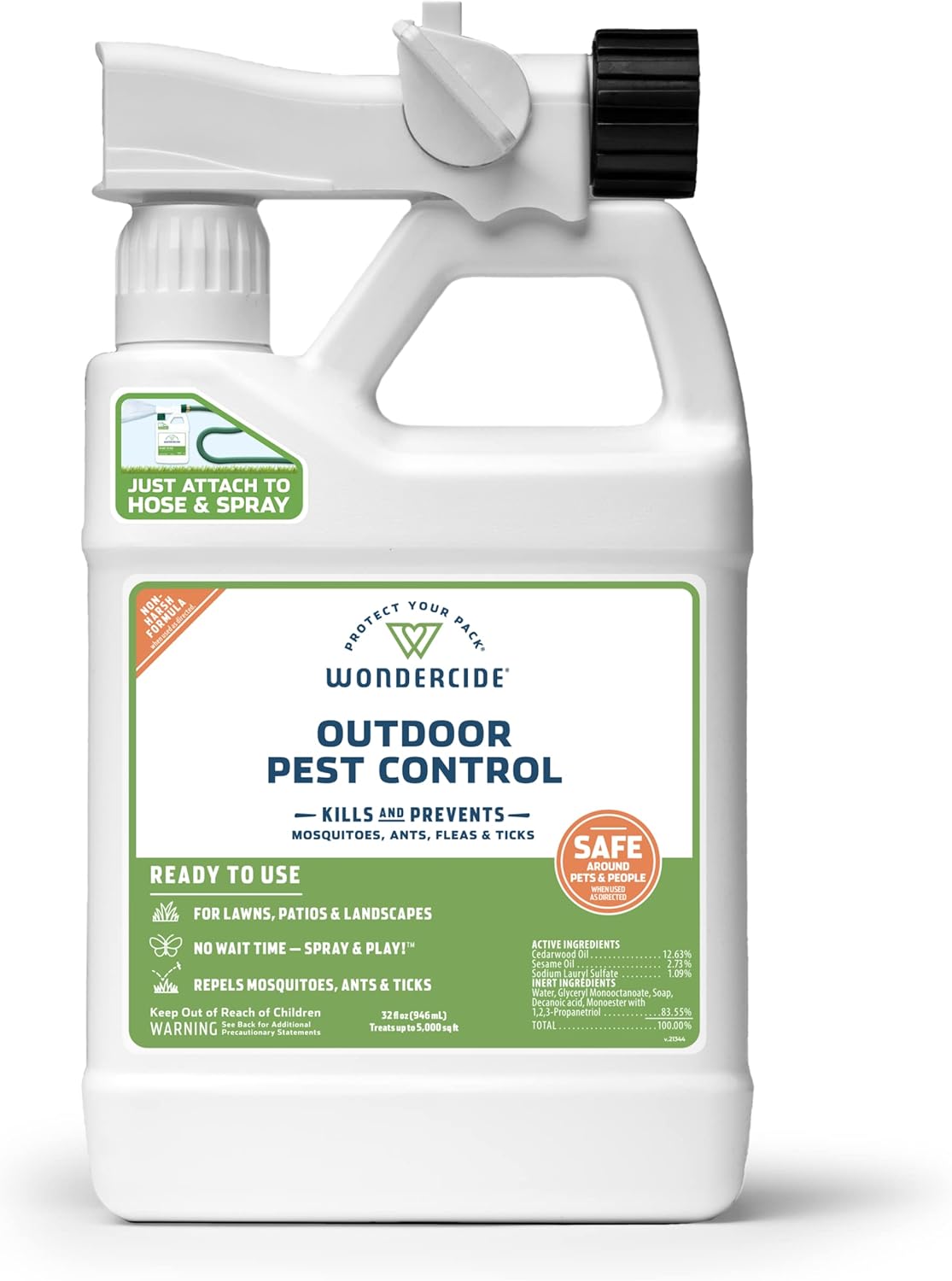
| Format | Pre-mixed, hose-end spray |
|---|---|
| Active ingredients | Cedarwood Oil 12.63%, Sesame Oil 2.73% |
| Coverage | Up to 5,000 sq ft (general); 2,500 sq ft (ticks/mosquito repel) |
Wondercide Ready-to-Use Outdoor Pest Control is a hose‑end spray designed for treating yards up to 5,000 sq ft for general pests and 2,500 sq ft for ticks and mosquito repellency. You attach the bottle to a garden hose, sweep the nozzle across lawns, patios, and foundation lines, and the cedarwood‑based formula delivers quick coverage with no dry time required. Notable features include plant-powered active ingredients (cedarwood and sesame oils), ready-to-use convenience, and instructions for both active infestations and preventative maintenance. Practical benefits are that it is safe to use around people and pets when directions are followed, residues are reported to be non-harmful to pollinators, and the hose attachment makes treating large areas fast. Important limitations are that effectiveness depends on water pressure, walking speed, and weather, heavy rain may require reapplication, and spraying in temperatures above 90°F or direct sun can cause plant burn. Users who need an all‑season, high‑durability pesticide for heavy infestations should plan on repeated applications and follow label precautions to protect sensitive plants.
Best for: Buyers who prioritize effective, plant‑based mosquito and tick control for medium to large yards and want a fast hose‑attached solution that is safe around families and pets when used as directed.
Less Ideal for: Gardeners who need a single, long‑lasting professional‑grade pesticide for severe, persistent infestations or who cannot reapply after rain should consider alternative, heavier‑duty treatments.
- Ready-to-use hose-end applicator for fast coverage of large yards
- Plant-based active ingredients (cedarwood and sesame oils) that target common yard pests
- No dry time required so kids and pets can re-enter treated areas quickly
- Covers up to 5,000 sq ft for general pest control and 2,500 sq ft for ticks/mosquito repellency
- May cause phytotoxic burning if applied in direct sun or temperatures above 90°F
- Performance depends on water pressure and user walking speed which can lead to uneven coverage
- Heavy rain can wash it away and requires reapplication
Verdict: If you want a fast, family- and pet-friendly plant‑based spray to reduce mosquitoes and ticks across a medium to large yard, this ready‑to‑use hose‑end formula delivers practical, repeatable results.
Choosing the Right Pet Safe Outdoor Ant Killer: Key Factors to Consider
Pet Safety Profile
Knowing how a product interacts with dogs, cats, and other animals is the single most important factor. Look for materials designed to be non-toxic when used as directed or delivery systems that restrict access, such as enclosed bait stations or granular formulations placed below the soil surface. Consider the behavior of your pets: foragers or diggers create different exposure risks.
Also think about the route of exposure. Contact sprays on surfaces pets touch present different hazards than contained baits. Even low-toxicity options can be harmful if ingested in large amounts, so a realistic assessment of how closely pets will access treated areas matters.
Colony Control Effectiveness
Effective ant control means treating the colony, not just killing visible workers. Baits that worker ants carry back to the nest can collapse colonies over time, while contact treatments mainly reduce surface activity quickly. Evaluate whether the treatment targets common species in your area and whether it relies on attractants that ants will accept in outdoor conditions.
Outdoor settings can require stronger attractants because alternative food sources exist. Expect a tradeoff between fast knockdown and slow-acting baits that reach the queen and brood.
Weather Resistance and Longevity
Outdoor treatments face rain, sun, and temperature swings. A product that degrades rapidly in sunlight or washes away in the first rain will need frequent reapplication, increasing the chance of pet exposure. Choose formulations specified for outdoor use and check how long they remain active after placement.
Longevity also affects maintenance: longer-lasting options reduce how often you must visit treated spots to refill or reapply, which can be important for busy gardeners or large properties.
Placement Flexibility
How you can position the treatment in the landscape affects both effectiveness and safety. Enclosed bait stations, below-ground granular placements, and products designed for patio cracks or around foundations offer different tradeoffs between control and pet access. Consider whether you need to treat lawns, mulch beds, patios, or potted-plant areas and select solutions that can be secured or hidden from pets.
Flexible placement also makes it easier to focus control where ants forage most and to avoid areas where pets eat, sleep, or play.
Ease of Use and Maintenance
Some effective strategies require regular monitoring and replenishment, while others are set-and-forget for weeks. Consider how much time you will spend checking stations, replacing bait, or reapplying treatments after rain. Simpler methods reduce the chance of misuse, which can compromise both effectiveness and pet safety.
Also factor in how easy it is to remove or neutralize the product if a pet does access it unintentionally. Clear labeling and accessible placement reduce accidents.
Understanding How Outdoor Ant Treatments Work
Different outdoor control methods work in distinct ways. Baits rely on worker ants transporting poisoned food back to the nest, which can lead to colony decline over time. Contact treatments reduce visible activity quickly but rarely reach the hidden queen and brood. Physical measures such as diatomaceous earth or barriers work by disrupting insect physiology or movement rather than using chemical toxicity.
- Baits: slow but colony-focused when accepted by foragers
- Contact treatments: fast knockdown on trails and surfaces
- Physical barriers and dusts: non-chemical options with variable speed
Safe Placement Strategies in Pet Areas
Placement is as important as product choice. Enclosed stations can be tucked under shrubs, behind pavers, or secured to fences where pets cannot easily access them. For granular options, placing material beneath a thin layer of soil or mulch reduces curiosity-driven ingestion by pets while still allowing ants to forage.
- Use secured bait stations in high-traffic pet zones
- Avoid leaving loose granules or open trays where pets eat or play
- Treat perimeter zones and entry points rather than open lawn areas when possible
Seasonal Timing and Ant Behavior
Ant activity and food preferences change with season and temperature. In warm months ants are more active and may forage more widely, which can increase bait acceptance. After heavy rain or during drought, surface activity may shift and treatments might require repositioning or replacement. Time more intensive treatments for when ants are most actively foraging to increase the chance baits are taken back to the colony.
- Target treatments during peak foraging for faster bait uptake
- Reassess placements after heavy rain or prolonged dry spells
- Adjust bait type seasonally if ants prefer different foods
Non-Chemical Approaches and Their Role
Non-chemical tactics can be part of a pet-conscious strategy. Removing food sources, sealing entry points, and maintaining clean patios reduce the need for treatments. Physical products like diatomaceous earth or boiling water can suppress small infestations without introducing toxins, though they often require repeat applications and are less effective against large, established colonies.
- Sanitation and habitat modification reduce attractants
- Physical dusts work best in dry conditions and protected spots
- Non-chemical methods are best as complements for long-term control
Monitoring and When to Reapply
After deploying any treatment, observe pet behavior and ant activity for several days. Effective baits may show increased forager activity initially as ants discover the food, then a gradual reduction as the colony declines. Contact treatments often show immediate reductions but may need follow-up to address nest activity. Set a monitoring schedule based on product longevity and local weather, and have a plan to remove or cover treatments if pets show interest.
- Check bait stations every few days initially, then weekly
- Look for reduced forager trails as a sign of colony impact
- Reapply or replace according to product guidance and after heavy rain
How We Chose the Best Pet Safe Outdoor Ant Killer
We focused on products and approaches that let gardeners control ant infestations outdoors without introducing undue risk to pets. Selection started with formulations and methods designed for outdoor placement only, then filtered for materials and active strategies with documented low acute toxicity to common domestic animals or that rely on physical rather than systemic chemical exposure. Concrete evaluation criteria included documented pet safety profile or low-toxicity design, demonstrated ant colony control (bait acceptance or residual contact efficacy), suitability for typical outdoor conditions such as rain and sun exposure, and practical deployment factors like placement options and ease of removal. We also considered longevity of effect and how likely treatments are to attract non-target wildlife. Excluded from the roundup were indoor-only products, products intended for agricultural pesticide use, and volatile sprays that disperse widely into outdoor spaces where pets roam. We prioritized options that gardeners can reasonably use around lawns, patios, flower beds, and entryways while managing pet access and monitoring.
FAQ
Are any outdoor ant controls completely safe for pets?
No treatment is risk-free if a pet directly ingests concentrated product. Many outdoor options are low-toxicity when used as directed or delivered in enclosed stations that limit access. Managing placement and supervision reduces risk significantly.
Can I use baits safely with young children and pets around?
Baits in sealed, tamper-resistant stations are the preferred option when children and pets are present. Avoid loose bait or open trays. Always follow label or product instructions for secure placement and replacement.
How long after treatment should I keep pets away from the area?
Follow the specific product guidance, but for contained bait stations pets often only need brief exclusion while stations are being placed. For surface sprays or dusts, keep pets off treated areas until the product dries or settles as advised.
Will rain wash away outdoor ant treatments?
Some formulations lose effectiveness after heavy rain. Enclosed stations and certain granular products are more resilient, but you should check placements after storms and replace or reposition treatments as needed.
Can natural remedies protect my garden without risk to pets?
Some non-chemical methods reduce ant activity and pose little toxicity risk, but they are often slower and less reliable against large colonies. Use habitat changes and physical tactics alongside other low-risk approaches for better control.
Final Verdict
Prioritize containment and placement when selecting a pet safe outdoor ant killer. Focus on delivery systems that limit pet access, approaches that reach the colony when possible, and products specified for outdoor conditions in your yard or patio. Tradeoffs are inevitable: fast-acting contact options reduce visible ants quickly but may not end a colony, while baits can take longer but address the source. Choose based on how your pets use the outdoor space, how much time you will spend monitoring stations, and the level of colony control you need. With careful placement and routine checks you can reduce ant problems while keeping animals safe.
