

Note: This article contains affiliate links. If you click on these links and make a purchase, I may earn a small commission at no extra cost to you. This helps support my research and content. Read my full affiliate disclosure here.
Choosing the right phosphorus fertilizer for your lawn matters because phosphorus directly supports early root growth, seedling establishment, and recovery after stress. The right product and application schedule help young turf develop a denser root mass and allow established grass to recover more quickly from wear or renovation. This guide covers seven shortlisted phosphorus fertilizers suited for lawn use and explains how each option stacks up against practical gardener concerns like nutrient ratio, ease of spreading, and timing. Read on for evaluation criteria and practical guidance to match a phosphorus product to your soil test, grass type, and seasonal needs.
Top Picks at a Glance
| Best Overall The best all-around choice for most situations | Lawn Synergy Starter Fertilizer 15-20-10 (50 lb) |  |
| Best Quality Built to a higher standard if you want something more solid | The Andersons SmartPhos DG 4-22-0 Slow-Release Phosphorus Fertilizer (18 lb) |  |
| Best Value The sweet spot between price and what you get | Simple Lawn Solutions 3-18-18 Liquid Lawn Food (1 Gallon) |  |
| Best Budget The cheapest option that still gets the job done reliably | Easy Peasy Triple Super Phosphate Fertilizer 0-46-0 (Granules) |  |
| Highest Rated A top-rated pick with lots of positive feedback | Supply Solutions Triple Superphosphate 0-45-0 High-Phosphorus Granular Fertilizer (10 lb) |  |
| Most Popular A crowd favorite that many people choose with confidence | Simple Lawn Solutions 3-18-18 Liquid Lawn Food (32 oz) with Hose-End Sprayer |  |
| Best Seller A high-volume bestseller chosen again and again | Scotts Turf Builder Starter Food for New Grass, 15 lb |  |
Lawn Synergy Starter Fertilizer 15-20-10 (50 lb)

| N-P-K | 15-20-10 |
|---|---|
| Item Form | Granules |
| Application Method | broadcast spreader |
| Coverage | 12,000 sq.ft. |
This 50 lb Lawn Synergy starter fertilizer is built specifically for new lawns, seeded areas, and fresh sod. The 15-20-10 formula emphasizes phosphorus to encourage strong early root growth while combining XCU slow-release nitrogen and ammonium sulfate for an initial green-up followed by steady feeding. It is applied with a broadcast or rotary spreader at the recommended 5 lbs per 1,000 sq ft to cover large areas efficiently. Notable features include polymer-sulfur coated XCU granules for up to about 10 weeks of nutrient release and added micronutrients to support stress tolerance in young turf. Practical benefits are predictable, extended nutrition that reduces the need for repeat applications and enough coverage for up to roughly 12,000 sq ft from one bag. Limitations are that it is a bulk 50 lb granular product that requires a spreader and handling space, and it is intended for establishment use rather than routine maintenance feeding.
Best for: Buyers who prioritize reliable, predictable establishment results for new seed or sod and want a single product that provides both immediate and extended nutrition during the first weeks of growth.
Less Ideal for: Gardeners who need a lightweight, small-quantity product for spot repairs or those looking for a regular maintenance fertilizer regimen rather than an establishment starter.
- High phosphorus ratio tailored for root development and stronger seed germination
- Dual-source nitrogen (XCU slow-release plus ammonium sulfate) for immediate color and sustained feeding
- Includes micronutrients to support young turf through establishment
- Covers a large area per bag when applied at the recommended rate
- Large 50 lb bag requires storage space and a spreader for even application
- Formulated for initial establishment rather than long-term maintenance feeding
Verdict: Choose this starter fertilizer when you want dependable, long-lasting nutrition to help new grass seed or sod establish quickly and evenly.
The Andersons SmartPhos DG 4-22-0 Slow-Release Phosphorus Fertilizer (18 lb)

| Analysis | 4-22-0 |
|---|---|
| Form | Granules |
| Coverage | Up to 7,800 sqft. |
The Andersons SmartPhos DG 4-22-0 is a high-phosphorus granular fertilizer designed to promote strong root development and faster establishment for new and phosphorus-deficient lawns. Its struvite-derived phosphorus and patented SmartPhos technology provide low water solubility so nutrients are released steadily rather than all at once. Very small granules produced with DG Technology break into microparticles on contact with water, which helps move phosphorus through the turf canopy into the root zone for more uniform uptake. Typical use is with a rotary spreader at the recommended rates, watering in lightly after application and repeating during establishment or applying once in spring and fall for mature lawns. Practical benefits include reliable phosphorus delivery regardless of soil pH, reduced leaching or tie-up compared with conventional sources, and coverage designed to treat large areas. Limitations to consider are that it focuses on phosphorus only, so additional nitrogen or potassium may be needed as part of a complete fertility program, and users must follow spreader settings and watering guidance for best results.
Best for: Buyers who prioritize measurable performance for lawn establishment and root strength, and who follow a planned fertility program to optimize turf results.
Less Ideal for: Casual gardeners seeking an all-in-one fertilizer or those who want a balanced NPK product without adding complementary fertilizers.
- Struvite-based phosphorus that resists leaching and tie-up in soil
- Patented SmartPhos slow-release formulation provides steady nutrient availability
- Extremely small DG granules disperse into microparticles for more uniform root-zone delivery
- Coverage rated up to 7,800 sq ft from the 18 lb bag, suitable for large lawns
- Contains only phosphorus-focused formulation so other macronutrients must be supplied separately
- Requires correct spreader settings and immediate light watering to move particles into the soil
Verdict: Choose SmartPhos DG 4-22-0 when you want a high-performance, slow-release phosphorus source that reliably improves root development and establishment.
Simple Lawn Solutions 3-18-18 Liquid Lawn Food (1 Gallon)

| Item Form | Liquid |
|---|---|
| Specific Uses For Product | Lawn |
| Application Method | Spray |
| Target Species | All grass types |
| Mixing Ratio | 3:18:18 |
This 1-gallon 3-18-18 liquid lawn food is designed to supply a quick dose of phosphorus and potassium to lawns that need improved root development or help preparing turf for seasonal changes. It comes as an easy-to-mix concentrate with an attached hose-end sprayer and can also be applied with backpack or pump sprayers for larger areas. The high phosphorus content makes it a sensible choice when establishing new sod or seed and the potassium supports overall plant functions that improve stress resilience. Because it is a low-nitrogen formula, it will not drive excessive top growth and is intended to be used alongside a regular fertilizer program. Coverage with the included hose-end sprayer is stated at roughly 3,200 sq ft per fill, and the manufacturer notes it is suitable for all warm- and cool-season grasses. Expect fairly fast nutrient availability from the liquid form, but plan to apply only to actively growing turf and follow label mixing directions to avoid overapplication.
Best for: Buyers who want a targeted, root-focused fertilizer to improve establishment or correct phosphorus and potassium deficiencies and who prefer quick liquid applications that integrate into a wider lawn program.
Less Ideal for: Gardeners seeking an all-in-one high-nitrogen growth fertilizer or those who want a granular slow-release product for low-maintenance feeding.
- High phosphorus and potassium formulation supports root establishment and plant stress functions
- Liquid form and included hose-end sprayer allow quick, even application and faster nutrient availability
- Broad compatibility with both warm- and cool-season grasses including use for new sod or seed
- Low nitrogen content reduces risk of excessive leaf growth when a root-focused treatment is desired
- Lower nitrogen means it will not replace a regular balanced fertilizer program for overall turf growth
- Coverage per hose-end fill is limited so larger lawns may require repeated refills or a separate sprayer
Verdict: Choose this liquid 3-18-18 formula when you need a fast, phosphorus-rich treatment to build root strength and help establish new turf.
Easy Peasy Triple Super Phosphate Fertilizer 0-46-0 (Granules)

| Item Form | Granules |
|---|---|
| Specific Uses For Product | Lawns,Plant Food |
| Application Method | Work into the top six inches of the soil |
| Target Species | Cactus |
This triple super phosphate product supplies a concentrated source of phosphorus in a granular form for gardeners who want to boost bloom size and root development. It is typically worked into the top of the soil and applied every 6 to 8 weeks during the growing season to support flowering plants such as wisteria, fruit trees, and ornamentals. Notable features include a 0-46-0 analysis that provides one of the highest phosphate concentrations available and a slow-release granular form that reduces the risk of burning plant roots compared with liquid high-strength alternatives. Practical benefits are clearer: stronger root establishment, more prolific flowering when phosphorus is the limiting nutrient, and easy soil incorporation around established shrubs and vines. Important limitations are that it supplies phosphorus only, so nitrogen and potassium must be provided separately, and it will not correct other soil issues like pH or micronutrient deficiencies. Also, because it is high in phosphate it should be used according to soil test results to avoid excess buildup.
Best for: Gardeners focused on maximizing blooms and root strength for flowering vines and shrubs who will apply targeted phosphorus treatments as part of a broader feeding plan.
Less Ideal for: People seeking an all-in-one balanced fertilizer or a product to correct pH or micronutrient deficiencies should consider a different option.
- Very high phosphate concentration (0-46-0) for strong bloom and root promotion
- Granular slow-release form lowers burn risk and is easy to work into soil
- Recommended application interval (every 6–8 weeks) aligns with growing season needs
- Suitable for a wide range of flowering shrubs and vines that benefit from extra phosphorus
- Provides only phosphorus so other nutrients must be added separately
- Can contribute to phosphate buildup if used without soil test guidance
Verdict: Use this concentrated phosphate granule to push bigger blooms and stronger roots on wisteria and other flowering shrubs when phosphorus is the primary limiting nutrient.
Supply Solutions Triple Superphosphate 0-45-0 High-Phosphorus Granular Fertilizer (10 lb)
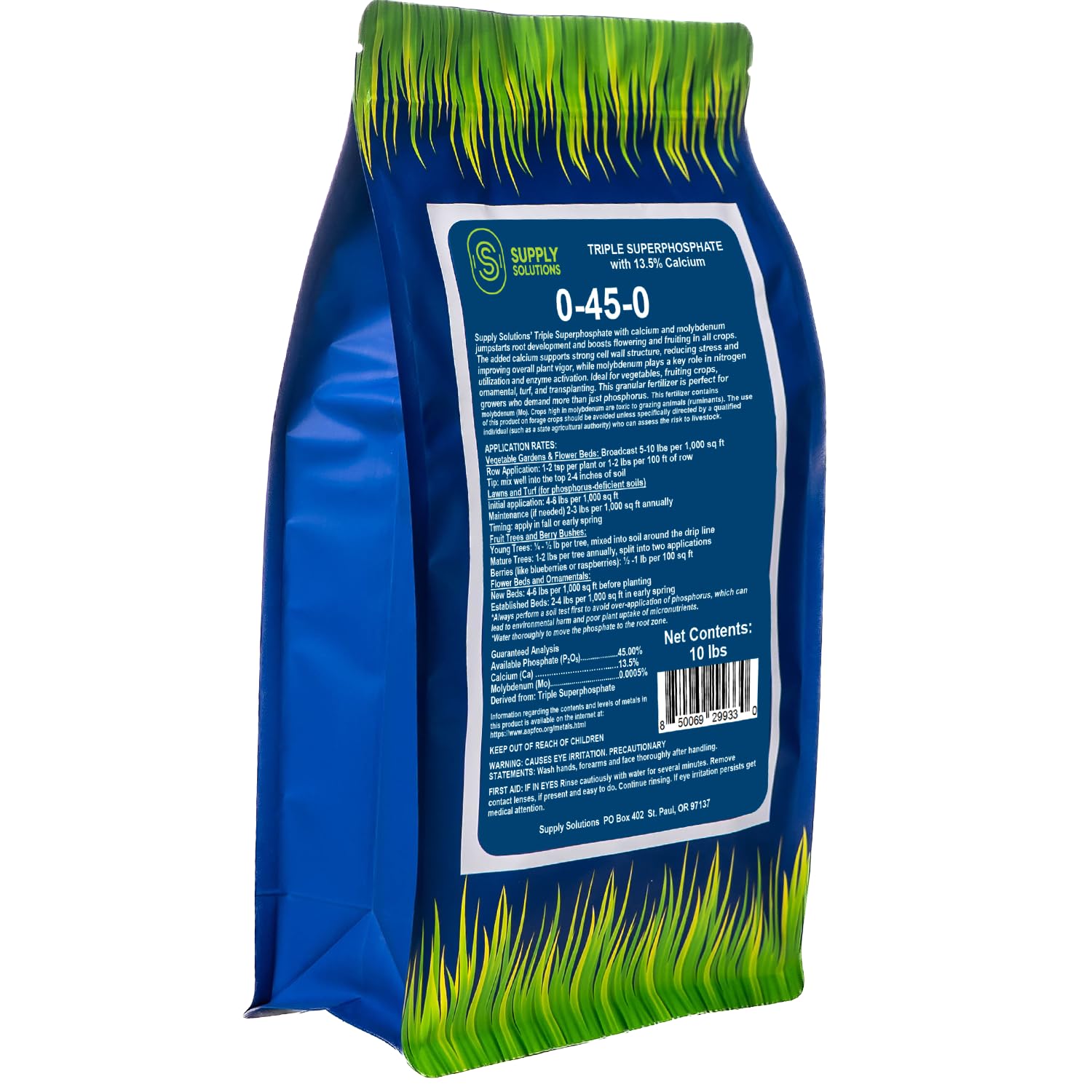
| NPK | 0-45-0 |
|---|---|
| Form | Granules |
| Unit Count | 160 Ounce |
| Includes | Granules Fertilizer |
Supply Solutions 0-45-0 Triple Superphosphate is a straightforward, phosphorus-focused granular fertilizer intended to strengthen roots and promote bigger blooms and fruit. You apply it as a dilute solution for potted plants or broadcast granules for outdoor beds and lawns following the label directions; typical use is every 4 to 6 weeks during active growth. Its concentrated 0-45-0 NPK delivers a strong phosphorus dose with added calcium to support cell strength and soil conditioning, which is useful as a starter treatment for transplants, for orchids and flowering shrubs, or as a seasonal booster for fruit trees and lawns. The product is versatile across indoor pots and garden plots and is easy to measure and mix with water or spread with a garden spreader. Important limitations are that it supplies virtually no nitrogen or potassium, so it should be used alongside a balanced fertilizer program when plants need overall nutrition, and it is not a complete feed for continuous use without complementary products.
Best for: Gardeners who prioritize consistent, measurable phosphorus boosts for flowering and fruiting plants and who plan to pair this with other feeds as part of a reliable fertilizer routine.
Less Ideal for: Beginners who want an all-in-one fertilizer or growers seeking a single-product maintenance feed for overall vegetative growth.
- Very high phosphorus concentration (0-45-0) for strong bloom and root stimulation
- Granular form that can be mixed for liquid feeds or broadcast for soil application
- Contains calcium to support cell strength and improve soil structure
- Clear application rates for both indoor and outdoor use make feeding predictable
- No nitrogen or potassium included, so it is not a standalone complete fertilizer
- Not suited for plants that need regular balanced feeding without additional products
Verdict: Choose this product when you need a dependable, high-phosphorus booster to reliably drive stronger roots, blooms, and fruit as part of a planned feeding program.
Simple Lawn Solutions 3-18-18 Liquid Lawn Food (32 oz) with Hose-End Sprayer

| Item Form | Liquid |
|---|---|
| Specific Uses For Product | Lawn |
| Application Method | Spray |
| Coverage | 3,200 square feet |
| Target Species | all grass types |
This 3-18-18 liquid lawn food is designed to boost root development and overall turf hardiness by delivering a high-phosphorus, high-potassium feed in a ready-to-apply hose-end format. You typically mix and spray it on actively growing lawns to help establish new turf, correct phosphorus or potassium deficiencies, or support lawns facing environmental stress. The included hose-end sprayer simplifies application and the stated coverage of 3,200 square feet per bottle makes it practical for medium-sized yards. Because the formula is low in nitrogen it will not drive excessive top growth, which is useful when you want roots and stress tolerance rather than rapid shoot development. Limitations to consider are that visible improvements from phosphorus and potassium can be subtle and slow to appear, and the product is intended for use only on actively growing grass so timing matters. For a long-term fertility program you will still want to use it alongside a regular lawn fertilizer schedule tailored to your soil test results.
Best for: Homeowners who prioritize strengthening roots and establishing new or stressed lawns and who want a simple, ready-to-use liquid treatment that fits into a practical lawn care routine.
Less Ideal for: Gardeners seeking a fast green-up or rapid top growth response or those who need an all-in-one high-nitrogen feeding for frequent mowing cycles.
- High phosphorus and potassium ratio supports root establishment and turf hardiness
- Comes with an attached hose-end sprayer for easy, even application
- Covers up to 3,200 square feet per bottle when applied with the included sprayer
- Low nitrogen formula reduces excessive top growth while focusing on root development
- Effects from phosphorus and potassium are often subtle and not immediately visible
- Intended for use only on actively growing turf so seasonal timing is important
Verdict: Choose this product if your main goal is to build stronger roots and improve turf establishment with a convenient hose-end liquid feed.
Scotts Turf Builder Starter Food for New Grass, 15 lb

| Item Form | Powder |
|---|---|
| Application Method | spreader |
| Specific Uses For Product | Starting |
| Coverage | 5000 square feet |
| Mixing Ratio | 24-25-4 |
Scotts Turf Builder Starter Food for New Grass is a powder starter fertilizer with a 24-25-4 NPK formulated specifically for new lawns. It is applied with a broadcast or drop spreader at planting and again 2 to 4 weeks later to encourage root development and faster, thicker turf. The high phosphate content is intended to fuel early root growth, which helps seedlings and newly laid sod establish more reliably than seed alone. Practical benefits include clear application guidance for Scotts spreaders, coverage of roughly 5,000 square feet per 15 lb bag, and compatibility with all grass types. Users should plan two timed applications and maintain consistent watering until seedlings are 2 inches tall, so it works best for owners willing to follow a short feeding schedule. Limitations are that it is a starter-only formula meant for initial establishment rather than ongoing maintenance and that proper spreader settings and watering are important for results, otherwise performance will be diminished.
Best for: Homeowners starting a lawn or reseeding patches who want a proven, easy-to-follow starter fertilizer to improve root establishment and germination success.
Less Ideal for: Gardeners looking for a year-round fertilizer or a combined weed-and-feed product should consider maintenance blends or targeted weed control options instead.
- High phosphate 24-25-4 formula designed to promote early root development
- Covers up to 5,000 sq. ft. per 15 lb bag, suitable for modest lawns
- Clear instructions for spreader settings and a recommended two-application schedule
- Safe for use on any grass type and applicable to seed, sod, plugs, or sprigs
- Starter-only formula so you must switch to a maintenance fertilizer after establishment
- Requires careful spreading and consistent watering to realize the claimed results
Verdict: Use this starter fertilizer if you want a straightforward, phosphate-rich feed to help new seed or sod establish stronger roots and fill in faster.
Choosing the Right Phosphorus Fertilizer for Lawns: Key Factors to Consider
Phosphorus Availability and Form
Phosphorus availability is the single most important factor for a phosphorus fertilizer for lawns. Soluble forms provide immediate availability for seedlings and roots, while some granules contain less-soluble organic or coated forms that release over time. Understanding the form helps you match product to the task: quick soluble phosphorus for seeding and repair, slower release for steady feeding.
Availability also depends on how the product presents guaranteed analysis. Look for clear labeling of elemental phosphorus or phosphate equivalents. Misreading the analysis can lead to under- or overapplication, which affects root development and environmental risk.
Nutrient Ratio and Lawn Needs
The N-P-K ratio matters because phosphorus is rarely the only nutrient your lawn needs. A product with too much nitrogen relative to phosphorus can force top growth before roots are established, while too little nitrogen may leave turf pale. Choose a balance that matches the task: higher phosphorus relative to nitrogen for overseeding and sod installation, more balanced blends for general maintenance.
Also consider micronutrient content. Some formulations include trace elements that support turf health, but these are secondary to matching the primary nutrient balance dictated by your soil test results.
Application Method and Equipment Compatibility
How a fertilizer applies matters for even coverage and safety. Granular fertilizers should match common broadcast and drop spreaders; clumping or irregular granules lead to streaking and uneven growth. Liquid phosphorus or soluble powders require different equipment and may be better for spot treatments or small lawns.
Ease of application also ties to dust generation and solubility. High dust levels make it harder to get an even spread and can irritate skin and lungs. Clear instructions for spreader settings and re-entry times improve the practical usability of a product on typical lawn equipment.
Release Profile and Timing
Release profile describes how quickly phosphorus becomes available after application. Fast-release products are useful for quick establishment and post-seeding feed, but they carry a higher short-term runoff risk. Slow-release or coated forms provide longer-lasting supply and reduce the need for repeat applications.
Think about the season and weather: apply quick-release phosphorus when rain is unlikely to cause runoff immediately after application, and consider slow-release options when you want steady uptake and less frequent treatments.
Soil Interaction and pH Sensitivity
Phosphorus availability is strongly influenced by soil pH and existing soil chemistry. In very acidic or alkaline soils, phosphorus can bind to minerals and become unavailable to roots. Choosing a product that performs across a range of pH values, or addressing pH with lime or sulfur first, will improve uptake.
If your soil test shows low phosphorus but extreme pH, correcting pH may be as important as adding fertilizer. Also consider cation interactions; high levels of iron, aluminum, or calcium can reduce phosphorus mobility.
Environmental Risk and Best Practices
Phosphorus runoff contributes to waterway eutrophication, so environmental safety should guide application decisions. Avoid overapplication, do not spread fertilizer near water bodies, and follow established buffer zone recommendations. Use products with clear runoff-reduction guidance if you are near streams or ponds.
Timing and method reduce risk. Avoid applying before heavy rain, sweep granules off impervious surfaces back onto the lawn, and favor slow-release options where appropriate to lower the short-term leaching risk.
When to Apply Phosphorus to Lawns
Apply phosphorus when roots are actively growing to maximize uptake. For cool-season grasses, early spring and early fall are common windows. For warm-season grasses, apply during active late spring to mid-summer growth, avoiding dormant periods.
Use soil test results to time applications. If you are seeding or repairing bare patches, apply a phosphorus-rich starter at the time of seeding for best root establishment. For general maintenance, follow soil-test recommendations rather than routine calendar applications.
- Seedlings benefit most from immediate-available phosphorus at planting.
- Avoid applications just before heavy rainfall to reduce runoff risk.
- Split applications can improve uptake and reduce waste.
Reading Fertilizer Labels for Turf Use
Labels list the guaranteed analysis as N-P-K. Interpret phosphorus numbers correctly by noting whether the label lists elemental phosphorus or phosphate (P2O5). Many lawn fertilizer labels show phosphate equivalents; convert or follow label instructions to understand actual phosphorus content.
Also read instructions for spreader settings, lawn size coverage, and any temperature or moisture limitations. A clear label that provides application rates for seeding, repair, and maintenance is more useful in practice than a cryptic analysis alone.
- Check for application windows and re-entry times.
- Follow spreader calibration guidance to avoid streaks.
- Note any soil pH or compatibility warnings on the label.
Applying Phosphorus Safely to Protect Waterways
Minimize environmental impact by following buffer guidelines and avoiding application within recommended distances of ponds, streams, and storm drains. Sweep any granules off driveways and sidewalks back onto the lawn immediately to prevent runoff into gutters.
Use the lowest effective rate informed by a soil test. If you must treat a steep slope or compacted area, consider slower-release options and combine with techniques that reduce erosion, such as aeration and overseeding with appropriate grasses.
- Avoid treating saturated ground or before heavy rain.
- Consider groundcover or erosion-control measures on slopes.
- Keep children and pets off treated areas until the product has been watered in or re-entry time has passed.
Starter Applications for Seeding and Sodding
Starter fertilizers with higher phosphorus relative to nitrogen help young turf develop roots quickly and compete with weeds. Apply at planting following label rates and water lightly to move phosphorus into the root zone without causing runoff.
For sod installation, apply starter phosphorus beneath the sod if allowed by the product instructions, or use a starter that is safe to place under new sod. Good seedbed preparation and consistent moisture are just as important as fertilizer choice for successful establishment.
- Follow recommended rates for seed versus sod to avoid burning.
- Water in starter applications to encourage root contact with phosphorus.
- Combine starter use with good soil contact and firming of seedbeds.
Combining Phosphorus with Cultural Practices
Fertilizer is only one part of lawn establishment and recovery. Aeration improves root zone access to phosphorus, while topdressing can help incorporate granules into the soil. Mowing height and irrigation schedule also influence how roots develop and take up nutrients.
Address compacted soils or poor drainage before relying on phosphorus alone. Improving organic matter and soil structure increases the effectiveness of any fertilizer program and reduces the need for repeated high-phosphorus applications.
- Use aeration to increase root access to applied phosphorus.
- Adjust irrigation to encourage deep rooting, not surface flushes.
- Monitor turf response and adjust cultural practices before increasing fertilizer rates.
How We Chose the Best Phosphorus Fertilizer for Lawns
We selected fertilizers based on criteria that reflect how phosphorus products actually perform in lawns rather than marketing claims. We prioritized nutrient analysis and phosphorus availability because the N-P-K ratio and form of phosphorus determine how much of the nutrient is plant-accessible in the short term. Application practicality was included to reflect spreader compatibility, granule size, and dust levels that affect even coverage. Release profile matters for timing and risk of runoff, so we filtered for products with clear soluble or controlled-release phosphorus statements. Compatibility with soil pH and typical lawn grass species was part of the evaluation, because phosphorus mobility and uptake vary with pH and root health. Safety and environmental guidance were examined, including instructions for avoiding runoff and overapplication. We excluded products that did not specify phosphorus content or lacked clear application instructions for turf. Also excluded were blends primarily intended for garden beds with very different nutrient balances. The final list reflects a balance of phosphorus availability, ease of use on lawns, predictable release behavior, and clear labeling for safe application. These dimensions align with the scoring criteria used across each shortlisted fertilizer.
FAQ
Does my lawn always need phosphorus fertilizer?
Not always. Many lawns have adequate phosphorus already, and a soil test is the reliable way to know. Overapplication offers little turf benefit and increases environmental risk, so apply phosphorus only when soil tests indicate a deficiency or during seeding and repair.
Can I use a high-phosphorus product on established lawns?
You can, but it is usually unnecessary unless a soil test shows low phosphorus or you are renovating or overseeding. For routine maintenance, choose a balanced fertilizer that matches your lawn's growth goals and test results.
How soon after application will phosphorus affect root growth?
Timing depends on the product form and soil conditions. Soluble phosphorus can be available within days, especially if watered in. Slower-release forms take weeks to months to provide measurable benefits. Soil temperature and pH also influence uptake speed.
Is phosphorus runoff a serious concern for home lawns?
Yes, it can be. Phosphorus runoff contributes to algal blooms in nearby waterways. Simple practices-using soil tests, following buffer recommendations, avoiding application before heavy rain, and sweeping off paved surfaces-substantially reduce runoff risk.
Should I adjust phosphorus application based on grass type?
Application timing can differ by grass type, with cool-season and warm-season grasses having different growth windows. The need for phosphorus itself is best determined by soil testing rather than grass type alone, but timing and product choice should reflect the grass species' active growth period.
Final Verdict
Prioritize a product that matches your soil test and the task at hand. Use higher phosphorus at seeding or sod installation to promote root establishment, and choose balanced or lower-phosphorus options for routine maintenance. Match the fertilizer form and release profile to your timing needs and equipment to improve uptake and reduce environmental risk. Follow label directions, correct soil pH if needed, and combine fertilizer use with cultural practices like aeration and proper irrigation. These steps will help you make confident, effective phosphorus choices for a healthier lawn.
