

Note: This article contains affiliate links. If you click on these links and make a purchase, I may earn a small commission at no extra cost to you. This helps support my research and content. Read my full affiliate disclosure here.
If you want bigger blooms, healthier fruit set, or stronger roots, choosing a phosphorus-rich natural fertilizer matters for how your garden performs. These fertilizers behave differently in real soil: some release phosphorus quickly, others feed plants slowly while improving soil biology. Picking the right option depends on soil test results, how quickly you need results, and whether you prefer granular, powder, or liquid forms. This guide covers five shortlisted options that suit common garden situations and explains the practical tradeoffs gardeners face. We evaluate nutrient concentration, how products act in the garden, ease of application, and gardener safety so you can match a phosphorus source to your beds, containers, or orchard. Read on to understand the factors we used and how each trait affects results in the soil.
Top Picks at a Glance
| Best Value The sweet spot between price and what you get | Jobe's Organics Granular Bone Meal Fertilizer, 4 lb |  |
| Best Budget The cheapest option that still gets the job done reliably | Whitney Farms Organic Bone Meal 6-8-0, 3 lb. |  |
| Highest Rated A top-rated pick with lots of positive feedback | Espoma Organic Bone Meal Fertilizer 4-12-0, 4 lb. Bag (Pack of 2) |  |
| Most Popular A crowd favorite that many people choose with confidence | Burpee Bone Meal Fertilizer, 3 lb |  |
| Best Seller A high-volume bestseller chosen again and again | FoxFarm Tiger Bloom Liquid Plant Food (1 pint) |  |
Jobe's Organics Granular Bone Meal Fertilizer, 4 lb

| Item Form | Granules |
|---|---|
| Application Method | Soil |
| Unit Count | 64 Ounce |
| Mixing Ratio | 2-14-0 |
Jobe's Organics Granular Bone Meal is a prilled, dust-reduced source of phosphorus and calcium aimed at strengthening root systems and improving blooms and tuber development. It is typically worked into the soil at planting for bulbs or applied around established plants every eight weeks during the growing season to support root- and flower-focused crops. The 2-14-0 NPK profile makes it especially useful where phosphorus is needed, and the granulated form is compatible with spreaders or hand application with minimal mess. Being OMRI-listed and made from 100 percent bone meal means it fits organic garden plans and is safe to use around children and pets when handled properly. Important limitations are that it supplies little to no nitrogen, so it should be paired with a balanced or nitrogen-rich amendment for leafy growth, and local regulations may restrict phosphorus use on lawns or near waterways. Also, results depend on existing soil phosphorus levels so a soil test is recommended before use.
Best for: Gardeners growing bulbs, tubers, flowering vegetables, or onions who want an organic phosphorus boost and prefer a low-dust granular product backed by positive user feedback.
Less Ideal for: Growers who need a complete all-purpose fertilizer for rapid leafy growth or those managing phosphorus-restricted turf or sites near sensitive waterways.
- High phosphorus and calcium content supports strong root development and better blooms
- Granulated prilled form reduces dust and works well with spreaders or hand application
- OMRI-listed and made from 100 percent organic bone meal suitable for organic gardens
- Directions recommend regular application every eight weeks for season-long support
- Contains little to no nitrogen so not sufficient alone for leafy growth
- Phosphorus fertilizers can be restricted in some areas because of runoff concerns
Verdict: A reliable organic bone meal to boost root development and bulb or onion bloom potential when soil phosphorus is needed.
Whitney Farms Organic Bone Meal 6-8-0, 3 lb.

| Item Form | Granules |
|---|---|
| Specific Uses For Product | Plant Growth, Root Development, Soil Conditioning |
| Coverage | Medium |
| Item Weight | 3 pounds |
This 3 lb. bag of Whitney Farms Organic Bone Meal is a simple, ready-to-use phosphorus supplement you spread into planting holes or work into the top 1 to 3 inches of soil at planting time. It is OMRI listed and formulated as a 6-8-0 NPK granule, so it supplies phosphorus and calcium that encourage stronger root systems and better flower set in bulbs such as tulips. Typical use is one application in spring, or spring and fall for bulbs, applying about 1 cup per 30 sq. ft. or 1 tablespoon per 2 sq. ft. The granular form is easy to measure and mixes into backfill or around established plants, and the slow-release nature reduces the need for frequent reapplications. Important limitations are that bone meal works slowly and depends on soil biology to release nutrients, so it is not a fast corrective for severely deficient soils; also it should be kept away from pets and stored dry. For gardeners looking for an organic, targeted phosphorus boost for tulip planting, this is a practical, no-frills option.
Best for: Gardeners planting tulip bulbs who want an inexpensive, organic phosphorus boost applied at planting time and prefer a simple, measured granular amendment.
Less Ideal for: People who need a rapid corrective fertilizer for severely phosphorus-deficient soil or who avoid animal-based amendments should consider alternative products.
- OMRI listed organic bone meal suitable for organic gardens
- 6-8-0 NPK formulation supplies phosphorus and calcium for root and flower development
- Granular form is easy to measure and work into planting holes or soil
- Recommended application rates and seasonal timing provided for bulbs
- Slow-release action requires soil microbes to convert nutrients so results are not immediate
- Contains animal-derived material so it must be stored away from pets and some gardeners may avoid it
Verdict: A budget-friendly, OMRI-listed bone meal that provides a straightforward, slow-release phosphorus boost ideal for improving tulip bulb root and flower development at planting time.
Espoma Organic Bone Meal Fertilizer 4-12-0, 4 lb. Bag (Pack of 2)

| Item Form | Granules |
|---|---|
| Specific Uses For Product | Gardening,Organic,Plant Food |
| Coverage | Medium |
| Target Species | bulbs, gardens, trees, shrubs, flowers, roses |
| Mixing Ratio | 10:100 |
Espoma Organic Bone Meal is a granular, slow-release source of phosphorus and some nitrogen designed primarily for bulbs, flowers and general garden use. You typically work it into the planting hole for individual bulbs or broadcast and rake it into soil at the recommended rate for beds and shrubs; directions include a 10 lb per 100 sq ft guideline and a teaspoon per bulb. The product comes in a modest 4 lb bag sold as a two-pack, so it is convenient for seasonal planting of tulips and other spring bulbs. Its organic formulation makes it suitable for gardeners who prefer natural amendments, and the granular form is easy to measure and apply. Limitations are that bone meal releases nutrients slowly and depends on soil biology and moisture to become available, so results are gradual and it will not correct acute nutrient deficiencies quickly. Also it supplies little potassium, so you may need an additional balanced fertilizer if plants require broader feeding.
Best for: Gardeners planting tulips and other flowering bulbs who want a natural, easy-to-apply phosphorus boost and prefer organic soil amendments for seasonal planting.
Less Ideal for: Growers who need a fast-acting corrective fertilizer or who want a single product that supplies a full NPK balance for all-season feeding.
- High phosphorus content helpful for root development and bloom initiation in bulbs
- Organic, all-natural formulation suited to organic gardening practices
- Granular form is easy to measure and apply to individual bulbs or garden beds
- Includes usage directions for bulbs, potted plants, shrubs and trees
- Slow nutrient release that relies on soil microbes and moisture, so effects are gradual
- Provides little to no potassium so additional fertilization may be needed for complete nutrition
Verdict: A straightforward organic bone meal that supplies the phosphorus bulbs need to set stronger roots and better blooms.
Burpee Bone Meal Fertilizer, 3 lb

| Item Form | Powder |
|---|---|
| Specific Uses For Product | Plant Growth, Root Development |
| Coverage | 240 Sqaure Feet |
| Target Species | tomatoes, peppers, and bulbs |
Burpee Bone Meal is a slow-release granular fertilizer designed to boost early root development and flowering in root and bulb crops. Gardeners typically work it into planting holes for bulbs or mix it into soil and potting media when starting seeds or transplanting vegetables like carrots, beets, and onions. The product is OMRI listed for organic gardening and provides phosphorus and calcium that support stronger root systems and better early-season growth. Its fine granular texture makes it easy to apply evenly, and because it breaks down slowly it feeds plants over the season without burning them. Practical benefits include targeted support for root vegetables and an easy application method for beds and containers. Limitations are that it supplies mainly phosphorus and calcium rather than a balanced NPK profile, so it is best used alongside a nitrogen source if foliage development is needed, and results are gradual rather than immediate because of the slow-release nature.
Best for: Gardeners focused on improving root development and bulb planting who prefer organic inputs and want a simple amendment to add at planting or during bed preparation.
Less Ideal for: Growers seeking an all-in-one balanced fertilizer for both foliage and root development or those who need fast-acting, soluble nutrients for immediate correction.
- OMRI listed for organic gardening, suitable for certified organic beds
- Fine granular form that is easy to spread and incorporate
- Provides phosphorus and calcium to encourage strong root and bulb development
- Slow-release action reduces risk of burning plants and supplies season-long support
- Not a complete fertilizer profile so additional nitrogen may be needed for leafy growth
Verdict: A reliable organic bone meal to strengthen roots and jump-start bulbs and root vegetables when added at planting.
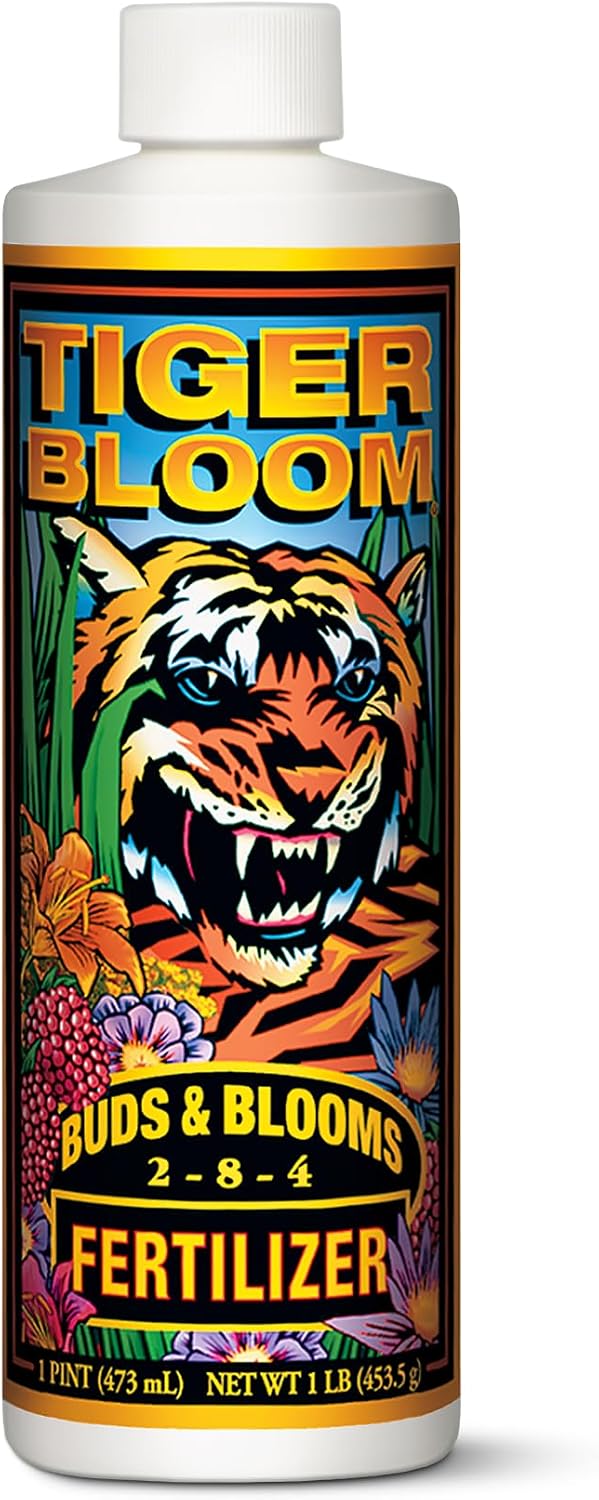
FoxFarm Tiger Bloom Liquid Plant Food (1 pint)
| Item Form | Liquid |
|---|---|
| Specific Uses For Product | Hydroponic |
| Application Method | Watering; Foliar spraying |
| Target Species | Flowering Plants |
| Mixing Ratio | 1:200 or 1:300 |
Tiger Bloom is a liquid, high-phosphorus fertilizer designed to push plants into a strong flowering and fruiting phase. You mix a small amount into the irrigation water or use it as a foliar spray and apply from first signs of flowering through harvest. The 2-8-4 formula and included micronutrients support bud set and larger blooms, and the concentrate mixes at 1:200 to 1:300 for routine feeding or 2 to 4 teaspoons per gallon for heavier feeding. It works in both soil and hydroponic setups and is formulated for quick nutrient uptake and stable micronutrient availability during storage. Practical benefits include flexible application methods, suitability for intensive flowering cycles, and a small bottle that lasts when used at recommended dilutions. Important limitations are that it is bloom-focused rather than an all-purpose feed so it may not meet vegetative needs, and the phosphorus content means users near waterways should follow local regulations to avoid runoff issues.
Best for: Serious growers who prioritize maximizing flower and bloom performance and want a concentrated, fast-acting bloom booster for soil or hydroponic environments.
Less Ideal for: Casual gardeners seeking a single all-purpose fertilizer for every growth stage or those managing turf or non-flowering lawns where phosphorus restrictions apply.
- High phosphorus NPK (2-8-4) concentrated for stronger bud development
- Works in soil and hydroponic systems for versatile use
- Liquid concentrate mixes easily for foliar or watering applications
- Formulated for quick nutrient uptake and stable micronutrient availability
- Focused on flowering so it is not a balanced all-stage fertilizer
- Contains phosphorus which may be restricted near waterways
Verdict: Choose Tiger Bloom when you need a concentrated, fast-acting bloom booster to maximize flower and fruit production.
Choosing the Right Phosphorus Rich Natural Fertilizer: Key Factors to Consider
Phosphorus Content and Form
Phosphorus appears in different chemical and physical forms, and that determines how quickly plants can use it. Soluble forms give a faster boost to blooms and fruit set but can leach in sandy soils, while less soluble forms release over months and support long-term root development.
Knowing the actual phosphorus percentage and whether it is readily soluble or bound in organic matter helps match a product to your goals. For fast correction of a deficiency you want a more available form applied carefully. For long-season crops or improving soil fertility over time, slower-release forms reduce the risk of runoff and feed successive plantings.
Soil pH and Phosphorus Availability
Soil pH strongly affects phosphorus availability. In very acidic or very alkaline soils, phosphorus can become chemically bound and unavailable to plants even when present in the soil. Testing pH first tells you whether a phosphorus amendment will be effective or if you need to change pH alongside fertilization.
If your soil locks up phosphorus, using a product that also improves soil organic matter or combining applications with pH adjustments can increase uptake. Gardeners should avoid repeated heavy applications into soils where pH prevents availability because that raises environmental runoff risk without helping plants.
Release Rate and Timing
When phosphorus becomes available influences plant response. Quick-release materials often support immediate bloom or fruit development but may require more frequent, smaller applications. Slow-release sources feed plants over longer windows and are useful for perennials, bulbs, and established shrubs that benefit from steady phosphorus supply.
Consider crop timing: bulbs and flowering perennials often need a phosphorus push at planting or just before bloom, while trees and long-season crops benefit from a sustained feed. Matching release rate to the crop schedule reduces waste and improves results.
Application Method and Form
Phosphorus-rich materials come as powders, granules, liquids, or solids you can incorporate into soil. Granules and powders are easy to broadcast or work into planting holes. Liquids can be applied as soil drenches for faster uptake but may require dilution and careful measurement.
Choose a form that fits how you garden. Containers and small beds often favor liquid or fine powder for even distribution. Larger beds or orchards may be best served by granules that can be spread with an even hand. Consider dust control, ability to mix with compost, and equipment you already own.
Environmental Impact and Runoff Risk
Phosphorus runoff contributes to water quality problems in nearby streams and ponds. Materials that release phosphorus rapidly or that are applied to bare slopes increase runoff risk. Using slower-release sources, applying near roots rather than broadcasting on bare soil, and avoiding applications before heavy rain reduce the chance of nutrient loss.
Gardeners with slopes, compacted soils, or sandy substrates should favor conservative application rates and integrate phosphorus into the root zone. Buffer strips and mulches also help retain phosphorus within the garden.
Safety and Handling
Even natural phosphorus sources can have dust, strong odors, or handling precautions. Some materials require gloves and a dust mask; others are safe to spread with bare hands. Consider storage needs too: humidity can cake powders and make handling messy.
Read product labels for recommended personal protective equipment and keep materials away from children and pets until incorporated into the soil. Safe handling practices keep applications precise and protect garden users.
When to Test Soil and How to Interpret Results
Test soil before adding a phosphorus-specific amendment. A soil test tells you existing phosphorus levels, pH, and other limiting nutrients so you do not add unnecessary phosphorus that could run off. Most garden labs report phosphorus on a scale that you can compare to crop-specific targets.
Interpret results with crop needs in mind. Vegetable gardens and new planting holes have different phosphorus targets than established lawn trees. If a test shows adequate phosphorus but poor plant performance, also check pH and micro-nutrients rather than increasing phosphorus blindly.
- Collect samples from the root zone of representative areas.
- Avoid testing right after a fresh phosphorus application; wait several weeks for more accurate results.
- Use pH and phosphorus together to make decisions.
Applying Phosphorus at Planting Vs Topdressing
For new plantings, place phosphorus-rich material in the planting hole or backfill so roots access it early. Bulbs and seedlings benefit from localized placement rather than wide broadcast applications. Incorporating the amendment near roots reduces waste and speeds uptake.
Topdressing established beds is practical for seasonal maintenance. Light, repeated topdressings are often more effective and less risky than a single heavy application. After topdressing, water gently to move phosphorus into the root zone without causing runoff.
- Planting: incorporate near root ball, mix with backfill.
- Established beds: spread thinly and water to settle.
- Containers: mix into potting medium at repotting, avoid surface-only adds.
Combining Phosphorus with Organic Matter
Pairing phosphorus sources with compost or well-rotted manure improves soil structure and microbial activity, which can increase phosphorus availability over time. Organic matter helps hold nutrients in the root zone and reduces leaching.
Do not bury fresh manure high in ammonia near young roots. Use well-decomposed organic matter to avoid burning plants and to ensure a steady nutrient release that complements phosphorus amendments.
- Mix compost into the topsoil before applying phosphorus where possible.
- Use mulch to reduce erosion after application.
- Avoid combining high-nitrogen fresh manures with high-phosphorus materials without testing.
Phosphorus Needs by Crop Type
Different plants vary in phosphorus demand. Root crops and flowering plants often show visible responses to additional phosphorus, while leafy greens may show little benefit. Trees and shrubs need steady phosphorus for root development more than frequent quick boosts.
Match application timing and rate to the crop. For example, bulbs often need a phosphorus dose at planting, whereas fruiting shrubs benefit from slower, seasonal feeding that supports fruit set without excess runoff.
- Bulbs and flowers: early-season phosphorus to support bloom.
- Vegetables: phosphorus at planting and moderate levels during fruit set.
- Perennials and shrubs: slow, incorporated sources for root health.
Storing and Preparing Natural Phosphorus Materials
Store dry materials in a cool, dry place in sealed containers to prevent moisture and caking. Liquids should be kept out of direct sunlight and tightly capped. Proper storage keeps materials effective and reduces handling problems.
Prepare materials according to the form. Powders may need sieving for even spread, and granules are often easier to distribute with a handheld spreader. Always measure doses to avoid overapplication.
- Label containers with source and date.
- Keep materials away from children and pets.
- Use masks or gloves for dusty powders.
How We Chose the Best Phosphorus Rich Natural Fertilizer
We prioritized sources that deliver meaningful phosphorus levels while fitting organic or minimally processed garden systems. Evaluation focused on nutrient concentration and release behavior, because how fast phosphorus becomes plant-available affects flowering and root response. We also tested application practicality by assessing typical forms and how easily a home gardener can apply the material evenly. Soil and environmental fit mattered: materials that improve soil biology or buffer pH were favored over fertilizers that solely supply nutrients. Availability and safety were considered by looking at common, legally accepted natural sources and handling precautions. We excluded synthetic phosphate blends and any amendments with unverified claims or hazardous contaminants. Final selections balanced measurable phosphorus contribution, predictable performance in a range of soils, reasonable application methods, and minimal safety concerns for gardeners.
FAQ
How quickly do natural phosphorus sources start working?
It depends. Soluble sources can increase availability within days, while less soluble, organic-bound phosphorus may take weeks to months as microbes break it down. Soil temperature and moisture influence the speed of release.
Can I apply phosphorus every season?
Often you can, but it depends on soil test results and crop needs. Repeated heavy applications without testing risk building up excess phosphorus and increasing runoff. Aim for targeted seasonal applications guided by tests.
Will adding phosphorus change my soil pH?
Some phosphorus materials have little direct effect on pH, while others can slightly acidify or buffer soil. If pH adjustment is needed, address pH separately because phosphorus availability interacts with pH but one amendment does not always fix the other.
Is phosphorus safe for vegetable gardens?
Yes, when used appropriately. Choose food-safe, natural sources and follow handling instructions. Incorporate phosphorus into soil rather than leaving it on the surface to reduce contamination risk and improve plant uptake.
How do I avoid phosphorus runoff after application?
Avoid applying before heavy rain, incorporate material into the root zone, use slower-release sources, and maintain ground cover or mulch to trap soil and nutrients. Conservative rates and proper timing are the most effective safeguards.
Final Verdict
Prioritize a phosphorus source that matches your soil test, crop timing, and application preferences. Faster-acting materials suit immediate bloom or fruit objectives, while slower-release and soil-building options support long-term root health and reduce runoff risk. Balance phosphorus concentration, release behavior, and safe application to get reliable results without harming nearby water. Decide by starting with a soil test, matching release rate to plant needs, and using placement techniques that send phosphorus straight to roots. With those priorities, you can pick a phosphorus-rich natural fertilizer that delivers the performance you need in your garden.
