

Note: This article contains affiliate links. If you click on these links and make a purchase, I may earn a small commission at no extra cost to you. This helps support my research and content. Read my full affiliate disclosure here.
If you grow African violets, the right plant food makes a visible difference in bloom frequency, leaf health, and compact growth. These tender, small-rooted plants respond best to fertilizers formulated for their needs rather than general houseplant feeds. You need recipes that deliver phosphorus for blooms, modest nitrogen to avoid legginess, and micronutrients suited to indoor light levels. This guide covers seven shortlisted plant foods for African violets and explains why each type made the list. We evaluated nutrient balance, application ease, and compatibility with common African violet growing situations so you can pick the feeding approach that fits your routine and growing setup.
Top Picks at a Glance
| Best Overall The best all-around choice for most situations | Jack's Classic 12-36-14 African Violet Water-Soluble Fertilizer, 8 oz |  |
| Best Quality Built to a higher standard if you want something more solid | Espoma Organic Violet! Liquid Plant Food (8 fl oz) |  |
| Best Value The sweet spot between price and what you get | HiThrive African Violet Liquid Fertilizer, 16 fl oz |  |
| Best Budget The cheapest option that still gets the job done reliably | Schultz African Violet Plus Liquid Plant Food 8-14-9, 4 fl oz |  |
| Highest Rated A top-rated pick with lots of positive feedback | Schultz African Violet Food, 4 fl oz |  |
| Most Popular A crowd favorite that many people choose with confidence | TPS Nutrients African Violet Liquid Fertilizer, 8 fl oz |  |
| Best Seller A high-volume bestseller chosen again and again | EarthPods African Violet Fertilizer Spikes, Organic, 100 Count |  |
Jack's Classic 12-36-14 African Violet Water-Soluble Fertilizer, 8 oz

| Item Form | Powder |
|---|---|
| Specific Uses For Product | African Violet care |
| Application Method | Spray or pour |
| Mixing Ratio | 1/4 teaspoon per gallon |
Jack's Classic 12-36-14 is a powder concentrate designed specifically for African violets and other houseplants, mixed at the recommended ratio to create a liquid feed. You can apply it as a foliar spray or pour it into the potting mix for root feeding, and a small 1/4 teaspoon per gallon mixing guideline makes it easy to dose repeatedly. The formula emphasizes bloom and bud development while supplying micronutrients for healthier foliage and stronger roots. Because it is concentrated powder, one 8 oz unit will make many gallons of feed, which is economical and convenient for steady, scheduled feeding. The product also includes a measuring spoon for precision dosing and claims a safety margin to reduce burn risk when used as directed. Limitations are that you need to mix it each time and follow the feeding schedule carefully, and it is tailored to African violets so it is not a one-size-fits-all houseplant fertilizer for radically different nutrient needs.
Best for: Buyers who prioritize consistent, proven results for African violets and prefer a professional-grade, easy-to-measure feed for regular scheduled feeding.
Less Ideal for: Casual plant owners who want ready-to-use liquid fertilizers or gardeners seeking a general-purpose houseplant feed for many different species.
- Formulated specifically for African violets to encourage blooms and strong foliage
- Water-soluble powder yields many gallons of feed from a small container, improving economy
- Includes micronutrients for balanced nutrition and a measuring spoon for accurate dosing
- Can be used as foliar spray or root drench for flexible application methods
- Requires mixing each use rather than being a ready-to-use product
- Nutrient ratio is specialized so may not suit all houseplant types
Verdict: A concentrated, professional-grade powder fertilizer that reliably boosts blooms and foliage on African violets when used as a regular feed.
Espoma Organic Violet! Liquid Plant Food (8 fl oz)

| Item Form | Liquid |
|---|---|
| Specific Uses For Product | Plant Growth and Flowering |
| Target Species | African violets, indoor flowering plants |
| Liquid Volume | 8 fluid ounces |
| Mixing Ratio | 1:2 |
Espoma Organic Violet! is a concentrated liquid plant food made specifically for African violets and similar indoor flowering plants. You mix half a cap per quart of water (mixing ratio 1:2 listed) and drench the potting soil every 2 to 4 weeks, so it fits easily into a regular watering routine. As an organic formula, it supplies essential plant nutrients intended to encourage fuller foliage and more frequent, vivid blooms without synthetic additives. The small 8 ounce bottle is easy to store and the dosing is simple, which helps avoid overfeeding sensitive violets. Because it is concentrated, a little goes a long way for individual houseplants, but the bottle size and medium coverage mean it is best suited to small collections rather than large-scale feeding. If you want a dedicated, organic fertilizer to keep potted violets blooming on a budget, this product is straightforward and effective, though heavy users with many plants may prefer larger or more economical concentrates.
Best for: A budget-minded houseplant owner who cares for a small collection of African violets and wants an easy organic fertilizer to encourage blooms without complicated dosing.
Less Ideal for: Collectors with many plants or commercial growers who need larger volumes or lower cost per treatment should consider bulk concentrates or larger packages.
- Formulated specifically for African violets and other indoor flowering plants
- Organic concentrated liquid that is easy to mix and apply
- Simple dosing instructions (1/2 cap per quart) reduce risk of overfeeding
- Small bottle stores easily and lasts for multiple treatments on a few plants
- 8 fl oz size limits cost-effectiveness for large collections or frequent use
- Coverage is described as medium so may require more product for many pots
Verdict: A simple, organic concentrated liquid fertilizer made for small collections of African violets to boost growth and blooms.
HiThrive African Violet Liquid Fertilizer, 16 fl oz

| Item Form | Liquid |
|---|---|
| Specific Uses For Product | Houseplants |
| Coverage | African Violets |
| Mixing Ratio | 1 teaspoon per 32 ounces of water |
HiThrive African Violet Liquid Fertilizer is a water-soluble concentrate intended to boost blooms and foliage on African violets. The 16 fl oz bottle mixes into roughly 24 gallons of feed solution, so it is designed for repeated use across many plants. Typical use is simple: add 1 teaspoon per quart of water for routine feeding every two weeks in active seasons, or use 1/2 teaspoon per pint for a light foliar mist. The formula lists balanced macronutrients plus micronutrients such as calcium, magnesium, iron and zinc, which supports stronger leaf color, reduced yellowing, and improved flowering when used consistently. Practical benefits include clear mixing instructions, flexible application (soil drench or foliar spray), and a concentrated volume that stretches for many feedings. Limits to consider are that the NPK ratio is described but not numerically listed on the page, so users wanting exact percentages may find the label vague, and it is formulated specifically for African violets rather than as a universal houseplant feed. Follow safety directions carefully to avoid contact with skin or eyes.
Best for: A practical grower who wants a dedicated, easy-to-use fertilizer to maintain and enhance African violet blooms without frequent repurchasing; ideal for hobbyists who prefer straightforward feeding schedules and concentrated solutions.
Less Ideal for: Gardeners who need precise NPK numbers for tailored nutrient programs or who want a single fertilizer to cover many different houseplant species.
- Concentrated bottle mixes into a large volume of feed so it lasts through many applications
- Formulated with macronutrients and multiple micronutrients aimed at improving blooms and leaf color
- Clear, simple mixing ratios for both watering and foliar misting
- Designed specifically for African violets which simplifies care decisions for that plant type
- Product page does not list exact NPK percentages, limiting precision for nutrient-sensitive growers
- Not formulated as a general-purpose houseplant fertilizer if you want one product for many species
Verdict: A concentrated, African violet–focused liquid fertilizer that stretches across many feedings and makes regular bloom-boosting care simple.
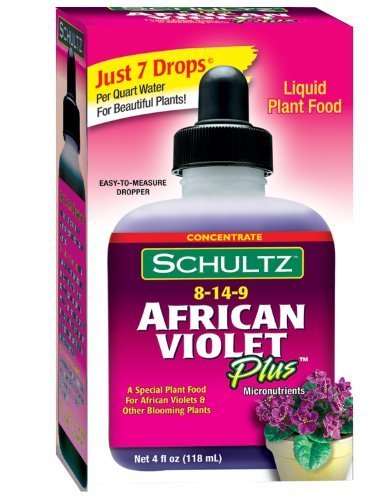
Schultz African Violet Plus Liquid Plant Food 8-14-9, 4 fl oz
| Item Form | Liquid |
|---|---|
| Specific Uses For Product | Plant Food |
| Target Species | African Violets & other plants in the Gesneriad family |
| Liquid Volume | 4 fluid ounces |
| Mixing Ratio | 1:400 |
Schultz African Violet Plus is a small, concentrated liquid fertilizer designed specifically for African violets and related gesneriad houseplants. It dispenses by dropper so you add a precise amount—the package directs 7 drops per quart, or a 1:400 mixing ratio—making it easy to feed plants without overdoing it. The 8-14-9 NPK formula provides higher phosphorus for bloom development while still supplying nitrogen and potassium for foliage and overall vigor. In practice this works well for regular light feeding of potted African violets between repottings and bloom cycles, and the liquid form dissolves quickly for even distribution. Because the bottle is only 4 ounces, it is best for growers who maintain a modest collection or who prefer buying small, targeted fertilizers rather than large, all-purpose bottles. Limitations are the small volume for frequent use on many plants and that the formula is tailored to gesneriads rather than being a universal houseplant feed.
Best for: Best for owners of a few African violets or other gesneriads who want a dedicated, easy-to-measure bloom-boosting fertilizer and prefer small, low-waste containers.
Less Ideal for: Not a good fit for hobbyists with large collections or mixed houseplant groups who need larger-volume or multi-purpose fertilizers.
- Targeted 8-14-9 formula tuned to promote flowering in African violets
- Dropper and clear mixing ratio (1:400) allow precise, low-waste dosing
- Liquid form dissolves quickly for even feeding
- Small bottle is convenient to store and reduces risk of fertilizer degradation over time
- 4 fl oz size is small for owners with many plants or frequent feeding needs
- Not formulated as a general-purpose fertilizer for other plant families
Verdict: A small, precise liquid formula that makes regular bloom-focused feeding easy for owners of a few African violets.
Schultz African Violet Food, 4 fl oz

| Item Form | Liquid |
|---|---|
| Application Method | Water |
| Coverage | African Violets and other blooming plants |
| Mixing Ratio | 7 drops per quart of water |
| Unit Count | 4 Fluid Ounces |
Schultz African Violet Food is a concentrated liquid fertilizer designed to boost bloom production in African violets and similar gesneriads. You measure just seven drops per quart of water using the built-in dropper and apply it with regular waterings, which makes feeding simple and precise for routine care. The 8-14-9 N-P-K formula is skewed toward phosphorus to encourage flowering, and the fast-release liquid form delivers nutrients directly to the root zone on each watering. For reliability-focused growers this product is convenient because dosing is repeatable and the small bottle stores easily between uses. Limitations are its small unit size if you have many plants and the need to follow the mixing ratio carefully to avoid overfeeding; it is also formulated specifically for flowering houseplants, so it is not a general all-purpose feed for foliage-only species. Overall it is a straightforward, easy-to-use option when your priority is consistent, flower-focused feeding for African violets.
Best for: A grower who values consistent, easy-to-repeat feeding routines for African violets and other blooming houseplants and wants a product that reliably encourages blooms.
Less Ideal for: Large-scale growers with many plants who need bulk fertilizer or gardeners seeking a general-purpose houseplant feed for non-blooming species.
- Concentrated liquid formula allows precise dosing with just seven drops per quart
- 8-14-9 N-P-K ratio formulated to encourage flowering in African violets
- Fast-release liquid delivers nutrients with each watering for predictable results
- Built-in dropper and small bottle are easy to store and use for regular feedings
- Small 4 fl oz unit may require frequent replacement for collections of many plants
- Focused formula is aimed at flowering houseplants rather than general-purpose feeding
Verdict: A small, concentrated liquid fertilizer that makes reliable, flower-focused feeding of African violets fast and repeatable.
TPS Nutrients African Violet Liquid Fertilizer, 8 fl oz

| Item Form | Liquid |
|---|---|
| Specific Uses For Product | Plant Food |
| Coverage | Medium |
| Target Species | African Violet |
| Mixing Ratio | 1:128-1:256 |
This 8 fl oz liquid fertilizer from TPS Nutrients is made for African violets and is designed to be diluted and applied regularly to support continuous flowering and healthy leaves. It is a low-concentration liquid formula with a recommended mixing ratio of 1:128 to 1:256 and directions to dilute 5 to 10 drops per quart of water and feed every two weeks or with every watering for best results. The product highlights gentle nutrition aimed at delicate roots, claims to reduce buildup and root stress, and specifically targets rebloom cycles and robust leaf color. Practical benefits include easy measuring for small indoor plants, even nutrient distribution when diluted, and a focused formulation that removes guesswork for violet owners. Limitations are the small bottle size for growers with many plants and the need for consistent dilution and schedule to see results; it is not a granular or slow-release option for hands-off users. Safety precautions and standard fertilizer warnings apply.
Best for: Violet owners who want a targeted, easy-to-dose nutrient solution and who follow a regular feeding routine to keep indoor plants blooming and healthy.
Less Ideal for: People who prefer low-maintenance slow-release or granular fertilizers or those who need a bulk supply for many plants at once.
- Formulated specifically for African violets to encourage reblooming and richer foliage
- Liquid concentrate allows precise dosing for small indoor plants
- Gentle, low-concentration formula intended to minimize root stress and buildup
- Clear mixing ratio and feeding instructions make routine use straightforward
- Small 8 fl oz bottle may require frequent replacement for multiple plants
Verdict: A small, easy-to-dose liquid fertilizer tailored to African violets that simplifies regular feeding to promote more blooms and healthier foliage.
EarthPods African Violet Fertilizer Spikes, Organic, 100 Count

| Brand | EarthPods |
|---|---|
| Unit Count | 100 Count |
| Item Form | Capsules |
| Specific Uses For Product | African Violet fertilizer, Blooming houseplant food |
EarthPods African Violet Fertilizer Spikes are small, organic capsules you push into moist potting mix to deliver nutrients gradually at the roots. Designed specifically for Saintpaulia and similar flowering gesneriads, the spikes release plant food for roughly 14 to 21 days so you do not need to mix liquids or worry about drips on fuzzy leaves. Typical use is simple: press one to two capsules into small pots (more for larger plants), water as usual, and repeat every two to three weeks during active growth. The product contains trace minerals and humates in a low-odor, pet- and child-friendly formula and comes in a 100-count supply that supports many feedings. Because the capsules are a measured, slow-release form, they reduce the chance of overfeeding compared with concentrated liquid fertilizers, but you still need to follow the recommended spacing and frequency to avoid buildup. These are best for indoor growers who want a low-effort, consistent feeding routine for bloom and compact growth without dealing with measuring or mess.
Best for: Indoor gardeners who prefer a low-effort, measured feeding routine for African violets and other blooming houseplants and who value gentle, organic products over mixing liquid fertilizers.
Less Ideal for: Gardeners who need a one-time long-term slow feed for large outdoor plants or who prefer customizable liquid nutrient mixes for precise nutrient control.
- Slow-release formula feeds plants for 14–21 days, reducing frequent dosing
- Organic, low-odor capsules avoid liquid spills on fuzzy violet leaves
- Clear, simple application: press into moist soil and water as usual
- Large 100-count supply supports many feedings for multiple plants
- Requires repeated insertion every 2–3 weeks which can be fiddly in very small pots
- Not formulated for non-blooming or large outdoor plants
Verdict: A simple, organic slow-release capsule system that takes the guesswork out of feeding African violets and keeps blooms steady with minimal effort.
Choosing the Right Plant Food for African Violets: Key Factors to Consider
Nutrient Ratio and Bloom Promotion
African violets have small root volumes and respond best to a fertilizer that favors bloom production without encouraging tall, floppy growth. Look for formulations with a balanced or slightly higher middle number (phosphorus) relative to nitrogen. Too much nitrogen can produce large leaves at the expense of flowers, while too little phosphorus can reduce bud set.
Consistent light feeding with a low-strength fertilizer often results in steadier flowering than infrequent heavy doses. For potted violets, the concentration you apply matters more than the absolute N-P-K numbers, because overconcentrated solutions can burn delicate root hairs.
Micronutrients and Water Chemistry
Calcium, magnesium, iron, and trace elements impact leaf color, petiole strength, and bud development. A plant food that supplies those micronutrients in available forms prevents common indoor deficiencies, especially when you use softened or low-mineral water. In many indoor setups, iron chelates and soluble magnesium can correct pale foliage more quickly than changing macronutrient levels.
Consider your local water quality. If you have very hard or very soft water, choose a formula or feeding schedule that compensates for the minerals your plants will or will not receive from irrigation.
Formulation Type and Application Frequency
Plant foods come as water-soluble powders, liquid concentrates, spikes, or slow-release granules. With African violets, soluble concentrates or powders used as weak, regular feeds fit the plants' small root systems best because they allow fine control over strength and timing. Slow-release products can work for busy growers but may be harder to dose for small pots and can tie up salts in the soil if not matched to potting mix.
Think about how often you water and your patience for mixing feeds. If you water infrequently, a slow-release might reduce maintenance, but if you prefer weekly light feeds, a water-soluble option gives more consistent results.
Salt Buildup and Root Safety
African violets are susceptible to fertilizer salt buildup because they are commonly grown in small, well-draining pots. Repeated feeding without periodic leaching can raise soluble salts and cause marginal leaf brown spots or slowed growth. Choose a plant food with a formulation designed for low salt index or follow a regimen of occasional flushing to prevent accumulation.
Also consider how clearly the product labels advise on leaching and dilution for small pots. Products that provide explicit low-strength instructions for small container sizes reduce the risk of accidental overfeeding.
Compatibility with Potting Mix and Soil pH
African violets prefer a slightly acidic, well-aerated potting mix. Some fertilizers alter substrate pH over time; others are buffered to minimize pH drift. Matching feed type to your potting medium helps maintain nutrient availability. For example, mixes with high peat content may acidify slowly, so choose a feed that keeps iron and micronutrients soluble.
If you repot regularly or use soilless mixes, pick a fertilizer that works predictably in that medium and monitor leaf color to catch gradual pH or nutrient shifts early.
Label Clarity and Practical Dosing
Clear dosing instructions that include example measurements for small pots or teaspoons per gallon reduce guesswork. Many growers make the mistake of following general houseplant directions that assume larger containers. A product that lists dilution rates for weekly weak feeds, monthly stronger feeds, and foliar applications is far more usable for violet growers.
Also check whether the product lists soluble salt content, storage recommendations, and advice for use with foliar sprays versus soil drench. Practical labeling lowers the chance of mistakes that harm these sensitive plants.
Why African Violets Need Different Feeding Than Other Houseplants
African violets have compact fibrous root systems and are usually grown in small pots with fast-draining mixes. That combination makes them more sensitive to concentrated fertilizers and salt buildup than larger potted plants. They typically thrive on low-strength, frequent feeding that supplies both macronutrients and essential micronutrients.
Because they flower repeatedly when conditions are right, the feeding goal is to support steady bud set rather than rapid vegetative growth. That changes how you approach both the fertilizer formulation and the frequency of application.
- Small root volume increases risk of fertilizer burn from high concentrations
- Frequent, dilute feeds often keep blooms coming without forcing excessive leaf growth
- Micronutrients have an outsized effect on leaf color and bud health
How to Read Fertilizer Labels for Small Pots
Fertilizer labels show N-P-K numbers and sometimes list micronutrients. For African violets, interpret those numbers in the context of dilution. A stronger N-P-K product can still be safe if the label supports an appropriately weak dilution for small pots.
Look for directions that give measurements per gallon or per liter and then convert that into the amount you will use for a 4- to 6-inch pot. If label instructions are vague, err on the side of a quarter to half the recommended strength for general houseplants and adjust based on plant response.
- Convert label dilution to your pot size before feeding
- Prefer products that include example dilutions for small containers
- When in doubt, start weaker and increase slowly if plants remain healthy
Foliar Feeding Versus Soil Drench
Foliar feeding can correct micronutrient deficiencies faster because leaves absorb certain elements quickly. It is useful for short-term corrections of pale foliage or to deliver a gentle boost before bloom. However, foliar sprays are not a substitute for regular soil drench feeding because they do not supply the full range of nutrients required by roots and stored for later use.
Soil drenches remain the primary feeding method for sustained bloom support. When using either method, avoid heavy concentrations and consider environmental conditions such as humidity and light to prevent foliar burn or unwanted residue.
- Use foliar sprays for quick micronutrient fixes and low-dose applications
- Reserve soil drench feeding for regular, balanced nutrient supply
- Avoid foliar feeding in direct strong sunlight to reduce leaf spotting risk
Adjusting Feed Schedules by Growth Stage and Season
African violets slow down growth in lower light or cooler conditions and need less fertilizer during those periods. Increase feeding modestly when plants are actively producing flowers and new leaves. Many growers adopt a weekly weak feed during active growth and reduce frequency in winter or low-light months.
If you repot or divide plants, pause fertilizer for a short recovery period and resume at a lower strength to avoid stressing fresh roots. Monitor bud set and leaf color to judge whether to adjust feeding frequency.
- Use reduced feeding in winter or low-light periods
- Increase slightly during active bloom and new growth
- Pause or reduce feeding after repotting until roots re-establish
Common Feeding Mistakes and How to Avoid Them
Overconcentration is the most frequent error. It causes brown leaf edges, stunted growth, and fewer blooms. Prevent this by measuring carefully and using plastic or glass measuring tools reserved for gardening to avoid contamination.
Another mistake is neglecting periodic leaching. Even with low-strength feeds, salts can accumulate in fast-draining mixes. Flush pots every few months with plain water at a lower volume than for large pots to reduce salt without overwatering the root ball.
- Measure precisely and follow low-strength routines for small pots
- Flush periodically to prevent salt buildup
- Observe leaves for early signs of underfeeding or overfeeding
How We Chose the Best Plant Food for African Violets
We focused on nutrient balance and practical performance for African violets rather than broad houseplant claims. Primary evaluation criteria included fertilizer formulation and N-P-K balance tuned to bloom promotion, the presence and bioavailability of micronutrients like calcium and magnesium, and the concentration and salt profile to suit small root systems. Application method and ease of use were weighted heavily because many growers prefer low-risk feeding routines for potted violets. We also assessed dilution flexibility for both weekly weak feeds and monthly treatments, and compatibility with common potting mixes and water qualities. Stability, storage, and shelf life were considered for powdered and liquid concentrates, along with how clearly dosing instructions guide repeatable results. We excluded products formulated expressly for outdoor garden beds or high-phosphorus bloom boosters intended for large shrubs, since those do not suit African violets' delicate roots. Final selections prioritize formulations and formats that reduce burn risk while supporting frequent, compact flowering.
FAQ
How often should I feed African violets?
Often weekly at a weak strength during active growth produces reliable blooms, while feeding can be reduced to every two to four weeks in lower light or cooler months. Frequency depends on your watering routine and how concentrated the product is.
Can I use a general houseplant fertilizer on African violets?
You can, but you should apply it at a reduced strength because general houseplant fertilizers tend to be stronger than formulas tuned for small-rooted violets. Adjust dilution and watch for signs of excessive leaf growth or salt buildup.
Is foliar feeding better than soil feeding for quick results?
Foliar feeding can correct micronutrient deficiencies quickly, but it should supplement rather than replace regular soil drench feeding. Foliar sprays do not supply the full range of nutrients needed for sustained growth and storage.
How do I avoid fertilizer burn in small pots?
Use dilute solutions and measure precisely. Flush pots periodically to remove accumulated salts and follow label guidance for low-strength feeds suited to small containers.
Should I change feed strength after repotting or dividing plants?
Yes. Newly repotted or divided plants often need gentler feeding until roots re-establish. Start with weaker applications and increase gradually as new growth appears.
Final Verdict
Prioritize a plant food that matches African violets' small-root needs: balanced N-P-K favoring bloom promotion, sufficient micronutrients, and low salt potential. Decide on a formulation that fits how often you water and how much mixing you want to do. Remember the tradeoff between convenience and control: slow-release options reduce maintenance but limit fine tuning, while soluble feeds offer precise dilution and quicker adjustments. Use modest, regular feeds and watch leaf color and bud set to guide changes. With the right feeding routine and attention to dilution and leaching, you can keep African violets compact, healthy, and consistently in flower.
