

Note: This article contains affiliate links. If you click on these links and make a purchase, I may earn a small commission at no extra cost to you. This helps support my research and content. Read my full affiliate disclosure here.
Butterfly bushes respond strongly to the right feeding program, showing fuller flower spikes and more resilient stems when given nutrients tuned to their needs. If you grow these flowering shrubs in beds, borders, containers, or along a sunny hedge, picking the right plant food matters for bloom timing, root strength, and winter hardiness. This guide presents seven vetted options for plant food for butterfly bushes, shortlisted for different garden situations and application preferences. We evaluate each choice on nutrient balance, feeding frequency, and ease of use so you can match a product to how you garden. Read on for practical guidance to help you keep your butterfly bushes blooming year after year.
Top Picks at a Glance
| Best Overall The best all-around choice for most situations | TPS NUTRIENTS Butterfly Bush Liquid Fertilizer, 8 fl oz |  |
| Best Quality Built to a higher standard if you want something more solid | FoxFarm Big Bloom Liquid Plant Food, 16 fl oz |  |
| Best Value The sweet spot between price and what you get | Miracle-Gro Shake 'N Feed Flowering Trees & Shrubs Plant Food, 8 lb. |  |
| Best Budget The cheapest option that still gets the job done reliably | Scotts Rose & Bloom Continuous Release Plant Food, 3 lb |  |
| Highest Rated A top-rated pick with lots of positive feedback | TPS Nutrients Liquid Bush Fertilizer, 32 fl oz |  |
| Most Popular A crowd favorite that many people choose with confidence | Miracle-Gro Water Soluble All Purpose Plant Food, 1.5 lb |  |
| Best Seller A high-volume bestseller chosen again and again | Miracle-Gro Water Soluble All Purpose Plant Food, 5 lb |  |
TPS NUTRIENTS Butterfly Bush Liquid Fertilizer, 8 fl oz

| Item Form | Liquid |
|---|---|
| Application Method | Watering can or sprayer |
| Coverage | Low |
| Target Species | Butterfly Bush |
| Unit Count | 8 Fluid Ounces |
This 8 ounce liquid fertilizer from TPS NUTRIENTS is formulated specifically for butterfly bush (Buddleia) to encourage consistent flowering and sturdier shrub development. It is applied with a watering can or sprayer and is intended for routine feeding of garden beds, borders, hedges, and landscape plantings. The liquid form makes it easy to mix and distribute evenly around the root zone, which helps maintain plant vitality and supports repeated bloom cycles that attract pollinators. Because coverage is listed as low, a small bottle is suitable for targeted use on a few plants or occasional feedings rather than large beds. The focused target-species formulation is useful if you want a product tuned for butterfly bush needs, but if you prefer an all-purpose fertilizer for mixed plantings you will need a separate product. For gardeners who want a simple, plant-specific feed to keep butterfly bushes healthy and flowering, this is a practical option.
Best for: Gardeners who maintain one to a few butterfly bushes and want a simple, species-focused liquid feed to encourage repeat flowering and sturdier shrubs.
Less Ideal for: People managing large beds, landscapes with many different plant types, or those who prefer a single all-purpose fertilizer for mixed plantings.
- Liquid formula is easy to apply with a watering can or sprayer for even feeding
- Designed specifically for butterfly bush to encourage blooms and stronger branch growth
- Small concentrated bottle is convenient for targeted use and storage
- Supports pollinator-attracting flowers through regular feeding
- Low coverage means the 8 fl oz bottle is not ideal for treating large plantings
- Formulation is targeted to butterfly bush so it is not a universal feed for mixed gardens
Verdict: A convenient, plant-specific liquid feed that makes it easy to keep one to a few butterfly bushes flowering strongly.
FoxFarm Big Bloom Liquid Plant Food, 16 fl oz

| Item Form | Liquid |
|---|---|
| Specific Uses For Product | Organic |
| Application Method | watering can, sprayer, or drip system |
| Unit Count | 16 Fluid Ounces |
| Mixing Ratio | 4 |
Big Bloom is a ready-to-mix liquid plant food intended for flowering and fruiting plants; you dilute 4 tablespoons per gallon of water and apply with a watering can, sprayer, or through drip systems. The formula centers on natural inputs such as bat guano and earthworm castings and is OMRI listed for organic gardening, so it supplies readily available nutrients that can boost blooms and help struggling plants recover quickly. Because it is a low-NPK, bloom-focused concentrate it is useful through multiple growth stages without overwhelming foliage with high nitrogen. Practical benefits include easy integration into existing irrigation, fast uptake for visible response, and suitability for organic beds, containers, and fruiting ornamentals. Important limits are that it contains phosphorus, which some local regulations restrict for turf or lawns, and the small 16 fl oz bottle means frequent refills for larger plantings. Users should follow dilution guidance and local rules to avoid runoff issues.
Best for: Buyers focused on maximizing blooms and fruit on ornamentals, container plants, and small fruiting crops who prefer organic, fast-acting feeding and want a product that fits existing watering systems.
Less Ideal for: People managing large turf areas, large-scale vegetable plots, or those who need a high-nitrogen general-purpose fertilizer should look for formulations designed specifically for those uses.
- Organic certified and OMRI listed, suitable for certified organic gardens
- Natural nutrient sources (bat guano and earthworm castings) that support flowering and fruit set
- Versatile application: watering can, sprayer, hose-end, or drip irrigation compatible
- Low-NPK bloom-focused formula that can be used throughout flowering stages without excessive foliage growth
- Contains phosphorus, which may be restricted by local regulations for some lawn or turf applications
- Smaller 16 fl oz bottle may require frequent repurchasing for medium to large gardens
Verdict: Choose Big Bloom if you want an OMRI-listed, easy-to-use liquid fertilizer that reliably boosts flowering and fruiting in small to medium organic gardens.
Miracle-Gro Shake 'N Feed Flowering Trees & Shrubs Plant Food, 8 lb.

| Item Form | Granules |
|---|---|
| Application Method | shake evenly onto the soil |
| Target Species | flowering trees, shrubs and other acid-loving plants |
| Mixing Ratio | 18:6:12 |
| Unit Count | 128 Ounce |
Miracle-Gro Shake 'N Feed Flowering Trees & Shrubs is a granular, slow-release fertilizer designed to support flowering shrubs and acid-loving plants over an extended period. You apply it by shaking the granules evenly onto the soil under the branch spread or working it into potting mix for containers, then watering to activate the nutrients. The formula lists an 18-6-12 N-P-K ratio and includes organic-derived inputs such as kelp, feather meal, bone meal and earthworm castings to help feed soil microbes and support root development. Practically, that means less frequent feeding and improved foliage and bloom quality across a season—Miracle-Gro recommends reapplying every three months. It works for both in-ground and container plantings and covers a medium area per bag. Limitations are that it is a general-purpose shrub formula tuned for acid-loving species so it is not a precision fertilizer for nutrient-deficient soils and you still need to avoid contact with trunks and foliage when applying. For best results monitor soil pH and follow labeled application rates for newly planted versus established shrubs.
Best for: Gardeners who want a low-effort, season-long feed for flowering shrubs like forsythia and prefer a product that supports soil health without frequent reapplication.
Less Ideal for: Growers who need a precise corrective fertilizer for diagnosed nutrient deficiencies or who maintain shrubs that prefer neutral to alkaline soils.
- Continuous-release granules feed plants for up to three months reducing application frequency
- Contains organic inputs like kelp and earthworm castings to support soil microbes and root health
- Clear application method for both in-ground and container plants makes it easy to use
- Higher nitrogen ratio (18-6-12) promotes lush foliage and supports flowering season-long
- Not a targeted corrective fertilizer for specific mineral deficiencies
- Designed for acid-loving plants so less suitable for neutral or alkaline-preferring shrubs
Verdict: Use this to give forsythia and other acid-loving shrubs an easy, three-month continuous feeding that boosts foliage and blooms with minimal effort.
Scotts Rose & Bloom Continuous Release Plant Food, 3 lb

| Item Form | Granules |
|---|---|
| Coverage | Medium |
| Target Species | Roses, annuals, perennials |
| Mixing Ratio | 12-4-8 |
| Unit Count | 48 Ounce |
This Scotts Rose & Bloom formula is a simple, no-frills granular fertilizer made to encourage flowering on roses, annuals and perennials. You apply it directly to soil, lightly rake it into the top 1–3 inches, water in, and it releases nutrients steadily for about two months. The N-P-K analysis (12-4-8) and emphasis on phosphorus means it favors bloom production over leafy growth, so it is useful during the flowering season. Its strengths are ease of use and predictable, slow feeding that reduces how often you need to treat beds. Because it is a granular continuous-release product, results appear over weeks rather than instantly like a liquid feed. Users should follow label rates to avoid overapplication and wear gloves to avoid skin or eye contact. For gardeners wanting a budget-friendly, low-maintenance way to increase bloom set, this product delivers reliable performance, but those who need rapid corrective feeding or precise soluble nutrition may prefer a water-soluble alternative.
Best for: Gardeners who want an affordable, low-maintenance fertilizer to increase flowering with fewer applications during the growing season.
Less Ideal for: Growers who need fast-acting, soluble feeds for quick correction or precise nutrient control should consider a water-soluble fertilizer instead.
- Continuous-release granules feed plants for up to two months, cutting application frequency
- Formulated to promote blooms on roses, annuals and perennials
- Easy application: sprinkle, rake into topsoil and water in
- Widely suitable for outdoor beds and containers when used as directed
- Not water-soluble so it does not provide an immediate nutrient boost
- Contains chemicals that require safe handling and temporary area reentry restrictions
Verdict: A budget-friendly, easy-to-use continuous-release fertilizer that reliably boosts blooms with only occasional applications.
TPS Nutrients Liquid Bush Fertilizer, 32 fl oz

| Brand | TPS NUTRIENTS |
|---|---|
| Item Form | Liquid |
| Specific Uses For Product | Plant Growth |
| Target Species | Shrubs and Bushes |
| Unit Count | 32 Fluid Ounces |
This 32 fl oz liquid bush fertilizer from TPS Nutrients is made to be a regular feed for hedges, ornamental shrubs, and landscape bushes. It supplies a balanced nutrient mix with added calcium, magnesium, and kelp in a nitrate-based liquid for quick uptake through roots and foliage. Typical use is straightforward dosing during the growing season and applying evenly to soil or as a foliar spray for faster absorption. Practical benefits include faster visible leaf growth, denser branching that helps maintain hedge shape, and support for root health that improves winter hardiness and resilience. The liquid format makes application and mixing predictable compared with slow-release granules, but it does require a regular schedule to maintain results. There is no detailed N-P-K breakdown on the label provided here, so gardeners who need exact nutrient ratios or specialized formulations may want additional information before committing. For everyday hedge maintenance this product delivers convenient, concentrated nutrition that helps keep shrubs full and vigorous.
Best for: Gardeners who want a simple, dependable liquid feed to keep hedges and ornamental shrubs consistently full and healthy and who prefer predictable, repeatable applications.
Less Ideal for: People seeking a precise N-P-K specification for tailored nutrient management or those who prefer one-time granular slow-release fertilizers for low-maintenance feeding.
- Liquid formula allows faster nutrient uptake and easy mixing for regular feeding
- Contains added calcium, magnesium, and kelp to support root strength and overall plant vigor
- Formulated specifically for shrubs and bushes to encourage denser branching and fuller foliage
- Concentrated 32 fl oz size suitable for multiple applications across a small to medium hedge
- No explicit N-P-K ratio listed in the provided product details, so exact nutrient balance is unclear
- Requires repeated applications during the season rather than a single slow-release treatment
Verdict: A reliable liquid feed that helps hedges and ornamental shrubs develop fuller foliage and stronger roots when used as a regular maintenance fertilizer.
Miracle-Gro Water Soluble All Purpose Plant Food, 1.5 lb

| Item Form | Powder |
|---|---|
| Application Method | Watering Can |
| Target Species | For all flowers, vegetables, trees, shrubs and houseplants |
| Mixing Ratio | 24-8-16 |
Miracle-Gro Water Soluble All Purpose Plant Food is a powder concentrate you mix with water to give a quick nutrient boost to flowers, vegetables, houseplants, shrubs and trees. It is typically dissolved in a watering can or used with a compatible garden feeder to soak soil at the base of plants, delivering nitrogen-heavy nutrition that shows effects faster than granular fertilizers. Notable features include an easy scooping method for indoor and outdoor dosing, compatibility with containers and in-ground planting, and clear directions for feeding every one to two weeks. In practice this makes the product a convenient option when you want visible growth and greener foliage quickly, and the 1.5 lb container covers roughly 600 sq. ft. Important limitations are that it is a fast-release, high-nitrogen formula best used as a regular quick feed rather than a long-term slow-release solution, and it requires careful measuring to avoid overfeeding. For routine maintenance combine with good watering and follow the label to avoid nutrient imbalance.
Best for: Buyers who prefer proven, easy-to-use feeding routines and want noticeable growth quickly for a variety of garden and houseplants, guided by established usage directions and broad user experience.
Less Ideal for: Gardeners seeking a single, long-term slow-release solution or those who prefer organic or low-nitrogen fertilizers for sensitive plantings should consider alternative products.
- Water-soluble powder starts working quickly at the roots when mixed and applied
- Clear, simple dosing for indoor and outdoor use with included scoop guidance
- Suitable for a wide range of plants including vegetables, flowers, shrubs and houseplants
- Covers a large area from a small container (about 600 sq. ft. per 1.5 lb)
- Fast-release formula means benefits are short-term compared with slow-release granular fertilizers
- Requires precise measuring and regular reapplication to avoid overfeeding
Verdict: A reliable, fast-acting water-soluble plant food for gardeners who want easy, repeatable feeding and quick visible results.
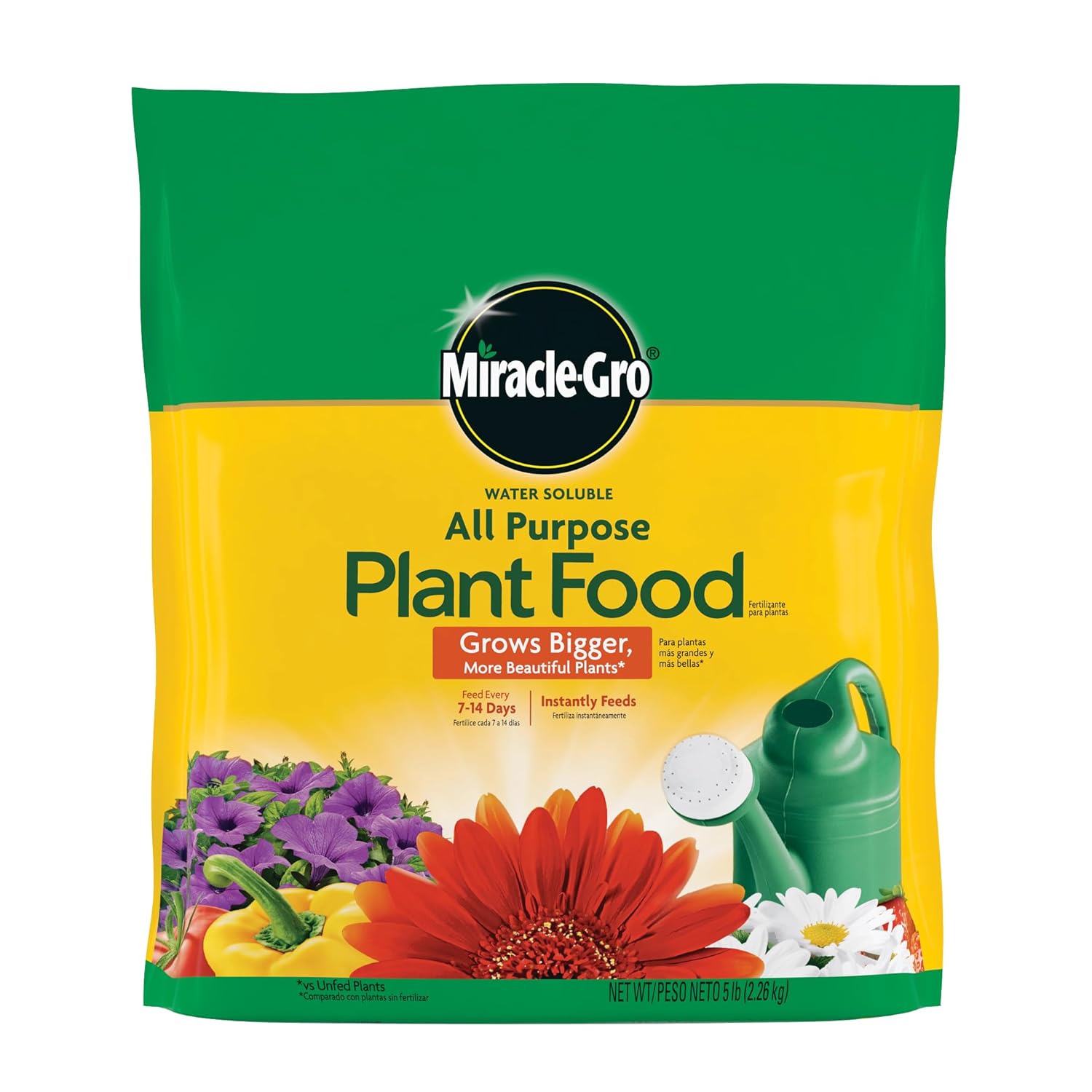
Miracle-Gro Water Soluble All Purpose Plant Food, 5 lb
| Item Form | Powder |
|---|---|
| Application Method | watering can |
| Target Species | all plants |
| Mixing Ratio | 24-8-16 |
| Unit Count | 80 Ounce |
This water-soluble Miracle-Gro formula is designed to give vegetables, flowers and houseplants a quick nutrient boost by dissolving in water and delivering NPK 24-8-16 straight to the root zone. It is typically mixed into a watering can or a garden feeder and applied every 7 to 14 days for outdoor vegetables or every 14 days for indoor plants. The powder format dissolves easily and starts working quickly, which is useful during the active growing season when leafy growth and fruit set matter. A single 5 lb bag covers a large area and the included scoop makes measuring straightforward. Important limitations: because it is a high-nitrogen, fast-release feed it favors quick growth and may need to be balanced with lower-nitrogen or bloom-focused fertilizers if you want more flowers or fruit quality over sheer foliage. Also it requires regular reapplication rather than providing long-term slow release, so plan for repeated treatments during the season.
Best for: Gardeners who want a reliable, quick-acting fertilizer to promote vigorous vegetable growth and who prefer products with broad use and strong customer acceptance.
Less Ideal for: Growers seeking a single application, slow-release fertilizer or those prioritizing low-nitrogen or specialty bloom/fruit formulas for flavor and flowering control.
- Fast-acting water-soluble formula that delivers nutrients quickly to roots
- All-purpose NPK 24-8-16 suitable for a wide range of vegetables and other plants
- Includes a scoop for easy measuring and mixing with a watering can or feeder
- One 5 lb bag feeds a large garden area, reducing the need for frequent purchases
- High-nitrogen formula is not a long-term slow-release feed and requires repeated applications
Verdict: A fast-acting, all-purpose water-soluble fertilizer that reliably boosts vegetable growth when applied regularly.
Choosing the Right Plant Food for Butterfly Bushes: Key Factors to Consider
Nutrient Ratio and Feeding Schedule
The balance of nitrogen, phosphorus, and potassium determines whether a feed encourages leaf growth, flowering, or overall hardiness. For butterfly bushes, look for formulas that favor bloom promotion without excessive nitrogen that pushes foliage at the expense of flowers. A clear N-P-K label and recommended seasonal schedule make it easier to match feeding to growth stages.
Feeding schedule matters because these shrubs produce best when given steady, moderate nutrition through the active growing season rather than heavy early-season doses. Slow-release granulars can provide steady supply, while soluble feeds give faster bloom response. Knowing the recommended frequency lets you plan pruning and fertilizer timing to support bud set and peak flowering.
Delivery Method and Application Control
Plant food comes as granules, water-soluble powders, liquids, or spikes. Granular slow-release formulas are low-maintenance and reduce the risk of overfeeding, while water-soluble and liquid feeds let you correct deficiencies quickly and time nutrition for bloom flushes. Spikes offer convenience but can be harder to adjust for container-grown specimens.
Consider how the delivery method fits your routine and garden layout. If you feed many shrubs or containers, a soluble concentrate with a hose-end applicator or a pre-measured liquid may save time. For isolated plants or heavy feeders, granular formulations that you spread once in spring and midseason can be practical.
Bloom Promotion and Flower Quality
Butterfly bushes are grown for long flower spikes that attract pollinators. Feeds that support bud formation and sustained blooming typically have higher phosphorus relative to nitrogen or include bloom-boosting microelements. Consistent phosphorus and balanced micronutrients help produce larger, more vibrant flowers and sustain multiple flushes during the season.
Avoid overapplication of high-nitrogen feeds, which can delay or reduce flowering by pushing vegetative growth. Also look for guidance on how feeding interacts with pruning, because timing fertilizer with light pruning influences the number and timing of bloom cycles.
Root Health and Woody-Stem Development
Strong root systems and sturdy stems help butterfly bushes survive dry spells and winter conditions. Feeds that include potassium and certain micronutrients help root development and overall plant vigor. Slow-release nitrogen combined with potassium supports woody tissue without combusting tender new shoots.
For newly planted or container-grown bushes, choose options that promote root establishment and avoid aggressive top growth that outpaces roots. Some formulations include mycorrhizal inoculants or seaweed extracts that support root function; those can be helpful when establishing plants in poor soils.
Compatibility With Containers Versus In-Ground Beds
Containers have limited soil volume and nutrient-holding capacity, so they need more frequent, gentle feeding compared with in-ground shrubs. Water-soluble feeds or low-strength weekly liquids are often the best fit for pots. In-ground specimens benefit from slow-release granulars applied to the root zone once or twice a season.
The potting medium and drainage will affect how quickly nutrients leach, so match concentration and frequency accordingly. Consider a product that specifies suitability for container use and provides dilution rates scaled to pot size to avoid salt buildup and root stress.
Pollinator Safety and Environmental Considerations
Butterfly bushes are intentionally planted to attract pollinators, so choose feeds that do not leave harmful residues on flowers during peak bloom. Water plants well after applying granulars that sit on the soil surface, and avoid foliar sprays that are applied directly to blossoms when pollinators are active.
Also consider fertilizer salt index and runoff potential, especially for landscapes near waterways. Products labeled for minimal runoff or those with lower soluble salt content reduce risks to surrounding plants and water systems. Following label instructions on timing and rate reduces environmental impact while protecting pollinators.
When to Feed Butterfly Bushes Throughout the Year
Timing fertilizer applications around growth cycles gets the most from each treatment. Feed lightly in early spring after new shoots appear to support initial growth, then switch to bloom-promoting schedules as flower buds form. A follow-up feeding midseason can sustain more flowering rounds.
Avoid heavy feeding late in the growing season because excess nutrient-driven new growth may not harden off before frost. For container plants, reduce strength and frequency in late summer to minimize late flushes that are vulnerable to cold.
- Early spring: low-to-moderate nitrogen to support shoot development
- Pre-bloom: shift to higher phosphorus for bud set
- Midseason: light maintenance feeds to extend bloom
- Late season: taper off to encourage hardening
Feeding Techniques for Different Garden Setups
How you apply plant food depends on whether your butterfly bushes are in the ground, in mixed borders, or in containers. In-ground plants tolerate granular slow-release products applied to the drip line and lightly worked into the topsoil. Use water-soluble feeds with a watering can or hose-end injector when you need quick results.
Containers need gentler, more frequent feeding. Use half-strength soluble feeds on a weekly or biweekly schedule, and occasionally flush pots with plain water to prevent salt buildup. Spike-style feeders can be convenient but watch concentration near the root ball.
- Spread granulars evenly around the drip line for even uptake
- Apply liquids to moist soil to reduce burn risk
- Flush containers monthly if using concentrated feeds
Organic and Natural Options to Consider
Organic sources like compost, well-rotted manure, and fish emulsion can support steady nutrition and improve soil structure over time. These options release nutrients more slowly and contribute beneficial soil biology, which can help long-term vigor and bloom consistency.
Natural amendments tend to require more frequent applications or larger initial volumes to match the nutrient delivery of synthetic concentrated feeds. They are valuable in pollinator-friendly gardens when combined with good soil management and appropriate timing.
- Compost adds slow, balanced nutrients and improves soil texture
- Fish emulsion gives a quick nitrogen boost but should be timed to avoid foliage-only growth
- Seaweed and kelp extracts support stress tolerance and root function
Addressing Common Feeding Problems
Yellow foliage, weak stems, or few blooms can point to feeding issues but also to other stresses. Excessive nitrogen often produces lush foliage with poor flowering. Conversely, lack of phosphorus or overall low fertility can reduce bud set. Always start by checking soil moisture, pH, and drainage before increasing fertilizer.
If you suspect fertilizer burn from overapplication, leach the soil with generous watering and hold off on further feeding until normal growth resumes. For persistent problems, conduct a soil test to guide targeted nutrient correction rather than repeated blanket applications.
- Test soil before major fertilizer changes
- Correct overfeeding by flushing soil and pausing applications
- Match feed type to observed deficiency rather than guessing
Pruning, Feeding, and Bloom Timing
Pruning shape and timing directly influence bloom cycles. Light spring pruning encourages vigorous summer bloom, while hard cutting in early spring can delay flower production but often results in fewer larger blooms later. Coordinate fertilizer timing with pruning to supply nutrients as new growth is initiated.
Avoid heavy late-summer feeding on plants you plan to prune hard in fall or early spring. Plan nutrient applications so the plant has what it needs to set buds after pruning without pushing vulnerable late growth.
- Pair early-season feeds with formative pruning for young plants
- Delay heavy bloom-feeding until after a light spring trim if you want earlier blooms
- Use midseason maintenance feeds after the first major flush to encourage repeat flowering
How We Chose the Best Plant Food for Butterfly Bushes
We focused on features that matter to gardeners growing butterfly bushes in sun-exposed beds, mixed borders, and containers. Key evaluation criteria included nutrient ratio and timing, delivery method and ease of application, impact on bloom quantity and quality, root and woody-stem support, suitability for container versus in-ground planting, and safety for pollinators. We prioritized products formulated with clear N-P-K ratios and guidance on application rates and frequency. We also weighed user experience factors such as how fast results become visible and how simple treatments fit into seasonal care routines. We excluded feeds that are only marketed for general houseplants or acid-loving species because butterfly bushes have specific bloom-driven and woody-shrub needs. We did not consider products lacking transparent ingredient lists or application instructions. The selections reflect options that balance predictable bloom response, manageable application, and compatibility with pollinator-friendly gardening practices.
FAQ
How often should I feed butterfly bushes in containers?
Containers usually need gentler, more frequent feeding than in-ground plants. Use a diluted liquid feed every one to two weeks during the active growing season and flush pots periodically to avoid salt buildup.
Can I use a general-purpose shrub fertilizer on butterfly bushes?
A general shrub fertilizer can work if it has a balanced N-P-K and clear application rates, but choose a formula that does not heavily favor nitrogen. Opt for a product that supports bloom and woody-stem health to get the best flower production.
Will feeding make butterfly bushes bloom longer?
Appropriate feeding timed to bud development and midseason maintenance usually increases bloom quantity and can prolong flowering. Overfeeding or wrong nutrient balance, especially high nitrogen, can reduce bloom performance.
Are organic plant foods effective for butterfly bushes?
Organic feeds can be very effective over time, improving soil structure and supporting beneficial microbes. They may act more slowly than synthetic options, so combine them with proper timing and supplemental feeding if you need faster bloom responses.
What signs indicate my butterfly bush needs fertilizer?
Signs include reduced bloom production, pale or yellowing leaves, and generally slow growth in otherwise favorable light conditions. Always check soil moisture, pH, and drainage first because these factors often mimic nutrient problems.
Is it safe to feed while flowers are open and attracting pollinators?
Avoid foliar sprays directly on open flowers and time applications when pollinators are less active, such as early morning or evening. Soil-applied granulars are often preferable during heavy bloom to minimize contact with foraging insects.
Final Verdict
Choosing the right plant food for butterfly bushes means balancing bloom promotion with root and woody-stem strength. Prioritize feeds with clear nutrient ratios that favor flowering and include guidance for seasonal timing. Match the delivery method to your garden setup-slow-release granulars for in-ground beds and gentler soluble feeds for containers. Consider tradeoffs between quick results and long-term soil health when deciding between synthetic and organic options. With proper timing, application control, and attention to pollinator safety, you can boost flowering and keep butterfly bushes vigorous across seasons.
