

Note: This article contains affiliate links. If you click on these links and make a purchase, I may earn a small commission at no extra cost to you. This helps support my research and content. Read my full affiliate disclosure here.
If you grow grapes, the right plant food makes a measurable difference in vine vigor, cluster size, and fruit quality. Vines respond to specific nutrient balances and feeding timing in ways that other fruiting shrubs do not, so choosing a fertilizer tailored for grapes helps avoid excessive vegetative growth or poor fruit set. This guide covers a short list of top plant foods chosen for grape vines and explains how each option suits different soil conditions, training systems, and harvest goals. We evaluate feeding formulations, ease of application, and how a product behaves in the row, trellis, or backyard pergola. Read on for practical guidance to match a feeding plan to your vineyard or garden vines.
Top Picks at a Glance
| Best Quality Built to a higher standard if you want something more solid | Soil Seed & Water Bacchus Organic Fertilizer for Grapevines |  |
| Best Value The sweet spot between price and what you get | E.B. Stone Organics Fruit, Berry & Vine Food 7-3-3 |  |
| Best Budget The cheapest option that still gets the job done reliably | Fairhaven Vitis-Max Grape Vine Fertilizer, 1 lb |  |
| Highest Rated A top-rated pick with lots of positive feedback | BRIRILINE Fruit, Berry & Vine Food 7-3-3, 64 fl oz |  |
| Most Popular A crowd favorite that many people choose with confidence | TPS Nutrients Grape Fertilizer Liquid Plant Food, 8 oz |  |
| Best Seller A high-volume bestseller chosen again and again | EB Stone Organics Fruit, Berry & Vine Food 7-3-3, 15 lb |  |
Soil Seed & Water Bacchus Organic Fertilizer for Grapevines

| Item Form | Granules |
|---|---|
| Specific Uses For Product | Vineyard Soil Enrichment |
| Application Method | Top-dress and mix into soil |
| Target Species | grapevines |
| Mixing Ratio | 1:4 |
Bacchus Blend is an organic, granulated soil amendment designed specifically for vineyards and grape production. It mixes dairy compost, worm castings and mineral supplements to build soil organic matter, improve water retention and feed vines through the root zone. Typical use is mixing one part Bacchus with four parts existing soil for new plantings or top-dressing established vines with a half-inch layer in early spring, then lightly incorporating and watering in. Notable features include an OMRI-listed organic formulation, an odorless granule form that is easy to spread, and clear application guidance for both home and commercial vineyards. Practical benefits are improved soil structure, increased microbial activity from compost and castings, and an easy way to deliver micronutrients like zinc and iron. Limitations are that it is a soil amendment rather than a complete granular NPK fertilizer so growers seeking rapid high-nitrogen responses may need to supplement, and recommended per-vine rates mean a single bag is modest for large plantings. Overall it is a good maintenance and soil-building product for grape growers focused on long-term vine health and fruit quality.
Best for: Grape growers who prioritize long-term soil health and fruit quality and who apply targeted organic amendments as part of a planned vineyard fertility program.
Less Ideal for: Growers who need fast-acting high-nitrogen feeding for rapid vegetative growth or those managing large commercial acreage who require bulk coverage from a single purchase.
- Formulated for grapevines with compost and worm castings to build soil biology
- OMRI-listed organic ingredients suitable for organic viticulture
- Clear instructions for new plantings and top-dressing established vines
- Granular, odorless form that is easy to spread and incorporate
- Not a balanced high-N fertilizer so may need supplemental nutrient sources for quick canopy pushes
- A single 9 lb unit is a limited coverage option for commercial-scale vineyards
Verdict: Choose Bacchus Blend if you want a certified organic soil-building amendment that improves vineyard soil biology and supports long-term grape quality.
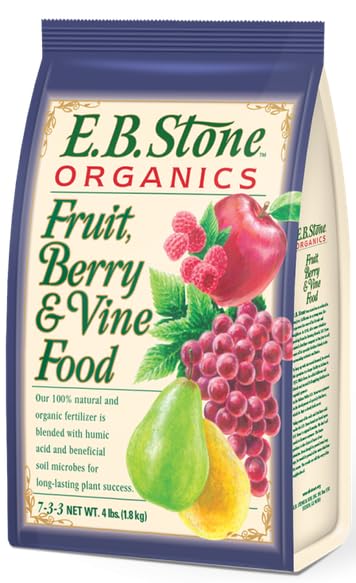
E.B. Stone Organics Fruit, Berry & Vine Food 7-3-3

| NPK ratio | 7-3-3 |
|---|---|
| Feed frequency | Every 6–8 weeks |
| Formula | 100% natural organic |
| Burn risk | Non‑burning |
This organic 7-3-3 plant food is designed to supply steady, low‑burn nutrition for fruiting plants and vines. It is a durable, nonburning formula intended for application every 6 to 8 weeks during the growing season, which makes it simple to schedule feedings for established grape vines. The balanced NPK favors fruit and shoot development without excessive nitrogen that can promote leafy growth at the expense of fruit. Because it is made from natural ingredients it is gentle on roots and suitable for use in soil where long‑term soil health is a priority. The practical downside is that results are slower and less immediately dramatic than synthetic, fast‑release fertilizers, so growers seeking rapid canopy size increases or quick correction of severe deficiencies may need supplemental products or soil testing. For routine seasonal feeding of grape vines, however, this product offers a low‑risk, maintenance‑focused approach that supports fruit set and ongoing soil biology.
Best for: Home gardeners and vineyard hobbyists who prioritize soil health and steady, low‑risk feeding for established grape vines and want a simple seasonal program.
Less Ideal for: Commercial growers or gardeners needing rapid, high‑nitrogen boosts or quick deficiency corrections should consider faster‑acting supplements or targeted fertility solutions.
- 100% natural organic formulation supports long‑term soil health
- Moderate 7-3-3 NPK suited to fruiting plants and vines
- Non‑burning, slow‑release action allows less frequent applications
- Simple schedule of every 6–8 weeks during the growing season
- Slower nutrient release than synthetic fertilizers so effects are gradual
- Not formulated for rapid correction of acute nutrient deficiencies
Verdict: Choose this organic 7-3-3 feed when you want a low‑risk, soil‑friendly fertilizer to maintain fruit production and long‑term vine health.
Fairhaven Vitis-Max Grape Vine Fertilizer, 1 lb

| Item Form | Granules |
|---|---|
| Specific Uses For Product | Organic |
| Application Method | top dress |
| Target Species | grape |
| Unit Count | 16 Fluid Ounces |
Fairhaven Vitis-Max is a granular, controlled-release fertilizer made for grape culture and intended as a single-season top-dress. The resin-coated prills open when soil is wet and close when dry, which helps deliver steady nutrition without burning vines. The maker recommends about 2 ounces per vine and says one pound treats roughly eight vines, so a single 1 lb container covers a small planting or a few established vines. It is sold as an organic formulation with a full range of grape-targeted nutrients and is straightforward to apply to the soil surface or mixed into planting medium. Practical benefits include easy, infrequent feeding and reduced risk of overfertilizing compared with soluble feedings. Limitations are coverage and longevity for larger vineyards since the package is small and it is designed for one-season use; heavier-feeding vines or larger blocks will need more product or repeated purchases. For gardeners on a budget this product can be cost-effective for small plantings but will require calculating per-vine cost for larger needs.
Best for: Home gardeners with a few grapevines who want a simple, low-maintenance, organic seasonal feed and prioritize straightforward application over bulk coverage.
Less Ideal for: Owners of larger vineyards or those who need long-term bulk supply should consider larger-capacity or multi-season products to lower per-vine cost and reduce repeat purchases.
- Resin-coated granules provide controlled, moisture-triggered release to reduce burn risk
- Formulated specifically for grape vines rather than a generic fertilizer
- Simple top-dress application or mixing at planting makes it easy to use
- Organic labeled formulation for growers avoiding synthetic feeds
- Small 1 lb package only covers about eight vines so not efficient for larger plantings
- Single-season formulation means repeat purchases for multi-year feeding plans
Verdict: A small, grape-specific controlled-release fertilizer that delivers easy, low-risk seasonal feeding ideal for small home plantings.
BRIRILINE Fruit, Berry & Vine Food 7-3-3, 64 fl oz
| Item Form | Granules |
|---|---|
| Specific Uses For Product | fruit trees, berries, and fruiting vines |
| Coverage | Organic |
| Liquid Volume | 64 fluid ounces |
| Mixing Ratio | 7:3:3 |
This organic 7-3-3 fertilizer is designed to supply steady, balanced nutrients to fruiting plants such as grapevines. Supplied as granules in a 64 fl oz container, it is applied by spreading around the root zone and watering in or mixing per the 7:3:3 directions, which makes it suitable for routine seasonal feedings. The blend emphasizes nitrogen for leafy growth while providing phosphate and potash to support flowering and fruit set, so it helps develop healthy canopies and promote crop production on grape vines. As an organic product it is appropriate for growers avoiding synthetic fertilizers, and the granular form is easy to store and measure for repeatable applications. Limitations are that nutrient analysis is modest compared with concentrated synthetic options and specific application rates are left to the label, so you may need to calculate amounts for mature vineyards or correct specific deficiencies with targeted amendments.
Best for: Home gardeners and small-scale growers who want a reliable organic feed to maintain healthy grapevines and improve fruit set through regular seasonal applications.
Less Ideal for: Commercial vineyard operators or growers needing rapid correction of specific nutrient deficiencies should consider higher‑analysis or targeted products instead.
- Organic formula suitable for growers avoiding synthetic fertilizers
- Balanced 7-3-3 N-P-K tailored for fruiting vines and berry crops
- Granular form that is easy to apply and store
- Supports leafy growth and fruit development with nitrogen, phosphate, and potash
- Lower nutrient concentrations than concentrated synthetic fertilizers so larger volumes may be required
- Label gives general directions but specific per-vine application rates are not detailed in the product data
Verdict: A dependable organic granular feed that provides balanced 7-3-3 nutrition to keep home grapevines healthy and productive.
TPS Nutrients Grape Fertilizer Liquid Plant Food, 8 oz

| Item Form | Liquid |
|---|---|
| Application Method | Soil drench |
| Target Species | Grapes |
| Liquid Volume | 8 fluid ounces |
This 8-ounce liquid grape fertilizer is a concentrated soil-drench designed to feed grape vines from root to fruit. It is typically mixed at the recommended ratio and applied as a soil drench around established vines, young table grape plants, or small vineyard blocks to encourage root strength, steady vegetative growth, and better cluster set. Notable features include a liquid formulation for quick availability to roots and a label focus on both vine vigor and fruit development, which makes it useful during active growth and pre-fruit set periods. Practical benefits are targeted nutrition for grapes, ease of application with a simple soil drench method, and suitability for backyard and small-scale vineyard use. Important limitations are the small 8 oz bottle size, which means frequent repurchasing or dilution when treating multiple plants, and the absence of detailed N-P-K numbers on the listing so you must follow label mixing guidance rather than tailoring precise macronutrient ratios. For gardeners who prefer a ready-to-use grape-specific feed, this is a convenient option, but larger plantings will need larger quantities or a different product for cost efficiency.
Best for: Gardeners who want a grape-specific, easy-to-apply liquid feed for a few vines or small hobby vineyard plots and who rely on product reputation and clear use instructions when choosing fertilizers.
Less Ideal for: Growers managing larger vineyards or many plants who need bulk quantities or exact macronutrient breakdowns should consider concentrated or bulk fertilizer options.
- Liquid formula provides nutrients that are quickly available to roots when applied as a soil drench
- Formulation and marketing targeted specifically to grapes, supporting vine vigor and cluster set
- Simple soil-drench application that fits routine watering schedules
- Suitable for both backyard vines and small vineyard plantings
- Small 8 oz bottle size may be impractical for treating multiple vines or larger plantings
- Product listing does not show explicit N-P-K values, limiting precise nutrient planning
Verdict: A convenient grape-focused liquid fertilizer that makes targeted feeding simple for backyard vines and small plantings.
EB Stone Organics Fruit, Berry & Vine Food 7-3-3, 15 lb

| Item Form | Granules |
|---|---|
| Target Species | fruit trees, berries and fruiting vines |
| Coverage | Medium |
| Mixing Ratio | 7:3:3 |
| Unit Count | 240 Ounce |
This EB Stone Organics 7-3-3 fruit, berry and vine fertilizer is a slow-release granular feed aimed at improving fruit set, flavor, and yield on grapevines and other fruiting plants. You spread it at the base of established vines or work it lightly into the soil according to package directions; the blend is designed to feed for about 6 to 8 weeks so you do not need to reapply constantly. The high potassium relative to nitrogen and phosphorus supports fruit development, while the 100% natural ingredients lower the risk of burn compared with synthetic quick-release formulas. Practical benefits include steady nutrient release, suitability for home vineyards and berry patches, and simple application for seasonal maintenance. Limitations are that it is a general-purpose orchard formula rather than a grapevine-specific program, so heavy-feeding situations or precise nutrient correction will still require soil testing and supplemental amendments. Also it ships as a bagged granular product so you will need to measure and store it properly to keep it dry and effective.
Best for: Home vineyard owners and gardeners who want a low-maintenance organic feed to improve fruit set and flavor without frequent applications.
Less Ideal for: Commercial growers or growers needing precise nutrient correction or high-rate fertilization should choose a vineyard-specific program guided by soil and tissue tests.
- 7-3-3 N-P-K ratio with higher potassium to support fruit development
- Slow-release granular formula feeds for about 6–8 weeks
- Made from 100% natural organic ingredients, reducing burn risk
- Easy to apply at the base of vines for routine seasonal feeding
- Not tailored specifically to grapevine micronutrient needs or corrective feeding
- Requires dry storage and measuring for repeated seasonal use
Verdict: A simple, organic slow‑release fertilizer that delivers higher potassium to help backyard grapevines produce sweeter, more abundant fruit with minimal fuss.
Choosing the Right Plant Food for Grape Vines: Key Factors to Consider
Nutrient Ratio and Seasonal Needs
Grape vines need a balance between nitrogen, phosphorus, and potassium that shifts with the season. Early in the season vines require enough nitrogen to support new shoot growth and canopy establishment, but excessive nitrogen late in the season can produce lush foliage at the expense of fruit set and sugar accumulation.
Understanding the NPK ratio on a plant food label helps you match feeding to the vine's stage. Higher phosphorus can support root development and flowering, while potassium helps fruit quality and winter hardiness. Plan feeds around pruning and bloom so the nutrient profile aligns with the vine's physiological needs rather than applying generic fertilizer year-round.
Release Profile and Timing
Different formulations deliver nutrients at different speeds. Quick-release soluble feeds give an immediate nutrient boost useful for correcting deficiencies or supporting rapid canopy growth, while slow-release or controlled-release products provide steady nutrition over weeks or months and reduce the need for frequent applications.
Selecting a release profile depends on your management style: small home gardeners often prefer liquid or water-soluble options for targeted applications, whereas those managing several vines or small plots may favor granular slow-release formulas that require less maintenance.
Micronutrients and Trace Element Needs
Beyond NPK, micronutrients like magnesium, iron, zinc, manganese, and boron influence grapevine health and fruit set. Deficiencies can show as chlorosis, poor flowering, or reduced cluster development. Some plant foods are fortified with chelated micronutrients to improve uptake in varied soil pH conditions.
If your soil test shows specific shortages, choose a product that provides those trace elements or plan supplemental foliar applications at critical stages such as pre-bloom and fruit set to correct deficiencies quickly.
Soil Type and Compatibility
Soil texture and pH control nutrient availability and influence what kind of plant food works best. Sandy soils drain quickly and may benefit from more frequent, lower-dose applications, while heavier clay soils retain nutrients longer and can tolerate less frequent feeding. High pH soils can lock up iron and manganese unless the fertilizer includes chelates.
Consider the physical form of the plant food as well: granular materials interact differently with soil moisture and microbial activity than liquid feeds. Match the product to your soil management practices for best results.
Application Method and Labor
How you plan to apply fertilizer is a practical constraint. Foliar sprays can deliver micronutrients rapidly and help with targeted correction, but they require spraying equipment and attention to timing. Soil-applied granular or soluble fertilizers are easy to work into the vine row or apply near drip emitters, but they may take longer to affect foliar symptoms.
Consider the time you have for maintenance and pick a product that fits your schedule, whether that means a once-per-season spike or monthly liquid feeds timed to growth stages.
Environmental Impact and Runoff Risk
Excessive fertilization can lead to nutrient runoff and local water quality issues. Controlled-release formulations and proper application rates reduce the risk of leaching, especially on sloped sites or near waterways. Organic-based plant foods may pose lower immediate runoff risk but can still contribute to nutrient loading if overapplied.
Follow label rates, avoid applications before heavy rain events, and consider buffer strips or mulch to reduce runoff. Choosing the right product includes evaluating its environmental profile relative to your site.
When to Feed Grape Vines
Timing feeds to vine phenology improves outcomes. Apply a balanced feed at bud break to support new shoot emergence, then consider a second application around bloom to support fruit set. Avoid high-nitrogen feeds late in the season once ripening starts, so the vine focuses on sugar accumulation and wood maturity.
If you use slow-release products, schedule the single application to coincide with early spring so nutrients are available through the growing season. For liquid feeds, space applications according to label guidance and vine vigor.
- Bud break: support early canopy growth with moderate nitrogen
- Pre-bloom/bloom: provide phosphorus and micronutrients to help flowering
- Post-veraison: reduce nitrogen to encourage ripening
Interpreting Soil and Tissue Tests
Soil tests give a baseline for macronutrients and pH, while tissue tests reveal what the vine is actually taking up. Use soil results to choose a base plant food and tissue tests to fine-tune micronutrient supplementation. Testing often pays for itself by preventing unnecessary or counterproductive applications.
Collect samples at recommended times and compare results to regional grape guidelines. If tests show a specific deficiency, a targeted amendment is usually more effective than increasing general fertilizer rates.
- Soil test frequency: every 2 to 4 years for established plantings
- Tissue tests: useful in challenging seasons or when symptoms appear
Organic Versus Synthetic Plant Foods
Organic plant foods release nutrients more slowly and can improve soil structure and microbial life over time. They are a good fit for gardeners focused on long-term soil health and lower synthetic inputs. Synthetic formulations deliver predictable nutrient ratios and fast correction for deficiencies.
Many gardeners use a hybrid approach: organic amendments to build soil health plus targeted synthetic or soluble feeds when vines need an immediate response. Match choice to your management goals and local regulations regarding nutrient management.
- Organic benefits: improved soil biology, slower release
- Synthetic benefits: precise NPK, rapid correction
Application Tips for Trellised and Container Vines
Vines on trellises have root zones that may compete with cover crops or surrounding plants, so concentrate fertilizer in the vine row or root area. Use drip emitters or banded granular application to deliver nutrients where roots are most active. Mulch helps retain moisture and moderates nutrient release.
Container-grown vines need more frequent, smaller doses because pots dry faster and have limited soil volume. Choose soluble feeds calibrated for containers and watch for salt buildup by occasionally flushing the media with clear water.
- Banded placement reduces waste to surrounding plants
- Containers: smaller, more frequent feedings and regular leaching
Common Nutrient Deficiency Signs in Grapevines
Recognizing visual symptoms helps you respond faster. Nitrogen deficiency typically shows as general yellowing and reduced shoot growth, while phosphorus shortages can slow canopy development and delay maturity. Potassium deficiency often appears as marginal leaf scorch and poor fruit quality.
Micronutrient shortages produce targeted symptoms: iron causes interveinal chlorosis on young leaves, zinc can lead to small leaves and shortened internodes, and boron shortage may reduce fruit set. Use visual diagnosis together with testing before applying corrective feeds.
- Nitrogen: uniform chlorosis and stunted growth
- Potassium: scorched leaf margins and softer fruit
- Iron and zinc: interveinal chlorosis or small leaves
How We Chose the Best Plant Food for Grape Vines
We shortlisted products by focusing on criteria that directly affect grape vine health and fruiting. First, nutrient ratio and formulation were prioritized because grape vines need a balance that supports flowering and fruit development without encouraging excessive shoot growth. Second, nutrient availability and release profile were evaluated to match growers who want either quick correction or slow steady feeding through the season. Third, ease of application and compatibility with common vineyard practices mattered because many gardeners use foliar sprays, soil drench, or feeder-row applications. Fourth, the presence of micronutrients and chelates was considered since deficiencies of iron, zinc, or boron can limit fruit set. We also assessed product safety for trained pruning and timing windows typical for grape management. Excluded from the list were specialty products aimed solely at ornamentals or lawns, mixes with unverified claims about microbial blends, and any items whose formulation information was incomplete. Our process favored products with clear NPK breakdowns, stated release characteristics, and straightforward feeding instructions. The evaluation criteria align with the scoring metrics below and reflect real decisions gardeners make when tailoring nutrition for grape vines.
FAQ
How often should I feed grape vines?
Frequency depends on the product. Slow-release granular feeds may be applied once in spring, while soluble liquid feeds are often applied every 3 to 6 weeks during active growth. Container vines typically need more frequent feeding than in-ground vines.
Can I use a lawn fertilizer on grape vines?
Lawn fertilizers usually have high nitrogen intended for turf growth and can encourage excess vegetative growth in vines. It is better to use a formulation suited to fruiting plants or adjust application rates carefully to avoid overstimulating shoots.
Do I need to adjust feeding for different grape varieties?
Varietal differences influence vigor and fruiting, so vigorous varieties may need lower nitrogen or reduced rates, while less vigorous types can benefit from slightly higher nitrogen early in the season. Observe how your specific variety responds and tailor feeding accordingly.
When should I apply micronutrient supplements?
Apply micronutrient supplements when soil or tissue tests indicate deficiencies or when visual symptoms appear. Foliar sprays are effective for quick correction during pre-bloom and early fruit set, while soil-applied chelated formulations can be used for longer-term correction.
Will overfertilizing affect winter hardiness?
Excessive nitrogen late in the season can delay wood maturation and reduce winter hardiness. Reduce or stop high-nitrogen feeds well before the dormant season to encourage proper lignification of canes.
Final Verdict
Prioritize a plant food that matches the vine's seasonal needs, soil conditions, and your application routine. Balance NPK for growth and fruiting, check soil and tissue tests before changing programs, and use slow-release or soluble products according to your maintenance capacity. By aligning nutrient ratio, release profile, and micronutrient support with your vineyard or backyard goals, you can improve fruit set, quality, and vine health without unnecessary inputs.
