

Note: This article contains affiliate links. If you click on these links and make a purchase, I may earn a small commission at no extra cost to you. This helps support my research and content. Read my full affiliate disclosure here.
Plumeria respond visibly to the right feeding program: bigger, longer-lasting flowers, sturdier stems, and fuller foliage. Getting the right plant food for Plumeria matters because these tropical shrubs need specific nutrient ratios and predictable feeding schedules to flower reliably in pots and garden beds. This guide looks at seven top options suited for Plumeria, shortlisted for real-garden performance. We focus on nutrient balance, ease of use, and how they fit different growing situations so you can pick a feed that matches your watering, potting, and climate habits.
Top Picks at a Glance
| Best Overall The best all-around choice for most situations | HiThrive Plumeria Liquid Fertilizer, 32 oz |  |
| Best Quality Built to a higher standard if you want something more solid | Nelson Plumeria & Tropical Plant Food Granular Fertilizer NutriStar 5-30-5 (4 lb) |  |
| Best Value The sweet spot between price and what you get | Cz Garden BloomBiscus Hibiscus Plant Food 10-4-12 (4 lb) |  |
| Best Budget The cheapest option that still gets the job done reliably | Leaves and Soul Plumeria Liquid Fertilizer, 3-5-4, 8 oz |  |
| Highest Rated A top-rated pick with lots of positive feedback | GrowThrive Plumeria Liquid Fertilizer, 10 fl oz |  |
| Most Popular A crowd favorite that many people choose with confidence | TPS Nutrients Plumeria Liquid Fertilizer, 8 oz |  |
| Best Seller A high-volume bestseller chosen again and again | EarthPods Tropical Flower Fertilizer Spikes, 100 Count |  |
HiThrive Plumeria Liquid Fertilizer, 32 oz

| Item Form | Liquid |
|---|---|
| Target Species | Plumeria |
| Unit Count | 32 Fluid Ounces |
This 32 oz HiThrive liquid fertilizer is designed specifically for plumeria and mixes with water for foliar spray or soil drench applications. It provides the three primary macronutrients nitrogen, phosphorus, and potassium plus six micronutrients such as calcium and magnesium to address common deficiencies that cause pale leaves and poor flowering. Typical use is every 1 to 2 weeks in spring and summer and monthly in cooler months, applying by watering can, hose-end sprayer, or leaf spray at the recommended dilution. The bottle size makes enough solution for many feedings, so it is convenient for small collections or several potted plants. Because it is a concentrated liquid you control application rate and timing, which helps encourage regular blooms and stronger roots when used as directed. Limitations are that it is a single concentrated formula without different NPK ratios for seasonal adjustment and it requires careful measuring to avoid overfeeding sensitive plants.
Best for: Gardeners wanting a straightforward, ready-to-mix fertilizer to keep plumerias healthy and blooming regularly, and who prefer a liquid feed they can apply on a schedule.
Less Ideal for: Growers who want granular slow-release feeding or who need different NPK ratios for distinct seasonal growth goals should consider other products.
- Formulated specifically for plumeria with N, P, K plus essential micronutrients
- Concentrated liquid mixes with water for foliar spray, watering can, or hose-end use
- Large 32 oz bottle yields many gallons of ready-to-use solution
- Clear dosing instructions for frequent growing-season feedings
- Single formula only, no alternate NPK blends for different growth stages
- Requires accurate measuring to avoid over-application
Verdict: A concentrated, plumeria-focused liquid fertilizer that makes many gallons of feed and simplifies regular bloom-promoting applications.
Nelson Plumeria & Tropical Plant Food Granular Fertilizer NutriStar 5-30-5 (4 lb)

| Item Form | Granules |
|---|---|
| Specific Uses For Product | Plant Food |
| Target Species | Fern |
| Mixing Ratio | 5:30:5 |
| Directions | Apply every 14 days during the growing season |
This granular Nelson Plumeria and Tropical Plant Food (5-30-5) is designed to boost blooms and overall plant vigor for flowering tropicals used in containers or in-ground. You broadcast or top-dress the granules around the root zone and water them in; the manufacturer recommends applying every 14 days during the growing season. The high phosphorus ratio and added micronutrients make it suited to push flowering and regrowth after pruning, while multiple nitrogen sources provide a steady feed rather than a short spike. It is easy to use, stores as dry granules, and works with soil biology to deliver both an immediate boost and ongoing feeding. Important practical limits are its specific formulation for bloom promotion rather than balanced all-season feeding and the need to follow safety directions like keeping it away from children and pets and wearing protection during application. For users wanting very slow release or a low-phosphorus general fertilizer, this product may not be the best match.
Best for: For gardeners who prioritize bigger, more frequent blooms on tropical flowering plants and want an easy granular feed that gives predictable two-week results.
Less Ideal for: Not the best choice for growers seeking a low-phosphorus all-purpose fertilizer or those who prefer a single-season slow-release product.
- High phosphorus (30%) profile promotes heavier and more frequent blooms.
- Granular formula feeds for about two weeks per application for low-maintenance intervals.
- Multiple nitrogen sources and added micronutrients support regrowth and overall plant health.
- Works for both container and in-ground tropicals, including indoor use when appropriate.
- Formulation is bloom-focused and may be too high in phosphorus for plants that need balanced maintenance feeding.
- Requires regular fortnightly application during the growing season rather than a long-term slow-release schedule.
Verdict: Choose this granular 5-30-5 formula when you want an easy, two-week feeding that reliably increases blooms on tropical flowering plants.
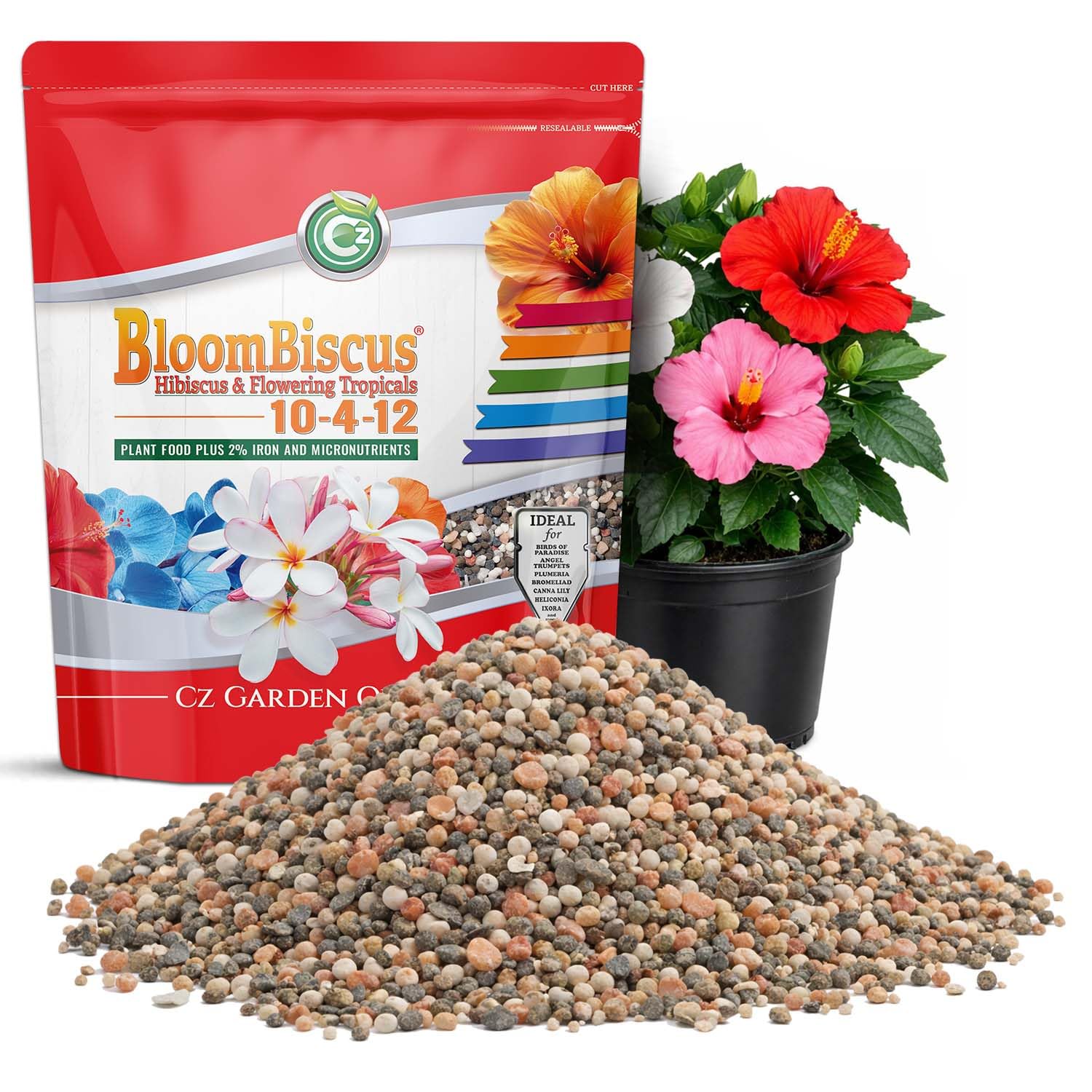
Cz Garden BloomBiscus Hibiscus Plant Food 10-4-12 (4 lb)
| Item Form | Granules |
|---|---|
| Specific Uses For Product | Plant Growth, Root Development, Seed Development, Soil Conditioning |
| Target Species | Flowering Tropicals |
| Unit Count | 64 Ounce |
| Mixing Ratio | 10-4-12 |
This granular BloomBiscus formula is designed to boost blooms and overall vigor in hibiscus and similar tropical flowering plants. It is typically worked into potting mix or applied around the root zone and watered in according to package directions. The 10-4-12 NPK delivers higher potassium for flowering and fruiting while the modest nitrogen supports leaf growth without excessive lushness that can reduce blooms. The added 2% iron and micronutrients help correct common deficiencies that dull flower color. Packaging comes in a resealable pouch for easy pouring and storage. Practical benefits include targeted nutrition for bloom production, broad suitability across many tropical species, and US-made ingredient sourcing. Limitations are that the product is a general granular feed rather than a slow-release or time-release formula so it may require regular reapplication and careful dosing for container-grown plants. Directions are brief on the label so growers who want a feeding schedule may need to follow common hibiscus fertilizing guidelines or consult extension recommendations.
Best for: A gardener focused on getting bigger, more consistent blooms from hibiscus and other tropical flowering plants who prefers a targeted, performance-oriented fertilizer.
Less Ideal for: Those who want a long-term slow-release feed or a liquid program for weekly foliar feeding should consider alternative formulations.
- NPK ratio (10-4-12) concentrated toward flowering and fruiting
- Includes 2% iron plus micronutrients to address common deficiencies
- Resealable heavy-duty pouch for easy pouring and storage
- Formulated specifically for hibiscus and other flowering tropicals
- Not specified as slow-release so it may need more frequent reapplication
Verdict: Choose this 10-4-12 granular with 2% iron when your main goal is stronger, more reliable hibiscus blooms.
Leaves and Soul Plumeria Liquid Fertilizer, 3-5-4, 8 oz

| Item Form | Liquid |
|---|---|
| Unit Count | 8 Fluid Ounces |
| Mixing Ratio | 3-5-4 |
| Specific Uses For Product | Plant Growth |
This liquid plumeria fertilizer uses a 3-5-4 formula to prioritize flowering and root development for both potted and in-ground plumeria. It arrives as an 8 oz concentrated bottle that you dilute with water and apply during regular watering, which makes it quick to absorb and suited to gardeners who want faster visible results than slow-release pellets. The higher middle number means it supplies extra phosphorus to encourage buds and blooms while still supporting foliage and plant vigor. In practice it is easy to mix and distributes evenly in the root zone, so you can use it for container-grown plumeria on patios or landscape specimens. Because it is a concentrate, a small amount stretches across multiple feedings, which helps control ongoing costs. Important limitations are that the bottle is relatively small for larger trees and you must follow dilution directions to avoid overfeeding; it does not include timed-release benefits and requires regular applications to maintain flowering.
Best for: Buyers who want a simple, fast-acting bloom booster for plumeria and prefer a concentrated liquid they can add to routine watering to get quicker flowering results on a modest budget.
Less Ideal for: Gardeners who want a one-time, long-duration slow-release feed for large specimens or who prefer bulk, low-frequency fertilizers for heavy-feeding landscapes.
- Balanced 3-5-4 N-P-K ratio tailored to encourage plumeria blooms and root growth
- Liquid concentrate is fast-absorbing for quicker visible results than granular fertilizers
- Small concentrated bottle means a little product goes a long way for multiple feedings
- Suitable for both potted and in-ground plumeria, indoors or outdoors
- 8 oz bottle may be small for large trees or frequent feed schedules
- Requires regular dilution and repeated applications since it is not slow-release
Verdict: A compact, budget-friendly liquid concentrate that speeds up flowering and root development in plumeria when added to regular watering.
GrowThrive Plumeria Liquid Fertilizer, 10 fl oz

| Item Form | Liquid |
|---|---|
| Specific Uses For Product | Plant Growth, Root Development, Seed Development, Soil Conditioning |
| Liquid Volume | 300 ml |
| Unit Count | 10 Fluid Ounces |
This GrowThrive Plumeria Liquid Fertilizer is a small, concentrated organic plant food designed for regular feeding of plumeria and similar flowering shrubs. It is a liquid formula that mixes into water for foliar or root application, with dosing guidance for leaves and roots to help avoid over-fertilization. The product emphasizes a natural probiotic microbe blend and chemical-free ingredients, which can improve soil biology and nutrient availability over time. In practice it is convenient to use on patio or garden container plants where gentle, repeatable feeding is preferred; the liquid form makes it easy to control concentration and spot-treat individual plants. The bottle size is compact, so it is best for a small collection or occasional use rather than long-term feeding of large beds. Labels list specific uses including plant growth, root and seed development, and soil conditioning, and the product’s focus on mild nutrition reduces the risk of burning sensitive seedlings. Limited volume is the main constraint for larger gardens, and users wanting precise N-P-K numbers will need to accept that detailed macronutrient values are not provided on the label.
Best for: Buyers who prioritize consistent, gentle feeding and soil health for a small collection of flowering shrubs and container plumeria will appreciate this product.
Less Ideal for: Gardeners managing large beds or entire landscapes who need bulk fertilizer or exact macronutrient ratios should consider larger or more detailed formulations.
- Organic, chemical-free formula that is gentle on seedlings and established plants
- Liquid concentrate allows precise dilution for foliar or root feeding
- Contains a probiotic microbe blend intended to improve soil health and nutrient availability
- Clear dosing recommendations for leaf and root applications to reduce risk of over-fertilization
- Small 10 fl oz volume may require frequent repurchasing for larger plant collections
- Label does not list standard N-P-K macronutrient values for precise fertilizer planning
Verdict: Choose this concentrate if you want a gentle, organic liquid feed that supports soil microbes and steady growth for a small plumeria or flowering shrub collection.
TPS Nutrients Plumeria Liquid Fertilizer, 8 oz

| Brand Name | TPS NUTRIENTS |
|---|---|
| Unit Count | 8 Fluid Ounces |
| Item Highlight | Supports Root Development, Encourages Flowering, Mixes Easily with Water |
This 8 oz TPS Nutrients Plumeria liquid fertilizer is designed for regular feeding of plumeria and similar tropical ornamentals. It mixes with water (manufacturer directions: 2 tablespoons per gallon) and is applied to container or garden plants to encourage stronger roots, fuller foliage, and more abundant blooms. Key benefits are a formulation targeted to flowering and root development and a small concentrated size that is easy to store and use for seasonal feeding. In practice it works well for potted plumeria and patio specimens where controlled, repeat applications are helpful. Limitations include the small bottle size, which means frequent repurchases for larger collections, and the lack of detailed N-P-K numbers on the product page for buyers who want exact nutrient ratios. It is best used as part of a seasonal feeding routine rather than a one-time fix, and gardeners should follow dilution instructions to avoid overfeeding young cuttings or stressed plants.
Best for: Gardeners who want a targeted, ready-to-mix feed to boost flowering and root health in plumeria and other tropical container or patio plants and who prefer products with positive user feedback.
Less Ideal for: Large-scale growers or those who need a bulk fertilizer solution for many trees or beds should consider larger-volume or granular options.
- Formulated specifically for plumeria and tropical flowering plants to encourage blooms and foliage
- Concentrated liquid that mixes easily with water for straightforward application
- Supports root development which helps uptake of water and nutrients
- Compact 8 oz bottle is easy to store and convenient for patio or container growers
- Small 8 oz volume can require frequent repurchase for multiple or large plants
- Product listing does not display explicit N-P-K ratios for precise nutrient planning
Verdict: A convenient, plumeria-focused liquid feed that makes regular seasonal feeding simple for patio and container growers.
EarthPods Tropical Flower Fertilizer Spikes, 100 Count

| Item Form | Capsules |
|---|---|
| Specific Uses For Product | Bougainvillea, Hibiscus, Plumeria, Tropical flowers |
| Unit Count | 100 Count |
| Coverage | Compact |
| Target Species | Tropical flowers | Hibiscus | Bougainvillea | Plumeria | Anthurium | Bird of paradise |
These EarthPods come as 100 push-in capsules formulated for tropical flowering plants like plumeria, hibiscus and bougainvillea. You insert the recommended number of capsules into moist soil near the stem and water; nutrients and trace minerals release slowly for roughly two to three weeks so you can avoid frequent liquid feeding. The capsules are organic and intended for pots or garden beds, which makes them convenient for container plumerias and patio specimens. Directions give clear dosing by plant size and a repeat schedule during active growth, so a cautious gardener can follow simple steps without measuring liquids. The product is compact and mess-free, but it is a repeat-application style fertilizer rather than a one-time long-season feed, so you will need to reapply every 14 to 21 days during bloom periods. Also the label emphasizes garden use only, so it is not a multi-purpose household product.
Best for: A gardener who prefers low-mess, easy-to-follow feeding for plumerias and other tropical flowering plants and values organic ingredients and predictable, short-term nutrient release.
Less Ideal for: People seeking a single, long-season fertilizer or a multiuse product for lawns, vegetables, or non-garden purposes should look elsewhere.
- Organic slow-release formula tailored for tropical flowering plants
- Simple push-in capsules eliminate liquid measuring and reduce mess
- Clear dosing guidance for small, medium and large plants
- Suitable for both containers and in-ground tropical specimens
- Requires regular reapplication every 14 to 21 days during active growth
- Not intended for uses outside garden plant feeding
Verdict: An easy, low-mess organic spike system that reliably feeds plumerias and other tropical flowering plants on a 14–21 day schedule.
Choosing the Right Plant Food for Plumeria: Key Factors to Consider
Nutrient Ratio for Flowering
Plumeria usually flower best with a formula that supports bloom production without forcing excessive leafy growth. A higher middle and lower nitrogen tendency helps push energy into flower formation while avoiding overly lush foliage that can reduce blooms.
Understanding the numbers on the package lets you pick a feed that matches your goal. For repeat bloom cycles, choose a product with clear guidance on how to alter feeding during active bloom versus rest periods.
Micronutrients and Trace Elements
Beyond N-P-K, micronutrients like magnesium, iron, and calcium influence flower color intensity, leaf health, and overall plant vigor. Magnesium supports chlorophyll production, which helps leaves remain productive so the plant can support heavy blooms.
Trace elements prevent subtle deficiencies that show up as yellowing or weak flowering. A balanced feed will list these nutrients and recommend foliar or soil application rates to correct minor shortages quickly.
Formulation and Application Method
Feeds come as water-soluble powders, liquids, and slow-release granules. Water-soluble and liquid feeds give fast results and are useful during active bloom flushes, while slow-release options reduce maintenance for container growers or those who prefer fewer interventions.
Consider how often you water and whether you grow Plumeria in pots or the ground. Containers often benefit from soluble feeds for quick correction, whereas in-ground plants may do well on periodic granular applications.
Salt Accumulation and Root Safety
Plumeria roots are sensitive to salt buildup from frequent fertilizing and hard water. High-salt formulations or overfeeding can cause leaf brown tips and reduced flowering. Look for low-salt or controlled-release options and follow rinse schedules or occasional flushes.
If you repot regularly or grow in shallow containers, prefer products with clear guidance on leaching and safe maximum frequencies to avoid root damage.
Feeding Schedule and Seasonal Adjustments
Plumeria have active growth and rest cycles. Feeding too often during dormancy wastes nutrients and can harm the plant; underfeeding during active growth limits flower production. A product that offers a seasonal schedule or clear adjustments for growth stages reduces guesswork.
Match the feed to your climate. In temperate areas with a winter rest, taper off applications; in warm climates with year-round growth, maintain a moderate schedule to encourage continuous bloom.
Ease of Use and Label Transparency
Clear directions, measured dosing tools, and straightforward concentration information matter for consistent results. Ambiguous labels lead to over- or under-feeding, which is a common cause of poor flowering.
Products that indicate ppm, teaspoons per gallon, or dosing charts for pot sizes help you apply the correct amount. Also note whether the label warns about mixing with other products or about foliar application limits.
Timing Feeds Around Bloom Cycles
Plumeria benefit from a feeding rhythm that follows their bloom cycle. Start light feeding as new growth appears, increase slightly during bud setting, and maintain steady feeds while blooms develop. Reduce or stop feeding as plants enter a cooler, shorter-day rest period so energy goes to root recovery rather than new growth.
- Begin with a weaker dose after winter dormancy
- Increase slightly during bud initiation
- Pause or cut back during dormancy or low-light months
Container Care and Feeding Frequency
Potted Plumeria need more frequent feeding than in-ground plants because potting media hold fewer nutrients. Use dilute soluble feeds every two to four weeks during the growing season, and supplement with a slow-release granule at potting time for steadier supply. Always follow container size dosing to avoid salt concentration at the root zone.
- Match feed strength to pot volume
- Flush containers occasionally to prevent salts
- Combine slow-release at repotting with lighter soluble top-ups
Foliar Feeding: When It Helps
Foliar sprays deliver micronutrients quickly and are useful for correcting deficiencies or supporting bud set in humid, low-light conditions. Apply foliar feeds in the morning or late afternoon to reduce leaf scorch risk and avoid spraying during the hottest part of the day. Do not rely on foliar feeding as the sole nutrient source; it is a supplement best used for short-term correction or a rapid boost before flowering.
- Use fine spray and low concentrations
- Avoid foliar feeding in direct midday sun
- Combine with soil feeding for full nutrition
Adjusting Feed for Climate and Water Quality
Hard water raises the risk of salt accumulation, so gardeners using municipal or well water should reduce feed concentration and flush soils periodically. In arid and hot climates, increased evaporation and frequent watering can change nutrient distribution in pots, requiring more frequent but weaker feeds. For coastal or high-salinity environments, prioritize low-salt formulas and more frequent leaching to protect roots.
- Test irrigation water when possible
- Reduce concentration if using hard water
- Leach containers quarterly in high-salt conditions
Supporting Plumeria During Repotting and Root Work
Repotting and root pruning stress Plumeria and may temporarily reduce flowering. Use a gentle, balanced feed after a recovery period rather than immediately heavy feeding. If using a slow-release at repotting, mix it into fresh media at recommended rates to avoid burning tender roots. Allow new roots to establish for a few weeks before resuming full-strength bloom-promoting feeds.
- Wait 2 to 4 weeks after repotting before full feeding
- Use mild starter feeds for recovery
- Avoid concentrated mixes directly against roots
How We Chose the Best Plant Food for Plumeria
Our shortlist prioritizes feeds that match Plumeria physiology and real-world garden use. We evaluated options for nutrient formulation focused on bloom and root support, clarity of directions and dosing for container or in-ground plantings, and the presence of micronutrients that aid flowering. Application flexibility was important: we favored products that work as both soil drenches and foliar feeds or that offer clear slow-release and water-soluble formats. We also considered fertilizer safety for common Plumeria practices such as root pruning and repotting, looking for formulas that avoid excess salt buildup and that provide guidance on frequency. Packaging and labeling clarity were judged because accurate dosing prevents leaf burn. We excluded products with vague nutrient information, unproven exotic additives, or formulas designed for unrelated plant groups where N-P-K ratios do not support heavy flowering. In short, the chosen feeds score well for bloom-focused nutrient profiles, manageable application, micronutrient content, label transparency, and salt-control safety for container-grown and garden Plumeria.
FAQ
How often should I feed Plumeria during the growing season?
It often depends on the feed type. Water-soluble or liquid feeds are usually applied every two to four weeks at a dilute rate, while slow-release granules are applied once at potting or at the start of the season. Adjust frequency by plant vigor and weather.
Can I use a general houseplant fertilizer on Plumeria?
General fertilizers can work but may not optimize flowering. Plumeria typically respond better to formulas that emphasize bloom-supporting ratios and include micronutrients that aid bud set and flower color.
Is foliar feeding safe for Plumeria?
Foliar feeding is usually safe when done with low concentrations and during cooler parts of the day. It is best used for quick correction of micronutrient deficiencies or a short-term boost, not as the only source of nutrients.
Will too much fertilizer prevent Plumeria from flowering?
Yes. Overfertilizing, especially with high nitrogen, can promote leafy growth at the expense of flowers and can cause salt buildup that stresses roots. Follow label dosing and reduce nitrogen during bud formation.
Should I change feeding in winter or dormancy?
In cooler or shorter-day months reduce or stop feeding because growth slows and plants do not need as much nutrient input. In warm climates with year-round growth, maintain a lighter feeding schedule.
Final Verdict
Choose a plant food that fits how you grow Plumeria: prioritize bloom-focused N-P-K balance, consistent micronutrient support, and an application method that matches your containers and watering habits. Be mindful of salt buildup and seasonal changes; dilute soluble feeds for containers and use slow-release at repotting when you want lower maintenance. When you match formulation, timing, and application to your local climate and watering routine, you will get more reliable blooms and healthier growth. Favor clear label guidance and moderate feeding over aggressive programs to protect roots and encourage repeated flowering.
