

Note: This article contains affiliate links. If you click on these links and make a purchase, I may earn a small commission at no extra cost to you. This helps support my research and content. Read my full affiliate disclosure here.
If you manage a backyard pond, fountain, or water garden, algae are one of the most persistent nuisances you will face. The right pond algaecide can knock back green water, string algae, and surface scums so your aquatic plants get light and your fish stay in healthier conditions. This guide covers the top shortlisted pond algaecides suitable for different pond sizes and ecosystems. We evaluated options for application ease, safety around fish and plants, spectrum of algae controlled, and residual activity. Below you will find practical guidance on choosing a product that fits your pond type and maintenance routine, plus what to expect when you treat algae. Read on for clear decision points before you pick a treatment approach.
Top Picks at a Glance
| Best Overall The best all-around choice for most situations | API Pond Algaefix 1 Gallon – Copper-Free Pond Algaecide |  |
| Best Quality Built to a higher standard if you want something more solid | Cutrine-Plus Liquid Algaecide (1 Gallon) |  |
| Best Value The sweet spot between price and what you get | CrystalClear Algae D-Solv EPA-Registered Pond Algaecide, 1 Gallon |  |
| Best Budget The cheapest option that still gets the job done reliably | Sanco Industries Decorative Fountain Algae Control, 8 oz |  |
| Highest Rated A top-rated pick with lots of positive feedback | API Pond Algaefix Algae Control Solution, 2.5-Gallon |  |
| Most Popular A crowd favorite that many people choose with confidence | API Pond Algaefix Pond Algae Control, 32 fl oz |  |
| Best Seller A high-volume bestseller chosen again and again | API Pond Algaefix Pond Algae Control, 64 fl oz |  |
API Pond Algaefix 1 Gallon – Copper-Free Pond Algaecide

| Liquid Volume | 1 gallons |
|---|---|
| Item Form | Liquid |
| Pet Type | Fish |
| Target Species | Fish and Plants |
API Pond Algaefix is a liquid algaecide designed to quickly control green water, string/hair algae, and blanket weed in ponds, koi ponds, and fountains. You dose it into well-aerated, contained ponds near the pump outflow or aeration point and repeat every three days until algae is reduced, then switch to a weekly maintenance dose. The formula is copper-free and EPA-registered, which reduces risk of copper accumulation and is intended to be safe for fish and aquatic plants when directions are followed. Practical benefits include a large one-gallon supply that treats a high total volume and straightforward dosage measurements for easy mixing. Important limitations are the need for vigorous 24-hour aeration during treatment to prevent oxygen drops as algae die off and that it must not be used with freshwater crustaceans. Also care is required to avoid overdosing and to siphon out dead algae to maintain water quality.
Best for: Buyers who want a reliable, large-volume algaecide for routine pond maintenance and fast control of visible algae while prioritizing fish and plant safety when used correctly.
Less Ideal for: Do not choose this if you keep freshwater crustaceans or have a pond without continuous aeration or an outflow system; consider gentler mechanical or biological controls instead.
- EPA-registered, copper-free formula intended to avoid metal buildup in ponds
- Effective against multiple algae types including green water and string algae
- Straightforward dosing instructions with a large one-gallon quantity for extended use
- Requires continuous, vigorous aeration during and after treatment to avoid oxygen depletion as algae decay
- Not safe for use with freshwater crustaceans and must be used only in contained, synthetically-lined ponds
Verdict: A dependable, EPA-registered copper-free algaecide that delivers fast control and long-term maintenance capacity for backyard ponds and fountains.
Cutrine-Plus Liquid Algaecide (1 Gallon)

| Formulation | Liquid |
|---|---|
| Package Size | 1 gallon |
| Recommended Pond Depth | Surface and water column |
| Application/Use | Dilute and spray in still or slow waters |
Cutrine-Plus is a concentrated, copper-based liquid algaecide designed for rapid knockdown of a wide range of algae in larger waterbodies. It is applied diluted via handheld or backpack sprayers and works on contact to break down algae cells, often noticeably reducing planktonic blooms in 1 to 2 days and filamentous mats in 3 to 4 days. The formulation is suitable for surface and water-column treatments and, when paired with the granular version, can address bottom-growing algae and certain rooted plants like Hydrilla. Practical benefits include fast visible results, compatibility with standard spraying equipment, and use approvals for ponds, lakes, reservoirs, hatcheries and many irrigation conveyances. Important limitations are that it contains copper so it must not be used where copper-sensitive species such as koi or trout are present and it is restricted in some states; it is also not intended for very small garden ponds. Users should measure water volume carefully and follow labeled dilution rates to avoid overapplication and downstream impacts.
Best for: Buyers who prioritize fast, reliable algae control for larger ponds, lakes or irrigation systems and who can follow label dosing and application procedures.
Less Ideal for: People managing small ornamental or koi ponds, or anyone with copper-sensitive fish populations should choose a different, fish-safe treatment.
- Fast-acting on contact with visible reduction of planktonic algae within 1–2 days
- Works on a broad spectrum of algae types including planktonic, filamentous and chara
- Liquid formula is easy to dilute and apply with handheld or backpack sprayers
- Approved for use in a wide range of water sites including ponds, lakes, reservoirs and irrigation systems
- Contains copper so it is unsafe for water bodies with copper-sensitive fish and certain aquatic organisms
- Not intended for very small garden or koi ponds and restricted for use in some states
Verdict: Choose Cutrine-Plus when you need a professional, fast-acting copper algaecide for reliable control of multiple algae types in larger ponds and water systems.
CrystalClear Algae D-Solv EPA-Registered Pond Algaecide, 1 Gallon

| Liquid Volume | 1 gallons |
|---|---|
| Item Form | Liquid |
| Item Highlight | Fast-Acting algae control for fountains & outdoor ponds containing koi & other fish, 1 gal treats 46,080 gallons. |
CrystalClear Algae D-Solv is a concentrated, fast-acting liquid algaecide designed to knock down green water, string algae, and blanketweed in outdoor ponds and fountains. You apply 1 fl oz per 360 gallons, pouring it around pond edges or into high-circulation areas, and repeat weekly for maintenance; the label emphasizes removing excess algae before treatment and maintaining good aeration. Notable features include its EPA registration and a copper-free formulation, which the manufacturer says reduces risk to koi and decorative plants when directions are followed. The product treats large volumes per bottle, so a gallon covers many maintenance doses for small to mid-size ponds. Limitations to plan for are the need to manually remove heavy mats before dosing, waiting a minimum of three days between treatments, and ensuring adequate aeration during treatment to protect fish oxygen levels. Practical benefits are quick visible reduction of nuisance algae and a straightforward dosing regimen that fits regular pond maintenance schedules.
Best for: Buyers who want an efficient, regulated algaecide to keep backyard ponds and fountains clear with minimal fuss and predictable dosing as part of a regular maintenance routine.
Less Ideal for: People who cannot provide pond aeration during treatment or who need an instant fix for extremely large, heavily vegetated water gardens without prior algae removal.
- EPA-registered formulation for predictable, regulated performance
- Copper-free formula intended to be safe for koi and ornamental plants when used as directed
- Concentrated dosing that treats large volumes from a single gallon
- Simple, repeatable dosing instructions suitable for routine maintenance
- Requires physical removal of heavy algae before treatment for best results
- Must maintain strong aeration during and after treatment to protect fish
Verdict: A concentrated, EPA-registered, copper-free algaecide that delivers fast, reliable algae control for routine pond maintenance.
Sanco Industries Decorative Fountain Algae Control, 8 oz

| Liquid Volume | 8 fluid ounces |
|---|---|
| Item Form | Liquid |
| Target Species | Aquatic Plants, Invertebrates |
This 8 oz Sanco decorative fountain algaecide is a concentrated liquid designed for small ponds, birdbaths, and water features where fish are not present. It treats green water, string and hair algae, and blanketweed; dosing guidance is clear so you can mix small, measured treatments depending on visible algae or routine maintenance. The formula is non-staining, non-foaming, and labeled as safe for birds, plants, and pets after dilution, which makes it practical for yard fountains and decorative basins. Because it is a concentrate, a single bottle stretches to treat many gallons when used at the recommended rates, so it is economical for regular upkeep. Important limitations are that it is not safe for use with fish and requires repeated applications during an active bloom before switching to maintenance dosing. Also the product carries standard handling cautions for the undiluted concentrate. For fishless water features where simple, budget-friendly algae control is the priority, this product performs the basic job reliably.
Best for: Homeowners with fishless ornamental fountains, birdbaths, or small water gardens who want an affordable, concentrated product for routine algae control and clear water.
Less Ideal for: Owners of ponds with fish or established aquatic ecosystems who need fish-safe treatments or solutions that address muck and biological balance.
- Concentrated formula that treats large volumes when diluted, making it cost-effective for repeated maintenance
- Targets multiple algae types including green water, string/hair algae, and blanketweed
- Non-staining and non-foaming when used as directed, suitable for decorative fountains and birdbaths
- Labeled as safe for birds, plants, and pets after proper dilution
- Not safe for use in water containing fish
- Requires repeated dosing during active blooms before switching to maintenance schedule
Verdict: A concentrated, budget-friendly algaecide that keeps decorative, fishless water features clear by treating multiple algae types effectively.
API Pond Algaefix Algae Control Solution, 2.5-Gallon

| Liquid Volume | 320 fluid ounces |
|---|---|
| Item Form | Liquid |
| Target Species | Fish |
| Included Components | one (1) 2.5-Gallon bottle |
API Pond Algaefix is a 2.5-gallon liquid algaecide designed to quickly reduce visible algae in contained ponds, water gardens, and fountains. It is typically dosed to pond volume every three days until algae is under control, then used weekly for maintenance. The formula targets green water, string/hair algae and blanketweed and is labeled safe for fish and aquatic plants when directions are followed; the product page emphasizes measuring pond volume and maintaining adequate aeration for fish health. A practical benefit of the large 2.5-gallon size is fewer refills for medium to large ponds and straightforward, repeatable dosing. Limitations include the need to avoid use with freshwater crustaceans and the requirement for correct dosing and aeration to prevent stress to aquatic life, so it is not a one-step fix for poorly maintained systems. Users should also follow the directions closely to balance algae control with pond ecology.
Best for: Gardeners and pond owners who prioritize a dependable, proven product to control visible algae in contained ornamental ponds and who are willing to follow dosing and aeration guidance.
Less Ideal for: People keeping freshwater crustaceans or those seeking a one-time permanent solution for algae without addressing nutrient or filtration issues should consider other approaches.
- Effective against multiple common pond algae types including green water, string/hair algae and blanketweed.
- Large 2.5-gallon volume reduces the frequency of repurchase for medium and larger ponds.
- Formulated for pond and fountain use and labeled safe for fish and plants when used as directed.
- Simple dosing schedule (every three days until controlled, then weekly) makes ongoing maintenance predictable.
- Not safe for freshwater crustaceans so cannot be used in ponds with shrimp or similar species.
- Requires accurate pond volume measurement and adequate aeration to avoid stressing fish.
- Does not address underlying causes of algae such as excess nutrients or poor filtration, so repeat treatments may be needed.
Verdict: A large, reliable liquid algaecide that quickly controls common pond algae and simplifies ongoing maintenance for ornamental ponds when used as directed.
API Pond Algaefix Pond Algae Control, 32 fl oz

| Liquid Volume | 32 fluid ounces |
|---|---|
| Item Form | Liquid |
| Pet Type | Fish |
| Manufacturer | Mars Fishcare |
API Pond Algaefix is a concentrated, EPA-registered liquid algaecide designed for synthetically-lined ponds and fountains. It targets green water and filamentous algae and is dosed directly into the pond near a pump outflow or aeration point; repeat treatments every three days until control is achieved and then use weekly maintenance doses. The formula is copper-free and labeled as safe for fish and aquatic plants when directions are followed, and the product documentation emphasizes vigorous aeration during treatment to prevent oxygen drops from decomposing algae. Practical benefits include straightforward volume-based dosing, broad algae coverage, and the convenience of treating up to several thousand gallons per bottle. Important limitations are that it must not be used in systems with freshwater crustaceans and it requires careful dosing and continuous aeration, especially in warm weather, to avoid stressing aquatic life. Users should also be prepared to remove dead algae and monitor oxygen levels during treatment.
Best for: Buyers who prioritize proven, labeled treatments and want a product with documented safety for fish and plants when applied correctly; suitable for pond owners who can monitor aeration and follow volume-based dosing.
Less Ideal for: Not a good choice for ponds or tanks housing freshwater crustaceans or for owners who cannot maintain continuous aeration and remove dead algae during treatment.
- EPA-registered, copper-free formula considered safe for fish and plants when used as directed
- Covers multiple algae types including green water and string/hair algae
- Clear dosing instructions tied to pond volume for predictable treatment
- Concentrated 32 fl oz bottle treats large pond volumes reducing refill frequency
- Not safe for freshwater crustaceans such as shrimp and crabs
- Requires vigorous 24-hour aeration during treatment to avoid oxygen depletion
- Treatment kills algae that then must be physically removed or siphoned out
Verdict: Choose API Pond Algaefix if you want a concentrated, EPA-registered, copper-free algaecide that reliably clears multiple algae types when used with proper aeration and dosing.
API Pond Algaefix Pond Algae Control, 64 fl oz
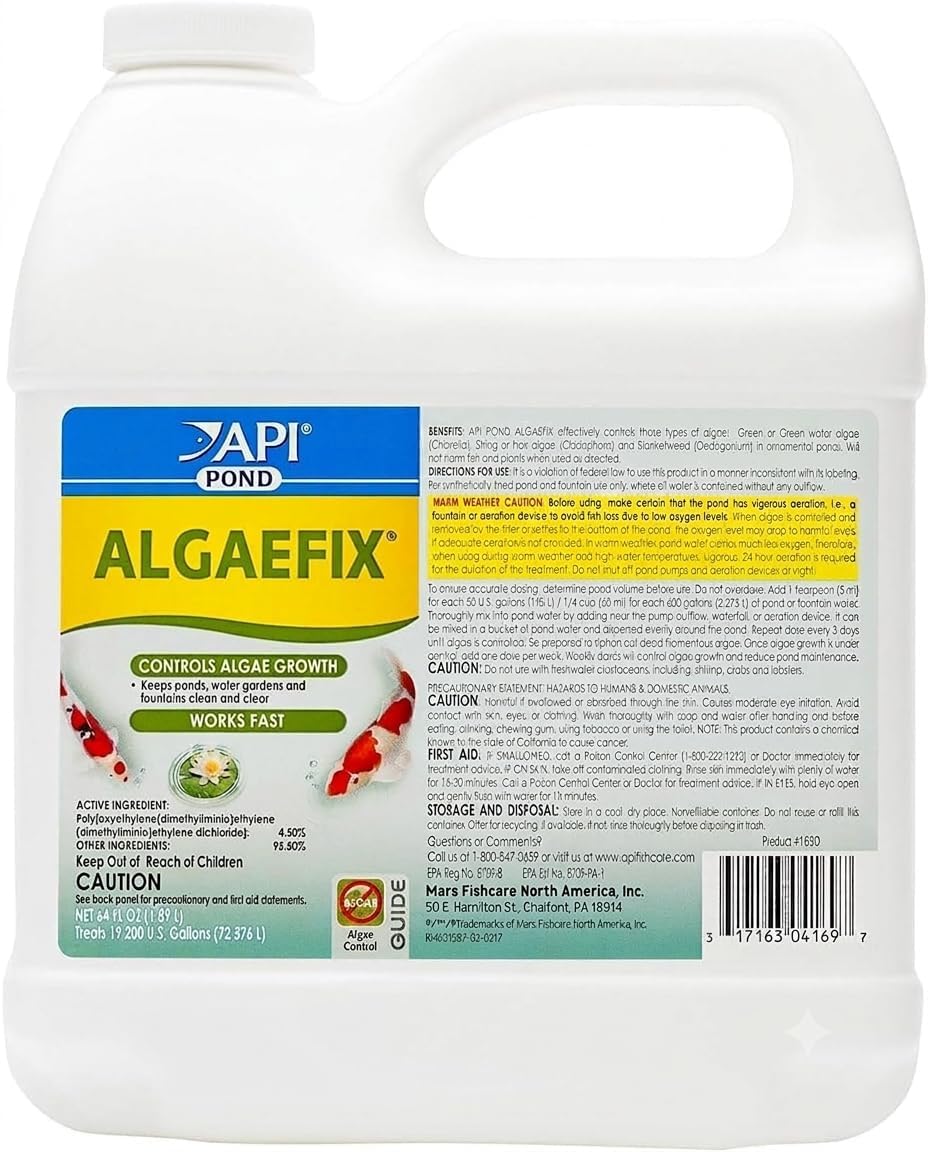
| Volume | 64 fl oz |
|---|---|
| Coverage | Treats up to 19,200 gallons |
| Registration | EPA-registered |
API Pond Algaefix is a liquid algaecide designed to quickly knock down common pond algae and keep water clear when used with proper aeration. It is typically dosed directly into the pond and mixed to disperse, repeated every three days until algae is controlled and then applied weekly for maintenance. Notable features include a copper-free, EPA-registered formula and explicit labeling for use around fish, aquatic plants, and wildlife when directions are followed. In practice the product is straightforward to use and lets you treat large volumes with the 64 fl oz bottle that covers up to 19,200 gallons. The copper-free formulation reduces the risk of copper buildup in sediment and is less likely to harm sensitive plants or beneficial bacteria, which appeals to cautious pond owners. Limitations are that it requires good aeration to be safe and effective and ongoing maintenance dosing; it is not a one-time permanent fix and will not replace mechanical cleaning or filtration when mats of blanketweed are heavy.
Best for: Pond owners who prioritize a cautious, fish-safe approach to algae control and want an EPA-registered, easy-to-apply treatment for routine maintenance.
Less Ideal for: Someone seeking a one-time permanent cure for severe algae infestations or a chemical-free mechanical solution should consider alternatives.
- EPA-registered, copper-free formula marketed as safe for fish, plants, and wildlife when used as directed
- Controls multiple algae types including green water, string/hair algae, and blanketweed
- Large 64 fl oz bottle covers up to 19,200 gallons for treating medium to large ponds
- Does not disrupt beneficial bacteria or accumulate in pond sediment according to the manufacturer
- Requires vigorous aeration and repeat dosing for effective and safe use
- Not a substitute for mechanical removal or filtration in heavily infested ponds
Verdict: Choose this EPA-registered, copper-free algaecide if you want a cautious, fish- and plant-friendly treatment that reliably clears common pond algae with routine dosing.
Choosing the Right Pond Algaecide: Key Factors to Consider
Type of Algae Present
Different algaecide chemistries work better on specific algae forms. Free-floating green water responds to treatments that target single-celled algae, while string algae and filamentous mats often require products formulated for attached growth. Knowing whether you are dealing with planktonic algae, filamentous growth, or surface scums changes which active ingredient and application method will be most effective.
Misidentifying algae can lead to repeated treatments that do not solve the problem and can stress fish. Observe the growth pattern, color, and where it accumulates before choosing an approach.
Fish and Plant Safety
Many pond owners keep fish and live marginal or submerged plants; those organisms influence which algaecide you can safely use. Some active ingredients are highly toxic to fish unless used at low concentrations or with additional aeration. Others can harm delicate aquatic plants if overdosed. Review labeled precautions and recommended aeration or water-change steps to reduce risk.
When in doubt, choose products labeled for use in ornamental ponds with clear instructions for holding times, aeration, and whether to remove or protect sensitive plants during treatment.
Pond Size and Water Volume Accuracy
Accurate dosing depends on knowing the pond volume. Small miscalculations can translate into underdosing that fails to control algae or overdosing that harms non-target life. Estimating volume by shape and average depth gives the dosing accuracy you need. Also factor in features such as waterfalls or aerators that dilute or mix treatments differently.
Products that provide simple per-gallon or per-acre-foot dosing scales make this step easier. If your pond volume is uncertain, measure or calculate it before treating.
Application Method and Equipment
Algaecides come as liquids, concentrates, granules, or tablets, and each format behaves differently in a pond. Liquids and concentrates usually mix quickly and disperse through surface application or with a pump, while granules may sink and act near the bottom. Tablets are often slow-release and better for localized treatment.
Consider what equipment you have: a pond pump, bucket for dilution, or a broadcast spreader. Ease of application affects how evenly the product distributes and how effective initial treatment is.
Residual Activity and Need for Repeat Treatments
Some products give immediate knockdown with little residual effect, requiring follow-up treatments to suppress recurring blooms. Others offer longer residual control but may carry higher risks for fish or require different dosing strategies. Think about whether you need an emergency quick-clear solution or a maintenance product to reduce frequency of treatment over a season.
Understand the recommended retreatment intervals and whether follow-up actions like filtration cleaning or nutrient reduction are advised to prevent rapid recurrence.
Water Chemistry and Environmental Conditions
pH, temperature, sunlight, and nutrient load all influence how well an algaecide performs. High sunlight and warm temperatures favor rapid algae growth and may neutralize some treatments faster. Similarly, high nutrient levels from runoff or decaying organic matter can produce repeated blooms even after a successful treatment.
Addressing underlying conditions such as excess nutrients, poor circulation, or inadequate filtration improves long-term control and reduces reliance on chemical treatments.
Preparing Your Pond Before Treatment
Before applying any algaecide, remove as much loose organic matter as possible. Rake out floating mats, skim surface scum, and prune dead plant material so the treatment targets living algae rather than decaying debris. Clearing debris also reduces oxygen demand as algae die back.
- Turn off or reduce skimmers briefly if instructed by product directions.
- Check and, if needed, top up water level to account for dosing concentrations.
- Note fish behavior and consider temporary aeration to protect oxygen levels during decomposition periods.
Timing Treatments for Best Results
Treat in the morning or evening when temperatures are cooler and sunlight is lower. Direct sunlight can accelerate breakdown of some active ingredients and can intensify oxygen depletion when treated algae die. Calm weather improves dispersal and reduces immediate dilution from heavy inflow.
- Avoid treating right before a heavy rain event that could dilute the dose.
- Space applications according to label retreatment intervals to avoid overdosing.
Supporting Measures to Reduce Recurrence
Chemical control is only one part of a long-term strategy. Reduce nutrient inputs by limiting fertilizer runoff, controlling leaf litter, and managing bird or pet waste near the pond. Improve circulation with a pump or aerator and consider adding beneficial bacteria or barley straw options where appropriate to slow algal regrowth.
- Clean or backwash filters after a bloom to remove accumulated algal fragments.
- Introduce or protect shading plants to reduce sunlight reaching planktonic algae.
Using Algaecide Safely Around Wildlife
Always follow label directions for use around fish, amphibians, and beneficial insects. Some treatments require temporary relocation of sensitive species or boosted aeration during and after application. Monitor fish closely for stress signs after a treatment and be prepared to perform partial water changes if advised by the product instructions.
- Avoid treating if a spawning event is underway for fish you want to protect.
- Keep pets and children away from treated water until the labeled reentry time has passed.
When to Choose Spot Treatments Versus Whole-Pond Applications
Localized filamentous mats often respond well to spot treatments that apply product directly to problem areas, minimizing exposure elsewhere. Conversely, green water blooms usually require whole-pond applications to treat suspended algae effectively. Consider using a targeted approach when only a small portion of the pond is affected to limit chemical exposure to the broader ecosystem.
- Spot treatments reduce total chemical load but may require repeat applications to catch regrowth.
- Whole-pond treatments are typically faster for widespread green water but need accurate volume estimates for safe dosing.
How We Chose the Best Pond Algaecide
Our selection process focused on factors that matter in real pond care rather than marketing claims. We prioritized products that demonstrate predictable control across common algae types, provide clear dosing instructions, and include guidance for use around fish and desirable plants. Safety documentation and labeled aquatic use were required to make the shortlist. We evaluated each option across these concrete dimensions: spectrum of algae controlled, toxicity and fish safety precautions, application method and clarity of instructions, and duration of control or need for retreatment. We excluded products lacking aquatic-use labeling, unclear dosing for pond volumes, or those primarily intended for non-pond uses such as swimming pools without aquatic guidance. The result is a set of algaecides that reflect practical tradeoffs: quick knockdown versus longer residual action, liquid versus granular formats, and products better suited to emergency treatments versus routine maintenance. These are the editorial filters we used to shape the recommendations here.
FAQ
How long after applying an algaecide can I safely let my fish swim near the treated area?
It often depends on the active ingredient and label directions. Many products allow fish to remain in the pond during treatment if instructions are followed, but some require temporary aeration or partial water changes. Always read the label for specific reentry times and fish-safety measures.
Will an algaecide harm my aquatic plants?
Some algaecides can damage sensitive marginal or submerged plants if overdosed. Others are formulated to be safe for established plants. Follow labeled rates and consider protecting or removing delicate specimens during treatment to minimize risk.
Can I use algaecide and beneficial bacteria together?
Yes, in many cases you can use both, but timing matters. Apply algaecide first to clear heavy blooms, then introduce beneficial bacteria after the active product has dissipated according to label guidance. This helps re-establish a biological balance that reduces recurrence.
How often should I retreat a pond after the first algaecide application?
Retreatment intervals vary by product and conditions. Some treatments work for weeks while others require weekly applications until control is achieved. Follow the product label and base the schedule on observed regrowth and underlying nutrient conditions.
Does water hardness or pH affect algaecide effectiveness?
Yes, pH and water chemistry can change how some active ingredients perform. Extremely high or low pH may reduce efficacy or increase toxicity risk. Check product literature for pH ranges and adjust pond chemistry if necessary before treatment.
Are granular algaecides better for bottom mats?
Granular formulations are often designed to sink and act near the bottom, which can be helpful for rooted or bottom-growing mats. However, correct application technique matters to avoid localized overdosing. Use a spreader or scaffolded application method as the label suggests.
Final Verdict
Choose a pond algaecide based on the type of algae you have, the sensitivity of fish and plants in your water, and how precise your pond volume measurements are. Balance the need for quick knockdown with the desire for longer residual control and select an application format that fits your equipment and treatment style. Prioritize products labeled for ornamental ponds and follow safety steps like improving aeration and reducing nutrient inputs to prevent repeat blooms. With the right match between algae type and treatment approach, you can restore clearer water while minimizing stress to your pond ecosystem.
