

Note: This article contains affiliate links. If you click on these links and make a purchase, I may earn a small commission at no extra cost to you. This helps support my research and content. Read my full affiliate disclosure here.
If you are fighting actively growing weeds in turf, beds, or a vegetable garden, the right post emergent herbicide makes the difference between a quick fix and repeated hand-pulling. You need a product that targets the species you have, fits the planting or turf situation, and lets you apply safely without harming nearby ornamentals or crops. This guide covers the top shortlisted options for Best Post Emergent Herbicide and explains the practical tradeoffs gardeners face. We evaluated products for weed-killing effectiveness, selectivity around desirable plants, application method and coverage, and user safety. Read on to compare characteristics that matter in real gardens and to find a solution suited to your planting situation and tolerance for control work.
Top Picks at a Glance
| Best Overall The best all-around choice for most situations | Roundup Quick Pro Powder Concentrate (makes 5 gallons) |  |
| Best Quality Built to a higher standard if you want something more solid | Tenacity Turf Herbicide, 8 fl oz (Mesotrione) |  |
| Best Value The sweet spot between price and what you get | PBI/Gordon SpeedZone EW Lawn Weed Killer, 20 fl oz |  |
| Best Budget The cheapest option that still gets the job done reliably | Ortho WeedClear Ready-to-Spray Lawn Weed Killer, 32 fl. oz. |  |
| Highest Rated A top-rated pick with lots of positive feedback | Target 6 Plus MSMA 48.3% Post-Emergent Turf Herbicide (2.5 gal) |  |
| Most Popular A crowd favorite that many people choose with confidence | Spruce Weed & Grass Killer Kit with Power Wand and 64 oz Refill |  |
| Best Seller A high-volume bestseller chosen again and again | Ortho GroundClear Year Long Vegetation Killer2 Concentrate, 2 gal |  |
Roundup Quick Pro Powder Concentrate (makes 5 gallons)

| Unit Count | 8 Ounce |
|---|---|
| Item Form | Powder |
| Coverage | Makes 5 gallons |
| Active Ingredients | Glyphosate, Diquat |
Roundup Quick Pro is a powdered concentrate designed to mix into water to treat unwanted vegetation across lawns, beds, driveways, and other outdoor areas. It combines glyphosate for systemic control with diquat for faster contact action so weeds brown more quickly and are less likely to recover after treatment. Typical use is mixing the specified rate into a handheld or backpack sprayer and applying to actively growing weeds on a calm, dry day; the product covers up to five gallons of spray from one box. The notable benefits are broad-spectrum activity against both annuals and perennials and improved rain resistance from the diquat addition, which helps absorption before rainfall. Important limitations are that it is a nonselective herbicide so it will damage desirable plants on contact or via drift and requires careful mixing and protective handling. It is best for targeted patch treatments and general post-emergent use rather than selective weed control inside mixed plantings.
Best for: Buyers who want a reliable post-emergent herbicide for general-purpose weed control across yards and hardscapes and who are comfortable following label safety and mixing instructions.
Less Ideal for: Gardeners who need selective weed control inside flower beds or who prefer organic or nonchemical weed management methods should consider alternatives.
- Systemic plus contact action combines glyphosate and diquat for faster visible knockdown and longer control
- Powder concentrate that mixes to make up to five gallons of spray for treating multiple areas
- Broad-spectrum labeled for most annual and perennial weeds
- Formulation offers improved absorption before rain compared with glyphosate alone
- Nonselective formulation will damage or kill any desirable vegetation it contacts
- Requires careful mixing, protective gear, and attention to drift and re-entry intervals
Verdict: Choose Roundup Quick Pro when you need a fast‑acting, broad‑spectrum post‑emergent herbicide that combines systemic control with quick visible knockdown.
Tenacity Turf Herbicide, 8 fl oz (Mesotrione)
| Unit Count | 8 Fluid Ounces |
|---|---|
| Item Form | Liquid |
| Coverage | 2000 ft^2 per 1sp of product |
| Active Ingredients | Mesotrione |
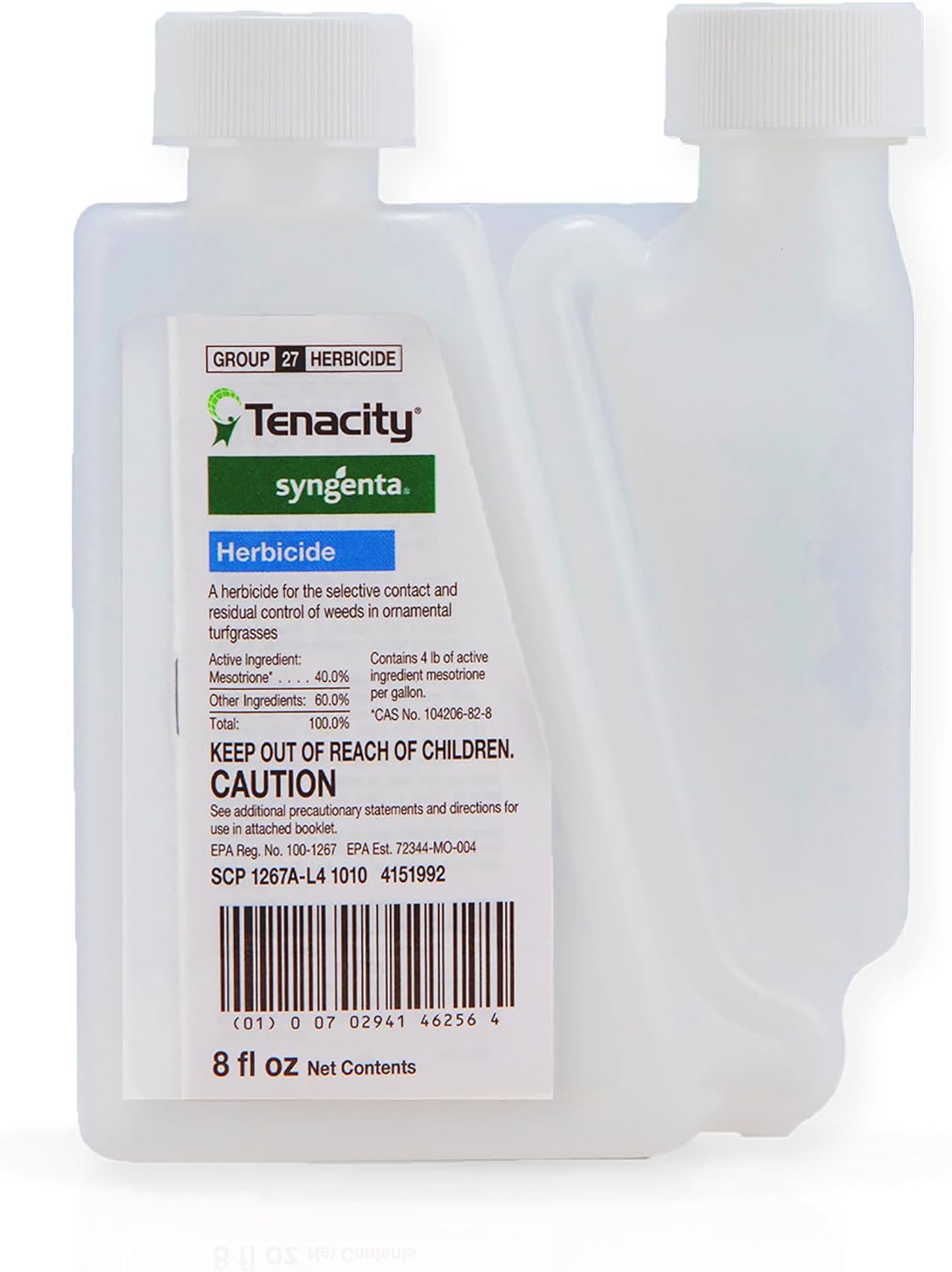
Tenacity is a concentrated liquid herbicide formulated for selective control of many common turf weeds both before and after they emerge. It is typically mixed and applied to lawns where it acts systemically and provides some residual control, making it useful against annual grasses like crabgrass and foxtail and broadleaves such as clover, chickweed, dandelion, and henbit. The product lists mesotrione as the active ingredient and claims coverage on the bottle sufficient for large areas when mixed per label directions. Practical benefits include versatility as a pre- or post-emergent treatment and a multi-target spectrum, which reduces the need for separate products. Users should plan applications around label instructions because timing, tank mixes, and turf species compatibility determine safety and effectiveness. It is a professional-strength option, so careful measuring, appropriate personal protection, and attention to environmental precautions are important. Expect visible control over days to weeks rather than instant knockdown, and plan follow-up applications for heavy infestations.
Best for: Gardeners and turf managers who prioritize strong, versatile weed control and are comfortable following label directions for mixing and timing to protect turf health.
Less Ideal for: Casual users who want immediate visible weed die-off or who prefer ready-to-use, low-hazard products for small spot treatments.
- Effective on both pre-emergent and post-emergent weeds for flexible timing
- Active ingredient mesotrione targets a broad spectrum of grassy and broadleaf weeds
- Concentrated liquid form allows treating larger areas when mixed per label
- Provides some residual control, reducing frequency of repeat applications
- Requires strict adherence to label for turf compatibility and safe use
- Control is not instantaneous and may take days to weeks to appear
Verdict: Buy this if you need a professional-strength, single product that offers both pre-emergent and post-emergent control of common turf weeds.
PBI/Gordon SpeedZone EW Lawn Weed Killer, 20 fl oz

| Unit Count | 20 Fluid Ounces |
|---|---|
| Item Form | Liquid |
| Coverage | Mix 1.8 fl oz (warm-season) or 1.5 fl oz (cool-season) per 1000 sq ft in 0.5–1 gal water |
| Active Ingredients | 2,4-D ester; Dicamba; Carfentrazone-ethyl; Mecoprop-p |
SpeedZone EW is a ready-to-mix post-emergent liquid herbicide designed for spot and broadcast treatments of broadleaf weeds in established turf. It combines four active ingredients to control more than 90 listed weeds including dandelion, clover, ground ivy and spurge, with visible injury in hours and plant death typically within 7 to 10 days. Use involves measuring small doses into a sprayer tank and applying across the lawn according to warm- or cool-season mixing rates; the label lists different dilution rates for warm- and cool-season grasses. Practical benefits include fast cool-weather performance, rainfast protection in about three hours, and the ability to reseed treated areas as soon as seven days. Limitations are that it is a chemical control requiring careful reading of the label and safety precautions, it targets broadleaf weeds rather than grassy weeds exclusively, and dosage accuracy is important to avoid turf stress. This product is best for targeted lawn weed control when you want reliable, relatively fast results and are comfortable handling concentrated herbicides.
Best for: Gardeners who prioritize efficient, reliable control of broadleaf lawn weeds and who are comfortable measuring and applying concentrated herbicides for fast results.
Less Ideal for: Those who prefer non-chemical or solely organic weed control methods or who need a product specifically targeted at grassy weed species.
- Four active ingredients give broad-spectrum control across 90+ listed broadleaf weeds
- Fast-acting with visible injury within hours and plant death in 7–10 days
- Rainfast in about three hours so treatments are less likely to wash off
- Label allows reseeding as soon as seven days after treatment
- Requires precise measuring and mixing of concentrated liquid for correct coverage
- Not focused on controlling grassy weeds as primary targets
- Must be used following label safety precautions due to potent active ingredients
Verdict: Choose SpeedZone EW when you want a fast, broad-spectrum post-emergent herbicide that reliably knocks back common broadleaf lawn weeds in cool and warm-season turf.
Ortho WeedClear Ready-to-Spray Lawn Weed Killer, 32 fl. oz.

| Unit Count | 32 Fluid Ounces |
|---|---|
| Coverage | 5000 square_feet |
| Item Form | Spray |
| Active Ingredients | 2,4-D; Quinclorac; Dicamba |
Ortho WeedClear Ready-to-Spray is a user-friendly post-emergent herbicide that connects directly to a garden hose and delivers a pre-mixed spray across your lawn. It targets more than 200 broadleaf and grassy weeds such as dandelion, clover, chickweed and crabgrass and is formulated to be safe on many northern lawn grasses when used as directed. Typical use is to apply to young, actively growing weeds in spring or fall, spray until the turf surface is wet and avoid treated areas until dry. Notable features include fast visible results, rainproof protection within an hour, and a comfort wand-style hose applicator for even coverage. Practical benefits are quick knockdown of common weeds without mixing concentrates and coverage large enough for a small-to-medium yard. Important limitations are that it is not labeled for many warm-season or specialty grasses and should not be applied in very hot conditions on some grasses, and it requires careful safety precautions around people and pets until the spray dries.
Best for: Homeowners who want an inexpensive, no-mix post-emergent solution to quickly remove common lawn weeds and treat a small to medium yard with minimal setup.
Less Ideal for: Those managing warm-season turf types not listed on the label or gardeners who prefer organic or non-chemical weed control methods.
- Ready-to-use hose-end applicator requires no measuring or mixing
- Kills a wide range of common lawn weeds down to the root
- Rainproof within one hour for reliable application windows
- Covers up to 5,000 square feet from a single 32 fl. oz. container
- Not labeled safe for many warm-season and specialty grasses
- Contains synthetic herbicide ingredients that require protective clothing and dry-time restrictions
Verdict: Buy this if you want an affordable, ready-to-use post-emergent spray that quickly kills common lawn weeds across a small to medium yard without mixing concentrates.
Target 6 Plus MSMA 48.3% Post-Emergent Turf Herbicide (2.5 gal)
| Item Form | Liquid |
|---|---|
| Liquid Volume | 2.5 gallons |
| Active Ingredients | Monosodium acid Methanearsonate MSMA |
| Coverage | Selective: Crabgrass, Dallisgrass, Johnsongrass, Nutsedge, Pigweed, Chickweed |
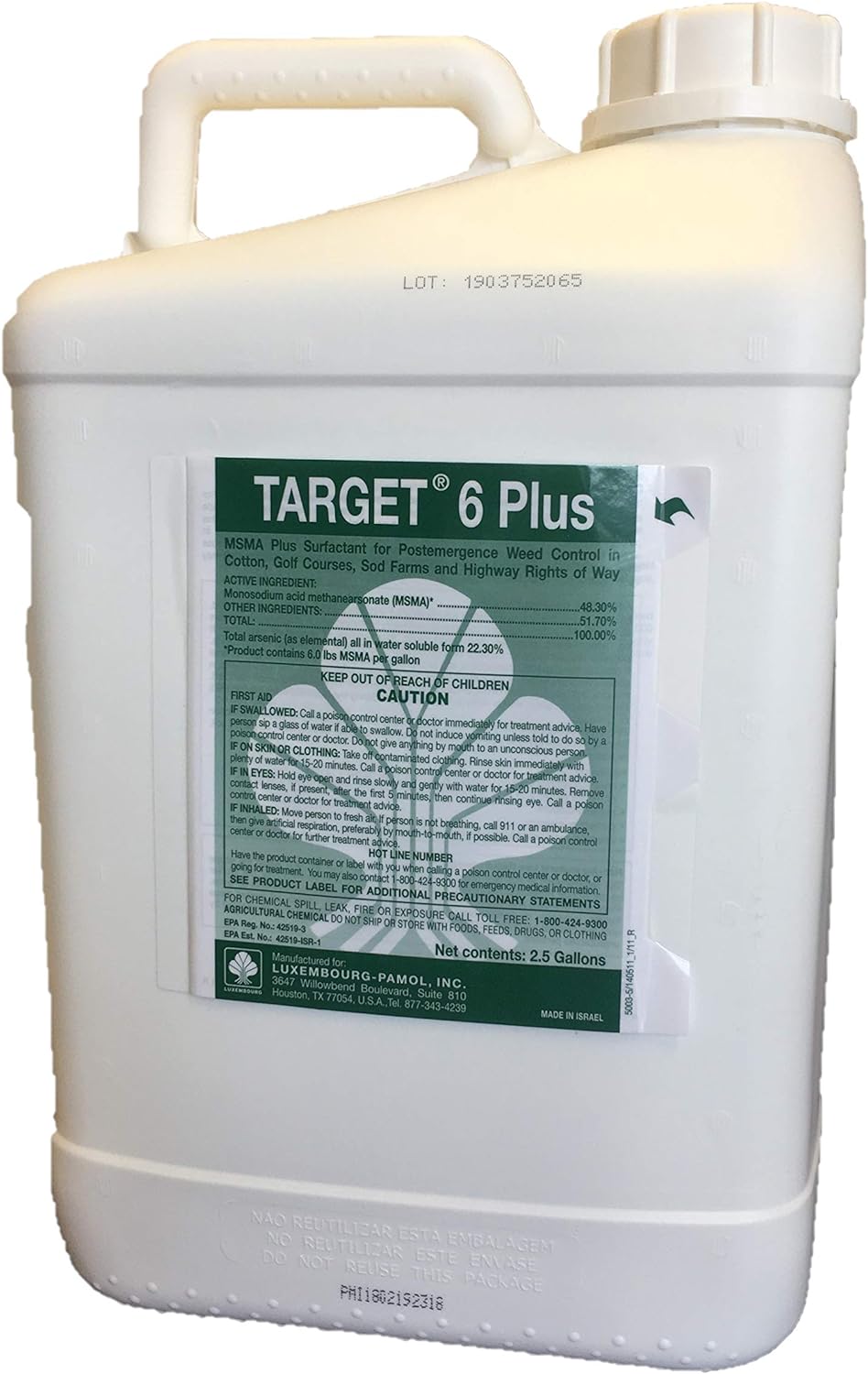
Target 6 Plus is a high-concentration MSMA post-emergent herbicide intended to selectively control crabgrass, dallisgrass, johnsongrass, nutsedge, pigweed, and chickweed in turf and certain commercial settings. It is supplied as a 2.5 gallon liquid designed to be diluted at roughly 2 ounces per gallon of water and applied as a coarse spray, which makes it practical for treating larger areas like sod farms, golf courses, and rights-of-way. The main benefits are strong activity on tough grassy weeds and a formulation that experienced users can mix to match coverage needs. Important limitations are safety and use restrictions: MSMA is hazardous if misused, requires careful handling, protective equipment, and must not be applied where food is grown. It also has label-specific site approvals, so it is best deployed where the product is permitted and where the applicator follows all label directions and local regulations.
Best for: Experienced applicators, turf managers, or commercial operators who need a dependable, concentrated post-emergent herbicide for recurring control of grassy weeds in approved turf and commercial sites.
Less Ideal for: Casual homeowners, new gardeners, or anyone who cannot follow strict label safety requirements or who needs a product approved for food-bearing gardens or broad residential use.
- High-concentration MSMA formula effective on several tough grassy weeds
- Large 2.5 gallon volume suitable for treating acres or recurring applications
- Mix-at-need liquid allows adjustable coverage with common sprayers
- Selective activity formulated for turf and commercial sites listed on the label
- Contains a hazardous active ingredient that requires strict safety precautions
- Use is restricted to labeled sites and may not be legal for some homeowner lawns
- Requires accurate mixing and application equipment to avoid damage to non-target plants
Verdict: Choose this concentrated MSMA formulation when you need a reliable, professional-strength post-emergent solution for persistent grassy weeds on approved turf and commercial sites.
Spruce Weed & Grass Killer Kit with Power Wand and 64 oz Refill

| Unit Count | 64 Fluid Ounces |
|---|---|
| Coverage | 1 bottle treats up to 400 weeds. |
| Item Highlight | Pet Safe Weed Killer Spray, Reusable Weed Sprayer, 2 AA Batteries Included |
| Item Form | Multiple |
This Spruce kit combines a refill bottle of no-mix herbicide with a reusable battery-powered wand for easy spot treatments of emerged weeds. The concentrate-free formula is formulated from water, essential oils, and a surfactant so you simply unlock the wand and spray leaves and stems until wet. It is designed for targeted applications on driveways, mulch beds, pavers, and garden edges rather than broadcast lawn treatments. Notable features are the powered wand for quicker coverage and included AA batteries, a rainproof formula within 10 minutes, and claims of visible leaf darkening within an hour and full plant death by about 24 hours. Practically, one 64 oz bottle is rated to treat up to 400 weeds which is useful for repeated spot control, and the reusable sprayer reduces waste compared with single-use bottles. Expect to aim carefully to avoid desirable plants since this is non-selective, and for best performance apply on calm, dry days above 60°F. The wand can take a moment to prime between uses but tapping the handle usually resolves that.
Best for: Buyers who want a fast, visible post-emergent solution for spot-treating weeds around hardscapes, beds, and cracks and who prioritize ease of use and safety around people and pets when used as directed.
Less Ideal for: Those needing a selective lawn herbicide for turf-wide weed control or people managing very large infestations where concentrated products or professional treatments are more economical.
- Ready-to-use no-mix formula simplifies spot treatment without measuring or diluting
- Included powered wand and batteries speed up application and improve reach
- Visible results often within 1 hour and full effect by 24 hours
- Formulated to be rainproof within 10 minutes, allowing short window before wash-off
- Reusable sprayer reduces single-use plastic and is rated for multiple years of use
- Non-selective formula can damage nearby desirable plants if oversprayed
- Not intended for broadcast lawn applications so larger infestations require many refills
- Wand may need tapping to prime after idle periods which slows spot work
Verdict: A convenient, fast-acting spot-treatment kit that makes post-emergent weed control easy and visible without mixing or complex setup.
Ortho GroundClear Year Long Vegetation Killer2 Concentrate, 2 gal

| Liquid Volume | 2 gallons |
|---|---|
| Coverage | 3,200 square feet |
| Item Form | Liquid |
Ortho GroundClear Year Long Vegetation Killer2 is a concentrated, non-selective post-emergent herbicide designed for tough, long-lasting weed control on hardscapes and other areas where you do not want plants to regrow. You mix 24 fl. oz. per gallon of water and apply with a tank sprayer; one 2 gallon container makes roughly 10.7 gallons of finished spray and treats up to about 3,200 sq ft. The formula starts working immediately, becomes rainproof in about an hour, and is labeled to prevent vegetation for up to a year, which reduces repeat applications. It is intended for use on driveways, sidewalks, patios, gravel and fence lines rather than around desired lawns, gardens, fruits or vegetables because it remains active in soil. Important practical considerations are following the label for dilution and safety, applying only on warm sunny days when weeds are actively growing, and keeping children and pets away until treated areas are dry. For homeowners wanting reliable, low-frequency control of weeds on hard surfaces, this concentrate delivers predictable long-term suppression but must be used cautiously near planting areas.
Best for: Homeowners who want dependable, low-frequency weed control on driveways, patios, gravel and other hardscape areas and who prefer a product that delivers predictable year-long suppression with careful, label-driven application.
Less Ideal for: Gardeners who need selective weed control in lawns or beds or want to plant in treated soil within a year should choose a different, plant-safe product.
- Long-lasting control that prevents regrowth for up to one year on treated areas
- Concentrated formula yields about 10.7 gallons of spray and covers up to 3,200 sq ft
- Fast-acting and rainproof within one hour, so treatment is less impacted by light rain
- Designed for a range of hardscape and non-planting areas including driveways, patios and gravel
- Non-selective and remains active in soil for up to a year, so it cannot be used where you plan to plant
- Requires proper dilution and a tank sprayer which adds an extra step versus ready-to-use products
Verdict: Buy this concentrate if you need reliable, year-long post-emergent weed control on hardscape areas and want to minimize repeat treatments.
Choosing the Right Post Emergent Herbicide: Key Factors to Consider
Target Weed Species and Growth Stage
Different post emergent herbicides work better on broadleaf weeds, grassy weeds, or a mix. Identifying the dominant species in your garden matters because some active ingredients are selective while others are broad-spectrum. Treating weeds while they are actively growing typically improves uptake and results, so timing applications to growth stage reduces repeat treatments.
Knowing which weeds you want to control also changes the application approach. Young, tender weeds may need lower concentrations and lighter coverage, while mature, woody perennial weeds often need higher rates or follow-up treatments. Match the herbicide label claims to the species and life stage in your plot to avoid wasted product and unnecessary plant stress.
Selectivity and Safe Use Near Desirable Plants
Selectivity determines whether the herbicide will harm ornamental plants, vegetables, or turf. Some post emergent chemistries are formulated to target only broadleaf weeds in lawns, while others will damage most green plants if they get sprayed. When treating flower beds, container plants, or mixed plantings, choose a product labeled for use around those plants or use targeted spot application methods to protect desirable species.
Buffer zones, shielded wands, and careful spray technique reduce drift and contact. Read label restrictions about proximity to sensitive crops and observe recommended waiting periods before replanting where applicable.
Application Method and Coverage
How you apply the herbicide affects both efficacy and safety. Ready-to-use spray bottles can be convenient for small areas and spot treatments, while tank-mix concentrates are more efficient for larger lawns or multiple beds. Application equipment-handheld pump sprayers, hose-end sprayers, or backpack units-changes how evenly you cover foliage and what droplet size you generate, which impacts uptake.
Even coverage is essential for systemic products that require leaf contact, and some formulations include surfactants to improve wetting. Consider whether you need a targeted wand for spot control or a broadcast method for widespread infestations and choose a product and applicator combination that you can use accurately.
Residual Activity and Follow-up Scheduling
Some post emergent herbicides have little to no soil residual activity and only kill the plant tissue sprayed, which means new germinants will require later treatment. Others provide residual control that suppresses regrowth or protects treated areas for a period. Understand whether the herbicide acts systemically and translocates to roots, or is primarily a contact killer, because that affects how many applications you must plan.
Residual behavior also affects replanting schedules for vegetable or ornamental beds. If you plan to sow seed or transplant, check label guidance on safe intervals to avoid damage to new plants.
Safety, Label Requirements, and Environmental Considerations
Gardeners must follow label instructions for personal protective equipment, mixing, and disposal. Some active ingredients require gloves, long sleeves, or even respiratory protection during mixing or broadcast application. Pay attention to precautions about runoff, proximity to water, and impacts on pollinators and beneficial insects.
Always follow local regulations about herbicide use and consider mechanical or cultural controls for sensitive areas. Proper storage, accurate measuring of concentrates, and disposal of leftover spray solution protect people and pets and reduce unintended environmental exposure.
When To Use Post Emergent Herbicide Versus Other Controls
Post emergent herbicides work best when weeds are actively growing and clearly visible. Use them for established infestations where spot treatments or broadcast sprays can reach the foliage, and when immediate reduction of weed competition is necessary to protect young transplants or turf health.
- Choose mechanical removal for isolated weeds or when plants are close to sensitive ornamentals.
- Consider softer options like hand-weeding or flame weeding in small beds or for seedlings.
- Use post emergent sprays when larger patches or tough perennial weeds make nonchemical control impractical.
Safe Application Practices for Home Gardens
Calibrate your sprayer and practice on a small area before full application. Avoid spraying on windy days to reduce drift, and keep pets and people off treated areas until the label allows re-entry. Use shields or targeted wands when working near desirable plants to limit accidental contact.
Wear the PPE specified on the product label during mixing and application, and measure concentrates precisely. Rinse application equipment according to directions to avoid residue carryover when switching products or using the sprayer for other garden chemicals.
- Mix only the amount you need to avoid waste.
- Label directions override informal advice found online.
- Store herbicides out of reach of children and animals in original containers.
Mixing and Tank-Mix Options
Many concentrates can be mixed with water and sometimes combined with surfactants or certain fertilizer solutions to improve uptake. However, tank-mixing requires careful label review because incompatible mixtures can reduce efficacy or increase crop injury risk.
When considering tank mixes, test a small area first and follow recommended order of addition. Keep records of concentrations and weather conditions for repeatability.
- Follow label guidance for compatible adjuvants.
- Avoid combining products unless label explicitly permits the mix.
- Use soft water if recommended to improve active ingredient performance.
Managing Tough Perennial Weeds
Perennial species with extensive root systems often require systemic chemistry that translocates to the roots. Multiple applications timed during peak translocation periods, such as late season when plants move carbohydrates to roots, increase likelihood of control.
Combine chemical treatment with cultural practices like cutting or digging to reduce biomass before herbicide application, but avoid treatments that remove foliage needed for uptake unless follow-up applications are planned.
- Treat when weeds are actively leafed out for best translocation.
- Expect follow-up treatments for dense or woody perennials.
- Control surrounding seedlings to prevent re-infestation.
How We Chose the Best Post Emergent Herbicide
We selected seven post emergent herbicides that reflect the range of gardeners' needs and site constraints. Our editorial filters prioritized documented efficacy against common broadleaf and grassy weeds, product selectivity so desirable plants are preserved, and flexibility of application for different site sizes from small beds to larger lawns. We also weighed formulation types and delivery systems that affect coverage and ease of use, such as ready-to-use sprays versus concentrate mixes, and we considered re-entry intervals and safety labeling for residential settings. Excluded from the list were products intended only for pre-emergent use, supplies designed solely for industrial or agricultural broadcast application, and products with labeling that prohibits typical residential garden use. Key dimensions that mattered in selection were spectrum of control, selectivity and labeled plant protection, application practicality and tank-mix options, residual activity and re-treatment intervals, and user safety and PPE requirements. These same dimensions form the basis of our scoring criteria and guided editorial judgment across all shortlisted options.
FAQ
Can I use post emergent herbicide in vegetable gardens?
It depends on the active ingredient and label. Some post emergent products are labeled for use around certain vegetables or for spot treatments in established beds. Always follow label directions and observe replanting or harvest intervals.
How soon after rain can I apply a post emergent herbicide?
Rainfastness varies by product. Many formulations require several hours to dry for effective uptake, while others need a full day. Check the label for specific rainfast timelines and avoid applying if rain is expected during that window.
Will spot-spraying prevent damage to nearby plants?
Spot-spraying reduces exposure but does not eliminate risk. Use shielded wands, avoid spray drift, and be cautious with systemic chemistries that can move in soil or runoff. Small droplets and windy conditions increase the chance of off-target damage.
Are post emergent herbicides safe for pets?
Safety depends on the active ingredient and how the product is used. Keep pets off treated areas until the label's re-entry interval has passed and follow storage and disposal guidance to minimize accidental exposure.
How often should I reapply post emergent herbicide?
Reapplication frequency depends on weed species, herbicide mode of action, and label directions. Some problems require a single systemic treatment, while others need follow-up applications at specified intervals for full control.
Final Verdict
Choose a post emergent herbicide by matching the active ingredient to the weeds you need to control, the planting situation, and your tolerance for follow-up work. Prioritize products labeled for use near the plants you want to protect and pick an application method you can use accurately. Balance efficacy, residual behavior, and safety requirements when deciding. When in doubt, start with targeted spot treatments and follow label guidance to minimize off-target effects and environmental risk.
