

Note: This article contains affiliate links. If you click on these links and make a purchase, I may earn a small commission at no extra cost to you. This helps support my research and content. Read my full affiliate disclosure here.
Picking the right potting mix for palms matters because palms have unique root and moisture needs compared with typical houseplants and many shrubs. A mix that drains too slowly leads to root rot, while one that dries out too fast stresses the shallow, fibrous root systems common to many palm species. Whether you are repotting a young parlor palm, settling a windmill palm into a patio container, or refreshing soil for a mature specimen, the right blend helps roots establish and foliage stay glossy. This guide covers seven shortlisted potting mixes chosen for common palm growing situations in containers and indoors. We focus on mixes that balance drainage, moisture retention, and nutrient delivery, and we evaluate each option against practical gardener concerns such as weight for balconies, longevity, and repotting ease. Read on to compare the tradeoffs and find a mix suited to your palm and growing conditions.
Top Picks at a Glance
| Best Overall The best all-around choice for most situations | Gardenera Madagascar Palm Potting Mix, 3 Quart |  |
| Best Quality Built to a higher standard if you want something more solid | Wekiva Foliage Palm Tree Soil Mix, 2 Quarts |  |
| Best Value The sweet spot between price and what you get | Miracle-Gro Cactus, Palm & Citrus Potting Mix, 8 qt., 3-Pack |  |
| Best Budget The cheapest option that still gets the job done reliably | Gardenera Palm Tree Potting Mix (1 Quart) |  |
| Highest Rated A top-rated pick with lots of positive feedback | E.B. Stone Organics Citrus & Palm Mix Potting Soil, 1.5 cu ft |  |
| Most Popular A crowd favorite that many people choose with confidence | Miracle-Gro Cactus, Palm & Citrus Potting Mix, 8 qt. |  |
| Best Seller A high-volume bestseller chosen again and again | Espoma Organic Cactus Potting Soil Mix, 4 qt |  |
Gardenera Madagascar Palm Potting Mix, 3 Quart

| Brand Name | Gardenera |
|---|---|
| Item Type Name | Soil Mix |
| Manufacturer | Gardenera |
| Volume | 3 quarts |
This Gardenera Madagascar Palm Potting Mix is a small-batch soil blend made specifically to support the growth habits of Madagascar palms. It combines Canadian peat moss for steady moisture retention, worm castings for added nutrients, sand to improve structure and drainage, and perlite to keep the mix airy for healthy roots. Use it when repotting or refreshing the top layer in containers where palms need both consistent moisture and good aeration; the composition helps reduce waterlogging while supplying organic fertility. The 3-quart bag is convenient for one or two small to medium potted specimens but is not sized for multiple large repots, so plan accordingly. The mix may produce dust when handling and should be used with care to avoid inhalation. For gardeners who want a palm-specific, ready-to-use medium that balances water retention with drainage and root oxygenation, this blend is a practical option.
Best for: Buyers who want a palm-tailored, ready-to-use potting medium for indoor or container Madagascar palms and who repot one or a few plants at a time.
Less Ideal for: Gardeners needing bulk soil for many or large repots or those seeking a peat-free or completely inorganic palm substrate.
- Formulated ingredients (peat moss, worm castings, sand, perlite) aimed at balancing moisture, nutrients, drainage, and aeration
- Worm castings add organic nutrients that support root vigor without immediate heavy fertilizer needs
- Perlite and sand improve structure to reduce waterlogging risk common with palms
- Convenient 3-quart size suitable for repotting small to medium potted palms
- Small 3-quart volume limits usefulness for multiple or large repots
- Contains peat which may compact over time and could require occasional amendment
- Product can be dusty during handling and requires care to avoid inhalation
Verdict: A compact, palm-focused potting mix that balances moisture retention, drainage, and nutrient enrichment for healthier Madagascar palms in containers.
Wekiva Foliage Palm Tree Soil Mix, 2 Quarts

| Brand | Wekiva Foliage |
|---|---|
| Unit Count | 2 Count |
| Style Name | 2 Quarts |
| Volume | 1 quarts |
This palm-specific potting mix is built for growers who want reliable performance when repotting or establishing potted palms. The blend of peat moss and HydraFiber holds moisture while perlite and HydraFiber improve aeration and prevent waterlogging, which helps roots avoid rot in containers. Lime and gypsum are included to help stabilize pH and supply calcium and sulfur, and Nitroform adds a baseline nutrient boost so young transplants start with available fertilizer. In practice this mix works well for common indoor and patio palms such as Areca, Majesty, Parlor, and Kentia when used in containers or small garden plantings. The 2-quart size is convenient for topping up pots or repotting single small specimens but means you will need multiple bags for larger plants. Expect healthier root development and less overwatering risk compared with generic potting soil, but plan ahead for quantity when working with mature palms.
Best for: Gardeners focused on getting measurable growth and root health from potted palms who repot or maintain individual indoor or patio specimens and want a purpose-made medium rather than a general potting soil.
Less Ideal for: People needing bulk soil for multiple large landscape palms or landscapers who prefer to source soil in large-volume bags or custom field blends.
- Formulated specifically for palms with ingredients targeting drainage, moisture retention, and nutrient balance
- Perlite and HydraFiber improve aeration to reduce risk of root rot in containers
- Includes lime and gypsum to help stabilize pH and supply essential minerals
- Contains Nitroform for an initial nutrient boost to support early growth
- Small 2-quart quantity requires multiple bags for repotting medium or large palms
- No specific N-P-K or long-term feeding schedule listed on product details
Verdict: Choose this mix if you want a palm-tailored potting medium that improves root aeration and moisture balance for healthier container-grown palms.
Miracle-Gro Cactus, Palm & Citrus Potting Mix, 8 qt., 3-Pack

| Item Form | Granules |
|---|---|
| Target Species | Cacti, Palm, Citrus, Succulents |
| Unit Count | 3 Count |
| Coverage | Low |
This Miracle-Gro mix is made for container plants that need quick drainage and a light, airy medium—cacti, succulents, palms and citrus. The blend of forest products, sphagnum peat moss, sand and perlite creates a porous texture that helps excess water move away from roots, and the included Miracle‑Gro plant food gives an immediate nutrient boost for early growth. Use it in pots with drainage holes, fill about a third of the pot and settle the root ball before topping up; the manufacturer notes each 8‑qt bag fills roughly two 8‑inch containers. Practical benefits include easier watering for moisture‑sensitive species, reduced risk of root rot, and ready-to-use nutrition so you do not need an immediate fertilizer application. Limits to expect are that coverage per bag is modest for large pots and outdoor beds, and the formula is tailored to containers rather than in-ground planting. If you prefer a very heavy, moisture‑retentive mix for tropical palms in large planters, this lighter cactus-style blend may require more frequent watering or amendment with additional organic matter.
Best for: Buyers who prioritize efficient, low‑maintenance container growing for palms, succulents or citrus and want a ready‑to‑use fast‑draining mix that supports healthy roots.
Less Ideal for: Gardeners planting large in-ground palms or those who need a high water‑retention soil for long dry spells should consider heavier potting soils or soil amendments instead.
- Fast-draining blend reduces standing moisture and helps prevent root rot in container palms and succulents
- Pre-enriched with plant food to support initial growth without immediate fertilizing
- Designed for indoor or outdoor containers so it works across patios and windowsills
- Light, porous ingredients (peat, sand, perlite) ease repotting and root establishment
- Each 8-qt bag provides limited volume so multiple bags are needed for larger pots
- Not formulated for in-ground planting or to heavily retain moisture over long periods
Verdict: Choose this mix when you need a lightweight, fast‑draining, ready‑to‑use potting medium that supports healthy container palms and succulents.
Gardenera Palm Tree Potting Mix (1 Quart)
| Unit Count | 1 Count |
|---|---|
| Item Type Name | Palm Tree Potting Mix |
| Volume | 1 quarts |
| Brand Name | Gardenera |
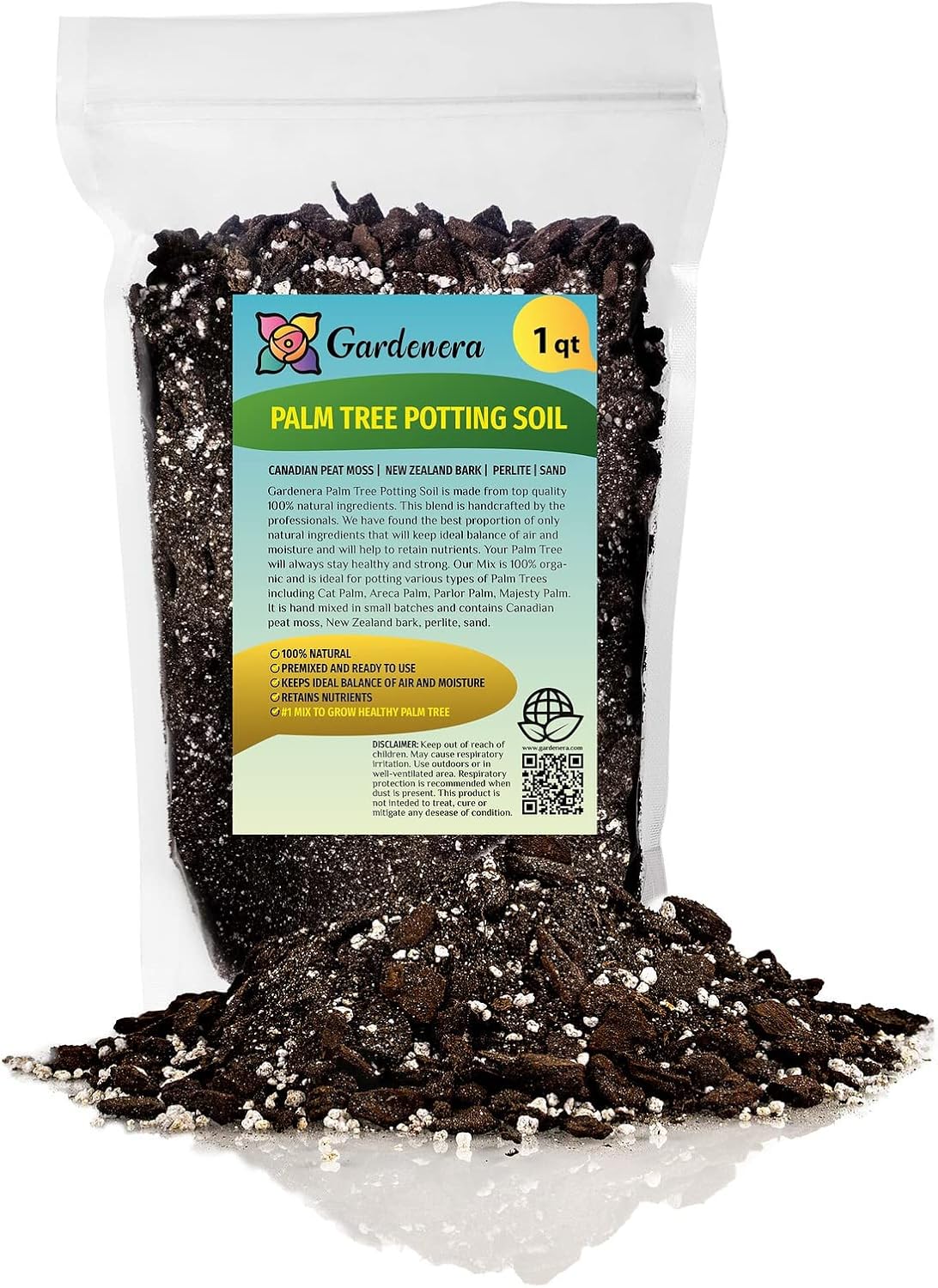
This Gardenera Palm Tree Potting Mix is a ready-to-use blend formulated for palm trees, combining Canadian peat moss, New Zealand bark, Ukrainian perlite, and sand to give a balance of moisture retention and drainage. It is typically used when repotting indoor or container palms or refreshing potting media for established potted specimens. The peat and bark add organic matter and structure while the perlite and sand increase aeration and reduce the risk of waterlogging. In practice this mix makes repotting straightforward: loosen roots, fill the new container, position the palm at the right height, and water to settle the soil. Because the bag is only 1 quart, it is best for single small pots, seedlings, or as a topdressing rather than filling large containers. The product notes safety precautions for handling dusty components, so wear a mask and gloves when working with it. If you want a palm-tailored, easy-to-use small bag for potting or small refreshes, this mix covers the bases; for larger jobs you will need multiple bags or a larger size option.
Best for: Buyers who need a small, palm-focused potting mix for repotting seedlings, small potted palms, or for topping up containers and who prioritize a product designed for palm root health.
Less Ideal for: Gardeners needing to fill large containers, multiple palm pots, or outdoor planting holes should avoid this size and choose bulk or larger-volume mixes instead.
- Formulated specifically for palms with peat, bark, perlite, and sand for balanced moisture and drainage
- Good aeration that helps prevent root rot in container palms
- Ready-to-use mix simplifies repotting and small pot top-ups
- Very small 1 quart volume limits use to seedlings or small pots
- Contains dusty components requiring gloves and a mask during handling
Verdict: A compact, palm-tailored potting mix that makes small repots and top-ups simple and effective.
E.B. Stone Organics Citrus & Palm Mix Potting Soil, 1.5 cu ft

| Brand Name | E.B. Stone Organics |
|---|---|
| Unit Count | 1536 Ounce |
| Volume | 1.5 cubic feet |
| Style Name | Potting Soil |
E.B. Stone Organics Citrus & Palm Mix is a ready-to-use organic soil blend designed for container and in-ground planting of citrus, palms, avocados and tropical foliage. The mix pairs aged fir bark and pumice to keep the root zone well aerated and fast-draining so plants that dislike soggy feet avoid root rot, while added mycorrhizae improve nutrient and water uptake. It is intended to be used straight from the bag for potting or worked into beds when planting, which simplifies planting and repotting tasks. For gardeners seeking reliability, this blend delivers consistent structure and moisture retention without heavy amendments, and the organic base supports longer-term soil biology. Limitations are the single bag volume of 1.5 cubic feet, which means larger projects will require multiple bags and mixing on site, and it does not list N-P-K numbers or slow-release fertilizer content so supplemental feeding may be needed for heavy-feeding specimens.
Best for: Gardeners who prioritize reliable, low-maintenance potting media for citrus and tropical plants and want a ready-made organic blend that supports healthy roots.
Less Ideal for: People who need large volumes for landscaping projects or who prefer a potting mix with specified fertilizer content and tailored nutrient ratios.
- Formulated specifically for citrus, palms and tropicals to match their root needs.
- Aged fir bark and pumice provide good drainage and aeration to reduce risk of root rot.
- Contains beneficial mycorrhizae to enhance root nutrient and water uptake.
- Ready-to-use bag simplifies repotting or planting without on-site blending.
- Single bag is only 1.5 cubic feet so multiple bags are required for larger trees or beds.
- No detailed fertilizer analysis provided so additional feeding may be necessary for heavy feeders.
Verdict: Choose this mix when you want a consistent, ready-to-use organic soil that promotes healthy, well-aerated roots for citrus and tropical plants.
Miracle-Gro Cactus, Palm & Citrus Potting Mix, 8 qt.
| Brand Name | Miracle-Gro |
|---|---|
| Volume | 8 quarts |
| Unit Count | 1 Count |
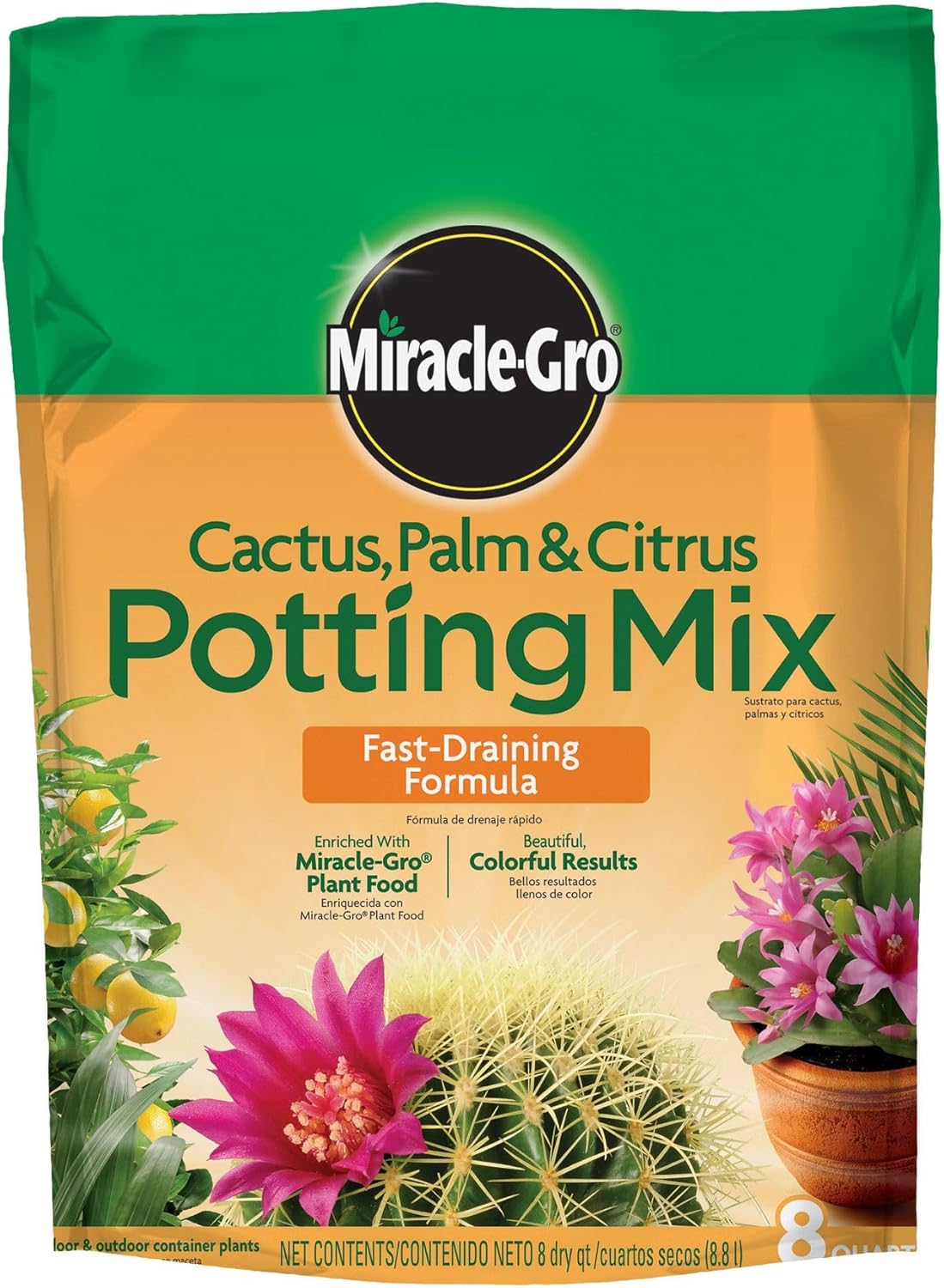
This 8-quart Miracle-Gro potting mix is designed for container-grown cacti, palms, and citrus and combines peat moss, sand, perlite, and forest products for faster drainage and reduced compaction. It arrives ready to use and is enriched with Miracle-Gro plant food so newly potted citrus get an initial nutrient boost without immediate fertilizing. Typical use is straightforward: choose a pot with drainage, fill about one third, set the root ball and top up, then water and allow to drain. The formula helps soil dry between waterings, which is important for citrus root health in containers, and one bag is enough for two 8-inch pots. Limitations are the small volume for larger trees and the presence of peat moss if you prefer peat-free mixes; heavier or older citrus will need larger volumes and eventual repotting. For growers wanting a quick, reliable container medium that balances moisture retention with drainage, this mix performs as expected.
Best for: Growers who repot or maintain container citrus and want a ready-to-use mix that balances drainage and initial feeding for healthier root development.
Less Ideal for: Gardeners potting mature or large citrus specimens that need large volumes of soil or those seeking a peat-free or custom mineral-heavy citrus bonsai substrate.
- Fast-draining blend reduces risk of waterlogged roots for container citrus
- Pre-enriched with plant food to give newly potted plants an initial nutrient boost
- Contains perlite and sand to resist compaction and maintain aeration
- Formulated for indoor or outdoor containers so it works across sites
- 8-quart bag is small for larger or multiple citrus containers
- Contains peat moss which some buyers avoid for sustainability reasons
Verdict: A convenient, fast-draining, plant-food–enriched container mix that makes repotting small to medium citrus trees quick and reliable.
Espoma Organic Cactus Potting Soil Mix, 4 qt

| Brand | Espoma |
|---|---|
| Volume | 4 quarts |
| Unit Count | 128 Ounce |
| Contains | Peat moss, humus, perlite, mycorrhizae |
Espoma Organic Cactus Potting Soil Mix is a lightweight, peat-based blend designed to improve drainage and root aeration for container plants. Typical uses include repotting succulents, cacti, and smaller container palms and citrus where fast drainage is important. The mix contains sphagnum peat moss, humus and perlite, plus a mycorrhizal inoculant to support root establishment. In practice this means soil that dries out more quickly than all-purpose mixes, reducing the risk of root rot in drought-tolerant species and helping young palms settle after repotting. Because it is organic and free of synthetic fertilizers, gardeners who prefer natural inputs can use it without adding immediate chemical feeds. Limitations are its small 4 quart volume and peat-heavy base, which may require mixing with coarser materials or regular feeding for larger palms or long-term container culture.
Best for: Buyers looking for an organic, fast-draining potting mix to repot succulents or small container palms and who prefer natural ingredients over synthetic additives.
Less Ideal for: Gardeners needing large volumes for big specimen palms or long-term container culture should choose a coarser, larger-volume mix or blend this with chunky amendments.
- Formulated for drainage and aeration with peat moss and perlite
- Includes mycorrhizae to encourage root growth and establishment
- Organic blend with no synthetic fertilizers or chemicals
- Suitable for repotting succulents, cacti and smaller container palms
- Small 4 quart bag may not be cost-effective for large pots or multiple palms
- Peat-heavy mix can compress over time and may need amendment for long-term container use
Verdict: A compact, organic, fast-draining mix that helps establish roots in succulents and small container palms when you need a natural potting medium.
Choosing the Right Potting Mix for Palms: Key Factors to Consider
Drainage and Aeration
Palms prefer a root environment that lets excess water escape quickly while keeping air pockets around fine roots. A mix with coarse components such as perlite, pumice, or coarse sand improves oxygen availability and lowers the risk of root rot. In practice, a gardener should look for visible chunky particles in a mix and avoid mixes that compact into a dense ball after watering.
Drainage affects watering frequency and how forgiving the mix is of occasional overwatering. Faster-draining mixes require more frequent monitoring but protect roots in humid or poorly ventilated rooms. For outdoor container palms exposed to rain, prioritize drainage even more to prevent waterlogged soil after storms.
Moisture Retention Balance
While good drainage is essential, palms also need reliable moisture between waterings. Components like coconut coir, well-aged composted bark, or peat alternatives hold moisture without creating an anaerobic zone. The ideal mix balances quick drainage channels with moisture-retaining pockets so roots can access water over several days.
Moisture-retentive ingredients influence watering routine and potting frequency. In small pots or heated indoor environments, choose mixes with higher water-holding capacity. In larger outdoor containers or overwater-prone sites, favor mixes with more coarse components to avoid soggy conditions.
Nutrient Holding and Feeding Schedule
Palms are moderate feeders that benefit from a steady supply of macro and micronutrients. A potting mix with a modest nutrient buffer or included slow-release granules reduces the need for frequent fertilizing, which is helpful for casual gardeners. Organic matter and well-composted bark increase cation exchange capacity so nutrients remain available longer.
Consider how long the mix will remain in a pot. For long-term plantings, mixes that maintain nutrient reserves and have slow-release feeding reduce maintenance. For seasonal or temporary plantings, a leaner mix plus scheduled fertilization may be preferable to avoid nutrient washout.
Particle Stability and Longevity
Mixes that break down quickly turn into fine, compacted media that restrict airflow and drain poorly. Ingredients such as aged bark, coconut chip, and stable mineral aggregates resist decomposition and retain structure through repeated wetting and drying cycles. Particle stability matters for repotting intervals and long-term root health.
A gardener should inspect the mix after a season. If it compresses and holds water excessively, it likely lacks stable particles and will need renewal during repotting. Choosing a more stable mix reduces how often you must replace or amend the soil in larger containers.
pH and Salt Levels
Many palms prefer slightly acidic to neutral pH. Extremely alkaline media can impair nutrient uptake, while high soluble salt levels can burn delicate root tips. The base materials and any preloaded fertilizers influence pH and salt content.
If you are using municipal water with high salts or frequently apply fertilizer, choose a mix with lower initial soluble salt content and monitor leaf tips for scorch. Periodic flushing of containers can manage salt accumulation, but starting with an appropriate mix reduces the frequency of corrective measures.
Weight and Container Considerations
Gardeners who place palms on balconies, shelves, or move pots seasonally must consider mix weight. Heavy mixes that rely on clay-based components or large volumes of compost can make pots unwieldy. Lightweight alternatives using pumice or expanded clay reduce load while maintaining drainage.
Weight also affects pot selection and stability. A very light mix in a tall, top-heavy palm may require extra ballast or a wider container to prevent tipping in wind. Balance weight concerns with moisture retention needs based on your planting location.
Mix Adjustments for Different Palm Types
Not all palms have identical soil needs. Feather-leaved palms with finer roots often do best in slightly lighter, finer-textured mixes that still provide aeration. Robust, fan-leaved species planted in large outdoor containers tolerate chunkier, bark-heavy blends that offer more stability and slower moisture loss.
Adjust a base palm mix by adding more coarse mineral components for outdoor-facing pots or more coir and compost for indoor specimens that dry faster. Small indoor palms benefit from a higher proportion of moisture-retentive material, while large patio palms need structural ingredients to support wind resistance and root anchoring.
- Fine-rooted indoor palms: increase coir and fine bark for gentle moisture retention
- Large outdoor palms: add more pumice or coarse bark for drainage and structure
- Temporary pots: use lighter mixes with easier re-potting characteristics
Repotting Tips for Palms
Repot palms when roots begin to circle the pot or when the mix has compacted and drains poorly. When repotting, gently tease root mass rather than aggressively cutting, as palms resent heavy root pruning. Choose a new container only one size larger to prevent excess media that stays too wet near the rim.
Refresh the rootball by removing the top few inches of old mix and replacing it with fresh blend, or fully replace the media if the original substrate has degraded. Water thoroughly after repotting to settle the mix, then allow the surface to dry partially before the next watering to promote root exploration.
- Check root health before repotting to avoid moving diseased roots
- Avoid oversized pots that retain too much moisture
- Use fresh mix with good drainage to jump-start root growth
DIY Palm Potting Mix Recipes
Gardeners can tailor mixes from a few core ingredients to match specific conditions. A balanced starting recipe for many container palms is two parts high-quality peat-free coir or aged bark, one part coarse perlite or pumice, and one part composted bark or fine compost for nutrients. Adjust ratios to increase drainage or water retention as needed.
For a lighter, quick-draining version suitable for warm, rainy climates, replace part of the coir with extra pumice and add a handful of horticultural charcoal to improve air and reduce odor in moist conditions. For indoor palms in dry homes, increase coir slightly and include a slow-release organic fertilizer to maintain foliage between feedings.
- Standard mix: 2 parts coir/bark, 1 part pumice/perlite, 1 part composted bark
- Rainy climate tweak: more pumice, less coir
- Dry indoor tweak: more coir, add slow-release nutrition
Watering Strategies with Palm Mixes
Water management depends on mix composition. Fast-draining mixes need more frequent, moderate waterings to keep roots supplied without saturating the soil. Heavier mixes with higher moisture retention allow longer intervals between waterings but require careful monitoring to avoid overwatering.
Use the finger test and lift pots to judge moisture rather than a fixed schedule. For larger containers, probe deeper into the root zone to confirm moisture presence because the surface can dry while the center remains damp.
- Fast-draining media: water more often in smaller amounts
- Moisture-retentive mixes: water thoroughly, then wait until top layers dry
- Always check root zone moisture before watering
Managing Fertility and Supplemental Feeding
Because many palm mixes are intentionally low in soluble salts, an appropriate feeding schedule keeps foliage healthy. Use balanced, palm-formulated fertilizers or a slow-release granular tailored to container plants. Foliar feeding can address minor micronutrient deficiencies quickly in indoor settings.
Monitor new growth and leaf color as indicators of nutrient needs. Gradual feeding is safer than heavy applications, which can cause salt buildup in pots. Periodic flushing of the potting mix with fresh water during the growing season helps prevent salt accumulation.
- Use slow-release products for steady nutrition
- Watch leaf tips and new fronds for deficiency signs
- Flush pots annually if salts build up
How We Chose the Best Potting Mix for Palms
We focused on criteria that directly affect how palms grow in containers and indoor setups. Drainage and aeration were prioritized because many palm roots are fine and suffer in waterlogged, compacted media. Moisture retention followed, since a mix must hold enough water between top-ups without staying soggy. Nutrient buffer and slow-release feeding matter for steady foliage growth and to reduce the need for constant fertilizing. Particle stability and texture were checked so mixes do not collapse into fine sludge over time, which harms aeration. Weight and suitability for containers were considered for gardeners who move pots or use hanging planters. Our selection filters excluded mixes designed strictly for cacti, succulents, or heavy woody shrubs because their formulations do not match palm needs. We also excluded pure peat or single-ingredient substrates that lack either drainage or moisture balance. The final picks reflect blends that score well on drainage, moisture-holding capacity, nutrient profile, and long-term structure. Editorial judgment emphasized real-world use: ease of repotting, shipping weight concerns for balcony gardeners, and how mixes behave after several watering cycles.
FAQ
How often should I water a palm in a potting mix for palms?
It depends on the mix and pot size. Fast-draining mixes usually require more frequent, shorter waterings, while moisture-retentive mixes allow longer intervals. Check the root zone with a finger or probe and water when the top inch or two feels dry.
Can I mix my own potting media for palms at home?
Yes. Many gardeners blend coir or aged bark with pumice or perlite and a portion of composted bark to balance drainage and moisture. Adjust proportions based on whether your palms are indoor, outdoor, or in rainy environments.
Is peat-free mix important for palms?
Peat-free mixes are fine and often preferred for sustainability. What matters more is the mix structure and moisture behavior rather than a single ingredient. Use peat alternatives that still provide moisture retention and stable particles.
How can I tell if my palm mix has compacted and needs replacing?
Signs include slower drainage, plant decline despite regular care, and a dense, soil-like texture when you inspect the rootball. If the media compresses and holds water, plan to refresh or replace it during repotting.
Should I add fertilizer directly to a potting mix when repotting?
A modest slow-release fertilizer incorporated at repotting can help establish new growth, but avoid heavy initial feeding. Palms prefer steady, moderate nutrition, so supplement with a balanced regimen rather than a single large dose.
Final Verdict
Choose a potting mix that matches your palm species and growing conditions by balancing drainage, moisture retention, and nutrient buffering. Lighter, pumice-rich blends favor fast drainage and are safer in wet or outdoor settings, while mixes with more coir or composted bark suit indoor palms that need steady moisture. Prioritize particle stability and an appropriate weight for your containers. Match feeding and watering routines to the mix you select, and plan to refresh degraded media during repotting. With those tradeoffs in mind, you can pick a mix that supports healthy roots and consistent frond growth for your palms.
